Proceedings of the
Fourth International Workshop on
Foundations and Techniques for
Open Source Software Certification
(OpenCert 2010)
Integrating Data from Multiple Repositories to Analyze Patterns of
Contribution in FOSS Projects.
Sulayman K. Sowe and Antonio Cerone
17 pages
Guest Editors: Luis S. Barbosa, Antonio Cerone, Siraj A. Shaikh Managing Editors: Tiziana Margaria, Julia Padberg, Gabriele Taentzer
Integrating Data from Multiple Repositories to Analyze Patterns of
Contribution in FOSS Projects.
Sulayman K. Sowe1∗and Antonio Cerone2
UNU-IAS, Yokohama, Japan.
UNU-IIST, Macau SAR China.
Abstract: The majority of Free and Open Source Software (FOSS) developers are mobile and often use different identities in the projects or communities they partic-ipate in. These characteristics not only poses challenges for researchers studying the presence (where) and contributions (how much) of developers across multiple repositories, but may also require special attention when formulating appropriate metrics or indicators for the certification of both the FOSS product and process. In this paper, we present a methodology to study the patterns of contribution of 502 de-velopers in both SVN and mailing lists in 20 GNOME projects. Our findings shows that only a small percentage of developers are contributing to both repositories and this cohort are making more commits than they are posting messages to mailing lists. The implications of these findings for our understanding of the patterns of contribution in FOSS projects and on the quality of the final product are discussed.
Keywords: Open Source Software developers, Open Source Software projects, Software repositories, Concurrent Versions System, Mailing lists, Linking data, Software Quality.
1
Introduction
Free and Open Source Software (FOSS) developers are like nomads; freely moving from one project to another. They commit bits and pieces of code, report and fix bugs, take part in discus-sions in various mailing lists, forums, and IRC channels, document coding ethics and guidelines, and help new entrants. Along the way they create and archive a wealth of knowledge and expe-rience associated with their art [SAS06]. Participants in various projects use tools (Versioning Systems, mailing lists, bug tracking systems, etc.) to enable the distributed and collaborative software development process to proceed. These tools serve as repositories which can be data mined to understandwhois involved, who is talking towhom,whatis talked about,how much someone contributes in terms of code commits or email postings. Thus, by applying cyber-archeology [SII07] to these repositories, we can learn and better understand the patterns of con-tribution [SFF+06,GKS08] of FOSS developers in the projects concerned.
An important aspect of software engineering research, and the certification of FOSS products in particular, is understanding and measuring the contribution of individuals, particularly devel-opers, who work on a project [SO09a,SAS06]. A host of factors which have both empirical and industrial implications motivates this kind of research. Factors include, but not limited to;
- helping practitioners understand and monitor the rate of project development,
- characterizing FOSS projects in terms of developers turnover and extent of contribution [CLM03,GKS08,SSSA08],
- identifying bottlenecks and isolate exceptional cases in terms of projects and individuals contributions [SO09a], and
- using the research results to develop new metrics or evaluate an existing taxonomy [SO09b] of metrics (Process, Product, and Resources) for FOSS quality attributes [SAOB02] and the certification process.
Furthermore, as argued by [SC09], communication and patterns of contribution are factors that contribute to measure the efficiency of the development process, a measure that the authors called “quality by development”. Indeed, the patterns of [code] contribution in FOSS projects has emerged as an important measure in assessing the quality of FOSS products [SO09b,SAOB02]. A lot of research utilizes data from a single repository to analyze code contribution of devel-opers [RG06, GKS08], trends and inequality in posting and replying activities in Apache and Mozilla [MFH02], KDE [Kuk06], Debian [SSL08], and FreeBSD [DB05]. Most of these re-searches use data from CVS or mailing lists as these arede factorepositories in FOSS projects. Source configuration management (SCM), of which CVS or SVN1is part, is mainly used to co-ordinate the coding activities of software developers and manage software builds and releases. Mailing lists, on the other hand, are the main communication channels [SSL08]. Many important aspects of a project are negotiated in [developer] lists: software configuration details, the way forward and how to deal with future requests, how tasks are distributed, issues concerning pack-age dependencies, scheduling online and off-line meetings, etc. Thus, for a developer to keep abreast with developments in a project, committing code to SVN alone is not sufficient. S/he needs to participate in the respective lists, communicate his ideas, and engage with colleagues. To bolster this view, [Bro75] pointed out the essence of communication as a means to foster long term success of software projects. This may take the form of a bi-directional developer to developer, developer to user, and developer to community communication.
Even though a strong linkage exist between the information in FOSS repositories (e.g. bug reports and source code repositories [DB07,ZPZ07]), few researchers strive to understand how developers’ contributions varies across repositories. In this research we tired to fill this niche by establishing links between SVN and mailing lists to locate developers who are present in both repositories and quantify their contribution in terms of commits and posts.
The rest of the paper is organized as follows. First, in section 2, we discuss the rationale behind this research and construct two hypothesis which will guide us for the rest of the paper.
1Note: SVN is our software code repository (see Subsection3.1). Reference is made to CVS when other researchers
In section3, we outline the methodology and data used in this research and present our algorithm for identifying and quantifying developers contributions to both SVN and mailing lists. This is followed by an analysis and discussion of our results in section4. Our concluding remarks and future work are presented in5section.
2
Research Rationale and Hypothesis
For software projects to evolve, it is by design that developers must continuously commit and re-view the codebase. In the eyes of the developer, user, and business community an active mailing list is a proxy of project success. The presence of project’s leads, core and active developers in mailing lists has a profound effect on the way individuals within and outside the project see the commitment of the most influential members in the project. For software companies and private enterprises, developers presence in lists may indicate that software support activities are not only available from ordinary users, but also comes form individuals behind the software and project. Thus, developers should strive to balance their coding activity with their involvement in mailing lists. This raises a number of questions which may be of great interest to both FOSS project administrators and researchers. For instance;
• How many developers are willing to commit code and patches and at the same time par-ticipate in discussions in mailing lists and other project’s fora?
• If developers are coding more than they are participating in mailing lists, what does this tell us about the maintenance and dynamics of the software and project?
• How much effort can a developer allocate to one activity and at what stage in the project’s life-cycle?
• If attaining a balance activity is much required in a project, how can project administrators schedule and assign or dedicate one activity at the expense of another?
• What is the impact on the performance the project of having developers specializing in one activity?
In this research, we used data provided by the FLOSSMetrics project2to proposed a method-ology to help us answer some of the above questions. FOSS researchers (e.g. [MFH02,Kuk06,
DB05]) study and report developers coding activities separately from their mailing lists activi-ties. However, research on the FOSS development process [Mas05,SFF+06] informs us that in many projects, a small number of talented core developers or “cod gods” [RG06] are busily (as if in asoftware beehive) submitting patches and tinkering with code to produce good and usable software for the rest of the community. This cohort also contribute to discussions in mailing lists; interacting with other software developers and users, keeping abreast with project activities and monitoring what goes on in there projects or packages [SSL08]. Nevertheless, we conjecture that not all the developers who commit or make changes to a project’s source repository also partici-pate in [developer] mailing lists. This study investigates the contributions of FOSS developers to
both SVN and developer mailing lists and presents a methodology to overcome the empirical re-search challenges associated with integrating or linking data from multiple repositories. That is, we find out if developers are coding through commits in SVN as much as they are participating in mailing lists. This involves correlating developers commits activities with their corresponding mailing lists activities within the same project. Hypothesis put forward in this research are the following;
• Hypothesis[H1]: Since developers must code and commit,ad infinitum, for the software and project to evolve, we hypothesize that FOSS developers make more commits to a project’s code (SVN) repository than they are posting messages to mailing lists.
• Hypothesis[H2]: However, we posit that developers must strike a balance between their coding and mailing lists activities. Thus, FOSS developers contribute equally to code repository and mailing lists.
3
Research Methodology
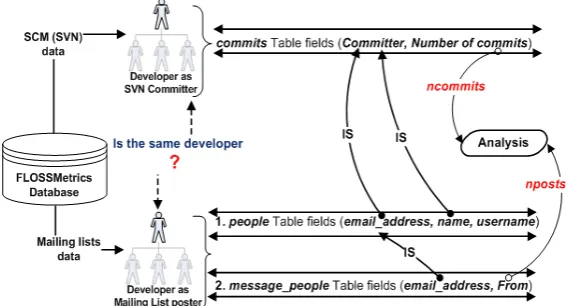
The methodology employed in this research investigates the simultaneous occurrence of devel-opers in SVN and mailing lists. That is, identifying develdevel-opers who make both commits and postings, and ensuring that the developer making the SVN commit is the same individual post-ing to the developer mailpost-ing list(s) of the same project. The methodology also ensures that developers with multiple identities are only counted once. The methodology, as represented in figure1, shows the FLOSSMetrics database as the data source from which we extracted SVN and mailing lists data for the 20 projects in our study. In our data acquisition, a fundamental question is always asked; “Is this the same developer we have in both repositories ?” Figure1
also shows the MYSQL database tables and fields from which we extracted commits and posts which are used in our analysis to identify developers (see subsection 3.3) in the projects. The links between the tables as indicated by the arrows (with “IS”) shows the path taken to locate a developer and counting his contribution to both SVN and mailing lists.
3.1 Data
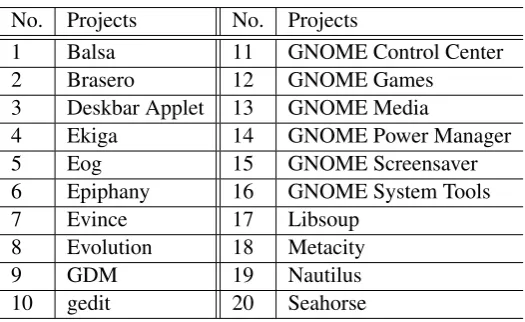
The data for this research consists of the 20 GNOME projects shown in table1. The
FLOSS-Table 1: List of GNOME projects studied
No. Projects No. Projects
1 Balsa 11 GNOME Control Center
2 Brasero 12 GNOME Games
3 Deskbar Applet 13 GNOME Media
4 Ekiga 14 GNOME Power Manager
5 Eog 15 GNOME Screensaver
6 Epiphany 16 GNOME System Tools
7 Evince 17 Libsoup
8 Evolution 18 Metacity
9 GDM 19 Nautilus
10 gedit 20 Seahorse
Metrics database retrieval system uses a combination of tools3to retrieve data from projects (e.g. GNOME and Apache) and forges (e.g. SourceForge) and computes various code and community metrics. TheCVSAnalY2[ARG06,RGCH09,SSSA08] tool retrieves Source Content Manage-ment systems (SCM) data and stores committers attributes into various tables. The MLStats [SSSA08] tool extracts one or more mailing lists archives of a particular project. For each of the 20 projects, committers SVN identifications (commit ID) and the total number of commits each committer made is extracted. For the mailing list data, for each project, data was extracted from two FLOSSMetrics database tables: Two fields (type of recipient andemail address) from the “messages people”table. The type of recipient field has the format “From”, “To”, and “Cc”. The “From” email header is used to identify lists posters [QJ04] and counting their contribu-tion to mailing lists [SAS06]. And three fields (email address,name, andusername) from the “people”table.
3.2 Data Cleaning
Having identified fields needed to analyze developers participation in SVN and mailing lists, we proceeded with data cleaning. For the mailing lists data, since we need both the “name” and “username”, all posters without recognizable names and/or usernames were removed. Some of the names contained unrecognizable characters such as “=?ISO88591?Q?g=FCrkan g=FCr?=”. Some of the posts with null posters/developere were also removed. Furthermore, since the full name (first +last) is needed to identify a developer, all posters with a single name were deleted from the mailing lists data. That is, delete developer “Foo” but retain developer “Foo Bar”. For the SVN data, all commits without committers or authors were removed. Aggregate number of items deleted in each of the above categories were; Unrecognizable characters = 28, Posts with null posters = 30, Posters with a single name = 14, and commits without authors = 5093.
3.3 Identification of developers across repositories
As depicted in figure1, a poster in the mailing lists can be identified in two ways. In the mes-sages peopletable, a poster is identified by his email address. By using the “From” field, all the emails posted by a particular person can be aggregated . Thepeopletable is used to identify a poster through his “email address”, poster“name”in the form of first name + last name (eg. Pawel Salek), and“username” (eg. pawsa). For the SVN data, the committer field from the commitstable was used to identify a committer or author of a commit. In SVN, an individual is simply identified as a “Committer” or an “Author” of one or more commits. Mailing lists participants, on the other hand, can be identified by means of message identifiers like “From:” in email headers [SAS06]. The identification process proceeds thus;
1. For each project in the commits table, LIST all the committers and for each committer (unique commit ID orcommit id) SUM all his commits and store the value asncommits variable.
2. For each project in the peopletable, LIST (“email address” + “name” + “username” or poster id) WHERE both name and username is the same for this committer as in the commitstable. And
3. From themessages peopletable, LIST developers “email address”, WHEREpeople.email address =messages people.email address. For each developer, COUNT all the posts and store the value asnpostsvariable.
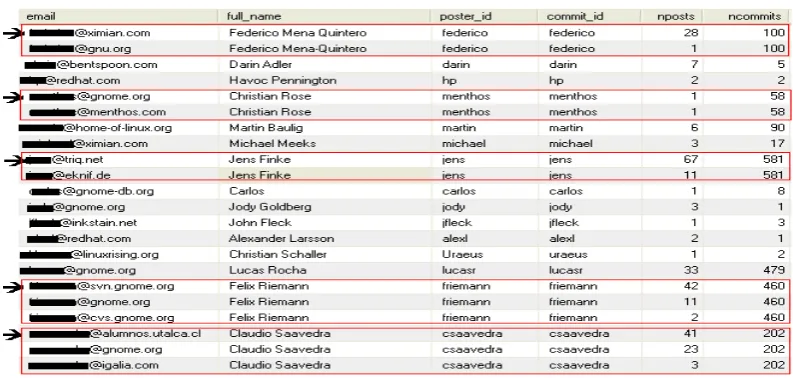
The results of a typical query is shown in figure2, with developers emails anonymized. From the query, it can be seen that a developer may appear many times. This is because, while a developer has only one identification in SVN, his commit id, the same developer may use many email addresses when posting messages to developer mailing lists.
3.3.1 Unmasking Aliases and removing duplicates
The volunteering nature of the FOSS development process and participation in public reposito-ries means that participants may use different emails. For example, as shown in figure2, a devel-oper (e.g. Felix Riemann) has his identity masked in three email aliases; [email protected], [email protected], [email protected]. The fundamental problem in email alias unmasking [BGD+06,SSL08] is finding out that those aliases all belong to one developer. The algorithm for checking duplicate records and unmasking aliases in the mailing lists data proceeded thus;
---Begin
Algorithm---For ALL records in project X
IF ncommits OCCURS MORE THAN ONCE for THIS developer AND poster_id = commit_id
RETURN ’’THIS is a duplicate’’
RECORD ONLY 1 value of ncommits for THIS developer TOTAL posts for this developer = SUM of nposts.
---End
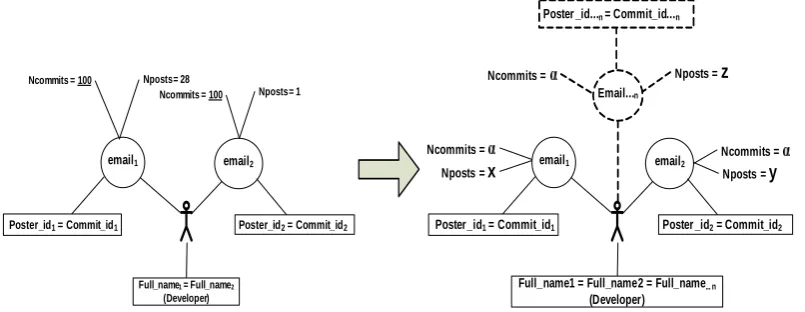
Algorithm---The query scenario in figure3shows the result when the algorithm is applied to the dataset. This literally means; a developer (e.g. Federico Mena Quinteroin figure2) with a unique com-mit id (federico) made 100 comcom-mits to the project’s SVN. However, he contributed to mailing lists using two emails ([email protected] and [email protected]). He posted 28 messages using the first email and 1 message using the second email. The developer’s overall email postings is the sum of the two posts he made using the different emails, i.e. 28 + 1 = 29. All duplicate
email1 email2 Nposts = 28 Ncommits = 100
Nposts = 1 Ncommits = 100
Poster_id2= Commit_id2
Poster_id1= Commit_id1
Full_name1 = Full_name2
(Developer)
email1 email2 Nposts = x
Ncommits =
Nposts = y Ncommits =
Poster _id2= Commit_id2 Poster_id1= Commit_id1
Full_name1 = Full_name2 = Full_name... n (Developer)
Email...n Poster _id...n = Commit_id...n
Ncommits = Nposts = z
Figure 3: Query scenario to identify developers in SVN and mailing lists
4
Analysis and discussion
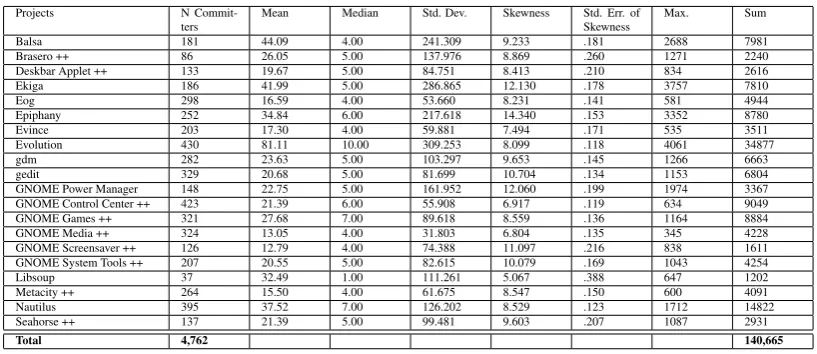
According to [Sek06], an exploratory study is undertaken “when not much is known about the situation at hand or no information is available on how similar problem or research issues have been solved in the past”. Thus, we begin our analysis using what we call anexploratory data analysis (EDA) techniqueto help us examine the distribution, the nature of the commits and posts, and prepare the ground for what may be the appropriate analysis technique to be used to answer the research hypothesis. Tables2and3shows the descriptive statistics of the developers posting and committing activities after data cleaning.
Table 2: Descriptive statistics of Posts
Projects N Posters Mean Median Std. Dev. Skewness Std. Err. of
Skewness
Max. Sum
Balsa ** 1088 12.98 2.00 67.273 13.942 .074 1465 14125
Brasero 63 4.13 1.00 8.071 3.498 .302 45 260
Deskbar Applet 97 7.00 2.00 19.187 5.200 .245 137 679
Ekiga ** 729 9.24 3.00 59.999 22.103 .091 1509 6734
Eog 134 4.17 1.50 8.914 4.533 .209 67 559
Epiphany ** 889 5.91 1.00 23.795 12.657 .082 470 5250
Evince ** 451 3.46 1.00 13.093 14.013 .115 238 1562
Evolution ** 4769 7.44 2.00 46.274 25.619 .035 1760 35478
GDM ** 658 3.99 1.00 25.597 20.006 .095 595 2628
gedit ** 571 3.95 1.00 15.653 14.252 .102 306 2253
GNOME Power Manager ** 203 5.58 2.00 33.046 13.881 .171 470 1133
GNOME Control Center 174 8.36 2.00 20.936 5.261 .184 186 1455
GNOME Games 173 8.79 2.00 25.146 5.909 .185 224 1521
GNOME Media 289 5.39 2.00 12.270 5.884 .143 115 1557
GNOME Screensaver 27 5.59 3.00 7.846 3.322 .448 39 151
GNOME System Tools ** 297 4.51 1.00 11.019 6.076 .141 112 1339
Libsoup ** 52 3.73 1.00 8.761 6.326 .330 63 194
Metacity 60 4.82 2.00 11.029 5.301 .309 77 289
Nautilus ** 2065 8.61 2.00 61.402 32.822 .054 2475 17782
Seahorse 62 6.16 2.00 18.382 5.390 .304 122 382
Total 128,512 95,331
Table 3: Descriptive statistics of Commits
Projects N
Commit-ters
Mean Median Std. Dev. Skewness Std. Err. of Skewness
Max. Sum
Balsa 181 44.09 4.00 241.309 9.233 .181 2688 7981
Brasero ++ 86 26.05 5.00 137.976 8.869 .260 1271 2240
Deskbar Applet ++ 133 19.67 5.00 84.751 8.413 .210 834 2616
Ekiga 186 41.99 5.00 286.865 12.130 .178 3757 7810
Eog 298 16.59 4.00 53.660 8.231 .141 581 4944
Epiphany 252 34.84 6.00 217.618 14.340 .153 3352 8780
Evince 203 17.30 4.00 59.881 7.494 .171 535 3511
Evolution 430 81.11 10.00 309.253 8.099 .118 4061 34877
gdm 282 23.63 5.00 103.297 9.653 .145 1266 6663
gedit 329 20.68 5.00 81.699 10.704 .134 1153 6804
GNOME Power Manager 148 22.75 5.00 161.952 12.060 .199 1974 3367
GNOME Control Center ++ 423 21.39 6.00 55.908 6.917 .119 634 9049
GNOME Games ++ 321 27.68 7.00 89.618 8.559 .136 1164 8884
GNOME Media ++ 324 13.05 4.00 31.803 6.804 .135 345 4228
GNOME Screensaver ++ 126 12.79 4.00 74.388 11.097 .216 838 1611
GNOME System Tools ++ 207 20.55 5.00 82.615 10.079 .169 1043 4254
Libsoup 37 32.49 1.00 111.261 5.067 .388 647 1202
Metacity ++ 264 15.50 4.00 61.675 8.547 .150 600 4091
Nautilus 395 37.52 7.00 126.202 8.529 .123 1712 14822
Seahorse ++ 137 21.39 5.00 99.481 9.603 .207 1087 2931
Total 4,762 140,665
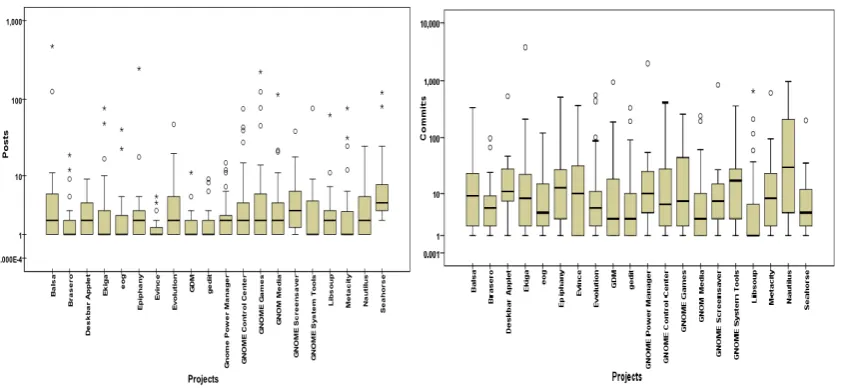
minimum numbers of posts made equals 1. A total of 12,851 posters contributed 95,331 email messages. Table3 shows the same descriptive statistics for the committers (N Committers) in each project. A total of 4,762 developers made 140,665 commits. Evident from the statistics is that each project has its unique characteristics [CLM03] in terms of developers’ postings and committing activities, as well as the number of developers involved in each activity. For instance, 45% (N = 9) of the projects (marked with ++ in table3) have more committers than posters. The other 55% (N = 11) of the projects (marked with ** in table2) have more posters than committers. Furthermore, figures 4(bothY-axis in logarithmic scale) shows the distribution of posts and commits in the respective projects. From the boxplots it can be seen that the contributions of the developers to mailing lists is characterized by smaller means (post per poster). However, the posting data has many outliers; with many developers posting few emails and a few making large numbers of posts. On the contrary, the commits are characterized by larger means (commits per committer). These characteristics are reminiscent of power distributions observed in FOSS participants’ contributions to mailing lists [SSL08] and CVS [MFT02] activities.
Figure 4: Box-plots showing the distributions of Posts and Commits.
4.1 Developers in both SVN and Mailing lists
In order to analyze the simultaneous occurrence of the developers in both repositories, we queried the SVN and mailing lists data for each project and computed developers contributions in terms of thencommitsandnpostsvariables discussed in subsection3.3. Table4shows the number of developers (N dev) in each project who contributed to both SVN and mailing lists. For the 20 projects, 502 developers made more commits (mean = 152.1; Std. deviation = 431.171) than posts (mean = 43.19; Std. deviation = 164.353).
rel-Table 4: Developers contribution to both SVN and Mailing Lists
nposts ncommits
Projects N dev. Mean Median Std.dev. Max. Sum Mean Median Std.dev. Max. Sum
balsa 40 37.23 5.5 133.76 851 1489 112.53 25 206.33 751 4501
brasero 6 19.33 2 30.936 77 116 69.17 8.5 98.3 196 415
deskbar applet 8 20.13 6 35.64 106 161 120.25 5.5 289.5 834 962
ekiga 4 438.25 121.50 722.49 1509 1753 2170.25 2417 1876.01 3757 8681
eog 16 18.81 4.5 25.95 78 301 129.38 37.5 196.16 581 2070
epiphany 40 55.73 7 116.69 470 2229 146.82 16.5 536.03 3352 5873
evince 18 27.17 2 58.61 238 489 100.89 10.5 180.31 535 1816
evolution 92 56.47 4.5 172.68 1481 5195 283.29 46 622.01 4061 26063
gdm 21 26.38 2 56.63 227 554 112.9 17 242.76 939 2371
gedit 19 20.84 2 69.34 306 396 103 4 267.13 1153 1957
gnome control center 35 21 4.00 51.753 296 735 69.54 19 125.13 527 2434
gnome games 14 43.57 7 83.15 304 610 178.93 13.5 341.49 1164 2505
gnome media 23 21.87 5 36.67 130 503 39.22 6 84.03 345 902
gnome power manager 7 3.43 4 1.51 6 24 8 2 11.4 32 56
gnome screensaver 4 15.75 10 15.84 39 63 211.5 3.5 417.67 838 846
gnome system tools 22 17.14 3 33.42 154 377 92.59 24 228.27 1043 2037
ibsoup 3 28.33 8 39.63 74 85 219.67 8 370.09 647 659
metacity 10 14.8 6 23.85 77 148 184.2 7 270.12 600 1842
nautilus 136 49.95 8.5 225.14 2475 6793 86.63 13 220.1 1712 11782
seahorse 2 73.5 73.5 101.12 145 147 198 198 275.77 393 396
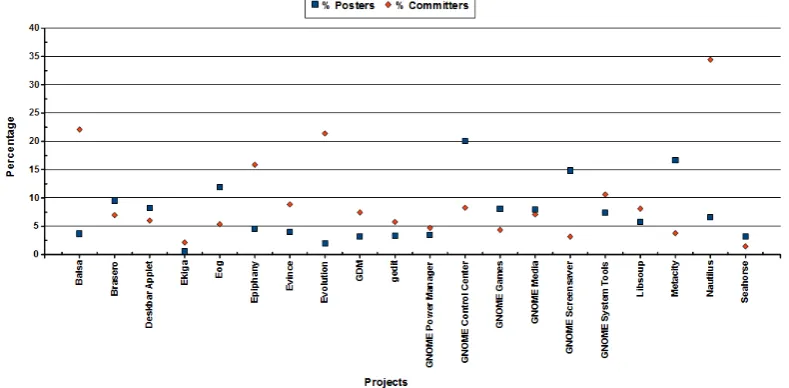
atively small, but varying, percentage4 of developers who are involved in both activities. The
Figure 5: Percentage of developers involved in posting and committing.
percentage of developers in each activity varies across the projects. For example, the Ekiga, Gnome Power Manager, and Seahorse projects having less than 5% of their developers commit-ting to SVN and at the same time poscommit-ting messages to their respective projects’ mailing lists. Projects such as Balsa and Nautilus have few poster (3.68% and 3.23%), but higher percentage of committers (22.1% and 34.43%).
4.1.1 Are developers making more commits than posts?
Hypothesis[H1]: FOSS developers make more commits to a project’s code (SVN) repository than they are posting messages to mailing lists.
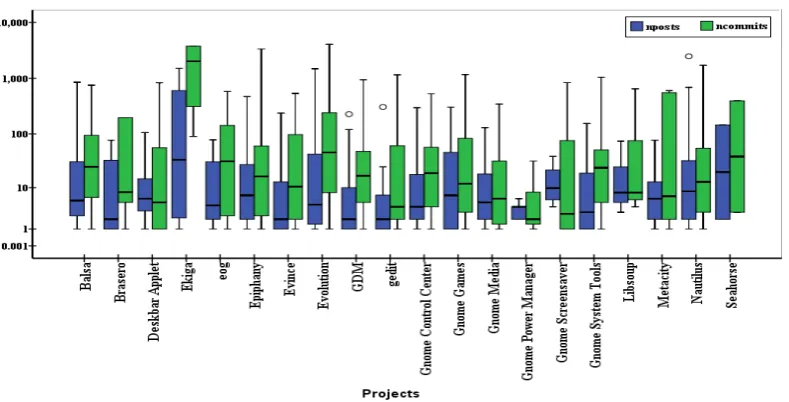
In our investigation ofH1, for each project, we compared the total number of commits made to SVN with the total number of messages developers posted to the mailing lists. The pattern of contribution for all the 502 developers in the 20 projects is shown in the boxplots in figure
6. In the boxplots, the median line and error T-bar widths for each set of project data (nposts and ncommits) are shown. The domination of SVN commits, with larger means of commits per developer (mean = 150.32, Std. deviation = 424.986) over posts (mean = 42.63, Std. deviation = 161.852) is evident in all the projects.
Figure 6: Distributions of posts and commits for all projects (y-axis in log scale).
4.1.2 Are developers contributing equally to SVN and mailing lists?
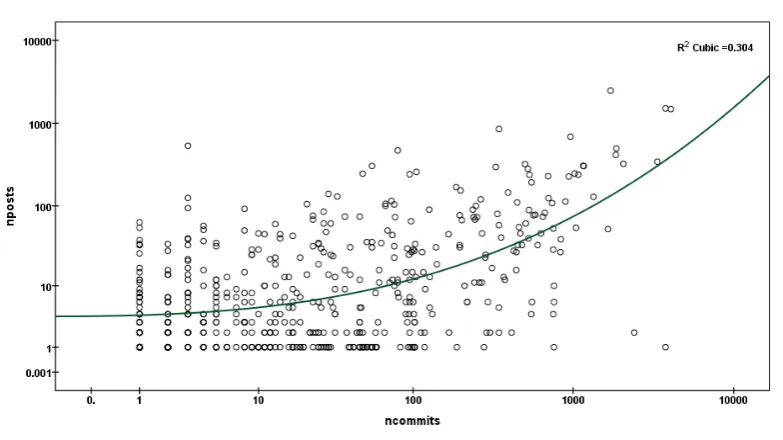
Hypothesis[H2]:FOSS developers contribute equally to code repository and mailing lists. We used correlation between commits and posts to study how developers activities in SVN and mailing lists are related. The scatter plot in figure7shows the correlation between commits and posts in all projects. In the plot, data points are fitted to a line to show the trend in the commits and posting activities of the developers. Previous research ([SSL08]; page 414) showed that FOSS developers and users mailing lists activities havefractalor self-similarities properties and could best be explained by a polynomial model of third order, i.e. a cubic relation of the type
LogN=b0+b1∗logr+b2∗(logr)2+b3∗(logr)3 (1)
Figure 7: Relationship between posts and commits.both axis in a log scale.
association betweennpostsandncommitsas measured by Pearson correlation = 0.594, and this is significant at the 0.01 level (2-tailed) withρ= 0.000. However, thenpostsandncommitsdata are not normally distributed and have outliers. Thus, nonparametric correlations using Spearman’s rho and Kendall’s tau b statistics, which work regardless of the distribution of the variables [Nor04], are used to report the association between posts and commits. Table 5 shows that, overall, there is a low correlation between commits and posts, with Spearman’s coefficient (ρ) = 0.426 (p=1.000).
Table 5: Correlations between posts and commits
nposts ncommits Kendall’s tau b nposts Correlation Coefficient 1.000 .308
Sig. (2-tailed) . .000
N 502 502
ncommits Correlation Coefficient .308 1.000
Sig. (2-tailed) .000 .
N 502 502
Spearman’s rho nposts Correlation Coefficient 1.000 .426
Sig. (2-tailed) . .000
N 502 502
ncommits Correlation Coefficient .426 1.000
Sig. (2-tailed) .000 .
N 502 502
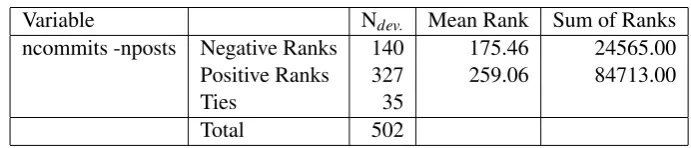
to compare the distributions of two variables. The results of the test in table6shows that for the 502 developers in the 20 projects; for 140 = ncommits<nposts, for 327 developer ncommits>
nposts, and 35 developers had a balanced activity with ncommits = nposts.
Table 6: Ranks of developers contribution
Variable Ndev. Mean Rank Sum of Ranks
ncommits -nposts Negative Ranks 140 175.46 24565.00 Positive Ranks 327 259.06 84713.00
Ties 35
Total 502
5
Concluding remarks
In this paper we have put forward research questions to investigate whether FOSS developers are making more commits to code repositories (SVN) than they are posting messages to mailing lists (Hypothesis 1), and whether developers should aim at a balanced activity by contributing equally there repositories (Hypothesis 2). Despite the fact that FOSS data is widely available and can be easily extracted [SASM07], this kind of research is made difficult because of the prob-lem associated with integrating data from and the subsequent identification of developers from multiple repositories (SVN and mailing lists). We have presented and discuss a methodology which alleviates these empirical research obstacles. The methodology and algorithm enabled us to locate and count the quantitative contribution of FOSS developers in 20 GNOME projects.
An exploratory data analysis or EDA technique was used to show that each project has its unique characteristics and developers contribution to either coding or mailing lists can vary tremendously. In our data consisting of 12,851 posters and 4,762 committers who, respectively posted 95,331 email messages and made 140,665 commits, we found out that in 55% (N = 11) of the projects there are more developers as posters, with smaller means (post per poster), than committers, with larger means (commits per committer).
From this sample of posters and committers we are able to extract 502 developers who simul-taneously contribute to both SVN and mailing lists. This cohort made more commits (mean = 152.1; Std. deviation = 431.171) than posts (mean = 43.19; Std. deviation = 164.353). How-ever, this group accounts for a relatively small percentage of the overall developer community in each project. But a close examination of the percentage of developers involved in posting and committing shows that projects with small number of posters will also have a small number of committers. This is valid in 60% (N = 12) of the projects studied. There is a 50-50 split (20%; N=4 on either side) between projects with small percentage of posters but large percent-age of committers (Balsa, Epiphany, Evolution, and Nautilus) and those with large percentpercent-age of posters but a smaller percentage of committers.
This moderately supports our second hypothesis (H2) that developers are contributing equally to code repositories and mailing lists. Wilcoxon signed ranks for the Two-Related-Samples Tests revealed that only 35 developers (less than 10%) had a balanced or tie activity.
The implications of these findings may provide assurance that FOSS developers, apart from coding and committing bits of code to a project’s SCM, they are also involved in knowledge brok-age [SAS06] in mailing lists. We can conjecture from earlier findings [SAS06,ARG06,Lon06] and our experience in both the FLOSSMetrics5and SQO-OSS6projects that this serendipity has implications for the quality of code since a large number of developers are externalizing and discussing their coding activities with other community members in the mailing lists. This kind of engagement may enable the developers to improve the quality of their code base, do more refactoring and learn about how the quality of the produced code may be improved.
Future work and research directions: As a follow up to this research, our future work aims at consolidating understanding developer dynamics and the development of appropriate community metrics [SC09] or indicators for the certification of both the FOSS product and process. Thus, narrowing the gap which exist in FOSS certification and formal methods [CS08]. Specifically, we plan to add a qualitative element to our research by interviewing some of theα [VTG+06] or star [SSL08] or key developers. This future work may also incorporate content analysis of the postings, new metrics like posts/commits and how such metrics vary overtime. This kind of data, metrics and commits analysis may help us better understand the quality of developers contribution, reveal any bottlenecks which may hinder the incorporation of developers code into the release product, and further reveal what kinds of metrics may be most appropriate when characterizing FOSS developers and projects.
Furthermore, in addition to SVN and mailing lists, developers also contribute intensively to the bug reporting and fixing process. Therefore, there exist an avenue of extending the methodology presented in this research to incorporate data from bug tracking systems data. This will provide a more comprehensive view of the pattern of developers contribution in open source projects. While the conclusion drawn from this study points out certain trends in Gnome projects, we are working on extracting a more heterogenous sample of projects and apply the same methodology to see if the patterns observed here can be generalized to other FOSS projects, not specifically Gnome based.
Acknowledgements: We are grateful to all partners in the FLOSSMETRICS project for provid-ing access to the data and tools used in this study. We also wish to acknowledge the excellent sug-gestions we received from anonymous reviewers and participants at the 4th International Work-shop on Foundations and Techniques for Open Source Software Certification (OpenCert2010). Their comments have helped us improve the paper greatly. The correspondence author wishes to acknowledge the Japan Society for the Promotion of Science (JSPS) who are currently sponsor-ing his research under Grant ID: P10807 and UNU-MERIT, Maastricht, Netherlands where this research began.
Bibliography
[ARG06] J. Amor, G. Robles, J. Gonzalez-Barahona. Discriminating Development Activities in Versioning Systems: A Case Study. In Proceedings PROMISE 2006: 2nd. In-ternational Workshop on Predictor Models in Software Engineering co-located at the 22th International Conference on Software Maintenance (Philadelphia, Pennsil-vanya, USA). 2006.
[BGD+06] C. Bird, A. Gourley, P. Devanbu, M. Gertz, A. Swaminathan. Mining email social networks. InMSR ’06: Proceedings of the 2006 international workshop on Mining software repositories. Pp. 137–143. ACM Press, New York, NY, USA, 2006.
[Bro75] F. Brooks. The Mythical Man-Month. Essays on Software Engineering. Addison-Welsey Publishing, 1975.
[CLM03] A. Capiluppi, P. Lago, M. Morisio. Characteristics of Open Source Projects. In CSMR ’03: Proceedings of the Seventh European Conference on Software Mainte-nance and Reengineering. P. 317. IEEE Computer Society, Washington, DC, USA, 2003.
[CS08] A. Cerone, S. A. Shaikh. Incorporating Formal Methods in the Open Source Soft-ware Development Process. In 2nd International Workshop on Foundations and Techniques for Open Source Software Certification. Milan, Italy, 10 September 2008 2008.
[DB05] T. T. Dinh-Trong, J. M. Bieman. The FreeBSD Project: A Replication Case Study of Open Source Development.IEEE Transactions on Software Engineering31(6):481– 494, 2005.
[DB07] J. M. Dalle, M. den Besten. Different Bug Fixing Regimes? A Preliminary Case for Superbugs. In Feller et al. (eds.),Open Source Development, Adoption and Inno-vation. IFIP International Federation for Information Processing 234, pp. 247–252. Springer, September 7-10 2007.
[GKS08] G. Gousios, E. Kalliamvakou, D. Spinellis. Measuring developer contribution from software repository data. InMSR ’08: Proceedings of the 2008 international work-shop on Mining software repositories. Pp. 129–132. ACM, 2008.
[Kuk06] G. Kuk. Strategic Interaction and Knowledge Sharing in the KDE Developer Mailing List.MANAGEMENT SCIENCE 2006 52: 1031-1042.52:1031–1042, 2006.
[Lon06] J. Long. Understanding the Role of Core Developers in Open Source Development. Journal of Information, Information Technology, and Organizations1:75–85, 2006.
[MFH02] A. Mockus, R. Fielding, J. Herbsleb. Two case studies of open source software devel-opment: Apache and Mozilla.Transactions on Software Engineering and Method-ology.11(3):1–38, 2002.
[MFT02] G. Madey, V. Freeh, R. Tynan. The open source software development phenomenon: An analysis based on social network theory. InAmericas conf. on Information Sys-tems (AMCIS2002). Pp. 1806–1813. 2002.
[Nor04] M. Norusis.Statistical Procedures Companion. Prentice Hall, Inc., 2004.
[QJ04] S. R. Q. Jones, G. Ravid. Information overload and the message dynamics of on-line interaction spaces: a theoretical model and empirical exploration.Information System Research15 (2):194210, 2004.
[RG06] G. Robles, J. Gonzalez-Barahona. Contributor Turnover in Libre Software Projects. In Damiani et al. (eds.),IFIP International Federation for Information Processing, Open Source Systems. Volume 203, pp. 273–286. Springer,Boston, 2006.
[RGCH09] G. Robles, J. Gonzalez-Barahona, D. Cortazar, I. Herraiz. Tools for the study of the usual data sources found in libre software projects.International Journal of Open Source Software and Processes1(1):24–45, Jan-March 2009.
[SAOB02] I. Stamelos, L. Angelis, A. Oikonomou, G. Bleris. Code Quality Analysis in Open-Source Software Development.Information Systems Journal, 2nd Special Issue on Open-Source, Blackwell Science12 (1):43–60, 2002.
[SAS06] S. K. Sowe, L. Angelis, I. Stamelos. Identifying Knowledge Brokers that Yield Soft-ware Engineering Knowledge in OSS Projects.Information and Software Technol-ogy48:1025–1033., 2006.
[SASM07] S. K. Sowe, L. Angelis, I. Stamelos, Y. Manolopoulos. Using Repository of Repos-itories (RoRs) to Study the Growth of F/OSS Projects: A Meta-Analysis Re-search Approach. In Open Source Development, Adoption and Innovation. IFIP International Federation for Information Processing 234/2007(978-0-387-72485-0), pp. 147–160. Springer Boston, August 2007.
[SC09] S. A. Shaikh, A. Cerone. Towards a metric for Open Source Software Quality. Elec-tronic Communications of the EASST Volume 20: Foundations and Techniques for Open Source Certification 2009, 2009.
[Sek06] U. Sekaran.Research Methods for Business: A Skill Building Approach. Wiley, 4th edition, 2006.
[SFF+06] W. Scacchi, J. Feller, B. Fitzgerald, S. A. Hissam, K. Lakhani. Understanding Free/Open Source Software Development Processes. Software Process: Improve-ment and Practice11(2):95–105, 2006.
[SO09a] SQO-OSS. Novel Quality Assessment Techniques. Deliverable Report-D7. Techni-cal report, Software Quality Observatory for Open Source Software. Project Num-ber: IST-2005-33331, 29 June 2009.
http://www.sqo-oss.eu/research/reports/SQO-OSS D 7 final.pdf
[SO09b] SQO-OSS. Overview of the state of the art. Deliverable Report-D2. Technical re-port, Software Quality Observatory for Open Source Software. Project Number: IST-2005-33331, 29 June 2009.
http://www.sqo-oss.eu/research/reports/SQO-OSS D 2 final.pdf
[SSL08] S. K. Sowe, I. Stamelos, A. Lefteris. Understanding Knowledge Sharing Activities in Free/Open Source Software Projects: An Empirical Study.Journal of Systems and Software81(3):431–446., 2008.
[SSSA08] S. K. Sowe, I. Samoladas, I. Stamelos, L. Angelis. Are FLOSS developers commit-ting to CVS/SVN as much as they are talking in mailing lists? Challenges for In-tegrating data from Multiple Repositories. In3rd International Workshop on Public Data about Software Development (WoPDaSD). September 7th - 10th 2008, Milan, Italy.2008.
[VTG+06] S. Valverde, G. Theraulaz, J. Gautrais, V. Fourcassie, R. V. Sole. Self-Organization Patterns in Wasp and Open Source Communities.IEEE Intelligent Systems21(2):36– 40, 2006.