ONE POT SYNTHESIS AND BIOLOGICAL EVALUATION OF
PYRANOPYRAZOLES
IN AQUEOUS MEDIUM
Priya M. Khandare,
[a]Rajita D. Ingale,
[a]Aparna S. Taware,
[a]Suresh U.
Shisodia,
[b]Shankar S. Pawar,
[c]Laszlo Kotai,
[d]Rajendra P. Pawar
[a]*Keywords: pyranopyrazoles; one pot reaction; catalysis; ultrasound waves; aqueous medium
A simple and green one pot protocol for the synthesis of pyranopyrazoles using ultrasonication waves in aqueous medium has been developed. Advantages of this method are it provides operational simplicity and environment-friendly green approach.
*Corresponding Authors
E-mail: [email protected]@yahoo.in
[a] Department of Chemistry, Deogiri College, Station Road, Aurangabad, Maharashtra- 431005, India [b] Department of Polymer Science and Engineering
Division, CSIR-National Chemical Laboratory, Dr. Homi Bhabha Road, Pune– 411008, Maharashtra, India
[c] Department of Chemistry, Ferguson, College, Pune, Maharashtra- 411004, India
[d] Research Centre for Natural Sciences, Hungarian Academy of Sciences, P. O. Box 17, HU-1525, Budapest, Hungary
Introduction
Multicomponent reactions (MCRs) are known as efficient tools for the generation of complex heterocyclic bioactive compounds useful in organic and medicinal chemistry, in which three or more reactants react to give final product in a one-pot procedure.1 The first multicomponent reaction was
described in 1850 by Strecker, and later many such reactions have been reported in the literature.2 This attracted attention
of industrial and academic researchers.3
Water is the safest and abundant substance in nature, and almost all compounds are sparingly soluble in water. Hence it is referred as a benign ‘Universal Solvent’.4 The search
for alternative reaction media to replace volatile, flammable and often toxic organic solvents is an important objective in the development of the green chemical process.5 Hence
organic synthesis in an aqueous medium is preferred from environmental as well as from the economical point of view.
Pyrano pyrazole is a fused heterocyclic compound, which adds functional diversity to the molecule and provides fruitful area to study the bioactivity. Pyranopyrazoles were first obtained in 1973 by the reaction between 3-methyl-1-phenylpyrazolin-5-one and tetracyano ethylene.6
Pyranopyrazole scaffold has shown bioactivity such as anticoagulant, spasmolytic, hypnotic, diuretic,7 insecticidal,8
anti-inflammatory,9 anticancer,10 antibacterial and
antifungal11, as well as antimicrobial.12 Owing to the
biological importance, scientists have developed several methodologies for the synthesis of pyranopyrazoles by using different catalysts such as piperidene,13 DBSA,14 PTSA,15
ZrO2-NPs,20 PS-PTSA,21 thiamine hydrochloride.4 But still,
these methods have certain limitations like use of harsh reaction conditions, low yield of products, use of volatile organic solvents, etc. Recently ultrasound irradiation has been used in organic synthesis.
In continuation of our efforts to the ecofriendly synthetic approach towards synthesis of bioactive heterocyclic compounds, herein we wish to report one pot four component synthesis of pyranopyrazoles by the reaction of aromatic aldehyde, malononitrile, ethyl acetoacetate, hydrazine hydrate using lanthanum (III) nitrate as a catalyst22 in aqueous medium under ultrasound irradiation
method in short time.
Scheme 1. General synthetic route to prepare compounds 4.
Experimental
All reagents and chemicals were of analytical grade and used without further purification. Sonication was performed in ultrasonic cleaner with a frequency of 25 KHz and nominal power 250 W. The reaction temperature was controlled by addition or removal of water from ultrasonic bath.
General procedure for the synthesis of substituted pyranopyrazoles
In 100 mL round bottom flask substituted benzaldehyde (1 mol), malononitrile (1.1 mol), ethyl acetoacetate (1 mol), hydrazine hydrate (1 mol) and La(NO3)3.6H2O (10 % mol)
H2N-NH2.H2O H O N N O O O O CN NH2 N N H R R
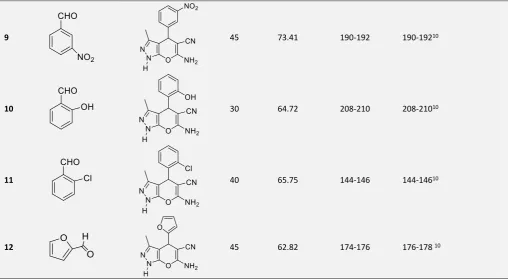
Table 1. Synthesis of pyranopyrazole derivatives
Sr. No.
Benzaldehyde Product Time,
min
Yield, % M.P., °C, found
M.P., °C lit.(ref.)
1 30 77.13 174 1759
2 30 85.41 193 1959
3 45 94.22 220-222 222-22410
4 30 70.61 178 1779
5 45 75.37 224-225 225-22710
6 30 83.58 169-170 169-17110
7 40 57.05 190-191 188-19010
9 45 73.41 190-192 190-19210
10 30 64.72 208-210 208-21010
11 40 65.75 144-146 144-14610
12 45 62.82 174-176 176-178 10
The resulting reaction mixture was sonicated for a period as indicated in Table 1. The progress of reaction was monitored by using TLC. After completion of reaction, the solid product obtained was filtered, washed with water and recrystallized from ethanol to afford the pure product. All the products were confirmed by comparing their melting points, IR and 1H NMR data with literature data.
Spectral data of compound 8.
6-Amino-3-methyl-4-(4-nitrophenyl)-2, 4-dihydropyrano [2,3-c] pyrazole-5-carbonitrile (2). Brown solid. IR (KBr): ѵ 3373.50, 3450.32, 2191.13, 1932.67, 854.47, 1H NMR :
(200 MHz, CDCl3) δ 8.27 (s, 1H, NH), 7.43-7.47 (dd, 2H,
arom), 8.17 (s, 2H, NH2 ), 8.21 (s, 2H, NH2), 1.56 ( s, 3H,
CH3), 7.55 (s, 3H, arom).
Results and discussion
To optimize the reaction conditions, we have carried out the model reaction of 4-hydroxybenzaldehyde, ethyl acetoacetate, hydrazine hydrate, and lanthanum (III) nitrate as a catalyst by using water or ethanol as a solvent or without solvent, at room temperature, reflux and by using ultrasound irradiations. Results obtained are presented in Table 2. High yields were obtained by using ultrasonication method and utilizing water as a green solvent in short time.
In order to understand amount of catalyst to obtain maximum yield we have carried out model reaction with different amount of catalyst (Table 3) and found that 10 mol % of catalyst is sufficient, further increasing the amount of catalyst does not affect the yield.
Table 2. Effect of various solvent on synthesis of compound 3.
Table 3. Effect of catalyst, on the synthesis of pyranopyrazole 3 by ultrasonification
Entry Amount of La(NO3)3.6H2O, mol % Yield, %
1 No catalyst 8
2 5 40
3 10 94
4 20 94
5 30 92
Entry Solvent Temperature,
0C/ )))))))
Time, min
Yield, %
1 H2O r.t. 360 85
2 H2O Reflux 240 83
3 H2O ))))))) 45 94
4 EtOH r.t 378 70
5 EtOH reflux 300 67
6 EtOH ))))))) 50 80
7 Without Solvent r.t 420 40
8 Without Solvent reflux 480 45
Mechanism
The possible mechanism for this reaction is, malononitrile and benzaldehyde through Knoevenagel condensation produces ylidene malononitrile and hydrazine on reaction with ethyl acetoacetate produces pyrazolone. These ylidenemalononitrile and pyrazolone together produce our desired product through Michael addition.
Antifungal activity
Antifungal activity of synthesized compounds has been screened against fungal species A. niger and Phytophthora using drug streptomycin as a standard. Agar well diffusion method is used for screening purpose. Observations were recorded after 72 h, and the zone of inhibition was measured in mm The antifungal activity is comparable with Streptomycin against A. niger and Phytophthora megasperma at a concentration of 10 mg/ml of DMF solvent.
It was observed that all the synthesized compounds showed good antifungal activity against fungal species A. niger and Phytophthora megasperma as compared to standard drug streptomycin.
Compounds 1, 4, 6, 11 shown excellent activity against A. niger whereas compounds 1, 3, 4, 5, 6, have shown excellent activity against Phytophthora species, Other compound shown good to moderate biological activity.
Table 4. Zone of inhibition in mm of synthesized pyranopyrazole derivatives
Compound A.niger Phytophthora megasperma
1 2 3 4 5 6 8 9 10 11 12 Standard
24 16 15 18 15 20 16 17 14 23 15 13
30 27 28 30 32 28 20 25 26 27 23 22
Table 5. GraphicalZone of inhibition in mm of synthesized pyranopyrazole derivatives
Conclusion
In conclusion, we have achieved pyranopyrazole synthesis by one pot multicomponent procedure using green synthetic protocol under ultrasound irradiation technique, using water as a green solvent and La(NO3)3.6H2O as a catalyst. Striking
features of this method are short reaction time, easy work up procedure, water solvent, use of ultrasound waves, atom economy.
Acknowledgement
Our sincere thanks to Dr. Shivaji N. Thore, Principal, Deogiri College, Aurangabad, for providing necessary laboratory facilities.
References
1Domling, A., Ugi, I., Angew. Chem., Int. Ed. Engl. 2000, 39,
3168.
https://doi.org/10.1002/1521- 3773(20000915)39:18<3168::AID-ANIE3168>3.0.CO;2-U
2Pawar, B., Jadhav, S. D., Patil, B. M., Shejwal, R. V., Patil
S., Arch. Appl. Sci. Res., 2014, 6, 150-158.
3Davood, A., Khatami, S. M., Razieh, N. Y., J. Chem. Sci.
2014, 126, 95-101. https://doi.org/10.1007/s12039-013-0548-x
4Nikam, M. D., Mahajan, P., Chate, A. V., Dabhade, S. K.,
5Khurana, J. M., Nand, B., Kumar, S., Synth Commun, 2011,
41, 405-410.
https://doi.org/10.1080/00397910903576669
6Junek, H., Aigner, H., Chem. Ber. 1973, 106, 914-921.
https://doi.org/10.1002/cber.19731060323
7Ahluwalia, V. K., Dahiya, A., Indian, V., Indian J. Chem.,
B: Org. Chem. Incl. Med. Chem., 1997, 36, 88.
8Ismil, Z. H., Aly, G. M., El-Degwi, M. S., Egypt. J.
Biotechnol, 2003, 13, 73-82.
9Zaki, M. E. A, Soliman, H. A., Rashad, A. E., Z.
Naturforsch. C., 2006,61, 1-5.
https://doi.org/10.1515/znc-2006-1-201
10Wang, J. L., Liu, D., Zheng, Z. J., Shan, S., Han, X.,
Srinivasula, S. M., Croce, C. M., Alnemri, E. S., Huang, Z., Proc. Natl. Acad. Sci. U. S. A., 2009, 97, 7124. https://doi.org/10.1073/pnas.97.13.7124
11Katariya, L. K., Kharadi, G. J., IJPRS, 2014, 3, 627-637. 12Dawane, B. S., Yemul, O. S., Chobe, S. S., Mandawad, G.
G., Kamble1, R. D., Shinde, A. V., Kale, M. P., Hurne1, A. O., Pawde, M. A:, Desai, N. P., Salgare, R. R., Patil, M. B., Mundhe S. N. and Chavan, S. R., Der Pharma Chemica, 2011, 3, 300-305.
13Bekington, M., Hormi M., Rohman, Md. R., Rajbangshi,
M., Kharkongor, I., Laoo, B. M., Iadeishisha, Kharbangar, Kshair, B., Org. Prep. Pro. I, 2013, 45, 253-303.
14Jin, T. S., Zhao, R. Q., Li, T. S., ARKIVOC, xi 2006,
176-182.
15Heravi, M. M., Javanmardi, N., Oskooie, H. A.,
Baghernejad, B., GUJ Sci., 2011, 24, 227-231.
16Nikam, K., Piran, A., Green Sustain. Chem., 2013, 3, 1-8. 17Pawar, P. B., Patil, B. M., Shejwalb, Patil, S., Arch. Appl.
Sci. Res., 2014, 6, 150-158.
18Kanagraj K., Pitchumani K., Tetrahedron Lett. , 2010, 51,
3312-3316. https://doi.org/10.1016/j.tetlet.2010.04.087
19Pagore, V. P., Rupnar, B. D., Tekale, S. U., Pawar, R. P.,
Der Pharma Chemica, 2015, 7, 312-317.
20Saha, A., Payra, S., Bannerjee, S., Green Chem., 2015, 17,
2859. https://doi.org/10.1039/C4GC02420F
21Chaudhari, M. A., Gujar, J. B., Kawade, D. S., Jogdand, N.
R., Shingare, M. S., Cogent Chem., 2015, 1, 1063830.
22Pandule, S. S., Shisodia,S. U., Patil,M. R., Chabukswar,
V. V., Eur. Chem. Bull., 2015, 4, 364-367. DOI: 10.17628/ecb.2017.6.365-375