Eur. Chem. Bull. 2013, 2(3), 137-143 DOI: 10.17628/ECB.2013.2.137
137
NANO-SYNTHESIS OF PROMISING FAMILIES OF HT
C-SUPERCONDUCTORS TO SAVE ELECTRICAL LOSS IN THE
ELECTRICAL POWER IN SAUDI ARABIA NET
(FREEZE DRY SYNTHESIS OF
NANO-Zr-ADDED-2212-BPSCCO-SUPERCONDUCTOR )
Khaled M. Elsabawy
[a,b]*and Waheed F. El-Hawary
[a,c]Keywords: Nano-additives, superconductors, SEM, XRD, Raman Spectrum, ZrO2
Saving energy loss through the conduction is the major objective of several advanced countries so superconductors are the essential material to achieve such these demands. The present investigations were concerned by synthesis of pure BPSCCO (Bi0.5Pb0.5)2Sr2Ca1Cu2O8
and its variant zirconium containing composites with general formula : Bi1+xZrxPbSr2Ca1Cu2Oz, where x=0.1, 0.2 and 0.3 mole %
respectively, were prepared via solution route (Freeze Drying Technique ) to obtain nano-product. ZrO2 has a limited effect on the main
crystalline superconductive 2212-phase as x amount added increase as indicated in XRD measurements. SE-microscopy along with EDX proved that, solution route was the best in the degree of homogneties and exact molar ratios. ZrO2 exhibits strong interactions on Raman
spectral modes of 2212-phase . ZrO2 has a slight effect on Tc’s even with maximum addition x=0.3 mole. Finally the application of ZrO2
-nano-additives to the 2212-BPSCCO superconductors enhance the super-conduction mechanism and consequently save too much the amount of electricity loss on the main nets of electricity .
*Corresponding Authors
*E-mail: [email protected] and
[a] Department of Chemistry, Faculty of Science, Taif University, 888- Taif, Kingdom of Saudi Arabia
[b] Materials Unit , Chemistry Department ,Faculty of Science, Tanta University, 31725-Tanta –Egypt
[c] Department of Chemistry, Faculty of Science, Cairo University, Egypt
Introduction
The cuprates offer a wide field of possibilities in terms of chemical composition, leading to required physical properties. Consequently, cationic substitutions and thermal treatments are commonly used as tools to modify the characteristics of a reference-compound.
Partial replacement of bismuth by lead in (Bi/Pb)2Sr2CaCu2O8+x (Bi-2212) is known to induce important structural changes, as it suppresses the c-axis component of the modulation.1,2 From the hole-doping point of view however, several reports suggest that Pb-incorporation does not affect the carrier concentration significantly.3,4
It was noticed from resistivity measurements5-7 or diamagnetic shielding observations8 that the interlayer coupling would be affected instead, resulting in a reduction of the material's anisotropy. On the other hand, oxygen non-stoichiometry in the Bi-based cuprates was not studied as extensively as it was for example in YBa2Cu3Oz9and this is
particularly true for the cation-substituted compounds. Nevertheless, it has been shown that oxygen excess in Bi-2212 varies in a small range but with a great effect on Tc10-13 and is dependent on the cationic substitutions.1416
In the case of Bi-2212, the decrease of the oxygen content has been mentioned to explain the absence of a Pb-induced doping effect.17,18 but only a few data are available in the literature. Superconducting properties of Bi-2212 depend on oxygen content.19-23 The superconducting transition temperature Tc decreases for x≥8.18 and is dependent on annealing temperature and cooling rate.24
Oxygen vacancies have also been suggested as a major source of flux pinning in BSCCO.25 The kinetics of oxygen motion and the formation and migration of oxygen defects in BSCCO have been studied by measurement of the oxygen–tracer diffusion parameters. These parameters provide not only input to the theoretical point–defect models, but can also be useful in developing fabrication techniques.
The pseudo-tetragonal 85 K -BSCCO superconductor of Bi2Sr2CaCu2Ox , or 2:2:1:2 consists of one Ca atom symmetrically located between the following layers sequences Cu-O, Sr-O and Bi-O and each layer is parallel to the ab plane.26 Most of studies reported on the 2223-phase are on Pb-doped compositions.27-31 There are a few studies reported on the preparation of 2223 from Pb free compositions containing a large excess of Bi, Ca/or Cu, for example, the nominal compositions BiSrCaCu2Ox,32 Bi2Sr2Ca3Cu4Ox, Bi2Sr2Ca4Cu5Ox33,34 were reported to lead a high volume fraction of the 2223 phase with variable amounts of impurity phases such as 2212,Ca2CuO3 and CuO.
Eur. Chem. Bull. 2013, 2(3), 137-143 DOI: 10.17628/ECB.2013.2.137
138
Many previous workers27-31 have investigated the doping effect of 3d-elements (M=Sc, Ti, V, Fe, Co, Ni and Zn ) on the Cu-site of BPSCCO system and they reported that, the doping with 3d-elements affecting on stabilization of structural phase (2223) is responsible for HTc -superconducting properties and there is a correlation between 2223-superconductive phase stability and the valency of 3d-metal cation dopant. Reaction kinetics and phase purity of the products were observed to be dependent upon the starting precursors during the formation of 2223, 2212 invariably forms as an intermediates have been incorporated to form 2223 plus some of impurity phases .The presence of transient liquid phase such as Ca2PbO4 is reported to be essential for diffusion of additional Ca and Cu ions into the 2212 framework.42-45 A special method was used to introduce Pb which significantly influenced the phase development and superconducting properties of the 2223 product.46
Wu et al.47 have used Raman techniques to identify variuos phases present in BPSCCO regime including alkaline earth cuprate, CuO, Bi-2212, Bi-2223 and Pb-containing phases specially (Sr/Ca) 2PbO4.
Lu et al.48 have determined the effect of MgO and Ag 2O oxides additives on the microstructure and superconducting properties of BPSCCO system and reported that , MgO addition did not affect the formation rate of 2212-phase which yields to 2223-phase, and could suppress the growth of Bi-free non-superconducting secondary phases furthermore, Shelke et al.49 have investigated also the effect of HgO addition on the superconducting properties and microstructural properties of BPSCCO superconductor system deducing that, Tc’s-offsets for 2212-BPSCCO variated in between 60 and 72 K according to the amount of HgO added.
Orlova et al.50 have determined the effect of ZrO
2 addition (1 wt.% to 5 wt.%) on the superconducting properties of sintered 123- Dy-Ba-Cu-O system and deduced that the best flux pinning in a magnetic field was achieved with maximum amount of addition ZrO2 (5 wt %). The aim of the present work is to investigate the influence of high valency cations nano-Zr4+ inclusion additives on the hole-superconducting and physical properties PBSCCO regime aiming for stabilizing oxygen content by using high charge cation (Zr4+) partially in place of lower one ( Bi3+ /Pb2+) site to avoid toxicity of heavy metal (lead) and enhancing the super-conduction mechanism to save energy loss during conduction .
EXPERIMENTS
Samples preparation
Solution route ( Freeze dry Synthesis )
The pure (Bi0.5Pb0.5)2Sr2Ca1Cu2O8 and its variant zirconium containing composites with general formula : Bi1+xZrxPbSr2CaCu2Oz, where x=0.1, 0.2 and 0.3 mole % respectively ,were prepared using freeze drying technique starting with estimated nitrate solutions (0.2M) for all cations except lead took as lead acetate followed by mixing the exact volumes in liquid nitrogen matrix then the resultant forwarded into freeze drying machine (slow program for sensitive samples ~ 90 h).
The obtained powders were ground and introduced to the same cycle of thermal treatment mentioned above.
Phase Identification
The X-ray diffraction (XRD) measurements were carried out at room temperature on the fine ground samples using Cu-Kα radiation source, Ni-filter and a computerized STOE diffractometer/Germany with two theta step scan technique .
Scannig Electron Microscopy (SEM) measurements were carried out using a small pieces of the prepared samples by using a computerized SEM camera with elemental analyzer unit (PHILIPS-XL 30 ESEM / USA) .
Superconducting measurements
The cryogenic AC-susceptibility of the prepared materials was undertaken as a function of temperature recorded in the cryogenic temperature zone down to 30 K using liquid helium refrigerator.
Raman Spectroscopy measurements
The measurements of Raman spectra were carried out on the finally ground powders with laser wavelength=632.8 nm (He-Ne laser) and laser power applied to the site of the sample = 0.4 mW with microscope objective = x20.
RESULTS AND DISCUSSION
Phase Identification:
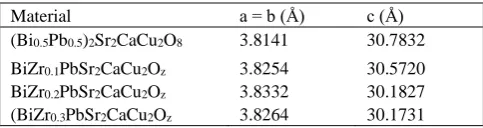
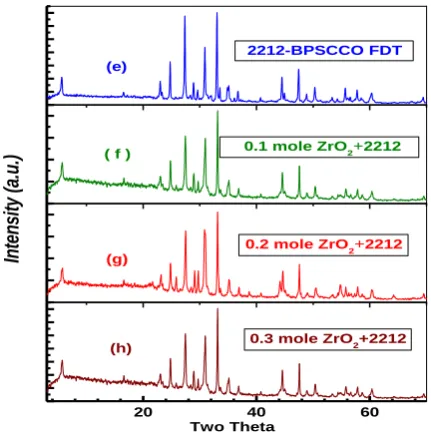
Fig. 1a-d displays the X-ray powder diffractometry patterns of the pure (Bi0.5Pb0.5)2Sr2Ca1Cu2O8 and variant Zr-additive content composites: BiZr0.1PbSr2CaCu2Oz, BiZr0.2PbSr2CaCu2Oz, and BiZr0.3PbSr2CaCu2Oz prepared via freeze drying technique respectively. Analysis of the corresponding 2θ values and the interplanar spacings d(Å) were carried out ,and indicated that ,the X-ray crystalline structure mainly belongs to a single tetragonal phase 2212 in major besides Ca2PbO4 secondary phase in minor. The unit cell dimensions were calculated using the most intense X-ray reflection peaks (see Table 1) to be a=b=3.8141 Å and c=30.7732 Å for the pure 2212-BPSCCO phase which is in
full agreement with those mentioned in literature.
Table 1. The calculated lattice parameters for the prepared samples
Material a = b (Å) c (Å)
(Bi0.5Pb0.5)2Sr2CaCu2O8 3.8141 30.7832
BiZr0.1PbSr2CaCu2Oz 3.8254 30.5720
BiZr0.2PbSr2CaCu2Oz 3.8332 30.1827
(BiZr0.3PbSr2CaCu2Oz 3.8264 30.1731
Eur. Chem. Bull. 2013, 2(3), 137-143 DOI: 10.17628/ECB.2013.2.137
139
From Table 1 one can indicate that c-axis decreases as zirconium dopant concentration increase from 0.1 to 0.2 while no noticeable effect from 0.2 to 0.3. This is an indication for (Zr4+) might substitute by some extent in the superconductive lattice and correlated with atomic radius of zirconium which is smaller than that of bismuth (Zr4+=0.72 Å while Bi3+ is 1.17 Å) and alteration of Ca/Sr ratios which for c-axis is dependent.2
Figure 1.a-d. X-ray diffraction patterns for the pure and variant ZrO2 2212-BPSCCO superconductors prepared by freeze drying
technique. (e): x=0.0 mole; (f): x = 0.1 mole; (g): x=0.2 mole; (h): x=0.3 mole
Some authors such as Lu et al.48 reported that the formation of 2212-phase comes from the step sequence reaction:
Ca2PbO4 CaO+Pb-rich phase . (1)
2CaO + CuO Ca2CuO3 (2)
Bi2O3 +Pb+CuO (Bi/Pb)2CuO4 (3)
(Bi/Pb)2CuO4+2SrO(Bi/Pb)2Sr2CuO6 2201-phase (4)
½( CuO + Ca2CuO3)+ 2201 2212-phase . (5)
In this respect , one can expect that ZrO2-additives to 2212 system produce some of Zr-based phases which is highly compatible with the superconductor phase specially the solubility of zirconium is enhanced via intermediate zirconate formation at the expense of the originally present Ca and Sr.51
Thus ,equilibrium between Bi-2201 and Sr1-xCaxZrO3 was achieved throughly the initial stage of synthesis :
Zr4+ + Ca/Sr (Ca/Sr)ZrO
3 (6)
(Ca/Sr)ZrO3+CuO+2201-Bi2Sr2CuO4+
Pb-rich phase 2212-phase (7) Figure 2.a-d.x=0.0 mole; (b): Raman Spectra for Zr-added-2212-BPSCCO; (a): x=0.1 mole; (c): x=0.2 mole; (d): x=0.3 mole
20 40 60
(h) 0.3 mole ZrO2+2212
Two Theta
(g)
0.2 mole ZrO2+2212
In te ns ity (a .u
.) ( f ) 0.1 mole ZrO2+2212
(e)
2212-BPSCCOFDT
100 200 300 400 500 600 700 800
0 5000 10000 15000 20000 25000 * 2212-BPSCCO * 2212-phase ° (Ca/Sr)2PbO4 + 2201-phase In te n s it y c o u n ts /s .
Raman Shift cm -1
373 501 579 406 324 261 627 660 [a] + + * ° * * * x = 0.0 mole
100 200 300 400 500 600 700 800 8000 9000 10000 11000 12000 13000 14000
259 346 403 461
550 625
651
x = 0.1 mole
2212-10 % mole Zr-added-BPSCCO
In te n s it y c o u n ts /s .
Raman Shift cm-1
[b]
200 300 400 500 600 700 800 6000 8000 10000 12000 14000 16000 SSR 323 265 412461
558 659 631
x = 0.2 mole
20 %-Zr-added-2212-BPSCCO In te n s it y c o u n ts /s .
Raman Shift cm -1
[c]
100 200 300 400 500 600 700 800
6000 8000 10000 12000 14000 16000 18000 SSR
259 412 549
454
634
x = 0.3 mole
30 % mole added Zr-2212-BPSCCO
In te n s it y c o u n ts /s .
Eur. Chem. Bull. 2013, 2(3), 137-143 DOI: 10.17628/ECB.2013.2.137
140
Thus, the amount of zirconate might be amorphous and consequently too difficult to be detected by X-ray means even for maximum Zr-addition x=0.3 mole. (see Fig.1d), these results are in partial agreement with Kazin et al.51
Liu et al.52 support and reinforce our view in their studies on phase transformation and conversion for 2201->2212 deducing that the optimal annealing temperature to convert liquid phase of (Bi-Pb-Sr-Ca-Cu ) mixture into 2212-phase is 795 °C and at annealing temperatures in the range (830-845 C°) 2223-phase decomposes to 2212 plus other phases and consequently 2212-becomes the major phase.
Raman Spectroscopy
Figs. 2a-d show the Raman spectra for pure and Zr(IV)-added 2212-BPSCCO system. From the modes frequencies which are listed and compared with some references see Table 2, one can indicate that 2212-BPSCCO phase is the domainating phase present in our polycrystalline BPSCCO beside small traces of strontium calcium plumbates and 2201-impurity phases .
It can be concluded from references47,53,54 for the undoped 2212-phase the first order Raman mode frequencies are mainly located at the following ranges i.e., 290-330 ,460-470, and 620-640 cm–1 ( the given ranges depend on samples compositions) and the most important modes frequencies are the Ag mode of OBi atoms vibration along the c-axis (290-330 cm–1), the the Ag mode of OSr atoms vibration along the c-axis (460-470 cm–1 ), and the the the Ag mode of OBi atoms vibration along the a-axis (620-640 cm– 1) which is induced by orthorhombic distortion. Furthermore, another shoulder peak (650-660 cm–1) at the higher frequency side of the ~ 630 cm–1 line which is fully typical with our results. This shoulder is ascribed to Ag vibrational mode of extra oxygen atoms residing in the double layers.53,54
Table 2. Mode frequencies of Raman spectra recorded for Zr(IV) added-2212 BPSCCO in the present work in contrast with some references
References
51 54
2212 x = 0 x = 0.1 x = 0.2 x = 0.3 282 285
296 295
313 355
391 400
469 465
- 497
631 630
659 660
261* 324+ 373* 406 501* 579° 627* 660*
259* 346+ 403* 461* - 550° 625* 651*
265* 323+ 412* 461* - 558° 631* 659*
259* 321+ 412* 454* - 549° 634* -
* 2212-phase, + 2201-phase,° (Sr/Ca)2PbO4
It is important to notify that the mode frequency lying at ~ 630 cm-1 is usually the most intense band for all three phases of BPSCCO superconductors (2201,2212 and 2223 )when they are in a polycrystalline state47 .
From Fig. 2a-d, Raman spectrograph for 2212-BPSCCO and its added Zr-2212 samples, the only violation from references of single crystal Raman spectrum is the band lies ~324 cm-1 which is ascribed to the 2201 phase as reported in52 and the band appears ~ 500 cm-1 which also belongs to
our main phase 2212 as reported by Sapriel et al55 who appears in their Raman spectrogram for 2212 single crystal band lies ~ 497 cm-1 which is fully supporting our results . The band appears ~ 560 ±10 cm-1 is indicated by existence of lead-rich phase (Sr/Ca)2PbO4 as reported in47 that also confirmed in our XRD.
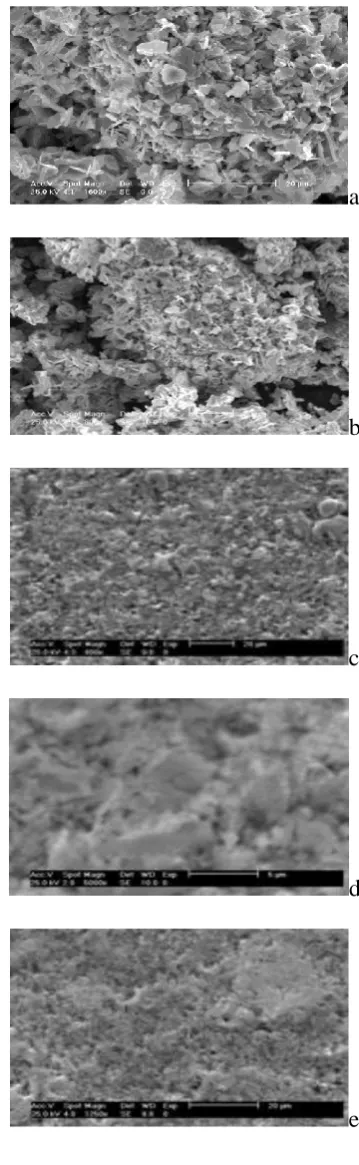
Figure 3.a-e. SE-micrographs for pure 2212-BPSCCO prepared by Freeze Drying Technique (FDT) and variant added-ZrO2 samples. [a]: Pure BiPb-2212 (FDT); [b]: 0.1 mole -ZrO2-added BiPb-2212
(FDT); [c]: 0.2 mole -ZrO2-added BiPb-2212 (FDT) [d] and [e] 0.3
mole -ZrO2-added BiPb-2212 (FDT).
a
b
c
d
Eur. Chem. Bull. 2013, 2(3), 137-143 DOI: 10.17628/ECB.2013.2.137
141
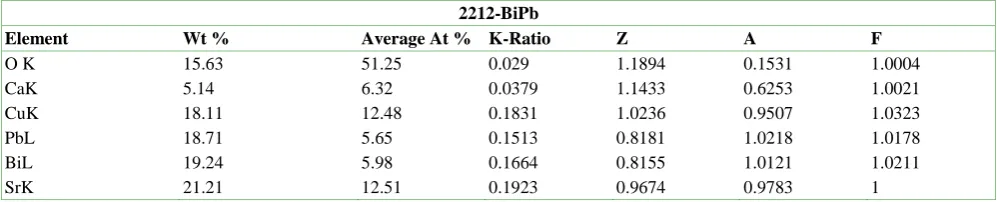
Table 3. EDX elemental data for pure -2212-BPSCCO (FDT).
2212-BiPb
Element Wt % Average At % K-Ratio Z A F
O K 15.63 51.25 0.029 1.1894 0.1531 1.0004
CaK 5.14 6.32 0.0379 1.1433 0.6253 1.0021
CuK 18.11 12.48 0.1831 1.0236 0.9507 1.0323
PbL 18.71 5.65 0.1513 0.8181 1.0218 1.0178
BiL 19.24 5.98 0.1664 0.8155 1.0121 1.0211
SrK 21.21 12.51 0.1923 0.9674 0.9783 1
Table 4. EDX elemental data for 0.1 mole added-ZrO2
-2212-BPSCCO (FDT) .
Element Average
At %
K-Ratio Z A F
O K 53.26 0.029 1.194 0.1531 1.0004
CaK 7.53 0.0379 1.1433 0.6253 1.0021
CuK 15.13 0.1831 1.0246 0.9507 1.0313
BiL 14.18 0.1664 0.8175 1.0131 1.0211
SrK 13.31 0.1923 0.9674 0.9783 1
ZrK 1.657 0.0253 0.9735 0.9832 1
Table 5. EDX elemental data for 0.2 mole added-ZrO2
-2212-BPSCCO (FDT) .
Element Average
At %
K-Ratio Z A F
O K 53.56 0.029 1.194 0.1631 1.0004
CaK 7.63 0.0379 1.1433 0.6253 1.0021
CuK 15.18 0.1831 1.0246 0.9507 1.0313
BiL 14.28 0.1664 0.8175 1.0131 1.0211
SrK 13.31 0.1923 0.9674 0.9783 1
ZrK 3.157 0.0253 0.9735 0.9831 1
Table 6. EDX elemental data for 0.3 mole added-ZrO2
-2212-BPSCCO (FDT) .
Element Average
At %
K-Ratio Z A F
O K 52.53 0.029 1.194 0.1531 1.0004
CaK 7.63 0.0379 1.1433 0.6233 1.0023
CuK 15.32 0.1831 1.0246 0.9507 1.0313
BiL 14.61 0.1664 0.8175 1.0131 1.0221
SrK 13.56 0.1923 0.9674 0.9783 1
ZrK 4.61 0.0253 0.9735 0.9824 1
From Fig.2a-d, it is clear that, as amount of Zr(IV)-added increases the bands lie ~ 579 corresponds to lead-rich phase plumbates) and the shoulder at 660 cm-1 (corresponds to the vibrational modes of extra oxygen atoms inside the bi-layer BPSCCO53,54) begin to be broad till complete broadening with maximum addition x=0.3 mole. In our opinion it might due to Zr(IV) added consumes some extent of Sr/Ca and extra oxygen to form zirconate impurity amorphous phase as described in eq.(6) .
SE-microscopy measurements
Fig.3a-d, show the SE-micrographs for pure and Zr-doped PBSCCO with x = 0.1 0.3 mole prepared by Freeze Drying Technique. The samples were measured as fine
ground powders ,the average particle size estimated to be in between 0.3 and 1.4 µm which is considered high to that estimated from solid state route.
The micrographs taken are more homogeneous than those for samples prapared via solid state route which reflect the priority to freeze drying technique than solid state route ( SSR) .
Table 3-6, is the EDX average data estimated from examinations of random spots inside the same sample for pure and Zr-added polycrystalline doped –PBSCCO prepared by freez dry technique .
The analysis of EDX data obtained from Table 3 for pure 2212BPSCCO prepared by solid state route (SSR) give us the following , stoichoimetric molar ratios Bi/Pb : Sr : Ca : Cu : O = 1.63 : 1.66 : 1 : 1.89 : 7.7 while the EDX analysis for the same parent pure-2212 BPSCCO prepared by freez dry technique see Table (4) Bi/Pb : Sr : Ca : Cu : O = 1.84 : 1.98 : 1 : 1.98 : 8.13 . These results proved that, the differences in the molar ratios EDX estimated for the same sample is totally better in FDT that emphasized also in their magnetic behaviour and good evidence for the existence of 2212 superconductive phase with good approximate molar ratios .
Superconductivity measurements
Fig. 4a-d shows the AC-magnetic susceptibility curves (Meissner & Shielded lines ) for pure and Zr-added samples with x=0.1–0.3 mole respectively prepared through solution route Freeze Drying Technique (FDT).
Eur. Chem. Bull. 2013, 2(3), 137-143 DOI: 10.17628/ECB.2013.2.137
142
Fig.(4a-d): AC- Susceptibility curves for Zr-added 2212 ( F DT ).(a): x=0.0 mole, (b): x=0.1 mole, (c): x=0.2 mole and (d): x=0.3 mole
Conclusions
Conclusive remarks can be summarized as
1-Solution route (Freeze Drying Technique ) yield to nano-product.
2-ZrO2 has a limited effect on the main crystalline superconductive 2212-phase as Zr- amount added increases.
3-Only lead-rich-plumbates appears as secondary phase in minor.
4-SE-microscopy accompanied with EDX proved that, solution route was the best in the degree of homogeneities and exact molar ratios.
5-ZrO2 exhibits strong interactions on Raman spectral modes of 2212-phase.
6-ZrO2 has a slight effect on Tc’s even with maximum addition x=0.3 mole.
7-Finally the application of ZrO2-nano-additives to the 2212-BPSCCO superconductors enhance the super-conduction mechanism and consequently save too much the amount of electricity loss on the main nets of electricity .
Aknowlegements
The authors would like to thank cordially and deeply Taif University represented by vice president of the university for research Prof. Dr. F. Felmban for their financial support to this research article under contract number 1031-432-1 Taif University- Saudi Arabia.
References
1Chen C. H., Werder D. J., Espinosa G. P. and Cooper A. S., Phys. Rev. B , 1989, 39,4686.
2Schneck J., Pierre L., Tolédano J. C. and Daguet, C. ,Phys. Rev. B ,1989, 39, 9624.
3Maeda A., Hase M., Tsukada I., Noda, K., Takebayashi S. and
Ushinokura K., Phys. Rev. B,1990, 41, 6418.
4Weber M., Amato A., Gygax F. N., Schenk A., Maletta H.,
Duginov V. N., Grebinnik V.G., Lazarev A. B., Olshevsky V. G., Pomjakushin V. Y., Shilov S. N., Zhukov V. A., Kirillov, B. F., Pirogov A. V., Ponomarev A. N., Storchak V. G., Kapusta S. and Bock J., Phys. Rev. B, 1993, 48, 13022.
5 Régi F. X., Schneck J., Savary H., Daguet C. and Huet F., IEEE Trans. Appl. Supercond., 1993, 3, 1190.
6Ma J., Alméras P., Kelley R. J., Berger H., Margaritondo G., Cai
X. Y., Feng Y.and Onellion M. ,Phys. Rev. B, 1995, 51, 9271.
7Winkeler L., Sadewasser S., Beschoten B., Frank H., Nouvertné
F.and Güntherodt G., Physica C, 1996, 265, 194.
8Manifacier L., Collin G. and Blanchard N., Int. J. Modern Phys. B,
1998, 12, 3306.
9 Lindemer T. B., Hunley J. F., Gates J. E., Sutton A. L., Brynestad
J. and Hubbard C., J. Am. Ceram. Soc., 1989, 72, 1775.
10Allgeier C. and Schilling J. S., Physica C, 1990, 168, 499.
0 20 40 60 80 100
-0.0020 -0.0015 -0.0010 -0.0005 0.0000
2212-BPSCCO-pure UNDOPED[FDT]
M
e
m
u
/g
m
Tem perature K [a]
Tc = 74.98 K
0 2 0 4 0 6 0 8 0 1 0 0
-0.0030 -0.0025 -0.0020 -0.0015 -0.0010 -0.0005 0.0000
2212-B P S C C O -0.1 m o le% Z rO2 ( F D T )
M
e
m
u
/g
m
T em p eratu re K [b ]
T c = 70.7 K
0 2 0 4 0 6 0 8 0 1 0 0
-0 .0 0 2 0 -0 .0 0 1 5 -0 .0 0 1 0 -0 .0 0 0 5 0 .0 0 0 0
F D T - B P S C C O -Z rO2 0.2 m o le% 2212
M
e
m
u
/g
m
T em p eratu re K [c ]
T c = 69.34 K
0 20 40 60 80 100
-0.0010 -0.0008 -0.0006 -0.0004 -0.0002 0.0000
FD T-B P S C C O -2212-ZrO2 0.3 m ole %
M
e
m
u
/g
m
Tem perature K
[d]
Eur. Chem. Bull. 2013, 2(3), 137-143 DOI: 10.17628/ECB.2013.2.137
143
11O'Bryan H. M., Rhodes W. W. and Gallagher P.K. Chem. Mater.,
1990, 2, 421.
12Presland M. R., Tallon J. L., Buckley R. G. and Flower N. E., Physica C, 1991, 176, 95.
13Sieburger R., Müller P. and Schilling J. S., Physica C, 1991, 181,
335.
14Manthiram A. and Goodenough J. B., ,Appl. Phys. Lett.1988, 53,
420.
15Groen W. A., Leeuw D. M. and Feiner L. F., Physica C,1990, 165, 55.
16Mitzi D. B., Lombardo L. W., Kapitulnik A., Laderman S. S. and
Jacowitz R. D. ,Phys. Rev. B,1990, 41, 6564.
17Tallon J. L., Buckley R. G., Gilberd P. W. and Presland M. R., Physica C,1989, 158, 247.
18Williams G. V. M., Pooke D. M., Pringle D. J., Trodahl H. J.,
Tallon J. L., , Crossley A. and Cohen L. F., Phys. Rev. B,
2001,63, 589.
19 Niu H., Fukushima N. and Ando K.; Jap. J. Appl. Phys., 1988, 27, 1442.
20Morris D. E., Hultgren C. T., Markelz A. M., Wei J. Y. T., Asmar
N. G. and Nickel J. H. ,Phys. Rev. B , 1989, 39, 6612.
21Zhao J. and Seehra M. S., Physica C, 1989, 159, 639.
22Presland M. R., Tallon J. L. ,Buckely R. G., Liu R. S. and Flower
N., Physica C, 1990, 176, 95.
23Kao H. C. I., Chen W. L., Wei T. P., Lui J. C. and Wang C. M., Physica C, 1993, 177, 376.
24Tarascon J. M., McKinnon W. R., Barboux P., Hwang D. M.,
Bagley B. G., Greene L. H., Hull G. W., Lepage Y., Stoffel N. and Giround M., Phys. Rev. B, 1988, 38, 885.
25Chudnovsky E. M., Phys. Rev. Lett., 1990, 65, 3060 .
26Hazen R. M., Prewitt C: T., Angel R. G., Ross N. L., Finger, L.
W., Hadidiacos C.G., Veblen D. R., Hor P. H., Meng R. L. and ChuC. W., Phys. Rev. Lett., 1988, 60, 1174.
27Sunshine S. A., Siegrist, T., Schneemeyer L. F., Murphy D.W.,
Cava R.J., Batlogg B., Van Dover R.B. , Nakahara S. , Farrow R. , Marsh P., Rupp L.W. and Peck W.P., Phys. Rev. B, 1988, 38, 898.
28Statt B. W., Wang Z., Lee M. G., Yakhmi J. V., De P.C., Major J.
F. ,and Rutter J. W., Physica C, 1988, 15, 156 .
29Calestani G., Rezzoli C., Andreetti G. D., Buluggiu E., Giori D.
C., Valenti A. and Ammoretti G. G., Physica C, 1988, 158, 217.
30Ueyama M., Hikata T., Kato T. and Sato K., Jap. J. Appl. Phys.,
1991, 30, 1384.
31Li Q., Brodersen K., Hjuler H. A. and Freltoft T., Physica C,
1993, 217, 360.
32Larbalesteir D. C., Cai X. Y., Feng Y., Edelman H., Umezawa A.,
Riley G. N. and Carter W. L., Physica C,1994, 221, 299.
33Namgung C., Lachowski E. E., Irvine J. T. S. and West A. R., Powder Diff., 1992, 7, 49.
34Shi D., Tang M., Boley M. S., Hash M., Vandervoort K., Claus H.
and Lwin Y. N., Phys. Rev. B, 1989, 40, 2247.
35Sumiyama A., Yoshitomi T., Endo H., Tsuchiya J., Kijima W.,
Mizuno M., and Oguri Y. Jap. J. Appl. Phys., 1988, 27, 542 .
36Sastry P. V., Yakhmi J. V. and Iyer R. M., Physica C, 1989, 161,
665.
37Dorris D. E., Prorok B. C.,Lanagan M. T., Sinha S. and Poepppel
R. B. ,Physica C, 1993, 212, 66.
38Pandey D., Mahesh R., Singh A. K., Tiiwari V. S.,and Singh S.
K., Solid State Commun., 1990, 67, 655.
39Zhengping X., Lian Z. ,and Chunlin J., Supercond. Sci. Technol.,
1992, 5, 240.
40Smith M. G. , Wills J. O., Poterson D. E., Binger J. F., Phillips D.
S., Coulter J. Y., Salazar K. V. and Hults W. L., Physica C,
1994, 231, 409 .
41Cloots R., Bougrine H., Houssa M., Stassen S., Urzo L. D.,
Rulmont A. and Ausloos M., Physica C, 1994, 231, 259.
42Sastry P. V. S. ,and West A. R., J. Mater. Chem., 1994, 4, 647.
43Wong-Ng W., Chiang C. K., Freiman S. W., Cook L. P. and Hiill
M. D., Am. Ceram. Soc. Bull. 1992, 71, 1261.
44Huang Y. T., Wang W. N., Wu S. F., Shei C. Y., Hurang W. M.,
Lee W. H. and Wu P. T., J. Am. Ceram. Soc., 1990, 73, 3507.
45Chen Y. L. and Stevens R., J. Am. Ceram. Soc., 1992, 75, 1150.
46Dorris S. E., Prorok B. C.,. Lanagen M. T., Browning N. B.,
Hazen M. R., Parell J. A., Feng Y., Umezawa A. and Larbalester D. C., Physica C, 1993, 223, 163.
47Wu K. T., Fisher A. K. and Maroni V. A., J. Mater. Res., 1997, 12, 1195.
48Lu X. Y., Nagata A., Sugawara K. and Kamada S., Physica C,
2000,335, 51.
49Shelke V., Tewari H., Gaur N. and Singh R., Physica C, 1998, 300, 217.
50Orlova T. S., Laval J., Huong C. N. and Dubon A., Supercond. Sci. Technol., 2001, 14, 59.
51Kazin P. E., Makarova M., Jansen M., Adelsberger T. and
Tretyakov Y., Supercond. Sci. Technol., 1997, 10, 616.
52Liu H. K., Zeng, R., Fu X. and Dou S. X. ,Physica C, 1999, 325,
70.
53Cardona M., Thomson C., Liu R., Von Schnering H. G. ,
Hartweg M., Yan Y. F. and Zhao Z. X., Solid State Commun., 1988, 66, 1225.
54Farrow L. A., Greene L. H., Tarascon J. M., Morris P. A., Bonner
W. A. and Hull G. W., Phys. Rev. B , 1988, 38, 752.
55Sapriel J., Pierre L., Morin D., Toledano J., Schneck J., Savary H.,
Chavignon J., Primot J., Daguet C. and Etrillard J., Phys. Rev. B , 1989, 39, 339.
56Zang L. D., Mu J. M., Nanomaterial Science, Liaoning Science & Technology Press, Shengyan, China, 1994, 92.
57Bradea I., Popa S., Aldica G., Mihalache V. and Crisan A., J. Supercond., 2002, 15, 237.
Received: 28.11.2012.