Available online throug
ISSN 2229 – 5046
COMBINED EFFECTS OF COUPLE STRESS AND MHD
ON SQUEEZE FILM LUBRICATION BETWEEN TWO PARALLEL PLATES
Shalini. M. Patil,
*1Dinesh P. A,
2and Vinay C. V
31, 3
Department of Mathematics, JSSATE Bangalore - 560060, India.
2
Department of Mathematics, MSRIT Bangalore - 560054, India.
(Received on: 04-12-13; Revised & Accepted on: 31-12-13)
ABSTRACT
T
his paper presents theoretically the combined effects of couple stress and magnetic field between two parallel plates of which upper plate has roughness surface and lower has smooth material. The lubricating fluid is linearly viscous, isothermal, incompressible, electrically conducting fluid in the presence of uniform transverse magnetic field. This model incorporates the appropriate no-slip boundary conditions. The finite difference based multigrid method is applied to solve the modified Reynolds equation. The bearing characteristics such as pressure distribution and load carrying capacity are obtained for different values of couple stress parameter and Hartmann number. The results reveal that the bearing characteristics such as pressure distribution and load carrying capacity increases for increasing couple stress parameter and Hartmann number compared to classical Newtonian case.Keywords: Couple stress fluid, MHD, Multigrid method, Reynolds equation, Squeeze film.
1. INTRODUCTION
In the recent years, the development in the field of lubrication has enhanced the quest of the lubricating effectiveness of non- Newtonian fluids in modern industries and technology based real world. To satisfy the needs of modern mechanics, the use of complex fluids as lubricants is getting more and more important. It is a known fact that the classical continuum mechanics of fluids neglect the size of fluid particles to describe the flow of fluids. Currently there exist several theories to describe the flow of such complex fluids. All the theories imply the polar nature of the continuum, exhibiting the asymmetric stress tensor. The simplest generalization theory that describes the classical behaviour of couple stress fluids was given by Stokes [16]. Many researchers and investigators have used this model to study the characteristic performance of various types of bearings, such as Naduvinamani [12], [13] and Lin [7], [8], [9], [10]. The study of squeeze film lubrication between two rough surfaces is quite important to clarify the contact situation between two mating surfaces during squeeze effect in conjunction with surface topography.
The basic concept behind hydromagnetics is that magnetic field which can induce currents in a moving conductive fluid, in turn creates forces on the fluid and also enhances the magnetic field itself. Examples of such fluids include plasmas, liquid metals and salt water or electrolytes. Several investigations have been focused on hydromagnetic lubrication. Theoretically and experimentally many investigations have taken place on MHD lubrication. The applications of MHD are identified in many areas like geophysics, astrophysics, MHD generators, MHD pumps, fusion reactors, crystal growth, MRI scanning, magnetic drug targeting and metallurgical applications.
The MHD lubrication in an externally pressurized thrust bearing has been investigated both theoretically and experimentally by Maki. Limited studies of MHD lubrication are available in the literature which include –MHD slider bearings (Anwar and Rodkiewicz [1], Bujurke [2], [3], Das [4], MHD Journal bearings by Kamiyama [6], Malik and Singh [11], MHD squeeze film bearings by Shukla [15], Hamza [5] has shown the effects of MHD on a fluid film squeezed between rotating surfaces). Recently Kudenatti [14] have investigated the Numerical solution of the MHD Reynolds equation for squeeze film lubrication between porous and rough rectangular plates.
The aim of this paper is to study the combined effects of couple stress fluid and magnetic field on hydrodynamic squeeze film lubrication between two parallel plates of which upper plate has roughness surface and lower is smooth in nature.
This paper is classified into different sections. The necessary basic equations with appropriate boundary conditions are given and subsequently the modified MHD Reynolds equation is derived in section 2. In section 3, finite difference based multigrid method is applied to solve the modified Reynolds equation for pressure in the fluid film. In section 4 the bearing characteristics like pressure distribution and load carrying capacity are analysed by varying couple-stress parameter, Hartmann number and aspect ratio. In the final section the important findings and their usefulness are discussed which helps in designing bearings.
2. FORMULATION OF THE PROBLEM
This model consists of flow of viscous isothermal and incompressible electrically conducting couple stress fluid between two rectangular plates of which the upper plate has a rough surface. The physical configuration of the problem is shown in figure 1. The upper rough plate approaches the lower smooth plate with a constant velocity
.
dt
dH
Auniform transverse magnetic field
M
0 is applied in the z-direction. The upper and lower plates are separated by film thickness H, where, the total film thickness is made up of two parts as)
,
,
(
0h
x
y
ξ
h
H
=
+
s(1)
Figure: 1 The physical configuration of squeeze film between rough and smooth rectangular plate in the presence of magnetic field.
where
h
0 is the height of the nominal smooth part of the film region,h
s is part due to the surface asperities measured from the nominal level which is a randomly varying quantity of zero mean and ξis the index parameter determining a definite roughness structure.In addition to the usual assumptions of lubrication theory, we assume fluid inertia to be negligible and except the Lorentz force, the body forces are also neglected. Under these assumptions, the governing equations in Cartesian co-ordinates system are
0
=
∂
∂
+
∂
∂
+
∂
∂
z
w
y
v
x
u
, (2)
,
2 0 4 4 2 2u
M
z
u
z
u
x
p
µ
η
−
σ
∂
∂
−
∂
∂
=
∂
∂
(3),
2 0 4 4 2 2v
M
z
v
z
v
y
p
µ
η
σ
−
∂
∂
−
∂
∂
=
∂
∂
(4)0
=
∂
∂
z
p
where u, v and w are the velocity components in x, y and z directions respectively, p is the pressure,
σ
is electrical conductivity of the fluid,M
0 is the impressed magnetic field. µ is viscosity of the fluid andη
couple stress parameter responsible for polar additive in the non- polar lubricant. The material length of the fluid is given by thequantity
η
µ
which has the dimension of length-squared. The above equation reduces to the classical Newtonian fluidwhen
η
=
0
.
The relevant boundary conditions for the velocity components are:
𝑢𝑢= 0, 𝑣𝑣= 0, 𝑤𝑤= 0, 𝜕𝜕𝜕𝜕𝑧𝑧2𝑢𝑢2 = 0,
𝜕𝜕2𝑣𝑣
𝜕𝜕𝑧𝑧2 = 0 at 𝑧𝑧= 0. (6a)
𝑢𝑢= 0, 𝑣𝑣= 0, 𝑤𝑤=𝑑𝑑𝑑𝑑𝑑𝑑𝑑𝑑, 𝜕𝜕𝜕𝜕𝑧𝑧2𝑢𝑢2 = 0,
𝜕𝜕2𝑣𝑣
𝜕𝜕𝑧𝑧2 = 0 at 𝑧𝑧=𝑑𝑑. (6b)
Making use of the solution of (3) and (4) for u and v using appropriate boundary conditions in (6) then substituting in the continuity equation and integrating with respect to z from 0 to H using the conditions 𝑤𝑤= 0 at 𝑧𝑧= 0 and 𝑤𝑤=𝑑𝑑𝑑𝑑
𝑑𝑑𝑑𝑑 at 𝑧𝑧=𝑑𝑑, we get the modified Reynolds equation for unknown pressure distribution in the fluid film region
𝜕𝜕
𝜕𝜕𝜕𝜕 �𝐹𝐹(𝑑𝑑, 𝐾𝐾3, 𝐾𝐾4) 𝜕𝜕𝜕𝜕 𝜕𝜕𝜕𝜕�+
𝜕𝜕
𝜕𝜕𝜕𝜕 �𝐹𝐹(𝑑𝑑, 𝐾𝐾3, 𝐾𝐾4) 𝜕𝜕𝜕𝜕 𝜕𝜕𝜕𝜕� =
𝜇𝜇 𝐾𝐾2
𝐾𝐾1 (𝐾𝐾3
2− 𝐾𝐾
42) 𝑑𝑑𝑑𝑑𝑑𝑑𝑑𝑑 (7)
where
𝐹𝐹(𝑑𝑑, 𝐾𝐾3,𝐾𝐾4) = 𝑑𝑑(𝐾𝐾32− 𝐾𝐾42) −2𝐾𝐾32
𝐾𝐾4 𝑑𝑑𝑡𝑡𝑡𝑡ℎ �𝐾𝐾
4𝑑𝑑 2 � �+2𝐾𝐾42
𝐾𝐾3 𝑑𝑑𝑡𝑡𝑡𝑡ℎ �𝐾𝐾
3𝑑𝑑 2 � �,
,
4
2
1
2
2 2 1 13
K
K
K
K
=
+
−
4
,
2
1
2
2 2 1 14
K
K
K
K
=
−
−
(8)2
2 2
1 2 2 0 0
0
,
M
,
,
K
K
M
M h
h
σ
τ
τ
µ
=
=
=
(9)The couple- stress parameter 𝜏𝜏=�
η
𝜇𝜇 is responsible for the effect of couple stress parameter. The parmeter M givesthe Hartmann (or Magnetic) number and is responsible for magnetic field on squeeze film lubrication.
In order to solve the modified Reynolds equation for the pressure, the following boundary conditions are used
,
0
=
p
atx
=
0
,
a
andy
=
0
,
b
.
(10)where a and b are finite dimensions of plates in x and y directions respectively.
Following non-dimensional parameters and variables are introduced.
,
a
x
x
=
,
b
y
y
=
,
0
h
H
H
=
(
)
,
2 3 0
t
h
a
p
h
p
∂
∂
−
=
µ
,
0h
τ
τ
=
𝛼𝛼 =𝑏𝑏𝑡𝑡 . (11)
Here p is the non-dimensional fluid film pressure. 𝛼𝛼 is the aspect ratio, after dropping the over head bars, the modified Reynolds equation is given by
𝜕𝜕
𝜕𝜕𝜕𝜕 ��𝐹𝐹(𝑑𝑑,𝐾𝐾3,𝐾𝐾4 )� 𝜕𝜕𝜕𝜕 𝜕𝜕𝜕𝜕� + 1 𝛼𝛼2 𝜕𝜕 𝜕𝜕𝜕𝜕 � 1
�1𝐹𝐹(𝑑𝑑,𝐾𝐾
3 ,𝐾𝐾4)
� �
𝜕𝜕𝜕𝜕
𝜕𝜕𝜕𝜕�=−𝑀𝑀2 (𝐾𝐾3 2 − 𝐾𝐾42) (12) where
𝐾𝐾3=√𝜏𝜏2 �1 +�1−4𝜏𝜏𝑀𝑀22�
1/2
, 𝐾𝐾4= 𝜏𝜏
√2 �1− �1− 4𝑀𝑀2
𝜏𝜏2 �
1/2
3. NUMERICAL SOLUTION BY MULTIGRID METHOD
The modified Reynolds equation (12) is of elliptic in nature, which is too complicated to be solved analytically, hence, we solve it numerically using finite difference based multigrid method. The terms in equation (12) have been approximated using standard second order finite difference scheme. The number of grids in each direction is taken to be
257 × 257. Thus, there are 257 × 257 number of unknowns and hence equations in the problem. We resort to the convergent accelerator multigrid method for the solution of the discretized Reynolds equation (12). This method provides us a simple way to compute the pressure distribution. In the multigrid method, few Gauss-Seidel iterations are applied for smoothing the errors; half weighting restriction operator is used for transferring the calculated residual to the coarser grid level. Repeat this procedure till we reach the coarsest level with just single grid, and solve it exactly. Next, bilinear interpolation operator is used to prolongate the solution obtained at the coarsest level to the next finer grid level. Repeat this till the original finest level is reached. The convergent solution for the pressure is obtained when the pressures at two consecutive finest levels are almost same upto 10−6. Full numerical results using 257 × 257 grid level have been compared with those obtained with 513 × 513 grid level, the pressure distribution between them are graphically indistinguishable, thus, former grid level is adopted for further computation.
4. RESULTS AND DISCUSSIONS
Multigrid method is applied to solve the modified Reynolds equation to study various physical parameters such as pre - ssure distribution, couple stress parameter, load carrying capacity, Hartmann number etc.,between two parallel plates in the presence of transverse of magnetic field. The characteristics of squeeze film bearings are obtained as functions of couple-stress fluid, aspect ratio and Hartmann number M. Multigrid solution to the Reynolds equation (12) exists when the quantities 𝐾𝐾3 and 𝐾𝐾4 are real and condition for 𝐾𝐾3 and 𝐾𝐾4 to become real is 𝜏𝜏> 2𝑀𝑀.
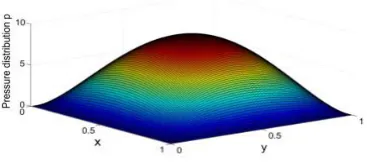
Figure 2a: Variation of pressure distribution p for 𝜏𝜏= 15 ,𝑀𝑀= 2 and 𝛼𝛼= 1.0.
Figure 2c: Variation of pressure distribution p for 𝜏𝜏= 15 ,𝑀𝑀= 6 and 𝛼𝛼= 1.0.
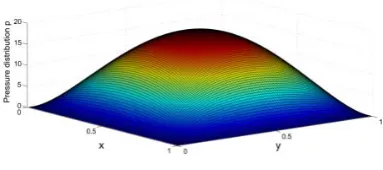
Figure 2d: Variation of pressure distribution p for 𝑀𝑀= 2,𝜏𝜏= 5 and 𝛼𝛼= 1.0.
Figure 2e: Variation of pressure distribution p for 𝑀𝑀= 2,𝜏𝜏= 10 and 𝛼𝛼= 1.0.
Figure 2f: Variation of pressure distribution p for 𝑀𝑀= 2, 𝜏𝜏 → ∞ and 𝛼𝛼= 1.0.
The effect of couple stress fluid with the variation of pressure distribution p with rectangular co-ordinates x and y are depicted in figures (2d-2f), i.e. for different values of couple-stress parameter 𝝉𝝉keeping other parameters constant. It is noticed that, for smaller values of couple- stress parameter, the built up pressure in fluid film region is higher than that of larger one. The built up pressure increases as an effect of couple stress. As 𝝉𝝉increases its value, the pressure rise starts to decreases in which the fluid loses its non-Newtonian characteristics. At large value of 𝝉𝝉the fluid becomes Newtonian at (𝜏𝜏=∞) and hence there is no variation of pressure rise.
Non-dimensional load carrying capacity: Load carrying capacity is one of salient feature of hydrodynamic characteristics. This can be obtained once the fluid film pressure is calculated. The load carrying capacity W of the bearing surface per unit area in a non-dimensional form is
( )
x
y
dxdy
p
W
=
∫∫
1
0 1
0
,
.Figure 3: Variation of non-dimensional load carrying capacity W as a function of aspect ratio 𝛼𝛼 for different values couple-stress parameter 𝜏𝜏.
Figure 3 shows that the load capacity W as a function of aspect ratio 𝛼𝛼 for different values couple stress parameters 𝝉𝝉 keeping other parameters constant. Couple–stress fluid increases the load capacity compared to the corresponding Newtonian case. The effect of couple stress fluid is to increase the pressure rise in the fluid film region and therefore load carrying capacity also increases. As 𝜏𝜏 → ∞, load carrying capacity also decreases. However, as the aspect ration
𝛼𝛼 increases from 0.1 to 10, the load carrying capacity increases and this trend is observed for all values of 𝝉𝝉 .
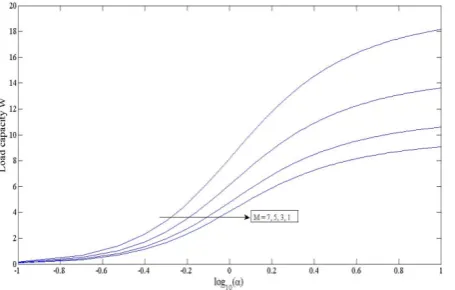
Figure 4: Variation of non-dimensional load carrying capacity W as a function of aspect ratio 𝛼𝛼 for different values of Hartmann number M.
Figure 4 represents the load capacity W as a function of aspect ratio 𝛼𝛼 for different values of Hartmann number M
keeping other parameters constant. As the Hartmann number increases the load carrying capacity also increases. Hence application of uniform transverse magnetic field enhances the non-dimensional load carrying capacity W. However, as the aspect ration 𝛼𝛼 increases from 0.1 to 10, the load carrying capacity increases for increasing Hartmann number.
CONCLUSIONS
Our investigations revealed that:
1. The bearing characteristics like pressure distribution and load carrying capacity increases for increasing Hartmann number (M).
2. The effect of couple stress (𝜏𝜏) is to increase the built up pressure in the film region. 3. Also, the load carrying capacity increases as the aspect ratio (
λ
) increases.It is expected that these results help the Mechanical engineers to choose the suitable parameters for given magnetic field to enhance the life of the bearings.
ACKNOWLEDGEMENT
The authors of this paper would like to thank the Management and Principals of J.S.S. Academy of Technical Education, M.S. Ramaiaha Institute of Technology, Bangalore, for their co- operation and encouragement in carrying out this work.
REFERENCES
1. Anwar M. I. and Rodkiewicz C. M. Non uniform magnetic field effects in MHD slider bearing, Jl. of Lubri. Techn., 94, (1972), 101.
2. Bujurke N. M. and Ramesh B. Kudenatti, MHD lubrication flow between rough rectangular plates,Fluid. Dyn. Res., D, vol. 9, (2007), 334.
3. Bujurke N. M. and Naduvinamani N. B, The lubrication of lightly loaded cylinders in combined rolling, sliding and normal motion with couple stress fluid, Int. Jl. of Mech. Sci., 32, 12, (1990), 969.
4. Das N. C., Study of optimum load capacity of slider bearings lubricated with power law fluids, Trib. Intl., 32, (1999), 435.
5. Hamza E. A., Magnetohydrodynamic effects on a fluid film squeezed between two rotating surfaces, Jl. of Phys.,
D, 24, (1991), 547.
6. Kamiyama S., Magnetohydrodynamic journal bearing (report1), Jl. of Lubr. Techn., 91, (1969), 380.
7. Lin J. R., Magneto-hydrodynamic squeeze film characteristics for finite rectangular plates, Indl. Lubr. Trib., 55, (2003), 84.
8. Lin J. R., Static characterstics of rotor bearing system lubricated with couple stress fluids, Comp. and Stru.,62(1), (1997), 175.
9. Lin J. R., The effects on couple stress in the squeeze film characteristics between a cylinder and a plane surface, Jl. of Mar. Sci. and Tech.,12, (2004), 119.
10. Lin J. R., Combined effects of non-Newtonian couple stress and fluid inertia on the squeeze film characteristics between a long cylinder and an infinite plate, Fluid. Dyn. Res., 39, (2007), N (8).
11. Malik M. and Singh D.V., Analysis of finite magnetohydrodynamic journal bearings, Wear, 64, (1980), 273. 12. Naduvinamani N. B and Santosh S., Micropolar fluid film lubrication of finite porous journal bearing, Trib. Intl.,
44, (2011), 409.
13. Naduvinamani N. B and Patil S. B., Numerical solution of finite modified Reynolds equation for couple stress squeeze film lubrication of porous journal bearings, Comp. and Struc., 87, (2009), 1287.
14. Ramesh B. Kudenatii., Muralidhara N. and Patil H.P, Numerical solution of the MHD Reynolds equation for Squeeze film lubrication between porous and rough rectangular plates, ISRN Tribology, 2013, (2013).
15. Shukla J. B., Hydromagnetic theory for squeeze films, Jl. of Basic Engg., 87, (1965), 142. 16. Stokes V. K., Couple stresses in fluids, Phy. of Fluids., 9, (1966),1709.