Mikhail Zymbler
South Ural State University, Chelyabinsk, Russian Federation
Parallel Algorithm for Frequent
Itemset Mining on Intel Many-core
Systems
This paper is an extended version of the paper [23], which was recommended for publication in CIT. Journal of Computing and Information Technology by the MiproBIS'2017 Conference Program Committee (within the Inter-national Convention MIPRO 2017), as the best paper of the conference.
Frequent itemset mining leads to the discovery of as-sociations and correlations among items in large trans-actional databases. Apriori is a classical frequent item-set mining algorithm, which employs iterative passes over database combining with generation of candidate itemsets based on frequent itemsets found at the pre-vious iteration, and pruning of clearly infrequent item-sets. The Dynamic Itemset Counting (DIC) algorithm is a variation of Apriori, which tries to reduce the num-ber of passes made over a transactional database while keeping the number of itemsets counted in a pass rel-atively low. In this paper, we address the problem of accelerating DIC on the Intel Xeon Phi many-core system for the case when the transactional database fits in main memory. Intel Xeon Phi provides a large number of small compute cores with vector processing units. The paper presents a parallel implementation of DIC based on OpenMP technology and thread-level parallelism. We exploit the bit-based internal layout for transactions and itemsets. This technique reduces the memory space for storing the transactional data-base, simplifies the support count via logical bitwise operation, and allows for vectorization of such a step. Experimental evaluation on the platforms of the Intel Xeon CPU and the Intel Xeon Phi coprocessor with large synthetic and real databases showed good perfor-mance and scalability of the proposed algorithm. ACM CCS (2012) Classification: Computing method-ologies → Parallel computing methodologies → Par-allel algorithms → Shared memory algorithms Information systems → Information systems applica-tions → Data mining → Association rules
Keywords: data mining, dynamic itemset counting, parallel algorithm, bitmap, OpenMP, many-core, Intel Xeon Phi
1. Introduction
Association rule mining is one of the import-ant problems in data mining [1]. The task is to discover strong associations among the items from a transactional database such that the oc-currence of one item in a transaction implies the occurrence of another. Association rule mining is divided into two subtasks [1]. The first one is to find all frequent itemsets that consist of items which often occur together in transactions. The second one is to generate all the association rules from the frequent itemsets found.
In this paper, we address the task of frequent itemset mining, which can be formally described as follows. Let J = (i1, …, im) be a set of literals, called items. Let D = (T1, …, Tn) be a database
of transactions, where each transactionTi ⊆J
consists of a set of items (itemset). An itemset that contains k items is called a k-itemset. The
support of an itemset I ⊆ J denotes the fraction of transactions in D that contain the itemset I. If the support of an itemset I ⊆ J satisfies the us-er-specified minimum support threshold called
minsup, then I is frequent itemset. Let the set of all frequent max k-itemsets be denoted by Lk and
1
k k k== k =
L L denotes a set of all frequent
item-sets, where kmax is the number of items in the longest frequent itemset. Given the transaction-al database D and minimum support threshold
There is a wide spectrum of algorithms for fre-quent itemset mining, and none of them outper-forms all others for all possible transactional databases and values of minsup threshold [9].
Apriori [1] is one of the most popular itemset mining algorithms, for which many refinements and parallel implementations for various plat-forms were proposed. Dynamic Itemset Count-ing (DIC) [3] is a variation of Apriori, which tries to reduce the number of passes made over a transactional database while keeping the num-ber of itemsets counted in a pass relatively low. Despite the fact that DIC has good potential of parallelization [3], it still has not been imple-mented for modern Intel many-core systems, to the best of our knowledge.
In this paper, we address the problem of accel-erating the DIC algorithm on the Intel Xeon Phi many-core system. Intel Xeon Phi [21] provides a large number of small compute cores with a high local memory bandwidth. Each core sup-ports a computational power weaker than that of the Intel Xeon core and provides 512 bit wide vector processing unit (VPU). VPU sup-ports data-level parallelism by a set of vector instructions, thanks to which it is possible to load and calculate several numbers at once (e.g. eight 64 bit integers or sixteen 16 bit floats). Such a routine is called vectorization, and Intel compilers provide options for automatic vector-ization. Since Intel Xeon Phi is based on Intel x86 architecture, it supports the same program-ming tools as a regular Intel Xeon CPU. Thus, Intel Xeon Phi can be considered as an attrac-tive hardware platform for the thread-level par-allel algorithm.
The basic contribution of the paper is as fol-lows. We propose a parallel implementation of the DIC algorithm for the Intel Xeon Phi ma-ny-core system. We exploit a bit-based internal layout for transactions and itemsets assuming that such a representation of a transactional database fits in main memory. This technique reduces memory space of storing the transac-tional database and simplifies the support count and generation of potentially frequent candi-date itemsets via logical bitwise operations. The algorithm is parallelized using OpenMP technology and thread-level parallelism. We conduct experiments on large synthetic and real databases to evaluate the performance and scal-ability of our algorithm.
The rest of the paper is organized as follows. In Section 2, related work is discussed. Section
3 provides a brief description of the original DIC algorithm. The proposed parallel algo-rithm is presented in Section 4. The results of experimental evaluation of the algorithm are described in Section 5. Finally, Section 6 con-cludes the paper.
2. Related Work
The original DIC algorithm was presented by Brin et al. in [3], where the authors briefly dis-cuss a way to parallelize DIC using the distri-bution of the transactional database among the nodes so that each node counts all itemsets for its own data segment.
Paranjape-Voditel et al. proposed DIC-OPT [16], a parallel version of DIC for distribut-ed memory systems. The key idea is that each node sends messages with the counts of poten-tially frequent itemsets to other nodes after ev-ery block of M transactions has been read. This initiates the early counting of the itemsets on other nodes without waiting for synchroniza-tion with other nodes. The authors carried out experiments on up to 12 nodes where their im-plementation showed sublinear speedup.
Cheung et al. suggested APM [5], a DIC-based parallel algorithm for SMP systems. APM is an adaptive parallel mining algorithm, where all CPUs generate candidates dynamically and count itemset supports independently without synchronization. The transactional database is partitioned across CPUs with highly homoge-neous itemset distributions. This technique ad-dresses the problem of a large number of candi-dates because of the low homogeneous itemset distribution in most cases. The experiments on the Sun Enterprise 4000 server with up to 12 nodes showed that APM outperforms Aprio-ri-like parallel algorithms. However, the APM speedup gradually drops down to 4 when the number of nodes is greater than four. This is be-cause APM suffers from the SMP system inher-ent problem of I/O continher-ention when the number of nodes is large.
Schlegel et al. proposed mcEclat [19], a paral-lel version of Eclat [22] for the Intel Xeon Phi coprocessor. mcEclat converts a dataset being mined into a set of tid bitmaps, which are re-peatedly intersected to obtain the frequent item-sets. Tid bitmap maps the IDs of transactions, in which an itemset exists, to bits in a bitmap
that any infrequent (k – 1)-itemset cannot be a subset of a frequent k-itemset. Apriori counts support of candidates which have not been pruned, and proceeds with such passes until there are no more candidates after pruning. The DIC algorithm tries to reduce the number of passes made over the transactional database while keeping the number of itemsets counted in a pass relatively low. Algorithm 1 depicts pseudo-code of DIC. The algorithm processes the database with stops at equal-length intervals between transactions specified by the M param-eter of the algorithm. At the end of the transac-tional database, it is necessary to rewind to its beginning.
DIC maintains four sets of itemsets, namely
Dashed Circle, Dashed Box, Solid Circle and
Solid Box. Itemsets in the "dashed" sets are sub-at certain positions. Tid bitmaps are intersected
via logical bitwise AND operation and then the support of an itemset is obtained by counting the bits set to one in its respective tid bitmap. Experiments showed up to 100 times speedup of mcEclat on Intel Xeon Phi. However, the algorithm performance on the Intel Xeon Phi coprocessor is similar or slightly worse (for smaller values of minsup) than on the system with two Intel Xeon CPUs when the maximum number of threads is employed on both sys-tems. The reason is that mcEclat does not fully exploit the vector processing capabilities of In-tel Xeon Phi.
Kumar et al. presented Bitwise DIC [12], a seri-al version of the DIC seri-algorithm based upon tid bitmap technique mentioned above. Authors re-port that Bitwise DIC outruns the original DIC on datasets with up to 5,000 transactions for the fixed minsup value.
In serial algorithms, MAFIA [4] and BitTable-FI [7], Burdick et al. and Dong et al., respec-tively, employed vertical bitmap to compress the transactional database for quick candidate itemsets generation and the support count. Ver-tical bitmap is a set of integers in which every bit represents an item. If an item i appears in the
j-th transaction, then the j-th bit of the bitmap for the item i is set to one; otherwise, the bit is set to zero. This idea is applied to both trans-actions and itemsets. In the case when itemsets appear in a significant number of transactions, the vertical bitmap is the smallest representa-tion of the informarepresenta-tion. However, the weakness of a vertical representation is the sparseness of the bitmaps, especially at the lower support lev-els.
3. Serial DIC Algorithm
Dynamic Itemset Counting (DIC) [3] is a vari-ation of the best known Apriori algorithm [1]. Apriori is an iterative, level-wise algorithm, which uses a bottom-up search. At the first pass over transactional database, it processes 1-itemsets and finds L1 set. A subsequent pass k
consists of two steps, namely candidate gener-ation and pruning. At the candidate generation
step, Apriori combines elements of L(k – 1) set to form potentially frequent candidatek-itemsets. At the pruning step, it discards infrequent can-didates using the a priori principle which states
Algorithm 1. Serial DIC algorithm.
Input:D, minsup, M Output:L
Initialize sets of itemsets
SolidBox ← ∅; SolidCirCle ← ∅; daShedBox← ∅
daShedCirCle← J
whiledaShedCirCle daShedBox≠∅ do
Scan database and rewind if necessary Read (D, M, Chunk)
if EOF (D) then Rewind (D) for allT∈Chunkdo
Count support of itemsets for allI∈daShedCirCle daShedBoxdo
ifI⊆Tthen
support(I) ← support(I) + 1
Generate candidate itemsets for allI∈daShedCirCledo
ifsupport(I) ≥ minsupthen daShedBox← daShedBox I
for alli∈Jdo C ← I i
if∀s⊆C, sÎSolidBox daShedBoxthen
daShedCirCle← daShedCirCle C
Check full pass completion for allI∈daShedCirCle daShedBoxdo
if IsPassCompleted(I) then switch Shape(I)
"dashed": daShedBox← daShedBox I
"solid": SolidBox← SolidBox I L ← SolidBox
There is a wide spectrum of algorithms for fre-quent itemset mining, and none of them outper-forms all others for all possible transactional databases and values of minsup threshold [9].
Apriori [1] is one of the most popular itemset mining algorithms, for which many refinements and parallel implementations for various plat-forms were proposed. Dynamic Itemset Count-ing (DIC) [3] is a variation of Apriori, which tries to reduce the number of passes made over a transactional database while keeping the num-ber of itemsets counted in a pass relatively low. Despite the fact that DIC has good potential of parallelization [3], it still has not been imple-mented for modern Intel many-core systems, to the best of our knowledge.
In this paper, we address the problem of accel-erating the DIC algorithm on the Intel Xeon Phi many-core system. Intel Xeon Phi [21] provides a large number of small compute cores with a high local memory bandwidth. Each core sup-ports a computational power weaker than that of the Intel Xeon core and provides 512 bit wide vector processing unit (VPU). VPU sup-ports data-level parallelism by a set of vector instructions, thanks to which it is possible to load and calculate several numbers at once (e.g. eight 64 bit integers or sixteen 16 bit floats). Such a routine is called vectorization, and Intel compilers provide options for automatic vector-ization. Since Intel Xeon Phi is based on Intel x86 architecture, it supports the same program-ming tools as a regular Intel Xeon CPU. Thus, Intel Xeon Phi can be considered as an attrac-tive hardware platform for the thread-level par-allel algorithm.
The basic contribution of the paper is as fol-lows. We propose a parallel implementation of the DIC algorithm for the Intel Xeon Phi ma-ny-core system. We exploit a bit-based internal layout for transactions and itemsets assuming that such a representation of a transactional database fits in main memory. This technique reduces memory space of storing the transac-tional database and simplifies the support count and generation of potentially frequent candi-date itemsets via logical bitwise operations. The algorithm is parallelized using OpenMP technology and thread-level parallelism. We conduct experiments on large synthetic and real databases to evaluate the performance and scal-ability of our algorithm.
The rest of the paper is organized as follows. In Section 2, related work is discussed. Section
3 provides a brief description of the original DIC algorithm. The proposed parallel algo-rithm is presented in Section 4. The results of experimental evaluation of the algorithm are described in Section 5. Finally, Section 6 con-cludes the paper.
2. Related Work
The original DIC algorithm was presented by Brin et al. in [3], where the authors briefly dis-cuss a way to parallelize DIC using the distri-bution of the transactional database among the nodes so that each node counts all itemsets for its own data segment.
Paranjape-Voditel et al. proposed DIC-OPT [16], a parallel version of DIC for distribut-ed memory systems. The key idea is that each node sends messages with the counts of poten-tially frequent itemsets to other nodes after ev-ery block of M transactions has been read. This initiates the early counting of the itemsets on other nodes without waiting for synchroniza-tion with other nodes. The authors carried out experiments on up to 12 nodes where their im-plementation showed sublinear speedup.
Cheung et al. suggested APM [5], a DIC-based parallel algorithm for SMP systems. APM is an adaptive parallel mining algorithm, where all CPUs generate candidates dynamically and count itemset supports independently without synchronization. The transactional database is partitioned across CPUs with highly homoge-neous itemset distributions. This technique ad-dresses the problem of a large number of candi-dates because of the low homogeneous itemset distribution in most cases. The experiments on the Sun Enterprise 4000 server with up to 12 nodes showed that APM outperforms Aprio-ri-like parallel algorithms. However, the APM speedup gradually drops down to 4 when the number of nodes is greater than four. This is be-cause APM suffers from the SMP system inher-ent problem of I/O continher-ention when the number of nodes is large.
Schlegel et al. proposed mcEclat [19], a paral-lel version of Eclat [22] for the Intel Xeon Phi coprocessor. mcEclat converts a dataset being mined into a set of tid bitmaps, which are re-peatedly intersected to obtain the frequent item-sets. Tid bitmap maps the IDs of transactions, in which an itemset exists, to bits in a bitmap
that any infrequent (k – 1)-itemset cannot be a subset of a frequent k-itemset. Apriori counts support of candidates which have not been pruned, and proceeds with such passes until there are no more candidates after pruning. The DIC algorithm tries to reduce the number of passes made over the transactional database while keeping the number of itemsets counted in a pass relatively low. Algorithm 1 depicts pseudo-code of DIC. The algorithm processes the database with stops at equal-length intervals between transactions specified by the M param-eter of the algorithm. At the end of the transac-tional database, it is necessary to rewind to its beginning.
DIC maintains four sets of itemsets, namely
Dashed Circle, Dashed Box, Solid Circle and
Solid Box. Itemsets in the "dashed" sets are sub-at certain positions. Tid bitmaps are intersected
via logical bitwise AND operation and then the support of an itemset is obtained by counting the bits set to one in its respective tid bitmap. Experiments showed up to 100 times speedup of mcEclat on Intel Xeon Phi. However, the algorithm performance on the Intel Xeon Phi coprocessor is similar or slightly worse (for smaller values of minsup) than on the system with two Intel Xeon CPUs when the maximum number of threads is employed on both sys-tems. The reason is that mcEclat does not fully exploit the vector processing capabilities of In-tel Xeon Phi.
Kumar et al. presented Bitwise DIC [12], a seri-al version of the DIC seri-algorithm based upon tid bitmap technique mentioned above. Authors re-port that Bitwise DIC outruns the original DIC on datasets with up to 5,000 transactions for the fixed minsup value.
In serial algorithms, MAFIA [4] and BitTable-FI [7], Burdick et al. and Dong et al., respec-tively, employed vertical bitmap to compress the transactional database for quick candidate itemsets generation and the support count. Ver-tical bitmap is a set of integers in which every bit represents an item. If an item i appears in the
j-th transaction, then the j-th bit of the bitmap for the item i is set to one; otherwise, the bit is set to zero. This idea is applied to both trans-actions and itemsets. In the case when itemsets appear in a significant number of transactions, the vertical bitmap is the smallest representa-tion of the informarepresenta-tion. However, the weakness of a vertical representation is the sparseness of the bitmaps, especially at the lower support lev-els.
3. Serial DIC Algorithm
Dynamic Itemset Counting (DIC) [3] is a vari-ation of the best known Apriori algorithm [1]. Apriori is an iterative, level-wise algorithm, which uses a bottom-up search. At the first pass over transactional database, it processes 1-itemsets and finds L1 set. A subsequent pass k
consists of two steps, namely candidate gener-ation and pruning. At the candidate generation
step, Apriori combines elements of L(k – 1) set to form potentially frequent candidatek-itemsets. At the pruning step, it discards infrequent can-didates using the a priori principle which states
Algorithm 1. Serial DIC algorithm.
Input:D, minsup, M Output:L
Initialize sets of itemsets
SolidBox ← ∅; SolidCirCle ← ∅; daShedBox← ∅
daShedCirCle← J
whiledaShedCirCle daShedBox≠∅ do
Scan database and rewind if necessary Read (D, M, Chunk)
if EOF (D) then Rewind (D) for allT∈Chunkdo
Count support of itemsets for allI∈daShedCirCle daShedBoxdo
ifI⊆Tthen
support(I) ← support(I) + 1
Generate candidate itemsets for allI∈daShedCirCledo
ifsupport(I) ≥ minsupthen daShedBox← daShedBox I
for alli∈Jdo C ← I i
if∀s⊆C, sÎSolidBox daShedBoxthen
daShedCirCle← daShedCirCle C
Check full pass completion for allI∈daShedCirCle daShedBoxdo
if IsPassCompleted(I) then switch Shape(I)
"dashed": daShedBox← daShedBox I
"solid": SolidBox← SolidBox I L ← SolidBox
jects for the support count while itemsets in the "solid" sets do not need to be counted. "Circles" contain infrequent itemsets while "boxes" con-tain frequent itemsets. Thus, Dashed Circle and
Dashed Box contain itemsets that are suspected infrequent and suspected frequent, respective-ly, while Solid Circle and Solid Box contain itemsets that are confirmed infrequent and con-firmed frequent, respectively. Figure 1 depicts life cycle of an itemset in the DIC algorithm. At start, Dashed Box, Solid Circle, and Solid Box are assumed empty, and Dashed Circle
contains all 1-itemsets. Before the stop, DIC counts support of itemsets from "dashed" sets for each transaction. At any stop, DIC per-forms as follows. Itemsets whose support ex-ceeds minsup are moved from Dashed Circle
to Dashed Box. New itemsets are added into
Dashed Circle, they are immediate supersets of those itemsets from Dashed Box with all of its subsets from "box" sets. Itemsets that have completed one full pass over the transactional database are moved from the "dashed" set to "solid" set. DIC proceeds as long as itemsets remain in the "dashed" sets.
4. Parallel DIC Algorithm
4.1. Internal Data Layout
In this paper, we propose the direct bit repre-sentation for both transactions and itemsets. This means that the transaction T ⊆ D (an item-set I ⊆ J, respectively) is represented by a word where each p-th bit is set to one if an item ipÎ
T(ip ÎI, respectively) and all other bits are set to zero. The word length W in bytes depends on the system environment and is calculated as
(
)
.sizeof bytem
W =
In our implementation, we use C++ and un-signed long long int data type, so we have W
= 8 and m = 64. Let us denote by BitMask a function that returns direct bit representation of a given itemset or transaction as a word, i.e. Bit-Mask: J → Z+. Then, the direct bit representa-tion of transacrepresenta-tional database D is an n-element array B where Bj = BitMask (Tj) ∀jÎ 1, ..., n. The direct bit representation has several major merits. It often requires less space than byte-based representation for dense transactional database with long transactions. In fact, B re-quires n · W bytes to store and allows B to fit in main memory. For instance, netflix, one of the most referenced datasets, contains n = 17,771 transactions consisting of m = 480,189 distinct items. Hence, the direct bit representation of the netflix dataset takes about 1 Gb. Thus, we further assume that B is preliminary produced from D and available in main memory.
Additionally, the direct bit representation sim-plifies support counting and vectorization of this operation. The fact that an itemset I exists in a transaction T (i.e. I ⊆ T) can be checked by one logical bitwise operation, that is BitMask(I) AND BitMask(T) = BitMask(I). Such an imple-mentation allows for auto-vectorization of the support count loop by the compiler.
Thereby, we implement an itemset as a record structure with the following basic fields, name-ly mask to provide direct bit representation, k as number of items in the itemset, stop as count-er to detcount-ermine when full pass for the given itemset is completed, and supp to store support count.
To implement a set of itemsets, we use a vector which represents an array of elements belong-ing to the same type and provides random ac-cess to its elements with the ability to automat-ically resize when appending elements. Such a data structure is implemented in C++ Standard Template Library as a class with iterator and methods for inserting an element and remov-ing an element with complexity of O(1) and
O(s) respectively, where s is the current size of a vector.
In order to reduce costs of moving elements across vectors, we establish a DASHED vector for "dashed box" and "dashed circle" itemsets and a SOLID vector for "solid box" and "solid circle" itemsets, and provide the itemset record structure with the shape field to indicate an ap-propriate set the given itemset belongs to.
4.2. Parallelization of the Algorithm
The proposed parallel version of DIC algorithm (hereinafter Parallel DIC) is presented in Algo-rithm 2, and basic sub-algoAlgo-rithms are depicted in Algorithm 3, Algorithm 4, and Algorithm 5.
We enhance the classical DIC algorithm by adding two more stages, namely FirstPass and
Prune where each of them is aimed at reduc-ing the number of itemsets to perform support counting.
We parallelize the following stages of the al-gorithm, namely the support count (cf. Algo-rithm 3), pruning of the Dashed Circle set (cf. Algorithm 4) and check of full pass completion
Figure 1. Life cycle of an itemset in the DIC algorithm.
Algorithm 2. Parallel DIC algorithm.
Input:B, minsup, M, num_of_threads Output:L
Initialize sets of itemsets Solid.init(); daShedBox.init()
for alliÎ 0... m – 1do
I.shape ← NIL; SetBit(I.mask, i) I.stop ← 0; I.supp ← 0; I.k ← 1 Solid.push_back(I)
k ← 1; stop ← 0; stopmax ← Mn
FirStPaSS(Solid, daShed)
while notdaShed.empty()do
Scan database and rewind if necessary stop ← stop + 1
ifstop > stopmaxthen stop ← 1
first ← (stop – 1) · M; last ← stop · M – 1 k ← k + 1
CountSuPPort(daShed, num_of_threads)
Prune(daShed, minsup)
MakeCandidateS(daShed)
CheCkFullPaSS(daShed, minsup) L ← {i | i ∈Solid∧I.shape = Box}
(a) Count all the "dashed" itemsets for each transaction: data races among threads are possible.
Figure 2. Support count in the Parallel DIC algorithm. (b) Count all the transactions for each "dashed" itemset:
jects for the support count while itemsets in the "solid" sets do not need to be counted. "Circles" contain infrequent itemsets while "boxes" con-tain frequent itemsets. Thus, Dashed Circle and
Dashed Box contain itemsets that are suspected infrequent and suspected frequent, respective-ly, while Solid Circle and Solid Box contain itemsets that are confirmed infrequent and con-firmed frequent, respectively. Figure 1 depicts life cycle of an itemset in the DIC algorithm. At start, Dashed Box, Solid Circle, and Solid Box are assumed empty, and Dashed Circle
contains all 1-itemsets. Before the stop, DIC counts support of itemsets from "dashed" sets for each transaction. At any stop, DIC per-forms as follows. Itemsets whose support ex-ceeds minsup are moved from Dashed Circle
to Dashed Box. New itemsets are added into
Dashed Circle, they are immediate supersets of those itemsets from Dashed Box with all of its subsets from "box" sets. Itemsets that have completed one full pass over the transactional database are moved from the "dashed" set to "solid" set. DIC proceeds as long as itemsets remain in the "dashed" sets.
4. Parallel DIC Algorithm
4.1. Internal Data Layout
In this paper, we propose the direct bit repre-sentation for both transactions and itemsets. This means that the transaction T ⊆ D (an item-set I ⊆ J, respectively) is represented by a word where each p-th bit is set to one if an item ipÎ
T(ip ÎI, respectively) and all other bits are set to zero. The word length W in bytes depends on the system environment and is calculated as
(
)
.sizeof bytem
W =
In our implementation, we use C++ and un-signed long long int data type, so we have W
= 8 and m = 64. Let us denote by BitMask a function that returns direct bit representation of a given itemset or transaction as a word, i.e. Bit-Mask: J → Z+. Then, the direct bit representa-tion of transacrepresenta-tional database D is an n-element array B where Bj = BitMask (Tj) ∀jÎ 1, ..., n. The direct bit representation has several major merits. It often requires less space than byte-based representation for dense transactional database with long transactions. In fact, B re-quires n · W bytes to store and allows B to fit in main memory. For instance, netflix, one of the most referenced datasets, contains n = 17,771 transactions consisting of m = 480,189 distinct items. Hence, the direct bit representation of the netflix dataset takes about 1 Gb. Thus, we further assume that B is preliminary produced from D and available in main memory.
Additionally, the direct bit representation sim-plifies support counting and vectorization of this operation. The fact that an itemset I exists in a transaction T (i.e. I ⊆ T) can be checked by one logical bitwise operation, that is BitMask(I) AND BitMask(T) = BitMask(I). Such an imple-mentation allows for auto-vectorization of the support count loop by the compiler.
Thereby, we implement an itemset as a record structure with the following basic fields, name-ly mask to provide direct bit representation, k as number of items in the itemset, stop as count-er to detcount-ermine when full pass for the given itemset is completed, and supp to store support count.
To implement a set of itemsets, we use a vector which represents an array of elements belong-ing to the same type and provides random ac-cess to its elements with the ability to automat-ically resize when appending elements. Such a data structure is implemented in C++ Standard Template Library as a class with iterator and methods for inserting an element and remov-ing an element with complexity of O(1) and
O(s) respectively, where s is the current size of a vector.
In order to reduce costs of moving elements across vectors, we establish a DASHED vector for "dashed box" and "dashed circle" itemsets and a SOLID vector for "solid box" and "solid circle" itemsets, and provide the itemset record structure with the shape field to indicate an ap-propriate set the given itemset belongs to.
4.2. Parallelization of the Algorithm
The proposed parallel version of DIC algorithm (hereinafter Parallel DIC) is presented in Algo-rithm 2, and basic sub-algoAlgo-rithms are depicted in Algorithm 3, Algorithm 4, and Algorithm 5.
We enhance the classical DIC algorithm by adding two more stages, namely FirstPass and
Prune where each of them is aimed at reduc-ing the number of itemsets to perform support counting.
We parallelize the following stages of the al-gorithm, namely the support count (cf. Algo-rithm 3), pruning of the Dashed Circle set (cf. Algorithm 4) and check of full pass completion
Figure 1. Life cycle of an itemset in the DIC algorithm.
Algorithm 2. Parallel DIC algorithm.
Input:B, minsup, M, num_of_threads Output:L
Initialize sets of itemsets Solid.init(); daShedBox.init()
for alliÎ 0... m – 1do
I.shape ← NIL; SetBit(I.mask, i) I.stop ← 0; I.supp ← 0; I.k ← 1 Solid.push_back(I)
k ← 1; stop ← 0; stopmax ← Mn
FirStPaSS(Solid, daShed)
while notdaShed.empty()do
Scan database and rewind if necessary stop ← stop + 1
ifstop > stopmaxthen stop ← 1
first ← (stop – 1) · M; last ← stop · M – 1 k ← k + 1
CountSuPPort(daShed, num_of_threads)
Prune(daShed, minsup)
MakeCandidateS(daShed)
CheCkFullPaSS(daShed, minsup) L ← {i | i ∈Solid∧I.shape = Box}
(a) Count all the "dashed" itemsets for each transaction: data races among threads are possible.
Figure 2. Support count in the Parallel DIC algorithm. (b) Count all the transactions for each "dashed" itemset:
for itemsets (cf. Algorithm 5) through OpenMP technology and thread-level parallelism.
In the classical DIC (cf. Algorithm 1), the
Dashed Circle set is initialized by all 1 item-sets. In contrast, we use the technique of full first pass [5]. This means that we initially per-form one full pass over D to find L1, the set of frequent 1-itemsets (this done similarly to Al-gorithm 3).
Then candidate 2-itemsets are computed from
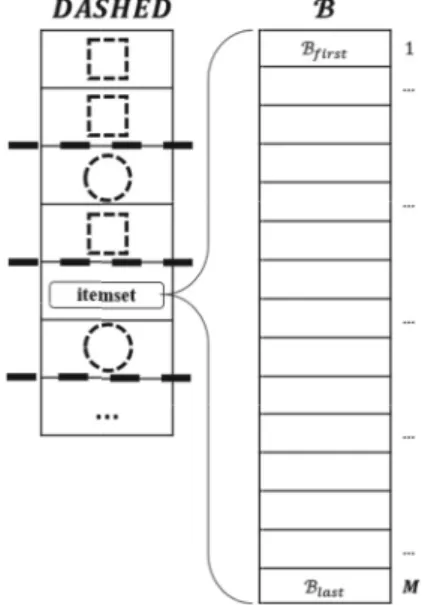
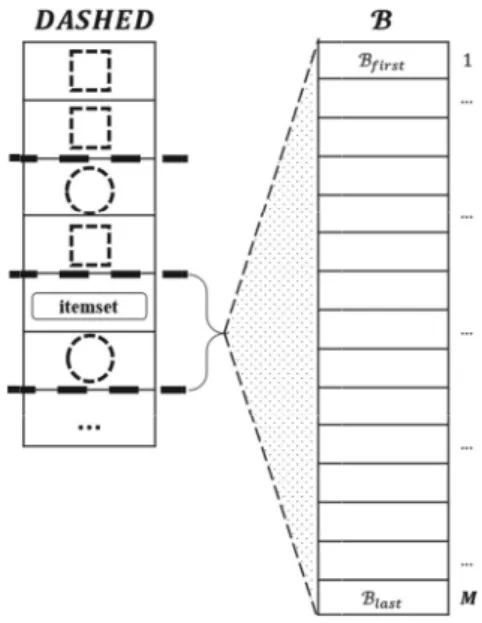
L1 through the Apriori join procedure [1]. This is done via logical bitwise OR operation on each pair of frequent 1-itemsets, and candidates are inserted in the Dashed Circle set. This tech-nique helps to reduce cardinality of the Dashed Circle set in further computations because in-frequent 1 itemsets and their supersets have been pruned according to the a priori principle. The original algorithm performs support count-ing by two nested loops where the outer loop takes transactions and the inner loop takes the "dashed" itemsets. As opposed to DIC, we change the order of these loops (cf. Figure 2). This shuffle allows avoiding data races when threads process different transactions and need to change the support count of the same item-sets simultaneously.
Then, we parallelize the outer loop through omp parallel for pragma (cf. Algorithm 3). Additionally, our algorithm balances the load of threads depending on the current total number of elements in both Dashed Circle and Dashed Box sets (cf. Figure 3).
If the number of available threads does not ex-ceed the current total number of "dashed"
sets, we parallelize the outer loop (along item-sets) using all threads. Otherwise, we enable nested parallelism and parallelize the outer loop using a number of threads equal to the current total number of "dashed" itemsets. Then we parallelize the inner loop (along transactions) so that each outer thread forks an equal-sized set of descendant threads where descendants perform counting by reducing the summing operation. This balancing technique allows for processing data effectively in the final stage of counting when the number of candidate item-sets tends to zero and increases the overall per-formance of the algorithm.
After the support count, in addition to moving appropriate itemsets from Dashed Circle set to
Dashed Box set as in classical DIC, we reduce the Dashed Circle set pruning clearly infre-quent itemsets as follows [12]. We compute an itemset highest possible support by adding its current support to the number of transactions which have not been processed yet (cf. Algo-rithm 4). If the value of the itemset highest pos-sible support is less than minsup threshold, then the itemset is pruned, and after that, we prune all its supersets according to the a priori prin-ciple.
After the reduction of the Dashed Circle set, we generate afresh itemsets to be inserted in the set performing Apriori join procedure [1] via the logical bitwise OR operation between all item-sets marked as "boxes".
Finally, for all itemsets in the Dashed Circle
set, we check if an itemset has been counted through all transactions, and if yes, we make the itemset "solid" and stop counting it. If the itemset support equals to or exceeds the minsup
threshold, then we mark it as "box" (cf. Algo-rithm 5). This activity is also parallelized along itemsets through omp parallel for pragma. In the end, SOLID vector contains "box" item-sets as an output of the algorithm.
5. Experiments
5.1. Experimental Setup
Hardware. The experiments were carried out on the node of the Tornado SUSU supercomput-er [11]. Such a node consists of a host, which is two 6 core Intel Xeon CPU, and a 61 core Intel Xeon Phi coprocessor. Table 1 depicts technical specifications of the hardware.
Table 1. Specifications of hardware.
Specifications Host Coprocessor Model, Intel Xeon X5680 Phi SE10X Number of physical cores 2 × 6 61
Hyper-threading factor 2 × 4 × Number of logical cores 24 244
Frequency, GHz 3.33 1.1
Peak performance, TFLOPS 0.371 1.076
Memory, Gb 24 8
Cache, Mb 12 30.5
Algorithm 3. Support count sub-algorithm.
Input:daShed, num_of_threads
Output:daShed
ifdaShed.size() ≥ num_of_threads then
#pragma omp parallel for for allIÎdaSheddo I.stop ← I.stop + 1 for all T ∈Bfirst ... Blastdo ifI.maskANDT = I.maskthen I.supp ← I.supp + 1
else
omp_set_nested(true)
#pragma omp parallel for num_threads(daShed.size()) for allIÎdaSheddo
I.stop ← I.stop + 1
#pragma omp parallel for reduction(+: I.supp) num_threads
ASHED
_ _
D . ()
num of threads size
for all T ∈Bfirst ... Blastdo ifI.maskANDT = I.maskthen I.supp ← I.supp + 1
(a) Number of threads is less than number of "dashed" itemsets: a thread takes its "dashed" itemsets to count.
Figure 3. Load balancing in the Parallel DIC algorithm. (b) Number of threads is greater than number of "dashed" itemsets: a thread takes one "dashed" itemset
and forks descendant threads to count.
Algorithm 4. Pruning sub-algorithm.
Input:daShed, num_of_threads
Output:daShed
#pragma omp parallel for num_threads(num_of_threads) for allIÎdaShedandI.shape = CirCledo
ifI.supp ≥ minsup then
Move appropriate itemsets to Dashed Box set I.shape ← Box
else
Prune clearly infrequent itemsets suppmax ← I.supp + M · (stopmax – I.stop) ifsuppmax < minsup then
I.shape ← nil
for allJÎdaShedandJ.shape = CirCledo
ifI.maskANDJ.mask = I.maskthen J.shape ← nil
daShed.erase ({I|I.shape = nil})
Algorithm 5. Check full pass sub-algorithm.
Input:daShed, num_of_threads
Output:daShed
#pragma omp parallel for num_threads(num_of_threads) for allIÎdaSheddo
ifI.stop = stopmaxthen ifI.supp ≥ minsup then
I.shape ← Box
Solid.push_back(I)
I.shape ← nil
for itemsets (cf. Algorithm 5) through OpenMP technology and thread-level parallelism.
In the classical DIC (cf. Algorithm 1), the
Dashed Circle set is initialized by all 1 item-sets. In contrast, we use the technique of full first pass [5]. This means that we initially per-form one full pass over D to find L1, the set of frequent 1-itemsets (this done similarly to Al-gorithm 3).
Then candidate 2-itemsets are computed from
L1 through the Apriori join procedure [1]. This is done via logical bitwise OR operation on each pair of frequent 1-itemsets, and candidates are inserted in the Dashed Circle set. This tech-nique helps to reduce cardinality of the Dashed Circle set in further computations because in-frequent 1 itemsets and their supersets have been pruned according to the a priori principle. The original algorithm performs support count-ing by two nested loops where the outer loop takes transactions and the inner loop takes the "dashed" itemsets. As opposed to DIC, we change the order of these loops (cf. Figure 2). This shuffle allows avoiding data races when threads process different transactions and need to change the support count of the same item-sets simultaneously.
Then, we parallelize the outer loop through omp parallel for pragma (cf. Algorithm 3). Additionally, our algorithm balances the load of threads depending on the current total number of elements in both Dashed Circle and Dashed Box sets (cf. Figure 3).
If the number of available threads does not ex-ceed the current total number of "dashed"
sets, we parallelize the outer loop (along item-sets) using all threads. Otherwise, we enable nested parallelism and parallelize the outer loop using a number of threads equal to the current total number of "dashed" itemsets. Then we parallelize the inner loop (along transactions) so that each outer thread forks an equal-sized set of descendant threads where descendants perform counting by reducing the summing operation. This balancing technique allows for processing data effectively in the final stage of counting when the number of candidate item-sets tends to zero and increases the overall per-formance of the algorithm.
After the support count, in addition to moving appropriate itemsets from Dashed Circle set to
Dashed Box set as in classical DIC, we reduce the Dashed Circle set pruning clearly infre-quent itemsets as follows [12]. We compute an itemset highest possible support by adding its current support to the number of transactions which have not been processed yet (cf. Algo-rithm 4). If the value of the itemset highest pos-sible support is less than minsup threshold, then the itemset is pruned, and after that, we prune all its supersets according to the a priori prin-ciple.
After the reduction of the Dashed Circle set, we generate afresh itemsets to be inserted in the set performing Apriori join procedure [1] via the logical bitwise OR operation between all item-sets marked as "boxes".
Finally, for all itemsets in the Dashed Circle
set, we check if an itemset has been counted through all transactions, and if yes, we make the itemset "solid" and stop counting it. If the itemset support equals to or exceeds the minsup
threshold, then we mark it as "box" (cf. Algo-rithm 5). This activity is also parallelized along itemsets through omp parallel for pragma. In the end, SOLID vector contains "box" item-sets as an output of the algorithm.
5. Experiments
5.1. Experimental Setup
Hardware. The experiments were carried out on the node of the Tornado SUSU supercomput-er [11]. Such a node consists of a host, which is two 6 core Intel Xeon CPU, and a 61 core Intel Xeon Phi coprocessor. Table 1 depicts technical specifications of the hardware.
Table 1. Specifications of hardware.
Specifications Host Coprocessor Model, Intel Xeon X5680 Phi SE10X Number of physical cores 2 × 6 61
Hyper-threading factor 2 × 4 × Number of logical cores 24 244
Frequency, GHz 3.33 1.1
Peak performance, TFLOPS 0.371 1.076
Memory, Gb 24 8
Cache, Mb 12 30.5
Algorithm 3. Support count sub-algorithm.
Input:daShed, num_of_threads
Output:daShed
ifdaShed.size() ≥ num_of_threads then
#pragma omp parallel for for allIÎdaSheddo I.stop ← I.stop + 1 for all T ∈Bfirst ... Blastdo ifI.maskANDT = I.maskthen I.supp ← I.supp + 1
else
omp_set_nested(true)
#pragma omp parallel for num_threads(daShed.size()) for allIÎdaSheddo
I.stop ← I.stop + 1
#pragma omp parallel for reduction(+: I.supp) num_threads
ASHED
_ _
D . ()
num of threads size
for all T ∈Bfirst ... Blastdo ifI.maskANDT = I.maskthen I.supp ← I.supp + 1
(a) Number of threads is less than number of "dashed" itemsets: a thread takes its "dashed" itemsets to count.
Figure 3. Load balancing in the Parallel DIC algorithm. (b) Number of threads is greater than number of "dashed" itemsets: a thread takes one "dashed" itemset
and forks descendant threads to count.
Algorithm 4. Pruning sub-algorithm.
Input:daShed, num_of_threads
Output:daShed
#pragma omp parallel for num_threads(num_of_threads) for allIÎdaShedandI.shape = CirCledo
ifI.supp ≥ minsup then
Move appropriate itemsets to Dashed Box set I.shape ← Box
else
Prune clearly infrequent itemsets suppmax ← I.supp + M · (stopmax – I.stop) ifsuppmax < minsup then
I.shape ← nil
for allJÎdaShedandJ.shape = CirCledo
ifI.maskANDJ.mask = I.maskthen J.shape ← nil
daShed.erase ({I|I.shape = nil})
Algorithm 5. Check full pass sub-algorithm.
Input:daShed, num_of_threads
Output:daShed
#pragma omp parallel for num_threads(num_of_threads) for allIÎdaSheddo
ifI.stop = stopmaxthen ifI.supp ≥ minsup then
I.shape ← Box
Solid.push_back(I)
I.shape ← nil
Measures. In the experiments, we evaluated the speedup and parallel efficiency of the de-veloped algorithm, where such characteristics of parallel-algorithm scalability are defined as follows. Speedup and parallel efficiency of a parallel algorithm employing k threads are cal-culated, respectively, as
( )
1k
t s k =t
and
( )
s k( )
,e k = k
where t1 and tk are the run times of the algo-rithm when one and k threads are employed, respectively.
Competitors. In the previous work [23], our experiments showed that the performance of serial implementation of DIC in [8] is substan-tially inferior to both our algorithm and serial Apriori in [2]. Thus, in this paper, we compared the performance of Parallel DIC with serial im-plementations of the following algorithms in [2]: Apriori, Eclat, and FP Growth.
Datasets. Experiments in our previous work [23] also showed that, for datasets with hun-dreds of thousands of transactions (e.g. the SKIN [6] dataset and the RECORDLINK [18] dataset with 245,057 and 574,913 transactions, respectively), Parallel DIC demonstrates deg-radation of the speedup and parallel efficiency. This is because of the following reasons. For datasets with relatively small number of short transactions, our algorithm provides insufficient amount of work in support counting, which is the heaviest part of the algorithm. At the same time, efficiency of Intel Xeon Phi utilization as well as vectorization increases with the growth of the problem size [20]. Thus, in this paper, we evaluated our algorithm on two datasets, each of which contains tens of millions transactions (cf. Table 2).
Synthetic dataset 20M was prepared through IBM Quest Data Generator [10] similar to the paper [3] where the original DIC algorithm was proposed. Eventually, the 20M dataset gives more than 4,600 frequent itemsets with at most 6 items.
Tornado20M is a real dataset with one-month voltage log of the Tornado SUSU supercom-puter [11] nodes. Such a log is mined to dis-cover the strong associations among the racks, shelves, and nodes of the supercomputer, and dangerous values of voltage. Tornado SUSU consists of 8 racks, and each rack consists of 8 shelves, each with 6 nodes onboard. For each node, there are 4 possible values of measured voltage, and for each possible value there are 4 statuses (i.e. "less than norm", "norm", "greater than norm", and "error"). Thus, it is possible to code a transaction of such a log using 64 bits (i.e. 8 bits for the number of a rack, 8 bits for the number of a shelf, and 8 bits for each of 6 nodes where each pair of bits represents the status of the measured voltage). Eventually, the Tornado20M dataset gives more than 340 fre-quent itemsets with at most 4 items.
Parameters. In the experiments, we took M, the number of transactions that should be pro-cessed before a stop, as n /2 in order to avoid overheads for initializing threads at each stop and increase the algorithm performance. We also evaluated the effect of the minsup thresh-old on the algorithm speedup. As for the exper-iments studying the algorithm scalability, we took minsup threshold as 0.1 as the most com-mon value of support.
5.2. Results
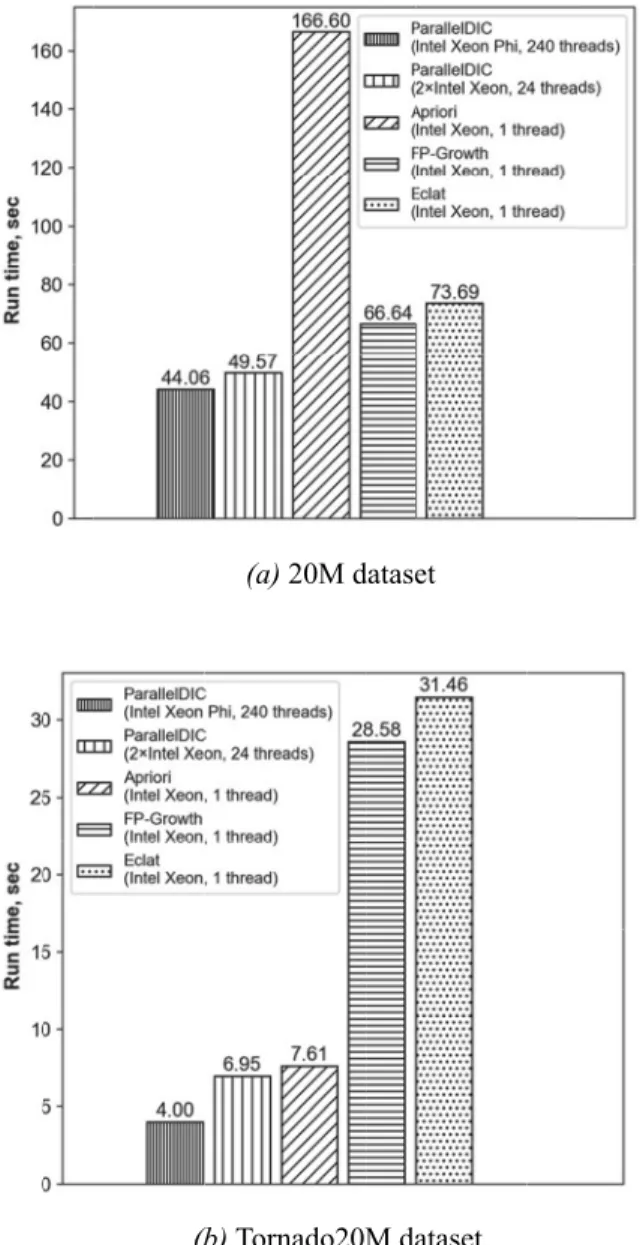
Figure 4 illustrates the performance of Paral-lel DIC on both Intel Xeon and Intel Xeon Phi in comparison with serial Apriori, FP Growth, and Eclat on Intel Xeon. Among serial
imple-mentations, Apriori performs the worst for the 20M dataset and performs the best for the Tor-nado20M dataset because this algorithm perfor-mance suffers when datasets with long transac-tions and the large number of frequent itemsets are processed, and may overtake competitors when transactions are relatively short and the number of frequent itemsets is small.
As we can see, Parallel DIC on Intel Xeon Phi outruns itself on two Intel Xeon up to 1.5 times. Parallel DIC on Intel Xeon Phi also outruns the best serial competitor on Intel Xeon up to 2 times. This is because more threads of Intel Xeon Phi allow for better exploiting the vector-ization abilities of our algorithm.
In addition, we compare performance of Par-allel DIC for the cases when the Intel compiler auto-vectorization option was enabled or dis-abled. Results in Table 3 show that, for the Tor-nado20M dataset, vectorization gives a perfor-mance boost of 1.2 and 2.6 times on Intel Xeon and Intel Xeon Phi, respectively.
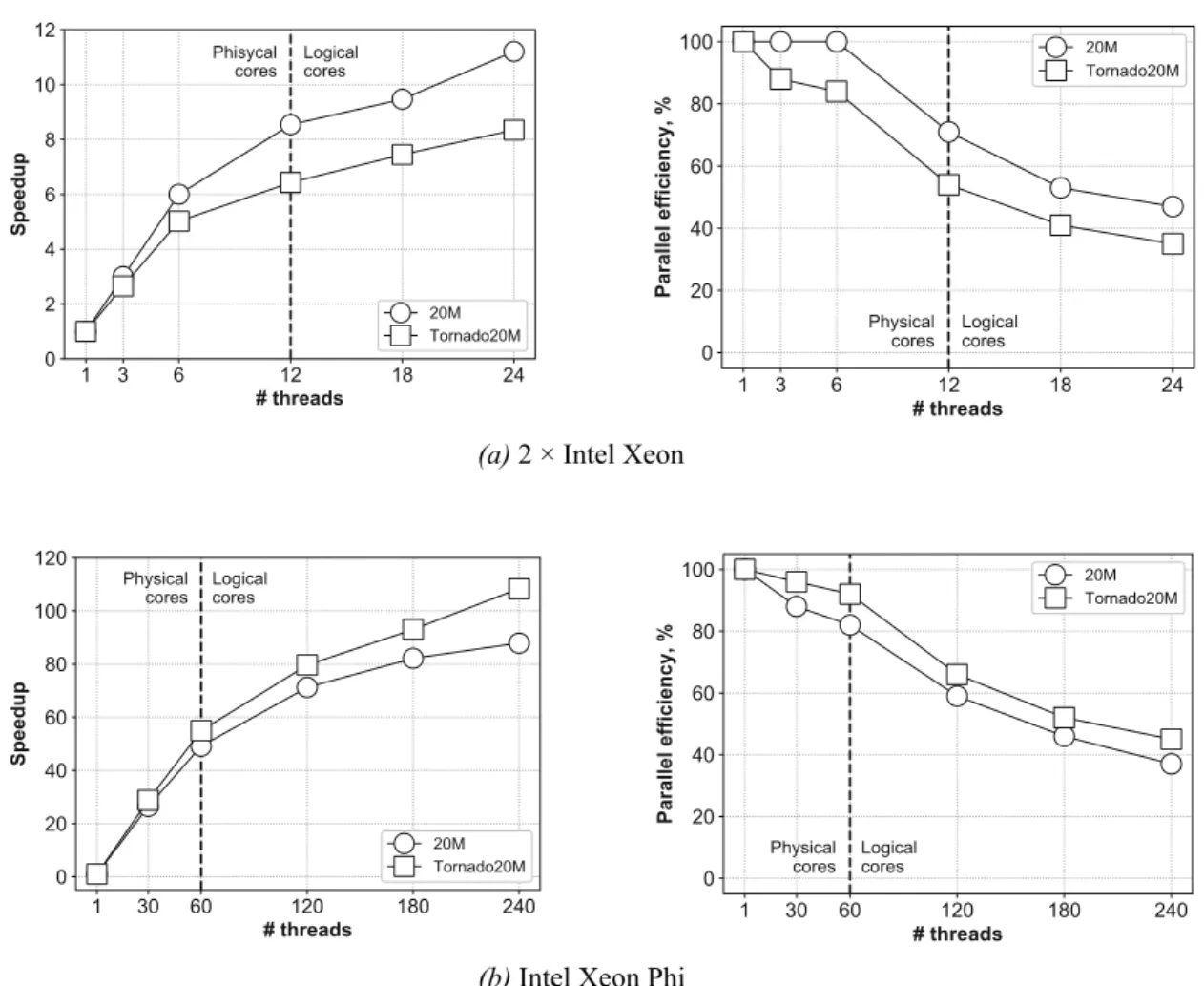
Figure 5 depicts the speedup and parallel effi-ciency of Parallel DIC. On Intel Xeon Phi, our algorithm shows close-to-linear speedup and near 100% parallel efficiency, when the num-ber of threads matches the numnum-ber of physical cores the algorithm is running on. When the algorithm employs more than one thread per physical core, speedup becomes sublinear (it slows down to 88 and 108 for the 20M data-set and the Tornado20M datadata-set, respectively), and parallel efficiency diminishes accordingly (down to 37% and 45% with respect to a data-set). On two Intel Xeon, there is a similar ten-dency but with more moderate results for the Tornado20M dataset. For this dataset, the al-gorithm speedup and parallel efficiency drop to 8 and 35%, respectively, when the maximal possible number of threads per physical core is employed.
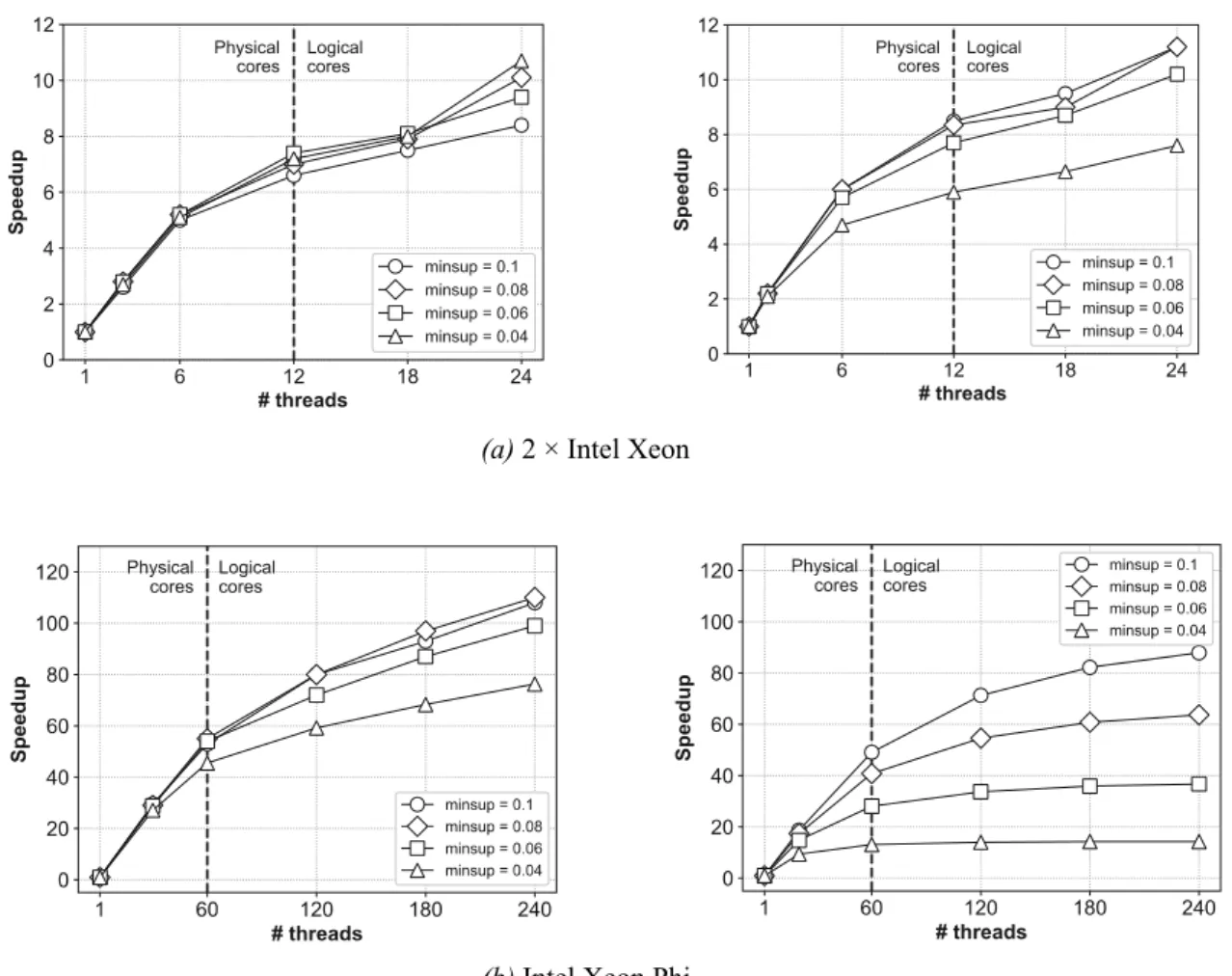
Figure 6 depicts speedup of the algorithm with respect to the minsup threshold. As expected, on both platforms and for both datasets, the al-gorithm speedup suffers from decreasing of the
minsup value since this significantly increases the number of candidate itemsets to be counted. Our algorithm still shows better speedup when only physical cores are involved, and better speedup on Intel Xeon Phi system than on two Intel Xeon nodes.
Summing up, Parallel DIC demonstrates good performance and scalability for large datasets (about tens of millions of transactions) and for
Figure 4. Comparison of performance.
Table 2. Specifications of datasets.
bb Category Transaction Frequent itemsets (minsup = 0.1)
n m Avg. length Total number kmax
20M Synthetic 2 · 107 64 40 4,606 6
Tornado20M Real 2 · 107 64 15 346 4
(a) 20M dataset
(b) Tornado20M dataset.
Table 3. Specifications of hardware.
Hardware Run time, s when vectorization is
enabled disabled
Intel Xeon Phi 4.00 10.36
Measures. In the experiments, we evaluated the speedup and parallel efficiency of the de-veloped algorithm, where such characteristics of parallel-algorithm scalability are defined as follows. Speedup and parallel efficiency of a parallel algorithm employing k threads are cal-culated, respectively, as
( )
1k
t s k =t
and
( )
s k( )
,e k = k
where t1 and tk are the run times of the algo-rithm when one and k threads are employed, respectively.
Competitors. In the previous work [23], our experiments showed that the performance of serial implementation of DIC in [8] is substan-tially inferior to both our algorithm and serial Apriori in [2]. Thus, in this paper, we compared the performance of Parallel DIC with serial im-plementations of the following algorithms in [2]: Apriori, Eclat, and FP Growth.
Datasets. Experiments in our previous work [23] also showed that, for datasets with hun-dreds of thousands of transactions (e.g. the SKIN [6] dataset and the RECORDLINK [18] dataset with 245,057 and 574,913 transactions, respectively), Parallel DIC demonstrates deg-radation of the speedup and parallel efficiency. This is because of the following reasons. For datasets with relatively small number of short transactions, our algorithm provides insufficient amount of work in support counting, which is the heaviest part of the algorithm. At the same time, efficiency of Intel Xeon Phi utilization as well as vectorization increases with the growth of the problem size [20]. Thus, in this paper, we evaluated our algorithm on two datasets, each of which contains tens of millions transactions (cf. Table 2).
Synthetic dataset 20M was prepared through IBM Quest Data Generator [10] similar to the paper [3] where the original DIC algorithm was proposed. Eventually, the 20M dataset gives more than 4,600 frequent itemsets with at most 6 items.
Tornado20M is a real dataset with one-month voltage log of the Tornado SUSU supercom-puter [11] nodes. Such a log is mined to dis-cover the strong associations among the racks, shelves, and nodes of the supercomputer, and dangerous values of voltage. Tornado SUSU consists of 8 racks, and each rack consists of 8 shelves, each with 6 nodes onboard. For each node, there are 4 possible values of measured voltage, and for each possible value there are 4 statuses (i.e. "less than norm", "norm", "greater than norm", and "error"). Thus, it is possible to code a transaction of such a log using 64 bits (i.e. 8 bits for the number of a rack, 8 bits for the number of a shelf, and 8 bits for each of 6 nodes where each pair of bits represents the status of the measured voltage). Eventually, the Tornado20M dataset gives more than 340 fre-quent itemsets with at most 4 items.
Parameters. In the experiments, we took M, the number of transactions that should be pro-cessed before a stop, as n /2 in order to avoid overheads for initializing threads at each stop and increase the algorithm performance. We also evaluated the effect of the minsup thresh-old on the algorithm speedup. As for the exper-iments studying the algorithm scalability, we took minsup threshold as 0.1 as the most com-mon value of support.
5.2. Results
Figure 4 illustrates the performance of Paral-lel DIC on both Intel Xeon and Intel Xeon Phi in comparison with serial Apriori, FP Growth, and Eclat on Intel Xeon. Among serial
imple-mentations, Apriori performs the worst for the 20M dataset and performs the best for the Tor-nado20M dataset because this algorithm perfor-mance suffers when datasets with long transac-tions and the large number of frequent itemsets are processed, and may overtake competitors when transactions are relatively short and the number of frequent itemsets is small.
As we can see, Parallel DIC on Intel Xeon Phi outruns itself on two Intel Xeon up to 1.5 times. Parallel DIC on Intel Xeon Phi also outruns the best serial competitor on Intel Xeon up to 2 times. This is because more threads of Intel Xeon Phi allow for better exploiting the vector-ization abilities of our algorithm.
In addition, we compare performance of Par-allel DIC for the cases when the Intel compiler auto-vectorization option was enabled or dis-abled. Results in Table 3 show that, for the Tor-nado20M dataset, vectorization gives a perfor-mance boost of 1.2 and 2.6 times on Intel Xeon and Intel Xeon Phi, respectively.
Figure 5 depicts the speedup and parallel effi-ciency of Parallel DIC. On Intel Xeon Phi, our algorithm shows close-to-linear speedup and near 100% parallel efficiency, when the num-ber of threads matches the numnum-ber of physical cores the algorithm is running on. When the algorithm employs more than one thread per physical core, speedup becomes sublinear (it slows down to 88 and 108 for the 20M data-set and the Tornado20M datadata-set, respectively), and parallel efficiency diminishes accordingly (down to 37% and 45% with respect to a data-set). On two Intel Xeon, there is a similar ten-dency but with more moderate results for the Tornado20M dataset. For this dataset, the al-gorithm speedup and parallel efficiency drop to 8 and 35%, respectively, when the maximal possible number of threads per physical core is employed.
Figure 6 depicts speedup of the algorithm with respect to the minsup threshold. As expected, on both platforms and for both datasets, the al-gorithm speedup suffers from decreasing of the
minsup value since this significantly increases the number of candidate itemsets to be counted. Our algorithm still shows better speedup when only physical cores are involved, and better speedup on Intel Xeon Phi system than on two Intel Xeon nodes.
Summing up, Parallel DIC demonstrates good performance and scalability for large datasets (about tens of millions of transactions) and for
Figure 4. Comparison of performance.
Table 2. Specifications of datasets.
bb Category Transaction Frequent itemsets (minsup = 0.1)
n m Avg. length Total number kmax
20M Synthetic 2 · 107 64 40 4,606 6
Tornado20M Real 2 · 107 64 15 346 4
(a) 20M dataset
(b) Tornado20M dataset.
Table 3. Specifications of hardware.
Hardware Run time, s when vectorization is
enabled disabled
Intel Xeon Phi 4.00 10.36
the most common value of minimum support threshold (minsup = 0.1) on Intel many-core platforms, especially on the Intel Xeon Phi sys-tem.
5.3. Discussion
In this paper, we propose a parallel version of the DIC algorithm for Intel Xeon and Xeon Phi many-core systems and exploit a direct bit rep-resentation of both transactional database and itemsets. Our implementation codes a transac-tion or an itemset as a 64 bit integer, i.e. m, the number of items in the problem statement, is limited by 64. This limitation is clearly unac-ceptable for some applications, e.g. search for items that are frequently purchased together by customers in a supermarket, search for frequent DNA sequences, and so on. However, the fol-lowing brief review of papers shows that our algorithm is applicable for discovering
interest-ing association rules in medical data. Li et al. in [13] proposed a method for mining optimal risk pattern sets and evaluated the algorithm on two real medical datasets with less than 30 attributes. In [14] and [15], Ordonez et al. in-troduced an algorithm to discover association rules in medical data, which incorporates sever-al important constraints. Authors described how medical records were mapped to a transactional format suitable for mining. In the experiments, authors took at most 25 attributes of more than 100 patient's attributes since the chosen attri-butes provide a complete picture of patients'. In addition, the authors' experience showed that rules with more than 5 medical attributes were hard to interpret. At last, Pattanaprateep et al. in [17] described mining the association rules in a hospital database with more than 2.5 million records of patients' visits including attributes regarding their demographics, diagnoses, and drug utilization.
6. Conclusion
In this paper, we have presented Parallel DIC, a parallel implementation of Dynamic Itemset Counting (DIC) algorithm for Intel many-core systems. DIC is a variation of classical Apri-ori algApri-orithm for frequent itemset mining. We parallelize the DIC algorithm through Open-MP technology and thread-level parallelism. We propose the direct bit representation for transactions and itemsets with the assumption that such a representation of the transactional database fits in main memory. This technique reduces memory space for storing the transac-tional database, simplifies the support count via logical bit-wise operation, and provides vector-ization of this step. Our algorithm balances the support count between threads, depending on the current total number of candidate itemsets. We performed an experimental evaluation on the platforms of the Intel Xeon CPU and the
Xeon Phi coprocessors with large synthetic and real databases (about millions of transactions), showing the good performance and scalability of the proposed algorithm, especially on the In-tel Xeon Phi system.
However, it should be remembered that since Parallel DIC exploits the direct bit technique, this limits the number of items in the problem statement to 64. Nevertheless, literature review shows that despite this limitation, our algorithm is applicable for discovering interesting associ-ation rules in large medical datasets.
Acknowledgement
This work was financially supported by the Russian Foundation for Basic Research (grant No. 17-07-00463), by Act 211 Govern-ment of the Russian Federation (contract No.
Figure 5. Speedup and parallel efficiency of the algorithm. (a) 2 × Intel Xeon
(b) Intel Xeon Phi
Figure 6. Speedup of the algorithm on Tornado20M (left) and 20M (right) datasets w.r.t. the minsup threshold.
(a) 2 × Intel Xeon
the most common value of minimum support threshold (minsup = 0.1) on Intel many-core platforms, especially on the Intel Xeon Phi sys-tem.
5.3. Discussion
In this paper, we propose a parallel version of the DIC algorithm for Intel Xeon and Xeon Phi many-core systems and exploit a direct bit rep-resentation of both transactional database and itemsets. Our implementation codes a transac-tion or an itemset as a 64 bit integer, i.e. m, the number of items in the problem statement, is limited by 64. This limitation is clearly unac-ceptable for some applications, e.g. search for items that are frequently purchased together by customers in a supermarket, search for frequent DNA sequences, and so on. However, the fol-lowing brief review of papers shows that our algorithm is applicable for discovering
interest-ing association rules in medical data. Li et al. in [13] proposed a method for mining optimal risk pattern sets and evaluated the algorithm on two real medical datasets with less than 30 attributes. In [14] and [15], Ordonez et al. in-troduced an algorithm to discover association rules in medical data, which incorporates sever-al important constraints. Authors described how medical records were mapped to a transactional format suitable for mining. In the experiments, authors took at most 25 attributes of more than 100 patient's attributes since the chosen attri-butes provide a complete picture of patients'. In addition, the authors' experience showed that rules with more than 5 medical attributes were hard to interpret. At last, Pattanaprateep et al. in [17] described mining the association rules in a hospital database with more than 2.5 million records of patients' visits including attributes regarding their demographics, diagnoses, and drug utilization.
6. Conclusion
In this paper, we have presented Parallel DIC, a parallel implementation of Dynamic Itemset Counting (DIC) algorithm for Intel many-core systems. DIC is a variation of classical Apri-ori algApri-orithm for frequent itemset mining. We parallelize the DIC algorithm through Open-MP technology and thread-level parallelism. We propose the direct bit representation for transactions and itemsets with the assumption that such a representation of the transactional database fits in main memory. This technique reduces memory space for storing the transac-tional database, simplifies the support count via logical bit-wise operation, and provides vector-ization of this step. Our algorithm balances the support count between threads, depending on the current total number of candidate itemsets. We performed an experimental evaluation on the platforms of the Intel Xeon CPU and the
Xeon Phi coprocessors with large synthetic and real databases (about millions of transactions), showing the good performance and scalability of the proposed algorithm, especially on the In-tel Xeon Phi system.
However, it should be remembered that since Parallel DIC exploits the direct bit technique, this limits the number of items in the problem statement to 64. Nevertheless, literature review shows that despite this limitation, our algorithm is applicable for discovering interesting associ-ation rules in large medical datasets.
Acknowledgement
This work was financially supported by the Russian Foundation for Basic Research (grant No. 17-07-00463), by Act 211 Govern-ment of the Russian Federation (contract No.
Figure 5. Speedup and parallel efficiency of the algorithm. (a) 2 × Intel Xeon
(b) Intel Xeon Phi
Figure 6. Speedup of the algorithm on Tornado20M (left) and 20M (right) datasets w.r.t. the minsup threshold.
(a) 2 × Intel Xeon