Study of Fuzzy Logic-based
Controller for Diff-Serv
Bandwidth Broking
Hadj Bourdoucen
1,2, Fatma Al-Azani
2and Ahmed Al-Naamany
31Communication and Information Research Center (CIRC), Sultan Qaboos University, Oman 2Department of Electrical and Computer Engineering, Sultan Qaboos University, Oman 3Modern College of Business and Science, Sultan Qaboos University, Oman
Combining transmission of both voice and data on the same network infrastructure was a challenging task which required an advanced network architecture which needs to be scalable and simple. This resulted in a new approach for Ethernet systems where Differentiated Ser-vice(Diff-Serv)was introduced to respond to this need and in addition, improve Quality of service(QoS)as a way of providing class of services for different end users. Therefore, optimizing the use of the network available bandwidth is a prim goal of this work which is focused on investigating the impact of implementing a fuzzy logic controller of the crucial factors affecting the performance of the network. These external or internal factors will be controlled by the developed Fuzzy Logic system that will act as bandwidth broker(BB)to provide each user with his optimal Code Point (CP). Within the scope of this work, the CP will not only involve packet loss rate as an external factor to check the network congestion, but in addition, it will consider the internal factors; which are a combination of both service-level agreement(SLA)and the type of user application used, as external factors as well. The Code Point will be marked in the transmitted packets, where it will be possible to the router to check it, and will treat it as per the agreement between the user and the administrator.
Keywords: fuzzy logic controller, diff-serv, service-level agreement, SLA, QoS, bandwidth broker, code point
1. Introduction
The huge growth of the businesses and the in-creasing societal needs lead to develop more internet technologies that depend on real-time applications which come over the capabilities of available network resources. The lack of reach-ing expected high performance is a real concern that needs to be well addressed by researchers.
Today’s network communication performance buzzwords include mainly: latency, jitter, band-width and packet loss. In addition, differenti-ation service is also a serious issue that needs to be looked at since the current datagram strat-egy is dealing with all transmitted and received packets in the same way, thus, offering a single level of service. Therefore, real time applica-tions under this type of service became imprac-ticable.
be implemented in different forms, but the sim-plest and most scalable approach for Ethernet is Differentiated Services(Diff-Serv).
Bandwidth prioritization is one solution for pro-viding network QoS. For this research work, a number of papers have been published focusing mainly on two key factors: type of application and bandwidth availability(e.g. L. Yunyue and W. Qishi 2013, C. C. Cholletteet al. 2012, and the references therein). In this line, another re-search work has considered one more factor in addition to these two, to generate the differenti-ated services code points(DSCP)and treat the packets in a more optimal way(A. S. Al-Belushi 2006). The work was based on developing a bandwidth controller based on Fuzzy logic that gives each user his optimal Code Point(CP)by considering his class, type of application and available bandwidth. In this case, the router checks each transmitted packet’s CP and treats it as contracted. A method to classify users and priorities to share transmission rate through a typical WAN link was suggested. The ap-proach was to develop and further investigate the impact of essential factors on performance of the fuzzy logic controller (Z. Wang 2001, A. Krishnamurthy et al. 2005, G. Stattenberger and T. Braun 1999). The present work focuses mainly on considering more factors influencing the bandwidth prioritization that limits the QoS. Such factors include: delay(jitter), throughput, key protocols, and computation overhead. After studying the fuzzy logic controller model which acts as a bandwidth broker(A. Sohail and S. Khanum 2008, M. Goel et al. 2004, I. Oku-muset al.2003, Y.-D. Linet al. 2001, R. Zhang
et al. 2000)and examination of different appli-cations of fuzzy logic approaches for design-ing decision algorithms for queue scheduldesign-ing, mobility management in heterogeneous wire-less network and self-tuning fuzzy controller for maximum drop probability management(C. C. Cholletteet al. 2012, Y. Tao, R. Peng, 2011, H. Wang et al. 2009)the resulting Diff-Serv QoS is explored accordingly.
Therefore, this work will describe a Fuzzy logic based controller that gives each user the opti-mal code point, taking into account the above mentioned factors which are Packet Loss(PL), Round Trip Time(RTT), application, SLA and BW.
2. Design and Set-up of Fuzzy Logic Controller
The first attempt in the design of Fuzzy logic controller was to present all the five factors to-gether as variables and study the relationship between them. As a result, the following two options have been considered:
• Option 1: Build a single Fuzzy logic con-troller which deals with all the five factors as inputs that result in one output code point which will be marked on the packets. A trial has been done to use a FL toolbox to build a controller that has all these five factors to-gether at the same time. This option was judged to produce a complex controller as it will have around 232possibilities to be inves-tigated. This is not simple, neither practical to implement through this tool.
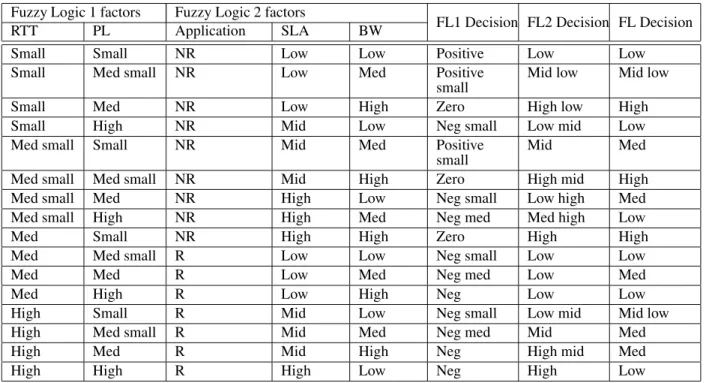
• Option 2: Create two separate Fuzzy logic controllers FL1 and FL2 and multiplex them. In this case, two FL parts need to be pre-sented separately. For instance, the main five rules used are presented in Table 1, whereas in Table 5, only three parameters out these five are indicated (Bandwidth, SLA and Packet loss). It is worth noting that in the first part, Table 1 was simplified to present only the most effective rules of the controller. This option has been implemented in the simulator and the results will be presented in the coming sections.
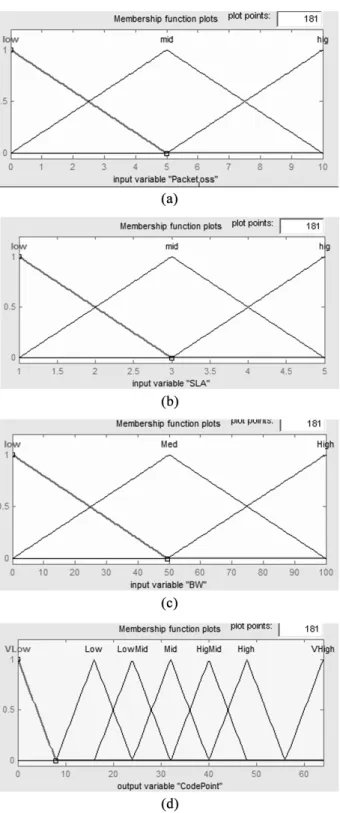
With regard to the first part of option 2, the membership function for the inputs and code point of Fuzzy Logic controller 1 (FL1) are shown in Figure 1 a through d. For the SLA, three membership functions have been intro-duced which are low, mid and high. The SLA has five classes that vary from one to five all over the research work, where the preferred user was assigned to class five.
Figure 1.Fuzzy Logic membership functions of controller FL1.
1, while the non-real time applications were pre-sented by value 0. The corresponding member-ship functions are NRT and RT(respectively for non-real time and real time applications). The membership functions applied on this FL controller are shown in Figure 1d. There are nine functions used which are: Low, MidLow, HigLow, LowMid, Mid, HigMid, LowHig, Mid-Hig and Mid-Hig, which are varying on a scale from 0 to 64. This adopted scale can be well
justi-Figure 2.Fuzzy Logic membership functions of controller FL2.
fied since the Diff-Serv byte overrides existing definition of IPv4 TOS byte (Type of Service byte)and IPv6 traffic class octet. Note that six bits are used as Diff-Serv code point (DSCP) to select the Per-Hop-Behavior(PHB), a packet experience at each node where the other two bits are currently unused.
This work deals with a complete Diff-Serv sche-me with detailed access node function, in which there are totally 64 levels of services for both real time and non-real time flows.
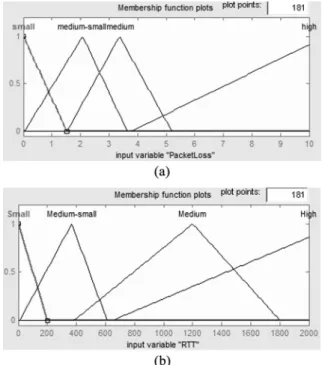
At Fuzzy Logic 2 controller(FL2), two factors have been considered which are the Packet Loss rate (PL)and the Round Trip Time (RTT). In fact, four membership functions of the PL were designated in order to give more highlight and differentiation. These are shown in Figure 2 a and b which are Small, Medium-small, Medium and High.
On the other hand, four membership functions were also considered for the RRT, which are Small, Medium-small, Medium and High as shown in Figure 2b.
Fuzzy Logic 1 factors Fuzzy Logic 2 factors
FL1 Decision FL2 Decision FL Decision RTT PL Application SLA BW
Small Small NR Low Low Positive Low Low Small Med small NR Low Med Positive
small Mid low Mid low Small Med NR Low High Zero High low High Small High NR Mid Low Neg small Low mid Low Med small Small NR Mid Med Positive
small Mid Med Med small Med small NR Mid High Zero High mid High Med small Med NR High Low Neg small Low high Med Med small High NR High Med Neg med Med high Low Med Small NR High High Zero High High Med Med small R Low Low Neg small Low Low Med Med R Low Med Neg med Low Med Med High R Low High Neg Low Low High Small R Mid Low Neg small Low mid Mid low High Med small R Mid Med Neg med Mid Med High Med R Mid High Neg High mid Med High High R High Low Neg High Low
Table 1.The five factors presented in one FL system with their relationships.
Figure 3.Simulation model for combined FL1 and FL2 controllers.
Note that from examination of the obtained sim-ulation results shown in Figure 4, the Code Point obtained from the product of the two controllers does not give a clear picture of the treatment of
Figure 4.Results product of FL1 and FL2.
It has been noticed that the most effected factors in the controller can be reduced to three factors only. These are, the Packet Loss from the first fuzzy logic controller, the Bandwidth and the SLA from the second fuzzy logic controller. As a result of this assumption, a second trial with the new factors has been introduced.
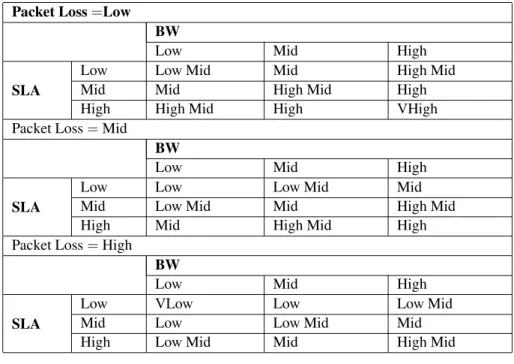
Therefore, in the second attempt, the number of factors is reduced to three which are expected to have more effects on the final results. Thus, we ended up with BW, SLA and Packet Loss. Table 5 shows all the rules controlling the FL at this stage.
In this scenario, the SLA was presented as a matrix for both the “user class” that is varying between Low, Med and High and the “applica-tion type” that can be “non-real time”, “other” and “real time” application as shown in Tables 2, 3 and 4.
This will give, as pointed out earlier, more high-lights and differentiation in the obtained results. For different types of applications which might start with sensitive voice traffic up to email and/or games, the users can be classified into five classes where the priority will be given to class 5 to be served first, i.e. before the rest of the classes.
Application Type Representation Number
RT Video conferencing 1Voice over IP 1
Other
GCC 0.8 FTP 0.5 Database 0.2 WWW 0.1 NRT
PDF file 0 Email and chat 0 Gaming 0
Table 2.Application Type.
Class # Probability of drop
Class 1 Higher Class 2 "" Class 3 Middle Class 4 "" Class 5 Lower
Table 3.SLA probability of drop.
NRT Other RT
High 3 4 5
Medium 2 3 4
Low 1 2 3
Packet Loss=Low BW
Low Mid High
SLA
Low Low Mid Mid High Mid Mid Mid High Mid High High High Mid High VHigh Packet Loss=Mid
BW
Low Mid High
SLA
Low Low Low Mid Mid Mid Low Mid Mid High Mid High Mid High Mid High Packet Loss=High
BW
Low Mid High
SLA
Low VLow Low Low Mid Mid Low Low Mid Mid High Low Mid Mid High Mid
Table 5.Fuzzy Logic rules between Bandwidth, SLA and Packet loss.
As shown in Table 5, there are three main fac-tors that were considered in this part which have major effects on the results of simulation. The membership function for the fuzzy inputs and code points for the combined FL are shown in Figure 5a – d respectively. All the factors of membership functions used above were re-utilized as they were(e.g. the packet loss doesn’t have any changes and can be pulled from the edge router through running a script on the bandwidth broker (BB) server to perform its function).
It is worth noting that the SLA in the above case has five classes, but with presentations different from the previous case, since they resulted from the combination of both the application type and administration classification of the user. The same applies to the available bandwidth where the BB will read its status from the edge router. Note also that the rules used for this case are extracted from Table 5 and configured at the fuzzy logic tool box as shown in the section below. The range of the code points varies be-tween 0 and 64. At the edge router, for instance, if the code point equals to N, it means that N out of 64 were passed forward and the others were dropped.
2.1. Processing a request
The developed model in this work is expected to be connected to a core switch of a network where processing capabilities are expected to be very high, as represented in Figure 6. The model can be run as a separate program within a server which can communicate to the database server(DB). The database can run in both oracle or SQL database and might carry any network and AD information. The routers connected to ingress/egress router to ISP and the links be-tween access routers and clients/servers are of 1Gbps Ethernet.
The following steps explain various envisaged communication phases involved to process any request from the user.
1. A user sends a message request that has all details about his data e.g.user name, pass-word, etc. . .
2. FL controller validates the user name, pass-word, and the class by checking the database. 3. Database sends back the answer for
valida-tion and class number.
5. Edge router sends back the percentage of both available bandwidth and packet loss. 6. FLC sends the generated code point to the
user.
7. The user configures the given code point which will be placed in packets’ headers.
Figure 5.Fuzzy Logic membership functions combined FL.
Figure 6. Comprehensive system network.
2.2. Model implementation and development in Matlab
In order to implement the whole system and im-prove the FL controllers presented in previous works, additional important factors have been considered to enhance the performance of the suggested model. Matlab’s fuzzy logic toolbox was used to implement the developed FL sys-tem where its Simulink layout model is shown in Figure 7.
Comparison of the output Code Points for dif-ferent values of SLA varying from 1 to 5 for the developed model was done.
3. Analysis and Results
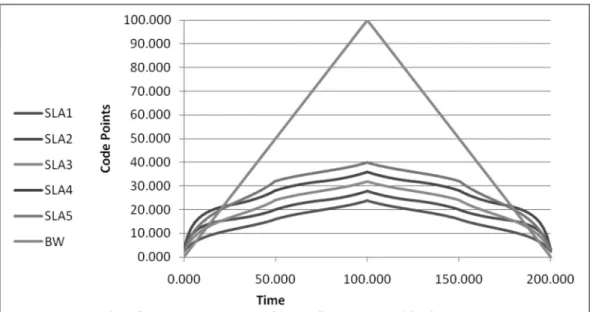
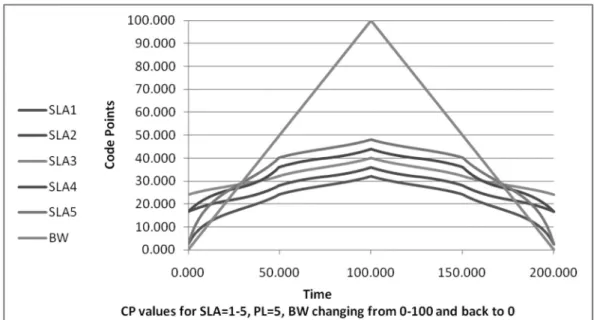
To demonstrate the validity of the developed ap-proach, a set of representative results obtained from the Simulink model are shown in Figures 8 through 10.
The results for a time range of 200, where the Bandwidth is changing from 0 to its peak value of 100 and then back to zero, are as shown in Figure 8.
This figure also shows that the packet loss reaches its highest value, which corresponds to PL=10, and in this case there will be no much differentiation between users since the available bandwidth is very low.
Figure 7.Matlab Simulink window of the developed model layout.
Figure 9.CP values for SLA=1-5, PL=5 and BW changes from 0-100 and then back to 0.
Figure 10. CP values for SLA=1-5, PL=0 and BW changes from 0-100 and back to 0.
On a stage where the packet loss is zero, the fuzzy logic bandwidth broker will try from first moment to provide the priority to the user with highest SLA as shown in Figure 10.
4. Conclusion
Quality of Service is considered as one way to provide a class of service with consistency, predictability and data delivery which will en-sure customers’ satisfaction with the service
provided. Diff-Serv as a technology is one so-lution to provide QoS in the network. In this work, the controlling factors were classified as external and internal factors, including Packet Loss, SLA and available bandwidth. The SLA is taken as a matrix of class of the user specified by the network administrator and the applica-tion type.
determined first. The SLA matrix output was set to 5 levels in the simulation. The bandwidth percentages were selected to be more general in-stead of using an exact amount since they differ from one network to another and the packet loss was varying from 0 to 10. Using both external and internal factors, it was possible to determine the decision code point via fuzzification, fuzzy interference and de-fuzzification.
It was noticed from the results that if the packet loss is zero, which means no network conges-tion outside the network, and the SLA is 5 with 50% of bandwidth available; the CP grade can reach up to 47. If the packet loss is 5, and the SLA is also 5 with 50% of bandwidth available, the CP can go down to reach 39 for its best. If the packet loss reaches its maximum value which is 10, and the SLA reads 5 with the same available bandwidth 50%, the CP grade will be 32. It was clear from this work how the con-troller is rewarding each user, depending on the mentioned factors. Thus, to achieve high per-formance communication networks that satisfy the business current needs, a simple and eas-ily administrable network control mechanism is required.
References
[1] A. KRISHNAMURTHY, L. QIAN, Y. WANG, P.
DAUCHY, A. CONTE, A new coordination
schedul-ing algorithm in distributed bandwidth broker QoS architecture. Dept. of Computer. Science, Texas Univ., Richardson, TX, USA. Aug, 2005.
[2] C. C. CHOLLETTE, A. K. U. CHUDE-OKONKWO, K.
A. BAKAR, O. V. MATTHEWS, A queue scheduling
approach to quality of service support in Diff-Serv networks using fuzzy logic. International Confer-ence on Computer and Communication Engineering (ICCCE), 2012.
[3] F.-C. REN, C.-J. CHANG, R.-G. CHENG,
QoS-guaranteed fuzzy transmission controller for dy-namic TDMA protocol in multimedia communica-tion systems.IEE Proceedings – Communications, vol. 149, no. 56, 2002.
[4] G. STATTENBERGER, T. BRAUN, Performance of Bandwidth Broker for Diff-Serv Networks. Institute of Computer Science and Applied Mathematics, University of Bern, Neubr¨uckstr. 10, 3012 Bern, Switzerland. Jan, 1999.
[5] H. AGHVAMI, A. GANZ, R. SIVAKUMAR, H. ZHENG, W. ZHU, C.-T. LEA, Advanced Mobility Manage-ment and QoS Protocols for Next-Generation Wire-less Internet. IEEE Journal on Selected Areas in Communications, vol. 22, no. 5, 2004.
[6] H. WANG, Z. JI, Y. SUN, A Fuzzy Logic Based
Con-gestion Control Algorithm Suitable for IP-Based Broadband Satellite Networks, Sixth International Conference on Fuzzy Systems and Knowledge Dis-covery, FSKD ’09, vol. 4, 2009.
[7] L. YUNYUE, W. QISHI, Complexity Analysis and
Al-gorithm Design for Advance Bandwidth Scheduling in Dedicated Networks, tIEEE/ACM Transactions on Networking, vol. 21, 1, 2013.
[8] M. GOEL, M. MOH, T. HASEGAWA, S. ANO,
Differentiated-service enabled group communica-tions using bandwidth brokers.Performance, Com-puting, and Communications Conference, 2004.
[9] O. ABOUL-MAGD, B. JAMOUSSI, QoS and service
interworking using constraint route label distribu-tion protocol (CR-LDP). IEEE Communications Magazine, vol. 39, no. 5, 2001.
[10] OKUMUS, S. J. CHAPIN, H. JUNSEOK, H. MAN -TAR, Scalability of inter-domain edge tunnels us-ing bandwidth brokers: a region-based approach.
Global Telecommunications Conference, GLOBE-COM ’03. vol. 5, 2003.
[11] QOSPROTOCOLS&ARCHITECTURES, 1999,
http:
www.qosforum.com
[12] R. ZHANG, J. MA, Fuzzy QoS management in
Diff-Serv networks. International Conference on Sys-tems, Man, and Cybernetics, vol. 5, 2000.
[13] S. AL-BELUSHI, Bandwidth Prioritization
Provision-ing for Inter-router Networks. MSc thesis report, Department of Electrical and Computer Engineer-ing, SQU, Sultanate of Oman, February, 2006.
[14] S. CHEN, K. NAHRSTEDT, Y. SHAVITT, A QoS-aware
multicast routing protocol. IEEE Journal on Se-lected Areas in Communications, vol. 18, no. 12, 2000.
[15] SOHAIL, S. KHANUM, Simplifying Network
Man-agement with Fuzzy Logic. Dept. of computer. Eng., NUST, Rawalpindi, May, 2008.
[16] Y. TAO, R. PENG, A fuzzy logic vertical handoff
algorithm with motion trend decision.6th
Interna-tional Forum on Strategic Technology (IFOST), vol. 2, 2011.
[17] Y.-D. LIN, C.-H. CHANG, Y.-C. HSU, Bandwidth
bro-kers of instantaneous and book-ahead requests for differentiated services networks. Global Telecom-munications Conference, GLOBECOM ’01. vol. 4, 2001.
Received:December, 2012
Revised:April, 2013
Accepted:May, 2013
Contact addresses:
Hadj Bourdoucen Communication and Information Research Center ECE Dept., College of Engineering Sultan Qaboos University PO Box 33 Al Khod, 123 Muscat Oman e-mail:[email protected]
Fatma A. S. Al-Azani ECE Dept., College of Engineering Sultan Qaboos University PO Box 33 Al Khod, 123 Muscat Oman e-mail:[email protected]
Ahmed Al-Naamany Modern College of Business & Science PO Box 100 Al-Khuwair, 133 Sultanate of Oman e-mail:[email protected]
HADJBOURDOUCENobtained his PhD degree from Ecole Centrale de Lyon, France, in 1987. Worked at the University of Science and Tech-nology Houari Boumedienne(USTHB), Algeria, 1987-90, then at the National Institute of Electricity and Electronics(INELEC), Boumerdes, 1990-97. He joined Sultan Qaboos University(SQU)in 1998 where he served as Head of Department of Information Engineering, then as Head of Department of Electrical and Computer Engineering until 2007. He is presently a Professor at ECE Dept., and Director of Communication and Information Research Center(CIRC), SQU. His research activities and interests include communication & networking, modelling, simu-lation & performance evaluation, integrated electronics and hardware design. In these areas he published over 100 research publications and edited several books and conference proceedings. Dr. Bourdoucen is an IEEE Senior member.
FATMAAL-AZANIobtained her Bachelor degree from Sultan Qaboos University, Oman, in June 2003 and the Master degree from the same university in 2010. She worked in Oil field industry at Petroleum De-velopment Oman(PDO)from 2004 to 2008 as a network engineer. She has been working in Occidental of Oman Inc. as a Telecom and network specialist for around five years. Her research activity for the Master de-gree was about bandwidth prioritization using customized Fuzzy logic model. The model functions to check three factors to decide the best treatment for the received data in order to utilize the bandwidth provided by the ISP when traffic sent through the internet. The three factors were the user class, RT/Non-RT applications, and the bandwidth available at the time of the request. The scenario built into an environment such as university where there are different user levels of e.g. management, university faculty and students.