The Asian Journal of Technology Management Vol. 10 No. 2 (2017): 58-73
Regional Innovation System Performance in Indonesia: Case of Semarang
and Balikpapan
Zulfika Satria Kusharsanto1*, Wiwandari Handayani2 & Artiningsih2
1Agency for the Assessment and Application of Technology (BPPT), Indonesia
2Diponegoro University, Indonesia
Abstract.Innovation system which promotes knowledge-based economy, instead of factor driven economy, has been realized by many countries to be an obligatory system to improve national or regional competitiveness. It requires the collaboration of all stakeholders which are related to development to enhance innovation with specialization as the competitiveness value. Semarang and Balikpapan, two emerging cities in Indonesia, has implemented regional innovation system (RIS) with their own strengths and weaknesses. This study uses conceptual analysis with qualitative and quantitative methodology and The Innovation Policy Framework as tool to assess both cities’ performance. The study finds that both cities have basic understanding about innovation with specialization such as Semarang develops innovation in city tourism while Balikpapan enhances innovation in green economy. The hard challenges faced by both cities are integration of all stakeholders in enhancing innovation that however is still partially implemented. At the end, this study draws the concept of both cities to develop the system yet without neglecting their existed performance.
Keywords:Balikpapan, collaboration, knowledge-based economy, regional innovation system, Semarang
1.
Introduction
Modern regional economic development approach nowadays does not solely rely on how much region’s natural resources. The recent approach prefers to gain other key drivers, which are knowledge and technology, to significantly drive the development (Grant, 1996). Moreover, global competitiveness seems to be more affected by local value instead of industrial massive capital (Scoville, 1986). So that it should be necessary to strengthen the advanced social cohesion among society, as a basic element, to increase either local or regional competitiveness.
In last recent years, world has realized that innovation should be implemented in a system to support development. Solow’s research in 1957 (Baier, Dwyer, & Tamura, 2006) showed that apparently US economic growth was only affected 12% by physical capital and labor. Surprisingly, the biggest part which affected its economic was total factor productivity (TFP) as remain factor
which has been agreed by many scholars to be defined as technology mastery and innovation development (Dias Avila & Evenson, 2010). That case actually opens a new paradigm in development policy to integrate between business, technology, education, and good-governance as an innovation system.
about RIS strengthening (among autonomy regions). That decree instructs all cities/regencies/provinces in Indonesia to implement RIS in their governmental system by involving other stakeholders.
To some extent this reflects that innovation system, especially RIS, becomes overriding consideration in fostering economic development. Two cities in Indonesia which have been seriously aware to this topic are Semarang and Balikpapan, which have competitive economic development. Those cities were chosen for this study because their high regard among other cities in implementing innovation system as mandate of state government by decree of RIS strengthening. Hence this study aims to elaborate both cities in applying RIS based on variables and indicators to assess RIS application within the city. The result will present what the difference of those two cities and in which part each city can improve at the utmost to make the innovation system effective.
Since both cities have not been praised as best practice and considered as tyro in RIS, this study is the best suit to understand how city or region can get underway to implement RIS especially among developing countries. Moreover, there has been little attention given to studies in the development of RIS in Indonesia cities/provinces although it has begun to be considered as an immediate economical approach.
2. Literature Study
Regional Innovation System Theory
Innovation is a creative and interactive process which involves market and non-market institutional system (OECD, 1999). It explains that innovation is not only about making new idea, but it should comprise benefit to society or, in economic sphere, it’s marketable. Hall (Hall, 2000) said that the successful key of United States of America to become the leader of technology is not only by inventing new products but also on its capability of selling and making vast market of technology.
Meanwhile, the definition of innovation system is a set of actors or stakeholders and institutions as well that interact, collaborate, and diffuse new and economically beneficial knowledge in the production process (Fischer, 2001). Some scholars mention that term as “innovation cluster” with similar definition (Bröcker, Dohse, & Soltwedel, 2003; Yongze, 2011).
Figure 1.
Innovation system concept (Fischer, 2001)
Innovation and innovation system should draw on capabilities of the region to be effective (Asheim, Smith, & Oughton, 2011). Hence policy has to conduct an identifying review on what the potential of the region is. It can be an act like zoning distinguished districts based on society culture or city’s long term plan. Nowadays, that paradigm is stimulated the advanced approach called the regional innovation system or RIS.
RIS is the laying of innovation system in specific space. The intelligible definition of RIS is a system consists of several institutions to create and process knowledge that defines new technology in scope of region border (Llerena, Matt, & Avadikyan, 2005). RIS has a general model which is the geographical proximity among actors, enabling direct contact, and the commitment to exchange tacit knowledge to each other. That tacit knowledge exchange is well-known in
knowledge based economics (KBE) also. The term region is limited to specific border such as city or province.
Figure 2.
How Regional Innovation System (RIS) works (Taufik, 2005)
RIS emphasizes to some contextual issues, such as regional specialization to distinguish city/region in competitiveness (Begg, 1999), innovation infrastructure (universities, research center and training center), network between stakeholders and specific policy which supports knowledge based economy. The relationship between all those elements is like the picture below.
Based on the mixed concepts above, this can be synthesized that RIS reinforcement is needed to apply good holistic system and to fix several issues related to innovation policy. It should (Taufik, 2005) implies 6 issues of innovation policy that commonly occurred in last decade:
1. How the condition of basic regulation for innovation is,
2. How the carrying capacity of science and technology and absorptive capacity of industry is,
3. How services and interaction between stakeholders are,
4. How the innovation culture of community is,
5. What industry cluster focus on and how it can integrate to other aspects,
6. How the entity can face global challenges.
Best Practice of RIS
In Asia sphere, one of good implementations of RIS can be found in Busan, South Korea. Furthermore, its characteristic as marine or coastal city is similar to Semarang and Balikpapan. Busan is a well-planned city that has developed to be an innovation city and global hub (Seo, Cho, & Skelton, 2015). Its successful key is on the commitment of government, local industries, academicians, R&D institutions, and numerous NGOs to establish knowledge sharing and cooperation to support city development.
District as city’s main business and commercial center and Centum District focuses on national film industry innovation as if it is the Hollywood of South Korea (Seo et al., 2015). All of those districts are synergized to arrange city’s comprehensive development through innovation on each part.
Busan has also an intelligence space called Busan Techno Park (BTP) to accommodate stakeholders’ collaboration. Since first established in 1999, BTP, the innovation center for city planning and development in Busan, has also contributed various strategic plan and delivered innovative idea to strengthen city’s pulse (Duke, Etzkowitz, Rhee, & Kitagawa, 2006).
3. Methodology
This study has a case study approach to examine both cities’ condition. It was expected that it could give a full picture of the phenomenon by doing the exploration of a phenomenon, with detailed data (Ridder, 2012). Data are mostly presented qualitatively. The approach is considerably
suitable because its tendency for knowing such as knowledge capacity and implementation of RIS.
It was using methodological triangulation, which comprised more than one method to gather data, such as interviews, observations, FGD, document studies, and list checking by ordinal number. Nonetheless, it mostly used FGD to gather data and perception from many stakeholders. The respondents consisted of many stakeholders about 15 people in each of both cities who represented as academia, government and business.
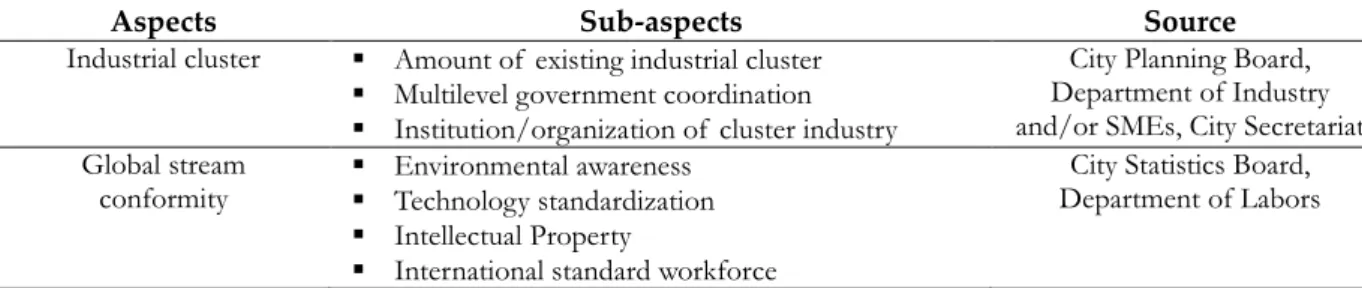
The researchers try to find the condition of each part from The Innovation Policy Framework (Kerangka Kebijakan Inovasi) issued by Ministry of Research and Technology in collaboration with BPPT which is derived from innovation policy issues (Taufik, 2005). The framework also has similarity with the concept conveyed by Fagerberg (Fagerberg & Srholec, 2008) and Cooke (Cooke, 2001). Aspects from the framework also can be described as variables of this study which are mentioned on the following table:
Table 1.
Aspects for RIS Assessment
Aspects Sub-aspects Source
Basic regulation for innovation
Database of business and innovation
Regulation related to business and innovation
Amount of innovation infrastructure such as business incubators
Incentive for innovation
City Planning Board
Absorptive capacity Amount of R&D institutions
Government’s spend on R&D
SME assistance and incubation program
City R&D Board, City Planning Board
Innovation collaboration and diffusion
Collaboration to strengthen innovation
Innovation diffusion /publication
Special space for innovation
Technology-based services
Universities, City Planning Board, Department of Communication or related
Innovation culture Entrepreneurships capacity through formal and non-formal training
Strengthen social cohesion
Innovation appreciation
Technopreneurs talent scouting
Table 1. (Continued) Aspects for RIS Assessment
This study uses conceptual and descriptive analysis (Furner, 2006) to examine Semarang’s and Balikpapan’s performance. In addition, this study does not intentionally compare Semarang and Balikpapan in order
to know which is better; instead it just intends to show two perspective of Indonesian municipality in facing the system and regulation.
Figure 3.
Location of Semarang & Balikpapan
General Characteristic and Speciali-zation of Semarang and Balikpapan
Semarang and Balikpapan have many similarities and differences as well. Both are located in different island: Semarang is in Java, meanwhile Balikpapan is in Borneo or Kalimantan. Nonetheless, both are the coastal cities in inner ocean of Indonesia. Semarang is the capital of Central Java (Jawa Tengah) Province which has strategic position due to its location on Java cities’ trading main network line. Its area is 373.67 km2 or as same as 50.4% of Jakarta’s, Indonesian capital, area. As the economic base, Semarang relies on tertiary sector such as trade and services. The biggest contributor to its regional GDP is trade, hotel, and food and beverages services sector. Semarang has also a vision to be a trade and service city which is cultured and prospered. That vision actually goes well along with the situation of existing economy.
(a)
(b)
Figure 4.
Gross Domestic Products (GDP) distribution
value based on economic sector in 2015: (a)
Semarang; (b) Balikpapan
1%
44% 55%
Primary Secondary Tertiary
4%
32%
64%
Primary Secondary Tertiary
Aspects Sub-aspects Source
Industrial cluster Amount of existing industrial cluster
Multilevel government coordination
Institution/organization of cluster industry
City Planning Board, Department of Industry and/or SMEs, City Secretariat Global stream
conformity
Environmental awareness
Technology standardization
Intellectual Property
International standard workforce
City Statistics Board, Department of Labors
Balikpapan
Most GDP is contributed from tertiary sector (trade, hotel, restaurant, and miscellaneous services) for about
55%
Tourist Village City’s program to develop the potential of tourism
FGD by 21 participants across various actors: tourism is the idealist idea to be developed with RIS
Trade & Services, Tourism, MICE
Most GDP is contributed from tertiary sector for about 64% makes this city’s main activity is trading
Green Economy Government’s vision to promote environment issues
FGD by 15 participants across various actors: environment is Balikpapan’s great power
SEMARANG
BALIKPAPAN
To focus on
Figure 5.
Specialization of each city and the determinants
As same as Semarang, Balikpapan is located in strategic position in East Kalimantan (Kalimantan Timur) Province, Borneo Island. Its area is 503.3 km2 or as wide as 68% of Jakarta’s total area. Besides it has essential role in Borneo, Balikpapan has also been set to be one of national strategic cities due to its history in producing crude oil. However, today Balikpapan economic apparently is not affected significantly by oil sector (secondary sector). In fact, its GDP distribution in recent years has been mostly contributed by trade and services or tertiary sector (64% of total GDP in last 2015).
In 2014, Balikpapan was awarded by Indonesian Association of Planners (IAP) as the most livable city in Indonesia (Natahadibrata, 2014). Balikpapan was considered to be a well-planned city with sufficient infrastructure, good management, astonishing economic and well-ordered land use. Its innovation on solid waste management seems to be the biggest factor
which takes this largest city in East Kalimantan to the pride. ASEAN Working Group on Environmentally Sustainable Cities (AWGESC) in 2011 awarded Balikpapan as the second place in ASEAN’s tidiest city and in 2014 Indonesian Government also prized this city with Adipura Kencana, the national highest award for city cleanliness.
Table 2.
General Comparison of Semarang and Balikpapan
Comparison Aspects Semarang Balikpapan
City Status The province capital and the
biggest city in province Not the capital but the biggest city in province
Location Lied on coastal Java Lied on coastal Borneo
Both cities are located in coastal area
Availability of research center Stand many universities Only few higher education institutions beside Kalimantan Institute of Technology
Economic Lean on trading and services as economic base and the biggest contributor to GDP (if oil processing is neglected)
Considered as notable fast growing economic city
4. Findings and Discussion
This section will analyze the attempt between Semarang and Balikpapan in applying regional innovation system based on innovation policy framework. Each aspect of framework will be elaborated respectively to enhance the picture of each city.
RIS in Semarang
In (1) Basic Regulation for Innovation aspect, Semarang has good remark on business and innovation. For example, through Agency for
Services and Permission Application of Semarang City, everyone can apply a permit to conduct own business in 3-5 days with particular fees based on type of business. Based on survey to public in 2013, 66% of applicants said they were satisfied. But to access information for public, Semarang’s website (www.semarangkota.go.id) often doesn’t get updated. Table below is the program list of local government which we consider that related to innovation, science, and technology.
Table 3.
Semarang Municipality’s programs which contain innovation in term of 2010-2015
Programs Goals in 2015
Industrial technology capacity building
Development of small and medium industries primarily on rising of creative industries and cluster percentage rate
Industrial technology capacity rate rises by 15%
378 creative small and medium industries and 10 clusters are formed
Optimization on marketing and management
of fisheries and fish-based food production Production rate rises up to 3% per annum
Improvement on agricultural technology application to increase the amount of agriculture products
99.71% of agricultural actors are able to apply technology
Tourism quality improvement with utilization of technology, institutional, tourist attraction, and supporting infrastructures
Tourism competitiveness index of Semarang rises up to 25%
Innovation has a fair attention in Semarang. Semarang is greatly helped in developing innovation by its great number of universities which are active to conduct research and community services. We find that Semarang has several business incubators at two universities (UNDIP and UNISSULA). Universities in Semarang also provide facilities such as intellectual property (IP) center and laboratory to develop featured products from Semarang (e.g. fishery product). Only one kind of infrastructure that Semarang hasn’t provided yet which is Science and Technology Park.
In (2) Absorptive Capacity aspect which requires R&D institution and program for SME assistance, Semarang supports all of them well. Its governmental R&D institution (Litbang) exists under Semarang City Planning and Development Board (Bappeda). Over and over, various universities help the city performance by providing R&D in each of them such as LPPM UNDIP, LPPM UNIKA, LP2M UNNES, and so on which remain active till now. The city has also its own city budgets for R&D even though not in enormous amount. In 2012, it cost only 0.02% of city budgets. Unfortunately, Semarang doesn’t have a database for recording all R&D activities in the city.
Training for SME is provided well in 2012-2014 by SME and Co-op Agency of Semarang such as web marketing, making financial report, and making gastronomy business. However, those training couldn’t be claimed as business incubation service. The business incubator was actually initiated in 2015 by community in Semarang.
Moreover, in (3) Innovation Collaboration and Diffusion aspect, Semarang has already some efforts. Every R&D institution in Semarang has conducted cooperation in doing some programs such as LPPM UNDIP with Ministry of Research and Technology in various research and also LPPM UNIKA with OEN Foundation and Culture and Tourism Agency of Semarang to conduct
tourist village research. Diffusion of innovation has been also conducted well such as publication of research in every university. Municipality also has online journal portal to publish every research from Semarang citizens related to city development and technology transfer namely RIPTEK.
In (4) Innovation Culture aspect, every school and university in Semarang has already applied entrepreneurship curriculum so that makes Semarang in good level in producing creative industry. To strengthen community’s capacity in technology, Semarang government also has provided some training in using city technology, for instance, flood early warning system and technology for supporting entrepreneurship. Since 2014, Semarang government has awarded citizens in Semarang who are able to invent innovative product based on market demand, namely KRENOVA award. However, till this research is arranged, there is no talent scouting program to raise or incubate technology-based entrepreneurs.
(5) Industrial Cluster is one of aspects which Semarang is quite well provided. There are 4 clusters formed in Semarang City: milkfish, craft, processed food, and batik. Even though the term cluster tends to form of “allies” instead of “collaboration”, the effort to initiate industrial cluster is useful to connect SMEs in Semarang. Management of the cluster itself is legitimated by Head of City Planning and Development Board of Semarang City Decree No. 050/913 issued on 16 March 2011.
2006 about Environmental Control. Since 2012, Semarang also has joined Asian Cities Climate Change Resilience Network (ACCCRN) and is selected as Indonesian delegation to 100 Resilient Cities in the world.
RIS in Balikpapan
Balikpapan’s (1) Basic Regulation for Innovation is well regulated. One of its best matters is providing incentive for industry which is interested in 11 top productions of Balikpapan. It’s regulated by Regional Regulation of Balikpapan No. 9 Year 2004 about Incentive for Investors such as tax cut
up to 75%. The government also gives incentive for investors who are interested to invest in Kariangau Industrial Park, the new industry area that is situated near the planned Techno Park in next region, Penajam Paser Utara Regency.
Meanwhile, regarding to the existence of business incubators, based on survey, there was not any business incubator in Balikpapan in that time. Government nonetheless has already provided some programs in term of 2011-2016 that generate innovation as follows.
Table 4.
Balikpapan Municipality’s Programs which Contain Innovation in Term of 2011-2016
Programs Goals 2016 (target)
Optimization of IT application
Level of IT-based public services is improved in order to support
Balikpapan Cyber City (e-governance)
100% covered to municipality
Community Development Utilization and socialization of appropriate technology 80% of mastery Capacity building on S&T
and industrial production system
Level of appropriate technology mastery
is increased 15 times annually
S&T Capacity of Industrial System Development
Contribution of industry sector is
increased IDR 47.94 trillion
Technical guidance for small and
medium industries 25 times annually
In (2) Absorptive Capacity, Balikpapan has its downside at the amount of R&D institutions located within this city. Also, Balikpapan doesn’t have many universities as Balikpapan just has 11 colleges and 2 universities. Hence, the R&D atmosphere also doesn’t evolve sufficiently. However, Balikpapan still had some fund for R&D although very small in amount compared with total budget in 2012, only 0.009%. Balikpapan also provides SME assistance program through Industry, Trade and Co-op Agency of Balikpapan. We found in City Mid Term Plan 2012-2016 that Balikpapan has two comprehensive programs to assist SMEs such as trainings and donations.
As the main curriculum, mandated by Ministry of Education and Culture, entrepreneurship is well taught in every high school in Balikpapan. It means that actually Balikpapan seems well in developing (4) Innovation Culture to young generation. The notable one is support from Sanitary, Park and Funeral Agency which is contributed in supporting community to utilize methane gas, which is released from Manggar1 landfill, for household energy. That agency, on behalf of Balikpapan government, since 2012 also has managed the landfill to be Education Park for children or all age visitors to learn about rubbish processing and recycling.
Even innovation culture seems to be actively given and taught to community, sort of appreciation for innovation and technology entrepreneurship scouting have not been existed yet. We didn’t find any databases that compile the amount and program of technology entrepreneur.
In (5) Industrial Cluster aspect, Balikpapan only has a cluster which is a fish farm cluster, located in East Balikpapan. It is monitored by Agriculture, Marine and Fisheries Agency of Balikpapan. To strengthen the cluster existence, that agency released a guide book for fish farm cluster management in 2013. Even though this cluster was seen as small pioneer, we saw that both local government and province government were very cooperative and supporting this cluster.
As we explained before in section about Balikpapan general condition that Balikpapan got many awards in environmental issue, it’s not surprising that in (6) Global Stream Conformity, this city is very good at environmental awareness. But again, similar to many cities in Indonesia, attention to technology standardization, IP, and international standard workforce does not take big part in policy. We didn’t find any policy or data related to these things.
1 Manggar Sanitary Landfill is integrated waste management
site in Balikpapan which promotes recycle and energy reuse.
Completeness of The Innovation Policy Framework’s Aspects
Table 5.
Completeness of the Innovation Policy Framework in Both Cities
Sub-aspects Semarang Balikpapan
Basic regulation for innovation
Database of business and innovation
Regulation related to business and innovation
Availability of innovation infrastructure such as business incubators
Incentive for innovation
1 1 1 0
1 1 0 1
Absorptive capacity
Amount of R&D institutions
Government’s spend on R&D
SME assistance and incubation program
1 1 1
0 1 1
Innovation collaboration and diffusion
Collaboration to strengthen innovation
Innovation diffusion/publication
Special space for innovation
Technology-based services
1 1 0 1
0 0 0 1
Innovation culture
Entrepreneurships capacity through formal and non-formal training
Strengthen social cohesion
Innovation special appreciation
Technopreneurs talent scouting
1 1 1 0
1 1 0 0
Industrial cluster
Amount of existing industrial cluster
Multilevel government coordination
Institution/organization of cluster industry
1 1 1
1 1 1
Global stream conformity
Environmental awareness
Technology standardization
Intellectual Property
International standard workforce
1 0 0 0
1 0 0 0
TOTAL 16/22 12/22
From the table above, we conclude that Semarang quantitatively has more completed aspects to run RIS in the city. Regarding to the period of RIS implementation was started, this makes sense because Semarang has tackled many actions prior to Balikpapan or since 2 years earlier than Balikpapan’s first step.
We see that both cities, based on the opinion of most of stakeholders, is well provided but without any clear collaboration between aspects. Each aspect is like different entity which does not support each other. As Woolthuis, Lankhuizen, and Gilsin (2005)
warned that all organizations should interact with each other well otherwise innovation cannot be created to enhance innovation system and leads to failure.
How RIS Works in Each City
Figure 6.
Concept of Innovation System in Semarang
Academic institutions are expected to enroll in research especially for local economic development (Mowery & Sampat, 2009) and business incubation toward marketing strategy for SMEs or startups. They are also expected to enhance the existence of Jatibarang 2 DAM by operating education gallery close to that massive infrastructure. Businesses run basic economy in Semarang which is trade and services and all things related such as hotel, retail market, service enterprises, and so on can enact the business circumstance (Llerena et al., 2005). Government has a responsibility to operate infrastructures and is expected to make regulation or policy and to give incentives that ease the system to run such as tax holiday (Asheim et al., 2011). Last but not least, tourist village should be operated by educated communities by promoting creative facilities and events while they ought to be assisted by academics as trainer and government as regulator.
Balikpapan which intends to promote green economy as specialization uses trade and services as main core to develop RIS. It can
2 Jatibarang is the name of DAM in Semarang which has
operated since 2014. It is expected to be a solution for recurrent
be realized from cooperative relationship between quadruple helix stakeholders. Government provides incentives to big industries (Lakitan, 2013) which care about eco-friendly entrepreneurship development. It is also responsible to operate city infrastructures to support the circumstance of business. Manggar Sanitary Landfill, the place to handle waste management throughout the city is considered as the primary innovation infrastructure. Academics can contribute to spread the knowledge-based economy (Duke et al., 2006) by conducting research about sustainable waste management like 3R (reduce, reuse, recycle) method.
Figure 7.
Concept of Innovation System in Balikpapan
5. Conclusions
Semarang and Balikpapan as two emerging
cities have been trying their best to implement RIS. Although not all aspects have been implemented yet and not all stakeholders are linked within the system, they can understand the necessity to promote innovation as the heart of knowledge-based economy. The differences between those cities are their specialization and their perspective in developing RIS. Semarang which focuses on tourism as its specialization leads the path in implementing RIS since it has been developed in 2012 until now. The RIS is also most supported by the participation of universities which is highly vibrant. This study assesses that the shortcoming of this city is the relation of all entities which seem like stand alone or still partially collaborative. Balikpapan in green economy specialization, even though it has shortcoming in the availability of higher education institutes, has vivid vision of government in RIS and the policy had been supportive to innovation system before RIS was officially implemented in 2014.
This study finally reveals several aspects whether they reflect as constraints or
boosters to the implementation of RIS. The concepts or graphs of RIS in this case can also be adapted to other cities, therefore RIS strategy will be easily depicted.
Because innovation is not an exactly quantitative or qualitative object and it is a complex thing to assess, we believe some aspects cannot be assessed as a number, but some are able to, vice versa. Hence we suggest conducting more research in detail in every aspect of The Innovation Policy Framework to strengthen these findings and update every variable, to know how every city achieve its goal. It’s very likely some aspects mentioned in this research as “not yet provided” will be provided in a year after or more due to dynamic development and fast growing rate of each city.
Acknowledgment
References
Asheim, B. T., Smith, H. L., & Oughton, C. (2011). Regional innovation systems: theory, empirics and policy. Regional Studies, 45(7), 875–891. Doi: 10.1080/00343404.2011.596701
Baier, S. L., Dwyer, G. P., & Tamura, R. (2006). How important are capital and total factor productivity for economic growth? Economic Inquiry, 44(1), 23–49. Doi:10.1093/ei/cbj003
Begg, I. (1999). Cities and competitiveness. urban studies, 36(January), 795–809. Doi: 10.1080/0042098993222
Bröcker, J., Dohse, D., & Soltwedel, R. (2003). Innovation clusters and interregional competition. Springer Berlin Heidelberg.
Retrieved from
https://books.google.co.id/books?id=tz D3BwAAQBAJ&dq=Innovation+clust ers+and+interregional+competition&lr =&source=gbs_navlinks_s
Cooke, P. (2001). Regional innovation systems, clusters, and the knowledge economy. Ind Corp Change, 10(4), 945– 974.
https://doi.org/10.1093/icc/10.4.945 Cooke, P., Heidenreich, M., & Braczyk, H. J.
(2004). Regional innovation systems: the role of governance in a globalized world. Routledge. Retrieved from https://books.google.co.id/books?id=7AguOI FbyToC&dq=Cooke,+P.+N.+C.,+Heidenr eich,+M.,+%26+Braczyk,+H.+J.+(Eds.). +(2004).+Regional+innovation+systems.+R outledge.&lr=&source=gbs_navlinks_s Dias Avila, A. F., & Evenson, R. E. (2010).
Chapter 72 Total factor productivity growth in agriculture. the role of technological capital. handbook of agricultural economics (Vol. 4). Doi: 10.1016/S1574-0072(09)04072-9 Duke, C., Etzkowitz, H., Rhee, B.-S., &
Kitagawa, F. (2006). Supporting the contribution of higher education institutions to regional development, peer review report: Busan, Republic of Korea. OECD. Retrieved from https://www.mysciencework.com/publication/ show/bcbf3fad1884e935aac5ddbfabee49f4
Fagerberg, J., & Srholec, M. (2008). National innovation systems, capabilities and economic development. Research Policy,
37(9), 1417–1435. Doi:
10.1016/j.respol.2008.06.003
Fischer, M. M. (2001). Innovation, knowledge creation and systems of innovation. The Annals of Regional Science, 35(2), 199–216. Doi: 10.1007/s001680000034
Furner, J. (2006). Conceptual analysis: a method for understanding information as evidence, and evidence as information. Archival Science, 4(3–4), 233–265. Doi: 10.1007/s10502-005-2594-8
Grant, R. M. (1996). Prospering in Dynamically-competitive Environments: Organizational Capability as Knowledge Integration. Organization Science, 7(4), 13. Doi: 10.1287/orsc.7.4.375
Hall, P. (2000). Creative cities and economic development. Urban Studies, 37(4), 639– 649. Doi: 10.1080/00420980050003946 Intarakumnerd, P., Chairatana, P., &
Tangchitpiboon, T. (2002). National innovation system in less successful developing countries: the case of Thailand. Research Policy, 31(8–9), 1445–
1457. Doi:
10.1016/S0048-7333(02)00074-4
Lakitan, B. (2013). Connecting all the dots: Identifying the “actor level” challenges in establishing effective innovation system in Indonesia. Technology in Society,
35(1), 41–54. Doi:
10.1016/j.techsoc.2013.03.002
Llerena, P., Matt, M., & Avadikyan, A. (2005). Innovation policy in a knowledge-based economy : theory and practice. Springer.
Retrieved from
https://books.google.co.id/books?id=JMYRF wyJs6MC&dq=Llerena,+Patrick,+Mireille +Matt.+(2006).+Innovation+Policy+in+a
+Knowledge-Based+Economy:+Theory+and+Practice.+S pringer+Science+%26+Business+Media+&l r=&source=gbs_navlinks_s
the National Innovation System. Research Policy, 34(5), 583–594. Doi: 10.1016/j.respol.2005.03.001
Mowery, D. C., & Sampat, B. N. (2009). Universities in National Innovation Systems. The Oxford Handbook of Innovation, 209–239. Doi: 10.1093/oxfordhb/9780199286805.003. 0008
Natahadibrata, N. (2014, August 14). Seven Indonesian cities “˜most livable”™: Survey. The Jakarta Post. Jakarta.
Retrieved from
http://www.thejakartapost.com/news/ 2014/08/12/seven-indonesian-cities-most-livable-survey.html
OECD. (1999). Managing National Innovation Systems, France. Oecd (Vol. 26). Doi: 10.1787/9789264189416-en
Ridder, H.-G. (2012). Yin , Robert K .: Case Study Research . Design and Methods. Zeitschrift Für Personalforschung, 26(1), 93– 96.
Scoville, J. G. (1986). The traditional industrial sector in developing countries: an update on its role and functioning. The American Journal of Economics and Sociology, 45(3), 313–328. Doi: 10.1111/j.1536-7150.1986.tb02392.x Seo, J. K., Cho, M., & Skelton, T. (2015).
“Dynamic Busan”: Envisioning a global hub city in Korea. Cities, 46, 26–34. Doi: 10.1016/j.cities.2015.03.012
Taufik, T. A. (2005). Pengembangan Sistem Inovasi Daerah: Perspektif Kebijakan. Badan Pengkajian dan Penerapan Teknologi.
Woolthuis, R.K., Lankhuizen, M., & Gilsin, V. (2005). A system failure framework for innovation policy design. Technovation,
25(6), 609–619. Doi:
10.1016/j.technovation.2003.11.002 Yongze, Y. (2011). Innovation cluster,