LMS Consulting Services
TABLE OF CONTENTS
Introduction 1 Summary 1 Our Approach 2 Our Consultants 4 Project Management 5 Deliverables 6Phase I (Investigate) Deliverables 6
Phase II (Select) Deliverables 6
Phase III (Implement) Deliverables 6
Appendix A – High-Level LMS Requirements 7
Appendix B – Learning Maps 8
The ThinkWorks Approach 8
Appendix C – Phase III (Implementation) -Taxonomy of Content 10
Define Standard Naming Conventions, Terminology and Taxonomy 10
Define a Taxonomy for the LMS 10
Define a Taxonomy for Content 11
Appendix D – LMS Standards 12
Guiding Principles and Vision 12
Policies and Procedures 12
Standards and Guidelines 12
Page 1
Introduction
ThinkWorks is pleased to provide this white paper that describes how we partner with our clients to provide Learning Management System (LMS) services.
Summary
This document provides an overview of our three phase process for LMS deployment, and detail on how our consultants can assist with the Investigation, Selection, and Implementation of a Learning
Management System.
ThinkWorks has extensive experience in helping companies to investigate their requirements for learning management, select the most appropriate technology solution and implement that solution. ThinkWorks offers the services of its senior consultants to assist in the process of investigating, selecting, and implementing an enterprise Learning Management system.
Our consultants have experience as corporate managers and leaders of learning organizations. They also have current knowledge in learning program design, development processes and technology such as LMS. The consultants collaborate, in partnership with you, to provide the most thorough and strategic analysis possible within the timeframe and budget that is established for your initiative.
One of the consultants available for this this engagement has been responsible for selecting and implementing an LMS in Fortune 500 corporations. Another consultant founded a company that developed a web-based enterprise LMS software system that was implemented by 3M, Cargill, LandO’Lakes and many other companies to support their world-wide corporate universities.
Our Approach
Learning Management Systems are continually changing. New systems, new vendors, new mergers, and new technologies result in a constantly changing playing field. To assist our clients in making the best possible decision, we approach the selection and implementation of an LMS as a three phase project:
1. Investigation
a. Determine LMS requirements
b. Research and identify potential solutions
c. Develop recommendations and “go forward” plan 2. Selection
a. Create vendor demonstration scripts b. Facilitate vendor demonstrations c. Facilitate final selection process 3. Implementation
a. Determine Taxonomy and Learning Paths b. Develop detailed implementation plan c. Execute implementation plan
Considerations in the Definition of Requirements
Requirements are generated from internal interviews of your stakeholders, web research, and our consultants’ prior experiences. However, our consultants have found that many organizations typically require some of the following special features that are not always listed in product descriptions:
Bulk assignment of learning programs or courses to specialized groups
Verification that the learner has the credentials to take a specific course
Manager assignment of a learning activity to a learner
Learner self assignment
Manager Sign-Off for completion of a learning activity (e.g. mentoring experience)
Manager certification that the learner has achieved a competency
Multi-level reporting (aggregation of information at levels of the organization)
Tracking the achievement of competencies
Tracking the completion of learning resources
This is a small but relevant list for organizations that use “blended learning” or provide learning experiences in several different formats (i.e., not just eLearning).
Considerations in the Selection Process
ThinkWorks will compile a list of optional solutions for LMS, compare the requirements list against the options and submit a “short list” of approximately ten (10) solutions/products that meet high level and intermediate level requirements. This list can include both hosted and installed solutions depending upon the approach your team wishes to take.
Page 3
Considerations for Implementation
LMS vendors expect the client to perform a number of tasks in the installation/implementation process. Our consultants help streamline this process. Our consultants partner with the appropriate internal resources to support the installation and implementation of the LMS.
Specifically, our consultants work with you to:
Review specifications provided by the LMS vendor prior to installation to identify "gap" functionality
Test and validate data on a staging server
Test and validate data on a production server
Implement the learning outcomes as defined in the requirements phase
Implement the appropriate taxonomy as defined in the requirements phase
Above all, our consultants act as advocate and technical voice for your team when interacting with internal IT resources and the LMS vendor implementation team.
Collaboration
ThinkWorks understands that every client is different. However, from our extensive prior experience working with companies on learning systems we can anticipate many of the activities that need to take place to meet your business need.
All information and findings from interviews and research are quickly posted to an online log accessible by your project team members and other approved stakeholders in the LMS selection process. This allows stakeholders to review and validate the information as it is collected, encourage them to share opinions and insights early in the process, and increase a sense of ownership in the final selection decision.
In all of its engagements, ThinkWorks attempts to build bridges of understanding between key stakeholders.
Our Consultants
To provide both depth and breadth of consulting services, ThinkWorks offers two of its most senior employees for this type of engagement. Our senior team members have consulted extensively with upper and middle management at numerous Fortune companies. They are comfortable interacting with business leaders and individual contributors. A brief description of their experience follows.
Larry Erickson, M.Ed
Larry has extensive experience in curriculum and learning systems design, information technology and consulting for large corporations. In addition, Larry has complete Doctoral level coursework in
instructional systems.
Larry’s career began in the education sector as teacher and then as Director of Curriculum Planning for a large urban school district. Larry has written and published e-learning courses, managed several
industrial training businesses and founded a software company that developed the Intranet U™ web-based system for enterprise learning management.
Larry worked with 3M, AT&T Wireless, Cargill, H.B. Fuller, Land O’Lakes, Toshiba and many other Fortune 500 companies to select and implement a new learning management system at these companies. This required consulting on the technical aspects of deploying an enterprise software system, set-up of learning maps (programs of study), linking learning objectives to all types of
instructional resources, developing the registration/tracking system for instructor-led classes and the business/systems analysis to customize the LMS.
Larry has consulted with companies such as Allied Waste, Cargill, Horace Mann Financial, IBM, Park Nicollet Health System, and UnitedHealth Group in competency mapping, aligning learning to corporate strategy, courseware development and instructional management systems. For five years Larry
presented and conducted workshops at the Corporate University Week national conference.
Garry L. Nordenstam
Garry Nordenstam, founder of ThinkWorks, has extensive experience managing the design,
development, and delivery of technology-based solutions. He has worked as a technology consultant, curriculum designer, application designer, and instructor. He has taught continuing education classes as a part of Minneapolis Community & Technical College’s technology curriculum. In addition to speaking at industry conferences, Garry is a published author of textbooks and articles.
Before founding ThinkWorks in 1998, Garry was the Honeywell Learning Innovations Leader in
Minneapolis, Minnesota, where he provided internal consulting regarding learning technologies in North America, Europe, and Asia-Pacific. He was responsible for the feasibility study and implementation of Honeywell’s virtual university in the Asia-Pacific region.
Garry’s experience includes facilitating the LMS selection and implementation process; leading process improvement initiatives; and designing business simulations, process training, sales training, and leadership training for organizations such as Ameriprise, American Medical Systems, Deluxe Corporation, superDimension, Toshiba and The Mosaic Company.
Garry has extensive experience also includes working with the AICC, IMS and SCORM standards; including the Tin Can API. As a beta tester, his input and feedback has shaped many commercial products.
Page 5
Project Management
The process for selecting and implementing an enterprise LMS is very similar to selecting and implementing other enterprise-wide software solutions. When selected to provide LMS Consulting Services, we immediately begin work by creating a detailed project plan for all of the phases customized to your situation.
We utilize an online project management tool, WorkZone, to keep our projects on time and on budget. The system provides the entire team secure, web-based access to the latest project schedules and status. All associated documents are easily accessible. The system also provides automated alerts to highlight tasks that need attention.
The investigation and selection process can typically be completed in three to six months. The time period is highly dependent upon access to key stakeholders and subject matter experts.
The implementation process can range from 6 to 12 months depending on the software selected and your organization’s requirements.
Deliverables
This section describes the typical deliverables for this type of engagement. Deliverables are met according to timelines mutually agreed upon by both parties. The actual services, deliverables, and cost are documented in a Statement of Work.
Phase I (Investigate) Deliverables
1. Matrix of LMS business requirements2. Matrix of top three solutions that meet your LMS business requirements. 3. Report documenting next steps, considerations, and concerns.
Phase II (Select) Deliverables
1. Vendor demonstration scripts for agreed upon roles and functionality. 2. Facilitation of the selection process.
3. Report documenting next steps, considerations, and concerns such as communication, change management etc.
Phase III (Implement) Deliverables
1. Mission statement for corporate learning that defines the audiences and the intended impact on the business for its learning investments.
2. List of the groups who will be assigned the same or similar learning resources and the restrictions or permission that applies to that group.
3. A taxonomy that supports efficient use, eliminates duplication, and increases re-use/sharing of learning resources.
4. Bylaws for a governing body that will coordinate the management of learning resources and review outcomes on the business.
5. Starter set of policies and procedures for using the LMS to cover acquiring/delivering, updating, loading, and evaluating content, maintaining an accurate database of people within the LMS and managing access to resources through the LMS, and reporting.
6. Set of standards for learning content in all forms (media, electronic, instructor, on-the-job learning experiences) that address adult learning principles and production values.
Page 7
Appendix A – High-Level LMS Requirements
During the Investigate phase, we work with you to identify your requirements in the following areas:
Technical Environment for Internal Hosting
Technical requirements for solution hosted within the organization’s technical environment
Technical Environment for External Hosting
Technical requirements for solution hosted outside the organizations technical environment, such as a SaaS (Software as a Service) model
Interoperability
Requirements for interoperability (e.g., data exchange) with current and future systems such as its human resources information system (HRIS), finance and accounting systems, corporate intranet, etc.
Standards Compliance
Standards requirements such as Regulatory Compliance, AICC, SCORM, HIPPA, ADA, etc
Business Performance Measurement
Business performance measurement requirements such as skill gap analysis, certification requirements, self-test and self-assessment requirements, etc.
Learner Interface
Learner interface requirements such as personalized learning plans, search capabilities, registration capabilities, support for employee and/or customer training, multi-language support, secure access, etc.
Content and Curriculum Management
Content and curriculum management requirements such as tracking and managing specific types of content including internal and third-party offerings
Assessment, Testing, and Evaluation
Functional requirements for assessment, testing and evaluations such as built-in assessment tool for creating quizzes and exams, storing results, pre-test, post-test, opt-out tests, etc.
Class Scheduling
Functional requirements for handling class scheduling including all course attributes, wait listing, prerequisites, etc.
Registration
Functional requirements for registration including data fields to store in system database, internal/external registrants, auto-notification, etc.
Finance Administration
Finance administration requirements such as departmental charge backs, exporting to other systems, invoicing, billing non-employees, etc.
Appendix B – Learning Maps
Implementation of an LMS requires more than just installing a software package or service and acquainting users in its operation. Implementation must be directed to achieving real business results. When implementing an LMS, the organization must determine if they will implement individualized Learning Maps. A Learning Map defines, for an individual or group, a set of learning experiences that support a company’s strategic business goals, objectives and initiatives. The LMS will need to be set-up so that learning investments by the company directly support the company’s strategic plans. How learning maps are set up in the LMS has a large influence on achieving this goal.
The ThinkWorks Approach
The first phase of any consultation regarding learning maps is to ensure that all stakeholders share a common vision for the use of the LMS. ThinkWorks uses a four step approach to create or validate a Vision Statement. These four steps are:
1. Define the purpose(s) for the LMS and Learning Maps (WHY) 2. Define and segment the learner audiences (WHO)
3. Define the type of information to be tracked by the LMS in the LMS– Achievement of Outcomes, Topics Studied or Completion of Learning Activities (WHAT)
4. Define the types of learning paths that will be supported by the LMS (HOW)
Step One: Define the Purpose(s) for Learning Maps (WHY)
The definition of the purpose(s) for learning maps is typically accomplished in meetings with training staff and other stakeholders. All potential future uses of the learning maps and the LMS are considered, such as to:
Respond to a specific business requirement (e.g. regulatory compliance)
Provide employees with a career development plan
Help a learner navigate through a set of purchased courses
Prepare employees to support a specific business initiative or program
Support the performance appraisal process
Step Two: Define and Segment the Audience (WHO)
A Learning Map within the LMS is typically created for a specific audience such as persons with the same job class. However, job class may not be the only meaningful segmentation of the learner population. Learners can be assigned to learning activities based on (a) job class, (b) industry topics that overlap job classes, (c) differences between managerial and technical jobs, (d) tenure and prior training completion, (e) regulatory considerations.
Step Three: Defining the Learning Map Framework (WHAT)
Defining a Learning Map Framework is the process of clarifying what types of information will be tracked through the LMS. This is a foundational question that has far-reaching implications for the credibility and effectiveness of the training and development function. There are three options. Our consultants guide your team through the process of considering and deciding on how it will use the selected LMS. The LMS can be set up to track learning in one of the following ways:
Page 9 2. Maintain a list of topics that an employee has studied 3. Maintain records of the completion of learning activities
Many learning maps are simply a list of topics studied or learning activities that an employee should complete. This type of learning map is similar to the list of the titles of specific classes that you were required to complete in college.
Although this type of information helps employees to build their resumes it seldom tells an employer if a person has the competencies/skills to perform in a job in the business world. The LMS needs to do more than document how much learning the company has provided to an employee.
More importantly, the LMS needs to help the company assess the preparedness of each individual to execute the company’s goals, objectives and strategic initiatives.
Learning maps can also be designed around Outcomes – e.g. descriptions of competencies and skills that are required for a specific job. The language of outcomes is much more specific, job related and
prescriptive. An often used “middle ground” is to display general learning topics.
In summary, our consultants guide your team through consideration of the basic options for setting up their LMS, regardless of which specific LMS has been chosen. These are:
1. Outcomes – descriptions of competencies or KSAs
2. Topics – descriptions of general content categories (e.g. data communication protocols) 3. Resources/Activities – specific opportunities for learning, such as online course or class 4. Combination of three above approaches
Step Four: Define the Learning Pathways (HOW)
There are many options for the layout of a professional development plan that is managed by the LMS. The ThinkWorks consultant will guide your team through these options. Some development plans need to be lock-step and sequential steps; others need to give learners options for what they will learn and in what order. Some types of pathways that will be considered include:
Sequential/lock-step path
Multi-threaded/branching path,
Random/nodal path (learner can select any next step)
Spiral path (concepts are re-visited in increasing depth)
Our consultants use the information collected for the Vision Statement to develop a project plan for the subsequent phase, during which detailed information is collected in each of the aforementioned
Appendix C – Phase III (Implementation) -Taxonomy of Content
In Phase III (Implementation) of an LMS deployment a taxonomy (multi-level organization schema) of course content in the LMS must be created so that investments in learning support the current business organization and structure, and are flexible enough to accommodate changes in the future. We partner with your team to define the taxonomy, which is implemented through the LMS.Define Standard Naming Conventions, Terminology and Taxonomy
At minimum, standard naming conventions, standard terminology, and a standard taxonomy for the organization of content need to be defined. Since this affects all organizations that use the LMS, their business requirements must be included. This is best addressed through the LMS Governancedocument.
However, a small working group could be convened to define catalog categories, course codes and naming conventions, and the taxonomy for all content, including content delivered through ILT, eLearning, and the LMS.
Define a Taxonomy for the LMS
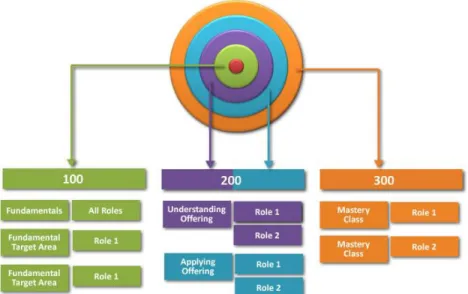
A simplified LMS taxonomy (organization of content within the LMS) can be constructed using Bloom’s Taxonomy. This taxonomy assumes the participant enters the curriculum with a core competency (baseline knowledge and skills as defined by the participant’s role.
Remembering: Describe fundamental knowledge Understanding: Demonstrate comprehension of knowledge using given skills
Applying: Apply knowledge and skills in the real environment
Mastery: Synthesize knowledge and develop advanced skill and mastery
The diagram shown above provides a view of the curriculum that provides the designer a map for developing new curricula or a method for identifying gaps in content/courseware that already exists. A sample mapping of the curriculum taxonomy to a framework of courseware is shown below.
Page 11
Figure 1 – A curriculum map built using Blooms Taxonomy.
Using the example above, the taxonomy for courseware and Course Codes could be developed: Series 100 XXX Fundamentals
Series 200 XXXX Practice Series 300 XXXX Mastery class
The number of levels in the frameworks should be kept to a minimum.
Define a Taxonomy for Content
To adopt standard naming conventions, your organization must define and agree upon a standard method for organizing content (content taxonomy) that is delivered to learners. This is different from the taxonomy for how content is organized within the LMS. This is about the hierarchy of content in a learning solution and how it relates to the other learning solutions.
For example, the LMS may only consist of three hierarchical levels, while the structure for the content may consists of five hierarchical levels.
The important thing is that the names of each level in the hierarchy need to be defined and agreed upon. What they are called doesn’t matter as much as the consistent use of the names and the hierarchy.
Keep in mind that there are two purposes for the content structure – one is for a consistent experience for the user, and the other is for a consistent development process by instructional designers.
Appendix D – LMS Standards
A successful LMS implementation requires standards for policies, procedures, and taxonomy. As use of the LMS grows across the enterprise, the lack of standards will result in the system becoming unusable. To ensure the LMS meets the needs of the enterprise the vision, policies, procedures, and standards for the system need to be defined. As part of Phase III (Implementation) our consultants guide your team through the process of answering questions such as the following:
Guiding Principles and V ision
What is the purpose of the LMS?
How will we know if it is successful?
What are the priority business drivers for learning investments?
What are the goals for learning?
What modalities of learning do we support?
Policies and Procedures
Who can use the LMS?
When can they access the LMS?
What content can they access?
What is the approval process for loading content on the LMS?
What are the procedures for:
o Developing content
o Loading content
o Updating content
o Archiving content
o Reporting on learning progress
Standards and Guidelines
Taxonomy of course structure
Lexicon of terms (curriculum, course, module, lesson, topic, etc.)
Production values
Optimize Use of the LMS
As part of the implementation, we partner with your team to…
Create a statement of the mission for corporate learning that defines the audiences and the intended impact on the business for its learning investments.
Identify the specific groups of people to be assigned the same or similar learning resources and the restrictions or permission that apply to each group.
re-Page 13
Create bylaws for a governing body that coordinate the management of learning resources and review outcomes on the business.
Draft a starter set of policies and procedures for using the LMS to cover acquiring/delivering, updating, loading, and evaluating content, maintaining an accurate database of people within the LMS and managing access to resources through the LMS, and reporting.
Create a set of standards for learning content in all forms (media, electronic, instructor, on-the-job experiences) that addresses adult learning principles and production values.
The ThinkWorks Approach
Our formal process to optimize the use of the LMS consists of Group Work Sessions and Post-Group Consultations led by a qualified facilitator well-versed in LMS governance. Each Group Work Session prepares the participants for the Post-Group Consultations that follow each Group Work Session. The process can be completed in eight to twelve weeks depending upon availability of business leaders.