i
PREMARITAL LIFE PLANS DURING THE TRANSITION TO ADULTHOOD IN THE UNITED STATES
Raquel Zanatta Coutinho
A thesis submitted to the faculty at the University of North Carolina at Chapel Hill in partial fulfillment of the requirements for the degree of Master of Arts in the Department of Sociology.
Chapel Hill 2013
Approved by:
Lisa D. Pearce
Michael J. Shanahan
ii
© 2013
iii ABSTRACT
Raquel Zanatta Coutinho: Premarital Life Plans during the Transition to Adulthood in the United States
(Under the direction of Lisa D. Pearce)
This paper investigates attitudes that never married young adults (ages 17-24) hold about
what is important to accomplish before getting married. Using data from the National Study of
Youth and Religion (NSYR), I investigate how a range of socio-economic and demographic
variables are related to a high degree of importance to particular achievements before marriage. I
then provide in-depth narrative of premarital life-plans drawing on qualitative data from
semi-structured interviews conducted with a subsample of NSYR survey respondents. As a result, the
preparation for marriage is a diverse experience in which young adults form their strategies
based on the combination and accumulation of three forms of capital: Human Capital, Identity
Formation Capital, and Relationship Capital. The importance of each seems to be structured by
important social institutions. Gender, religion, race/ethnicity, geographic location and family are
schema-producing and help shaping what young adults think is necessary to be achieved before
iv
To my parents, Maria Teresa and Marcelo,
for the amazing and cheerful encouragement and support.
To my partner, Andre,
v
ACKNOWLEDGEMENTS
I would like to first thank my advisor, Lisa D. Pearce, for allowing me under her
exceptional guidance. It was an incredible experience to be in close contact with her high-quality
research skills.
I thank the members of my committee, professor Mike Shanahan and professor Phillip
Morgan. Their classes, advice and suggestions were incredible rich not only for this paper, but also
for my future career doing research on the intersections of fertility and the life course. I also would
like to thank Lisa's research group, composed of the students Jessica Pearlman, Emily
Mckendry-Smith, Jane Lee, Sally Morris, and Karam Hwang for their feedback on a previous version of this
paper. Special thanks go to Jane, who walked me through the NSYR transcripts and to Jessica,
who taught me everything I know about latent class analysis and more.
I also thank the wonderful professors Cathy Zimmer, for Stata related help, Peter
Uhlenberg, for providing research material, and Victor Marshall and his wife Joanne Marshall, for
providing research material but also for life-related help and career mentorship. It feels really good
to have professors who cheer for you. Thanks to all my professors, colleagues from sociology and
outside, and friends, such as Jan Hendrickson-Smith and her husband Doug Smith for their advice
and friendship, Kassio, the Brazilian, for the happy moments spent in Chapel Hill and my cousin
Elisa Zanatta, for the fun experience of having a little sister for two months.
I want to acknowledge that I have been receiving high quality education and economic
support from the Department of Sociology at University of North Carolina at Chapel Hill. Without
vi
in my topic of study. I am very proud to be a student here and I know what my obligations are in
terms of trying to make this world a better place. I also receive a Carolina Population Center
training grant that allows me to have office space, travel money and a multitude of benefits that
just make life easier. When in Brazil during the summer of 2013, I was granted visiting scholar
status by the Demography Department of Cedeplar/UFMG. So, I thank the professors Paula
Miranda-Ribeiro and Simone Wajnman for making the arrangements.
I thank Andre Golgher, my partner, for all his support, advices and great ideas regarding
this paper and graduate student life. It is amazing to share a household where social science is
always on the menu.
Last but not least, I thank my wonderful cohort members, Brian Foster, Courtney
Boen, Daniel Auguste, Didem Turkoglu, Haj Yazdiha, Holly Straut, Karen Gerken, Kristen
Schorpp, and Michael Good (as well as their wonderful significant others Dan, Josh, George,
Travis, Sarah, Alyssa and Luna). No international student can survive studying abroad without
having friends. In my case, I was blessed; I got 9 angels that take excellent care of me. I love you
vii
TABLE OF CONTENTS
LIST OF FIGURES ... viii
Chapter 1 ... 1
INTRODUCTION ... 1
1.1 Theoretical Framework ... 3
1.2 Components of premarital life plan... 6
1.3 What may shape premarital life plans? ... 12
Chapter 2 ... 20
DATA AND METHODS ... 20
2.1 Data ... 20
2.2 Methods ... 21
Chapter 3 ... 26
RESULTS ... 26
3.1 Quantitative Analysis ... 26
3.2 Qualitative Analysis ... 35
3.3 Milestones that overlap ... 47
Chapter 4 ... 52
DISCUSSION & CONCLUSIONS ... 52
viii
LIST OF FIGURES
Table 1. Descriptive statistics of analytical sample……….………..27
Table 2. Ordinal Logit Regressions of the level of importance of selected
milestones being accomplished before marriage. ……….…31
Figure 1. Relative distribution of level of importance of premarital
achievements by selected variables………..………...……..29
Figure 2. Milestones cited by the young adults as premarital life plans and types of capital they belong: Human Capital, Relationship Formation
Capital and Identity Formation Capital. ………...………..37
Table 1 (Appendix). Ordinal Logit Regressions of the level of importance
1
Chapter 1
INTRODUCTION
Historically, the transition to adulthood has been understood as the accomplishment of
five markers, which are leaving school, starting a full-time job, leaving the home of origin,
getting married, and becoming a parent for the first time (Shanahan 2000)1. The ideal ordering of
events is socially constructed and transitioning in non-normative ways (out or off time) is argued
to decrease the social support available to an individual, leading to penalties in achievements
across the life course (Cherlin et al. 2008).Specific aspects of this transition and their order have
been exhaustively studied, such as completion of formal schooling, entrance into the labor force,
marriage, and parenthood (Hogan 1978; Rindfuss, Swicegood and Rosenfeld 1987; Settersten
and Mayer 1997; Shanahan 2000). Studies find pathways to adult hood are becoming more
diverse, especially since the 1980’s, when life trajectories no longer necessarily include marriage
and children (Thornton and Freedman 1982; Kefalas et al. 2011; Shanahan 2000), and other
types of investments such as education and career become more important (Blossfeld and
Huinink 1991).
Family formation has become a less-predictable sequence of events (Eggebeen and Dew 2009).
Although sequencing in the events that lead to adulthood varies, the percentage of people that
1 Some authors classify the transition into adulthood as a distinct life stage in industrialized societies that they call
2
consider "having a good marriage and family life" important has remained high, approximately
80% for women and 70% for men, throughout the years (Smock 2000);(Thornton and
Young-DeMarco 2001);(Cherlin 2004; Kefalas et al. 2011) suggesting that saying “I do” has not lost its
appeal. Ideas surrounding timing, circumstances, necessity, and gender differences in the
division of labor regarding marriage, as well as the acceptance of marriage dissolution forma
general set of commonly studied “attitudes toward marriage” (Pearce and Thornton 2007).
Perceptions, norms and values that explain decisions about starting to live with a partner are also
part of this set of attitudes, but little is known about how young adults draw their life plans and
where marriage fits in comparison with other accomplishments, such as completing one’s
education. Existing literature has emphasized the necessity of studying youth’s life plans and
what variables might shape these different outlines (Shanahan 2000).
A growing body of research is focused on what young adults say should be accomplished
before marriage and their predictors (Martin et al. 2003);(Hoffnung 2004);(Cunningham
and Thornton 2005); Smock, Manning and Porter 2005;(Cherlin et al. 2008); (Carroll et al.
2009); (Willoughby 2010); (Kefalas et al. 2011; Taylor and Vogel-Ferguson 2011);
(Willoughby et al. 2012);(Willoughby 2012). The results indicate that the accomplishments
young adults view as most important to achieve before marriage are those related to the
accumulation of experiences that will allow them to have a worry-free adult life, such as
financial stability, the achievements of personal goals, and compatibility with the marital partner.
However, most studies to date are limited in geographic scope, use non-probability samples,
focus on young adolescents, or only include current cohabiters. This paper extends these studies
by focusing on a representative sample of never married young adults using a mixed method
3
paper, I examine which milestones are reported as necessary to be accomplished in order for one
to feel ready for marriage, the degree of importance youth give to accomplishing certain
milestones before marriage, and how different socio-demographic characteristics relate to having
unique views on what is important to achieve before one marries. Grounded in selected elements
of the sociology of family literature, I explore young adults’ thoughts about pathways to
marriage and define characteristics associated with different ideals for the ordering of marriage
in relation to other life events.
First, I identify premarital life plans and their correlates by using survey data from the
longitudinal and multi-method National Study of Youth and Religion (NSYR) to model the level
of importance attributed to achieving the following milestones: completing education,
establishing a career, living on their own, buying a house, living with a partner, and dating
enough other people. Later, in-depth interviews conducted with a subsample of NSYR expand
the meaning of the six milestones and capture other important premarital life plans that are not
anticipated in the survey. This holistic set of evidence gives insight into how contemporary youth
will plan for the transition into adulthood and into marriage (Raley et al. 2007; Shanahan 2000;
Willoughby 2010).
1.1 Theoretical Framework
Life course scholars who have empirically tested changes in the patterns of life stage
transitions have concluded that life has become less predictable, less stable, less orderly, less
collectively determined, and less tied to age norms (Settersten 1998; Bruckner and Mayer2005;
Billari and Liefbroer, 2007; Kefalas et al., 2011). However, marriage continues to be highly
valued by young adults and held as extremely important. Thus, delays in the timing of marriage,
4
and positive attitudes toward marriage, which continues to be nearly universally viewed as part
of the transition to adulthood (Thornton and Freedman 1982; Thornton and Young-De Marco
2001; Willoughby 2010).
These findings open up a field of research that investigates where marriage will be
situated in the life-plan or whether it is included at all. This line of inquiry also seeks to address
questions regarding the influences that shape the meaning of marriage and different degrees of
importance to different milestones being accomplished before getting married. In this vein, I
argue that these diverse forms of prioritizing certain orders of pre-marital achievements are
defined by the individual; however, they are shaped by societal norms. The Theory of
Conjunctural Action (TCA), which is based on Sewell’s (1992) discussion of culture and
structure defines social structure as “durable forms of organization, patterns of behavior, or
systems of social relations (Johnson-Hanks et al. 2011, p. 1). In this theory, the concept of
structure is divided into two components: schemas and materials.2Schemas are expected ideas
and behavior one learns by induction or direct exposure overtime through socialization and
interaction.
Our interaction partners rely on the schematic components of structure in navigating specific social conjunctures, normalizing the schemas as they go. Each successful reiteration of a cultural schema legitimates and strengthens it, making the schema appear non-ideological and noncontroversial. Uncontested schemas, hegemonic ones, are experienced as normal and transparent modes of being or acting—not as options, but as just the ways things are (Johnson-Hanks et al. 2011:6).
2 The other component of structure, material, is the symbolic representation of a schema, such as a bachelor’s degree.
5
Schemas are essentially mental maps of how an individual is going to respond and interact with
the world. A relevant example of this would be a person’s conceptualization of milestones that
are needed to be achieved prior to marriage. In this sense, schemas produced by social structures,
like the family, help shape the premarital life plans a person will draw.
A commonly discussed type of milestone often prioritized on the path to marriage in
one’s life plan are investments in human capital or activities that “influence future monetary and
psychic income by increasing the resources in people” (Becker 1964, p.11). In fact there are
other forms of capital that young people consider valuable for their premarital life plans. Thus,
the period before marriage, commonly situated during young adulthood, can be understood as a
period of accumulation of capitals, both tangible and intangible, that will increase people’s
resources, improving the chances that a future marriage and family life will be successful. Three
forms of capital are described in the next section, with the last two of them never having been
explicitly labeled as capitals before: Human Capital, Identity Formation Capital, and
Relationship Capital. Examples of these types of capitals are, respectively, resources linked to
financial stability (for example, completing education or starting a career); those related to
having acquired a maturity of personality (like, for example, by becoming old enough); and last,
the wellbeing of the relationship (for example, having tested the compatibility of the couple by
means of cohabitation).
In addition to the influence of institutions, people are not passive recipients of structures.
They are cognitive beings, thus the TCA defines identity, which is shaped by social structure and
also by agency as a “capacity for autonomous social action” or “ability to resist structure”
(Calhoun 2002, p. 7, and Emirbayer and Mische, 1998 in Johnson-Hanks et al 2011).I recognize
6
and positions they occupy, which can reinforce or challenge the person’s identity. Stryker and
Burke (2000) explain that the higher the salience and the commitment to certain identity, the
higher the chances that the identity will be enacted.
In conclusion, social structures will suggest guidelines and expectations of capital
accumulation that are visible in the discourse of young adults who are planning their premarital
life. However, young adults have the autonomy to choose the forms of capital that they believe
are more important to be achieved before marriage according to their own identity.
The present article analyzes what milestones are necessary to be accomplished in order
for one to feel ready for marriage, the degree of importance youth give to accomplishing certain
milestones before marriage, and how socio-economic and demographic variables are associated
with different premarital life plans and accumulations.3
1.2 Components of premarital life plan
Recent research has found that the meaning of marriage and markers that needs to be
accomplished before getting married differs among individuals. As an example, marriage can be
defined as a form of personal achievement, showing families and friends “you passed a
milestone in the development of self-identities” or you have achieved financial stability (Cherlin,
2004). Using Oppenheimer’s theory (1994) to explain that marriage is a function of affordability
Edin (2000) explains that a couple marries when they have the minimum conditions to establish
an independent household with a “culturally-defined” minimum (Edin, 2000, p. 127). In other
cases marriage is not necessarily understood as a rite of passage or a symbol of financial
3 Showing these associations is one of the main aims of this paper. Unfortunately, given the age of the interviewees
7
independence. Rather it serves to grant status, respectability or to affirm the quality of the
couple’s relationship by establishing a public commitment regardless of previous achievements
(Cherlin 2004; Edin 2000). Nevertheless, love, self-fulfillment and commitment, as suggested by
Cherlin (2004) could surpass the importance of other achievements4. As seen above, much has
been researched on things that need to be accomplished before getting married. To my
knowledge, only one study has focused on how these components form different premarital plans
and how these priorities differ among individuals (Kefalas et al. 2011).
Kefalas et al. (2011) address views of marriage and what must be accomplished
beforehand using qualitative data from in-depth interviews.5 They find that 18% of the sample is
composed of marriage naturalists or fast starters, people who marry at earlier ages and achieve
the markers of adulthood afterwards. These respondents are usually from rural areas in the
United States and view marriage as a form of commitment with the inevitable outcome of a long
lasting relationship. Marriage is part of a schedule to follow, without a particular order, but in
which being married is a prerequisite for being an adult (Kefalas et al. 2011:870). Alternatively,
a second group of people, marriage planners, present a completely different narrative. They are
usually from urban areas and present characteristics of post-industrialized societies in which
personal life goals for higher education and economic security need to be guaranteed in order for
one to be considered an adult. In this situation, marriage is incompatible with pursuit of a career.
The eventual commitment comes with great effort from both partners, following the
accumulation of intimate knowledge and, among other things, developing a sense of mutual trust
4 Brown (2003), for example, in a study with 646 cohabiters and 3086 married couples using the National Survey of
Families and Households found that marriage among cohabiting couples is a matter of relationship happiness and expectations about marriage.
8
with the carefully selected partner. Marriage will not happen unless a subjective sense of
readiness and maturating is present and only after the relationship is tested, usually by
cohabitation. In order for planners to get married, just like some of the youth Regnerus and
Uecker (2011) studied, they need to acquire a marriage mentality – “a cognitive framework that
allows them to give up the self-interested ways of the unattached single so they can commit to
the obligations and responsibilities of being a husband and a wife (Kefalas et al. 2011:868).” It is
important to keep in mind that Kefalas et al. (2011) organizes the sample into two major groups,
but they do not deny the existence of people who are caught in between naturalists and planners.
Thus, the literature might not have fully uncovered the milestones that need to be accomplished
before marriage and the predictors of different premarital plans.
Following these authors, markers that need to be accomplished, or accumulated, before
marriage, or the so called “components of marital readiness” derive from three main spheres:
human capital (for instance, completing education), identity formation capital (for instance,
fulfilling personal dreams), and relationship capital (which includes, for example, living with the
person before getting married to test the compatibility of the relationship). I will develop these
factors below.
1.2.1 Human Capital Attainment
In reviewing the literature, one particular variable is consistently cited as an essential
premarital achievement: completing education. Although it can fit into the “personal
development” sphere, completing education seems to be much closer to human capital
attainment because of the common understanding that education increases life opportunities.
Historically, those who were in college but wanted to get married would quit school.
9
to a significantly better life of opportunities, and leaving school “truncates the accumulation of
knowledge and skills necessary for an attractive job, resulting in a poorer job and a lower
standard of living” (Thornton, Axinn, and Teachman, 1995, p. 763).Since there is a widespread
desire not to let marriage interfere with education and to obtain some work experience before
marriage, many who wish to attain further education are more likely to postpone marriage
(Thornton and Freedman 1982; Lehrer 2004b; Smock, Manning and Porter 2005; Regnerus and
Uecker 2011).
Research using data from Germany shows how increasing investments in human capital
by females prolongs schooling, which postpones marriage and childbearing (Blossfeld and
Huinink, 1991;Rindfuss, Swicegood and Rosenfeld 1987;Oppenheimer 1988). In this line,
“women's timing of marriage is therefore independent of the quantity of human capital
investments. (…) marriage is postponed because women postpone their transition from youth to
adulthood and not because women acquire greater quantities of human capital, thereby
increasing their labor-force attachment” (Blossfeld and Huinink, 1991, p.158).
Although extensive research suggests that higher education delays marriage, there are no
differences by education in the proportion of those who ever marry, which means marriage is
still very universal(Manda and Meyer 2005; Raymo 2003).Thus, adolescents who have high
educational aspirations also have high expectations to marry (Starrels and Holm 2000 in
Manning, Longmore and Giordano, 2007). Apparently, the mechanism is that during adolescence
young adults will favor career plans and friends over family life, but over time they will
prioritize plans for marriage, which demonstrates that a person will make adjustments in their
10
In addition to education, financial independence is among the most cited variables when
it comes to define what is necessary for a person to get married or to transition from cohabitation
to marriage (Thornton, Axinn and Teachman 1995; Cherlin 2004; Smock, Manning and Porter
2005; Carroll et al. 2009; Gerson 2010; Kefalas et al. 2011; Regnerus and Uecker 2011). In this
sense, just like education, availability of money or financial independence from parents is a goal
to be achieved before one changes their marital status. The literature indicates that the reasons
for financial stability vary by gender. While men expect to fulfill their role as the provider for the
family, women want to make sure they can support themselves in case anything goes wrong.
According to Gerson (2010), “self-reliant women look to the workplace as the most
straightforward route to gaining financial security, social status, and personal identity” (Gerson,
2010, p. 135).
Purchasing a house is not seen as an important premarital achievement as education or
career, suggesting home ownership is not tightly linked with their kinds of financial stability
necessary before marriage. In the study of Carroll et al. (2009), 24% of young adults said that a
house was important, much fewer than other indicators such as getting settled with a career
(51%) and finishing education (43%). Young adults may expect that the actual purchase of a
house occurs after marriage rather than before.
1.2.2 Identity Formation Capital
In terms of personal development, living on one’s own, and learning to take care of
oneself feature very prominently in the literature of things that need to be accomplished before
getting married. For some respondents in Regnerus and Uecker (2011)’s research of young
adult’s relationships and sexuality in the United States, “fear of divorce”, “low confidence in
11
marrying early. Getting married challenges personal freedom, disturbs investments in personal
goals such as international travel, and brings concern about having other lives linked to their
own. In sum, respondents indicated that marriage was something to be postponed until the
moment when the person is ready to move beyond their self-focused nature.
Dating enough other people and having sexual experiences before marriage are also seen
as important steps that should be achieved before staying with only one person. Regnerus and
Uecker (2011) reveal young adults’ desire to have as many sexual experiences as they can before
marriage. Willoughby (2012), incorporating measurements of sexual behavior and attitudes,
creates clusters of attitudes toward marriage resulting in four different packages of marital
readiness. Respondents who most engaged in sexual activities are also those that respond most
favorably to cohabitation and are most likely to postpone marriage, which suggests that for this
group of young adults especially, dating other people and living with the partner is an important
pre-marital achievement.
1.2.3 Relationship Capital
Differently from accumulating multiple dating experiences, relationship capital
accumulation refers to the investments in the quality of the relationship and stability of the
couple. Apparently, being sure that the person is the one and that the couple is compatible is a
very important achievement.
Research demonstrates that cohabiting, or living with the person before getting married,
is commonly understood as a necessary step on the way to the aisle. For example, Bourdais and
Lapierre-Adamcyk (2004), conducting research in Canada found that for a proportion of their
sample, cohabitation is a period to test the compatibility of relationship while completing
12
seen as a way to increase and optimize the chances of a successful marriage (Martin et al. 2003).
Living together has many of the same benefits of marriage without the necessary permanence, so
one is able to know the partner better and determine compatibility. Following a period of
successful cohabitation, a successful marriage is seen as more likely (Heuveline and Timberlake,
2004; Regnerus and Uecker, 2011).
1.3 What may shape premarital life plans?
Given that youth might be subjected to various schemas for marriage, investigating the
different sources of schemas is important to understand what types of premarital capital
accumulation are valued and whether premarital life plans vary by socio-economic and
demographic characteristics.6In the literature, there are five commonly discussed sources of
schemas that contribute to differences in pre-marital life plans and for attributing different levels
of importance to achieving certain milestones before marriage. They are religious affiliation,
gender, race/ethnicity, geographic location, and family resources (values and structure).In the
cases where the relationship between the sources of schema and attitudes toward marriage has
not yet been defined by the literature, I bring factors that help understand why certain schemas
set the expectation for certain premarital life plans.
1.3.1 Religious affiliation
The importance of incorporating religious affiliation in a study of attitudes toward
marriage lays on the fact that values, norms, and beliefs that ultimately shape important decisions
on the life course and might affect society are being made under the influence of religious
institutions and religious socialization (Pearce and Thornton 2007; Lehrer 2004b; Regnerus and
6 As much as I would like to investigate how schemas shape attitudes, this paper investigates associations between
13
Uecker2011). While Catholics, Jews and people without religious affiliation tend to marry later,
Evangelical Protestants and Mormons marry much earlier. Mainline Protestants are in between.
Other researchers have found that Catholics delay marriage as much as liberal Protestants and
more often than their Conservative Protestant and Mormon peers. Jews on the other hand, marry
later than all denominations but earlier than people without religious affiliation (Lehrer 2000,
2004; Xu, Hudspeth, and Bartkowski 2005). These differences in the timing of marriage across
religious groups may reflect differences in value placed on certain types of capital being
accumulated before marriage.
If educational aspirations vary by affiliation, one might observe different attitudes toward
accomplishing education before marriage according to the religious affiliation (Xu, Hudspeth
and Bartkowski, 2005). Jewish and Mainline Protestant women, for example, who usually have a
higher desire for educational attainment and commitment to the labor market, will likely value
postponing marriage to finish their education and gain financial independence (Lehrer 2004).
An extensive literature also points to the fact that religious influence encompasses the
entry into dating and marriage by fostering long term relationships and early marriage (Mahoney,
Swank, Tarakeshwar 2001; Pearce and Thornton, 2007; Lehrer, 2004, 2004b; Xu, Hudspeth, and
Bartkowski, 2005; Carroll et al, 2000).However, with regard to likelihood of cohabitation,
Evangelical Protestants are not significantly different from others religious service attendants
(Pearce and Thornton, 2007). In fact, religious service adherents, independently of their
affiliation, tend to be more similar among themselves than when compared to non-religious
groups, which are constantly found as the ones most likely to cohabit. Because there might be
competition between religious schemas for early marriage and postponement of marriage to
14
Evangelical Protestants will give less importance to achieving human capital, personal
development, or relationship capital before marriage when compared to other affiliations.
1.3.2 Gender
Gerson’s qualitative research on gender, work, and family bring several examples of how
gender shapes the transition to adulthood with men being more concerned with providing for their
families while women are concerned about self-reliability. However, she shows how the new
generations do not have only one single path to follow regarding their premarital life plans. “Work
and family shifts have created an ambiguous mix of new options and new insecurities, with
growing conflict between work and parenting, autonomy and commitment, time and money”
(Gerson 2010, p. 7). I then expect that human capital achievements such as education completion
and establishment of a career will be equally important before marriage for men and women.
The same cannot be said about the association between gender and Identity Formation
Capital and Relationship Capital. In the United States, women are more likely to disapprove of
cohabitation and think more highly of marriage than men, presenting a lower median for preferable
age at marriage (23.8) than when compared to that of the young men (25.1) (Thornton, 1989;
Thornton and Young-DeMarco 2001; Pearce and Thornton, 2007; Thornton and Freedman 1982;
Crissey 2005). Thus, achievements associated with Identity Formation Capital seem to be more
important for men, while achievements associated with the strength of the Relationship Capital
seem to be more important for women.
15
The association between race/ethnicity and attitudes toward marriage is not very well
described by the literature. However, prior research has shown interesting racial and ethnic
variation in marriage that helps to understand how race/ethnicity might be setting the expectation
for certain premarital life plans (Starrels and Holm 2000; South 2001; Regnerus and
Uecker,2011). Blacks have consistently low percentages of early marriage and increased
cohabitations rates. In the work of Regnerus and Uecker (2011), only 15% of African American
women and men marry before the age of 24. For whites, the percentage is 36% for women and
24% for men. Hispanic men are the most likely to marry, with 3 in 10 men getting married
before they reach 23. Their female counterparts are only lower than the white, with 30% getting
married before age 24. The results found by South (2001) are even more striking: the odds for
blacks to get married are 43% lower than the corresponding odds for non-blacks.
In the case of blacks, studies do not show that the postponement of marriage is a way to
foster education and work opportunities. Among the most studied hypotheses are the
deterioration of the labor market, the decrease in marriageable partners, the impact of family
socioeconomic resources on marital timing, the lower levels of resources in black families and
the worsening in young men’s economic circumstances (Oppenheimer et al. 1997,Lichter,
Le-Clere, and McLaughlin, 1991 in Starrels and Holm 2000). However, given that blacks tend to
postpone marriage more than whites and other races/ethnicities, I expect that they will attribute
higher degree of importance to achieving milestones related to Human Capital Achievement. As
for Hispanics, given that they marry earlier than whites, I expect that they are the ones who will
16
No specific reference for racial and ethnicity differences in regards to Identity Formation
Capital and Relationship Capital was found in the literature, so I do not expect to have
significant results.
1.3.4 Geographic location
In two recent studies (Kefalas et al, 2011; Regnerus and Uecker, 2011), living in rural
areas or in the south of the United States was found to be associated with earlier marriage, and
intuitively, fewer necessary milestones accomplished before marriage. According to Regnerus
and Uecker (2011), approximately 45% of females living in rural areas were married by age 24,
while in urban settings, urban or suburban, the percentage was around 28. Men, regardless of
location, had smaller percentages, with around 31% married before 24 in rural settings and
around 21% for urban/suburban. Kefalas et al (2011) explains the behavior of people who live in
rural areas as a matter of how opportunities are structured in those regions compared to urban
areas. According to the authors, a mixture of agrarian and industrial economy with lower cost of
living reduces the barriers for housing and makes it easier for a couple to achieve financial
independence compared to that of young urban couples. Apart from that, small towns provide
their young inhabitants with fewer things to do and fewer choices in life, while big cities convey
the notion that “there is more to life than starting a family” (Kefalas et al. 2011, p. 858).Given all
this, I expect that people living in rural areas will hold more schemas that place less importance
on accumulating personal goals prior to marriage.
1.3.5 Family resources, structure, and values
The literature on attitudes toward marriage suggests that there are several family
characteristics that may influence ideas regarding the best timing for union formation for an
17
social class), family structure, and parental values. Parental resources are likely to influence
children’s attitudes toward marriage because the effects of economic wellbeing are likely to
persist even after children leave the household, which are predominantly demonstrated in the
accumulated opportunities over the life course (South, 2001; Regnerus and Uecker, 2011).7 In
this sense, greater parental resources may delay marriage by fostering higher education
aspiration by providing better educational opportunities and “enhancing the material home
environment for adolescents and young adults, reducing their motivation to leave home through
marriage or other routes” (Avery, Goldscheider, and Speare, 1992 in South 2011:607; Blossfeld
and Huinink 1991). Thus, “these resources constitute not only income positions, properties,
consumption styles, and economic strategies of families, but also their social orientations, values,
and beliefs, which influence educational and career decisions of children (Blossfeld and Huinink
1991, p. 154). I then expect that children of high income will be more likely to attribute high
importance to completing education or establishing a career, when compared to their low SES
counterparts. Because SES is associated with level of education, I expect the same relationship
above specified when comparing children of parents with high educational level and low
educational level.
At the same time high parental resources reduce the motivation to leave home, high
income parents could support their children living in independent households, which then could
increase the changes of new living arrangements such as living on their own or cohabiting. Thus,
I do not expect parental resources to have any effect on the accumulation of capital related to
Identity Formation and Relationship.
7With time, as the person grows older, the effect of family resources decreases, but not for children of single
18
The link between family structure and the accumulation of Human Capital is well
described by the literature. Children of those called intact families have higher odds of
graduating high school and higher education aspirations (Astoneand McLanahan 1991;
Gintherand Pollak 2003, Carlson and Berger 2013).I then expect that children of divorced
parents or single parents will devote less importance to accumulating human capital prior to
marriage.
Non-traditional family structure (parental divorce, parental remarriage, and single-parent
families) is associated with children’s marriage and cohabitation patterns increasing negative
thoughts about marriage at the same time it values singlehood as a way of life (Thornton and
Freedman 1982, p. 297; Crissey 2005; Raley et al, 2007). Adolescents living with cohabiting
parents have 74% higher odds of expecting to cohabit prior to marriage than teens living with
two married parents (Manning, Longmore and Giordano 2007).8Those raised by single mothers
have only 82% the chances of getting married of a child raised in the so-called “intact” families
(South 2001). It seems that individuals raised in non-traditional family structures are more likely
to see other family arrangements as possibilities, or not be constrained to think that marriage is
the only way. Thus, I expect they are more likely to state that identity Formation Capital and
Relationship Capital need to be accomplished before settling down, given that they may have
been exposed to the failure of a marriage.
Parent’s values will be measured by their religiosity. Youth who grew up in more
religious backgrounds, having parents who attended religious service often, are less likely to
cohabit (Kalmijn and Luijkx, 2005; Willoughby et al. 2012). That could be directly linked to
19
parental expectations that children get married in traditional religious arrangements or to the
expectations of the children themselves, who will share the same beliefs as their parents.
I expect parental religious service attendance to inform their children’s schemas on
premarital life plan and to work as well as the children’s religious affiliation. The more religious
and conservative the parents are, the fewer capitals will need to be achieved before getting
married.
Based on the theoretical dimension hereby presented, the current article analyzes what
milestones are necessary to be accomplished in order for one to feel ready for marriage, the
degree of importance youth give to accomplishing certain milestones before marriage, and how
socio-economic and demographic variables are associated with different premarital life plans. In
20
Chapter 2
DATA AND METHODS
2.1 Data
Data come from the National Study of Youth and Religion (NSYR),9 a longitudinal,
multi-method research project launched in 2001to understand how an adolescent’s life is shaped
and influenced by religion and spirituality throughout youth and adulthood. A random-digit-dial
telephone survey method was employed to sample nationally-representative households with
youth ages 13-17 present. These youths and their parents were first interviewed in the summer of
2002 (wave 1) and then only the youth were re-interviewed in 2005 (wave 2) and in 2007/2008
(wave 3).
The total sample size in wave 1 was 3370, and the completion rates are of 78% for wave
2 and 77.1% for wave 3, resulting in 2532 people in wave 3 that are eligible for this analysis.
Analysis indicates that missing cases can be treated as Missing Completely at Random (166).
After deleting those, the Jewish oversample (80), and the ever married respondents (143), sample
size was reduced to 2143, which is the quantitative analytical sample.
Only the first and last waves were utilized in this paper. As customary in longitudinal
surveys, the covariates are measured at wave 1 while respondents were still living in their
9 Studies have shown that the NSYR is a representative sample of the U.S. teenage population aged 13-17 and their
21
parent’s or guardian’s home and because the measurement of those characteristics precede the
measurement of the dependent variables of wave 3.
The NSYR also contained a qualitative portion. After every wave of the survey, a subset
of youth was selected from the telephone survey respondents to participate in semi-structured
interviews by using a stratified quota sample that is not nationally representative but does contain
key variance in many socio-demographic characteristics, such as region, urban/suburban/rural,
age, sex, race/ethnicity, household income, religion and school. For this analysis, I used230
interviews conducted after the wave 3 survey, including 151 who had been interviewed in
previous waves’ semi-structured interview and 79 randomly selected in order to renew the
sample and verify possible “contamination” of interview answers based on the fact of having
participated in interviews before. After excluding those who were already married (12 of them),
the number of interviews that were coded and analyzed was 218.The semi-structured interview
guide covered the same topics as the survey; however, the questions were asked in different
formats, probing respondents to provide more in-depth answers.
2.2 Methods
In order to investigate how a range of socio-economic and demographic variables are
related to the degree of importance to particular achievements before marriage, STATA 12 was
used to perform Ordered Logit Models, as I will further detail below.10The survey allows the
10 Three strategies of research were tested prior to the definition of the methodology of this article. The first
22
assessment of importance to achieve the six prior established milestones before marriage. Given
that this six item list does not exhaust the range of possible milestones, the in-depth interviews
make possible the assessment of other markers that were not listed in the survey, but are part of
what one considers important to achieve before saying I do, such as love and relationship
commitment, among other elements which to my knowledge had not yet been described by the
literature. Then, qualitative data from semi-structured interviews conducted with a subsample of
NSYR survey respondents was analyzed with the support of the online software Dedoose, that
facilitates coding and selection of excerpts. In this software, the choice of coding and themes is
manually done by the researcher, having the software serve the function of organizing, marking
and counting. The literature review provided the first codes and themes considered in the
analysis of qualitative data, such as complete education and other more common milestones. As
new themes emerged, for example, personal goals, they were added to the codebook, a method
described by other qualitative researchers (Weiss 1994; Coffey and Atkinson 1996; Ryan and
Bernard 2003).
In depth interviews are frequently used in the social sciences, and their analysis allows
for capturing people’s perception and interpretation, thoughts and feelings, and also implied
discourse, which is much more difficult to capture on quantitative questionnaires (Weiss 1994).
Nevertheless, qualitative interviews place attitudes in a context embedded in a conversation,
which is believed to provide additional nuance to the responses given in the survey.11Thus, this
mixed methods approach in which semi-structured interviews enlighten and complement the
author decided to keep the analysis the simplest way as possible by running 6 ordinal logits without any grouping or any attempt to reduce the dependent variables.
11 Given the extensive length of the interviews, the analysis will be concentrated only in the portions related to
23
findings from the quantitative analysis provides a more comprehensive picture and more in-depth
perspective of premarital life plans (Small 2009).
In the following paragraphs I will briefly explain the Quantitative method of this study,
as well as the variables used in the regressions.
2.2.1 Variables
The survey allows the assessment of the importance of different milestones to be
achieved before marriage. The variables that represent these milestones come from Wave 3 and
they can also be associated with three types of capitals (see below in parenthesis).12They are:
1.Complete your education before getting married (Human Capital)
2.Establish your career before getting married (Human Capital)
3.Buy a home before getting married (Human Capital/Relationship Capital)
4.Live on your own a while before getting married (Identity Formation Capital)
5.Date enough other people before getting married (Relationship Capital/Identity
Formation Capital)
6.Live with partner (Relationship Capital)
Each of these variables contains a four category level of importance as follows: not very
important or not at all important,13somewhat important, very important, and extremely important.
Consequently, I chose to use an Ordered Logit Model, as I will specify further below.
12 Preliminary tests have shown that some of the six variables are correlated. For instance, establishing a career is
correlated with completing education before marriage (Gamma= 0.60 and Kendall Tau-b= 0.44). This same
tendency of being correlated was also observed for other variables which sparked the attempt to group variables into indexes, but this attempt, as explained before, was not successful.
13 The original variable in the dataset, not very important and not at all important were different categories. They
24
2.2.2 Covariates
The variables used as predictors for the Ordered Logit Model have the function of
standing as proxies for social or schema-producing institutions. They all come from Wave 1 and
their respective categories and codes are: Race/Ethnicity (white=1, black=2, Latino=3, Other=4),
Gender (male=0, female=1), Religious affiliation (1= Conservative Protestants, 2 = Mainline
Protestants, 3 = Black Protestants, 4=Catholics, 5=Jewish, 6=Not-Religious, 7=Other),
Geographic location (urban=0, rural=1). In order to investigate Family Resources, Structure, and
Values, a series of variables will be included in the models. They are Household income (Up to
$30K=1, $30K to $50K=2, $50K to $80K=3, More than $80K=4, Don´t know or missing =5),
Parents’ highest education14 (Less than high school=1, High school=2, Some education after
high school=3, BA/BS or Grad school incomplete= 4, Some grad school completed=5), parental
religious service attendance (never =1, Once or more times a week=2, Once to 3 times a
month=3, Few to many times a year=4), and times experienced parental breakup (no=0, once=1,
more than once=2).15The relative distribution of responses across categories can be seen on
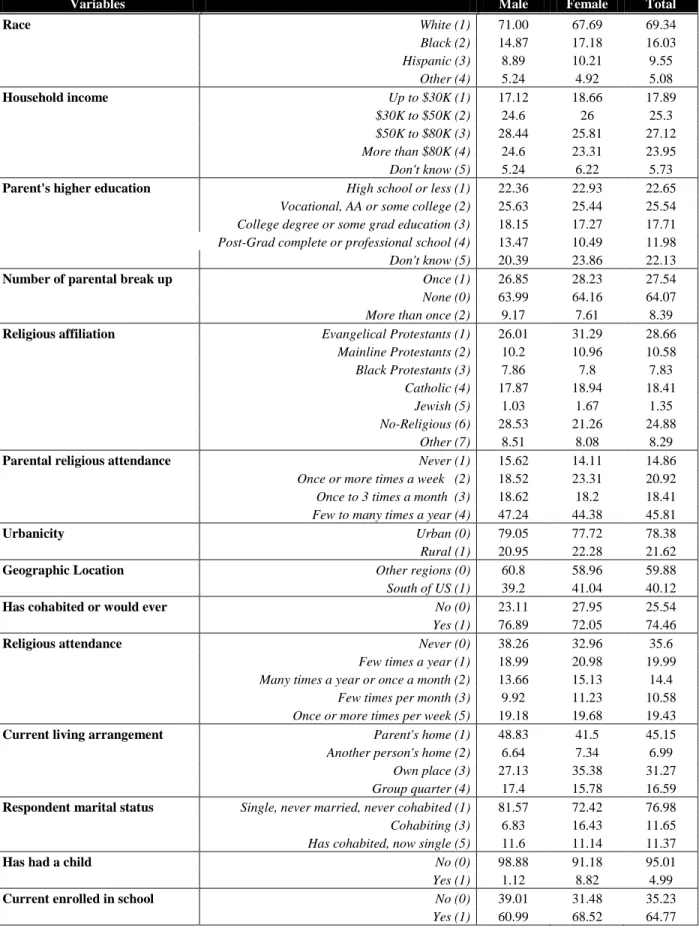
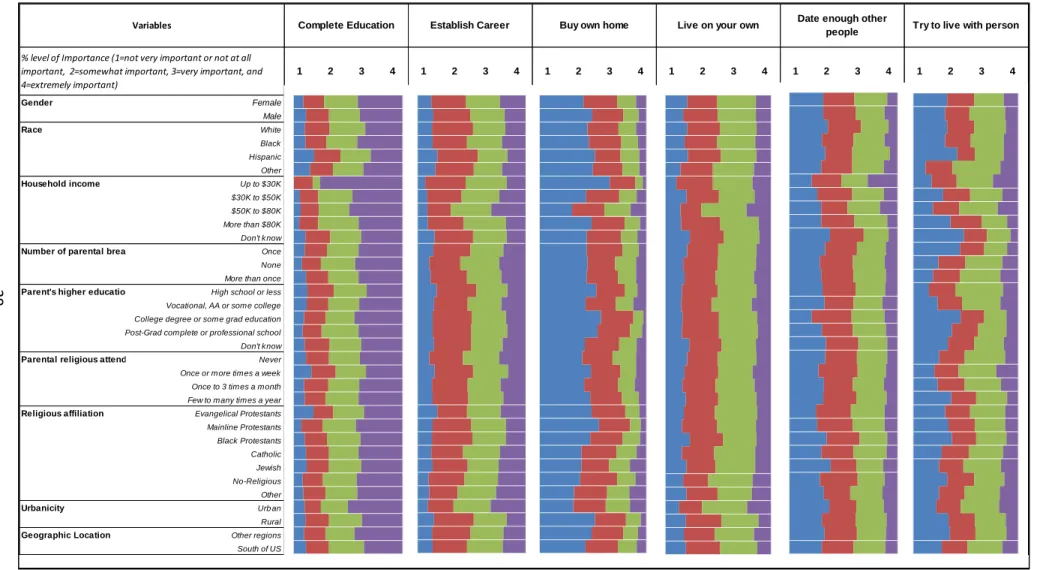
Table 1. A distribution of level of importance for each milestone can be seen in Figure 1.
Adding to that, other variables are used as sources of control. They are Age (continuous),
Years of achieved education (continuous), Current living arrangement (parents, by him or
herself, partner, roommate, sonorities/fraternities/dorms);Respondent´s marital status (single,
never married, never cohabited=1, cohabiting=2, has cohabited, now single=3); Ever cohabited
or would cohabit (no=0, yes = 1); Ever dated (no=0, yes = 1), Ever had sex (no=0, yes = 1); Has
14 This is the highest level of education achieved among the parents or guardians.
15 Previous analysis indicated that, although Parental Marital Status would be the best variable to control for family
25
had a child (no=0, yes=1); Currently enrolled in school (no=0, yes=1). Since people with the
same religious affiliation might have different behaviors, it is important to control for religiosity.
I use religious service attendance (never=0, few times a year=1, many times a year or once a
month=2, few times per month=3, once or more times per week=4).
2.2.3 Ordered Logit Model
The level of importance of accomplishing the six milestones before marriage has a four
category response ranging from extremely important to not very or not at all important. Given
the small number of categories, it is not advised to use Classical Linear Regression, and I chose
to use Ordered Logit Regression, which is a regression model for ordinal dependent variables
(Wooldridge, 2009, Greene and Hensher 2010).16
Coefficients are estimated using Maximum Likelihood Estimation,17 and the error is
assumed to be logistically distributed. This equation is a generalization of the ordinary binary
logit model (Stata Corp 2003).
16 Another option would be to use Multinomial Logit Regression, in which each category of response is set to be
independent and discrete. In order to decide on the best approach, I applied the test of proportional odds which indicates if the categories of a dependent variable should be treated as ordered. If that is the case, the Ordered Logit Model has advantages over the Multinomial Logit because it produces only one set of slope coefficients while the latter produces a set of slopes for each category, therefore rendering a more complex interpretation. Preliminary tests indicate that the data meets the proportional odds assumption for 5 of the 6 milestones; hence I confirmed my choice for the Ordered Logit Regression for all six variables to keep consistency. The values for the Proportional Odds assumption are found below the coefficients in the table of results.
26
Chapter 3
RESULTS
3.1 Quantitative Analysis
The result of the six ordinal regressions indicate that institutions may, in fact, be sources
of schemas for marriage. Gender, religion, race/ethnicity, family structure and geographic location
seem to be highly influential in regards to the things that need to be accomplished before one gets
married, even after controlling for endogenous variables that could change the strength of the
association18. Below, I will discuss the factors that are associated with increasing importance of
each milestone inquired in the quantitative survey. The coefficients for the ordered logit
regressions can be found in Table 2. The odds ratio reveal the likelihood of a person to have a one
unit increase in the outcome variables (so, from saying that certain milestones is not important at
all to saying that it is somewhat important, then from saying it is somewhat important to very
important, and lastly, from saying it is very important, to saying it is extremely important), given
a one unit increase in the independent variable.
27
Table 1. Descriptive statistics of analytical sample (NSYR, n=2134)
Variables Male Female Total
Race White (1) 71.00 67.69 69.34
Black (2) 14.87 17.18 16.03
Hispanic (3) 8.89 10.21 9.55
Other (4) 5.24 4.92 5.08
Household income Up to $30K (1) 17.12 18.66 17.89
$30K to $50K (2) 24.6 26 25.3
$50K to $80K (3) 28.44 25.81 27.12
More than $80K (4) 24.6 23.31 23.95
Don't know (5) 5.24 6.22 5.73
Parent's higher education High school or less (1) 22.36 22.93 22.65
Vocational, AA or some college (2) 25.63 25.44 25.54
College degree or some grad education (3) 18.15 17.27 17.71
Post-Grad complete or professional school (4) 13.47 10.49 11.98
Don't know (5) 20.39 23.86 22.13
Number of parental break up Once (1) 26.85 28.23 27.54
None (0) 63.99 64.16 64.07
More than once (2) 9.17 7.61 8.39
Religious affiliation Evangelical Protestants (1) 26.01 31.29 28.66
Mainline Protestants (2) 10.2 10.96 10.58
Black Protestants (3) 7.86 7.8 7.83
Catholic (4) 17.87 18.94 18.41
Jewish (5) 1.03 1.67 1.35
No-Religious (6) 28.53 21.26 24.88
Other (7) 8.51 8.08 8.29
Parental religious attendance Never (1) 15.62 14.11 14.86
Once or more times a week (2) 18.52 23.31 20.92
Once to 3 times a month (3) 18.62 18.2 18.41
Few to many times a year (4) 47.24 44.38 45.81
Urbanicity Urban (0) 79.05 77.72 78.38
Rural (1) 20.95 22.28 21.62
Geographic Location Other regions (0) 60.8 58.96 59.88
South of US (1) 39.2 41.04 40.12
Has cohabited or would ever No (0) 23.11 27.95 25.54
Yes (1) 76.89 72.05 74.46
Religious attendance Never (0) 38.26 32.96 35.6
Few times a year (1) 18.99 20.98 19.99
Many times a year or once a month (2) 13.66 15.13 14.4
Few times per month (3) 9.92 11.23 10.58
Once or more times per week (5) 19.18 19.68 19.43
Current living arrangement Parent's home (1) 48.83 41.5 45.15
Another person's home (2) 6.64 7.34 6.99
Own place (3) 27.13 35.38 31.27
Group quarter (4) 17.4 15.78 16.59
Respondent marital status Single, never married, never cohabited (1) 81.57 72.42 76.98
Cohabiting (3) 6.83 16.43 11.65
Has cohabited, now single (5) 11.6 11.14 11.37
Has had a child No (0) 98.88 91.18 95.01
Yes (1) 1.12 8.82 4.99
Current enrolled in school No (0) 39.01 31.48 35.23
28
Variables Male Female Total
Ever reported dating activity No (0) 4.4 4.46 4.43
Yes (1) 95.6 95.54 95.57
Has had sexual intercourse No (0) 25.63 26.83 26.23
Yes (1) 74.37 73.17 73.77
29
Figure 1: relative distribution of level of importance of premarital achievements by selected variables (NSYR, n=2134).
1 2 3 4 1 2 3 4 1 2 3 4 1 2 3 4 1 2 3 4 1 2 3 4
Gender Female 11.5 20.7 32.2 35.6 14.0 31.9 32.9 21.2 43.0 30.4 17.7 8.9 19.3 32.3 35.7 12.7 30.0 29.2 29.4 11.4 27.1 24.6 33.2 15.2
Male 9.3 20.0 26.6 44.1 13.5 35.2 30.6 20.6 48.5 29.6 14.4 7.6 17.7 29.4 36.8 16.2 32.5 30.1 26.7 10.8 35.1 24.0 29.7 11.2
Race White 10.9 21.8 30.3 37.1 15.4 36.8 30.7 17.1 51.5 29.4 13.6 5.4 19.7 33.7 34.9 11.8 30.1 31.2 28.5 10.2 33.9 24.5 30.1 11.5
Black 9.9 14.9 25.2 50.0 9.7 24.0 34.2 32.2 31.3 30.4 22.8 15.5 13.2 21.4 42.7 22.8 36.7 24.9 25.5 12.9 22.2 23.1 36.6 18.1
Hispanic 8.9 20.3 29.2 41.6 10.9 26.2 35.6 27.2 32.2 30.7 21.3 15.8 19.8 29.7 32.2 18.3 32.2 23.8 30.2 13.9 24.8 24.3 33.7 17.3
Other 8.3 18.4 31.2 42.2 10.1 33.0 31.2 25.7 37.6 34.9 17.4 10.1 16.5 23.9 42.2 17.4 28.4 34.9 24.8 11.9 32.1 25.7 29.4 12.8
Household income Up to $30K 11.8 20.7 29.7 37.8 13.9 32.3 28.9 24.9 38.9 26.3 19.7 15.2 20.2 27.0 37.8 15.0 38.4 23.2 25.3 13.2 24.7 22.8 36.5 16.0
$30K to $50K 11.1 21.1 27.4 40.4 12.8 29.4 34.3 23.5 39.3 32.8 18.7 9.3 15.4 30.9 38.5 15.2 29.7 29.6 30.7 10.0 27.2 25.9 32.6 14.3
$50K to $80K 10.2 20.5 30.5 38.8 13.6 37.4 31.0 17.9 47.2 30.3 16.7 5.7 23.3 31.2 31.9 13.6 34.1 30.9 25.2 9.8 37.1 23.1 28.8 11.0
More than $80K 7.1 19.6 30.2 43.1 13.9 35.8 32.3 18.0 55.4 29.0 10.4 5.3 15.3 33.5 36.7 14.5 25.8 32.7 29.8 11.7 33.3 25.1 29.0 12.6
Don't know 18.0 18.0 28.7 35.3 18.0 27.9 31.2 23.0 48.4 32.0 13.1 6.6 17.2 29.5 40.2 13.1 24.6 32.0 31.2 12.3 30.3 23.8 33.6 12.3
Number of parental break up Once 10.1 19.4 29.9 40.7 13.8 33.2 32.4 20.6 47.2 29.6 16.4 6.9 19.6 30.5 36.3 13.6 31.5 30.2 28.0 10.4 36.0 23.8 29.4 10.8
None 9.5 22.0 28.8 39.7 13.1 33.7 30.2 23.1 41.7 31.7 15.6 11.0 16.1 31.2 37.1 15.6 31.9 26.5 28.7 12.9 23.1 25.8 34.8 16.4
More than once 16.1 22.2 27.8 33.9 16.1 35.6 32.2 16.1 47.8 27.8 15.0 9.4 17.8 32.2 32.8 17.2 27.2 36.1 26.1 10.6 20.0 23.3 36.1 20.6
Parent's higher education High school or less 11.2 21.0 28.6 39.2 10.6 31.5 33.6 24.3 39.6 28.8 21.8 9.8 20.3 28.8 37.1 13.7 33.2 29.5 27.6 9.8 24.7 24.5 38.6 12.2
Vocational, AA or some college 10.3 23.0 29.0 37.7 15.1 34.3 29.5 21.1 42.0 32.3 16.5 9.2 22.8 30.3 33.0 13.9 33.8 30.0 26.7 9.6 33.0 25.1 28.4 13.4
College degree or some grad education 8.2 17.2 34.0 40.6 13.7 36.2 33.5 16.6 54.1 30.3 11.6 4.0 15.8 34.8 36.9 12.4 30.2 28.8 30.2 10.9 36.9 25.1 27.2 10.8
Post-Grad complete or professional school 9.4 19.6 26.7 44.3 14.1 36.1 32.2 17.7 57.7 30.2 9.4 2.8 16.1 34.3 36.6 13.0 20.8 36.5 30.6 12.2 45.1 22.4 21.6 11.0
Don't know 12.1 19.7 28.3 40.0 15.4 31.3 30.9 22.4 43.1 28.1 16.7 12.1 15.0 28.5 38.3 18.2 32.8 26.5 26.9 13.8 23.1 23.5 36.4 17.0
Parental religious attendance Never 12.4 24.1 30.5 33.0 17.7 37.0 28.8 16.5 52.9 26.6 12.3 8.2 15.8 33.5 37.0 13.6 30.8 30.2 27.9 11.1 15.2 25.0 45.6 14.2
Once or more times a week 11.4 20.6 27.6 40.4 12.1 33.9 31.8 22.2 44.4 28.9 17.3 9.4 17.9 29.6 36.1 16.4 29.7 29.7 29.9 10.8 18.8 26.0 38.1 17.0
Once to 3 times a month 7.9 17.3 31.0 43.8 10.9 28.5 36.6 23.9 44.8 26.0 19.3 9.9 16.5 32.8 36.4 14.3 28.3 30.6 29.3 11.7 24.2 25.5 35.4 15.0
Few to many times a year 10.3 20.2 29.2 40.3 14.4 34.3 30.8 20.5 44.4 33.2 15.3 7.1 20.4 29.8 36.0 13.9 33.3 29.1 26.7 10.9 44.6 22.8 22.3 10.3
Religious affiliation Evangelical Protestants 10.6 23.1 28.2 38.1 16.0 35.4 31.3 17.4 43.9 32.7 14.7 8.7 23.1 31.8 34.0 11.1 37.5 31.2 23.1 8.2 48.6 21.9 21.9 7.5
Mainline Protestants 4.9 17.7 37.2 40.3 9.7 33.2 38.9 18.1 48.7 31.0 14.2 6.2 15.1 36.9 36.0 12.0 29.2 31.0 30.1 9.7 35.4 29.7 24.3 10.6
Black Protestants 6.6 16.8 27.5 49.1 9.0 22.2 37.1 31.7 30.5 29.9 24.6 15.0 14.4 19.8 42.5 23.4 29.3 24.6 29.9 16.2 19.2 24.6 36.5 19.8
Catholic 5.6 17.0 31.5 45.9 9.1 31.7 34.8 24.4 43.4 31.2 16.2 9.1 20.3 30.5 34.0 15.2 25.9 32.2 29.2 12.7 28.8 25.7 30.5 15.0
Jewish 0.0 17.2 6.9 75.9 6.9 37.9 37.9 17.2 65.5 24.1 6.9 3.5 10.3 34.5 37.9 17.2 20.7 27.6 24.1 27.6 17.2 24.1 34.5 24.1
No-Religious 15.2 20.8 28.2 35.8 16.6 35.2 26.5 21.7 50.1 27.8 15.5 6.6 14.0 30.8 39.1 16.1 29.4 28.8 29.4 12.5 11.5 26.1 45.8 16.6
Other 18.5 24.2 28.1 29.2 18.5 37.1 27.5 16.9 51.7 24.2 17.4 6.7 21.4 30.9 34.3 13.5 33.3 24.9 34.5 7.3 42.1 16.9 27.5 13.5
Urbanicity Urb an 10.5 19.6 28.5 41.4 13.9 32.2 32.4 21.5 45.9 30.3 16.0 7.8 17.8 30.7 36.7 14.7 30.0 29.4 28.8 11.8 30.7 24.0 31.7 13.6
Rural 10.0 22.9 32.7 34.4 13.2 38.5 29.4 18.8 45.0 29.0 16.2 9.7 20.8 31.4 34.4 13.4 35.8 30.6 25.2 8.5 32.5 25.3 30.5 11.7
Geographic Location Other regions 11.6 20.9 28.6 38.9 14.6 34.4 31.9 19.1 49.0 29.0 14.8 7.2 16.8 32.8 35.8 14.6 31.1 30.4 26.5 12.1 30.2 23.6 33.6 12.6
South of US 8.6 19.5 30.6 41.2 12.5 32.4 31.5 23.6 40.9 31.4 17.9 9.8 20.9 28.0 36.8 14.3 31.5 28.6 30.3 9.6 32.4 25.4 28.3 14.0
% level of Importance (1=not very important or not at all important, 2=somewhat important, 3=very important, and 4=extremely important)
Variables Complete Education Establish Career Buy own home Live on your own Date enough other
people Try to live with person
30
3.1.1 Finishing education
Results of the quantitative analysis indicate that the most influential institutions in regards
to finishing education before marriage are religion, race/ethnicity, gender and geographic location.
Jews have almost four times the odds of attributing higher levels of importance to education when
compared to Non-Religious. They are followed by Catholics (64% higher odds) and Mainline
Protestants (46% higher odds). Religious service attendance of any frequency is associated with
decreased importance of education when compared to people who never attend religious service.
Race/ethnicity is also a powerful predictor, with Blacks having 75% higher odds of increasing
level of importance when compared to their White counterparts. Gender comes in third, with
women having higher odds (34% higher) of thinking completing education is important when
compared with men. Lastly, living in the South increases the odds by 17%. No variable on the
31
Table 2. Ordinal Logit Regressions of the level of importance of selected milestones being accomplished before marriage. The level of importance increases from not important or not important at all to extremely important with 3 different cut points. Results are shown in odds ratio
Variables Complete Education Establish Career
Buy own home
Live on your own
Date enough other people
Try to live with person
Gender Female (1) 1.34** (0.11) 1.03 (0.09) 0.79** (0.07) 1.31** (0.11) 1.02 (0.09) 0.70** (0.06)
Age Age continuous 0.96 (0.04) 1.07+ (0.04) 1.02 (0.04) 1.03 (0.04) 1.062+ (0.04) 1.02 (0.04)
Race Black (2) 1.76** (0.29) 2.08** (0.33) 2.14** (0.33) 2.15** (0.33) 0.68* (0.11) 1.79** (0.29)
White (1) Hispanic (3) 1.19 (0.18) 1.58** (0.23) 2.00** (0.30) 1.31+ (0.20) 1.18 (0.17) 1.36* (0.20) Other (4) 1.46* (0.27) 1.75** (0.33) 1.85** (0.35) 1.594* (0.30) 1.03 (0.19) 1.05 (0.21)
Household income $30K to $50K (2) 0.90 (0.12) 1.11 (0.14) 0.91 (0.12) 1.31* (0.17) 1.25+ (0.16) 1.00 (0.13)
Up to $30K (1) $50K to $80K (3) 0.84 (0.12) 0.80+ (0.11) 0.72* (0.10) 1.05 (0.14) 0.96 (0.13) 0.83 (0.12) More than $80K (4) 0.88 (0.14) 0.84 (0.13) 0.70* (0.11) 1.30+ (0.20) 1.09 (0.17) 1.06 (0.17) Don't know (5) 0.604* (0.12) 0.90 (0.18) 0.73 (0.15) 1.23 (0.25) 1.31 (0.26) 0.95 (0.20) Parent's higher
education
Vocational, AA or some college
(2) 0.90 (0.11) 0.81+ (0.10) 1.03 (0.12) 0.92 (0.11) 0.96 (0.11) 0.92 (0.11)
High school or less (1)
College degree or some grad
education (3) 0.96 (0.14) 0.80 (0.11) 0.74* (0.11) 1.09 (0.15) 1.09 (0.15) 0.93 (0.13)
Post-Grad complete or
professional school (4) 0.98 (0.16) 0.82 (0.13) 0.71* (0.12) 1.10 (0.18) 1.25 (0.20) 0.74+ (0.13) Don't know (5) 0.88 (0.12) 0.68** (0.09) 0.77+ (0.10) 1.11 (0.15) 1.01 (0.13) 0.99 (0.13) Number of parental
break up None (0) 0.93 (0.09) 0.93 (0.09) 0.92 (0.09) 0.93 (0.09) 0.90 (0.09) 0.85 (0.09)
Once (1) More than once (2) 0.84 (0.13) 0.82 (0.13) 0.81 (0.13) 0.96 (0.15) 0.99 (0.16) 1.11 (0.18)
Religious affiliation Evangelical Protestants (1) 1.27 (0.21) 0.97 (0.16) 1.16 (0.20) 0.70* (0.11) 0.82 (0.13) 0.63** (0.10)
No-Religious (6) Mainline Protestants (2) 1.47* (0.27) 1.30 (0.23) 1.19 (0.23) 0.78 (0.14) 0.93 (0.16) 0.81 (0.15) Black Protestants (3) 1.20 (0.29) 1.06 (0.25) 1.10 (0.26) 0.84 (0.20) 1.79* (0.42) 1.05 (0.25) Catholic (4) 1.64** (0.27) 1.43* (0.23) 1.28 (0.21) 0.80 (0.13) 1.08 (0.17) 1.08 (0.17) Jewish (5) 4.31** (1.96) 1.29 (0.46) 0.76 (0.32) 0.93 (0.33) 1.37 (0.50) 1.80 (0.69) Other (7) 0.83 (0.16) 0.76 (0.14) 0.89 (0.18) 0.65* (0.12) 1.00 (0.19) 0.83 (0.16) Parental religious
attendance Once or more times a week (2) 1.16 (0.16) 1.29+ (0.18) 1.23 (0.18) 1.06 (0.15) 1.05 (0.15) 1.04 (0.14)
Never (1) Once to 3 times a month (3) 1.26 (0.19) 1.43* (0.21) 1.26 (0.19) 1.00 (0.14) 1.06 (0.16) 0.92 (0.14) Few to many times a year (4) 1.09 (0.15) 1.12 (0.15) 1.08 (0.15) 1.07 (0.14) 1.05 (0.14) 0.68** (0.09)
Urbanicity Rural (1) 0.95 (0.10) 0.92 (0.09) 1.03 (0.11) 0.99 (0.10) 0.78* (0.08) 1.01 (0.11)
Urban (0)
Geographic Location South of US (1) 1.18+ (0.10) 1.17+ (0.10) 1.21* (0.11) 0.90 (0.08) 1.09 (0.09) 1.10 (0.10)