Biochemical and genetic analysis of the role of the
viral polymerase in enterovirus recombination
Andrew Woodman
2,†, Jamie J. Arnold
2,†, Craig E. Cameron
2and David J. Evans
1,*1Biomedical Sciences Research Complex, North Haugh, University of St. Andrews, St. Andrews KY16 9ST, UK and
2Dept. of Biochemistry & Molecular Biology, 201 Althouse Lab, University Park, PA 16802, USA
Received April 11, 2016; Revised June 07, 2016; Accepted June 14, 2016
ABSTRACT
Genetic recombination in single-strand, positive-sense RNA viruses is a poorly understand mecha-nism responsible for generating extensive genetic change and novel phenotypes. By moving a crit-ical cis-acting replication element (CRE) from the polyprotein coding region to the 3non-coding region we have further developed a cell-based assay (the 3CRE-REP assay) to yield recombinants throughout the non-structural coding region of poliovirus from dually transfected cells. We have additionally devel-oped a defined biochemical assay in which the only protein present is the poliovirus RNA dependent RNA polymerase (RdRp), which recapitulates the strand transfer events of the recombination process. We have used both assays to investigate the role of the polymerase fidelity and nucleotide turnover rates in recombination. Our results, of both poliovirus inter-typic and intrainter-typic recombination in the CRE-REP assay and using a range of polymerase variants in the biochemical assay, demonstrate that RdRp fi-delity is a fundamental determinant of recombination frequency. High fidelity polymerases exhibit reduced recombination and low fidelity polymerases exhibit increased recombination in both assays. These stud-ies provide the basis for the analysis of poliovirus re-combination throughout the non-structural region of the virus genome and provide a defined biochemical assay to further dissect this important evolutionary process.
INTRODUCTION
Recombination in single-stranded, positive-sense RNA viruses is a relatively poorly understood driver of extensive genetic change. This group of viruses, typified by poliovirus, exist as viral quasispecies as a consequence of misincorpo-rations by their error-prone RNA dependent RNA
poly-merases (RdRp) during genome replication coupled with strand transfer events that create hybrids (recombinants) between two viruses replicating in the same cell. As well as being a driver of genetic variation, recombination may have evolved to ‘rescue’ genomes from deleterious mutations that accumulate during error-prone replication (1) though this may only be important for small population sizes such as might occur during inter-host transmission (2).
Poliovirus, the prototype picornavirus and aetiological agent of paralytic poliomyelitis, provides a tractable experi-mental system to study recombination. The 7.5 kb genome encodes a single polyprotein, flanked by non-coding regions (NCR), that is co- and post-translationally processed to generate the structural proteins (the P1 proteins; VP4, VP2, VP3 and VP1) which assemble to form the icosahedral cap-sid and the non-structural proteins (the P2 and P3 proteins; 2Apro, 2B, 2C, 3A, 3BVPg, 3Cpro and 3Dpol) that subvert
the cellular environment and replicate the virus genome. The genome can essentially be considered modular, con-sisting of structural (P1) and replication (P2 and P3) com-ponents, together with the flanking translation and repli-cation determinants occupying the 5 and 3 NCRs (3,4). This modularity is emphasized inin vitrostudies in which viable recombinants have been engineered or selected (5,6). More compellingly, studies of paralysis induced by vaccine derived recombinant polioviruses (VDRP)––in which the live attenuated Sabin vaccine strain has recombined with a co-circulating species C enterovirus––have demonstrated the importance of recombinationin vivo(7). In related en-teroviruses, recombinant forms––defined by serotype ac-cording to their capsid proteins––have been shown to emerge, prevail and then disappear in temporal epidemio-logical surveys of globally-distributed serotypes (8–10). In these examples the recombinants are pathogenic (generally associated with poliomyelitis, a range of acute flaccid paral-yses or viral encephalitis) and demonstrate maintenance and transmission of the capsid in the population by a range of non-structural ‘modules’ from genetically-related but di-vergent viruses. An improved mechanistic understanding of recombination is required, both to comprehend the process as a driver of evolutionary change and to develop
strate-*To whom correspondence should be addressed. Tel: +44 1334 463396; Fax: +44 1334 462595; Email: [email protected]
†These authors contributed equally to this study as First Authors.
C
The Author(s) 2016. Published by Oxford University Press on behalf of Nucleic Acids Research.
6884 Nucleic Acids Research, 2016, Vol. 44, No. 14
gies to prevent or mitigate the consequences of recombina-tion, for example by the design of non-recombinogenic live-attenuated vaccines.
We have recently described anin vitroassay (designated the CRE-REP assay) that enabled the identification of early recombination products (11). Briefly, the assay involves two poliovirus genomes each containing a different deleterious (and non-reverting) modification that prevents the produc-tion of viable progeny. One genome, a sub-genomic repli-con (12), was replication competent but did not encode capsid proteins. The other contained a well-understood mutation (designated SL3) in a critical cis-acting replica-tion element (CRE), a defined stemloop structure essential for positive-strand replication (13,14). Co-transfection of murine cells––permissive for infection, but not-susceptible due to the absence of the poliovirus receptor ––resulted in the recovery of viable progeny following a recombina-tion strand transfer event between the non-structural pro-tein (P2 and P3) modules of the sub-genomic replicon (the polymerase donor) and the structural (P1) module of the CRE-defective SL3 genome. By using genomes of different poliovirus serotypes with divergent sequences it was possi-ble to unambiguously identify the recombination junction. To our surprise, the majority of initial viable recombinants were ‘imprecise’ and contained an in-frame partial genome duplication. Subsequent serial passage resulted in the incre-mental loss of the genome duplication, leaving a range of ‘precise’ junctions with no additional sequences (11). These observations strongly suggest that recombination may be biphasic, involving the formation of an initial imprecise product that, through a process we termed resolution, yields the genome-length recombinants that are typically isolated
in vivo. Further studies demonstrated that modifying the polymerase fidelity significantly influenced the yield of re-combinants, an observation supported by a recent study in alphaviruses (15). This indicated both a fundamental role for the polymerase in the process of recombination and that the process was replicative and therefore different from pre-viously described non-replicative recombination (16,17).
Although the CRE-REP assay enables the role of the polymerase in recombination to be analysed it does not demonstrate that the polymerase is sufficient for strand ex-change. Furthermore, although modification of the poly-merase fidelity influences recombination yield in the CRE-REP assay, this does not exclude the possibility that this is an indirect consequence of the polymerase interacting with cellular components of the replication machinery. Rebination occurs within membrane-bound replication com-plexes (RCs), as shown by elegant imaging studies and the demonstration that nocodazole––a drug that prevents RC coalescence––inhibits the process (11,18). Since the compo-nents of the RC are not fully understood we reasoned that a definedin vitrorecombination assay would enable the role of viral, and possibly cellular, components to be more read-ily delineated. Using such an assay we demonstrate here that the viral polymerase alone is sufficient for the strand trans-fer reaction. In addition, by analysis of variants of the poly-merase with well-characterised changes to the enzymes’ fi-delity or nucleotide turnover, we demonstrate both that this biochemically definedin vitroassay recapitulates aspects of the CRE-REP assay and that the fidelity of the viral
poly-merase is a key determinant of the recombination process. In support of this conclusion we demonstrate that the ma-jority of in vitro-generated transfer products contain ad-ditional nucleotides or mutations at or near the recombi-nation junction. By modifying components of thein vitro
assay we show that the strand transfer event is sequence-dependent. Finally, we modified the CRE-REP assay and demonstrate that recombinant yield is influenced by the distance between the deleterious mutations in the parental genomes and can partially compensate for polymerases with reduced nucleotide turnover. These studies will enable the analysis of recombination events throughout the region en-coding the non-structural proteins of poliovirus, and––by extrapolation––to related enteroviruses and other positive sense RNA viruses. This study provides the basis for the de-tailed kinetic and mechanistic analysis of the initial strand-transfer and subsequent resolution events critical for the formation of both viable and competitively fit recombinant viruses.
MATERIALS AND METHODS
Viruses and cell culture
Adherent monolayers of HeLa and L929 fibroblasts were grown in Dulbecco’s Modified Eagle Medium (DMEM) or Glasgow Minimum Essential Medium (GMEM supple-mented with G418 antibiotic). Media was supplesupple-mented with 100 U/ml penicillin, 100g/ml streptomycin, 2 mM
L-glutamine and 10% heat inactivated (HI)-FBS. All cells were passaged in the presence of trypsin–EDTA. Where stated, guanidine hydrochloride (Sigma) was added to growth media at 4 mM. Poliovirus type 1 (Mahoney) and type 3 (Leon) were recovered following transfection of RNA generatedin vitro(see below) from full-length cDNA. Virus was quantified by plaque assay or TCID50 as appropriate
and as described previously (19). Virus growth analysis was determined by synchronous infection of HeLa cells at a multiplicity of infection (moi) of 10 pfu/cell, washing with PBS to remove unadsorbed virus and incubation in fresh media at 37◦C in an atmosphere containing 5% CO2.
Su-pernatant virus was quantified at various time points post infection by plaque assay. Virus competition assays were conducted by co-infection (at the specified ratios) of HeLa cells with a final moi of 10 pfu/cell. When serially passag-ing virus, harvested supernatant was diluted 1:4 with fresh media.
Plasmids,in vitrotranscription, cell transfection and recom-binant virus characterisation
pRLucWT and pT7Rep3-L are, respectively, cDNAs in pBR-derived plasmids encoding poliovirus type 1 Mahoney and type 3 Leon sub-genomic replicons with a luciferase reporter gene inserted in-frame in place of the P1 cap-sid coding region (13,20). pRLucWTG64S contains a Gly
to Ser substitution at residue 64 of the viral polymerase. Derivatives of these replicons bearing substitution of lysine 359 with arginine (pRLucWTK359R and pT7Rep3-LK359R)
3 (Leon) cDNA bearing 8 synonymous substitutions in thecis-acting replication element (CRE) in the 2C-coding region. pT7/SL3K359R was constructed by exchange of a
relevant restriction fragment from pT7Rep3-LK359R into
pT7/FLC, a plasmid carrying a full length cDNA for po-liovirus type 3 Leon. A derivative of pRLucWT deleted for the CRE in the native location (pRLucWTCRE) was gen-erated by site directed mutagenesis introducing the same 8 substitutions defined in the SL3 mutant of poliovirus previ-ously described (13). A synthetic CRE was introduced into the region encoding the 3 NCR of pRLucWTCRE by first introducing a Bss HII site immediately following the site of polyprotein termination and then adding comple-mentary oligonucleotides for the Synth2 version of the CRE (21) so creating pRLucWTCRE 3CRE. Similar methods were used to introduce a 3CRE into a full length poliovirus type 3 genome to create pFLCCRE 3CRE.
Plasmids encoding type 1 and type 3 poliovirus genomes (full length or sub-genomic) were linearized withSalI and
ApaI respectively, transcribedin vitrousing T7 RNA Poly-merase (Fermentas), treated with 2 U DNAse Turbo (Am-bion) to remove residual DNA template and the RNA tran-scripts purified using RNeasy Mini Kit (Qiagen) before spectrophotometric quantification. Unless otherwise spec-ified 1g of RNA was transfected into near-confluent T25 flasks using Lipofectamine 2000 (Invitrogen).
Recovered recombinant viruses were isolated by limit dilution and sequenced following RT-PCR amplification across the recombination junction as described previously (11). Viral RNA was extracted from clarified culture su-pernatant using a Qiagen RNAeasy Mini kit, reverse tran-scribed using Superscript II reverse transcriptase (Invit-rogen) and an oligo-dT primer at 46◦C for 50 min with the reaction terminated by incubation for 15 min at 70◦C. PCR amplification of recombination junctions used tem-plate cDNA and appropriate oligonucleotides as listed in Supplementary Table T1 with KOD XL DNA polymerase (Novagen) used according to the manufacturer’s protocol. Growth competition studies between parental type 3 po-liovirus and FLCCRE 3CRE were conducted by coinfec-tion at a final moi of 10pfu/cell using 1:1, 10:1 and 1:10 ra-tios of input, with recovered virus being RT-PCR amplified across the region encoding the 2C-CRE followed bySwaI digestion of the PCR product and agarose gel electrophore-sis.
Luciferase assays
Supernatant was removed from transfected cell monolayers, cells were briefly washed with PBS and lysed using 200l 1×Glo Lysis Buffer (PromegaR
) per well in a 12-well plate. The oxidation reaction was catalysed by the addition of 50 l cell lysate to 50l room temperatureBright-GloTM Lu-ciferase Assay System (PromegaR) substrate and shielded from the light for 5 mins. Luciferase activity was measured using a luminometer with values normalised to mock trans-fection controls.
In vitrosym/sub-based template switching assay
The sym/sub assay has been described previously (22). Elongation complexes were assembled by incubating 5M
WT or mutant poliovirus polymerase with 1M sym/sub RNA primer-template and 500 M ATP for 5 min (Mix 1). Unless otherwise specified, template-switching reactions were initiated by addition of 60M RNA acceptor tem-plate and 500M CTP, GTP and UTP (Mix 2) and then quenched at various times by addition of 50 mM EDTA. All reactions were performed at 30◦C in 50 mM HEPES, pH 7.5, 10 mM 2-mercaptoethanol, 60M ZnCl2, and 5
mM MgCl2. Products were analyzed by denaturing
poly-acrylamide gel electrophoresis, visualized using a Phospho-rImager and the transfer products quantified using Image-Quant software (GE Healthcare). The strand transfer prod-uct was excised from the gel and sequenced following the miRCat-33TMprotocol (Integrated DNA Technologies).
CRE-REP recombination assay
The CRE-REP assay for replicative recombination was con-ducted as described previously (11) and similar conditions were used for the 3CRE-REP assay developed during this study. Where specified, ribavirin was added to transfected L929 monolayers at 600 M. Recombinant viruses were quantified by plaque assay.
RESULTS
Polymerase fidelity and nucleotide turnover influences viral recombination
Mutations to the viral polymerase can influence the fidelity and nucleotide turnover rate of the enzyme. Previous stud-ies have demonstrated that substitution of a glycine to ser-ine at position 64 in the poliovirus polymerase (G64S) con-fers resistance to ribavirin, a guanine-analog (23,24). We have demonstrated that this mutation decreased recombi-nant yield in an intertypic (poliovirus type 1 versus po-liovirus type 3) CRE-REP assay by∼20-fold whereas the addition of ribavirin, which enhances the polymerase error rate, increased recombinant yield in the same assay (11). To determine whether independently identified polymerase fi-delity variants similarly influenced recombination we inves-tigated the consequences of a conserved lysine to arginine substitution at residue 359 (K359R). This residue, located within motif D of the polymerase adjacent to the active site, is proposed to act as the general acid required for the second protonation event during polymerase-catalyzed nucleotidyl transfer (25). Polymerases bearing a K359R substitution re-tain activity but turn over nucleotides at 5–10% the rate of the unmodified protein and are both genetically-stable and attenuating (26). We additionally studied the influence of a polymerase with an extensively characterized (27) mutator phenotype, bearing a histidine to arginine substitution at residue 273 (H273R). This polymerase substitution has no impact on virus replication (27) but increases the mutation rate 3-fold and markedly attenuates the virusin vivo. Sim-ilar low fidelity polymerases have recently been shown to positively influence the yield of recombinant and defective interfering (DI) virus in an alphavirus model (15).
6886 Nucleic Acids Research, 2016, Vol. 44, No. 14
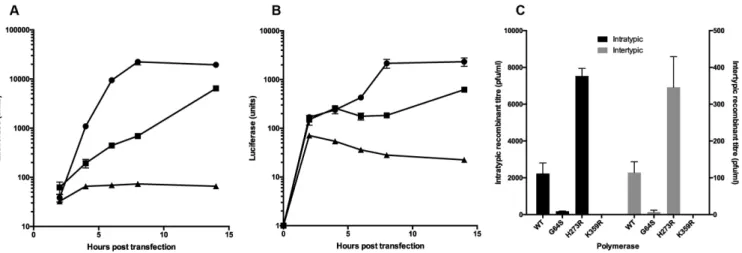
Figure 1. Replication and recombination analysis of poliovirus bearing a K359R mutation in the viral polymerase. (AandB) Replication kinetics of sub-genomic replicons of poliovirus type 1 (RLucWT – A) or poliovirus type 3 (Rep3-L – B). Unmodified (wild-type) replicons indicated with filled circles, replicons bearing a K359R polymerase mutation with filled squares and wild-type replicons in the presence of 4mM guanidine hydrochloride, an inhibitor of poliovirus RNA replication, with filled triangles. 250ng of RNA generatedin vitrowas transfected into HeLa cells. Samples were taken at the times indicated and luciferase activity was measured and normalised using a mock transfected control. Error bars indicate standard deviation of two independent samples. (C) Influence of G64S, H273R and K359R polymerase mutants on the yield of recombinants in an intertypic (grey bars) and intratypic (black bars) CRE-REP recombination assay. Yield of recombinants is expressed as pfu/ml with error bars showing standard deviation from at least three independent assays. Note that the intratypic and intertypic assays use different scale Y axes. The X axis indicates the identity of the viral polymerase in both donor (sub-genomic replicon) and acceptor (SL3-derived genome) templates. Plaque assay quantities were independently confirmed by TCID50(data not shown).
HeLa cells with RNA synthesised in vitro. Both K359R-containing replicons exhibited a marked delay in maxi-mal luciferase synthesis and a lower overall yield, reaching
∼30% of the luciferase level generated by the unmodified parental replicons (Figure1A and B). We additionally en-gineered the K359R or H273R substitutions into the po-liovirus type 3-derived SL3 genome, generating SL3K359R
and SL3H273Rrespectively. We then conducted independent
CRE-REP recombination assays using the SL3K359R and
SL3H273R acceptor genomes with type 1 or type 3 sub-genomic replicons bearing the matching mutation, monitor-ing the yield of inter- and intratypic recombinants produced in 48 hours following transfection of murine L929 cells.
Using unmodified (WT) parental SL3 and sub-genomic replicons yielded∼2200 pfu/ml (±571; all titres determined in three or more independent assays and expressed±SD) and 114 pfu/ml (±29) in intratypic and intertypic CRE-REP assays respectively, in broad agreement with previous results (11). In parallel assays the previously characterized G64S high fidelity polymerase variant produced 180 pfu/ml (±14) and 7 pfu/ml (±5) in intra- and intertypic recombi-nants respectively, the latter in agreement with earlier results (11). In the intertypic CRE-REP assay, genomes bearing the H273R substitution yielded 346 pfu/ml (±83; Figure1C), an increase of ∼3-fold over the unmodified templates. A comparable (∼3.3-fold) increase in recombinant yield was also observed in the intratypic CRE-REP assay with tem-plates bearing the same H273R variant polymerase. In con-trast, the presence of the K359R mutation in both donor and recipient genomes prevented the recovery of any viable recombinants in either inter- or intratypic CRE-REP as-says (Figure1C). The results obtained with the low fidelity H273R polymerase, together with the recombination phe-notype of the high fidelity K359R and G64S (11) enzymes,
strongly support a role for polymerase fidelity as a key de-terminant of recombination frequency.
Engineering the CRE into the 3non-coding region of the po-liovirus genome
The frequency of recombination is presumably related to the opportunity the polymerase has to switch templates. For example, in previous studies we demonstrated that prevent-ing replication complex coalescence (via nocodazole inhi-bition of microtubule polymerisation) reduced the yield of recombinants. Since the generation of viable recombinant progeny in the CRE-REP assay is dependent upon a strand transfer event occurring within the∼1kb separating the P1-coding region of the sub-genomic replicon and the defective CRE in the SL3 acceptor template (11) we reasoned that increasing the separation of these selection markers should also increase recombinant yield which would confer advan-tages in analysis of polymerases with reduced nucleotide turnover, such as K359R.
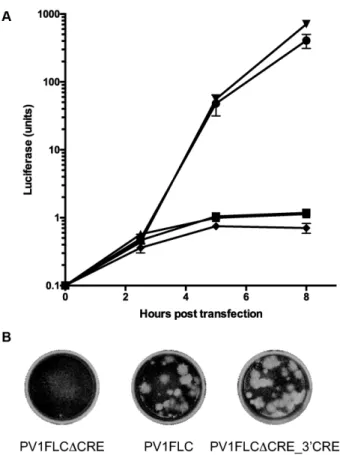
Figure 2. Replication and recombination of poliovirus with the CRE lo-cated in the 3 non-coding region. (A) Replication of sub-genomic po-liovirus type 1 replicons expressing a luciferase reporter gene. Wild-type (RLucWT) replicon in the absence (•) and presence () of 4mM guani-dine hydrochloride, together with the replicon with the native CRE inacti-vated (RLucWTCRE;). The luciferase activity expressed by a replicon with a synthetic CRE inserted into the 3NCR (RLucWTCRE 3CRE) in the absence () and presence of 4mM guanidine hydrochloride (). In each case, 250ng of relevant RNA transcribedin vitrowas transfected into L929 cells in duplicate, samples were harvested at the time points indicated and luciferase activity was measured and normalized using a mock trans-fected control. (B) Representative crystal violet stained Hela cell monolay-ers inoculated with supernatant obtained following transfection of RNA transcribedin vitrofrom the relevant full-length cDNAs indicated. Infected HeLa cells were covered with plaque assay overlay medium and stained 3 days post infection.
guanidine hydrochloride, a potent inhibitor of poliovirus replication (28), indicating it was solely from translation of the transfected RNA. We subsequently engineered a syn-thetic variant of the CRE sequence into the 3 NCR of a pRLucWTCRE to generate pRLucWTCRE 3CRE. The synthetic CRE sequence used had previously been shown to function when inserted into the 5NCR and con-sisted of the terminal 18 nt. of the wild-type CRE sequence engineered to form the terminal loop on a stem with sim-ilar structural stability to the native element (Supplemen-tary Figure S1). This sequence was known to be stable in genomes bearing dual CRE sequences (21). RNA generated
in vitrofrom pRLucWTCRE 3CRE was transfected into murine L929 cells and luciferase synthesis monitored for 8 hours post-transfection. In parallel assays the luciferase signal from pRLucWTCRE 3CRE-derived RNA was marginally greater than that from RNA generated from the
parental sub-genomic replicon, pRLucWT, confirming that insertion of the CRE within the 3NCR was not incompat-ible with genome replication (Figure2A).
To ensure that the resulting modifications had not intro-duced unexpected functional defects (e.g. disruption of en-capsidation, a process critical for the identification of vi-able recombinants in the CRE-REP assay) into the virus genome we engineered the same mutations to the na-tive CRE (creating pPV1FLCCRE) and 3 NCR (cre-ating pPV1FLCCRE 3CRE) in a full length infectious poliovirus type 1 cDNA (pPV1FLC). RNA generated in vitrowas independently transfected into murine L929 cell monolayers and de novogenerated supernatant virus was quantified by subsequent plaque assay on HeLa cells. pPV1FLCCRE yielded no measurable virus and subse-quent blind serial passage did not lead to the emergence of variants capable of replicating, a result in agreement with comparable studies on poliovirus type 3 (13). In con-trast, RNA from pPV1FLCCRE 3CRE generated viral plaques indistinguishable in appearance from the parental unmodified cDNA (Figure 2B) with a yield of 6 × 10⁸ pfu/ml, similar to the 4×10⁸pfu/ml yield from PV1FLC
under similar assay conditions. To further confirm that a virus bearing the CRE in the 3NCR replicated with simi-lar kinetics to the unmodified parental virus we conducted competition experiments between the two viruses, broadly recapitulating the conditions that would prevail in a mixed infection recombination assay (Supplementary Figure S2). The results demonstrated that the poliovirus CRE can be relocated to the 3NCR without apparently compromising virus replication, thereby making it a suitable template for analysis of recombination throughout the region encoding the virus non-structural proteins.
Extending the CRE-REP assay
The relocated CRE in the 3 NCR is situated ∼2.9 kb from it’s native position, extending the potential region for recombination––the distance separating the VP1 capsid-coding region (absent from the sub-genomic replicon) and a functional CRE (absent from the SL3 parental genome)––from ∼1 kb to almost 4 kb (Figure 3A). We investigated intertypic recombination following transfec-tion of murine L929 cells with RNA generated in vitro
from pRLucWTCRE 3CRE and pT7FLC/SL3. In par-allel, we conducted a control CRE-REP recombination assay with RNA derived from parental pRLucWT and pT7FLC/SL3 (Figure3B). The latter generated 157 pfu/ml (±20) whereas the assay with the extended recombination region yielded an increase of∼5.8-fold to an average of 920 pfu/ml (±317; Figure3C). Preliminary analysis of recombi-nation junctions in viruses recovered in the extended CRE-REP assay (henceforth designated 3CRE-REP) indicated they were located throughout the region encoding the non-structural proteins, with both imprecise and precise junc-tions identified (Supplementary Figure S3).
6888 Nucleic Acids Research, 2016, Vol. 44, No. 14
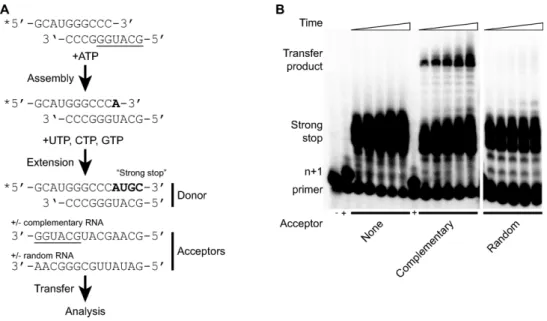
Figure 4. A biochemically-definedin vitrorecombination assay. (A) Scheme forin vitrotemplate-switching assay. A radiolabelled (end labelled, indicated *) primer substrate pair known as sym/sub is the basis for the assembly of an elongation complex by the addition of ATP and purified polymerase protein. Addition of remaining nucleotides allows complete extension of the sym/sub template to form a strong stop product. The latter is considered the donor template to which acceptor template ribo-oligonucleotides are added. The complementary acceptor has six nucleotides (underlined) that have the potential to pair with the 3end of the extended sym/sub donor product. An alternative acceptor template with no complementarity was also tested. The products of the assay are analysed by polyacrylamide gel electrophoresis (PAGE). (B) Denaturing PAGE ofin vitroreactions quenched at 5, 10, 20, 40 and 60 min after addition of the UTP/CTP/GTP and acceptor template (indicated below) mix. Reactions conducted in the absence (-) or presence (+) of ATP only indicated. Then+ 1 product is the assembled elongation complex. The strong stop product is the fully extended sym/sub template. The high molecular weight products result from a template switch to the indicated RNA acceptor.
cDNAs modified to include the K359R mutation in the 3Dpolcoding region, no recombinants were recovered
(Fig-ure 3C). Therefore, although increasing the size of the re-gion in which recombination could occur enhanced the yield of recombinants, it was not sufficient to compensate for the non-recombinogenic K359R mutation in the viral polymerase.
A biochemically-defined recombination assay
To further investigate the strand-transfer reaction that must occur during recombination we exploited a biochemically-defined assay based upon the sym/sub system (22), a 10 nt. heteropolymeric RNA primer-template symmetrical self-complementary substrate (sym/sub) forming a 6 nt duplex flanked with 4 nt. 5 unpaired regions (Figure 4A). Pre-vious studies using homopolymeric templates and primers has suggested that purified poliovirus polymerase was suf-ficient for the strand-transfer event (29). We therefore in-vestigated modification of this well-characterised sym/sub assay by inclusion of an acceptor template containing two potential regions of limited complementarity with the pri-mary extension product. Briefly, the two-stage reaction in-volves assembling the radiolabeled sym/sub template with purified polymerase and ATP (Mix 1) in a suitable buffer to allow the formation of the elongation complex. Addi-tion of the remaining nucleotides and an acceptor template (Mix 2) enables extension and––potentially––strand trans-fer, with the reaction products over a time course analysed by polyacrylamide gel electrophoresis. The formation of an
n+ 1 product indicates functional assembly of the elonga-tion complex (Figure4A and B) prior to the addition of Mix
2. This results in the rapid formation of a number of>n+ 1 products including the fully extended sym/sub template represented by then+ 4 product (‘Strong stop’, Figure4A and B). The generation of ann + 5 product is due to the non-templated addition to the end of the primer template, as previously described (29). The strand transfer product is represented by a discrete band appearing after the addition of Mix 2, the level of which increased as the reaction was in-cubated for up to 60 min (Figure4B). Quantification of the strand transfer product at 30 min allowed the optimization of experimental conditions, including polymerase and ac-ceptor template concentrations (Arnoldet al., manuscript in preparation).
Under the optimized conditions a maximum yield of
∼5% of the strand transfer product was achieved after 30 min when catalyzed by the native virus RdRp at 5M (Fig-ures4B and5B). We reasoned that the acceptor template needed to be present in molar excess over the sym/sub tem-plate (1 M) to provide maximum opportunity for tem-plate switching. As copy-choice recombination occurs dur-ing negative-strand synthesis (30) we also reasoned that a 60-fold excess of acceptor RNA over sym/sub template would be biologically relevant. Indeed, previous research has shown that negative strand synthesis is between 40–60-fold in excess of positive strand RNA synthesis during the early stages of RNA replication (31). The generation of a strand transfer product was dependent upon both the pres-ence (Figure4B) and sequence of the acceptor template. We initially investigated the suitability of an acceptor with a similar base composition (the ‘Random’ acceptor, Figure
6890 Nucleic Acids Research, 2016, Vol. 44, No. 14
of the transfer product. We extended this analysis to investi-gate the specific involvement of 3sequences in the acceptor by using each of three RNA molecules that were truncated by one, two or three nucleotides at the 3end, but were oth-erwise identical to the complementary RNA acceptor (Fig-ure5C). None could be incorporated into a transfer prod-uct.
sym/sub analysis of fidelity polymerase variants
The development and optimization of a biochemically de-fined sym/sub recombination assay confirmed that the viral polymerase was the only protein required for formation of the strand transfer product. This assay therefore provides an experimental environment to investigate the direct influ-ence of polymerase on strand transfer. Using the optimized conditions already established (Arnoldet al., manuscript in preparation) we investigated the formation of the sym/sub strand transfer product by G64S, H273R and K359R poly-merase fidelity mutants by quantifying the production of the strand transfer product 30 min after addition of accep-tor template and nucleotides to the reaction. The high fi-delity G64S polymerase variant generated 1.8-fold less of the strand transfer product compared to wild type at 30 min. In contrast, the H273R low fidelity variant increased tem-plate transfer product 3-fold. Strikingly, the generation of the strand transfer product by the K359R polymerase was so low that accurate quantification over a 30 minute time course was not possible (Figure5A and B).
Sequence analysis of the strand transfer product
The observations in both CRE-REP and sym/sub assays indicated that polymerase fidelity was a key determinant of strand transfer efficiency. The demonstration that the ma-jority of the strand transfer products were of a minimum uniform size suggested there may be some sequence speci-ficity to the in vitro recombination event, presumably in-volving one or other of the two limited regions of comple-mentarity with the primary extension product (Figure4A). In order to gain insight into the strand switching event we isolated the transfer product and subsequently cloned and sequenced the RNA species. Over 100 sequences were ob-tained, analysis of which resulted in two striking observa-tions (Table1). Firstly, the template switch occurred at the 3 end of the acceptor template not at the internal region
of complementarity. Secondly, a significant number of mis-incorporations or non-templated nucleotide additions oc-curred at or near the junction of the sym/sub donor and acceptor templates. Many of these involve the addition of C nucleotides, thereby increasing the potential for C–G base pairing with the 3end of the acceptor template. Only one of the sequences obtained showed no evidence of misincorpo-ration or non-templated base additions. These observations support the role of polymerase fidelity in strand transfer and, together with the failure to observe a strand transfer product with random or truncated acceptor templates (Fig-ures4B and5C), indicate that minimal regions of sequence complementarity are required for recombinationin vitro.
DISCUSSION
Recombination in mammalian positive sense RNA viruses, such as poliovirus, is a relatively poorly characterized mech-anism responsible for the generation of extensive genetic variation in the progeny of co-infections. In a recent study we demonstrated that replicative recombination (i.e. in which both parental viruses are replication-competent, to distinguish it from a distinct non-replicative process that has also been described (16,17)) is a biphasic process that involves distinct strand-transfer and resolution events (11). Both phases are necessary for the generation of genome-length recombinants that circulate in the population (7,10). The CRE-REP assay developed in our previous study en-abled both viral and cellular determinants of these phases to be investigated. However, being cell-based, it did not al-low the influence of the viral polymerase to be defined and studied in isolation. Furthermore, recombination was only quantifiable within a limited region of the genome. We ad-dress both these restrictions here. We describe a modified CRE-REP assay in which recombination throughout the re-gion encoding the viral non-structural proteins can be anal-ysed. In addition, we show that recombination can be reca-pitulated in a defined biochemical system in which the only protein present is the viral polymerase. We use these two strategies to investigate the role of RNA dependent RNA polymerase fidelity and nucleotide turnover rate in the ge-netic recombination of poliovirus.
We had previously demonstrated that a G64S high fidelity polymerase variant significantly reduced (∼20-fold) the re-combination rate observed in the CRE-REP assay. We ex-tended this study by investigating the influence of K359R
Table 1. Sequence analysis of strand transfer products
# Misincorporation Untemplated Sequence 5-GCAUGGGCCC . . . -3
24 +C AUGC C AUGC AUGC UUGC N0-3
20 +CC AUGC CC AUGC AUGC UUGC N0-3
2 G→C +C AUCC C AUGC AUGC UUGC N0-3
38 G→C AUCC AUGC AUGC UUGC N0-3
14 (U/G)→C ACC AUGC AUGC UUGC N0-3
4 +A(C/U)C AUGC A(C/U)C AUGC AUGC UUGC
1 AUGC AUGC UUGC
1 G AUC AUGC UUGC
6892 Nucleic Acids Research, 2016, Vol. 44, No. 14
and H273R polymerase mutants, which are reported to ex-hibit higher and lower fidelity than the native enzyme re-spectively (26,27). In all instances, the relevant polymerase mutation was present in both the donor (sub-genomic repli-con) and acceptor (SL3-derived) templates. In contrast to the G64S results, the presence of the H273R mutation led to at least a 3-fold increase in recombinant yield (Figure1C), suggesting that low fidelity increases the rate of template switching by the viral polymerase, a result in agreement with a recent study in alphaviruses (15). Both the G64S and H273R variations have little impact upon the replica-tion of poliovirus or sub-genomic replicons in cell based as-says (27,32) indicating that fidelity alone may account for the changes in recombination rates measured in the CRE-REP assay. With the K359R mutation we were unable to detect any intra- or intertypic recombinants using the CRE-REP assay under conditions previously shown to yield vi-able progeny from G64S-containing templates (Figure1C). Since the K359R polymerase has a lower fidelity than the G64S enzyme (26), fidelity alone cannot explain the dif-ferent phenotypes of these enzymes in this assay. However, the K359R mutation also catalyses nucleotidyl transfer at 10% the rate of the unmodified enzyme (25,26), an observa-tion we verified in luciferase assays using poliovirus type 1 or type 3 sub-genomic replicons (Figure1A and B), which could also influence the recombination process. If there was a directly proportional relationship between replication rate and recombinant yield, we would have expected to detect recombinants in the intratypic CRE-REP assay (where the native enzyme generated ∼103 pfu/ml) even if they were undetectable in the intertypic assay which is ∼20-fold less sensitive. However, when investigated (Figure1C), the ab-sence of recombinants in the intratypic CRE-REP assay by K359R-containing genomes, indicates that the yield was at least 3log10 lower, implying that replication rate and
poly-merase fidelity may exert a cumulative influence on recom-bination. Previous studies have already indicated that there is a direct relationship between elongation rate and poly-merase fidelity (26,33). Due to the pleiotropic effect of mu-tations such as K359R on the activities of the polymerase it is difficult to determine the relative importance of these two polymerase phenotypes on recombination. In an at-tempt to achieve this we have investigated the consequences of adding the mutagen ribavirin on recombinant recovery in the CRE-REP assay primed with donor and acceptor RNAs bearing the high-fidelity G64S mutation (which ex-hibits similar processivity to the native enzyme (26)). Rib-avirin at 600M enhanced the yield of recombinants from either the intertypic or intratypic CRE-REP assay 2- to 3-fold (Supplementary Figure S4) providing additional con-firmation that fidelity per se is a key determinant of the template switching events in recombination. Ribavirin at a similar concentration could not rescue recovery of recombi-nants from CRE-REP assays primed with templates bear-ing the K359R polymerase mutation (data not shown).
We reasoned that increasing the region within which re-combination could occur in the CRE-REP assay might compensate for the reduced replication of the K359R poly-merase mutant. We tested this by further separating the lesions that rendered the donor and recipient templates incapable of alone generating viable progeny, which we
achieved by introducing a synthetic variant of the CRE to the 3 NCR. In doing this, we demonstrated that the poliovirus CRE is functional in the 3 NCR, 2.9 kb away from the native location and 6.8 kb distant from the 5 NCR location previously reported (21). The robust replica-tion of RLucCRE 3CRE (Figure2A and B) convincingly demonstrates the positional independence of the poliovirus CRE, as has also been shown for foot and mouth disease virus (34). Using a donor template (Figure3A and C) with the CRE in the 3 NCR increased recombinant yield by
∼5.8-fold in the modified 3-CRE-REP assay over the orig-inal assay. The increased yield of recombinants was approx-imately proportional to the increase in separation of the ge-netic lesions used for the selection (5.8-fold versus 4-fold re-spectively). We interpret this as indicating there were no sig-nificant recombination ‘hotspots’ within the non-structural coding region that were absent from the∼1 kb recombina-tion window in the original CRE-REP assay. This conclu-sion is supported by preliminary analysis of a limited panel of recombinants from the 3CRE-REP assay which indi-cated they were distributed throughout the region encod-ing the viral non-structural proteins (Supplementary Fig-ure S3), with limited evidence of clustering at the 2C/3A boundary and the region encoding the C-terminus of the polymerase. We have previously suggested that the cluster-ing of imprecise recombinants could be explained by func-tional constraints on the initial hybrid virus genome (11). The extended opportunity for recombination offered by the 3CRE-REP assay will allow the influence of RNA struc-ture, sequence identity and these functional constraints to be more fully examined in future studies.
Notwithstanding the increased yield of recombinants ob-tained from the 3CRE-REP assay with the unmodified polymerase, inclusion of the K359R mutation completely inhibited the formation of detectable recombinant progeny (Figure1C). This provides further support for this muta-tion having a non-recombinogenic phenotype, but does not help elucidate the role of reduced nucleotide incorporation and/or increased fidelity in achieving this behaviour.
A notable feature of the replication of the K359R poly-merase is the apparent ‘stall’ in replication from around 2 to 6 h post-transfection. This was reported in a previ-ous study (26) and also observed in sub-genomic replicons bearing this substitution (Figure1A and B). During this period replication is occurring, but at a markedly reduced rate when compared to genomes bearing the native poly-merase. After 6–8 h, replication gradually picks up, result-ing in an overall yield ∼1log10 lower than the wild-type
transfer eventper se, and a defect in one or more of the cell-related events required for recombination, we investigated the process in a system in which the polymerase was the only protein present.
We exploited the well-characterised sym/sub assay that has previously been used to analyse the phenotype of the poliovirus polymerase in a biochemically-defined system. Briefly, an elongation complex is assembled on a 10 nt self-complementary template in the presence of ATP alone and the stalled extension relieved by addition of the remain-ing nucleotides. By inclusion of an acceptor template with limited complementarity to the primary extension product (Figure4A and B) we were able to demonstrate the forma-tion of a specific strand-transfer product which exhibited the expected reduced mobility, confirming that the poly-merase alone is necessary for template switching during re-combination. We used this assay to explore the influence of polymerase variants or the sequence of the acceptor tem-plate on the production of the strand-transfer product.
Our results strongly suggest that interactions of the donor and acceptor templates are important during recombina-tionin vitro. An acceptor oligonucleotide with 6 nt. of com-plementarity (to the ‘strong stop’ extension product; un-derlined in Figure4A) at its 3end was incorporated into the strand-transfer product, the length of which (Figure4B) and subsequent sequencing (Table1) indicated it is the posi-tion at which the polymerase switches template from donor to acceptor. The sequence specificity of this interaction was emphasised by the inability to generate a detectable strand-transfer product in the presence of an acceptor template with no complementarity (Figure4B) or with acceptor tem-plates truncated by 1–3 nucleotides at the 3 end (Figure
5C). This analysis clearly demonstrates that the presence of two G nucleotides at the 3 end of the acceptor––and complementarity between donor and acceptor template 3 ends––was critical for generation of the transfer product.
Sequence analysis of the strand transfer product (Ta-ble 1) provides further insight to the importance of the two G nucleotides at the 3 end of the acceptor. The ma-jority of the sequences exhibited additional cytidine nu-cleotides at or near the recombination junction between the sym/sub donor and acceptor templates. Over 50% of the sequences included misincorporations, primarily of G to C, which would increase the sequence complementar-ity with the G dinucleotide at the 3 end of the accep-tor. In addition, an equivalent proportion (∼48%) of the sequences showed evidence of one or two non-templated C nucleotides at the junction. These presumably account for the reduced mobility apparent in some ‘strong stop’ products (Figures 4B and 5A) and would again increase the sequence complementarity between donor and ac-ceptor molecules. Of the 104 transfer product sequences obtained, only one contained no sequence substitutions, additions or deletions from the expected product (5
-GCAUGGGCCCAUGCAUGCUUGC-3). This level of
variation has not been observed in the sequence of pre-sumed recombination junctions in previous studies (1,37– 41) or in our recent analysis using the CRE-REP assay ((11) and Bentleyet al., manuscript in preparation), all of which involved analysis of replication-competent genomes. How-ever, these analysed junctions were predominantly located
within the polyprotein-coding region which, if disrupted, would be incompatible with virus viability. Over 60% of the strand transfer products sequenced (Table1) contained ad-ditional nucleotides which would have resulted in the pre-mature truncation of the open reading frame (ORF), and those in which the ORF remained intact contained addi-tional amino acids, potentially poorly tolerated in the viral polyprotein. This strongly suggests that stringent functional selection of a diverse population of recombinant molecules may generate a much more limited subset of sequences which are observed in replication-competent viral popula-tions.
Although the non-templated addition of nucleotides to the 3end of the donor was important in enhancing com-plementarity with the acceptor it does not alone account for the ability of the polymerase to generate a strand trans-fer product. The K359R polymerase generates reduced-mobility ‘strong stop’ products, indicative of this untem-plated addition, but was unable to generate recombinant products in either the sym/sub or CRE-REP assays (Fig-ures1C and 5A). Additional polymerase fidelity mutants tested in the sym/sub assay also recapitulated the pheno-types previously characterized in the cell-based CRE-REP assay (Figures 1C, 4A and 5A). The low fidelity H273R polymerase yielded ∼3-fold more transfer product in the sym/sub assay and at least 3-fold more recombinants in the CRE-REP assay when compared with the unmodified poly-merase. Similarly, in both the biochemical and cell-based assay the high fidelity G64S mutant polymerase exhibited a reduced yield, by∼2-fold and∼20-fold respectively (11). These results emphasise the relevance of the sym/sub re-combination assay and allow the detailed dissection of the contributions of polymerase, the donor and acceptor molecules in the strand transfer event. This should pro-vide important insights into the molecular mechanism of recombination in enteroviruses and, by extrapolation, other single-stranded RNA viruses. It may additionally help un-derstand the processes involved in other polymerase/RNA interactions in which discontinuous RNA sequences are juxtaposed in the resulting product, for example during the generation of internally-deleted defective interfering genomes (42) or the involvement of the body and leader transcriptional regulatory sequences implicated in discon-tinuous subgenomic transcription in coronaviruses (43).
It is clear that the phenotype of the K359R mutant poly-merase is of wider significance. This mutation lies within motif D, a conserved element present in all RNA dependent RNA polymerases, where the lysine acts as a general acid for nucleotidyl transfer (25,44,45). Not only does K359R attenuate poliovirus neurovirulence (26) but it is now shown that it also inhibits the frequency of template switching. Re-combination between live attenuated Sabin vaccines and co-circulating species C enteroviruses is regularly observed and associated with paralytic disease (7,46,47). Once poliovirus eradication is achieved a K359R-containing variant could be considered as a suitable vaccine seed until global po-liovirus vaccination programs are terminated.
6894 Nucleic Acids Research, 2016, Vol. 44, No. 14
duplications within the genome. Sequence analysis of sev-eral hundred of these has failed to detect any sequence speci-ficity to the process ((11) and unpublished). In contrast, the junctions resulting from the resolution event always contain ‘ambiguities’ where it is unclear whether the sequence at the junction is derived from the donor or recipient template. This implies that there may be a requirement for comple-mentarity for resolution. Formally, recombination is atrans
event involving the joining of separate molecules whereas resolution could occur either in cisorin trans. It is thefore interesting to note the sequence complementarity re-quired for the generation of the strand-transfer product in the sym/sub assay which, by definition, must occurin trans. Further studies will determine whether the biochemically-defined sym/sub recombination assay is actually recapitu-lating the primary recombination or secondary resolution events described.
SUPPLEMENTARY DATA
Supplementary Dataare available at NAR Online.
FUNDING
Biotechnology and Biological Sciences Research Council [BB/M009343/1] and PhD. studentship funding for AW (to D.J.E.); NIH [R01 AI045818 from NIAID to C.E.C.). Funding for open access charge: Biotechnology and Bio-logical Sciences Research Council and University of St. An-drews.
Conflict of interest statement.None declared.
REFERENCES
1. Runckel,C., Westesson,O., Andino,R. and DeRisi,J.L. (2013) Identification and manipulation of the molecular determinants influencing poliovirus recombination.PLoS Pathog.,9, e1003164. 2. Simon-Loriere,E. and Holmes,E.C. (2011) Why do RNA viruses
recombine?Nat. Rev. Microbiol.,9, 617–626.
3. Lukashev,A.N., Lashkevich,V.A., Ivanova,O.E., Koroleva,G.A., Hinkkanen,A.E. and Ilonen,J. (2005) Recombination in circulating Human enterovirus B: independent evolution of structural and non-structural genome regions.J. Gen. Virol.,86, 3281–3290. 4. Oberste,M.S., Maher,K. and Pallansch,M.A. (2004) Evidence for
frequent recombination within species human enterovirus B based on complete genomic sequences of all thirty-seven serotypes.J. Virol., 78, 855–867.
5. Rohll,J.B., Percy,N., Ley,R., Evans,D.J., Almond,J.W. and Barclay,W.S. (1994) The 5-untranslated regions of picornavirus RNAs contain independent functional domains essential for RNA replication and translation.J. Virol.,68, 4384–4391.
6. Rohll,J., Moon,D., Evans,D.J. and Almond,J.W. (1995) The 3-untranslated region of picornavirus RNA - features required for efficient genome replication.J. Virol.,69, 7835–7844.
7. Kew,O., Morris-Glasgow,V., Landaverde,M., Burns,C., Shaw,J., Garib,Z., Andr´e,J., Blackman,E., Freeman,C.J., Jorba,J.et al.(2002) Outbreak of poliomyelitis in Hispaniola associated with circulating type 1 vaccine-derived poliovirus.Science,296, 356–359.
8. McWilliam Leitch,E.C., Bendig,J., Cabrerizo,M., Cardosa,J., Hyypi¨a,T., Ivanova,O.E., Kelly,A., Kroes,A.C., Lukashev,A., MacAdam,A.et al.(2009) Transmission networks and population turnover of echovirus 30.J. Virol.,83, 2109–2118.
9. McWilliam Leitch,E.C., Cabrerizo,M., Cardosa,J., Harvala,H., Ivanova,O.E., Kroes,A.C.M., Lukashev,A., Muir,P., Odoom,J., Roivainen,M.et al.(2010) Evolutionary dynamics and
temporal/geographical correlates of recombination in the human enterovirus echovirus types 9, 11, and 30.J. Virol.,84, 9292–9300.
10. McWilliam Leitch,E.C., Cabrerizo,M., Cardosa,J., Harvala,H., Ivanova,O.E., Koike,S., Kroes,A.C., Lukashev,A., Perera,D., Roivainen,M.et al.(2012) The association of recombination events in the founding and emergence of subgenogroup evolutionary lineages of human enterovirus 71.J. Virol.,86, 2676–2685.
11. Lowry,K., Woodman,A., Cook,J. and Evans,D.J. (2014) Recombination in Enteroviruses Is a Biphasic Replicative Process Involving the Generation of Greater-than Genome Length ’Imprecise’ Intermediates.PLoS Pathogens,10, e1004191. 12. Percy,N., Barclay,W.S., Sullivan,M. and Almond,J.W. (1992) A
poliovirus replicon containing the chloramphenicol acetyltransferase gene can be used to study the replication and encapsidation of poliovirus RNA.J. Virol.,66, 5040–5046.
13. Goodfellow,I., Chaudhry,Y., Richardson,A., Meredith,J., Almond,J.W., Barclay,W. and Evans,D.J. (2000) Identification of a cis-acting replication element within the poliovirus coding region.J. Virol.,74, 4590–4600.
14. Goodfellow,I., Polacek,C., Andino,R. and Evans,D.J. (2003) The poliovirus 2C cis-acting replication element-mediated uridylylation of VPg is not required for synthesis of negative-sense genomes.J. Gen. Virol.,84, 2359–2363.
15. Poirier,E.Z., Mounce,B.C., Rozen-Gagnon,K., Hooikaas,P.J., Stapleford,K.A., Moratorio,G. and Vignuzzi,M. (2015) Low-fidelity polymerases of alphaviruses recombine at higher rates to overproduce defective interfering particles.J. Virol.,90, 2446–2454.
16. Gmyl,A.P., Belousov,E.V., Maslova,S.V., Khitrina,E.V., Chetverin,A.B. and Agol,V.I. (1999) Nonreplicative RNA recombination in poliovirus.J. Virol.,73, 8958–8965. 17. Gmyl,A.P., Korshenko,S.A., Belousov,E.V., Khitrina,E.V. and
Agol,V.I. (2003) Nonreplicative homologous RNA recombination: promiscuous joining of RNA pieces?RNA,9, 1221–1231. 18. Egger,D. and Bienz,K. (2002) Recombination of poliovirus RNA
proceeds in mixed replication complexes originating from distinct replication start sites.J. Virol.,76, 10960–10971.
19. Minor,P.D. (1985) In: Mahy,BWJ (ed).Virology: A practical approach. IRL Press, Oxford, pp. 25–41.
20. Andino,R., Rieckhof,G.E., Achacoso,P.L. and Baltimore,D. (1993) Poliovirus RNA synthesis utilizes an RNP complex formed around the 5-end of viral RNA.EMBO J.,12, 3587–3598.
21. Goodfellow,I., Kerrigan,D. and Evans,D.J. (2003) Structure and function analysis of the poliovirus cis-acting replication element (CRE).RNA,9, 124–137.
22. Arnold,J.J. and Cameron,C.E. (2000) Poliovirus RNA-dependent RNA polymerase (3D(pol)). Assembly of stable,
elongation-competent complexes by using a symmetrical
primer-template substrate (sym/sub).J. Biol. Chem.,275, 5329–5336. 23. Pfeiffer,J.K. and Kirkegaard,K. (2003) A single mutation in
poliovirus RNA-dependent RNA polymerase confers resistance to mutagenic nucleotide analogs via increased fidelity.Proc. Natl. Acad. Sci. U.S.A.,100, 7289–7294.
24. Pfeiffer,J.K. and Kirkegaard,K. (2005) Increased fidelity reduces poliovirus fitness and virulence under selective pressure in mice. PLoS Pathog.,1, e11.
25. Castro,C., Smidansky,E.D., Arnold,J.J., Maksimchuk,K.R., Moustafa,I., Uchida,A., Gotte,M., Konigsberg,W. and
Cameron,C.E. (2009) Nucleic acid polymerases use a general acid for nucleotidyl transfer.Nat. Struct. Mol. Biol.,16, 212–218.
26. Weeks,S.A., Lee,C.A., Zhao,Y., Smidansky,E.D., August,A., Arnold,J.J. and Cameron,C.E. (2012) A polymerase mechanism-based strategy for viral attenuation and vaccine development.J. Biol. Chem.,287, 31618–31622.
27. Korboukh,V.K., Lee,C.A., Acevedo,A., Vignuzzi,M., Xiao,Y., Arnold,J.J., Hemperly,S., Graci,J.D., August,A., Andino,R.et al. (2014) RNA virus population diversity, an optimum for maximal fitness and virulence.J. Biol. Chem.,289, 29531–29544.
28. Pfister,T. and Wimmer,E. (1999) Characterization of the nucleoside triphosphatase activity of poliovirus protein 2C reveals a mechanism by which guanidine inhibits poliovirus replication.J. Biol. Chem., 274, 6992–7001.
29. Arnold,J.J. and Cameron,C.E. (1999) Poliovirus RNA-dependent RNA polymerase (3Dpol) is sufficient for template switching in vitro. J. Biol. Chem.,274, 2706–2716.
31. Novak,J.E. and Kirkegaard,K. (1991) Improved method for detecting poliovirus negative strands used to demonstrate specificity of positive-strand encapsidation and the ratio of positive to negative strands in infected cells.J. Virol.,65, 3384–3387.
32. Vignuzzi,M., Wendt,E. and Andino,R. (2008) Engineering attenuated virus vaccines by controlling replication fidelity.Nat. Med.,14, 154–161.
33. Campagnola,G., McDonald,S., Beaucourt,S., Vignuzzi,M. and Peersen,O.B. (2015) Structure-function relationships underlying the replication fidelity of viral RNA-dependent RNA polymerases.J. Virol.,89, 275–286.
34. Mason,P.W., Bezborodova,S.V. and Henry,T.M. (2002) Identification and characterization of a cis-acting replication element (cre) adjacent to the internal ribosome entry site of foot-and-mouth disease virus.J. Virol.,76, 9686–9694.
35. Bolten,R., Egger,D., Gosert,R., Schaub,G., Landmann,L. and Bienz,K. (1998) Intracellular localization of poliovirus plus- and minus-strand RNA visualized by strand-specific fluorescentin situ hybridization.J. Virol.,72, 8578–8585.
36. Egger,D. and Bienz,K. (2005) Intracellular location and translocation of silent and active poliovirus replication complexes.J. Gen. Virol., 86, 707–718.
37. King,A.M. (1988) Preferred sites of recombination in poliovirus RNA: an analysis of 40 intertypic cross-over sequences.Nucleic Acids Res.,16, 11705–11723.
38. Pilipenko,E.V., Gmyl,A.P. and Agol,V.I. (1995) A model for rearrangements in RNA genomes.Nucleic Acids Res.,23, 1870–1875. 39. Dedepsidis,E., Kyriakopoulou,Z., Pliaka,V. and Markoulatos,P.
(2010) Correlation between recombination junctions and RNA secondary structure elements in poliovirus Sabin strains.Virus Genes, 41, 181–191.
40. Romanova,L.I., Blinov,V.M., Tolskaya,E.A., Viktorova,E.G., Kolesnikova,M.S., Guseva,E.A. and Agol,V.I. (1986) The primary structure of crossover regions of intertypic poliovirus recombinants: a
model of recombination between RNA genomes.Virology,155, 202–213.
41. Tolskaya,E.A., Romanova,L.I., Blinov,V.M., Viktorova,E.G., Sinyakov,A.N., Kolesnikova,M.S. and Agol,V.I. (1987) Studies on the recombination between RNA genomes of poliovirus: the primary structure and nonrandom distribution of crossover regions in the genomes of intertypic poliovirus recombinants.Virology,161, 54–61. 42. Kuge,S., Saito,I. and Nomoto,A. (1986) Primary structure of
poliovirus defective-interfering particle genomes and possible generation mechanisms of the particles.J. Mol. Biol.,192, 473–487. 43. Sawicki,S.G., Sawicki,D.L. and Siddell,S.G. (2007) A contemporary
view of coronavirus transcription.J. Virol.,81, 20–29. 44. Castro,C., Smidansky,E., Maksimchuk,K.R., Arnold,J.J.,
Korneeva,V.S., Gotte,M., Konigsberg,W. and Cameron,C.E. (2007) Two proton transfers in the transition state for nucleotidyl transfer catalyzed by RNA- and DNA-dependent RNA and DNA polymerases.Proc. Natl. Acad. Sci. U.S.A.,104, 4267–4272. 45. Liu,X., Yang,X., Lee,C.A., Moustafa,I.M., Smidansky,E.D.,
Lum,D., Arnold,J.J., Cameron,C.E. and Boehr,D.D. (2013) Vaccine-derived mutation in motif D of poliovirus RNA-dependent RNA polymerase lowers nucleotide incorporation fidelity.J. Biol. Chem.,288, 32753–32765.
46. Yang,C.F., Chen,H.Y., Jorba,J., Sun,H.C., Yang,S.J., Lee,H.C., Huang,Y.C., Lin,T.Y., Chen,P.J., Shimizu,H.et al.(2005) Intratypic recombination among lineages of type 1 vaccine-derived poliovirus emerging during chronic infection of an immunodeficient patient.J. Virol.,79, 12623–12634.