Table of Contents
ABSTRACT... 2
ACKNOWLEDGEMENTS AND AUTHOR’S BIOGRAPHY...3
INTRODUCTION... 4
LITERATURE REVIEW... 9
BACKGROUNDAND INITIAL JUSTIFICATIONOF MANDATORY ARREST POLICIES...10
LANGUAGE SURROUNDING MANDATORY ARREST STATUTES...17
RACEAND DOMESTIC VIOLENCE...19
Who Deserves Help? The Ideal Domestic Violence Victim...20
Black Women, Stereotypes, and Public Policy...21
CLASS STATUSAND DOMESTIC VIOLENCE...26
MISSING LINKSIN RESEARCHAND THEORETICAL FRAMEWORKS MOVING FORWARD...28
METHODS... 29
QUANTITATIVE DATA...30
Chi Squared Test and Two Proportions Z Test Statistical Analysis...32
SEMI-STRUCTURED INTERVIEWS...33
WHO IS PROTECTED UNDER DOMESTIC VIOLENCE ARREST POLICIES?...34
DESCRIPTIVE STATISTICS...35
RACEAND ETHNICITY ANALYSIS...39
EDUCATION ATTAINMENT LEVEL ANALYSIS...42
CONCLUSION... 43
CASE STUDY: AN EXPLORATORY ANALYSIS OF BLACK WOMEN, ARREST POLICES, AND INTIMATE PARTNER VIOLENCE IN NORTH CAROLINA...45
QUANTITATIVE DATA ANALYSIS...45
QUALITATIVE DATA ANALYSIS...50
Varying Levels of Required Domestic Violence Training...52
Urban vs. Rural...52
Immigrant Communities and Disparities...54
Black Women and Barriers to Domestic Violence Arrest Policies and Prosecution...56
Class Disparities...60
POTENTIAL SOLUTIONS... 61
CONCLUSION... 64
CONCLUSIONS... 67
LIMITATIONSAND GENERALIZABILITY...68
RESEARCHAND POLICY IMPLICATIONS...68
Abstract
This thesis examines how different domestic violence arrest policies influence the distribution of intimate partner violence (IPV)-related homicide cases when taking into account race and socioeconomic status. To answer my research questions, I conduct a mixed methods analysis using a 27-state sample from the Center for Disease Control (CDC)’s National Violent Death Reporting System between 2003-2015 alongside interview data that I collected from five relevant professionals in North Carolina. The results of the statistical analysis show a statistically significant relationship between race, socioeconomic status, and domestic violence arrest
policies. Descriptive statistics show that black women and American Indian/Alaskan Native women are over represented amongst IPV-related homicide cases whereas white women and women are underrepresented within the sample. Additionally, women with less than or equal to a high school education are over represented within the sample whereas women with some college education or beyond are underrepresented. Findings of this study aim to create a more nuanced discussion around the effectiveness of domestic violence arrest policies with hopes of informing policy makers of ways in which they can create more effective interventionist policies for black women and poor women who experience domestic violence.
Acknowledgements and Author’s Biography
I would like to thank Dr. Candis Smith, Assistant Professor for the UNC Chapel Hill Public Policy Department, for her continued mentorship as my advisor for this thesis alongside other research projects. Since first meeting Dr. Smith in her Politics and Public Policy class, she has challenged me and helped me to grow as a student, as a researcher, and as a person. I am greatly appreciative of the endless support and kindness that she has provided to me while here at Carolina. I would also like to thank Dr. Cathy Zimmer at the Odum Institute for her endless patience, kindness, and support in helping me organize and conduct my statistical analysis. Lastly, I would like to thank all of my co-workers and friends that I have worked with at Solace Women’s Aid and the Compass Center for Women and Families over the past two years. It is the priceless and difficult work that these wonderful people do every day to support survivors of domestic violence that inspired me to conduct this thesis.
This project was supported by the Tom and Elizabeth Long Excellence Fund for Honors
administered by Honors Carolina.
Author’s Biography
Introduction
On June 18th of 2017, Charleena Lyles— a black mother of three who was pregnant with her fourth child—called the Seattle Police department for help after an attempted burglary in her apartment, one of many homes for formerly homeless people and families. Before arriving to the scene, Lyles was considered dangerous due to her mental health diagnosis and her history of interactions with the Seattle court system involving her abusive ex-partner (Thompson 2017). Upon arrival to the scene, Charleena Lyles was killed with seven bullets by two white police officers. Before law enforcement arrived, she was presumed a criminal. Though it may seem anomalous, the experience of Charleena Lyles is not uncommon. A 2017 report by the Insititute for Women’s Policy Research noted that not only are Black women more likely to be killed by an intimate partner than other races and ethnicities, but Black women who experience domestic violence—especially low income Black women—are also more likely to be criminalized (Childers, DuMonthier, and Milli 2017).
Intersectionality is a theory coined by Kimberlé Crenshaw that argues insitutions of power interconnect to create a complex and overlapping system of advantage and disadvantage (Crenshaw 1991). Misogynoir specifically is a term that is derived from Crenshaw’s
intersectionality and was coined by queer Black feminist scholar Moya Bailey that describes the specific actions of racism and misogyny that shape Black women’s lives (Bailey 2016; Bristol 2017). These theories are important to keep in mind when discussing the unique ways in which Black women are criminalized, making them even more vulnerable when they experience domestic violence.
According to a 2016 report conducted by the Vera Institute of Justice, 77% of
al. 2016). Additionally, even though Black women make up 12.7% of the US adult female population, they represent 44% of incarcerated women (Swavola et al. 2016). These statistics are not mutually exclusive, and result, in part, from the increased criminalization of domestic
violence over the past few decades. When the 1994 Violence Against Women Act (VAWA) was passed under the broader Violent Crime Control and Law Enforcement Act, it was a big victory for women’s rights movements and groups looking to end violence against women (Davis, 1978; Lehrner & Allen, 2009). It was the first U.S. federal legislation designed to acknowledge and address domestic violence and sexual assault as crimes with subsequent consequences. One of the more profound provisions to come from the act were mandatory arrest policies.
Mandatory arrest policies mandate that if the police get a call about domestic violence, whether it be the person experiencing the violence, the perpetrator, or some unknown third party, they have to make an arrest (Hirschel, 2008). This policy regarding increased criminalization of domestic violence is one favored under carceral feminism, or discourse surrounding violence against women (although not exclusively) that advocates for increased policing, prosecution, and imprisonment as a primary solution to violence against women (Bernstein, 2012, Bumiller 2009, Braithwaite and Daly 1998).
racism has and will continue to leave Black women who experience domestic violence unprotected by the very law, ostensibly, designed to do the opposite.
I ask several research questions to explore the relationship between race, class, and domestic violence arrest policies. The first set of questions I ask are: 1) To what extent are Intimate Partner Violence (IPV)- related homicide rates influenced by the presence of mandatory arrest policies? 2) Are we better able to predict IPV-related homicide rates by accounting not only for policy, but also for race and socioeconomic status of states’ residents? The second set of questions I ask are: 1) To what extent does discretionary domestic violence policy influence IPV-related homicide rates in North Carolina? 2) What is the role of race and class? In order to answer my research questions, I will conduct a mixed methods intersectional (cross-racial and cross-socioeconomic) analysis of IPV-related homicide rates using the CDC’s National Violent Death Reporting System database. To answer my second set of questions, I execute a case study of North Carolina’s arrest laws related to domestic violence, with hopes of not only better understanding the discretionary stance that precedes whether or not an arrest is made, but also determining amongst professionals’ responses if there are any racially biased policies in place that further disenfranchise Black women who experience domestic violence. I have three
similar racial and socioeconomic patterns amongst the distribution of IPV-related homicide cases for the state as described in my second hypothesis, I use an inductive approach to understand the nature of discretionary arrest policies in North Carolina through interview data.
The greater debate around the criminalization of domestic violence via domestic violence arrest policies has been reflected in Public Policy through Helen Ingram and Anne Schneider’s (1993) social construction of target populations theory. They argue that the social construction of different groups influences not only public policy agendas but also the selection of policy tools and means of justifying policy decisions that benefit certain groups while punishing others. In their updated 2005 text, Deserving and Entitled: Social Constructions and Public Policy, Ingram and Schneider take a more intersectional approach by highlighting the work of Dionne
Bensonsmith. Bensonsmith argues that the Moynihan Report’s intent to pathologize poor Black people (namely poor Black women’s “uncontrollable sexuality”) served as one of the key elements in justifying government policy responses that marked Black communities (especially Black women) as undeserving of government aid in the form of various welfare policies and beyond. Specifically, Bensonsmith claims that this report and subsequent policies resulting from it helped to serve as a marker on American family values—and that stereotypes of Black women and their families would never fit within that paradigm. These theoretical frameworks—the social construction of target populations and intersectionality—help to better contextualize the policy issue at hand. Who do mandatory arrest policies work for, if at all? If Black women (and poor Black women) are constructed as deviants in American society—making them what Ingram and Schneider would argue as being one of the least powerful and the most overburdened
Literature Review
This chapter will explore the existing literature around domestic violence, beginning with a background of Mandatory Arrest Policies and the initial justification of the policy. Next, this chapter will explore the language surrounding Mandatory Arrest Statutes and the implications of those policies with regards to how they are enforced on the state level. Following that will be a discussion and analysis of the intersections between race, stereotypes about black women, and domestic violence arrest policies. Building on that will be an analysis of the intersections between class and domestic violence arrest policies, including the influence of poor communities’ relationships with law enforcement. The chapter will conclude by analyzing missing links in current literature and how that will influence the data analysis in Chapter 4 and 5.
Background and Initial Justification of Mandatory Arrest Policies
Mandatory Arrest laws are generally defined as laws wherein the arresting police officer is required to make an arrest, without a warrant, if they believe an act of domestic violence has occurred (Smith, 2014).1A primary justification for enacting mandatory arrest policies is based on a singular case study called the Minneapolis Domestic Violence Experiment, which was funded by the National Institute of Justice (Sherman and Berk, 1984). This experiment, done over seventeen months during 1981 and 1982, was designed so that 51 patrol officers in the
1Domestic violence is defined by the United States Department of Justice as “a pattern of abusive
behavior in any relationship that is used by one partner to gain or maintain power and control over another intimate partner. Domestic violence can be physical, sexual, emotional, economic, or
Minneapolis Police Department were randomly assigned to respond to existing misdemeanor assault calls (which make up the bulk of domestic violence calls) by doing one of three things: sending the abuser away for eight hours, providing advice and mediation of disputes, or making an arrest (Sherman and Berk, 1984). After conducting interviews in a six-month follow-up period with victims and offenders alongside official records, it was determined that among the total 330 cases done, arrest was the most effective police response in reducing rates of offenders re-offending (Sherman and Berk, 1984). Thus, given the results of this study, the purpose of mandatory arrest policies is to prevent perpetrators of domestic violence from re-offending.
Given the methodology of the study, there are certainly questions of how effective the arrests were. One limitation of the study is the small sample size. The specific geographic location of the study may not be applicable on a large scale with different demographics of not only departments, but also the people they serve. Another issue with the small sample size is that it that there are varying state policies that could affect policing on a more local scale such as funding for police departments. Another limitation of the study is that the researchers determined that re-offending did not occur with only their analysis of interviews and looking at police records, but it is possible that there could have been response bias present in the interviews with victims and perpetrators. For example, if a victim feared violence and future retaliation of an angry abusive partner after returning from jail (abusers were only required to be in jail overnight), they could have decided not to report again for safety reasons. Lastly, the
have mitigated instances of violence that would have otherwise continued without such constant police observation.
Even though mandatory arrest policies were not addressed on the federal level until the Violence Against Women Act (VAWA) was passed, local police departments in Dallas, TX, Houston, TX, Washington D.C., and New York City, NY implemented mandatory arrest policies in response to the Minneapolis experiment (Associated Press, 1984; LeMoyne, 1984; Schmidt and Sherman, 1993). Soon after, more states including Nevada (1985) and Louisiana (1985), enacted mandatory arrest laws (Zeoli et. al. 2011).
Table 1. Domestic Violence Arrest Policies by State as of January 2017
State Statute Year the statute
was implementedPhrase of arrestauthority Time limit for warrantless arrest to occur
Reporting Requirements for no or dual arrest
Alabama Code of Ala.
§15-10-3 1989 May arrest No No
Alaska* Alaska Stat.
§18.65.530 1996 Shall arrest 12hours Yes
Arizona* A.R.S. §13-3601 1991 May Arrest and
Shall Arrest No No
Arkansas A.C.A. §16-81-113 1991 May arrest and
“Arrest . . . shall be considered the preferred action”
4 hours; 12 hours if physical injury No
California Cal. Pen. Code §8361997 May arrest As soon as
probable cause arises
No
Colorado* C.R.S. §18-6-803.6 1994 Shall arrest Without undue
delay No
Connecticut* Con. Gen. Stat.
§46b-38b 1986 Shall arrest No No
Delaware 11 Del C. §1904 1984 “Arrest is …
lawful” No No
Florida Fla. Stat. §741.29;
Fla. Stat. §901.15
1992 May arrest No Yes
Georgia* O.C.G.A. §17-4-20 1981 “Arrest…may be made”
No Yes
Hawaii* H.R.S. §709-906 1980 May Arrest No No
Idaho Idaho Code §19-6031979 May Arrest On immediate
response to a report of a crime
No
Illinois 725 ILCS 5/
112A-30
1993 “Shall . . . use all
reasonable means
. . ., including: arrest the abusing party”g
Immediately Yes
Indiana Burns Ind. Code
Ann. §35-33-1-1 2000 May Arrest No No
Iowa Iowa Code §236.12;
Iowa Code §804.7 1986 May Arrest and Shall Arrest No No
State Statute Year the statute
was implementedPhrase of arrestauthority Time limit for warrantless arrest to occur
Kansas* K.S.A. §22.2307j 1992 “Policies shall include . . . a statement directing that the officers shall make an arrest . . .”
No No
Kentucky* K.R.S. §431.005 1980 May Arrest No No
Louisiana La. R.S. §46:2140 1985 “Shall…use all
reasonable means . . ., including arresting the abusive party”g
Immediately No
Maine 19-A M.R.S. §4012 1980 Shall Arrest Immediately No
Maryland* MD. Crim. Proc. Code §2-204
1986 May Arrest Report to Police
must be made within 48 h of incident to allow warrantless arrest
Massachussetts* ALM GL ch. 209A
§6 1988 “Arrest shall be the preferred
response”
No Yes—dual only
Michigan* MLCS §764.15a 1978 May Arrest No No
Minnesota* Minn. Stat.
§629.341 1978 May Arrest 24 hours No
Mississippi Miss. Code Ann.
§99-3-7
1995 Shall Arrest 24 hours No
Missouri §455.085 R.S.Mo 1989 May Arrest and
Shall Arrest
No for may authority; 12 hours after first police visit for shall authority
Yes for may authority
Montana Mont. Code Ann.
§46- 6-311 1991 “Arrest is the preferred response”
No No
Nebraska R.R.S. Neb.
§29-404.02 1989 May Arrest No No
Nevada
State Statute Year the statute
was implementedPhrase of arrestauthority Time limit for warrantless arrest to occur
Reporting Requirements for no or dual arrest New Hampshire* R.S.A. 594:10 1979 “Arrest . . . is
lawful” 12 hours No
New Jersey* N.J. Stat. §2C:25-21 1991 May Arrest and
Shall Arrest No No
New Mexico* N.M. Stat. Ann.
§40- 13-7 1987 “Shall be required to take whatever steps
are reasonably necessary…,incl uding…arrest the alleged perpetrator”
New York* N.Y.C.L.S.C.P.L.
§140.10 1996 Shall Arrest No No
North Carolina* N.C. Gen. Stat. §15A- 401
1991 May Arrest No No
North Dakota N.D. Cent. Code
§14- 07.1-10 1995 “Arresting the person is the appropriate response”
12 hours after determination of probable cause No Ohio* O.R.C.Ann. §2935.03; O.R.C.Ann §2935.032 1995 “Preferred
course of action” and shall arrest
No Yes
Oklahoma 22 Okl. St. §40.3 1987 May Arrest 72 hours No
Oregon* ORS §133.055 1978 Shall Arrest No No
Pennsylvania 18 Pa.C.S. §2711 1986 “Shall have the
same right of arrest without a warrant as in a felony ...”
No No
Rhode Island* R.I Gen. Laws §12-
29-3 1988 Shall Arrest 24 hours No
South Carolina* S.C. Code Ann.
§16- 25-70 1995 May Arrest and Must Arrest Freshly committed Yes—dual only South Dakota S.D. Codified Laws
§23A-3-2.1 1989 Shall Arrest 48 hours No
Tennessee Ten.CodeAnn.§36-
3-619 1995 “Preferred response . . . is
arrest”
No Yes
Texas Tex. Code Crim.
Proc. art.14.03 1989 May Arrest No No
Utah* Utah Code Ann.
§77- 36-2.2 1995 Shall Arrest No Yes
State Statute Year the statute
was implementedPhrase of arrestauthority Time limit for warrantless arrest to occur
Reporting Requirements for no or dual arrest
Vermont* V.R.Cr.P. Rule 3 1985 May Arrest No No
Virginia* Va. Code Ann.
§19.2- 81.3 1997 May Arrest and Shall Arrest No Yes
Washington Rev. Code Wash
§10.31.100
1995 Shall Arrest 4 hours No
West Virginia W.Va. Code §48-27- 1002
1994 Has authority to
arrest
Wisconsin* Wis. Stat. §968.075(3)
1989 Shall Arrest Report to police
must be made within 28 days of incident to allow warrantless arrest
Yes—no arrest only
Wyoming Wyo. Stat.
§7-20-102; §35-21-107 1987 May arrest and “May take whatever steps are . . . necessary. . . including: arresting the abusing household member”g
24 hours No
* states within the CDC dataset
Source: Table 1 in Journal of Interpersonal Violence; Zeoli, A. M., Norris, A., & Brenner, H. (2011). A summary and analysis of warrantless arrest statutes for domestic violence in the United States, pg. 2816-2824
Language Surrounding Mandatory Arrest Statutes
Much of the contention amongst policy makers, lawyers, scholars, law enforcement, and domestic violence advocates over the effectiveness of mandatory arrest policies concerns the discretion of officers. Zeoli et. al. (2011) provide a thorough explanation of the legal ambiguity of statutes defining arrest policies for domestic violence. Instead of just looking at whether the phrasing of a statute is discretionary, preferred arrest, or mandatory arrest, Zeoli et al. (2011) also highlight four other elements to take into consideration. The first concern is whether additional factors of domestic violence need to be present and evidenced for the officer to trigger the arrest authority. Some of these factors may include injury, use of a deadly weapon, or rarely —mention of illegal sexual contact. The second is analyzing what qualifications are required for the authority to make an arrest. An example of a qualification that may be helpful when
determining whether an arrest is appropriate is if the responding officer has received any
sensitivity training in responding to crisis situations such as domestic violence. The vast majority of states (39 out of 50) do not state additional qualifications needed in order to make an arrest.
The third element to take into account is the time limits for a warrantless arrest. Thirty-three states did not have a time limit mentioned in the statute, but of the 18 states that did, times ranged from immediately to 48 hours after the incident occurred. Washington was an exception of allowing up to 28 days after the incident. The timing in which an arrest can be made is
important for four reasons. One reason is because the perpetrators of domestic violence may flee before the police arrive. Feder (1996) found that roughly half of all perpetrators were absent when police arrived, making it hard for police to make an arrest within the time allotted.2 Timing of arrest is also important because there are potential safety concerns for the victim should the
perpetrator decide to retaliate after police leave and the ability to collect accurate evidence diminishes over time.
Lastly, the fourth element examines whether police officers are required to report why they eithermade a dual or no arrest. Dual arrests are defined as arrests in which both parties are arrested during a domestic violence call, typically because the arresting officer cannot
distinguish who the primary aggressor is. Only 11 states are required within their statutes to make reports about why they made a dual arrest or no arrest at all. Zeoli et al. (2011) argue that requirements to report and explain why an officer made an arrest or not can discourage dual arrests because it puts more pressure on arresting officers to justify their decisions (Zeoli et al. 2011). Conversely, in the case of Wisconsin, it encourages arrests because officers must justify why they did not make an arrest in the domestic violence case (Zeoli et al. 2011).
though Blacks in New York City only compromised 15.88% of the population according to 2000 census data (U.S. Census Bureau 2002; Haviland et. al., 2001).
Race and Domestic Violence
We cannot fully understand the impact and effectiveness of arrest policies and
domestic violence without considering the role of race and gender. Aside from disproportionate representation of African-Americans in prison, a vast body of literature also reveals racial bias in policing with not only treatment of African Americans, but negative attitudes about the Black communities from law enforcement in general (Fridell et. al. 2001, Goff and Kahn 2012, Nellis 2016). Current political context and discourse with regards to policing and discrimination has highlighted instances of police brutality especially in predominately Black communities. Concordantly, trust towards law enforcement is lower in Black communities in comparison to white communities (Lee and Gibbs 2015, Miller 2008, Webb 1995). A Gallup Poll with aggregate results from surveys between 2011-2014 found that only 39% of Black respondents have a lot confidence in police in comparison to 59% of white respondents (Newport 2014). Additionally, there tend to be slower police response times in Black neighborhoods, especially poor Black neighborhoods (Miller 2009). All of these factors are important when taking into account reporting domestic violence in Black communities because a community’s relationship with law enforcement impacts how much they may rely on police as a resource when seeking help.
Who Deserves Help? The Ideal Domestic Violence Victim
frequently seen as innocent and worthy of help than Black women and therefore have more access to interventionist policies not limited to police protection (via removal of the primary aggressor) offered under mandatory arrest policies (Morrison, 2006). Being the perfect or ideal victim has always been socially constructed around fragile, white womanhood (Martinson, 2008). Legal advocate Madiba Dennie (2016) explains:
The perfect victim is white. She’s middle class. She’s heterosexual and cisgender. She’s able-bodied and has no history of mental illness. In accordance with the archetypes of white femininity, the perfect victim is both deserving of and dependent on others’ protection. And to that end, she calls the police. This is simply not a realistic option for Black women... A Black woman is regarded as so emotionally and physically strong she cannot truly be abused; so sexually available that she cannot be raped; so angry and emasculating that she cannot be blameless; or so untrustworthy that her account cannot be believed.
This account of differing experiences for Black and white women who face abuse is well
constructed policies, it becomes reasonable to hypothesize that policies such as mandatory arrest policies, designed to help all women who experience domestic violence, would not be as
accessible to Black women.
The Center for Disease Control (CDC) released a report titled “Racial and Ethnic Differences in Homicides of Adult Women and the Role of Intimate Partner Violence — United States, 2003–2014”. In this study, of the 18 states in the sample, they found that Black women are almost three times more likely to die from intimate partner violence in comparison to white women (Petrosky et al. 2017). This study suggests that not only should there be more
preventative policy surrounding intimate partner violence for Black women, but that there should be more effective interventionist policies as well—such as more effective arrest policies
(Petrosky et al. 2017).
Black Women, Stereotypes, and Public Policy
When taking into account Black women’s experiences with domestic violence, resources get even more complicated. Historically and currently, Black women have very complex relationships with public policy because few policies such as safety net policies in the welfare state (which have been deteriorating since the 1980s) have been able to address Black women’s intersectional position in society as being oppressed by patriarchy and racism (Harris-Perry 2011, Roberts 1997, Roberts 2012).
a policy that only treats marginalized identities as exclusive categories. This specific issue served as one of the primary case studies for Black feminist legal scholar Kimberlé Crenshaw.
Crenshaw discusses the 1976 DeGraffenreid v. General Motors class action Title VII suit that was dismissed; the judge ruled that the 5 Black women plaintiffs could not legally combine their lawsuits against General Motors for sex and race discrimination because it violated the confines of Title VII. In this way, the refusal of the court system to acknowledge how seniority policies leave Black women more vulnerable to employment discrimination (due to historical
discrimination laws), relies on an addictive theory of marginalization.
Crenshaw (1991) highlights the ways in which intersectionality as a theoretical framework is integral to understanding Black women’s experiences, not only within the Black community, but in public policy as well, such as job discrimination or even VAWA. Crenshaw states that “unless the senators and other policymakers consciously examine why violence remained insignificant as long as it was understood as a minority problem, it is unlikely that women of color will share equally in the distribution of resources and concern” (Crenshaw, 1991). Here, she points out the ways in which the normalization and and minimization of gendered violence in communities of color as something unavoidable, leaves less room for women of color who experience domestic violence to get help from the resources outlined in VAWA designed to help all women.
Methodologically speaking, the few studies that have considered race and gender as factors impacting health outcomes for example, have done so using an additive model (Bowleg 2012). An additive model typically would involve using a linear regression of interacting variables such as race and gender in order to capture the effects of both. This wrongfully
white women face when in reality, those experiences compound on each other to create a multiplicative effect greater than the sum of its parts—i.e. being a Black woman has greater negative impacts that just being Black and just being a woman (Bowleg 2012). Hancock (2007) discusses the ways in which an additive model assumes that the categories of race and gender are static and that the relationship between them is predetermined.
By instead focusing on a multiplicative intersectional approach, the nuances of Black women’s experiences can be explored in understanding two things. One, there is no
predetermined relationship between the two variables. Second, individual and institutional understandings can be integrated in the analysis. This means that individual social locations can be used to better understand and diversify our understanding of the institutional effects of race, class, gender, etc. (Hancock 2007).
This marginalization from accessible and effective policy that Black women face has especially pernicious consequences for those who experience domestic violence. Black women experience intimate partner violence at a rate 35% higher than that of white women (Bureau of Justice Statistics, 2001), but are less likely than white women to use social services, battered women’s programs, or go to the hospital because of domestic violence (Women of Color Network, 2006). Some of this can be explained by the harmful ways in which Black women are stereotyped. From Mammy to Jezebel to Sapphire to the Strong Black Woman stereotype3, these 3Mammy is a stereotype that extends back to slavery characterizing black women as typically asexual
tropes have and continue to negatively shape Black women’s relationship with public policy (Harris- Perry 2011). Not only are Black women constructed by society and public policy to be both criminalized and undeserving of help from the state, but internalized racism and
understandings of the Strong Black Woman stereotype can also give Black women the impression that they cannot ask for help (Donovan 2002, Harris-Perry 2011, West 2016). Additionally, internalizations of the Strong Black Woman stereotype can foster a sense of responsibility for some Black women to protect the Black community (including their abusive partners) from police brutality even if it leaves them vulnerable to more violence (Nash, 2005). Paradoxically, the internalization of the strong Black woman stereotype in particular has served to manifest itself as a means of survival for Black women as they deal with the often intersecting oppressions of white supremacy, patriarchy and classism (alongside other intersecting identities). On the same note, this internalization creates a perceived notion that Black women must put everyone ahead of themselves and their own sense of safety. This complex understanding of oneself and one’s role is further complicated by the ways in which the strong Black woman stereotype has and continues to be used in the policy making process to socially construct Black women as not needing or not deserving help from different potential interventions to domestic violence, thus maintaining a vicious process in which many Black women experience domestic violence with less access to resources and interventionist policies to disrupt that cycle of violence before it becomes fatal.
Dr. Anat Anais-Bar (2013), a social work scholar, outlines the ways in which self-identified Black women face institutional barriers when trying to access social services related to their experiences of domestic abuse; the report primarily focuses on physical abuse. All of the
women featured in the report recruited via court-mandated anger management programs in the New York Metropolitan area, and they were all mothers. When asked about their relationships to public institutions like schools, the police, domestic violence and homeless shelters, public assistance programs, and the Administration for Children Services (ACS), the women expressed feeling judged, mistreated, and shamed (Schneider and Ingram 2005, Soss 2005; Anais-Bar, 2013). When interacting with these formal institutions, there is no separation of experiences of poverty, racism, and sexism; these different systems of oppression affect not only Black
women’s access to services, but also the quality of services that they receive. One participant in the study claimed, “A lot of Black men due to racism are not able to support their families… there are many obstacles that Black men face…a lot of Black men get frustrated and they will beat you…the abuse that African American women go through is indirectly because of racism”(Anais-Bar, 2013).
Under this logic, the violence that Black women face at the hands of their Black male partners as a response to white supremacy and racial oppression is justified. Kimberlé Crenshaw warns against the notion that the primary solution to gender violence in the Black community is to uplift Black men. Again, she points to the need for an intersectional analysis; simply giving Black men to unfettered access to white cishetero patriarchy in the form of more job
opportunities and other resources as means of accessing institutional power will not end violence against Black women (Crenshaw, 1991). Arguing that liberation for Black people is only tied to giving Black men patriarchal power ignores the ways in which gender violence is perpetuated in patriarchal systems of power.
lack of personal or family resources, Black women are either limited to staying longer in the abusive relationships or turning to these inefficient and discriminatory social institutions for help such as social services, law enforcement, or the criminal justice system (Soss et al. 2011). These specific experiences with racism and classism that Black women face has been largely left out of discourse surrounding mandatory arrest policies.
Class Status and Domestic Violence
Undoubtedly, class status also plays a role in access to resources when experiencing domestic violence. Cunradi et al. (2000) explores the relationship between neighborhood poverty level and risk of domestic violence between Black, white, and Hispanic couples and finds only a statistically significant relationship between neighborhood poverty and risk of domestic violence for Black couples. Specifically, Cunradi et al. find that Black couples living in poverty are at three times more risk to experience male-to-female partner violence (MFPV) than Black couples not living in poor areas. This study highlights the importance of looking beyond just instances of domestic violence, but also highlighting the environment in which this violence occurs.
Another study conducted by Allard (1997) analyzes the prevalence of domestic
experiencing abuse, that these potential programs that could alleviate barriers to leaving an abusive relationship just further entrench them (Allard 1997).
With regards to policing in poor neighborhoods, some of the same concerns remain. In a 2017 report published by the Urban Institute, director of the Justice Policy Center Nancy La Vigne, outlines people’s perceptions of police officers who live in low-income, high crime communities. She finds that using survey responses from residents in Birmingham, Alabama, Fort Worth, Texas, Gary, Indiana, Minneapolis, Minnesota, Pittsburgh, Pennsylvania, and Stockton, California, she finds that only 30 percent of respondents feel that police officers treat people with respect and dignity (La Vigne et al. 2017). Additionally, only 26 percent of
respondents feel that police officers make fair and impartial decisions in the cases they deal with (La Vigne et al. 2017). Over 55 percent of respondents feel that police officers will treat them differently because of their race and/or ethnicity and only 37.8 percent of respondents stated that they feel safe around the police (La Vigne et al. 2017). The findings of this report are important to consider because people who occupy lower socioeconomic statuses that experience domestic violence are already left with less resources to leave an abusive relationship, but the additional barrier of lack of community trust in police can also be an important factor that leaves these marginalized groups more vulnerable to domestic violence.
Missing Links in Research and Theoretical Frameworks Moving Forward
account race and socioeconomic status. Another gap in the research has been a lack of
intersectional analysis with regards to race, gender, and class. Specifically, it is important to look beyond just Black and white women’s experiences with mandatory arrest laws to examine varying levels of access to mandatory arrest policies as a means of domestic violence
intervention for Black women across different socioeconomic statuses. To answer the research question, I will be conducting a mixed methods analysis. For the quantitative analysis, I will use data from the Center for Disease Control’s (CDC) National Violent Death Reporting System (NVDRS) that looks at intimate partner violence- related homicide rates in 27 states from 2003-2015. For the qualitative analysis, I will conduct a case study of North Carolina’s arrest policies as a means of better understanding the nuances of arrest laws for domestic violence.
While this research study does not aim to look at racial bias in responding to domestic violence calls within the quantitative analysis, the interview analysis of North Carolina's arrest policies, asks questions related to racial bias when responding to domestic violence calls. The aim of these questions is to explore the extent to which racial bias serves as at least a partial explanation of why Black women might experience higher rates of intimate partner violence- related homicide (as noted in the 2017 CDC report above).
Methods
For this research study, in order to answer my research questions concerning the relationship between race, class, and domestic violence arrest policies, I conducted a mixed methods analysis. The quantitative sample was conducted using CDC data from the National Violent Death Reporting System (NVDRS) from 2003-2015. In order to analyze the nuances of North Carolina’s arrest policies for domestic violence, I conducted semi-structured interviews. I interviewed police officers, legal experts, and employees working at domestic violence non-profits.
For my quantitative analysis, I used the CDC’s National Violent Death Reporting System database. This database collects information on violent deaths (homicides and suicides) using police reports, medical examinations, coroners’ reports, toxicology reports, and vital statistics records. I used data for the years 2003-2015. This involved a total of 9,825 cases of IPV related homicides in 27 reporting states where the victim was identified as female and the victim’s suspected killer was identified as male. I only kept observations where the victim was female and the suspected killer was male in an effort to control for sexuality of victims and their suspected killers being a potential lurking variable.
First, I coded whether a state should be designated as having a mandatory arrest policy or a discretionary arrest policy. Table 2 shows which states have mandatory arrest policies and which states have discretionary arrest policies.
Table 2: Domestic Violence Arrest Policies by States in the Sample
Mandatory Arrest Policy (13 states) Discretionary Arrest Policy (14 states)
Alaska Arizona
Colorado Georgia
Connecticut Hawaii
Kansas Kentucky
Massachusetts Maine
New Jersey Maryland
New York Michigan
Ohio Minnesota
Oregon New Hampshire
Rhode Island New Mexico
Virginia Oklahoma
Wisconsin South Carolina
Vermont
I used the language of the statute to inform how the groups would be created. There is some disagreement in literature, namely legal reference books, about which words in legal statutes actually denote whether or not a certain action is mandatory by law (Johnson, 2011). Zeoli et al.’s (2011) analysis differentiates mandatory arrest states and discretionary states in their use of the word “shall” and “may”; they claim that “shall” denotes an action is legally required and “may” denotes that an action is legally allowed but is not legally required. This analysis was my main guide in determining how to code each of the states, as I decided to denote any state arrest policy with “shall” or “must” as a mandatory arrest policy state. Any state in the sample with “should”, “may”, or “can” for its arrest policy statute was categorized as a discretionary arrest policy state. As mentioned in the literature review, Zeoli et al. categorized the statutes listed as mandatory arrest, preferred arrest, and discretionary arrest. None of the states in the sample met the criteria for “preferred arrest” in the statutes when I conducted additional updated research (since the article had been published in 2011) on individual state statutes.
Bachelor’s degree and/or beyond. I merged the census data with the existing CDC dataset so that the individual IPV homicide cases could be reflected on a state level.
With regards to limitations for my variables, my main concern was not being able to create other variables that better measure socioeconomic status. While there is research to indicate some of the usefulness of using education level as an indicator for socioeconomic status, (Cirino et al. 2002) without indicators for income and occupation, that data was not readily accessible. For my case study of North Carolina, I will compare county level IPV-related homicide rates with the county level average income to create some sort of comparative scale. Chi Squared Test and Two Proportions Z Test Statistical Analysis
For my analysis, I will conduct a series of chi tests and two-proportion z-tests. The dependent variables of my analyses will be the categorical variables displaying varying
education levels and racial and ethnic identities of the IPV-related homicide victims within the sample. The independent variable will be the domestic violence arrest policies. For the two- proportion z tests, I will be examining if there is any statistical significance in the difference of proportions of Black and White women IPV-relates homicide cases in states with mandatory arrest policies and discretionary arrest policies. A multivariate regression certainly would have provided a fuller picture of the data, but the current limitations of the CDC dataset makes it difficult to conduct a high quality multivariate regression.
Semi-Structured Interviews
professionals, it was important to be able to make the most of the interview time because there is freedom to ask clarifying questions as they came up with different professionals. Relatedly, the second reason that semi-structured interviews were used is because there were only two sets of interview questions used to interview a variety of professionals who all interact with domestic violence policies in different ways. This interview method leaves room for the creation of reliable and comparable data to analyze.
In order to conduct interviews, I primarily did an online search of police departments and domestic violence nonprofits in North Carolina in order to find contact information for potential respondents. I emailed potential respondents initially and followed up with them by email a week later, and then phone the week after that. If respondents did not respond to any of the
another professional that they knew of that would potentially be interested in being interviewed. All of the interviews were transcribed either by myself or by GMR transcription in order to analyze patterns in responses. In total, I emailed thirty potential participants and only five expressed interest in being in the study. Of the thirty potential interview participants I emailed, thirteen work in law enforcement, four work in the legal and judicial system, and thirteen work with domestic violence nonprofits. Of the five participants that ended up participating in the study, one is a police officer, one is a judge, one is a director of a domestic violence nonprofit, and two are lawyers. Because the qualitative interviews were used to understand North Carolina arrest policies, I mainly relied on Barney Glaser and Anselm Strauss’s grounded theory to guide my analysis. In The Discovery of Grounded Theory (1967), Glaser and Strauss describe
grounded theory as a way of constructing theory through the analysis of data. I used this method instead of traditional deductive methods used to test existing frameworks because there was no guided expectation or theory for understanding the nuances of arrest laws for domestic violence in North Carolina, as there are so many factors that go into their implementation.
Who is Protected Under Domestic Violence Arrest Policies?
less willing to report to law enforcement if they know that an arrest must legally occur— therefore increasing the likelihood of dual arrests occurring.
Second, I predict that black women will be disproportionately represented amongst IPV-related homicide cases in mandatory arrest states in comparison to white women because I argue that mandatory arrest policies were designed to be more accessible to white women as an
effective intervention for IPV.
Third, I predict that women with less than or equal to a high school education will be disproportionately represented amongst IPV-related homicide rates in mandatory arrest states in comparison to women with some college education or more because I argue that mandatory arrest policies were designed to be more accessible to white women as an effective intervention for IPV.
I conducted a series of chi squared tests, and one z-test of proportions on the different racial, ethnic, and education attainment rate variables against the independent variable of
whether or not the incident occurred in a state with a mandatory arrest policy between 2003-2015 using the CDC’s National Violent Death Reporting System database.
Descriptive Statistics
To better understand the relationship between race, ethnicity, education attainment level, and domestic violence arrest policies, I provide a series of bar graphs below.
The bar graph above shows that the two highest groups of IPV-related homicide cases are Non-Hispanic Black women and Non-Non-Hispanic White women. The groups with the lowest IPV-related homicide cases are American Indian/Alaskan Native, non-Hispanic women and
Asian/Pacific Islander, non-Hispanic women. For population context, American Indian/Alaskan Native women have the least amount of IPV-related homicide cases at 1.8%, but they also have the smallest population at an average of .74% of the general population, making American Indian/Alaskan Native women over-represented within this sample. Non-Hispanic Black women are also over-represented within the sample; even though they only make up 12.6% of the United States (US) female population, they make up 32.6% of IPV-related homicide cases. Hispanic women, non-Hispanic Asian/Pacific Islander women, and non-Hispanic White women are conversely underrepresented amongst IPV-related homicide cases in retrospect to their percentage population in the US.
Figure 2. IPV-Related Homicide Cases by Education Attainment Level
54.1 %
9.6%
1.8% 1.9%
Figure 2 illustrates that roughly half of the cases in the CDC sample had an unknown education level due to insufficient data collection (for example, Vermont has no data on the education attainment levels of its IPV-related homicide victims from the years 2003-2015), so those observations are not included here. Therefore, while these observations are large enough to provide a detailed understanding of IPV-related homicide cases and education attainment levels, it is limited in its nuance of the influence of education attainment levels on the distribution of IPV-related homicide cases. There is a roughly negative correlation between education attainment level and IPV-Related homicide cases. While there is a small spike in cases from 1,939 for victims who have less than a high school education to 2,039 cases of victims with a high school degree/ GED, there is a significant drop in IPV-related homicide cases for victims who have completed at least some college (including an associates degree). IPV-related homicide cases for women who have less than a high school education is almost four times higher than those with at least a Bachelor’s degree. This graph provides support that education attainment level as a proxy for socioeconomic status has some influence on the distribution of
36.5%
19.7%
IPV-related homicide cases, disproportionately negatively affecting women with less than or equal to a high school education.
Figure 3 shows an interactive relationship between race, ethnicity, and education attainment levels for IPV-related homicide cases.
Figure 3. IPV-Related Homicide Cases by Race, Ethnicity, and Education Attainment Level
American Indian/Alaskan Native victims, 32.6 % of Asian/Pacific Islander victims, and 52% of Hispanic women victims within this cross-tabulation have less than a high school education, only 29.5% of White non-Hispanic women victims have less than a high school education.
Race and Ethnicity Analysis
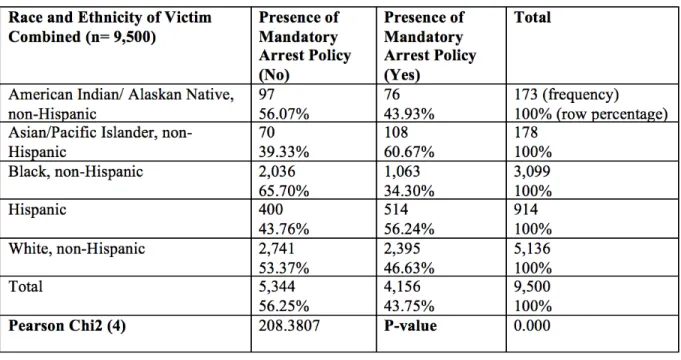
My first hypothesis is that there will be there will be a higher instance of IPV-related homicide cases in states with mandatory arrest policies. In order to test this hypothesis, I run a chi squared test of independence to see if there is a statistically significant relationship between race and policy.
Table 1. Chi Squared Test for Race and Policy
As seen above, the presence of mandatory arrest policies presents two important
larger immigrant populations (Asian/ Pacific Islander, non-Hispanic and Hispanic), the majority of IPV-related homicide cases are in states with mandatory arrest policies in place. Among non-Hispanic Asian/Pacific Islander women, 39.33% of IPV-related homicide cases occurred in states with discretionary arrest policies, while 60.67% of IPV-related homicide cases occurred in states with mandatory arrest policies. For Hispanic women, 43.76% of IPV-related homicide cases occurred in states with discretionary arrest policies, while 56.24% of IPV-related homicide cases occurred in states with mandatory arrest policies.
For the other racial groups, IPV-related homicide cases are lower in states with
particular disparity between Black and White women is nuanced further in the z-test proportion tests.
My second hypothesis is that black women will be disproportionately represented amongst IPV-related homicide cases in mandatory arrest states and discretionary arrest states in comparison to white women. In order to test this hypothesis, I run a two proportions z test to see if there is a statistically significant difference of black women disproportionately represented amongst IPV-related homicide cases in mandatory arrest states in comparison to white women.
Table 2. Z-Test of Proportions Between Black and White Women in Discretionary Arrest States and Mandatory Arrest States
As highlighted in Table 2, both two-proportion z-tests were statistically significant with a p-value of zero, showing support for my hypothesis that there is a statistically significant
analysis of the extent to which race and ethnicity influences the distribution of IPV-related homicide cases; in comparing Black and White women directly, it is easier to see how the social construction of target populations can produce different outcomes within and amongst different policies intended to have the same positive effect—in this instance, preventing future violence to domestic violence survivors.
Education Attainment Level Analysis
My third hypothesis is that women with less than or equal to a high school education will be disproportionately represented amongst IPV-related homicide rates in mandatory arrest states in comparison to women with some college education or more. To test this hypothesis, I ran one chi squared test.
Table 3. Chi Squared Test for Education Attainment Level
levels. For all education attainment levels except for the completion of a Bachelor’s Degree and/ or beyond, the presence of mandatory arrest policies correlates to a decrease in intimate partner violence- related homicide rates. For women with an education attainment level of at least a Bachelor’s Degree, the policy conditions seem to have less of an influence on the distribution of IPV-related homicide cases with such a small percentage difference of 2.82% between
mandatory arrest policy states and discretionary arrest policy states. For women with less than a high school education, mandatory arrest policies have a strong positive influence on the
distribution of IPV-related homicide rates, with 22.6% less IPV-related homicide cases from that demographic in states with mandatory arrest policies. Again, these results provide no support for my hypothesis that there would be more IPV-related homicide cases in states with mandatory arrest policies, but there is support for my hypothesis that there is a statistically significant disproportion of women with equal to or less than a high school education represented amongst IPV-related homicide victims.
Conclusion
burden and responsibility of prosecuting the abuser is removed from the survivor to law
enforcement and therefore potentially protects them from fatal violence. Perhaps for immigrant groups in the sample, there are additional barriers to reporting to law enforcement such as language barriers or a fear of deportation to name a few. Since the IPV-related homicide cases are drawn from a 27-state sample from 2003-2015, it would be important to note that obtaining more data from more states will help to nuance the patterns seen in this quantitative data analysis.
Case Study: An Exploratory Analysis of Black Women, Arrest
Polices, and Intimate Partner Violence in North Carolina
be disproportionate rates of IPV-related homicides for poor black women, and 2) the lack of social policy to address racial bias and class bias within law enforcement and the broader criminal justice system response to domestic violence is a significant factor that leaves poor black women more vulnerable to the risk of being killed by an intimate partner. I conducted a mixed-methods cross-racial and cross-socioeconomic analysis of IPV-related homicide rates using the CDC’s National Violent Death Reporting System database. Second, I analyzed a case study of North Carolina’s arrest laws related to domestic violence, with hopes of not only better understanding the discretionary stance that precedes whether an arrest is made, but also
determining amongst professionals’ responses if there are any policies with racially bias outcomes in place that further disenfranchise black women who experience domestic violence.
Quantitative Data Analysis
To answer my research questions, I rely on the CDC data to examine the distribution of IPV-related homicide rates across North Carolina between 2003-2015. North Carolina does not have a mandatory arrest statute, but each individual police agency in North Carolina is given the discretion to create their own arrest policy regarding domestic violence. Unfortunately, data on which arrest policies correlate with which department policy is not available.
values in the sample (75.44%) in which the education of the victim was unknown. This meant that I could include those values when looking at just the distribution of race, but I would not be able to analyze those 1,250 values when doing a comparative analysis of race and education level of the victim. That being said, I decided to show what the distribution looks like before and after getting rid of those unknown values. Table 1 shows what the distribution of IPV-related
homicides looks like when examining race and ethnicity:
Table 1 Race and Ethnicity of North Carolina IPV-Related Homicide Cases, 2003-2015
Race and Ethnicity Group Frequency Percent of Sample
American Indian/Alaskan Native, non-Hispanic
36 2.2%
Asian/Pacific Islander, non-Hispanic 20 1.2%
Black, non-Hispanic 625 38.3%
Hispanic 103 6.3%
White, non-Hispanic 848 52%
Total 1,632 100%
As you can see above, Black women make up almost 38% of IPV-related homicides even though black people only make up 22.2% of North Carolina’s population in 20164. Additionally, white women make up 51.18% of IPV-related homicides even though white people make up 71% of North Carolina’s population in 20165. Another point of reference on the table that brings up concern is that American Indian and Alaska Native women make up 2.17% of IPV-related homicides even though American Indian and Alaska Native people only make up 1.6% of North Carolina’s population in 20166. This points to the need for further research of American Indian and Alaska Native women’s experiences with domestic violence in North Carolina. If domestic violence is pervasive and not higher in any other racial group than the other, then the distribution of IPV-related homicide rates should correlate to each racial and ethnic group’s broader
population rate in North Carolina. This table, however, shows how black women are
disproportionally over represented in this sample (alongside American Indian and Alaska Native women) and every other racial group, most noticeably white women, are underrepresented within the sample. This shows us that other factors are influencing the likelihood that women in North Carolina are killed by an intimate partner, such as access to domestic violence arrest policies.
Table 2 shows what the distribution of IPV-related homicides looks like when doing a cross- race & ethnicity with education level analysis.
Table 2: Race and Ethnicity of North Carolina IPV-Related Homicide Cases by Education
Attainment Level, 2003-2015
Race and Ethnicity of
Victim Education Attainment Level of victim Less Than High School Total Education High School Diploma/ GED Some College Completion Bachelor’s Degree or Beyond
American
Indian/Alaskan Native, non-Hispanic
2 40% 2 40% 0 0% 1 20% 5 2%
Asian/Pacific Islander, non-Hispanic
3 60% 0 0% 0 0% 2 40% 5 2%
Black, non-Hispanic 75 53% 29 21% 27 195 10 7% 141 42%
Hispanic 21 75% 7 25% 0 0% 0 0% 28 8 %
White, non-Hispanic 67 43% 43 28% 30 19% 15 10% 155 46%
Total 168 50% 81 24% 57 17% 28 8% 334
their education level increased. Fifty-three percent of black women in the sample have less than an 8th grade education in comparison to 43% of white women in the sample.
As an additional element of my analysis, I looked at the distribution of IPV-related homicide rates across counties in order to see if there was a difference in homicide rates across counties with varying racial and ethnic demographics as well as varying average income levels. The dataset showed that the following three counties had the highest rates of IPV-related homicides in North Carolina from 2003-2015: 194 homicides in Mecklenburg County, 92 homicides in Wake County, and 90 homicides in Guilford County. In a comparative context, however, these three counties also are the three largest counties in North Carolina. According to 2010 census data, Mecklenburg County has a population of 967,971 people, Wake County has a population of 952,143 people, And Guilford County has a population of 501,018 people.
The dataset showed that Clay County, Avery County, and Washington County had some of the lowest rates of IPV-related homicides in North Carolina from 2003-2015 with only 1 homicide in each county (there were a few other counties who only had 1 IPV-related homicide as well). Avery County has a population of 17,633 people. Washington County has a population of 12,717people. And Clay county has a population of 10,645 people.
Carolina for this time. The only other clear difference between these two groups is that the three with the highest homicide rates happen to be in more geographically urban areas versus the other three counties are in geographically rural areas. According to the literature, it would be expected that Mecklenburg, Wake, and Guilford County would have lower average income levels than Avery, Clay, and Washington County since their IPV-related homicide cases are so high. Here in this data lies an ecological fallacy. If the average income of Mecklenburg, Wake, or Guilford County is broken down further into neighborhoods, for instance, it may show patterns that are more consistent with the literature. In other words, it is possible that instances of economic disparities within these counties show on the surface level that average income levels are high, but that communities with residents of those counties with higher incomes may not be
experiencing IPV-related homicide cases at the same frequency as communities with lower incomes.
Another potential site of difference is the racial demographics of each county. The racial demographics for Mecklenburg county are 32.7% black and 58.2% white. The racial
discretion or having a pro-arrest statute for the department) may correlate with the racial demographics of that region.
Qualitative Data Analysis
I conducted semi-structured interviews with professionals who interact, in some capacity, with domestic violence arrest policies in North Carolina. I interviewed one police officer, a judge, a director of a domestic violence nonprofit, and two lawyers. The police officer is an African-American man, and the four other participants are white women. They consented to being recorded with an audio recorder with the understanding that their identities would be kept confidential. Their names have been changed and the names of counties have been changed to protect the identities of participants. The director of the domestic violence nonprofit is named Marcie. The police officer is named Joe from Purple County . The first attorney is named Allyssa from James County. The second attorney is named Camille from Smith County. And the Judge is named Destiny from Smith County as well. The interviews lasted, on average, thirty minutes. For each interview, I asked participants a nearly identical set of eight to nine questions, but
depending on their profession, they were asked different questions so that the questions asked were as contextualized for their profession as possible. I asked the police officer a slightly different set of nine questions that consisted of:
1. What is your arrest policy regarding cases of domestic violence?
2. Do officers in your police department receive training surrounding domestic violence calls? If so, about how many or what proportion go through this training?
3. Are there any follow-up procedures you have in place after a call and/or arrest takes place? If so, what does that look like?
4. How do determine who is the primary aggressor is in domestic violence situations? 5. Have you noticed any patterns in your experience with domestic violence arrests in terms
of specific communities? If so, what does that look like?
7. Have you noticed that people use what they learn from these courses when they are doing their work, especially in domestic violence situations? If those policies are in place, what do they look like when applied to arrests being made for domestic violence?
8. If you could change anything about your arrest policies surrounding domestic violence, what would it be?
9. NC police departments have been very forthcoming about racial inequalities in traffic stops. Would you say that some of the trends found there also might be found DV cases? Are there any differences in training or in practice (the arrest themselves) applied across different racial or ethnic minority groups? If so, what do they look like?
The other professionals were asked the following eight questions:
1. What patterns have you noticed regarding arrest policies for domestic violence in the state and/or community your organization works with?
2. In your interaction with any clients who have experienced domestic violence, have you noticed any broad opinions they may have about the arrest policy? (Do they think it is more harmful or helpful and why or why not?)
3. Have you noticed any differences in those opinions across different racial and ethnic communities of the clients you work with? If so, please explain.
4. What type of race sensitivity training does your organization have to undergo? Is this mandatory for all staff and/or volunteers and what does that process look like? 5. Are there any differences in training applied across different racial or ethnic minority
groups? If so, what do they look like?
6. Do you think there are any circumstances surrounding a domestic violence arrest that leave particular communities of color at risk? If so, what are they?
7. What ideal arrest policy (if any) for domestic violence do you think should be in place? 8. Are there any better preventative or interventionist alternatives to preventing instances of
domestic violence? If so, what would that look like?
communities, and undocumented communities. Fourth, some experts emphasize varying levels of criminalization for women of color who experience domestic violence in comparison to their white counterparts. Fifth, the experts discuss the varying levels of prosecution for domestic violence across socioeconomic levels in North Carolina, disproportionately favoring wealthier groups. Lastly, the experts all offer potential solutions to preventing domestic violence, such as comprehensive sex education and increased law enforcement training.
Varying Levels of Required Domestic Violence Training
All of the participants were required to complete varying levels of trainings around domestic violence and some form of cultural competency. Officer Joe explained that police officers’ training around domestic violence (and he did not mention any specific trainings around racial and socioeconomic disparities in domestic violence) is relatively limited given how common domestic violence calls are. Both officer Joe and attorney Allyssa (who spent some time as a prosecutor in domestic violence court and currently trains police officers across North Carolina) mentioned that how much time spent training depends on the priorities of the
department. Officer Joe said that this is usually a decision made by the police chief, funding, and what topics are mandated by the state for that year. Joe specifically stated that domestic violence is only given priority every other year to make it on the agenda.
Urban vs. Rural
I pretty much like our policy because like I said, we’re pro-arrest. You know, back in the day, I’ve been in law enforcement for fifteen years and back in the day, it was truly up to the officers, so if people didn’t want to deal with it, you know, they could this all that and the third, or especially more out in rural places, especially if they knew the individual or their friends, or there was a possibility that you know, arrest might not be made. “But that’s old Joe, you know how they get on Saturdays”, you know? But I do like the pro-arrest policy that we have because per policy, if you see signs of abuse or you see
physical signs of abuse, you’re more prone to make an arrest and it holds us accountable. Here Joe notes that in a smaller town where people may be more familiar with each other and have closer relationships, a mandatory law or pro-arrest statute may be the only policy holding police officers accountable when making domestic violence arrests. Another difference that was mentioned is that there are more resources that can be dedicated to making arrests in more urban places. Attorney Allyssa specifically states:
I think it really depends on what jurisdiction you’re in. Like I know that, in any agency within a jurisdiction so like you might have a—and this isn’t particularly always true— our urban jurisdictions may be a little bit more, I guess I would say that if they do have probable cause, then they will follow this practice of being the one to actually effectuate the arrest as opposed to them telling the victim that even if the victim wants the
perpetrator arrested them telling the victim to go down to the magistrate’s office where a lot of counties, especially in rural counties or counties that have less resources so they don’t have as many officers available that in some of those counties, even if they have probable cause, they will tell the victim that they need to go down to the magistrate’s office and take out the charges themselves—