THE FINANCIAL IMPACT OF THE VOLCKER RULE – THE PROHIBITION OF PROPRIETARY TRADING AND ITS EFFECT ON THE PROFITABILITY OF
SYSTEMICALLY IMPORTANT BANK HOLDING COMPANIES IN THE UNITED STATES
Rally M. Tocheva
An honors thesis submitted to the faculty of the Kenan-Flagler Business School at the
University of North Carolina at Chapel Hill
Chapel Hill 2017
ii
ABSTRACT
Rally M. Tocheva
The Financial Impact of the Volcker Rule – The Prohibition of Proprietary Trading and its Effect on the Profitability of Systemically Important Bank Holding Companies in the United States
(Under the direction of Dr. Kristin Wilson)
iii
ACKNOWLEDGEMENTS
The completion of this thesis would not have been possible without the guidance and expertise of several key individuals, and I’d like to recognize these individuals for their effort and dedication. Thank you.
Dr. Kristin Wilson – thank you for providing guidance and knowledge on this topic and being a reliable resource over the course of the year. You helped shape this paper into what it is. Dr. Bradley Hammer & Dr. Richard Blackburn – thank you for serving on my committee,
engaging in the paper, and providing diligent the feedback which improved the quality of the thesis.
Dr. Patricia Harms – thank you for building the foundation on which I expanded to complete this work, and thank you for always caring for your students and their success.
My parents – thank you for providing me the opportunity to complete this thesis and for always supporting me and believing in my capacity to succeed. You made it all possible.
iv
TABLE OF CONTENTS
ABSTRACT ··· ii
ACKNOWLEDGEMENTS ··· iii
LIST OF TABLES ··· vi
LIST OF FIGURES ··· vii
I. LITERATURE REVIEW ··· 1
A. Introduction ··· 1
B. The Volcker Rule ··· 4
C. Potential Perceived Benefits of the Volcker Rule ··· 7
D. Potential Perceived Costs of the Volcker Rule ··· 9
E. Conclusion ··· 12
II. RESEARCH METHODOLOGY ··· 15
A. Sample Section ··· 15
B. Research Design ··· 17
C. Gathering Data ··· 19
D. Metrics ··· 20
III. RESEARCH FINDINGS ··· 26
A. Return on Assets ··· 26
B. Trading Activities ··· 30
C. Specific Trading Desk Activities ··· 39
v
E. Limitations and Future Research ··· 47
IV. FUTURE CHALLENGES TO THE VOLCKER RULE ··· 52
V. APPENDIX ··· 54
Appendix A: Mnemonic and Line Item Definitions ··· 54
Appendix B: Return on Assets Statistical Regression Model ··· 55
Appendix C: Bank Holding Company Trading Assets Statistical Regression Model ··· 56
Appendix D: Quarterly Percentage Change in Bank Holding Company Trading Assets ··· 57
Appendix E: Ratio of Interest Rate Derivative Contracts Held for Trading to Interest Rate Derivative Contracts Held for Purposes Other than Trading ··· 58
vi
LIST OF TABLES
vii
LIST OF FIGURES
Figure 1: Bank Holding Company Return on Assets – Industry Average ··· 27
Figure 2: Bank Holding Company Return on Assets ··· 28
Figure 3: Bank Holding Company Trading Assets – Industry Total ··· 30
Figure 4: Bank Holding Company Trading Assets ··· 31
Figure 5: Trading Assets as a Component of Total Assets – Industry Average ··· 33
Figure 6: Bank Holding Company Trading Revenue – Industry Total ··· 35
Figure 7: Bank Holding Company Trading Revenue ··· 36
Figure 8: Trading Revenue as a Percent of Adjusted Operating Income – Industry Average ··· 37
Figure 9: Interest Rate Derivative Contracts Held for Trading – Industry Total ··· 40
Figure 10: Interest Rate Derivative Contracts Held for Trading ··· 41
Figure 11: Interest Rate Derivative Contracts Dashboard ··· 43
Figure 12: Foreign Exchange Derivative Contracts Held for Trading – Industry Total ··· 44
1
LITERATURE REVIEW
Introduction
Through the excessive risk-taking in the financial markets, the economic crisis of 2008 presented over-leveraged capital structures in United States-based banks and financial
institutions. Consequently, high-risk sub-prime mortgage-backed securities, coupled with the FDIC insured bank holding companies’ speculative proprietary trading, left the financial system unable to secure and lend credit. Thereby, the devaluation and inevitable collapse of these government-backed banks shifted the burden of capital loss to the U.S. taxpayers, whose deposits helped secure the federal government’s bailout of the failed banks. As such, the monetary losses assumed by the United States economy charged Congress with the crafting of more far-reaching regulatory oversight, protecting the American consumer from continued financial loss. In response to the financial crisis, on July 21, 2010, President Barack Obama signed into effect the Dodd-Frank Wall Street Reform and Consumer Protection Act (commonly referred to as “Dodd-Frank”), which brought the most significant changes to financial regulation since the reactionary era following the Great Depression. The Dodd-Frank Act sought to decrease and manage systemic risk in the financial system through the establishment and reorganization of financial regulatory agencies, together with the creation of new financial regulation. Within Dodd-Frank lies the Volcker Rule, one of the most controversial and publicly debated paragraphs of the law (12 U.S.C § 1851).
2 encompasses any trade that is made using the bank holding company’s capital for the profit of the firm as opposed to its clients’ financial benefit. The FDIC-insured deposits partly comprise each bank holding company’s capital base, depending on their respective capital structures.
Considering that these deposits are a liability to each financial institution, the bank’s debtholders – the everyday American consumers – are at risk for financial loss when banks take on excessive risk with these funds. On an aggregate level, this results in more speculative trading activity within capital markets. Therefore, under the assumption that proprietary trading poses a risk to capital markets, the Volcker Rule aligns with the central purpose of the Dodd-Frank Act to stabilize the United States financial system and reduce its systemic risk. The five regulatory agencies responsible for enacting the law – the Board of Governors of the Federal Reserve System, the Office of the Comptroller of the Currency (OCC), the Federal Deposit Insurance Corporation (FDIC), the Securities and Exchange Commission (SEC), and the Commodity Futures Trading Commission (CFTC) – issued the final rule on December 10, 2013, following multiple rounds of public comment period extensions.
The current literature and public opinion about the Volcker Rule is contradictory and controversial (Baxter 2012). That is, the reactions to the law’s initial announcement were mixed, varying between support and resistance. Through my research, the literature examined presented professional opinions of the rule and its soundness. While both regulators and finance
professionals agree that the Volcker Rule is not the most functional piece of legislation due to its unclear definitions of terminology, they take different stances regarding the necessity for a tightening of proprietary trading. On one hand, regulators responsible for its enactment argue that the Volcker Rule ultimately provides a benefit to financial markets, as it is effective and
successful in reducing systemic risk and protecting the overall financial system from a collapse similar to the that of 2008. They claim that the separation of commercial and investment banking activity under the same entity is integral to protecting depositors’ funds from being
3 Conversely, opponents of the regulation argue that the trading limitation will ultimately harm the financial system by reducing bank profitability, imposing a greater cost than benefit to the American financial system. Through this lens of critics, bank accounts will be adversely impacted by the trading restriction (Duffie 2012). This reduction in bank profits would stem from a decline in market liquidity which the Volcker Rule will inevitably cause. Lack of market liquidity would dry up investing opportunities within the markets, harming the overall financial system and impeding its functionality. Opponents of the Volcker Rule assert that market making – which is not easily distinguishable from proprietary trading, but legal under Dodd-Frank – is essential in creating capital market liquidity and stimulating activity within financial markets. Thus, overly-restrictive legislation, coupled with unclear guidelines in the text of the Volcker Rule, would hinder the banks’ ability to create capital market liquidity. The opposition to the Volcker Rule was wide-spread among bankers upon the rule’s announcement in 2011. Banks pushed back aggressively against the legislation by attempting to halt the Dodd-Frank Act and repealed to weaken the rule’s restrictions while the act was still in the writing stage (Dymski 2011).
Through my research, I explore the financial impact of the Volcker Rule on the top five systemically important financial institution by asset size: JPMorgan Chase, Bank of America Corporation, The Goldman Sachs Group, Citigroup, and Wells Fargo & Company. More specifically, my study measures the rule’s impact on the profitability measures of these firms, defined by return on assets, between 2013 and 2016. I have selected these financial institutions because they produce most of the systemic risk in the United States financial system (Acharya et al. 2010). Therefore, in theory, the Volcker Rule’s effort to reduce systemic risk should have a measurable financial effect on the specific trading activity, trading revenue, and return on assets of these banks. (More detailed information on metrics is provided in the Methodology section.)
4 relying more heavily on trading as a source of revenue should be more affected by the regulation. Upon initial announcement of the new proprietary trading regulation, Morgan Stanley analyst Betsy Graseck presumed that “Goldman Sachs would be most affected by the new rules” (Patel 2013). Graseck implied that Goldman’s reliance on trading would make the company the most vulnerable to the Volcker Rule. As a subsequent analysis to the examination of profitability, I explore and find the differential impact of the Volcker Rule on the financial institutions throughout all metrics observed in the research study.
I review literature that generally defines, breaks down, and analyzes the Volcker Rule, articles and white papers that posit specific implications of the regulation on these bank holding companies, and the banks’ consolidated reports of income for financial information that
represents profitability. Research exists that suggests the Volcker Rule’s impact on the banking world would be both positive and negative. The specific research studies and papers that are cited in my work occurred around the announcement of the Volcker Rule and posit potential costs and benefits that would occur as a result of the rule’s implementation. However, from the literature I examined in the scope of this study, no papers conclude definitively the rule’s financial impact, and whether or not if affects bank profitability from the date of its full implementation through the end of 2016. Thus, after conducting my research of consolidated financial statements reported by the aforementioned banks, I state that the Volcker Rule has not negatively impacted the profitability of the top five systemically important United States financial institutions, effectively filling the gap in current literature.
The Volcker Rule
The Volcker Rule – named after its champion and creator, former Federal Reserve Chairman Paul Volcker – is paragraph 619 from the Dodd-Frank Consumer and Protection Act of 2010 (12 U.S.C § 1851). The paragraph puts forth several restrictions on taking equity,
5 Rule prohibits proprietary trading within large FDIC-insured financial holding companies in the United States. The rule also applies to the United States-based branches of banks domiciled in foreign nations (12 U.S.C § 1851). The Volcker Rule is argued to be a Glass-Steagall type of legislation as it aims to separate commercial banking activities from investment banking activities (Uchitelle 2010). Commercial banking activities entail extending loans, mortgages, and credit, just as a retail branch functions, while investment banking activities focus on utilizing capital markets to create profits for clients. Proprietary trading exemplifies the latter by creating value for the investor through certain trades. More specifically, Senator Christopher Dodd has described the Volcker legislation as a “compromise between the formal separation of investment and commercial banking activities enforced by the Glass-Steagall Act of 1933 and the liberalization of affiliations between depository institutions and other financial companies under the Gramm-Leach-Bliley Act of 1999” (Dombalagian 2013). The Gramm-Gramm-Leach-Bliley Act, otherwise known as the Financial Modernization Act of 1999, broke down barriers between different kinds of financial institutions (Janger 2001), effectively deregulating the financial industry. In other words, the Volcker Rule aims to reinstate the segregation of these activities while still taking into consideration the functionality and characteristics of modern financial markets.
The text of the Volcker Rule defines explicitly proprietary trading as
“engaging as a principal for the trading account of a banking organization or supervised nonbank financial company in any transaction to purchase or sell, or other-wise acquire or dispose of any security, any derivative, any contract of sale of a commodity for future delivery, or any option on such security, derivative, or contract” (12 U.S.C § 1851).
6 financial institutions were assuming to maximize profitability, as well as, how much unjustified risk they were taking in the interest of bank profit.
The legislation includes certain exemptions that allow trading desks to execute trades which are technically categorized as proprietary trading. First, the Volcker Rule omits trading transactions in government securities from the restriction. The rule also permits trading in connection with underwriting or market-making, “to the extent that either does not exceed near term demands of clients, customers, or counterparties” (12 U.S.C § 1851). This partially mitigates the extremity of the rule and mediates the controversy between the regulators and the bankers. Nonetheless, the rhetoric in the legislation itself allows for a subjective interpretation of this specific exemption, as proprietary trading and market-making are often difficult to distinguish and vary among different types of securities and trading desks. Further, the aforementioned “reasonably expected near term demand of clients, customers, and counterparties” – a stipulation in the text of the Volcker Rule labeled “RENTD” by banks – is difficult to determine and is subjective from bank to bank (Facini 2016). This further challenges bank holding companies to differentiate between trades which exceed this demand (and consequently violate the law) and those which would be cleared by regulators. To ensure regulatory compliance, banks employ a conservative approach when trading. Thus, the subjective nature of the clauses in the Volcker Rule not only fails to provide a clear direction for banks to follow, but acts as an unnecessary restrictor on trading activity and ultimately, profitability.
7 FDIC extended the public comment period multiple times. The full compliance deadline was also extended various times until the Volcker Rule’s final enactment on July 21, 2015. The numerous extensions exemplify the heightened controversy the Volcker Rule has caused and banks’ resistance to comply. Regardless, discontent with the Volcker Rule remains between regulators and bankers today, as the latter are still not fully pleased with the restriction of proprietary trading.
The Volcker Rule has created much controversy within the world of financial regulation, accompanied by resistance from bank holding companies to comply. Through its restriction of proprietary trading, it aims to reduce systemic risk within the American financial system. This perceived reduction in risk is the main benefit that regulators reference when supporting the legislation. However, on the other hand, opponents to the Volcker Rule cite the potential costs to overall bank profitability through a reduction in capital market liquidity when expressing their discontent, arguing that the cost to the financial system outweighs any potential benefits.
Potential Perceived Benefits of the Volcker Rule
The primary objective of the Volcker Rule, consistent with the overarching Dodd-Frank Act, is to reduce and manage systemic risk in the American financial system. This prospective reduction in systemic risk is naturally the primary benefit of the Volcker Rule’s restriction of proprietary trading. Regulators, such as Paul Volcker, and several academics discussed below argue that its specific clauses effectively reduce systemic risk. Through a regulatory lens, the management of systemic risk in the financial markets is more important than the profitability of large bank holding companies.
8 less regulated. “Shadow banking” refers to this set of financial institutions that act as bank-like intermediaries but are not regulated as such (The Economist 2016). Claiming that the size of the shadow banking system was roughly the size of the traditional banking system, Paul Volcker believed that it evolved to “circumvent existing regulations” (Acharya et al. 2010). (Hedge funds and private equity funds fall under the umbrella of shadow banking, relationships with which are prohibited by the Volcker Rule.) Thus, he proposed the Volcker Rule within the Dodd-Frank Act to reform financial giants. Today, he continues to dispute claims that the legislation is responsible for a drop in market liquidity (Creighton 2016). Paul Volcker also contends that the accusations of the rule reducing liquidity in the market are motivated by traders’ self-interest: “liquidity is in the mind of the beholder. When you’re trading, you want a lot of liquidity, but if you have a lot of liquidity, it generates a lot of trade and you get a lot of risk-taking” (Creighton 2016). In other words, he argues that the traders who oppose the Volcker Rule are doing so simply to benefit themselves, not the overall financial system. And, they should have the soundness of the greater financial system in mind when conducting business activities.
Additionally, the Volcker Rule does make sense economically considering that it is a restriction on certain assets holdings that are considered risky. Matthew Richardson, a professor of Applied Economics at NYU’s Stern School of Business, argues exactly this in his white paper. Richardson believes that this type of financial regulation would result in “firms organically choosing to be less leveraged and holding less risky asset positions” through the firms’
9 conservatively and make the required capital requirements large enough to cover the large losses, which occur in the case of aggregate risk. Herein lies the inefficiency from this type of protection against large financial losses: losses of such scale are so unlikely that the corresponding capital requirements seem unnecessary and overly restrictive. Thus, Richardson argues that loosening excessive capital requirements, while simultaneously strengthening the Volcker Rule restriction on asset holdings, would result in a more effective approach to mitigating systemic risk.
Potential Perceived Costs of the Volcker Rule
Conversely, a strict implementation of the Volcker Rule could have financial costs to large bank holding companies and financial institutions, as argued by those who heavily contest the rule. Most importantly, opponents to the Volcker Rule argue that the regulation could cause a decrease in their overall profitability, measured by the most common metric: return on assets. Through reduced market liquidity, investment opportunities would dry up within financial markets, making conducting business more expensive. An increase in transaction costs would translate into lower profitability for the banks facilitating the transactions. From this vantage point of the public debate, the potential costs to the financial system outweigh the potential benefits that a reduction in systemic risk would provide.
In addition, due to compliance expenses, an ineffective internal implementation program could prove to be unnecessarily costly to bank holding companies. Higher costs would harm bank profitability. Both defendants and opponents of the Volcker Rule generally agree on one central point: the legislation’s ambiguity and lack of definition deems it fundamentally unclear, making it difficult to define regulatory standards. This lack of clarity allows for discrepancy in
10 Many professionals in the finance industry, as well as several academics, disagree with the implementation of the Volcker Rule. Citing a perceived decrease in profits, banks resisted full implementation of the regulation in its original form and text. The decline in profits would result from an overly restrictive implementation. As stated before, in order to be fully compliant and ensure against violating the law, financial institutions act conservatively when applying Volcker Rule guidelines in their trading activities. The legislation’s ambiguous rhetoric causes this conservative approach.
11 Further, the regulatory agencies fail to anticipate the evolving definition of market
making in the text of the Volcker Rule. Dombalagian claims that the market makers who provide liquidity to investors must evolve with their clients’ needs and demands (pg. 475). Rex Chatterjee agrees with this point, claiming that the reliance on current definitions “renders it [the Volcker Rule] ineffective,” and that a “new solution is needed to adequately regulate proprietary trading” (Chatterjee 2011). These unclear and unprogressive definitions, coupled with the blurred line that separates proprietary trading and market making, could result in an overly-stringent
implementation which harms financial markets and the profitability of the large financial institutions who are big players in financial markets.
However, Dombalagian does not take an extremist perspective by simply pushing for the Volcker Rule’s repeal. Rather, he proposes an alternative rule, which bridges the gap between the two diverging opinions of the Volcker Rule. He posits that the United States banking industry needs a Volcker Rule “which balances the statutory mandate to promote the safety and soundness of U.S. banking organizations with the significant role that bank-affiliated dealers currently play as providers of liquidity in over-the-counter markets” (Dombalagian 2013). He argues that less stringent restrictions would be ultimately more beneficial to the market players, their customers, and those who would be affected by the systemic risk involved. His argument confirms the notion that the potential benefit of reducing systemic risk does not outweigh the cost caused by the Volcker regulation. Dombalagian further claims that such an implementation could be integral to the vitality and longevity of not only financial market functionality, but the Volcker Rule itself.
12 with diminished liquidity within financial markets, the network effects in the capital markets and financial services industry would shrink as well (Thakor 2012). Shrinking network effects imply less efficient and less valuable financial institutions, essentially destroying the demand for their services. And, without demand for the services of financial institutions, revenues would be lost, and their profitability would decrease significantly.
In addition to reduced market liquidity as it relates to bank profitability, a balance sheet impact is likely as a result of the Volcker Rule’s implementation. Dr. Thakor continues to comment on this impact of the Volcker Rule on systemically important financial institutions. Dr. Thakor argues that the Volcker Rule inadequately manages risk, and in fact, makes the financial system more vulnerable to collapse due to proprietary trading. He posits that, under the
assumption that market liquidity will be reduced due to trading restrictions, bank holding companies will be forced to hold more cash on their balance sheets in the event of necessary liquidity (pg. 23-24). Holding large quantities of cash would make bank holding companies more vulnerable to large losses in times of financial distress.
Conclusion
13 argue that the perceived costs of its implementation outweigh the potential benefits. This
inequality stems from the ambiguous nature of the rule in regards to its definitions, coupled with trader frustration with stricter regulation. The difficulty of measuring systemic risk further affects the diversified reactions to the Volcker Rule; in other words, it is easier to measure the costs the regulation would cause by restricting big banks from proprietary trading than it is to prove whether or not the potential reduction in systemic risk achieved by the Volcker Rule has prevented a hypothetical financial collapse. For this reason, the resistance to the regulation is more prominent than its support.
After the initial announcement of the Volcker Rule, and before its full implementation on July 21, 2015, financial analysts and academics hypothesized a decrease in trading revenue and subsequently, profitability. Modification in the types (and amounts) of certain assets bank holding companies keep on their balance sheets was also predicted. Dr. Anjan Thakor specifically posited that the prohibition of proprietary trading would harm bank profits through an inevitable
reduction in market liquidity, effectively forcing companies to keep more cash on hand to remain liquid. However, since full compliance by large financial holding companies, little to no research exists that demonstrates whether these predictions have been realized.
15
RESEARCH METHODOLOGY
In this section, I describe the methodology I used to gather, analyze, and present my research on the financial impact of the Volcker Rule. More specifically, I examine on a technical level whether a significant change in profitability occurred within the U.S. financial market, defined by five systemically important financial institutions, as a result of the legislation’s implementation. Subsequently, if a change did occur, I look for a differential impact on the Volcker Rule on the selected bank holding companies. First, I state and justify the sample section of financial institutions I chose for my research study. Then, I describe the design of my research, in addition to how I gathered and analyzed the data necessary for effective execution. Finally, the Metrics section serves to describe in detail how I analyzed important financial metrics which define profitability within banks.
Sample Financial Institutions
The Volcker Rule – paragraph 619 of the Dodd-Frank Wall Street Reform Consumer and Protection Act – prohibits proprietary trading in large, FDIC-insured financial holding companies with total net assets exceeding $10 billion (12 U.S.C § 1851). The Volcker Rule defines
proprietary trading as trading securities for the financial benefit of the bank which partakes in the trading, using the bank’s profits, as opposed to the near-term demand and financial gain of its clients.
16 financial institutions classified as systemically important. Because the mission of the Volcker Rule is to reduce systemic risk within capital markets, I ensured that the group of banks analyzed were categorized as such. The Financial Stability Board (FSB) first developed the list of global systemically important banks (G-SIBs) in 2009, following the 2007-2008 financial crisis, as a method to protect global financial markets from collapsing in the event of another recession. By definition, these banks are “systemically important” because, due to their size and impact, their hypothetical failure would cause a financial “system” collapse. In addition to the FSB, the Basel Committee on Banking Supervision, and more specifically the Third Basel Accord, requires each G-SIB to maintain a certain capital adequacy ratio in an effort to prevent potential bankruptcy in period of financial downturn.
The Financial Stability Board classifies the following five bank holding companies as G-SIBs: Bank of America Corporation, JPMorgan Chase, The Goldman Sachs Group, Citigroup, and Wells Fargo & Company. These five financial institutions also fall under “Peer group 1” in the Federal Financial Institutions Examination Council classification. Peer group 1 describes financial institutions that possess consolidated assets with value greater than or equal to $10 billion.
17 following banks to represent the United States financial system. Table 1 depicts the top five bank holding companies by asset size (assets shown in 000’s).
Bank Holding Company Headquarter Location Total Assets (As of 12/31/2016)
JPMorgan Chase & Co. New York, NY $2,490,972,000
Bank of America Corporation Charlotte, NC $2,189,266,000
Wells Fargo & Company San Francisco, CA $1,930,115,000
Citigroup Inc. New York, NY $1,792,077,000
The Goldman Sachs Group New York, NY $860,185,000
I restrict my observations to the following range: 2013 Q1 – 2016 Q4. Due to availability of data from the Federal Reserve, the fourth quarter of 2016 is the most recent financial
performance report accessible for observation at the time of this research study. Beginning the analysis in the first quarter of 2013 allows for sufficient data observation before the
announcement of the Volcker Rule and before the full compliance deadline. The selected time range provides six quarters of financial data to trace after full implementation. Hypothetically, this is an adequate amount of time to track the financial effect of the Volcker Rule. Through the defined time range, I capture financial metrics of the bank holding companies before, during, and after full implementation of the Volcker Rule. This ensures proper analysis of financial trends pre-Volcker and post-Volcker in the American financial system. Within those trends lies what I seek to answer with this research study: the impact on profitability of the Volcker Rule on the five bank holding companies in the sample section.
Research Design
I designed my research as a continuous time series between two points in time – the starting point being the first quarter of 2013, and the ending point being the fourth quarter of 2016. The SEC required full implementation of the Volcker Rule by the applicable FDIC-insured
18 financial institutions on July 21, 2015. Thus, the selected period allows for enough time before and after this specific date to measure significant changes in bank profitability: ten quarters before the deadline and six quarters following full required enactment. Examining the time series, I observe the selected defining measures of the consolidated financial statements and follow their trends over time. (More information on defining measures is provided in the Metrics section.) From this analysis of the time series, I investigate the central question of the research study: I posit whether the Volcker Rule has caused a substantial decrease in bank profitability within the selected financial institutions. I draw conclusions from the data by firstly analyzing how the banking industry reacted to the Volcker Rule, followed by how each specific bank holding company was impacted by the regulation. As a secondary analysis, I describe how this financial impact varies across each systemically important bank.
Through the secondary analysis of the data, I examine a differential effect of the Volcker Rule implementation on the bank holding companies chosen. To measure how the Volcker Rule impacts the banks to varying degrees, I compare the results of the two banks that have the greatest variety in their bank strategies: Wells Fargo and Goldman Sachs. Theoretically, considering that the Volcker Rule targets certain types of trading, investment banks should experience a greater reduction in profitability than commercially-focused banks. Wells Fargo is the most retail-focused bank holding company in the dataset. The firm focuses on commercial banking,
exemplified by extending residential loans, issuing checking and savings accounts, and providing mortgages. Wells Fargo’s investment banking arm is young and underdeveloped relative to its peers in this study’s sample section.
19 2013). That is, due to the diversified focus of Bank of America, JP Morgan, Goldman Sachs, Wells Fargo, and Citigroup, respectively, on a variety of banking activities, a restriction focused on trading should affect differently the firms. I note any divergent effects of the Volcker
regulation in every metric listed and describe the reasons for these trends. Through use of Wells Fargo and Goldman Sachs as the divergent financial institutions in this study, the differential impact of the Volcker Rule can be examined. The differential impact evaluation follows through the research study.
Gathering Data
To properly analyze the profitability of the top five bank-holding companies, I perused their consolidated financial statements – balance sheets and income statements – in the form of Bank Holding Company Performance Reports and Federal Reserve (FR) Y-9C reports. The Federal Reserve requires quarterly reporting on financial data by regulated banks. Bank Holding Company Performance Reports (BHCPR) are produced and published by the Federal Reserve and serve as a supervisory tool, aiding with on-site examination and inspections, as well as off-site surveillance and monitoring (FRB 2014). The reports list consolidated information from financial statements, competitive ratios, and peer percentiles. Given that BHCPRs provide an overview of a bank’s financial condition, I examined these reports firstly to determine which measures would be most applicable to my research. Subsequently, I employed Y-9C reports to delve into more comprehensive data, which I used to construct a model to analyze. In essence, the Bank Holding Company Performance Reports summarize the Y-9C reports.
20 primary analytical tool for regulators and analysts as it contains more schedules than any FR Y-9, making it the most widely requested and reviewed report at the holding company level (FRB).
I downloaded the Y-9C reports in bulk .TXT files from the Chicago Federal Reserve website for the 16 quarters observed in my study: Q1 2013 – Q4 2016. I imported the raw data into Excel to distribute into columns and manipulate the figures. I consequently filtered for the top five bank holding companies I examined in my research. Each financial institution, at the bank holding company level, is required to report over 2000 metrics painting a picture of the company’s financial standing at the time of reporting. The metrics are coded with mnemonics that correlate to specific line items on the firms’ balance sheets and income statements. The
mnemonic codes aid in consolidation and distribution of the reports. I decoded the mnemonics to translate the codes into the corresponding line item title, making the data easier to interpret. These 2000 metrics were surveyed and narrowed down to the most appropriate and applicable measures that illustrate the financial impact of the Volcker Rule. From these specific line items, I was able to analyze any potential change in profitability for each of the bank holding companies as a result of the Volcker Rule implementation. (The metrics and their mnemonic codes are listed in detail in Appendix A.)
The ‘BHCK’ prefix to the mnemonic codes denotes that the reporting numbers are at the bank holding company level. The FR Y-9C is filed by bank holding companies with consolidated assets of over $500 billion (FRB). For this reason, I only assess metrics with the mnemonics beginning with BHCK. In this manner, I examine the financial institutions in totality, standardizing for the varying organizational structures across my sample section.
Metrics
21 provide information about the financial impact of the Volcker Rule on trading activity within banks, and more importantly, the regulation’s impact on bank holding company profitability.
First, I looked to the balance sheet portion of each bank holding company to find the total assets figure. Total assets provide information about how the balance sheet has changed over the observable period. The total assets figure also serves as a scaling basis for several measures selected in this study. Dividing by total assets aids in standardizing the varying reported figures for each bank. Scaling each bank holding company’s reported figures to the respective bank’s total assets is critical in comparing data across the various financial institutions observed, as the revenue and net income that banks report need to be measured against the assets that helped generate the revenue and net income. I measured total assets on a notional basis:
𝑇𝑜𝑡𝑎𝑙 𝐴𝑠𝑠𝑒𝑡𝑠
To begin the income statement analysis, I examined bank profitability, turning to the net income line item on the financial statements. I examined bank holding company profitability through Return on Assets, the most common measure of profitability used by financial analysts. Using this ratio as opposed to net income on a nominal basis is critical to analysis because it scales the net income generated by each bank holding company to its underlying assets. The Bank Holding Company Performance Reports lists the values in percentage form. Both the net income and the total assets value in the metric are reported on a quarterly basis by the Federal Reserve, and the return on assets (ROA) ratio is computed by the following formula:
22 Consequently, I focused on the trading habits of each bank, as this is the target of the Volcker Rule. To analyze trends in trading activity on an all-encompassing level, I examined the level of trading assets of the financial institutions over the selected time range. Examining trading on an all-encompassing level includes collecting data from all trading desks – not just those who focused on proprietary trading – and the trading assets the desks hold for bank. The trading assets line item on the Y-9C form reports the value of all assets held in trading accounts (FRB). I examined the trading assets figure on a nominal value basis:
𝑇𝑟𝑎𝑑𝑖𝑛𝑔 𝐴𝑠𝑠𝑒𝑡𝑠
Additionally, I measured how the trading activity of a bank changed in proportion to all activities. I wanted to discover how much emphasis each financial institution placed on trading activity as a source of revenue over the time-range. To see how the trading assets portion of the balance sheet changed – either shrank or expanded – I examined trading assets as a percentage of total bank holding company assets over the 16–quarter period. This information suggests whether or not banks rearranged their balance sheets, and if they were doing so to move away from trading or to concentrate more assets in their trading activity. I used the following formula to measure the change in emphasis on trading assets over the time series:
𝑇𝑟𝑎𝑑𝑖𝑛𝑔 𝐴𝑠𝑠𝑒𝑡𝑠 𝑇𝑜𝑡𝑎𝑙 𝐴𝑠𝑠𝑒𝑡𝑠
23 peer comparison. (The Federal Reserve Board also requires banks to report quarterly year-to-date net income on their Y-9C reports.) To measure how the trends in trading activity impact
profitability from this perspective, I examined trading revenue and its trend over the observable period.
Trading revenue is an applicable measure because the Volcker Rule’s restrictions on proprietary trading should impact it specifically. Many investment banks dedicated entire trading desks to proprietary trading because of its lucrative nature. The restriction of certain types of trades resulted in spin-offs of the respective desks – some banks closed down their desks
completely, while others restructured and shifted the proprietary trading activities to other parts of the business to comply with the Volcker regulation. The prohibition of proprietary trading should yield a decrease in trading revenue.
To measure the trend of trading revenue over time, I scaled it by dividing by the trading assets that generated the trading revenue. This scaling allowed me to partially control for external market conditions that may have affected trading revenue, as well as the varying nominal value of each bank’s trading assets, which shows the differential emphasis on trading. Further, considering that the Federal Reserve reports trading revenue as an annual, cumulative measure, I converted the reported values to quarterly values in my data analysis to match the quarterly volumes of trading assets. For each quarter listed, I subtracted the sum of the trading revenue for all preceding quarters in the respective year of data. For example, to report the 2015 Q4 measure, I subtracted the sum of Q1—Q3 of 2015 to arrive at the appropriate number. Consequently, I used the following formula to examine trading revenue in proportion to trading assets over the period:
24 In addition to observing how trading revenue was affected as a result of the Volcker Rule implementation, I looked into how trading revenue flowed down the income statement into the operating income of a bank holding company’s financials. I examined this specific dataset through a value collected from the BHCPR, where it is reported as a percentage of the adjusted operating income on a tax equivalent basis. Operating income, as reported by the Federal Reserve, resembles a company’s income after deducting operating expenses from total revenue. This ratio displays how critical the value of trading revenue is to each respective bank’s activity and profitability. The below ratio depicts the “net gain or loss recognized from trading cash instruments and derivative contracts (including commodity contracts) divided by adjusted operating income on a taxable equivalent basis” (FRB). I used the following formula:
𝑇𝑟𝑎𝑑𝑖𝑛𝑔 𝑅𝑒𝑣𝑒𝑛𝑢𝑒 𝐴𝑑𝑗𝑢𝑠𝑡𝑒𝑑 𝑂𝑝𝑒𝑟𝑎𝑡𝑖𝑛𝑔 𝐼𝑛𝑐𝑜𝑚𝑒
Finally, I examined the effect of the proprietary trading restriction on more specific trading habits of the bank. I wanted to see how much the Volcker Rule has reduced the nominal value of certain trades. Interest rates desks assumed the bulk of the proprietary trading before the Volcker Rule was instituted. Therefore, I selected the following specific derivative instruments as measures of rates trading: interest rate derivative contracts and foreign exchange (FX) derivative contracts. I expected this data to depict how much proprietary trading existed within these specific trading desks, and how the Volcker Rule impacted the notional value of the trading contracts. Thus, these measures should reflect a direct impact of the regulation.
25 categories: contracts held for trading and contracts held for purposes other than trading. However, I examined only the contracts that are held for trading on a notional basis for the purposes of analysis. Additionally, I used the value of the derivative contracts used for purposes other than trading to compare the values of the two distinctions of contracts in my analysis. I measured the values on a notional basis:
𝐼𝑛𝑡𝑒𝑟𝑒𝑠𝑡 𝑅𝑎𝑡𝑒 𝐷𝑒𝑟𝑖𝑣𝑎𝑡𝑖𝑣𝑒 𝐶𝑜𝑛𝑡𝑟𝑎𝑐𝑡𝑠 𝐻𝑒𝑙𝑑 𝑓𝑜𝑟 𝑇𝑟𝑎𝑑𝑖𝑛𝑔
𝐼𝑛𝑡𝑒𝑟𝑒𝑠𝑡 𝑅𝑎𝑡𝑒 𝐷𝑒𝑟𝑖𝑣𝑎𝑡𝑖𝑣𝑒 𝐶𝑜𝑛𝑡𝑟𝑎𝑐𝑡𝑠 𝐻𝑒𝑙𝑑 𝑓𝑜𝑟 𝑃𝑢𝑟𝑝𝑜𝑠𝑒𝑠 𝑜𝑡ℎ𝑒𝑟 𝑡ℎ𝑎𝑛 𝑇𝑟𝑎𝑑𝑖𝑛𝑔
𝐹𝑜𝑟𝑒𝑔𝑛 𝐸𝑥𝑐ℎ𝑎𝑛𝑔𝑒 𝐷𝑒𝑟𝑖𝑣𝑎𝑡𝑖𝑣𝑒 𝐶𝑜𝑛𝑡𝑟𝑎𝑐𝑡𝑠 𝐻𝑒𝑙𝑑 𝑓𝑜𝑟 𝑇𝑟𝑎𝑑𝑖𝑛𝑔
𝐹𝑜𝑟𝑒𝑖𝑔𝑛 𝐸𝑥𝑐ℎ𝑎𝑛𝑔𝑒 𝐷𝑒𝑟𝑖𝑣𝑎𝑡𝑖𝑣𝑒 𝐶𝑜𝑛𝑡𝑟𝑎𝑐𝑡𝑠 𝐻𝑒𝑙𝑑 𝑓𝑜𝑟 𝑃𝑢𝑟𝑝𝑜𝑠𝑒𝑠 𝑜𝑡ℎ𝑒𝑟 𝑡ℎ𝑎𝑛 𝑇𝑟𝑎𝑑𝑖𝑛𝑔
26
RESEARCH FINDINGS
Throughout this section, my analyses focus on the marketplace implications of
diminished profitability across United States banks. Through the data collected and my analyses, I conclude that the Volcker Rule implementation did not cause a substantial decrease in bank profitability between its full enactment and the end of the fourth quarter of 2016. Firstly, my data reports on the key profitability measures of the bank holding companies. Subsequent to these analyses, my argument focuses the scope of the analysis to trading activity at the bank-level, delving deeper into the target of the Volcker Rule to depict how it might have impacted trading. From trading figures on an all-encompassing level, I go into further detail and describe the trends in trading activity of the selected specific trading desks – interest rate and foreign exchange derivatives – where most of the proprietary trading occurred.
Return on Assets
27 examined as a percentage of average assets. The average assets figure used denotes the
“year-to-date cumulative sum of the quarterly average consoli“year-to-dated assets divided by the number of
calendar quarters to date (four-point average)” (FRB). Both the values that construct the return on
assets ratio – net income and average assets – are reported in quarterly values.
From Figure 1, it is evident that the average profitability of the banking industry did not
decrease over the period examined. Although the trend line decreases immediately after the
Volcker Rule implementation deadline, marked by the vertical red line, the average industry ROA
recovers and begins growing in the first quarter of 2016. Thus, the combined return on asset
figures for all five banks result in an increase over the whole period examined, marked by the
statistical trend line. This trend suggests that the Volcker Rule prohibition of proprietary trading
did not have an adverse impact on banking industry profitability as predicted by critics of the
28 period to construct the increasing industry average. Figure 2 depicts each bank’s return on assets
and their statistical trends over the studied period.
29 The most substantial decrease from the third to the fourth quarter of 2015 in this metric –
11% – is attributed to Goldman Sachs. Conversely, Wells Fargo boasted the lowest decrease in
ROA quarter-over-quarter, reporting a 2% decline. This disparity provides evidence to support
the argument that the Volcker Rule caused a differential impact on bank holding companies with
different business focuses. Goldman Sachs, being the typical investment bank in the sample,
suffered more than Wells Fargo, which focuses in the retail banking sector.
Another interesting pattern to note in these trends is the convergence of all five bank
holding companies’ return on assets ratios over the period. Leading up to and initially following
the full implementation of the Volcker Rule on July 21, 2015, the ROA of the banks trend toward
a ratio of 0.9. That is, over the period examined, the difference between the most and least
profitable banks is reduced. This suggests that the Volcker Rule, through its restriction on a
lucrative type of trading, helped stabilize profitability among the five largest banks.
Figure 2 also includes statistical trend lines that accompany the return on asset figures. A
variety of external factors affect return on assets. Immediately after the full implementation of the
Volcker Rule, all banks’ ROA slightly decreased. However, financial institutions recovered and
posted increases in return on assets in the first quarter of 2016, only three quarters after the
Volcker Rule implementation deadline. Through statistical analysis, I examine the trend lines of
each bank over the selected period. (Statistical model shown in Appendix B.) With statistical
significance, Bank of America and JP Morgan actually experienced an increase in their return on
assets over the period studied. This suggests that the Volcker Rule did not have as substantial an
effect as predicted by those opposing the regulation (when measured in a 16-quarter period.) It is
possible that external market an economic factors had an overpowering impact of the profitability
of the five banks. Further, whatever negative impact the Volcker Rule did cause on banks’ return
on assets ratios, the financial institutions were able to recover and return to previous, if not
30
Trading Activities
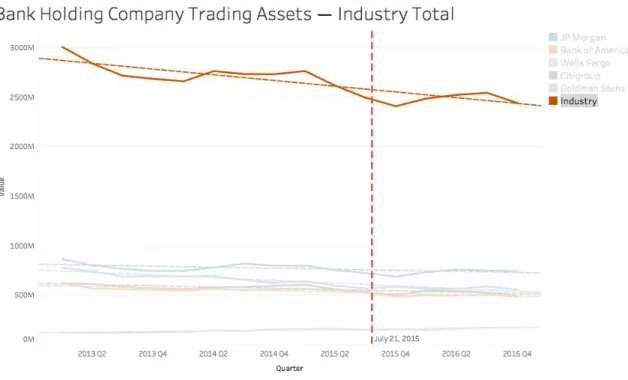
From examining profitability measures on a firm-wide basis, I turn to trading activity, which the Volcker Rule targeted specifically. The trading assets of a bank holding company depict the value of assets held in trading accounts, which are traders utilize to generate trading revenue. The change in trading assets over the period shows how the banks reallocated their assets, theoretically to optimize revenue and profitability. To see how the banking industry employed asset reallocation to comply with the Volcker Rule, I examine the nominal value of trading assets of all five banks and their trends over time. Figure 3 illustrates these values.
31 A possibility exists that this trend occurred before the examined period. This implies that, upon the Volcker Rule’s announcement, bank holding companies initiated their internal compliance programs to roll off the newly restricted proprietary trading. Nonetheless, not all banks reacted in a similar manner to the Volcker Rule. While the banking industry reduced their trading assets over time, some of the financial institutions had a greater impact on this industry total. Figure 4 depicts the trading assets of each bank holding company examined.
Figure 4 depicts how each bank has consistently decreased or increased their trading assets over the observable period. With statistical significance at a value of .05, Bank of America, JP Morgan, Goldman Sachs, and Citigroup all experienced a reduction in trading assets.
(Statistical model show in Appendix C.) The only outlier in this metric is Wells Fargo, as its trading assets increased over the 16-quarter period, also with statistical significance. As
32 Sachs’s investment banking focus. Thus, Wells Fargo’s diverging data trend can be attributed to the bank’s young investment banking arm – Wells Fargo Securities. Wells Fargo Securities was founded as a result of the 2009 merger with Wachovia Securities. Wells Fargo’s increase in trading assets, which opposes the typical trend of the remaining financial institutions analyzed, suggests that it was not as affected by the Volcker Rule as the investment banking-focused firms in the sample. This, coupled with its significantly smaller value of trading assets, portrays the differential impact of the Volcker Rule on the top five bank holding companies through a trading activity perspective.
Through proprietary trading’s prominence in investment banks rather than commercial banks, the Volcker Rule is successfully targeted at the investment banks which participated in proprietary trading. The differential impact of the Volcker Rule on the bank holding companies in the sample can be seen through each bank’s specific reliance on trading activities. A reliance on trading can be examined by calculating how much of their balance sheet is devoted to trading assets. Under the assumption that assets help generate revenue, a higher proportion of trading assets implies greater reliance on trading as a source of revenue. In theory, the greater
34 Sachs’s average ratio dropped from 37.87% to 32.56% – a decrease of 5.31%, or 14% of the original average. When calculated for Wells Fargo, the average proportion of trading assets changed from 4.31% to 4.27%, a reduction of 0.04%, or .99% of the original value. (Percent change charts are presented in detail in Appendix D.) The figure illustrates this through a steeper declining trend for Goldman Sachs. Although Wells Fargo increased its nominal value of trading assets according to Figure 4, the relatively static ratio of trading to total assets implies that Wells Fargo is increasing its total asset base over the period as well. When scaled in this way, it is evident that the Volcker Rule impacted the trading assets of each bank differently. This
discrepancy in focus on trading activity as a core banking operations allows for this differential impact of the regulation.
36 Again, a differential impact of the regulation is evident in the data presented. Goldman Sachs, the best representation of a typical investment bank, reports the highest trading revenue in nine of the 16 quarters observed. Conversely, Wells Fargo records the lowest value among all five bank holding companies in every quarter in the period except for Q4 of 2013. After the implementation of the Volcker Rule, Goldman Sachs’s trading revenue continues to maintain high volatility. This is also seen in Bank of America, JP Morgan, and Citigroup, banks which also focus in investment banking more heavily than Wells Fargo. As mentioned earlier, the external factors in this specific metric may overpower the financial impact of Volcker. However, the relatively low volatility of Wells Fargo’s trend in trading revenue shows a differential impact on banks with diversified activity focuses.
37 institution, namely depicting how vital trading revenue is to the operating income of that firm. The operating income line item on a company’s financial statement shows the income before deducting taxes and interest expense. Figure 8 shows the trading revenue as a percentage of adjusted operating income of each of the five bank holding companies, including the industry average. (The first three quarters of the overarching time series are omitted due to availability of data from the Federal Reserve.)
38 other banks maintained a relatively steady percentage trading revenue of operating income. On one hand, this could imply that both trading revenue and operating income are decreasing as a result of the Volcker Rule, essentially diminishing profitability. Under this assumption, trading revenue would remain as important to the operating income, and consequently, the return on assets of a company. However, on the other hand, it is possible that the Volcker Rule did not impact substantially either trading revenue or bank holding company operating income. This is consistent with the preceding trading revenue analysis, which suggested that outlying factors could have overpowered the perceived diminishing impact of the Volcker Rule on trading revenue.
Secondly, from Figure 8, it is clear that Goldman Sachs relies heavily on trading relative to its peers, as also noted in the trading assets analysis. Their average trading revenue of adjusted operating income proportion over the period exceeds consistently that of Wells Fargo by a multiple greater than four. This suggests that Goldman Sachs has the most company-level revenue at stake with the implementation of the Volcker Rule, which confirms Betsy Graseck’s prediction that Goldman Sachs would be “most affected by the new rules” (Patel 2013).
Furthermore, Goldman Sachs is the only bank holding company that saw their trading revenue as a percentage of total operating income drop below any level recorded in the 13-quarter period studied. This implies that, since the Volcker Rule impacted Goldman Sachs’s core banking activity more heavily than any other bank observed, the firm was tasked with the most reallocation of business activities of its peers to preserve its traditional levels of operating income.
39 holding companies can be observed in two ways in this specific financial measure: the decrease in the percentage of trading revenue as it related to operating income and the fluctuation of trading revenue percentage within each bank.
However, regression analysis states that the overall decreasing trend in trading revenue as a percentage of adjusted operating income was not statistically significant. This is true for all five banks in the sample section. This trend could be offset by the notable spike in trading revenue in Q1 of 2015. While the first quarter of the year is typically the strongest in terms of trading revenue, 2015 was different. In this specific quarter, equities trading skyrocketed within each bank, increasing their trading revenue dramatically. This stemmed from an unexpected move on part of the Swiss Central Bank: the SCB removed the cap on the Swiss franc (Trefis 2015). Combined with other market factors, the SCB’s decision acted as a catalyst to equities trading within banks, making the first quarter of 2015 one of the most profitable in terms on trading revenue. Considering this is an isolated market event that impacted trading within large bank holding companies and affected the trend in my analysis, many other factors play together to influence trading revenue as a proportion of adjusted operating income. Therefore, through the lens of trading revenue as a percentage of operating income, the Volcker Rule does not impact substantially bank profitability in a way from which the bank holding companies cannot recover.
Specific Trading Desk Activities
40 reporting purposes (FRB). Since the Volcker Rule targets a certain type of trading, I only
examined the value of the contracts “held for trading.” Figure 9 depicts the trend in the notional value of interest rate derivative contracts held for trading for the five banks in the sample section.
According to Figure 9, the notional value of interest rate derivative contracts held for trading decreased 30.21% over the period. Through regression analysis, the value reduction proves to be statistically significant. This drop in value of interest rate derivative contracts
41 regulation. Figure 10 illustrates the banks’ individual reported notional values of interest rate derivative contracts over the period.
42 newly restricted interest rate positions. Trading volatility could be a reason for the lack of
statistical significance.
Further, Figure 10 represents that JP Morgan, Bank of America, and Citigroup experienced the greatest percentage decline in the notional value of interest rate derivative contracts. The value reduction in derivative contracts was significant for all three banks. This could be due to the fact that the three firms held greater amounts of interest rate derivative contracts in the first quarter of 2013. Conversely, Wells Fargo’s growth in interest rate derivative contracts opposes the general trend in this metric. Wells Fargo’s increasing trend suggests that the Volcker Rule was not as impactful on banks that focus in commercial banking, or that Wells Fargo did not participate in proprietary trading with this specific financial instrument.
44 Consistent with previous analysis, Wells Fargo reported the lowest ratio of trading to non-traded rates derivatives contracts. The financial institution second to Wells Fargo in this regard is Bank of America, who also boasts a strong retail branch and commercial banking activity. The primarily investment banking-focused financial institutions, Goldman Sachs, JP Morgan, and Citigroup, evidently placed a greater emphasis on using derivative contracts for trading rather than hedging purposes. The discrepancy between these two groups of banks further exemplifies the varying levels of impact the Volcker Rule exerted on the relevant bank holding companies. In addition to interest rate derivative contracts, foreign exchange (FX) derivative desks also assumed considerable proprietary trading before the Volcker Rule implementation. Figure 12 illustrates the value of FX derivatives contracts on an industry-wide basis.
45 Rule should hypothetically have caused a substantial decrease in the value of these contracts, as it caused with the interest rate derivative contracts. However, FX derivative contracts held for trading increased over the period on an industry-wide basis. All bank holding companies
experienced individual increased in the notional value of FX derivative contracts held for trading. This pattern contradicts the perceived restrictive effect of the Volcker Rule on the derivative trading desks and counters the prior trend in the interest rates derivative contracts. The pattern suggests that an external factor impacted the foreign exchange trading desks. The FX derivative data for each individual bank holding company are illustrated through Figure 13.
46 plausible that the trading activity increased due to growing global demand. Further, the foreign exchange market is a large and growing one (Potter 2015). Derivatives accounted for 60% of the total global FX trading turnover in 2013. Derivative instruments “play an important role in helping transfer a wide variety of risks from entities that cannot or do not want to bear it” (Potter 2015). Thus, the foreign exchange market is critical to the global economy and may not be as affected by the Volcker Rule than other trading instruments. Under the assumption that each of the five bank holding companies observed has a global presence, it is safe to presume that this market feature is one reason for the contradictory trend in FX derivative contracts. Once again, an evident discrepancy is seen with Wells Fargo – the firm’s derivative contracts held for trading increase at a much slower rate than the rest of its competitors in the sample, while also
maintaining a substantially lower value. This can also be attributed to Wells Fargo’s focus in the commercial banking sector, contributing to the Volcker Rule’s weaker impact on its derivative contracts.
Conclusion
Following its initial announcement, the Volcker Rule, through its prohibition on proprietary trading, was predicted by critics to have a substantial negative impact on the trading capabilities and profitability of large, systemically important financial holding companies. Through a profitability lens, my analysis stated that the return on assets of the bank holding companies studied did not experience any unrecoverable decrease. That is, while net income as a proportion of total assets initially declined following the July 21, 2015 deadline, all banks in the sample successfully recovered their previous levels of net income. In some cases, banks exceeded them within the specified period of Q1 2013 – Q4 2016, illustrating that the Volcker Rule did not drastically impede their ability to produce profits.
47 period, coupled with varying market condition, contributed to this volatility. From the perspective of trading revenue, there is no evidence suggesting that Volcker Rule alone caused a decrease in bank holding companies’ trading revenue.
Further, as the data shows, the halt in proprietary trading activity diminished substantially the banking industry’s value of interest rate derivatives held for trading, which is a clear indicator that most of the activity in this specific market revolved around proprietary trading. However, despite proprietary trading also being focused on the foreign exchange derivative market, the notional value of FX derivative contracts held for trading increased across all bank holding companies. This pattern reflects the growth and global nature of the foreign exchange derivative market.
An important distinction to note is the differential impact that the Volcker Rule caused. In the most extreme divergence, Goldman Sachs and Wells Fargo serve as the benchmark. The two financial institutions focus the core of their banking activities on fundamentally different areas of financial services: Goldman Sachs is the typical investment bank, while Wells Fargo focuses in commercial banking. Through the respective strategic decisions, the banks reacted differently to the Volcker Rule. The differences stem from the banks’ varied reliance on trading activities as a source of revenue, measured by the proportion of trading assets to total assets. Thus, the data suggested an important distinction: the Volcker Rule’s prohibition of proprietary trading affected investment banks more substantially than traditional retail banks.
Limitations and Future Research Opportunities
48 I controlled for the effects from other regulatory restrictions such as the Third Basel Accord and CCAR (Comprehensive Capital Analysis and Review). The Third Basel Accord – also known as Basel III – places restrictions on the capital ratio that large bank holding companies must keep in the event of an economic downturn. The capital ratio, or capital requirement, ensures that a large financial institution holds enough high-quality liquid assets (HQLA’s) at any point in time. Through strengthening capital requirements and decreasing bank leverage, Basel III protects banks and bank holding companies from failing during economic distress.
On the other hand, the Federal Reserve Board enforces CCAR as an annual test, which determines whether financial institutions in the United States keep sufficient capital to sustain operations during potential economic downturns. These tests, more commonly referred to as “stress tests,” apply to 33 of the largest bank holding companies with operations in the United States. Through using hypothetical scenarios, CCAR tests how banks would react to economic disasters and determines whether or not each financial institution has a sound and comprehensive plan in the event of economic distress. Stress tests conduct both quantitative and qualitative tests for the banks and observe the balance sheets of large financial institutions. To best separate and control for concurrent regulations, I examined metrics which the Volcker Rule targeted
specifically, and CCAR and Basel III do not. Nonetheless, it is important to note for the purpose of this study that any concurrent regulations could have economic impacts on the financial performance of the five bank holding companies that affect the results of this study.
Additionally, proper examination of the Volcker Rule’s financial impact necessitates time restrictions and recognition of the nature of bank compliance. Because exiting the newly
49 early as 2014. However, exiting the newly restricted investments required more time than initially expected. The extensive implementation process, coupled with consistent resistance on the part of the banks, resulted in multiple deadline extensions to ensure full compliance by all financial institutions affected. The regulators complied with requests from the banks and extended the deadline multiple times for the Volcker Rule. The final deadline was set for July 21, 2015, requiring full implementation and compliance by the applicable financial institutions. Although the termination of proprietary trading was a fluid and not sudden process, some proprietary trading activity still occurred before the July 21, 2015, compliance deadline. Therefore, examining quarters after this date is an accurate representation of the financial state of bank holding companies without the existence of any proprietary trading.
It is important to note that the financial costs of the Volcker Rule are much easier to measure than the potential benefits it caused. That is, simulating a financial recession to measure how the Volcker Rule could have prevented any financial damage is challenging and nearly impossible. Under this assumption, a direct causal relationship between the Volcker Rule and the state of the American economy would be difficult to discern. Outlying factors, such as economic conditions, unobservable factors could be influencing the financial data used in the research study.
50 would provide additional insight into the financial impact of the Volcker Rule on the American banking industry.
As previously stated, certain critics of the Volcker Rule cited the essential migration of proprietary trading from the regulated banks to the unregulated entities, and not its elimination, as a shortcoming of the legislation’s effect. This potential shift is something that the Volcker Rule failed to foresee and capture in its regulation of proprietary trading. Some would argue that the Volcker Rule actually caused this shift in proprietary trading out of the regulated financial
markets and into the less-regulated financial institutions, such as hedge funds and alternative asset managers. The migration of proprietary trading to the unregulated shadow banking entities poses some concern for regulators and bankers, alike. Large hedge funds would be the market actors to undertake this trading activity. The existence of speculative trading in the shadow banking world could have even more catastrophic effects – as this industry is not regulated, no restrictions exist to limit the amount of risk the financial institutions assume. Such excessive risk in the financial markets could once again cause an economic downturn in the United States. The regulatory agencies do not have the authority to control these covered funds and the risk they undertake, as they are not insured by government funds. Instead, private capital solely finances transactions in the shadow banking industry. For example, the FDIC-insured banks have the capacity to insure their depositors through the government, and in return, government agencies regulate these banks. The absence of this relationship within the shadow banking industry restricts any regulatory oversight.
51 Rule achieved its mission in reducing systemic risk within the overall financial system, or merely transferred it to covered funds. If the risk was in fact shifted to less regulated finance institutions, the systemic risk remains in the system and still poses a threat to financial markets. Because these less-regulated financial institutions are still intertwined in the overarching financial system, their actions could have a substantial impact on the United States economy.