,.
The Effectiveness of Disaster Training for Healthcare Workers: A Systematic Review
By
Jefferson G. Williams
A Master's Paper
Submitted to the faculty of the University of North Carolina at Chapel Hill in partial fulfillment ofthe requirements for the degree of Master of Public Health
in the Public Health Leadership -Health Care and Prevention Program
Chapel Hill
Acknowledgements
This systematic review was conducted with the support of the University of North Carolina at Chapel Hill Injury Prevention Research Center (IPRC) and the North Carolina Department of Health and Human Services Injury and Violence Prevention Branch.
The author would like to thank Jane Brice, MD, MPH, Carri Casteel, MPH, PhD, Maryalice Nocera, RN, MSN, and Russell Harris, MD, MPH for their time and advice. Their support of this project and the author's education in medicine and public health are invaluable. The author would also like to thanks Lynne Morris from the University ofNorth Carolina at Chapel Hill Health Sciences Library for
ABSTRACT
OBJECTIVES: Disaster training for health care workers is an important focus for medical and public service institutions. Knowledge from evidence-based medical literature is lacking regarding the best methods to train health care providers in disaster response. The authors systematically reviewed the literature to report
whether training interventions in disaster preparedness improve knowledge and skills in disaster response. METHODS: The authors searched MEDLINE, lSI Web of Science, BIOSIS, Cumulative Index to Nursing and Allied Health (CINAHL), The Cochrane Library, ClinicalTrials.gov, the Public Affairs Information Service, and
Education Full Text. Selected journals, articles, and other comprehensive reports were also reviewed for relevant citations. Subjects of eligible articles were hospital based and prehospital healthcare providers. Inclusion Criteria for the literature were: articles published in English between January 2000 and December 2005, described a training exercise undertaken to further knowledge and/or skills in disaster response, measured a quantitative and objective outcome, and used a control or comparison group. Included studies were independently reviewed by two researchers and study quality was assessed using criteria adapted from the US Preventive Services Task Force and the Centre for Reviews and Dissemination. RESULTS: The literature search identified 258 studies, and ten studies met inclusion criteria. Subjects of included studies consisted of emergency medical services personnel, public health nurses, medical students, emergency department physicians and nurses, and long-term care facility staff. Evidence exists that both supports and questions the effectiveness of computer and web-based training interventions. Fair to poor
INTRODUCTION
Disasters are increasing in incidence and severity worldwide. Consequences of disasters in terms of human morbidity and mortality as well as economic cost are growing at an astounding rate.1 Whether a disaster is caused by a natural or man-made force, it may be defined by its capacity to overwhelm a community's ability to provide basic needs, including healthcare?· 3 Any disaster, due to a geologic or weather event, or created by acts of terrorism or large-scale industrial accidents, may cause significant human suffering. By taking a considerable toll on human life and health, disasters often create "mass-casualty incidents" (MCis) that require special effort and large-scale coordinated response ofhealthcare professionals both in and out of hospitals and healthcare facilities.
Along with the increase in incidence of disasters themselves, recent years have seen the healthcare and public service communities give increased attention to disaster preparedness and response. High-profile natural and man-made disasters such as Hurricane Katrina and the terrorist attacks of September 11th 2001 have forced healthcare leaders to take a fresh look at disaster planning. Regardless of the devastating effects on healthcare infrastructure and the mentally overwhelming nature of these events, health care professionals and public service leaders must prepare and train their organizations and personnel to respond and mitigate disasters when they occur.
For example, the Association of American Medical Colleges (AAMC)has recommended that bioterrorism education be incorporated into all four years of medical school.4 Furthermore, the Joint Commission on Accreditation ofHealthcare Organizations (JCAHO) has mandated that hospitals must practice disaster
they serve.5 These drills must occur twice a year aud intend to assess the
communication, coordination, and effectiveness of the hospital's and community's ability to respond to a disaster. The drills are "critiqued to identij'y deficiencies and opportunities for improvement."5 However, JCAHO does not specij'y measures to be used to assess the effectiveness of disaster response. In addition, it is unclear whether these drills are effective in improving the response ofhealthcare providers in the event of an actual mass casualty event.
Much of the literature on disaster training and response reports "lessons learned" and other subjective measures that create a conventional wisdom that is "at variance with empirical field disaster research."6 Despite efforts to suggest
standardized and objective tools and methods to assess and execute disaster training1• 7
"9 the literature in disaster training lacks scientific rigor. Sadly, the same "lessons" seem to be "learned" over and over again during responses to real disasters!6 The movement towards evidence-based disaster planning and training has had to begin with debunking the assumptions and myths of a false conventional wisdom that may limit the effectiveness ofhealthcare providers' response to disasters.6• 10
response, including disaster training in basic medical education for students in healthcare professions, and following systematic protocols such as the Incident Command System to manage disasters.1• 7• 11• 12 However, evaluating these and other methods of disaster training and response is difficult mainly due to the paucity of published data on disasters and disaster training. The question remains: How do we know if disaster training is effective in improving disaster response?
A limited number of review articles written in the last five years have approached this question?· 3• 13-15 The most systematic is an evidence report completed by Hsu, et al,2 for the Agency for Healthcare Research and Quality (AHRQ) and also published in the peer-reviewed Iiterature.15 This report assessed the effectiveness of training methods for hospital staff in mass-casualty incident management. The literature search for this report was conducted through February 2003, with no search restrictions based on publication date. The report was unable to draw firm conclusions on training effectiveness due to insufficient strength of the evidence. Additionally, the report excluded out-of-hospital healthcare workers such as EMTs, firefighters, and public health personnel, who play a critical role in disaster response and complement the efforts of hospital-based staff. Another review for the AHRQ assessed training relevant to bioterrorism preparedness via literature available before June 2001.13 However, the vast majority of the evidence in that review dealt with infectious disease outbreaks that may not have been directly related to acute disaster response.
planning and research, coupled with calls for more scientifically rigorous studies of disaster training, has increased the available evidence regarding disaster training in
METHODS A. Focused Question:
This systematic review seeks to answer the question: "Do training interventions for healthcare providers in disaster preparedness, such as didactic and hands-on courses, disaster drills and simulations, and other forms of continuing education, improve objective measures of knowledge and skills in disaster response?"
B. Target Population:
For the purposes of this review, "health care providers" includes all potential providers of health care services in a disaster or mass-casualty situation. This defmition includes health care facility staff such as physicians, nurses, and physician extenders; "first responders" such as paramedics, emergency medical technicians and fire fighters; and other prehospital personnel such as public health nurses and county or municipal emergency management staff.
C. Literature Search
We searched eight electronic databases, included MEDLINE via PubMed, lSI Web of Science, BIOSIS, Cumulative Index to Nursing and Allied Health
(CINAHL), The Cochrane Library, ClinicalTrials.gov, the Public Affairs Information
Service, and Education Full Text. These databases were selected by recommendation of a health sciences librarian in combination with databases cited in published
Evaluation Studies, Outcome Assessment, and Effectiveness. These terms were combined in various ways with Boolean operators (Appendix I). We limited the electronic searches to "human" studies and "English Language." Since the majority of relevant literature has been published post 9/11101, we concentrated our search on this era. However, we also included the year prior to 9/11 to obtain a sample of this earlier literature. Therefore, we searched the databases from January 2000 to December 2005.
The reference lists of systematic reviews and comprehensive reports on disasters not part of the inclusion criteria for this review were manually searched for other relevant citations. A prior search strategy by the UNC Injury Prevention Research Center (IPRC) for a previously completed bibliography16 was also hand-searched for relevant citations (Appendix II). To be thorough, researchers performed a targeted hand-search of pertinent journals for potentially eligible articles (Appendix III). We also searched the reference lists of articles deemed eligible for inclusion in this review.
All citations were imported into the electronic database management program EndNote 9.0 (Thomson Corporation, Stamford, CT, USA). Within the EndNote Libraries (ENLs ), citations were compiled and duplicate articles found by the various searching methods were discarded.
D. Study Screening and Inclusion Criteria
One researcher screened potentially relevant abstracts by inclusion criteria agreed upon by the research team. To meet inclusion criteria, articles must have been
the purpose of furthering knowledge and/or skills in disaster response. The subjects of included articles had to be health care providers, either hospital or pre-hospital, including but not limited to nurses, doctors, paramedics, emergency medical technicians, and fire department, public health, and emergency management personnel. Included articles had to have a quantitative outcome such as time, test score, or other objective measures of changes in knowledge or skill. Studies that only reported perceptions or attitudes regarding the potential benefits of training were not included. Articles that solely described qualitative outcomes such as "lessons learned" or subjective preferences for a training method (i.e. the exercise was "enjoyable" or "beneficial") were also not included. Outcomes must have been compared to a control group or comparison group (at minimum, pre/post testing of the same group) for the article to be included. Lastly, to be included, a purpose of the article must have been to evaluate the effectiveness of a training program at achieving a level of competence relating to disaster response. Studies that only described "how" to evaluate disaster planning or training, drills, and exercises were not included.
E. Study Selection and Data Abstraction
Articles with abstracts that met inclusion criteria underwent full text review. Two researchers independently evaluated the full text of articles deemed eligible by
screening using a standardized worksheet. Ifboth reviewers agreed that the study met inclusion criteria, it was included in the review. Any disagreements were adjudicated by consensus discussion of the whole research team.
spreadsheet to ensure completeness and consistency in reviewing quality assessment and synthesizing results. Two reviewers independently abstracted data from each included article and graded the quality of the study. Researchers abstracted the following data from eligible studies: Type, date, location and description of training; type and number ofhealthcare providers; study design; sampling method; type of comparison group; measured outcome and method of measurement; type of analysis and study findings. In addition, the researchers made comments on the
appropriateness of the analyses conducted, internal and external validity, and potential study biases.
F. Quality Assessment
We graded the quality of the evidence in the articles based on criteria adapted from the US Preventive Services Task Force (USPSTF) of the Agency for Healthcare Research and Quality (AHRQ) and the Canadian Centre for Reviews and
Dissemination (CRD).17-19 These criteria are based on the work ofleading experts in the independent evaluation of the scientific evidence for effectiveness on a broad range of clinical topics. After critically appraising each study, two authors
independently rated the quality of the evidence in each included study as good, fair, or poor using a standardized worksheet (Appendix V).
Good studies were well designed and well conducted experimental (e.g.
outcomes were clearly described and appropriately analyzed (e.g. intention to treat for RCTs and adjustment for potential confounders for cohort studies). Study findings were generalizable to other healthcare provider populations.
Fair studies were experimental, quasi-experimental (e.g. before-after design) or observational studies that reported adequate data to statistically assess the
effectiveness of a training intervention. Adequate controls were used to measure effectiveness. The training intervention and measured outcomes were adequately described. Strength of evidence was limited by questions about the internal validity of the study, generalizability of the findings, or the size or sampling method of the study population.
Poor studies had important methodological or design flaws that question the validity of the reported results of the study. Objective outcome measures and control groups were present, but evidence was insufficient to assess the effectiveness of the training intervention. Specifically, measured outcomes or the training intervention may have been poorly described or inadequately reported. Selection bias,
measurement bias, or confounding may have been sufficiently present to challenge the validity of reported results.
G. Analysis
RESULTS A. Literature Search
The literature search identified 258 potentially relevant citations. Electronic databases yielded 160 articles, 31 were found via targeted hand-searching, and 67 were included from the IPRC bibliography search (Figure One). We reviewed and excluded nine abstracts not imported into the ENL because of problems with electronic import filters. Sixty-three duplicate articles across all three search strategies were discarded, yielding 186 unique and potentially relevant citations.
We further excluded 160 articles (86%) based on abstract analysis in accordance with the inclusion criteria. Two reviewers independently assessed the full text of the remaining 26 articles. Upon full text review, 16 of the articles were excluded. Four of the excluded articles 20.23 had inadequate data (outcomes were self-report surveys or assessed opinions) or did not specifically evaluate training in disaster response. Twelve8• 9• 24-33 of the articles had no comparison group, and most of these had
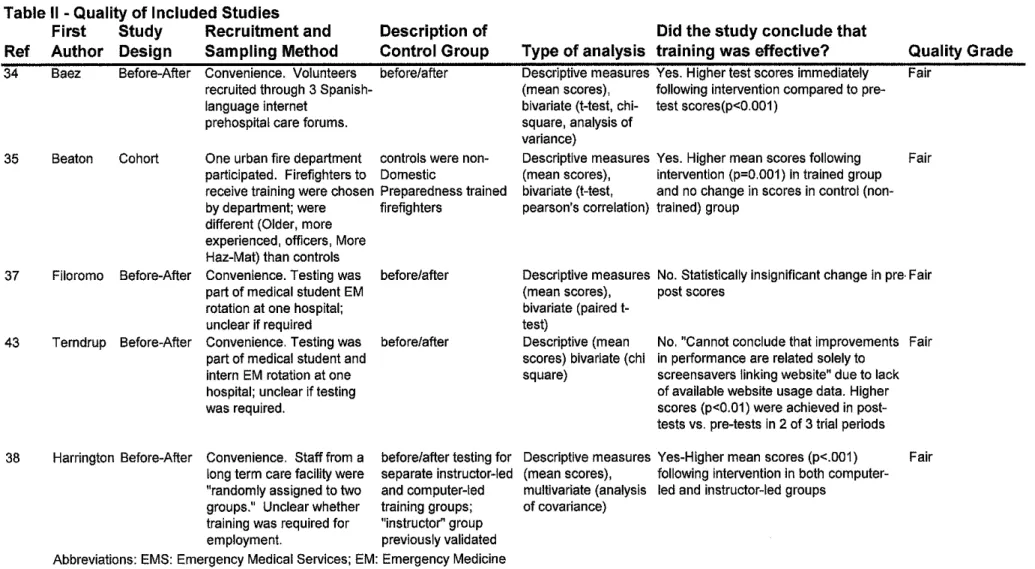
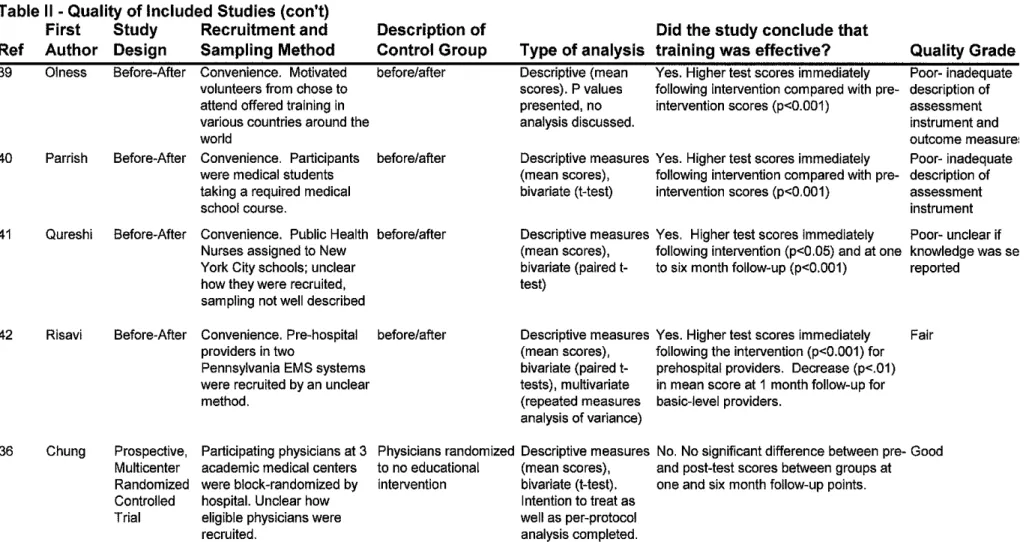
inadequate data as well. The remaining ten articles34-43 were deemed eligible for data abstraction and inclusion in this review (Figure One). Characteristics and quality of each included study are summarized in Tables I and II.
B. Description of the Included Studies
Eight of the ten included studies34•3641•43 were published in the latter part of our search period (2003-2005). All but two of the studies evaluated training
The number of subjects in each study ranged from 50 to 764. In three35• 41• 42 articles, subjects were out-of-hospital healthcare providers: different types of EMS system personnel, firefighters, and public health nurses. Subjects in one study'8 were nursing facility staff. An additional four36• 37• 40• 43 articles described training subjects who were hospital-based healthcare providers (only Emergency Department
providers were represented) or medical students. Subjects in the remaining two studies were both hospital-based and out-of-hospital providers: Latin American emergency care providers of several types,34 and multi-national physicians and "other health care professionals."39
The training intervention in four articles34• 36• 37• 43 was computer or internet-based and had no face-to-face education component. Five of the articles35•3942 evaluated training methods that included didactic lectures given by on-site
instructors, presentations, and interactive discussions about disaster scenarios. The remaining study'8 compared computer-based to lecture-based training.
The outcome measure in all ten articles was some type oftest of knowledge. A statistically significant change in knowledge, measured by an increased test score, was used to demonstrate effectiveness of the training intervention. In general, studies with computer or website interventions used computers to conduct the test, while studies with lecture interventions used written multiple choice tests.
C. Design, Quality, and Results of the Included Studies
randomized to the website intervention did not access the site. Nonetheless,
intention-to-treat analysis as well as per-protocol analysis that grouped physicians by actual website usage found no difference in bioterrorism knowledge due to the intervention. Although the study was conducted during late 2001 during the highly publicized anthrax incidents, both the intervention and control groups had the same exposure to media and other forms of information. Neither group appeared to increase knowledge ofbioterrorism. This study was the only included article to receive a "good" quality rating.
One cohort study"5 was included in the review. In this study, authors evaluated Department of Defense "Domestic Preparedness" (DP) training. Firefighters and paramedics who attended 40 hours of didactic lecture education increased their mean scores on a validated "Domestic Preparedness Questionnaire," while firefighters and paramedics who did not attend this training did not increase their scores. However, meaningful selection bias may have been present, as personnel who received DP training were hand-selected by their department. In addition, DP-trained personnel were different than non-DP trained personnel with regard to potentially confounding variables. Firefighters and paramedics selected to attend the DP training were significantly older, more experienced, were more likely to be officers, and had received a greater amount of hazardous materials training. This study received a "fair'' quality rating.
on the subjects that may have nothing to do with the intervention.18 Without
consideration and measurement of potential outside influences over the study period, adequate follow-up assessment, one cannot evaluate whether any improvements in training are attributable to the training intervention or some other competing factor.
For example, two studies, one a pilot studl7 for the second,43 attempted to assess whether a screensaver and linked website was an effective intervention to increase bioterrorism knowledge. The authors could not conclude that improvements in knowledge were due to their intervention. One likely reason for the inconclusive results is that data were collected during late 2001 and early 2002, shortly after the September 11th, 2001 terrorist attacks and fall2001 anthrax incidents. The "secular trend" of dramatically increasing media coverage and public and healthcare provider awareness ofbioterrorism during this time could provide a reasonable explanation for the subjects' increase in bioterrorism knowledge. To their credit, the authors did not overstate the ability of these studies to assess the effectiveness of their interventions. These two studies were given a quality rating of "fair."
Three of the other quasi-experimental studies34• 38• 42 were also given a quality rating of"fair." These studies concluded that the training intervention was effective in improving knowledge. However, these three studies did not clearly describe the data collection instrument, outcome measures or timing of measurement. For example, in two of the studies34• 42 it was unclear if subjects took short and similar tests after relatively short training interventions, i.e. test improvement could have been due to memory and not the training intervention. Along with similar
long-term care staff. In the specialized setting of a nursing home, the content of disaster training may be less applicable to other providers in disaster response.
The final three included studies 3941 were given a quality rating of poor. These studies did not adequately report information on the data collection instruments used to measure potential change in knowledge. In one study of public health nurses in New York City,41 it was unclear whether change in knowledge was measured objectively. The authors stated that test scores "revealed participants' knowledge" but then presented a table (Table 241) that suggested change in knowledge may have been self-assessed (i.e. the participants may have been asked "Do you know the answer to this question" rather than "what is the answer to this question"). A stud~9 examining the needs of children in disasters stated that an "objective multiple choice questionnaire" was used for a pretest and posttest, but did not further describe the test items or state what the test purported to measure. The last study40 thoroughly
described a medical school course on bioterrorism and disaster response, but presented no information on the test instrument used to assess pre- and post-training knowledge. All three of these studies concluded that their training interventions were associated with improved knowledge. However, we felt that these conclusions were not supported by what is (and is not) reported in these studies and the studies received a grade of"poor." The interventions described may or may not be effective in
disaster training.
D. Principal Findings of this Review
research team. Additionally, the only study of good quality,36 which was a
randomized controlled trial, concluded that its training intervention did not increase participants' knowledge ofbioterrorism.
Fair evidence exists in support of the effectiveness of computer and web-based training interventions, 34• 38 while both good36 and fai?7• 43 evidence also exists
h · h ffi · fth f · · F · Js 38 42 39-41
DISCUSSION A. Synthesis of Results
Little additional good evidence regarding the effectiveness of disaster training has become available in the five years since domestic terrorism focused the attention of health care providers on disaster preparedness. The large majority of studies published during our search period of January 200 I to December 2005 that have attempted to evaluate disaster training interventions are not scientifically rigorous enough to adequately assess the effectiveness of described interventions. While the quality of studies in this area of the literature may have improved somewhat since prior systematic reviews2• 13 were conducted, the body of evidence remains unable to offer definitive conclusions regarding the most effective methods of training
healthcare providers in disaster response.
Despite the shortcomings of the evidence, this review does offer four important contributions to the disaster preparedness literature. We rigorously analyzed the quality of the evidence for disaster training methods, and included studies of all types of health care providers. In addition, our review illustrates the need for researchers to use a common method of training evaluation and highlights the important differences between studies of efficacy and studies of effectiveness.
a12 included four studies31• 32• 44• 45 published within the time frame of our search (2000-2005). While our search strategy identified all four studies, none were included in our review because they did not have a control group. Indeed, Hsu, et al note that in their review, "no study had a control group,''2
Secondly, we reviewed studies that assessed the training of pre-hospital health care providers, not just hospital staff. Six34• 35• 38• 39• 41• 42 of the ten included studies evaluated the training of health care providers who practice in out-of-hospital settings or nursing facilities where advanced care may not be immediately available. Experience with many types of disasters shows us that pre-hospital personnel such as EMS workers, both on-duty professionals and self-dispatched volunteers,46 are a part of disaster response. These personnel should be considered in any evaluation of disaster training. The Centers for Disease Control and Prevention (CDC) and others6• 37
• 47 have noted that public health workers and many other types of public service personnel are important potential primary contacts in disaster detection and response.
data.48 An "Utstein Style" has also been proposed for disaster research, 1 which endorses a similar style of uniform reporting that would allow for comparison across studies as well as more valid and reliable methods of combining study results. Hopefully, published endorsements for these or other broad-based evaluation
methods for disaster training8• 49will encourage researchers to subscribe to a common ground. Universally accepted criteria that are used to evaluate both disaster response and disaster training would greatly improve the strength of evidence regarding the most effective methods of disaster response and could potentially lead to the ability to conduct meta-analyses.
Lastly, we remind that conducting studies that truly assess the effectiveness of disaster training interventions is inherently difficult. It is unclear whether
knowledge gained via a short multiple-choice test would represent better performance in a real disaster situation. It seems likely that improvement on objective measures under ideal conditions would be a poor proxy for improvement in a true disaster response. For example, just as a cardiac arrest training simulation50 cannot mimic the stress of performing real-life cardiopulmonary resuscitation, short triage scenarios34• 42
Furthermore, "the question of whether various preparedness and response measures actually affect morbidity and mortality remains to be addressed."6
Appropriate patient-centered research outcomes such as "lives saved" due to a given training intervention would provide evidence of effectiveness. However, such outcomes are difficult to measure. Each disaster situation has unique challenges that make standard evaluation of disaster response a complex task.
B. Limitations
This review has several limitations. First, we limited our search to only include English-language articles. Efforts to improve education in disaster
preparedness and response are most certainly international. The European Master in Disaster Medicine 51 program is one example of a multi-national collaboration (including partners in the United States at Harvard University, Yale University52 and Vanderbilt University53) that aims to formalize and improve education in disaster medicine. However, a repeated PubMed search that was not limited by language did not return any additional articles. Therefore, this may be a minor limitation.
Furthermore, we excluded studies that evaluated knowledge and skills that may be related to disaster response in some cases. We determined that a broad set of medical knowledge and skills is relevant in some way to disaster response.
Nonetheless, our review only included studies conducted for the explicit purpose of evaluating disaster training. For example, the review by Catlett, et aln assessed studies that may be related to training in bioterrorism preparedness. However, the vast majority of included studies in that review dealt with identifYing infectious disease outbreaks such as HIV I AIDS and other sexually transmitted diseases. We excluded studies such as these. We also excluded studies that evaluated training of trauma surgery teams21 via patient simulators because the studies were not conducted expressly for the purpose of disaster training. Detecting infectious disease outbreaks and trauma surgery may be necessary components of some responses to disasters, as many fields of medicine may be. However, including the many areas of medicine that are components of a disaster response would been an overwhelming task that would have further hindered our ability to draw conclusions regarding the
effectiveness of disaster training. We focused on training interventions most specifically related to acute disaster response. In an attempt to decrease the number of extraneous studies in our review, we may have excluded studies that some readers would consider relevant to training in disaster response.
C. Recommendations for future research
subjects receiving the intervention to subjects not receiving the intervention. This may be an unappealing requirement in disaster training, as healthcare agencies would likely prefer that all personnel receive training. However, which types of training are effective remains unclear. Certainly in most situations the "control group" in a given training evaluation (i.e. those not receiving training) could undergo the training intervention once it is shown to be effective, or at least efficacious.
Additionally, future research should work to incorporate multiple types of healthcare providers into regular training scenarios. Regularly occurring JCAHO-mandated drills and curricula encouraged by the AAMC provide ample opportunity to conduct disaster training research with multiple types ofhealthcare providers. Researchers recently presented an abstract of an evaluation of such an
interdisciplinary training. 54 Further similar efforts are encouraged.
Perhaps most importantly, future evaluations of disaster training efforts should be presented and published. We agree with AufderHeide that "more emphasis needs to be placed on reporting the fmdings of field research through peer-reviewed scientific journals."6
D. Conclusions
We conclude that the available evidence is insufficient to determine whether a given training intervention in disaster preparedness for healthcare providers is
effective in improving knowledge and skills in disaster response.
Table I -Characteristics of Included Studies
First Year Year Study Number of Description of Training Outcome
Ref Author Published Conducted Study Location Design Participants (n) Type of Provider Intervention Measures"' 34 Baez 2005 unclear Internet prehospital care Before-After 55 Latin American First 2 15-mlnute Internet education Number of sceriS.rios
forums Responders, EMTs, modules correctly trlaged
nurses, physicians
35 Beaton 2002 September 2000 Urban fire department, Cohort baseline = 206 DP Pre-Hospital: Dept of Defense Domestic DPQ scores: test of northwest US trained= 80 Non- Firefighters and Preparedness training. 40 hours knowledge of domestic
DP trained =78 paramedics onsite education by experts: preparedness lectures, multimedia,
demonstrations, handbook.
37 Filoromo 2003 Late 2001 UABED Before-After 50 In-Hospital: Med Interactive screen saver and General test on Student ED rotators linked web site bioterrorism
knowledge from website
43 Terndrup 2005 Late 2001, early UABED Before-After 157 In-Hospital: Med Interactive screen saver and Bioterrorism-specific
2002 Student and Intern ED linked web site questions In an
rotators Emergency Medicine
rotation test 38 Harrington 2003 unclear Not Stated Before-After 289 Long Term Care Comparison of Computer vs. Test of knowledge
Facility Staff Instructor led- workshop-style training in fire safety and emergency procedures
39 Olness 2005 2001-2004 Cleveland, Thailand, Before-After 280 Non-specific 5 day course- didactic lectures, Objective multiple Pakistan, Ethiopia, Physicians and Health case discussion, eval and choice questionnaire Nicaragua, Panama, Care Professionals feedback
Syria, India
40 Parrish 2005 03-04 and 04-05 Texas A&M college of Before-After 72 In-Hospital: 2nd year 4 day block of Instruction Test of knowledge of medical school medicine Medical Students including lecture and hands-on disaster preparedness
years experience with scenarios
41 Qureshi 2004 August 2001 New York City (NYC) Before-After 764 Pre-Hospital: Public 4 hour didactic training Knowledge regarding health nurses In public conducted by Columbia emergency schools In NYC professors preparedness 42 Rlsavi 2001 unclear, but Pennsylvania Before-After 109 Pre-Hospital: Two-hour didactic lecture with Written 20 question
before 9-11-01 paramedics, RNs, slides and video, given by Mass Casualty Incident EMTs, first responders principle investigator. scenario
36 Chung 2004 November 2001 Boston Prospective, 63 In-Hospital: EM and Training Intervention group Multiple choice to October 2002 Multicenter Peds EM attendlngs, randomized to access to an questions on
Randomized fellows, and 4th year educational web site, also knowledge, diagnosis, Controlled EM residents weekly scenarios emailed. treatment of
Trial Duration 1 month. bioterrorism
• Several studies also measured other outcomes such as attitudes or opinions. Only outcomes relevant to our question are reported here.
Table II -Quality of Included Studies
First Study Recruitment and
Ref Author Design Sampling Method
Description of Control Group 34 35 37 43 38
Baez Before-After Convenience. Volunteers before/after recruited through 3
Spanish-language internet prehospital care forums.
Beaton Cohort One urban fire department controls were non-participated. Firefighters to Domestic
receive training were chosen Preparedness trained by department; were firefighters
different (Older, more experienced, officers, More Haz-Mat) than controls
Filoromo Before-After Convenience. Testing was before/after part of medical student EM
rotation at one hospital; unclear if required
Terndrup Before-After Convenience. Testing was before/after
Harrington Before-After
part of medical student and intern EM rotation at one hospital; unclear if testing was required.
Convenience. Staff from a long term care facility were "randomly assigned to two groups." Unclear whether training was required for employment.
before/after testing for separate instructor-led and computer-led training groups;
"instructor" group
previously validated Abbreviations: EMS: Emergency Medical Services; EM: Emergency Medicine
Did the study conclude that Type of analysis training was effective? Descriptive measures Yes. Higher test scores immediately (mean scores), following intervention compared to pre-bivariate (!-test, chi- test scores(p<0.001)
square, analysis of variance)
Descriptive measures Yes. Higher mean scores following (mean scores), intervention (p=0.001) in trained group bivariate (!-test, and no change in scores in control (non-pearson's correlation) trained) group
Quality Grade Fair
Fair
Descriptive measures No. Statistically insignificant change in pre· Fair (mean scores), post scores
bivariate (paired !-test)
Descriptive (mean scores) bivariate (chi square)
No. "Cannot conclude that improvements in performance are related solely to
screen savers linking website" due to lack
of available website usage data. Higher scores (p<0.01) were achieved in post-tests vs. pre-post-tests in 2 of 3 trial periods
Descriptive measures Yes-Higher mean scores (p<.001) (mean scores), following intervention in both computer-multivariate (analysis led and instructor-led groups
of covariance)
Fair
Table II -Quality of Included Studies (con't) Ref 39 40 41 42 36 First Author Olness Parrish Qureshi Risavi Chung Study Design Before-After Before-After Before-After Before-After Prospective, Multicenter Randomized Controlled Trial
Recruitment and Description of Did the study conclude that
Sampling Method Control Group Type of analysis training was effective? Quality Grade
Convenience. Motivated before/after Descriptive (mean Yes. Higher test scores immediately Poor- inadequate volunteers from chose to scores). P values following intervention compared with pre- description of attend offered training in presented, no intervention scores {p<0.001) assessment
various countries around the analysis discussed. instrument and
world outcome measure:
Convenience. Participants before/after Descriptive measures Yes. Higher test scores immediately Poor- inadequate were medical students (mean scores), following intervention compared with pre- description of taking a required medical bivariate (!-test) intervention scores {p<0.001) assessment
school course. instrument
Convenience. Public Health before/after Descriptive measures Yes. Higher test scores immediately Poor- unclear if Nurses assigned to New
York City schools; unclear how they were recruited, sampling not well described
Convenience. Pre-hospital providers in two
Pennsylvania EMS systems were recruited by an unclear method.
Participating physicians at 3 academic medical centers were block-randomized by hospital. Unclear how eligible physicians were recruited.
(mean scores), following intervention (p<0.05) and at one knowledge was se bivariate (paired t- to six month follow-up {p<0.001) reported
test)
before/after Descriptive measures Yes. Higher test scores immediately Fair (mean scores), following the intervention (p<0.001) for bivariate (paired t- prehospital providers. Decrease (p<.01) tests), multivariate in mean score at 1 month follow-up for (repeated measures basic-level providers.
analysis of variance)
Physicians randomized Descriptive measures No. No significant difference between pre- Good to no educational (mean scores), and post-test scores between groups at
intervention bivariate (!-test). one and six month follow-up points. Intention to treat as
Appendix I
Literature Search Strategies and Key Words 1. PubMed Search using MeSH headings and keywords:
("education"[Subheading] OR "preparedness") AND ("Health
Personnel"[MeSH] OR "Emergency Medical Technicians"[MeSH] OR "Emergency Medical Services"[MeSH] OR "First Responders") AND ("Disasters"[MeSH] OR "Terrorism"[MeSH] OR "Mass Casualty") AND ("Evaluation Studies"[MeSH] OR "Outcome Assessment (Health
Care )"[MeSH])
2. ISI Web of Science Search and BIOSIS Search
TS=(Health Personnel OR Hospital Staff OR Emergency Medical Technicians OR Emergency Medical Services OR First Responders) AND TS=(Disasters OR Terrorism OR Mass Casualty) AND TS=(Training OR Evaluation Studies OR Outcome Assessment OR Effectiveness)
DocType=All document types; Language=English; Databases=SCI-EXPANDED, SSCI; Timespan=2000-2005
3. CINAHL via EBSCO host
(Health Personnel OR Hospital Staff OR Emergency Medical Technicians OR Emergency Medical Services OR First Responders) AND (Disasters OR Terrorism OR Mass Casualty) AND (Training OR Evaluation Studies OR Outcome Assessment OR Effectiveness)
Appendix II
IPRC Capacity and Preparedness Search Methodology
Appendix III
Journals Manually Searched for Relevant Reviews and Articles
The search was conducted in April2006 for articles published between January 2000 and December 2005. The following is a list of targeted journals searched:
Academic Emergency Medicine
American Journal of Emergency Medicine Annals of Emergency Medicine
Disasters
Emergency Medicine Clinics ofNorth America Journal of Emergency Nursing
Journal of Trauma, Injury, Infection, and Critical Care Prehospital and Disaster Medicine
Article Author: Year: Title:
AppendixN
Disaster Training Review- Inclusion Criteria Worksheet
Inclusion Criteria
Comments:
Published between Jan 2000 and December 2005 Experiment, Drill Course, Training exercise furthering knowledge/Skills in Disaster management or response.
AppendixV
Disaster Training Review- Quality Assessment ofincluded Studies Worksheet Article
Author: Year: Title:
Criteria (Circle number if criterion is present)
I. The study is a well designed and well conducted experimental (e.g. randomized controlled trial- RC1) or observational (e.g. cohort) study.
2. The study includes consistent and ample data to assess the effectiveness of the training intervention.
3. Appropriate controls were used to measure effectiveness,
4. Subject groups were comparable on any important confounding factors. 5. The training intervention and measured outcomes were clearly described and
appropriately analyzed (e.g. intention to treat for RCTs and adjustment for potential confounders for cohort studies).
6. Subjects and study findings were generalizable to other populations involved in disaster response.
7. The study is experimental, quasi-experimental (e.g. before-after design) or an observational study.
8. The study has adequate, not ample, data to assess the effectiveness of a training intervention.
10. Adequate controls were used to measure effectiveness.
11. The training intervention and measured outcomes were adequately described. 12. Strength of evidence is limited by questions about the internal validity of the
study, generalizability of the findings, or size and nature of the study population.
13. Objective data and control groups are present, but evidence is insufficient to assess the effectiveness of the training intervention.
14. Measured outcomes or the training intervention are poorly described or inadequately reported.
15. Selection bias, measurement bias, or confounding is sufficiently present to challenge the validity of reported results.
INSTRUCTIONS
1. If criteria 1-6 are all present, the study should be rated GOOD.
2. If the majority of criteria 7-12 are present, including criterion 12, the study should be rated FAIR.
3. If ANY of criteria 13-15 are present, the study should be rated POOR. Please comment on and describe any POOR rating.
Figure One- QUOROM55 Tree for Literature Search Results
Potential Citations via Potential Citations via Potential Citations via Electronic Databases Hand Searching prior IPRC Search
n= 160 n = 31 n=67
I
Citations Included inElectronic Citations not in ENL, End-Note Library but reviewed and excluded n= 249
n=9
~
Duplicates Discardedn= 63
Unique Citations Included in End-Note Library
n= 186
---Citations Excluded by Abstract Review
n= 160 Full Text Articles Reviewed
n= 26
Full Text Articles
Excluded by Criteria Articles Eligible for
n= 16 Inclusion
References
I. Task Force on Quality Control of Disaster Management. Health Disaster
Management: Guidelines for Evaluation and Research in the Utstein Style:
Executive Summary. Prehospital & Disaster Medicine. 1999;14:43-52.
2. Hsu EB JM, Catlett CL, Robinson KA, Feuerstein CJ, Cosgrove SE, eta!.
Training of Hospital Staff to Respond to a Mass Casualty Incident.
Evidence Report/Technology Assessment No. 95. Prepared by the Johns
Hopkins University Evidence-based Practice Center under Contract No.
290-02-0018.: AHRQ Publication No. 04-E015-2. Rockville, MD: Agency
for Healthcare Research and Quality. June 2004.
3. Milsten A. Hospital responses to acute-onset disasters: a review.
Pre hospital Disaster Med Jan-Mar 2000; 15(1 ):32-45.
4. Association of American Medical Colleges. Training Future Physicians
About Weapons of Mass Destruction: Report of the Expert Panel on
Bioterrorism Education for Medical Students. 2003;
http://www.aamc.org/newsroom/bioterrorism/bioterrorismrec.pdf.
5. Joint Commission on Accreditation of Healthcare Organizations.
Comprehensive Accreditation Manual for Hospitals: The Official
Handbook. Oakbrook Terrace Terrace, IL: Joint Commission Resources;
2006:EC-4.20.
6. Auf der Heide E. The importance of evidence-based disaster planning.
7. Markenson D, DiMaggio C, Redlener I. Preparing health professions
students for terrorism, disaster, and public health emergencies: core
competencies. A cad Med. Jun 2005;80(6):517-526.
8. Green GB, Modi S, Lunney K, Thomas TL. Generic evaluation methods
for disaster drills in developing countries. Ann Emerg Med. May
2003;41(5):689-699.
9. Klein KR, Brandenburg DC, Atas JG, Maher A. The use of trained
observers as an evaluation tool for a multi-hospital bioterrorism exercise.
Prehospital Disaster Med. May-Jun 2005;20(3):159-163.
10. Burstein JL. The Myths of Disaster Education. Ann Emerg Med.
2006;47:50-52.
11. Arnold JL, Paturas J, Rodoplu U. Measures of effectiveness of hospital
incident command system performance. Prehospital Disaster Med.
May-Jun 2005;20(3):202-205.
12. Thomas TL, Hsu EB, Kim HK, Colli S, Arana G, Green GB. The incident
command system in disasters: evaluation methods for a hospital-based
exercise. Prehospital Disaster Med. Jan-Feb 2005;20(1):14-23.
13. Catlett C, Perl T, Jenckes M, et a!. Training of Clinicians for Public Health
Events Relevant to Bioterrorism Preparedness (Evidence
Report/Technology Assessment No. 51 (Prepared by Johns Hopkins
Evidence-based Practice Center under Contract No. 290-97-006). AHRQ
Pub. No. 02-EOll. Rockville, MD: Agency for Healthcare Research and
14. Chaffee MW. Hospital response to acute-onset disasters: the state of the
science in 2005. Nurs Clin North Am. Sep 2005;40(3):565-577, x.
15. Hsu EB, Jenckes MW, Catlett CL, eta!. Effectiveness of hospital staff
mass-casualty incident training methods: a systematic literature review.
Prehospital Disaster Med Jul-Sep 2004;19(3):191-199.
16. Nocera M, Sparks K, Casteel C. Annotated Biliography for Capacity and
Preparedness. University of North Carolina at Chapel Hill Injury
Prevention Research Center
[!lttp://www.iprc.unc.edu/pages/research/IPRC%20Bibliography.pdf.
17. Harris RP, Helfand M, WoolfSH, eta!. Current methods of the US
Preventive Services Task Force: a review of the process. Am J Prev Med.
Apr 2001;20(3 Suppl):21-35.
18. Khan K, Riet G, Glanville J, Sowden A, Kleijnen J. Undertaking
Systematic Reviews of Research on Effectiveness: CRD's Guidance for
those Carrying Out or Commissioning Reviews. CRD Report Number 4
(2nd Edition) March 2001. NHS Centre for Reviews and Dissemination,
University of York [http://www.york.ac.uk/inst/crdlreport4.htm,.
19. U.S. Preventive Services Task Force Ratings: Strength of
Recommendations and Quality of Evidence. Guide to Clinical Preventive
Services Third Edition: Periodic Updates 2000-2003
[http://www.ahrg.gov/clinic/3rduspstfi'ratings.htm.
20. Ablah E, Molgaard CA, Fredrickson DD, Wetta-Hall R, Cook DJ.
Terrorism and Emerging Infections". J Public Health Manag Pract. Nov
2005;11(6 Suppl):S17-S24.
21. Bruce S, Bridges EJ, Holcomb JB. Preparing to respond: Joint Trauma Training Center and USAF Nursing Warskills Simulation Laboratory. Crit
Care Nurs Clin NorthAm. Jun 2003;15(2):149-162.
22. Henning KJ, Brennan PJ, Hoegg C, O'Rourke E, Dyer BD, Grace TL.
Health system preparedness for bioterrorism: bringing the tabletop to the
hospital. Infect Control Hasp Epidemiol. Feb 2004;25(2):146-155.
23. Sarpy SA, Warren CR., Kaplan S, Bradley J, HoweR. Simulating public
health response to a severe acute respiratory syndrome (SARS) event: a
comprehensive and systematic approach to designing, implementing, and
evaluating a tabletop exercise. Journal of Public Health Management &
Practice (J PUBLIC HEALTH MANAGE PRACT), 2005 Nov:
Supplement: S75-82 (28 ref). 2005.
24. Al-Darnouk M, Bleetman A. Impact of the Department of Health initiative
to equip and train acute trusts to manage chemically contaminated
casualties. Emerg Med J. May 2005;22(5):347-350.
25. Alexander AJ, Bandiera GW, Mazurik L. A multiphase disaster training
exercise for emergency medicine residents: opportunity knocks. Acad
Emerg Med. May 2005;12(5):404-409.
26. Beaton RD, Stevermer A, Wicklund J, Owens D, Boase J, Oberle MW.
dispensing exercise, part II--dispensary site worker findings. J Public
Health Manag Pract. Jan-Feb 2004;10(1):77-85.
27. ChiCH, Chao WH, Chuang CC, Tsai MC, Tsai LM. Emergency medical
technicians' disaster training by tabletop exercise. Am J Emerg Med. Sep
2001 ;19(5):433-436.
28. FitzGerald DJ, Sztajnkrycer MD, Crocco TJ. Chemical weapon functional
exercise--Cincinnati: observations and lessons learned from a "typical
medium-sized" city's response to simulated terrorism utilizing Weapons of
Mass Destruction. Public Health Rep. May-Jun 2003;118(3):205-214.
29. Gershon RR, Qureshi KA, Sepkowitz KA, Gurtman AC, Galea S,
Sherman MF. Clinicians' knowledge, attitudes, and concerns regarding
bioterrorism after a brief educational program. J Occup Environ Med. Jan
2004;46(1):77-83.
30. Gildea JR, Etengoff S. Vertical evacuation simulation of critically ill
patients in a hospitaL Prehospital Disaster Me d. Jul-Aug 2005;20(
4):243-248.
31. Gretenkort P, Harke H, Blazejak J, Pache B, Leledakis G. Interface
between hospital and fire authorities--a concept for management of
incidents in hospitals. Pre hospital Disaster Med. Jan-Mar 2002;17(1
):42-47.
32. Inglesby TV, Grossman R, O'Toole T. A plague on your city: observations
33. Lee WH, Chiu TF, Ng CJ, Chen JC. Emergency medical preparedness and response to a Singapore airliner crash. Acad Emerg Med Mar
2002;9(3):194-198.
34. Baez AA, Sztajnkrycer MD, Smester P, Giraldez E, Vargas LE.
Effectiveness of a simple Internet-based disaster triage educational tool directed toward Latin-American EMS providers. Prehosp Emerg Care.
Apr-Jun 2005;9(2):227-230.
35. Beaton RD, Johnson LC. Instrument development and evaluation of domestic preparedness training for first responders. Prehospital Disaster Med. Jul-Sep 2002;17(3):119-125.
36. Chung S, Mandl KD, Shannon M, Fleisher GR. Efficacy of an educational Web site for educating physicians about bioterrorism. Acad Emerg Med
Feb 2004;11(2):143-148.
37. Fi1oromo C, Macrina D, Pryor E, Temdrup T, McNutt SD. An innovative approach to training hospital-based clinicians for bioterrorist attacks. Am J
Infect Control. Dec 2003;31(8):511-514.
38. Harrington SS, Walker BL. Is computer-based instruction an effective way to present fire safety training to long-term care staff? J Nurses Staff Dev.
May-Jun 2003;19(3):147-154.
39. Olness K, Sinha M, Herran M, Cheren M, Pairojkul S. Training ofhea1th care professionals on the special needs of children in the management of disasters: experience in Asia, Africa, and Latin America. Ambul Pediatr.
40. Parrish AR, Oliver S, Jenkins D, Ruscio B, Green JB, Colenda C. A short medical school course on responding to bioterrorism and other disasters.
Acad Med Sep 2005;80(9):820-823.
41. Qureshi KA, Gershon RR, Merrill JA, eta!. Effectiveness of an
emergency preparedness training program for public health nurses in New
York City. Fam Community Health. Jul-Sep 2004;27(3):242-249.
42. Risavi BL, Salen PN, Heller MB, Arcona S. A two-hour intervention using START improves pre hospital triage of mass casualty incidents.
Prehospital Emergency Care (PREHOSPITAL EMERG CARE). Apr-Jun
2001;5(2):197-199 (116 ref).
43. Temdrup T, Nafziger S, WeissmanN, Casebeer L, Pryor E. Online
bioterrorism continuing medical education: development and preliminary
testing. Acad Emerg Med Jan 2005;12(1):45-50.
44. Classic KL, Knutson AH, Smith GD. Radiation safety role in institutional disaster planning. Health Phys. May 2000;78(5 Suppl):S35-39.
45. Bissell RA, Pinet L, Nelson M, Levy M. Evidence of the effectiveness of health sector preparedness in disaster response: the example of four
earthquakes. Fam Community Health. Jul-Sep 2004;27(3):193-203.
46. Cone DC, Weir SD, Bogucki S. Convergent volunteerism. Ann Emerg Med. Apr 2003;41(4):457-462.
Strategic Planning Workgroup. MMWR. 2000;April 21,
2000( 49(RR04)): 1-14.
48. Cummins RO, Chamberlain DA, Abramson NS, et al. Recommended
guidelines for uniform reporting of data from out-of-hospital cardiac
arrest: the Utstein Style. A statement for health professionals from a task
force of the American Heart Association, the European Resuscitation
Council, the Heart and Stroke Foundation of Canada, and the Australian
Resuscitation Council. Circulation. Aug 1991;84(2):960-975.
49. Hsu EB, Thomas TL, Bass EB, Whyne D, Kelen GD, Green GB.
Healthcare worker competencies for disaster training. BMC Med Educ.
2006;6:19.
50. Williams JG, Brice JH, De Maio VJ, Jalbuena T. A Simulation Trial of
Traditional Dispatcher-Assisted CPR Versus Compressions-Only
Dispatcher-Assisted CPR. Prehosp Emerg Care. Apr-Jun
2006;10(2):247-253.
51. European Master in Disaster Medicine. http://www.dismedmaster.com/.
Accessed May 2006.
52.
Yale New Haven Center for Emergency Preparedness and DisasterResponse. http://yalenewhavenhealth.org/emergency/. Accessed May
2006.
53.
National Center for Emergency Preparedness at Vanderbilt University54. Marcozzi D, Gerardo C, Grochowski C, et aL A Professional School's
Disaster Preparedness Curriculum: Multidisciplinary and Effective.
Abstract Poster Presentation. Southeastern Regional Society for Academic
Emergency Medicine Meeting. Greensboro, NC; 2006.
55. Moher D, Cook DJ, Eastwood S, Olkin I, Rennie D, Stroup DF. Improving
the quality of reports of meta-analyses of randomised controlled trials: the
QUOROM statement. Quality of Reporting of Meta-analyses. Lancet. Nov