http://dx.doi.org/10.4236/jdaip.2015.33007
Design and Development of E-Governance
Model for Service Quality Enhancement
Tulu Tilahun
1, Durga Prasad Sharma
21Department of Computer Science & IT, Arba Minch Institute of Technology, Arba Minch, Ethiopia 2AMiT, AMU, MOEFDRE under UNDP, Ethiopia
Email: [email protected], [email protected]
Received 10 June 2015; accepted 3 August 2015; published 6 August 2015
Copyright © 2015 by authors and Scientific Research Publishing Inc.
This work is licensed under the Creative Commons Attribution International License (CC BY). http://creativecommons.org/licenses/by/4.0/
Abstract
Governance is a process of establishing policies or laws and continuously monitoring their im-plementation in the public. Citizens are the main stakeholders in this process. To make the gover-nance process cost effective, easy and convenient to the citizens, information and communication technologies (ICTs) are playing a vital role. Using ICTs in governance domain can be referred as e-governance. It helps citizen to participate not only in policy making but also in service quality improvements and getting government services over network. Web technology is one of the major technologies that have been used in e-governance as a major contributor. Before invention of web, citizens used to write their opinions and send to concerned body via post mail or local suggestion box for improvements of services. After the invention of the web, it became possible to post or send the opinions/comments over organization’s web sites or portals. As the number of comments increases over the web, it is very difficult to have relevant information for furthering the decision making processes. In these study, text processing and data mining techniques have been used. The prototype system classifies citizen’s opinions in one of six service categories with the precision of 87.3% and recall of 85.8%. Further, the system determines opinions as appreciation with the pre-cision of 100% for both depression and appreciation, and average recall of 90.85% for both de-pression and appreciation. The results obtained from the prototype system indicate that the tech-niques that have been applied are promising for real world application in e-governance.
Keywords
E-Governance, Depression, Appreciation, Neutral, Information and Communications Technology
1. Introduction
making processes. It is a process by which citizens manage their common affairs. Citizen oriented governance is undoubtedly one of the most important considerations for the governments all over the world. It is observed that most of the developing and devolved countries have been focusing on to citizen centric services over the net-work i.e. e-governance. In the current era, citizen’s desire is focused on higher level of information access of the government services. They also want to have direct interaction with the government via network media so as to minimize distance discomforts and get the services for 24 hours a day and 7 days a week.
In this 21st century, citizens of every country expect from their respective governments to include citizens ideas with majority in the policy making and other agendas. A well informed citizen can be able to have a better position to exercise or render his/her duties with judicious rights. They can be able to carry out their responsibil-ities within the community in better and effective manner.
E-governance is the delivery of convenient; citizen oriented and cost effective public services through sharing of information via electronic media. Precisely, e-governance harnesses ICTs such as Wide Area Networks (WAN), the Internet, and mobile based computing and communication to transform the work culture of citizens. Most often, the term e-government interchangeably used with e-governance. Actually, they are two distinct terms but meaning and references have many similarities. E-governance is a wider topic that deals with the whole scale of the relationship and networks within government regarding the usage and application of ICTs while e-government is a narrower discipline dealing with the development of online services to the citizens. E-governance has become increasingly acknowledged over the last few years, and many governments desire for online service.
Different authors and organizations defined the e-government and/or e-governance with different perspectives. The e-government or electronic government can be defined as: Government activities that take place over elec-tronic communications among all levels of government, citizens, and the business community, including: ac-quiring and providing products and services; placing and receiving orders; providing and obtaining information; and completing financial transactions [1]. Hence, e-government is a way for governments to use the most inno-vative information and communication technologies, particularly web-based Internet applications, to provide citizens and businesses with more convenient access to government information and support services, to im-prove the quality of the services and to provide greater opportunities to participate in democratic institutions and processes. E-governance is beyond the scope of e-government. While e-government is defined as a mere deli-very of government services and information to the public using electronic means, e-governance allows citizen’s direct participation of constituents in political activities going beyond government and includes e-democracy, e-voting, and participating political activity online. The concept of e-governance can cover government, citizens’ participation, political parties and organizations, parliament and judiciary functions [1].
There are a large number of e-governance services under the various service providers. The main categories include: education, health, employment, business, environment, resources, law, transport, taxes and travelling. Each category displays the number of e-services available. E-governance helps the government to become more responsive and accessible to the citizens. E-governance can be one of the many ways to ensure transparency, provide accurate and speedy information to citizens and improve administrative services.
In the e-governance domain, there are a number of dynamic e-governance sites/portals. These sites/portals have been used by citizen to get significant information from the government and also use the same portal to request government to solve issues in the administration and services. It is advisable for the governments to have dedicated sites to facilitate posting opinions/comments in terms of blogs where citizens can freely and openly post their views and experiences about the services of the government. Hence, it may be a better opportunity for sensitive and popularly democratic governments to improve their quality of the services in due consideration of citizen’s opinions.
The better informed citizen is the one who gets chance of using ICTs as an effective tool for performing dif-ferent activities. Nowadays, citizens are expected to be involved in the democratic processes of governance and to receive higher standard of services and get care from their respective government. In the current digital age, the best possible answer to this need is the utilization of ICTs.
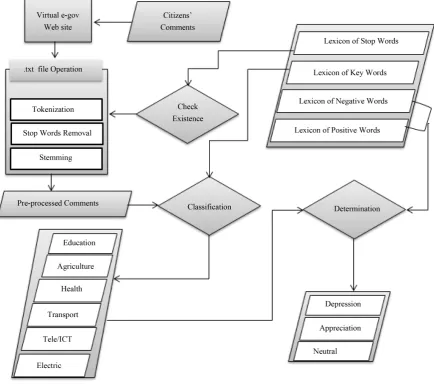
In order to achieve the goal of this research, certain sequence of steps has been followed. The first step is to prepare sample of citizens’ opinions which have been assumed to be posted on the virtual e-governance web sites. These opinions for the prototype/model are evaluated. Afterwards, the given comments have been prepro-cessed for further analysis. Four lexicons have been prepared as a third step i.e. lexicon of stop words for stop word removal, lexicon of keywords for classifying opinions in one of six sub categories, and lexicon of negative and positive English words for the determination of classified opinions as depression, appreciation and neutral for decision making purpose.
2. Related Works
New information and communication technologies can make a significant contribution to the achievement of good governance goals. E-governance can make governance more efficient and more effective, and bring other benefits too [2]. The author outlines contributions of e-governance as: improving government processes (e- administration); connecting citizens (e-citizens and e-services); and building external interactions (e-society).
E-governance is an application of electronic means in the interaction between: government (G) and citizen (C), government (G) and business (B), government (G) and government (G) to simplify and improve governance and enable people’s participation in governance through the Internet [3]. According to the author, ICT has been vi-sualized by some as having much deeper and wider impact on society and even capable of affecting the quality of life and nature of democracy. The author also noticed the significant issues that have become highly relevant for large scale implementation of ICT in governance. Some of these issues are: security, privacy, vulnerability of public ICT infrastructure to crime, potential for abuse and terrorism.
E-governance, meaning “electronic governance”, has evolved as an information-age model of governance that seeks to realize processes and structures for harnessing the potentialities of information and communication technologies (ICTs) at various levels of government and the public sector and beyond, for the purpose of en-hancing good governance [4].
Information and Communication Technologies have raised citizens’ expectations of their government. Citi-zens now expect to be directly involved in designing government programs and services. At the various stages of the policy process, from elections to policy planning and implementation, citizens are becoming increasingly involved, through various participatory tools, such as focus groups, design sessions, hands-on testing and e-par- ticipation tools [5].
Around the world, a number of countries provide online user feedback opportunities to enhance the govern- ment’s ability to receive and take on board feedback from citizens, so as to better tailor their services to meet the actual needs and priorities of users. For example, a few countries’ national portals provide web statistics on citi-zen usage (in 47 countries), features on seeking comments from citiciti-zens to improve its online services (in 68 countries) and section for “hot topics” or mostly used features (in 80 countries) and a much smaller number of countries (20 countries) provide outcome on feedback received from citizens concerning the improvement of its online services [6].
According to Ailsa Kolsaker [7], frequent e-governance users are more motivated than others to acquire knowledge and exercise their voice. If experience and efficacy influence value perceptions, as their results sug-gest, then providers must find innovative ways of getting citizens online.
With the advent of a number of electronic online forums, social networking sites and blogs, the opportunity of gathering citizens’ petitions and stakeholders’ views on government policy and proposals has increased greatly, but the volume and the complexity of analyzing unstructured data makes this difficult [8]. In their research paper they have discussed, how text-mining techniques can help in retrieval of information and relationships from textual data sources, thereby assisting policy makers in discovering associations between policies and citizens’ opinions expressed in electronic public forums and blogs etc. They also presented, an integrated text mining based architecture for e-governance decision support systems along with a discussion on the particular country scenario.
Opinion mining can be made appropriately as a subdiscipline of computational linguistics that exactly con-centrates on extracting people’s opinion from the web, surveys and others which are available digitally [9]. In this paper they have tried to evolve the opinions towards e-government projects and policies on the basis of opi-nion collected from the people. They tried to analyze the effectiveness of e-governance using the concept of opinion mining.
opinions in one of the six identified service categories which is missing in the research contributions [8] and [9]. Afterwards it needs to determine citizen’s comments/opinions as; a depression, appreciation and neutral in the form of results. Concerned government bodies can use these research findings which can produce structured summary from unstructured complex opinions in decision making processes. It can be used to ensure the demo-cratic participation of citizens in government and governances affairs.
3. Research Design
In this research, opinions that were collected via public portal have been preprocessed. Pre-process is one of the data mining processes which is used for removing irrelevant text in which redundant or unreliable data can be removed from the text. After this a lexicon of keywords and polarity words created for a particular subject and for the purpose of classifying and determining polarity. The overall process of prototype system in this re-search has been depicted in Figure 1.
[image:4.595.94.529.322.707.2]Citizens can post their opinions/comments via dedicated website. As a result, the size of unstructured text dramatically increased to be used for decision making. It is very difficult to use this text as it is. It needs an ap-plication that can extract relevant information and set it into appropriate format. That is why we propose this re-search; to classify citizens’ opinions under sub category services and to generate relevant and summarized in-formation for the government’s concerned office. Hence, government becomes opportune to know area that needs improvement and where preserve high quality service.
3.1. Collecting Citizens’ Comments
People used to give their opinion or their experience of the service via local suggestion box. This box is locked by the owners and unlocked by the concerned body to collect given opinions. After reading each comment or opinion the manager or concerned body may call for a meeting and discuss on the issues that have been sug-gested by the customers or users of the services. These days, the wooden suggestion box is replaced with elec-tronic suggestion box. Elecelec-tronic suggestion box is an online dynamic web site that employees and customers can reach you at anytime, anywhere; pervasive/ubiquitous in its nature. For this research, we could have e-gov- ernment virtual web site which is not hosted for any specific government. Citizens can send their comments via this web site and then these opinions can be preprocessed as described under Section 3.2.
3.2. Text Operations
Text is a sequence of words to convey a message. Text processing is taking these words doing something with it. When we say doing something it might be deleting a word or words from the sentence/s or trimming part of the words. Actually in computer it needs to identify these words at the beginning by using delimiter like space be-tween words. In this research, citizens’ opinions/comments have been exported to text file and saved as “com-ment.txt”. This file needs to be opened whenever some operation required.
3.2.1. Tokenization
It is difficult to operate on the sentences or paragraph as it is. Hence, it needs to be tokenized. Tokenization is a process of chopping sentences into words for further operations. In order to develop prototype system, we have used python 3.1. We have written line segments which depicted in Figure 2. As depicted in Figure 2 below; “tokenized” is the variable that holds list of words in the text.
3.2.2. Stop Words Removal
Stop words are words that have very little relevance in the text processing. If these words kept as they are, com-putational complexity would have been increased. Hence, these words need to be removed for advantages. In this research, lexicon of 942 stop words has been created. These are words such as: and, the, off, of, a, an etc. If the word from this lexicon exists in the citizen’s opinions, it will be removed.
3.2.3. Stemming
Stemming is the term used in natural language processing to elaborate the process of reducing inflected and de-rived words. It is very complex and has high computational complexity to include each and every reflected and derived word in the text processing. In this research, comments in text format have been used after stemming. Porter algorithm has been adapted for stemming purpose. The Porter stemming algorithm or Porter stemmer is a widely adopted algorithm for removing the commoner morphological and inflectional endings [10].
3.3. Corpus Preparation
Corpus is a collection of written text in natural language processing and has the same meaning in this work. In this research work, we have created texts such as: pre-processed opinions, lexicon of 942 stop words, lexicon of keywords for six sub categories such as: 1362 words for agriculture, 1828 words for education, 1818 words for electric, 4225 words for health, 3056 words for tele/ICT, and 2258 words for transport have been created. And also 225 negative vocabulary of English language and 267 positive vocabulary of English language have been created for polarity determination.
3.4. Opinion Classification
Responsible citizens and governments take the responsibility of improving quality of government services. Even citizen can give their opinions regarding standard of any service. For instance, one can give comments regarding education systems while the others can give comments regarding agricultural development. The component for the classification of opinions/comments to the one of six service categories has been designed.
3.5. Polarity Determination
People can post positive and negative opinions at the same time. This needs to be identified and determined un-der positive and negative classes. Sometimes the opinions might be vague to classify as either positive or nega-tive; as a result it is determined as a neutral i.e. for instance if someone give two positive and two negative opi-nions regarding education the resultant will be neutral. In this work positive opiopi-nions considered as appreciation while negative opinions have been taken as depreciation.
3.6. Summarized Visualization of Opinions
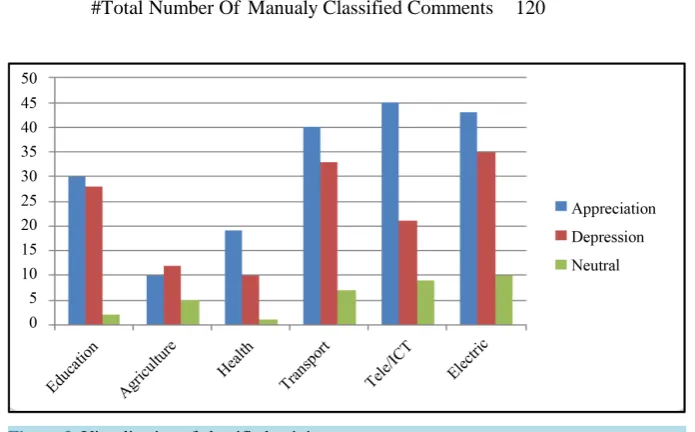
Opinions can be given at different levels. It can be at sentences level, document or feature level. Feature level is the most important and complex level. Identifying and extracting features, determining opinions regarding iden-tified features, organizing and summarizing unstructured subjective text are the most common activities in the feature level opinion mining [11]. This work is based on the document level opinion classification and polarity determination. As it is depicted in Figure 3, citizens’ opinions are classified to subcategory service and polarity of the comments/opinions was also determined. Hence, it is easy to know area that needs improvement.
4. Results
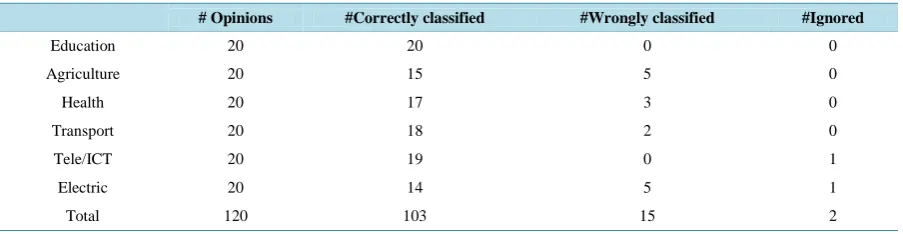
The result has been evaluated in order to know the effectiveness of applied techniques and algorithms. For the testing purpose; total opinions used are 120 and 20 for each sub category that have been collected and analyzed. These opinions have been manually classified. Further, the same opinions imported to the prototype system and the system could correctly classify 103 opinions, wrongly classify 15 opinions and 2 opinions have been ignored by the system, shown in the Table 1.
#Correctly Classified Comments 103 Precision 0.873
#Totaly Classified Comments 118
= = =
#Correctly Classified Comments 103
Recall 0.858
#Total Number Of Manualy Classified Comments 120
[image:6.595.140.488.497.713.2]= = =
Table 1. Number of opinions classified and ignored by prototype system.
# Opinions #Correctly classified #Wrongly classified #Ignored
Education 20 20 0 0
Agriculture 20 15 5 0
Health 20 17 3 0
Transport 20 18 2 0
Tele/ICT 20 19 0 1
Electric 20 14 5 1
Total 120 103 15 2
Based on lexicon of keywords of service categories and the rules that we have designed; precision of 87.3% and recall of 85.8% have been obtained in opinion classification. On the other hand, from 120 opinions; 197 ap-preciation and 163 deap-preciation words have been identified manually in order to check against prototype system. From 197 appreciation words, 190 have been determined correctly while remaining 7 words ignored by the sys-tem. Accordingly, the obtained precision is 1 and recall 0.964. And, 163 depreciation words have been manually identified in which 139 of them correctly determined while the remains 24 ignored by the system. Therefore, precision is again 1 while recall is 0.853. Here, it has been observed that: precision of both appreciation and preciation are 1 and recall in second case is less because of the difficulty of including all appreciation and de-preciation words in the lexicons.
5. Conclusion
Adoption and appropriate injection of digital technologies in governance processes could open new doors and perspectives for the dynamic and responsible citizens to participate in governance processes to resolve country issues in more democratic, easy, communicable and comfortable ways. In the digital governance domain, e-governance sites have features that facilitate the citizens to post their opinions or comments for betterment of the system and their judicious participation. In this research, opinions and comments collected from citizens were processed and classified under specific categories with precision of 87.3% and recall of 85.8%. In addition, the designed techniques for determining the polarity of citizens’ opinions and the performance of the determina-tion were obtained 100% precision for both depression and appreciadetermina-tion. On the other hand, average recall of 90.85% was obtained for both appreciation and depression. These results indicate that the designed techniques are promising and worth contributing for e-governance domain in order to collect, classify and summarize the opinions of the citizens to ensure their democratic participation towards betterment of governance processes and services.
References
[1] Fang, Z. (2002) E-Government in Digital Era: Concept, Practice, and Development. International Journal of the Com-puter, the Internet and Management, 10, 1-22.
[2] Heeks, R. (2001) I-Government. In: Heeks, R., 11th Part, Understanding E-Governance for Development. Institute for Development Policy and Management, Manchester, 1-27.
[3] Prabhu, C. (2013) E-Governance: Concepts and Case Studies. 2nd Edition, PHI Learning Pvt. Ltd., New Delhi.
[4] Saxena, K.B.C. (2005) Towards Excellence in E-Governance. International Journal of Public Sector Management, 18, 498-513. http://dx.doi.org/10.1108/09513550510616733
[5] Seema, H., Richard, K., Jeffrey, R. and Chris, H. (2008) United Nations E-Government Survey 2008: From E-Gov- ernment to Connected Governance. United Nations, New York.
[6] UN (2014) United Nations E-Government Survey 2014: E-Government for the Future We Want.
http://unpan3.un.org/egovkb/en-us/
[7] Ailsa Kolsaker, L.L.-K. (2008) Citizens’ Attitudes towards E-Government and E-Governance: A UK Study. Interna-tional Journal of Public Sector Management, 21, 723-738. http://dx.doi.org/10.1108/09513550810904532
[9] Kumar, P., Zaidi, A., Srivastava, A. and Jain, G. (2015) Evolving Sentiments towards E-Governance Using Opinion Mining. IJCA Proceedings on International Conference on Distributed Computing and Internet Technology, ICDCIT 2015, 24-27.
[10] Willett, P. (2006) The Porter Stemming Algorithm: Then and Now. Program: Electronic Library and Information Sys-tems, 40, 219-223. http://dx.doi.org/10.1108/00330330610681295