http://www.jgc301.com; [email protected] | Journal of Geriatric Cardiology
Cardiovascular Care for Older Adults
Open Access
Stable ischemic heart disease in the older adults
Xuming DAI
1, Jan Busby-Whitehead
2, Daniel E Forman
3, Karen P Alexander
41Division of Cardiology, University of North Carolina at Chapel Hill Chapel Hill, North Carolina, USA
2Division of Geriatric Medicine, Center for Aging and Health, University of North Carolina at Chapel Hill, North Carolina, USA
3Section of Geriatric Cardiology, University of Pittsburgh Medical Center, Geriatrics, Research, Education, and Clinical Center, VA Pittsburgh Healthcare
System, Pittsburgh, PA, USA
4Division of Cardiology, Duke University Medical Center, Durham, North Carolina, USA
J Geriatr Cardiol 2016; 13: 109114. doi:10.11909/j.issn.1671-5411.2016.02.013
Keywords: Aging; Coronary artery disease; Older adults; Risk assessment; Stable ischemic heart disease
1 Introduction
Ischemic heart disease is caused by atherosclerotic and/or thrombotic obstruction of coronary arteries. Clinical spec-trum of ischemic heart disease expands from asymptomatic atherosclerosis of coronary arteries to acute coronary syn-dromes (ACS) including unstable angina, acute myocardial infarction (non-ST elevation myocardial infarction and ST elevation myocardial infarction). Stable ischemic heart dis-ease (SIHD) refers to patients with known or suspected SIHD who have no recent or acute changes in their symp-tomatic status, suggesting no active thrombotic process is underway. These patients include those with (1) recent-onset or stable angina or ischemic equivalent symptoms, such as dyspnea or arm pain with exertion; (2) post-ACS stabilized after revascularization or medical therapy; and (3) asymp-tomatic SIHD diagnosed by abnormal stress tests or imag-ing studies. This review summarizes clinical features and management of SIHD in the older adult. ACS in older adults is not considered in this review.
Age is a strong independent risk factor for the develop-ment of atherosclerotic arterial disease. In the coming dec-ades, tremendous increase of the prevalence of SIHD in the older adults is projected for the following reasons: (1) The world’s population is aging, with those aged 80 and older expanding most rapidly. (2) The elderly population makes up the majority of new angina pectoris patients. In the USA, the annual rates per 1000 population of new episodes of angina pectoris of nonblack men were reported to be 28.3
Correspondence to: Karen P Alexander, MD, Division of Cardiology, Duke University Medical Center, Durham, North Carolina, USA
E-mail: [email protected]
Received: January 19, 2016 Revised:February 7, 2016
Accepted: February 9, 2016 Published online:February 16, 2016
for those 65 to 74 years of age, 36.3 for 75 to 84 years of age and 33.0 for 85 years of age; and 14.1, 20.0 and 22.0 for nonblack women in the same age groups; 22.4, 33.8 and 39.5 for black women; 15.3, 23.6 and 35.9 for black women, respectively.[1] (3) The acute myocardial infarction (AMI) survival rate has improved dramatically under current ACS care, so large numbers of AMI patients become SIHD pa-tients. (4) The increased use of non-invasive (coronary ar-tery calcium score, coronary CT angiography, etc) and in-vasive diagnostic modalities adds significantly to the num-ber diagnosed with SIHD. SIHD in the older adult presents unique challenges to the healthcare community with pre-dictable increasing burden but less clinical evidence to guide practice.
In the older adults, SIHD has equal prevalence in men and women. Obstructive coronary artery disease (CAD) is often more diffuse and severe anatomically. These patients have higher prevalence of left main stenosis, multi-vessel disease and impaired left ventricular function than in younger patients. In this population, other pathophysiologi-cal mechanisms may also cause myocardial ischemia and contribute to SIHD clinical presentation. These include mi-crovascular dysfunction, endothelial dysfunction, vascular spasm or micro-embolism, left ventricular hypertrophy asso-ciated microvascular insufficiency or other factors contribut-ing to supply-demand imbalance.[2] Microvascular and en-dothelial dysfunction are common in the older adult popula-tion. Therefore, SIHD in the older adult requires a compre-hensive approach, not only diagnosing and treating obstruc-tive CAD, but also managing other potential etiologies.
2
Clinical presentations and general evaluation
indicated for the evaluation of patients suspected of having SIHD. It provides critical information regarding typical ver-sus atypical angina, cardiac verver-sus non-cardiac symptoms, high risk vs. non-high risk features, as well as contributing non-cardiac etiologies. However, obtaining information accurately in older adults may be challenged by declining activity level, presence of comorbid conditions, cognitive impairment and atypical symptoms. Only a minority of older adults with ischemic heart disease complain of typical angina. Ischemia presentations are often characterized by lack of energy, exertional fatigue and dyspnea, epigastric or back discomfort. The origins of many of these symptoms are difficult to differentiate from chronic anemia, arthritis, gastric dysfunction, chronic lung disease, and overall physi-cal inactivity. Post-prandial or emotional stress triggers may be common. Careful physical examination often leads to important clues of significant rhythms abnormalities (e.g., atrial fibrillation, bradycardia), valvular diseases, and pe-ripheral arterial disease (e.g., carotid bruits, abdominal aorta aneurysm bruit and diminished pedal pulse).
The prevalence of resting electrocardiographic (ECG) abnormalities is significantly higher in older asymptomatic women and men, such as the prevalence of large or inter-mediate Q-waves, left axis deviation, T-wave inversions, left ventricular hypertrophy, bundle branch block and atrial fibrillation/flutter.[3] Many of these abnormalities confound the use of ECG in risk stratification and guide modality for non-invasive ischemia workup. Transthoracic echocardi-ography is informative in the diagnosis and management of SIHD in the older adults, providing information on left ventricular function, segmental ventricular contractility, left ventricular hypertrophy, diastolic function, valvular disease, and aortic root condition.
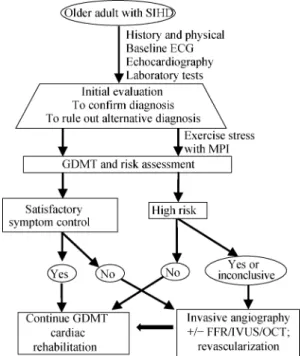
In contrast to an older adult with an acute presentation of coronary artery disease, an older adult who is asymptomatic or has stable symptoms benefits from CAD risk modifica-tion and guideline directed preventive therapy. Addimodifica-tional ischemic workup may be warranted if symptoms are not managed with initial attempts at medical therapy. Figure 1. is the flow chart of assessment and management of SIHD in the elderly.
3
Risk assessment and ischemia workup
Clinical risk assessment is an important part of the SIHD workup in older adults. Prolonging survival with optimal quality of life is the main goal, and is informed by the pa-tient’s underlying risk of adverse outcome and symptom status. Risk assessment incorporates socio-demographics, symptoms and signs, risk factors, comorbid conditions, laboratory data, ECG and other non-invasive or invasive ischemic workup results. Existing models used to assess the
risk are derived from populations aged 70 years, so their specificity and sensitivity in the older adult are less certain. The selection of ischemic testing modalities should be based on an estimation of the pre-test probability of ischemic heart disease or obstructive CAD.[4] When pre-test probability of ischemic heart disease is low (< 20%), further workup is not recommended due to a concern of false positive rate ex-ceeding the true positive rate. When the pre-test probability is high (> 80%), negative non-invasive test results may not exclude obstructive CAD, so an invasive approach may provide a more definitive answer. Patients with intermediate pre-test likelihood benefit most from stress testing.
3.1 Exercise treadmill test
Whereas exercise treadmill testing (ETT) is often used in the assessment of CAD, the diagnostic and prognostic sen-sitivity and specificity of ETT is often questioned in older adults.[5] Lower exercise capacity associated with aging (i.e., effects of reduced peak heart rate, reduced muscle mass, as well as deconditioning) may limit exercise workload such that it is insufficient to provoke ischemic ECG changes or symp-toms. Comorbidities associated with aging also often addition-ally impede exercise, and baseline ECG abnormalities often diminish specificity of any exercise-induced ECG changes.
http://www.jgc301.com; [email protected] | Journal of Geriatric Cardiology While ETT is less useful to diagnose ischemia in older
adults, it may still provide insights for clinical management. Symptoms, chronotropic responses, arrhythmias, hemody-namics, exercise capacity, cardiorespiratory fitness, and other parameters can often by ascertained by exercise test-ing. Furthermore, ETT can be coupled with cardiopulmon-ary assessments and imaging assessments (e.g., myocardial perfusion imaging or echocardiography) to increase sensi-tivity and specificity to detect ischemia, and to also ascer-tain additional insights regarding pulmonary hypertension, valvular heart disease, and other pertinent aspects of disease and management.[6]
3.2 Imaging modalities
Both SPECT myocardial perfusion imaging (MPI) and echocardiology can be coupled with ETT to improve ische-mic specificity and sensitivity.[7,8] The diagnostic/prognostic utilities of both modalities are similar to one other, and often depends on particular expertise and/or equipment that is available at different hospital centers.
For older patients who are unable to exercise, pharma-cological stress can be coupled with MPI or echocardiogra-phy (i.e., pharmacological stress tests) to still enable diag-nostic and risk stratification of SIHD in the older adult.[9] For MPI, vasodilating agents are usually the preferred phar-macological stress option as they facilitate sensitive ische-mic assessments that are generally well tolerated. For both MPI and echocardiographic pharmacologic studies, dobu-tamine can also be used to provoke stress. Since dobudobu-tamine is relatively more likely to provoke arrhythmias and hemo-dynamic lability than vasodilating agents, it is used rela-tively less frequently for SPECT imaging, but it remains the primary pharmacological stimulus for pharmacologic echo-cardiographic stress tests.
3.3 Coronary calcium score and coronary CT
angio-graphy
Older adults have high prevalence of coronary calcifica-tion. For asymptomatic individuals 70 years of age or older, electron beam tomography (EBT) derived coronary artery calcium (CAC) score was found to improve prediction of coronary events based on cardiovascular risk factors in a population-based study, in particular, elderly persons with no or very low CAC have a lower mortality rate.[10] How-ever, the value of CAC score in symptomatic elderly pa-tients with suspected SIHD is limited. Coronary CT an-giography (CCTA) is another commonly used imaging mo-dality in detecting obstructive CAD and is found beneficial in younger adults. However, due to high prevalence of sig-nificant coronary calcification, and inability to perform
sat-isfactory breath-hold for the scan, CCTA may be less accu-rate and less feasible for some older patients.[11]
3.4 Invasive coronary angiography
Coronary angiography remains the “gold standard” for definitive evaluation of epicardial CAD. It provides infor-mation for assessment of risk of death and future cardio-vascular events. It is a prerequisite for ascertaining the fea-sibility and selection of revascularization approaches if in-dicated. In general, coronary angiography is recommended for patients whose clinical characteristics and/or results noninvasive testing indicate a high likelihood of severe IHD at high risk of coronary events or death. Coronary an-giography is also recommended for patients with moderate clinical risk profile who have decreased left ventricular con-tractile function, inconclusive prognostic information after non-invasive testing, or unsatisfactory quality of life thought to be due to IHD.[12] Coronary angiography is generally safe in the older adults. However, increased risks of bleeding, stroke, contrast-induced kidney injury and increased preva-lence of peripheral arterial disease and tortuosity, chronic kidney disease, and decreased tolerance of sedative and narcotics, are factors requiring attention. Despite some risks, older adults may benefit from coronary angiography due to higher prevalence of multi-vessel and left main CAD, atyp-ical presentations and inconclusive non-invasive testing.
4
Treatment
4.1 Treatment goals
The goals for SIHD treatment include maximizing sur-vival, minimizing risk of cardiovascular events and achiev-ing nearly complete elimination of symptoms with return to normal activities. Older adults with declined baseline activ-ity level, multiple serious coexisting conditions, may be satisfied with a reduction in symptoms that permits con-tinuation of some limited activities of daily living. Therefore, individualized discussion about goals of treatments, risk and benefit of therapeutic approaches, especially revasculariza-tion of obstructive CAD by either percutaneous coronary intervention (PCI) and coronary artery bypass grafting (CABG) surgery, is important. Patients’ preferences can vary as a function of age. Improvement of quality of life, eliminating symptoms and maintenance of independency in daily life become more important than prolonging length of life in the decision-making of the older adults.[13]
4.2 Guideline-directed medical therapy and risk factor modification
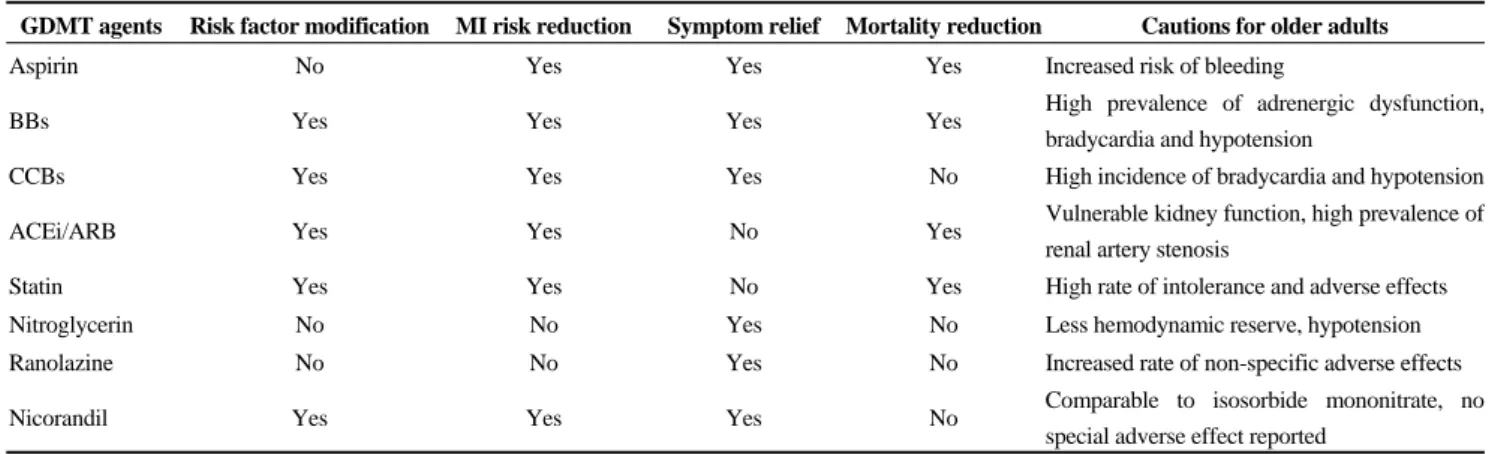
older, and these patients have higher mortality. Guideline- directed medical therapy (GDMT) is as effective as com-pared to younger groups, with favorable benefit and risk ratio.[14,15] GDMT should be the initial approach in treating most patients with SIHD, including older adults. A com-prehensive GDMT for SIHD would include: (1) patient education and counseling to promote lifestyle changes, i.e., smoking cessation, maintaining healthy weight, engaging physical activity, adopting healthy diet, achieving psycho-social well-being and increasing medication adherence and involvement of self-monitoring; (2) pharmacological ther-apy to optimize risk factor modification, i.e., blood pressure, glucose and cholesterol control and treating other comorbid conditions; (3) medical therapy to prevent MI with anti- platelet therapy and other agents; and (4) medical therapy to relieve ischemic symptoms. All agents proven to be benefi-cial to younger groups with SIHD may be used in the older adults, with cautions to be paid due to alteration of cardio-vascular physiology and their response to each medication (Table 1). These approaches/agents decrease SIHD patient’s vulnerability, partially by its plaque stabilizing effects via reducing inflammation, lipid content, and thrombotic poten-tial and improving endothelial dysfunction. Selection of agents for older adults might be also individualized accord-ing to comorbidities, contra-indications, adverse effects, drug and costs, and personal preference.
4.3 Revascularization therapy
Older adults are known to have increased mortality and morbidity undergoing PCI and CABG revascularization comparing to younger patients. Revascularization and its approach should be carefully planned after considerations of coronary anatomy, technical feasibility, risks of complica-tion, patient preferences, functional capacity, goal of care, quality-of-life, life-expectancy, and end-of-life issues, as
well as alternative therapies. Nevertheless, SIHD patients with refractory symptoms despite GDMT, particularly if evidence of moderate or severe ischemia in non-invasive diagnostic tests, should be considered for invasive coronary angiographic and optimal revascularization. In the TIME study, faster symptom relief and improved exercise capacity were achieved by revascularization in comparison to GDMT alone in elderly SIHD patients (aged 75 years with mean 80 years).[16] Revascularization also reduces hos-pitalization, non-fatal MI and improves survival in the eld-erly population.
The comparative effectiveness of PCI and CABG for SIHD are an ongoing topic of debate which continues to evolve as new approaches, stents and understanding of complete revascularization enter the discussion. Selection of approach should consider CAD lesion complexity (SYN-TAX score as a surrogate), surgical risk (STS score, Euro-Score), comorbid conditions, functional capacity, and pa-tient’s preference. Limited data suggests comparable mor-tality and symptom relief between CABG and PCI, but very few patients aged 75 years were included in these studies. CABG may result in a higher rate of complete revascu-larization, lower recurrence of symptoms and better long term mortality. However, CABG requires longer recovery, higher risk of stroke and peri-procedural neurological com-plications (60% post CABG elderly patients experience short term and 20% long term cognitive impairment), as well as higher costs for the index hospitalization and life-time.[17,18] To many older adults, improving quality of life, eliminating adverse symptoms and maintaining independ-ence in daily life becomes more important than prolonging the length of life in the decision-making process. It is un-derstandable that a less invasive approach with PCI is pref-erable among older adults. Advancement of PCI techniques (i.e., increased use of radial artery approach, more sophisti-
Table 1. Categories of pharmacotherapy for management of SIHD.
GDMT agents Risk factor modification MI risk reduction Symptom relief Mortality reduction Cautions for older adults
Aspirin No Yes Yes Yes Increased risk of bleeding
BBs Yes Yes Yes Yes High prevalence of adrenergic dysfunction,
bradycardia and hypotension
CCBs Yes Yes Yes No High incidence of bradycardia and hypotension
ACEi/ARB Yes Yes No Yes Vulnerable kidney function, high prevalence of
renal artery stenosis
Statin Yes Yes No Yes High rate of intolerance and adverse effects
Nitroglycerin No No Yes No Less hemodynamic reserve, hypotension
Ranolazine No No Yes No Increased rate of non-specific adverse effects
Nicorandil Yes Yes Yes No Comparable to isosorbide mononitrate, no
special adverse effect reported
http://www.jgc301.com; [email protected] | Journal of Geriatric Cardiology cated devices and balloon/stent designs) and rigorous and
standardized professional training and regulations, adjunc-tive pharmacotherapy and post procedure dual antiplatelet therapy contribute to steadily declined procedural complica-tions.[19] However, comparing with younger patients, PCI has higher rate of complications including bleeding, stroke, contrast-induced kidney injury and post-procedural MI in older adults.[20] Drug eluting stents reduce the rates of in-stent restenosis compared with bare metal stents but re-quire longer duration of dual antiplatelet therapy associated increased risk of bleeding.
5
Follow-up care and cardiac rehabilitation
Considering that older adults with SIHD often have mul-tiple comorbidities, it is essential to have appropriate clini-cal follow-up to ensure regular communication. Secondary prevention in the elderly has been addressed extensively in previous review.[20] Comprehensive, exercise-centered car-diac rehabilitation is effective in reducing mortality, de-creasing hospitalization and improving quality-of-life in older SIHD patients. Exercise training improves exercise tolerance and functional capacity, and education and coun-seling reduces the risk of further cardiac events by optimiz-ing pharmacological therapy (e.g., monitoroptimiz-ing and encour-aging concordance with medication). Other important out-comes of patient education include promotion of a healthy lifestyle (e.g., smoking cessation, dietary advice, increasing physical activity) and identifying and counseling of post cardiac event psychological stresses.
6
Future opportunities and clinical pearls
There are opportunities for research: (1) comparative ef-fectiveness of GDMT alone and GDMT plus revasculariza-tion in the older adult with SIHD; (2) comparative effec-tiveness of multivessel PCI with new generation drug eluting stents or CABG for older adults with left main or complex multi-vessel CAD; and (3) optimizing risk assess-ment of SIHD in older adults with invasive (angiography) or non-invasive (CCTA and echo) testing.
Clinical pearls include: (1) SIHD is common in older adults with equal prevalence in men and women. (2) Older adults with SIHD have more comorbidities and higher risk profiles. They have a high prevalence of multi-vessel CAD, left main disease and left ventricular dysfunction. (3) Exer-cise stress test with and without pharmacological stress combined with myocardial perfusion imaging is often used for risk assessment. (4) Invasive coronary angiography is reserved for older adults with SIHD and high likelihood of
severe IHD in non-invasive testing, or moderate risk with depressed left ventricular function, or inconclusive non-in-vasive testing and unsatisfactory symptom controls despite optimized GDMT. (5) GDMT is the first line therapy for older adult with SIHD. This modality includes lifestyle modification and pharmacotherapy with the goals of risk factor modification, reduction of MI risk, symptoms relief and prolonging of life. (6) Older adults with refractory symptoms affecting quality of life despite optimized GDMT should be referred for revascularization. (7) Clinic fol-low-up and cardiac rehabilitation are integrative compo-nents of care for SIHD in the older adults.
References
1 Go AS, Mozaffarian D, Roger VL, et al. Heart disease and stroke statistics-2014 update: a report from the American Heart Association. Circulation 2014; 129: e28–e292.
2 Marzilli M, Merz CN, Boden WE, et al. Obstructive coronary atherosclerosis and ischemic heart disease: an elusive link! J Am Coll Cardiol 2012; 60: 951–956.
3 Molander U, Dey DK, Sundh V, et al. ECG abnormalities in the elderly: prevalence, time and generation trends and asso-ciation with mortality. Aging Clin Exp Res 2003; 15: 488–493. 4 Diamond GA, Forrester JS. Analysis of probability as an aid in the clinical diagnosis of coronary-artery disease. N Engl J Med 1979; 300: 1350–1358.
5 Katsikis A, Theodorakos A, Kouzoumi A, et al. Prognostic value of the Duke treadmill score in octogenarians undergoing myocardial perfusion imaging. Atherosclerosis 2014; 236: 373–380.
6 Fletcher GF, Ades PA, Kligfield P, et al. Exercise standards for testing and training: a scientific statement from the Ame-rican Heart Association. Circulation 2013; 128: 873–934. 7 Hachamovitch R, Kang X, Amanullah AM, et al. Prognostic
implications of myocardial perfusion single-photon emission computed tomography in the elderly. Circulation 2009; 120: 2197–2206.
8 Rai M, Baker WL, Parker MW, et al. Meta-analysis of opti-mal risk stratification in patients > 65 years of age. Am J Car-diol 110: 1092–1099.
9 Makaryus AN, Diamond JA. Nuclear stress testing in elderly patients: a review of its use in the assessment of cardiac risk, particularly in patients undergoing preoperative risk assess-ment. Drugs Aging 2007; 24: 467–479.
10 Tota-Maharaj R, Blaha MJ, McEvoy JW, et al. Coronary artery calcium for the prediction of mortality in young adults < 45 years old and elderly adults > 75 years old. Eur Heart J
33: 2955–2962.
12 Niebauer J, Sixt S, Zhang F, et al. Contemporary outcome of cardiac catheterizations in 1085 consecutive octogenarians. Int J Cardiol 2004; 93: 225–230.
13 Singh M, Alexander K, Roger VL, et al. Frailty and its poten-tial relevance to cardiovascular care. Mayo Clin Proc. 2008; 83: 1146–1153.
14 Maron DJ, Spertus JA, Mancini GB, et al. Impact of an initial strategy of medical therapy without percutaneous coronary intervention in high-risk patients from the Clinical Outcomes Utilizing Revascularization and Aggressive DruG Evaluation (COURAGE) trial. Am J Cardiol 2009; 104: 1055–1062. 15 Pfisterer M, Buser P, Osswald S, et al. Outcome of elderly
pa-tients with chronic symptomatic coronary artery disease with an invasive vs. optimized medical treatment strategy: one-year results of the randomized TIME trial. JAMA 2003; 289: 1117–1123.
16 Pfisterer M. Long-term outcome in elderly patients with chro-nic angina managed invasively versus by optimized medical therapy: four-year follow-up of the randomized Trial of Inva-sive versus Medical therapy in Elderly patients (TIME). Cir-culation 2004; 110: 1213–1218.
17 Newman MF, Kirchner JL, Phillips-Bute B, et al. Longitudi-nal assessment of neurocognitive function after coronary-arte-ry bypass surgecoronary-arte-ry. N Engl J Med 2001; 344: 395–402. 18 Zhang Z, Kolm P, Grau-Sepulveda MV, et al.
Cost-effecti-veness of revascularization strategies: the ASCERT study J Am Coll Cardiol 2015; 65: 1–11.
19 Wang TY, Gutierrez A, Peterson ED. Percutaneous coronary intervention in the elderly. Nat Rev Cardiol 2011; 8: 79–90. 20 Damluji A, Ramireddy A, Otalvaro L, et al. Secondary