ENGAGING OUR HISTORIES AND THE DIFFICULT HISTORIES WE TEACH
Stephanie C. Konle
A dissertation submitted to the faculty at the University of North Carolina at Chapel Hill in partial fulfillment of the requirements for the degree of Doctor of Philosophy in the School of
Education.
Chapel Hill 2018
Approved by:
ABSTRACT
Stephanie C. Konle: Engaging Our Histories and the Difficult Histories We Teach (Under the direction of Madeleine R. Grumet)
This dissertation proposes to enrich the scope of history education research, and by extension the preparation of history and social studies teachers and the classroom experiences of their students, through the inclusion of autobiography in the study of history. Education research on the teaching of history has typically focused on what scholars call “historical thinking skills,” skills imported from the professional discipline, including contextualization, perspective, use of evidence, etc. While these disciplinary methods are important for the promotion of a deeper and more critical understanding of the past, they often neglect the more emotionally fraught interests, concerns, and questions about the past that teachers and students bring into the classroom.
ACKNOWLEDGEMENTS
I am grateful to the women who served on this committee for their support and encouragement throughout the duration of my studies at UNC Chapel Hill. Dr. Lynda Stone, you brought new perspectives to the questions I asked and pushed my thinking. Dr. Cheryl Bolick, your steadfast enthusiasm for this project and conversations about the social studies sustained me. To Dr. Suzanne Gulledge I am thankful for giving me the opportunity to teach the social studies methods class, where the idea for this project was born, and for your availability and counsel. Dr. Xue Rong, you shared your expertise and your wisdom, and were my advocate in matters of material and professional concern, patient, candid, and positive: thank you. And Dr. Madeleine Grumet, you are home and you are love. You helped me to articulate intuitions and turn them into a project that is about the mind and the heart and that I hope has made you proud. I am forever grateful at the chance to learn from you.
I would like to acknowledge the encouragement and affection throughout graduate school from my friend and colleague Mariah Smith Murrell: from the first moments of our classes together I knew we could count on and learn from each other. Thank you also to Hillary Parkhouse: you unselfishly gave of your time and shared resources, advice, ideas, and friendship. Thank you to Wenyang Sun for our study dates and conversations and to
Esmeralda Rodriguez for your humor, kindness, and cultural and linguistic nurturance. I am so very grateful to the six teachers who participated in this project. Your honesty and vulnerability humbled me at each of our meetings, as did your clear and constant
about the project of educating the young, and even more of a challenge to, in this time, express hope about the future in teaching the past. Thank you for your thoughtfulness and intelligence, and the care with which you did the hard work of thinking about what it means to understand the past.
To Tessie Alden, owner of Tessie’s Daycare, thank you for peace of mind during the time writing took me away from Rafael. You have provided a loving and warm place for my son to be.
TABLE OF CONTENTS
LIST OF TABLES ... xi
CHAPTER 1: INTRODUCTION AND OVERVIEW OF STUDY... 1
1.1 Introduction: Connections to the Past ... 1
1.2 Outline of the Dissertation ... 10
CHAPTER 2: MAKING SENSE OF THE PAST ... 14
2.1 Historical Consciousness and How We Shape Images of the Past ... 18
2.2 Language, Narrative, and Historical Consciousness ... 21
2.3 A Detour: Reflections on Content and Form ... 26
2.4 Purposes of Narratives of the Past: Learning About Who and How We Are ... 29
2.5 History and Memory in Making Sense of the Past ... 36
2.6 History and Memory in Schools: Educational Interpretations and Applications ... 39
2.6.1 Historical Thinking Defined ... 39
2.6.2 Origins ... 40
2.6.3 Contemporary Research in Historical Thinking ... 41
2.6.4 Memory, Heritage, and History Education ... 47
2.7 Voices and Reminders from within the Discipline ... 48
2.8 Feelings about the Past in the Classroom ... 52
2.9 Bridging Historical Consciousness and Lived Experience: Making Meaning of the Past and Difficult Histories ... 56
CHAPTER 3: RESEARCH METHODS ... 59
3.2 Searching For a Method ... 62
3.3 Methodological Foundations and Frames ... 65
3.3.1 Autobiography ... 65
3.3.2 Phenomenological Frames ... 66
3.3.3 Psychoanalytic Frames ... 67
3.3.4 Pedagogical Frames ... 70
3.4 The Study ... 72
3.4.1 Brief Overview ... 72
3.4.2 Research Questions ... 72
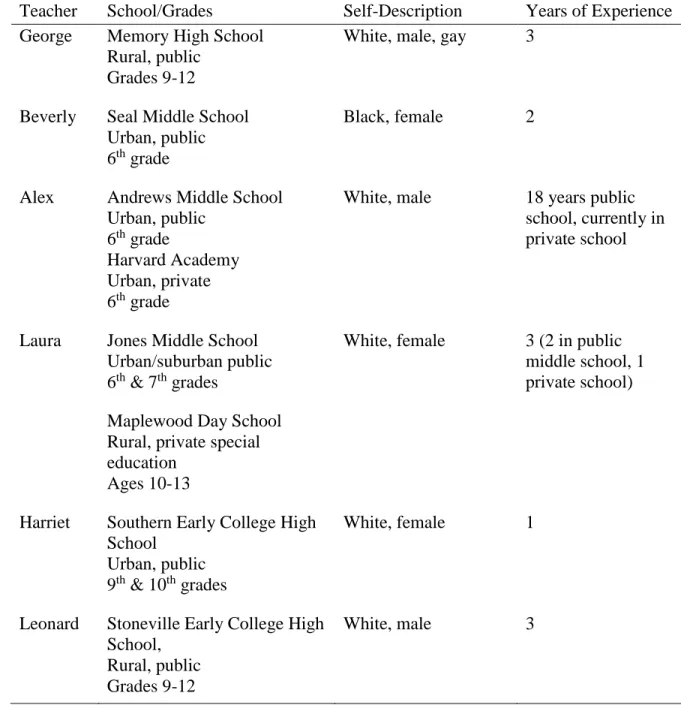
3.4.3 Participant Selection ... 73
3.4.4 Data Gathering ... 77
3.4.5 Interpretive Seminar ... 80
3.4.6 Analysis and Interpretation ... 85
CHAPTER 4: TEACHERS’ NARRATIVES OF EXPERIENCE ... 88
4.1 Introduction ... 88
4.2 The Group ... 88
4.2.1 Alex ... 89
4.2.2 Harriet ... 90
4.2.3 Leonard ... 91
4.2.4 Laura ... 93
4.2.5 George ... 94
4.2.6 Beverly ... 95
4.3 The Narratives ... 96
4.3.1 Introduction ... 96
4.4 Control and Chaos: Fears of Powerlessness and Contingency ... 98
4.4.1 Narrative and Making Sense of Time ... 109
4.5 Meaning and Significance in Making Sense of the Past ... 110
4.5.1 Moments Beyond Narrative Cohesion ... 122
4.6 The Teacher As Absent Presence ... 123
CHAPTER 5: ENGAGING OUR HISTORIES ... 125
5.1 Seminar 1 ... 127
5.1.1 Overview ... 127
5.1.2 Introduction ... 127
5.1.3 Initial Encounters: Control and Chaos in Making Meaning of the Past ... 129
5.1.4 Whole Group Discussion ... 140
5.1.5 Questions of Narrative Functions and Difficult Knowledge ... 144
5.2 Seminar 2 ... 148
5.2.1 Overview ... 148
5.2.2 Introduction ... 149
5.2.3 Emotional Connections to the Past: Darkness and Hope ... 150
5.2.4 ‘That Just All Sounded So Heavy:’ Hope and Despair in Teaching About the Past ... 157
5.2.5 Naming the Absent-Present Teacher: The Person Behind Me ... 166
5.2.6 Humans Are Bad, But We’re Trying to Make it Better: Making Sense of Our Stories ... 167
5.3 Seminar 3 ... 171
5.3.1 Overview ... 171
5.3.2 Introduction ... 171
5.3.4 Seminar 3, Section 2: The Place of Emotions in Reacting to
History ... 187
5.3.5 The Person Behind Me: Fear and Abstention ... 194
5.3.6 A Different Kind of Historical Problem Space ... 197
5.4 Seminar 4 ... 199
5.4.1 Doing History: The “Beginnings of a Conversation” ... 210
CHAPTER 6: SYNTHESIS AND IMPLICATIONS ... 213
REFERENCES ... 238
APPENDIX 1: FOUR TYPES OF HISTORICAL CONSCIOUSNESS ... 227
APPENDIX 2: LIVED EXPERIENCE DESCRIPTION PROMPT ... 228
APPENDIX 3: SUMMARY OF NARRATIVE THEMES AND QUESTIONS ... 229
APPENDIX 4: SUMMARY OF ASSIGNED READINGS ... 233
LIST OF TABLES
Table 1. Teacher Participants ... 75
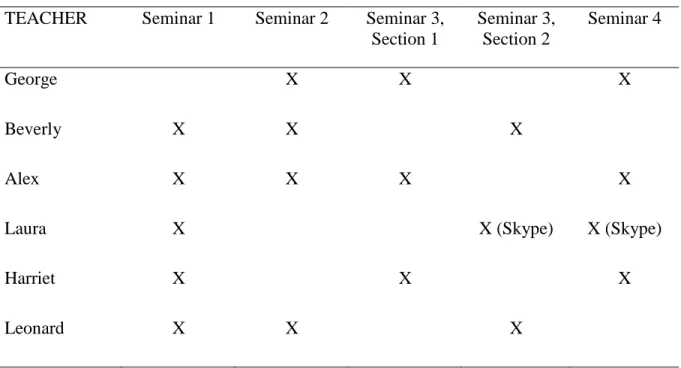
Table 2. Teacher Attendance ... 85
Table 3. Four Types of Historical Consciousness ... 227
Table 4. Summary of Narrative Themes and Questions ... 229
Table 5. Summary of Assigned Readings ... 233
CHAPTER 1: INTRODUCTION AND OVERVIEW OF STUDY 1.1 Introduction: Connections to the Past
I remember my fifth grade teacher, Mrs. Mankin. She had dark curly hair and braces. I remember that I was upset because the next year I would no longer be in elementary school and I would miss seeing her after the braces came off. One evening she called my house to tell my family that I had won a writing award. It was a very anxious night for me because I was not told what the phone call was about and only found out the next day when she noticed that I did not seem excited. I had won a competition called “What It Means to be American” or “Why I’m Proud to be An American.” She told me that I would be presented an award by a group of war veterans who had read our papers. I was to share first place with another girl, and we would have to read our essays in front of the fifth grade class and the parents of other students who had won.
As she talked my stomach dropped, my armpits began to sweat, and I remember feeling angry with her. I would have to read these words out loud, words that I had written insincerely. I wasn’t technically American—I was not born here, and I only had a green card. Would they check?
I cannot remember what I wrote, but it was not about the way of being American I had learned at home. At home, being American was a reprimand. I was told “no sea tan Americana” or “parece toda una Americana”1 if I didn’t greet an elder quickly enough, if I shut the door to my room, or if I asked for a different kind of sandwich in my school lunch.
1 “Don’t be so American.” The second sentence can be translated several ways: “She looks/seems like a total
Being American meant that you didn’t like your family or you asked them to stay at a hotel when they came for a holiday. It meant not knowing about the world, not knowing that people who speak Spanish come from many different countries and that they too had arts and universities and culture.
A popular nursery rhyme in Spanish that teaches vowel sounds consists of the lyrics “La mar estaba serena, serena estaba la mar.” For each verse, a vowel replaces the original vowels in the words until the child has gone through a-e-i-o-and u. This song is the only one I remember singing with my stepmother as a child. In our version of the rhyme, the second verse was: La mara estaba serena, serena estaba la mar, los yanquis quieren robarnos
docientas millas de mar.” In English the lyrics are, “The sea was serene, serene was the sea, the Yankees want to steal two hundred miles of our sea.” She told me stories about how the United States tried to steal ocean from Ecuador and other countries in order to fish for tuna. She would tell me about yanqui oil interests in Ecuador, yanqui supported military regimes that tortured and killed people, yanqui exploitation of natural resources, Chiquita Banana, and even yanqui appropriation of the American identity. They called themselves by a name that belonged to all the people of the Americas.
I feared the moment these two ways of being American would collide. Perhaps I dreaded having to declare an allegiance to one or the other- would the veterans who had chosen my essay as one of the best confront me? Would my family? Why hadn’t my teacher stopped this?
At the time, I am certain I didn’t consider myself to have “critical consciousness” or awareness of national myths of progress. I did not have categories for the jarring differences between the history of the United States I was learning at school and the one I had learned at home, but I was disturbed by the contradictions between, for example, the narrative told in the United States of how regular German people succumbed to National Socialism, the complete denial of their complicity or responsibility I heard from some members of my German family, and the blunt acknowledgement of these situations from family on my mother’s side. While perhaps an adult might consider these contradictions part of history’s interpretative nature, or a nuanced context or perspective about the past and a people’s need to weave narratives that make the past coherent (Bruner, 2005), to me, these completely different ways of seeing the past were unsettling.
Education literature, in social studies and history in particular, praises a critical, even skeptical orientation toward knowledge and the world; students should be (or will one day be) active citizens on the lookout for the -isms, should be conscious of racial, gender, and economic inequity, develop critical thinking skills that help them to uncover oppressive and hegemonic power structures, and doubt the heroic narratives of progress toward greater freedom for all. But if I am honest, in my everyday life, the consistent doubt and
historical narratives described by narrative psychologist Jürgen Straub (2005b), as the mutual creation of a world between the teller and the listener wherein the listener has accepted the teller’s invitation to share a conception of reality and they “create a basis for consensual judgments and coordinated, cooperative action” (66). I declined the invitation and instead felt unattached. How did this alienation shape my understanding of history? How would such feelings work within my role as a teacher? Historical narratives and historical thinking raise questions that are intellectual and directly related to the stuff of teaching social studies, but they also raise questions that are very personal, emotional, and meaningful to the lived experiences of teachers and to the complicated conversation of curriculum.
In this study, I wish to propose an approach that addresses both the intellectual and emotional interests and concerns of those who teach about the past. This project is guided by the following questions:
1. How do teachers describe their connections to the past?
2. How are teachers’ conceptions of the past related to conceptions of the past within the discipline of history?
3. How do teachers’ questions and concerns about the past inform their interpretations and teaching of history?
time were based (Murison, 2009). Brown sets the novel in the year the Constitution was written and published (1787) and tells the readers in the preface that the narrator’s adventures “[grow] out of the condition of our country” (1791, p. 3). What does this mean? Edgar Huntly offers a glimpse at the dangers of an over-reliance on rationalism and the mind in the construction of history, particularly through the written documents produced at the time. The Constitution, land deeds and titles, treaties with native peoples, and other written texts were documents that served as the rational basis for the legitimization of the nation and to
reconstruct the settler colonial narrative (Bergland, 2004). What might it mean to cast doubt on the documents, the “evidence”, used to secure the rights to land and people while taking it from others?
At different points in my life, beginning as a high school student, I read and reread Jean Rhys’ (1966) haunting novel Wide Sargasso Sea, an adaptation of Charlotte Brontë’s Jane Eyre focused on the story of the madwoman in the attic. Jean Rhys is said to have taken issue with Brontë’s portrayal, or rather non-portrayal, of Bertha Mason’s character
I think I was drawn to these novels, and others like them, because their narratives acknowledged ambiguity, contradiction, contingency, and, most of all, doubt and uneasiness about the past and its ability to be contained. These were stories that explored what it felt like to exist between the boundaries that constitute national, ethnic, racial, or linguistic
identifications and questioned the texts upon which what is called historical evidence were based. In them, it was never clear who was victim and who was perpetrator, who was oppressed and who was the oppressor. I should point out that I had found a place to explore my preoccupations about the past in literature, and not in the academic study of history. I had not considered my interests and concerns historical as these musings were solitary and my ideas about the past inchoate as they remained unexamined suspicions and intuitions, even when I became a fifth grade teacher myself and had the responsibility of teaching the past to young children.
and poor, one mass shooting after another, the earthquake in Haiti, the South Asian tsunami, Hurricane Katrina, visits to Manhattan from the Bronx and students’ reactions to the
differences between the two, the racial slur spray-painted on the office door of the only black teacher in the Piedmont school. Yet, conversations among teachers or between students and teachers did not address such themes as provocations for historical thinking.
It is not my own, particular experience of learning about the past that I want to focus upon, or on what it was like to teach history to groups of fifth graders. Rather, what is significant is the fact of my isolation in making sense of my experience of what it might mean to understand the past, as well as that I had never considered my questions and feelings “historical.” I had thought that questions that involved complexity and uneasiness belonged in the realms of creativity and imagination. I did not realize, for example, that my own reactions to questions about my cultural identity or language use, and the negotiations involved in responding to “Where are you from?” could be explored by the study of history as well as poetry and literature and art. My feelings about such questions connected to historical narratives of nationalism, linguicism, and changing constructions of the categories we use to classify one another; yet, I had framed these issues as particular to my own
situation. Years later, in graduate school, while watching others teach, I came to realize that perhaps such concerns, fears, and questions about the past and curriculum should be
considered relevant to history.
As a social studies methods instructor, I observed many lessons by student teachers. Some planned action-filled simulations of war, mock-debates about major historical
illustrations. I wondered what anxieties and concerns of their own, what hopes and fears about the past they addressed while constructing their accounts of the past represented in these lessons. I wondered about the topics they avoided teaching, which historical actors they sympathized with or condemned, and why so many student teachers focused on the details of human suffering. As they taught, I intuited an underlying anxiety in these ‘model’ lessons— in the pauses as they talked with students, in furtive glances cast toward me, and in
breakdowns in communication as we processed and “debriefed” their lessons.
I thought I might explore these anxieties with them in the methods class. There, discussions that went beyond the development and purposes of social studies education into the murky territory of emotions or “theory” ended disastrously. Students could articulate their fears about classroom management and seemed confident that their love of children, concern with social justice, ability to make learning fun and be agents of change would contribute to their success. And, to varying degrees, students agreed on the interpretative nature of history and that this orientation should be conveyed somehow to their students. We could, however, not seem to have discussions that did not devolve into “what is truth,
anyway?” or some variant of this, and students grew frustrated with me because these discussions did not relate to their immediate classroom needs.
One class session in particular stands out in my mind: I had assigned students a reading by Peter Seixas. They read a chapter from Narration, Identity, and Historical Consciousness, titled “Historical Consciousness: The Progress of Knowledge in a
agency. He also describes four types of historical consciousness: traditional, progressive, critical, and genetic2. It is pretty easy to guess which type(s) students thought they should be and which was an anathema in their teacher education program.
The chapter presented the issues/paradoxes with examples that historians have worked to interpret, to which I thought the students might relate in terms of what they had been tasked with teaching. At first no one would participate and, with much coaxing, several students admitted they did not understand the chapter. I thought that this was really a polite way of rejecting the substance of what they had read; they were right, it did not relate directly to what they would have to do the next day in the classrooms or help them to pass their own teacher portfolio standardized assessments. I had named the anxieties I had detected in their teaching as the specific issues outlined in the assigned reading and had set them up to feel judged and evaluate themselves and each other; it was no surprise they resisted. I had taken the complex questions about teaching the past to young people and predetermined which examples they might find thought provoking and referred them to a rubric like all the other rubrics they encountered. I had not asked them: what does this mean to you?
The Seixas issues and paradoxes might help us to frame conversations about
historical consciousness and historical thinking, but they led us to focus on just that: thinking. The uneasiness and palpable tension in the room during some of their most authentic
teaching, during reenactments, for example, did not come from their thoughts alone. Anxiety and worry are part of learning, and play no small role in learning to teach; that much has
2 This is based on Jörn Rüsen’s work. See for example, Meaning and Representation in History (2006) and
been discussed elsewhere.3 I think that some of my students’ discomfort might have come from unasked questions about what exactly it was that they were responsible for
communicating about history and the past. Entangled in the usual new teacher hopes and fears that accompany the responsibility of educating the young about history are bigger questions about the meaning of the discipline and of the very project of trying to understand the past.
Through autobiographical and phenomenological research methods, and psychoanalytic and pedagogical frames, this study considers what kinds of interests, concerns, and questions the past raises for teachers, as well as how such expressions of subjectivity relate to the discipline of history and its presence in their own classroom practice. The specificity of autobiographical writing and the phenomenological analyses it leads to, invite complexity, ambiguity, and contradiction, and acknowledge an interrogative, rather than prescriptive, stance toward history.
1.2 Outline of the Dissertation
Chapter 2 offers a synthesis of scholarship that explores the epistemological issues related to answering the question: what does it mean to understand the past. I examine work that discusses how language and narrative shape and are shaped by how we make sense of and interpret the past with other people (Bruner, 2005; Polkinghorne, 2005; Rüsen, 2005c; Straub, 2005b; J. V. Wertsch, 2004), the structure and function of narratives (Bruner, 2005; Polkinghorne, 2005; Straub, 2005b) and of historical consciousness (Rüsen, 2005c; P. Seixas, 2000, 2004, 2005). Part of studying the past also involves considering how time is
experienced and talked about and what is meant when people say they feel connected to
3 See for example the work of Deborah Britzman, including Practice Makes Practice: A Critical Study of
historical places or things (Carr, 2006, 2014), or experience history itself (Ankersmit, 2005, 2006a). In addition to studies of narrative, I also included scholarship on how groups share narratives through collective memory, how narratives tell us who and how we are and should be, as well as how the present calls on the past in orienting people in the present (Halbwachs, 1992; J. V. Wertsch, 2008). My goal was to enrich discussions with the project participants in their interpretations of their autobiographical writings, but also to use these texts as frames through which to read and interpret their writings and discussions during the seminar
meetings.
I also include in this chapter a brief overview and analysis of the educational
scholarship to which this project responds. I review the various meanings and interpretations of the concept of historical thinking as well as the empirical work that addresses historical thinking in the preparation of history and social studies teachers and argue that teacher interpretations and connections to the past must be acknowledged. Finally, I address how the discipline itself can provide inspiration for a pedagogy that acknowledges human
subjectivity, creativity, and reflexivity.
Chapter 3 describes the research approach of this study. I examine research methods and mindsets in education that I find diminish the subjectivity and experiences of teachers, as well as discuss my search for a method that does acknowledge these dimensions as well as include participants in both the object and findings of the study (the form and the content). Next, I describe the approaches to educational research from which I draw: autobiography, phenomenology, psychoanalytic theory, and pedagogy. This chapter also includes a
In Chapter 4, I discuss my interpretations of the participating teachers’ narratives. I open with a brief introduction to each of the teachers, and then discuss the issues, dilemmas, inconsistencies, and questions the teachers raised in their narratives. One undercurrent of these multi-layered narratives was an interest in the tension between order and chaos, control/agency and contingency: the teachers questioned guilt and responsibility in understanding the past, the limits of human agency within a chaotic past, and control in narrating and passing on stories through generations. Teachers also struggled to make sense of the troubled legacies we inherit and how we communicate them to young people. Some of the narratives took up themes about collective memory and the tension between the desire for belonging entwined with community, tradition, and family, and the wish to escape the
potentially stifling embrace or the outright rejection of this same community or family. In Chapter 5, I interpret the four seminar meetings, with attention to the content and the form of our discussions and how they take up the teachers’ questions about what it means to understand the past in relation to their autobiographical narratives and the academic readings with which they engaged. I approach the analysis of these meetings both
Finally in Chapter 6, I synthesize the findings and questions this study raised for me as well as for its participants. I also present possibilities for shifts in the culture of teaching to allow for a vision of the study of history that acknowledges human subjectivity. I also
CHAPTER 2: MAKING SENSE OF THE PAST
For that summer Lucille was still loyal to us. ... She and I were together, always, everywhere. Sometimes she would only be quiet, sometimes she would tell me that I ought not to look at the ground when I walked (my posture was intended not to so much to conceal as to acknowledge and apologize for my increasingly excessive height), and sometimes we would try to remember our mother, though more and more we disagreed and even quarreled about what she had been like. Lucille’s mother had been orderly, vigorous, sensible, a widow (more than I ever knew or she could prove) who was killed in an accident. My mother presided over a life so strictly simple and circumscribed that it could not have made significant demands on her attention. She tended us with a gentle indifference that made me feel she would have liked to be even more alone-she was the abandoner, and not the one abandoned. (Robinson, 1997, p. 109)
This passage in Marilynne Robinson’s Housekeeping haunts me each time I read it as Ruthie reveals the diverging stories that memorialize her mother. At this point in Ruthie’s recollections, she and her sister Lucille have begun to grow apart. The girls’ drifter aunt Sylvie cares for them after their grandmother’s death, and with each passing day under her care, the house and their lives seem to move further away from the established patterns and practices of their lives before Sylvie’s arrival.
Slowly, leaves accumulate in corners, creatures inhabit the cupboards, and collections of cans and bottles cover all surfaces of the house. Sylvie spends many hours in silence, absorbed in her own thoughts. When she speaks it is to tell stories about her travels, stories not always told with the recognition of her listeners’ young age or with the acknowledgment that recounting the past entails certain expectations or responsibilities. For example, when the girls ask her about their mother, who had committed suicide, Sylvie describes their mother’s love of cats and stamp collecting. When they press for more information, “But what was she
cannot, or will not, provide the girls with the comfort of a description that might inscribe their mother in their memories.
As time passes and Sylvie’s eccentric ways of keeping house draw the attention of the town’s authorities, Lucille begins to long for order and orderliness in her life while Ruthie embraces Sylvie’s transient ways of thinking and being. We see these differences in their narratives about their mother. One mother is normal, she keeps house and wants to live— she performs the role of “mother” in the way Lucille sees it performed by other mothers in the town. Ruthie’s version of their mother portrays a woman who cannot be bothered to notice her children, and it does not obscure her suicide. Sylvie, the last connection to their family and to the past, does not characterize her at all.
What is haunting to me about this particular description of how the sisters’ relate to the past is that a “teacher” in the scenario, a role model, an adult keeper of the family’s memories, is absent. Sylvie abstains from building a narrative that would bind together two sisters, a family, a community, a town, a society, or even one about their mother’s suicide, why they returned to Fingerbone, or much at all about what the family was like. She engages with neither history nor memory, she does not pass on family stories to the girls: look, this is who you are, who we are, how we are etc. Instead, Lucille and Ruthie retain only quickly fading images of their mother and bits and pieces of information about their family, none of which tells them much about who they are in relation to their mother or to the world. They must construct the stories themselves from scraps of the past that have rotted away, differing stories that lead Lucille toward a normal life, Ruthie toward a life of itinerancy. From
‘I have never distinguished readily between thinking and dreaming. I know my life would be much different if I could ever say, This I have learned from my senses, while that I have merely imagined. […] Fact explains nothing. On the contrary, it is fact that requires explanation’ (pp. 215-7).
The sisters’ exchange about their mother is haunting, not because I do not recognize the oppressiveness of the past Sylvie and Ruthie try to escape or avoid, but because such a contingent and tenuous reconstruction of who someone might have been seems terrifying. Cut off from others’ stories that help us create our own (Carr, 2014; Ricœur, 2006), where does subjectivity come from or go? What does it mean to refuse the symbols and
representations of history and memory that people use to connect past with present, to anchor the individual somewhere in the stream of time and to others? What kinds of symbols and representations within a person’s lived experience hold meaning? And, with Sylvie in mind, how do these questions relate to the commitments and responsibilities of teachers and caretakers as they understand and communicate the past? Sylvie, as the link between the girls and the world, neither shields them from nor explains the difficult knowledge of their mother’s suicide and abandonment: what can such an act of pedagogical abstention tell us about the fears and concerns teachers have about teaching a troubled past to students?
Robinson’s novel does not give us answers to these questions. While the novel is not a complete repudiation of housekeeping— the project of ordering and tidying life in attempts to establish some kind of permanence or coherence— Ruthie’s story does raise doubts and questions about this project. It reminds me that the project of history is also a type of
what might have been the original experience, photos into albums, stories we tell ourselves about our individual existence.
Through the results of Sylvie’s and Ruthie’s peace with no longer being tethered to the past, to ritual or custom, facts or stories, we see our own need for making sense of the past in our everyday lives as well as the tenuousness of our ability to understand the past. The aim of this chapter is to identify and examine, through the frames of historical theory and the study of historical memory, the issues, dilemmas, paradoxes, juxtapositions, and
complications that arise in the attempt to understand and discuss the past, and especially how these matter to those who teach about the past. I trace some of the themes that guided this study and my discussions with teachers around the question of what it means to understand and connect to the past, the limitations of extant discourses within education related to these themes, and I introduce a vision for a social studies pedagogy that honors human subjectivity.
2.1 Historical Consciousness and How We Shape Images of the Past
I want to first contextualize the concept of historical consciousness within the scholarship that addresses some of the questions we must consider in descriptions of what it means to understand the past and to teach about it to young people. Historical consciousness is one way of describing how we make sense of the past, the kinds of questions we ask, the types of stories we both hear, interpret, and communicate about the past. It is the term I used in the various discussions and communications with teachers when I wanted to signify something other than skills or methods, and a concept about which they read in the assigned texts that framed our discussions about their own connections to the past and how these related to their classroom practice. Psychologists like Straub (2005) look to narrative to explore how people engage in the meaning-making processes associated with interpretation of the past through the narrative construction of connections between past, present, and future; he loosely terms this “historical consciousness.” Though, as Straub contends, (2005b) there is no generally accepted definition, and in order to reconsider taken-for-granted
understandings of this widely used4 concept, it is helpful to work through some extant descriptions of historical consciousness.
Peter Seixas (2004), founding director of the Centre for the Study of Historical Consciousness5 at the University of British Columbia, aligns with a definition in the journal
History and Memory, “the area in which collective memory, the writing of history, and other
modes of shaping images of the past in the public mind merge” (p. 10), and extends the focus on the past to include the relationship emphasized by European scholars between the
4 It is widely used in discussing both disciplinary and everyday orientations toward the past, as well as in
literature on history education.
past and its connections to understandings of the present and future. He describes the
European, specifically German6, concept of historical consciousness as distinctive (2017a, p. 595) in that it not only addresses the relationship of academic history to ordinary life, but also that between knower and known, and its expression through narrative. In the European model, he points out, when historical consciousness infused school curricula, the “goal” of teaching historical consciousness in schools was not to learn how to “do” history (as has been in the United States) but for the public to develop ways to make sense of history (p. 596).
The specific focus on the present and future is a preoccupation in the work of Jörn Rüsen (2005b). In History: Narration, Interpretation, Orientation (part of the Making Sense of History series) he emphasizes the role of historical consciousness in practical life. He writes:
Stated succinctly, history is the mirror of past actuality into which the present peers in order to learn something about its future. Historical consciousness should be
conceptualized as an operation of human intellection rendering present actuality intelligible while fashioning its future perspectives. Historical consciousness deals with the past qua experience; it reveals to us the web of temporal change within which our lives are caught up, and (at least indirectly) the future perspectives toward which that change is flowing (p. 28-9).
Rüsen, as I mentioned in Chapter 1, has developed a description of four types of historical consciousness: traditional, exemplary, critical, and genetic (see Appendix 1). The most concise summary of the typlogy comes from Seixas’ (2017a) most recent work on models of historical thinking: he describes the stages progressing from ignorance of the differences between past, present, and future (traditional) to the ability to learn from actions, ideas and mores of the past, recognize the role of context, and use the past in orientations toward the future (genetic). For this typology, Rüsen (2005b) considers six factors of historical consciousness in describing each type: experienced of time, patterns of historical
significance, orientation of external life, orientation of internal life (historical identity), relation to moral values, and relation to moral reasoning. While such a characterization of historical consciousness may seem reductionist, Rüsen is careful to point out that his typology is meant as a heuristic and methodological tool for comparative research7.
Work in history education in the United States has largely neglected historical consciousness, and has instead focused on historical understanding and thinking. Within an orientation toward the past that seeks, as I mentioned earlier, to inculcate the “doing” of history in teachers and students, everyday understandings of the past have been left out of curricular conversations. Seixas (2017a) attributes this focus to the incorporation of history into the social studies and the American fixation upon methods, as well as curricular positions that prioritize a Brunerian structure of the disciplines approach rather than theory of history or historical consciousness. He claims, “it is only a slight overstatement to say that the methods of doing history became the ends of learning history” (pg. 596).
I incorporate the concept of historical consciousness into all parts of this study—how I make sense of my own relationship to the past, in the assigned readings that provided teachers with new language through which to think about their own and on another’s connections to the past, how I read and interpreted the teachers’ narratives and subsequent analyses and readings—because it is a concept that, unlike historical thinking, places emphasis on dynamic, dialogic relationships: between student and teacher, self and world, self and past, self and self. In orientation, toward the past, future, and present, there is
7 Seixas (2017b) points out that while Rüsen’s four types of historical consciousness are important and useful
movement, and in movement I see a way to address what the past means within people’s lives.
2.2 Language, Narrative, and Historical Consciousness
Once a moment is part of the past, it is gone. What meaning we can make is partial and inferential, as the gap between the present and the past can only be bridged through language, and language, of course, is a representation and not the thing itself. Language and its representation in the study of the past provides the first kind of complexity in
understanding the past I wish to address, in particular because of their importance to pedagogy. Language and its representation of the past link the student to the teacher, and both to the evidentiary record and other types of textual representations of the past, and are the medium through which we communicate our understandings of ourselves and of the past. I also wanted to consider in this study the limitations of language in understanding and communicating about the past: how can academic discourses help us to make meaning of experiences of and in the past that are beyond language?
Intellectual historian Frank Ankersmitt (2006b), states that “language as the embodiment of context and tradition …destroys … the structure of experience and places itself between us and the world” (p.117), but encourages us not to fret too much about the inability of language to convey truth, reminding us that without representation we would, in fact, have no access to the represented at all. It is perhaps more important to notice the limitations, conflicts, and situatedness of records of the past and their linguistic
In the special case of the past, our own and the historical past, philosopher of history and phenomenologist David Carr (2014) points out that the gap between past and present is even greater because the object which language is supposed to represent was never an object in the world to begin with, but rather an event, person, or action. The professional historian, too, faces these issues. As Carr (2014) and others such Ankersmitt (1996) or narrative psychologist Jürgen Straub (2005) assert, the evidentiary record upon which historians rely does not grow from observations by historians of events or people in the past, but from fragments and representations. To complicate things further, the layperson or professional historian who examines these representations of the past “sees” in ways that are guided by the questions and concerns that prompt the examination in the first place. In other words, as Parkes (2011), interpreting Tom Popkewitz, points out: the evidence is shaped by the questions a person asks or the problems she attempts to solve or understand.
This is not to say that there are not verifiable “facts” about the past with which historians and others can work to understand what came before. I turn to Hayden White to illustrate this point. In The Content of the Form: Narrative Discourse and Historical
what kinds of meanings are communicated to students? It is the need for this continuity, and its execution, that leads us to the next complexity, the “facts” must be turned into a narrative that explains why those events matter and what meaning can be made through their
connections.
Straub (2005b) addresses this concern as he interprets Ricoeur’s work; he explains that through “the sign of the Analogous” historical representations that carry within them traces of the past consist of transformations and mediations that produce understanding, and groups of people share representations that are significant to them. Whether it is through the documents and artifacts historians study or the particular echoes and materials of the past in our everyday experiences, the representations we share with others are often in narrative8 form.
There are varying interdisciplinary perspectives on the existence of narrative, but there are two unanswerable questions these address: are our experiences of the world chaotic, incoherent, and in need of narrative to make sense of them, or do we make sense of the world through narrative as we live in it? In applying these questions to the study of the past, formal or informal, we come back to the issue of its partial remains: does the evidentiary record exist in narrative form (because we, and those who came before us, experience the world in narrative form) or do we impose narrative structure on a collection of unrelated documents, events, and people? How do we make sense of our own lives and the lives of those who came before use? These questions, even if unarticulated, are engaged every day in the classroom.
8 In much of the scholarship on narrative and history/historical understanding, the meanings of narrative are
difficult to pin down. While some scholars treat narrative as a mode of cognition as well as a structure of thought as well as text or discourse (i.e. Bruner, Wertsch), others pay more attention to the types of narrative from which historical thinkers, including historians, choose in the construction of an explanation or
Critiques of the authorless master narratives of the textbook aside, teachers still engage in communicating something about the past: what is the story they tell and what does it mean (to them)?
Another aspect of historical narrative to consider is its role for and within individuals: as a noun, as described above, but also as a verb. Other narrative/cognitive psychologists such as Donald Polkinghorne and Jerome Bruner (2005) consider narrative to be part of individuals’ ways of thinking; Polkinghorne calls this narrative structuring. It is the main way in which people sort and order their experiences— unreflective, lived-through experiences as well as memories, into stories with various structures, functions, and interpretations. What links the individual to history, according to Polkinghorne, is the idea that narrative
explanations, and not generalizable laws, are the best way in which to understand human activity. Psychologists differ in their positions about whether the capacity to structure experiences into narrative form is learned and culturally specific or innate (or both).
this burden and the threat of death. In reading the teachers’ narratives of experience, I wanted to understand: what fears are masked, or at least held at bay, by narratives constructed in making sense of our own and the collective past— can these tell us something about how and why certain narratives have prominence in the classroom?
What types of narratives might we use to make sense of our lives, past, present, and future? In his work on collective memory, educational psychologist James V. Wertsch (2002; 2004, 2008) suggests that the narratives from which people draw to sort and understand the world around them are both how historical consciousness is organized and, drawing on work by philosopher Alasdair McIntyre, cultural toolkits shaped by particular socio-cultural settings. These cultural toolkits, of which narratives are just one example, shape the way people think and speak about the past to such a degree, Wertsch (2008) argues, that they can be considered “coauthors” in reflection on the past. He describes two levels of narratives: specific narratives that are based on specific settings, events, and places, and schematic narrative templates that are more generalized structures that generate specific narratives. Specific narratives describe, for example, “what happened” in a war, with general and
specific events, places, battles, etc. The schematic narrative template, then, is the “story” into which this particular explanation might fit: could the story be called “Progress toward
Greater Freedom,” or “The Lost Cause” or “Expulsion of Foreign Enemies”? Such narratives carry great emotional import for the communities who share them; they are another way in which narrative functions to maintain identity and cohesion over time.9 It is through Wertsch’s categorization of narratives that I could understand the relationship between
9 Wertsch’s work focuses specifically on the specific and schematic narrative templates used by nation-states in
teachers’ narratives of their particular experiences in and with the past, and the themes and questions these provoked about history and the human experience of time.
2.3 A Detour: Reflections on Content and Form
Trying to address the many angles of what it means to understand the past is dizzying. An image of a Möbius strip comes to mind: it is a strip of paper folded and taped in such a way that if one traces a line along the length of the strip of paper, the line returns to the starting point without having crossed an edge and can be seen on both sides of the paper. Once the line is drawn, the unanswerable (at least for me) questions begin: how is it possible to draw on both sides of a paper without turning it over? How can one continue in a straight line but traverse to a new perspective/position, while still somehow existing with the
original?
I see a parallel to this infinite journey along the Möbius strip in thinking about events in time and what it means to tell others about them. For example, although this project is not explicitly about the dimensions of experience as they present themselves to human
consciousness, any consideration of time must mention experience in general and the human experience of time in particular, and from several perspectives that include even more themes and questions. In his contribution to the Making Sense of History series, “The Reality Of History,” David Carr (2006) discusses the complexities of the relationships between historical and nonhistorical narrative, including historians’ pursuit of objectivity in the analysis of ordinary experiences and actions in the past.
a form of life. He argues that narrative is “an organizing principle for actions and experiences but also for the self who acts … the self of the subject of a life story which is forever being told and retold in the process of being lived. Living one’s life and telling its story to oneself as well as others, are part of the same process” (pg. 113). Because the acts of living and seeing ourselves living are inextricable, he sees continuity between historical reality and historical narrative so that narrative is not an alien form imposed upon the past. Still, he questions this “universal” way of experiencing time. Rather than an emphasis on the differences between past and present to orient us toward the future and give meaning to the present, and on progress and linearity, formulated through narrative, what about a conception of time based on ritual, repetition, and commemoration (pg. 127)?10 What is to be said about narratives, like many of the teachers’, that emphasize not change and movement toward something (besides death) in human lives, such as self-understanding or greater empathy and connection to historical others, but the persistence of familial ties and ways of being in the world?
If we consider how humans experience time, we also consider whether it is possible to experience the past itself. Ankersmit (1996, 2005, 2006a), by way of Dutch historian Johan Huizinga’s work, studies this question and likens a historical experience to an aesthetic one— a break in the distance between past and present wherein one is completely absorbed in a sensation of authenticity and receives a revelation of what the past was “really” like. In this sense, history is not about knowledge of the past but concerned with questions of
10 See, for example, social historian John Demos’ (2004) Circles and Lines: The Shape of Life in Early America
ontology. He (Ankersmit, 2006b, 2006a) claims that although many historians have this experience, provoked by ordinary objects or places and resistant to contextualization, its description (or even an acknowledgement of its existence) does not appear in their monographs. The experiential basis for the study of history is, rather than the object of investigation itself, the historical documents that provide the basis for a re-construction, rather than construction, of the past.
Of course the evidentiary basis of history may be a result of the discipline’s structures and traditions of argumentation and justification, as there is no way to scrutinize the
sensations and intuitions that constitute a particular historical experience. And yet we can say, as Ankersmit (2006a, 2006b) argues, that historians are indeed guided by the intuitions born of such experiences; the kinds of things they choose to ask of the past or whether they agree or disagree with colleagues for example, are part of the “Bildung” of the historian’s
mind (2006b, p. 120). From Bildung to monograph, then, we encounter once again the problem of representation and language and are back to Ankersmit’s unpleasant metaphors for language as a prison or for the distance between reality of the past and language as a bridge that cannot be crossed. Having considered a new perspective—historical experience— we are back along the Möbius strip to narrative and language.
understand the past, and the trajectory of our conversations was much like the series of musings in the example above. We moved through connected ideas and perspectives and traversed to new ones; experience to narrative and the limits of representation and feelings, and back again to experience, with old insights never really behind us and onward onto a new set of associations and considerations that included, but were beyond, where we had begun. For the remainder of this chapter, then, I will discuss the ideas that informed and enriched these discussions11, with the image of the Möbius strip in mind.
2.4 Purposes of Narratives of the Past: Learning About Who and How We Are If we disentangle for a moment the relationship of narrative to the writing of academic history, we can examine how narratives12 function in organizing our everyday experiences with and understandings of the past. In terms of the past, narrative helps us “give [shape] to the past by ‘storied’ accounts, accounts which satisfy us by their logical consistency, their coherent relationship with the relics of the past and the ‘lifelikeness’, their ‘feel’ for what, as human beings, we think is likely to have been the case” (Husbands, 1996, p. 45). Jerome Bruner (2005) asserts that though shaped by the particularities of time, place, and culture, the narratives people use to make sense of the world and the past share universal features, ten to be exact. Some of these are: the search for reasons behind historical actions, the hermeneutic compulsion that pushes us to ask “why,” construction according to prevalent genres, and the inherent contestability within the narratives we construct. Bruner, however, places the most emphasis on the imposition of coherence onto the past; the shaping of
11 I selected some of these texts based on the themes and questions provoked by the teachers’ autobiographical
narratives as well as our discussions; the teachers also read these texts. Others, not read by the teachers, were selected because they were related to and/or necessary for indirectly shaping our conversations. This will be discussed further in the next chapter.
seemingly unconnected events into a story that allows us to “create a continuity and then locate ourselves in its invented stream” (2005, p. 37). Narrative is how we exist in time.
Of course any claim to universality can become problematic, even when it acknowledges the role of culture in shaping the stories we tell about the past or how, as I mentioned previously, linear, progressive time may not be the only way individuals or groups experience time. In “Narrative Psychology and Historical Consciousness” psychologist Donald Polkinghorne (2005) addresses this problem by pointing out that inherent in the concept of narrativity are two tensions. The first is between cosmological time and
phenomenological time: narrative addresses time as universal in that all humans experience a movement from past to present to future with all its limitations and conditions, but, at the same time, as a particular, personal phenomenon open to unique interpretations. Though we all experience time, our interpretations of the narratives we construct, though influenced, if not bounded by, the social world, are expressions of subjectivity. The second tension is that narrative must address both the experience of time within individual human consciousness and real events and actions in the world.
In grasping and making sense of the past in our everyday lives, narratives not only provide coherence and a place for individuals within the movement of time, but also function within the present. Maurice Halbwachs (1992), though perhaps not the first to do so
frameworks of memory” or the “frameworks of collective memory” (Cubitt, 2007).13 The relationships we have to others, families, ethnic or any other group identity within the present “teach” us, so to speak, how to remember the past.
One such way of remembering the past familiar to those who study education is that of preserving group cohesion through inclusion or exclusion. In a family, for example, Halbwachs (1992) explains that narratives passed on through generations adapt to the mental habits and representations of the past common to the family members’ contemporaries. In this way, the rules and customs can be preserved over time, but are not so rigid that they become unfamiliar to subsequent generations; the need to preserve the rules for “how to be” in a particular family shapes the narrative that is to be passed on.
Narratives of the past, of course, exist to preserve nations and to maintain their legitimacy in crises,14 the notorious “grand” or “master” narratives that tell us who can be and how to be an immigrant, citizen, true American, a European, whomever. Much of the scholarship in education that addresses the past, whether in social studies specifically or in the general examination of the processes of education, tends to focus on the place of such narratives in schools. More often than not, narratives associated with collective memory or heritage, absorbed within the family and society, function in contrast to school knowledge and must be unlearned through the teaching of historical narratives. At the same time, the
13 Collective memory is a field unto itself; for the purposes of this dissertation, I will use ‘collective memory’ to
refer to narratives that stand in contrast to disciplinary historical narratives; that is, narratives that refer specifically to the conceptualization and sharing, both within and among individuals, of everyday understandings of the past.
14 See for example: (Ahonen, 2001; Gerstle, 1997; Lepore, 1998; Thelen, 1998, 2002, J. V. Wertsch, 2004,
narratives taught in schools, “official”15 narratives, can function to preserve myths of progress and liberation or to idealize the past in service of consolidating a national identity. Researchers study students who, for example, respond differently to history to which their heritage aligns (Levy, 2014), student teachers whose understandings of mythologized
historical figures must be addressed through consciousness raising (Sánchez, 2010), teachers as literal embodiments of national identity (Greenwalt & Holohan, 2011), or the appeal to teachers of patriotic indoctrination in teaching about the nation’s past (Slekar, 2009).
Though not always acknowledged within the research itself, this scholarship on national narratives about the past16 raises questions that move beyond the immediate, practical purposes they serve. We must once again consider the tensions within the human experience of time, both social and individual, to question how the social organization of time, in this case time represented in public education, connects the past, present, and future. Carr (2006) suggests that we reconsider static orientations to the past generally associated with socially organized time. The sustenance of communities through the sharing of national narratives of progress with young people, for example, serves not only to protect a group from an uncertain future, but also as a call to action in the present. As a result, the past itself is constantly revisited and revised, appealed to or condemned: never again, looking back at golden times, hope and change, etc.
Historical and social narratives also serve less pernicious purposes and exist within and between individuals as they make sense of their relationships to national or other large-group narratives. Straub (2005b) and Polkinghorne (2005) point to purposes such as: to form
15 For a discussion of the difference between “master” and “official” narratives in social studies education, see,
for example Goldberg’s (2013; 2006) work in Israeli schools.
16 For more examples see the volume of work edited by Carretero, Asensio, and Rodriguez-Moreno (2012)
and preserve identity, communicate values and norms, alleviate conscience or self-justification, to idealize or criticize the self or reference group, to displace aggression or reduce anxiety, to heal, to inspire, or to fulfill wishes. For the individual, narratives about the past serve as a tool of orientation for life practice; reciprocally constitutive (Straub, 2005b), narrative and the experience of time tell us about the world as we construct it, who and how we are to ourselves and others, how to face the radical uncertainty of the future. The “use” of history has itself, in fact, become a concept in history education to link historical
consciousness and historical culture; it is a way to concretize how people use the past to orient themselves in the present (Nordgren, 2016).17 According to Nordgren this might specifically include: to explain the world through academic history as well as myths, culture, etc.; to form identities (ethnic, national, etc.); and to build arguments to exert influence (e.g. policy, the nation-state and collective memory).
The preceding is only a brief overview of how narratives help us to make sense of the past and its presence in everyday experience. The structure and function of narrative, as well as how narratives change over time, are objects of study across and within many disciplines. So far, I have discussed social narratives with some mention of their relation to historical narratives that emerge from the work of academic historians. Do the narratives individuals and groups use to make sense of the past and the world disappear after historians’ careful disciplinary training? If we consider the use of narrative as a mode of discourse through which to communicate interpretations of the past, then narrative indeed has a place in academic history.
17 Kenneth Nordgren, a Swedish history education scholar, advocates for the inclusion of “use of history” as a
historical thinking skill. Though not related to the historian’s craft, he argues that this concept (for which he has developed a framework) connects interdisciplinary knowledge about the contemporary role of history
In the monographs and other written work historians produce, they do not typically create narratives about their own lived experiences of the past. As Ankersmit (2006a, 2006b) reminds us, historians rarely admit having had direct contact with the past; but sometimes, as Peter Novick (1988b) points out in his introduction to That Noble Dream, there are glimpses of connections to their material in the personal notes not intended for readers’ eyes. Rather, that which they actually narrativize is much more removed. While many argue that, though perhaps not in a causal manner, individual historians’ present understandings certainly influence what types of narrative they produce (Ankersmit, 2006b; Carr, 2006; Polkinghorne, 2005; White, 1973, 1987), the point is that historians consciously or unconsciously apply narrative forms to the experiences of people who lived in the distant past with the end goal of understanding something specific about this past and sometimes to make meaning of the present. Once again we are in the territory of the relationships between the language,
narrative, representation, and that which is represented: the term history itself is ambiguous. When we use it, in everyday life, in the classroom, at the dinner table, do we refer to the events themselves or to historians’ written accounts of those events (White, 1987), the event or the representation (Straub, 2005b)?
Hayden White (1973)18, whose Metahistory challenged history’s claims to objectivity
and emphasized its reliance on language, characterized the relationship between the events of the past and their representation in the work of historians as a sort of wish fulfillment:
‘[Arising] out of the desire to have real events display the coherence, integrity, fullness, and closure of an image of life that can only be imaginary. The notion that sequences of real events possess the formal attributes of the stories we tell about imaginary events could only have its origin in wishes, day dreams, reveries’ (White, 1987, p. 24).
18 Much has been written across several disciplines since Metahistory, both in support and in refutation of
While this example is specifically about the “beginnings” and “endings” attributed to events in the past, White generally does not see historical writing as representative of the past, but sees an ordered, coherent past as a creation of historical writing. In his narrative theory of history, a historian “prefigures” the field even before she has written an
interpretation. Her “modes of consciousness,” the ways historical “data” and the world in general relate to one another in her consciousness, influence how she sees the entire field and the questions she asks.
History as literature, as fiction, has not been part of our considerations thus far. After all, the very foundation of research in historical thinking and how teachers are to present the past to students rest on the use, evaluation, and interpretation of evidence – a rigorous methodology and skills based approach that is supposed to prevent students (and teachers) from descending into the “what is truth anyway” despair, wherein, as I mentioned in the introduction to this project, all conclusions about the past are equally valid. As Rüsen (2005b) has pointed out, White’s thesis caused historians to feel “consigned to the
uncomfortable and ambiguous vicinity of poetry and robbed of their hard earned dignity as scholars of a highly rationalized methodologically confirmed discipline” (p. 9).
“conviction that [historians are] participating in a collaborative effort … progressing toward the ultimate and unitary objective historical truth” (p. 3). It is the field’s own narrative, one that eases, if not resolves, the tension between the actual events in the past and the existence of such different versions of these events (Novick, 1988b). And yet, again, in spite of
addressing these questions about narrative and its role in our everyday understandings of the past and in the writing of history, we still want to know, as Ankersmit (2006b) and Rüsen (2005b) have described: whose version is more accurate? Did this really happen in this way? And, should this interpretation matter to me in this particular way? I see this middle space as a pedagogical one in which the student or teacher of history can interrogate such questions about their own narrative or interpretive preferences and commitments, as well as the sources of ambiguity the quest for certainty seeks to eradicate.
2.5 History and Memory in Making Sense of the Past
In our everyday lives we make sense of particular and isolated moments, encounters, and interactions by weaving them into narratives: this is who and how I am, these things have made me who I am and led to me this point, I am how I am now because of these significant events in my past. The past is not just “there” as a mental object or image, but consciousness shapes it so that we live in the world in a particular way, aware of the past in present
perception and future anticipations.
both present in our lives, but it is also an aim and product of the human mind, and perhaps memory links the individual, particular in human experience to what is shared with others. Historians direct their mental activities at our collective past, which becomes history only after the historian has intentionally represented it as such through interpretation and explanation. For the individual, I think it is this process of making sense of life within the various possibilities the past offers, the different versions of stories and settings for human activity, that makes the study of the past not only meaningful and interesting, but is the source of orientation in the present and toward the future that Straub (2005) emphasizes.
Beyond the shared use of narrative to give shape and meaning to the past, the relationship between academic history and everyday understandings of the past can be characterized as anything but harmonious. Philosophers of history and theorists will admit that all people have historical consciousness; they think about history and the past, whether it is a personal, family, national, ethnic, or other. Many of those who actually study such matters, and take them seriously, however, are not scholars in history departments; many have taken residence in disciplines such as philosophy, anthropology, literary theory, or narrative psychology. Historians do not seem enthusiastic about opening the borders that separate their craft from common, lived experiences and understandings of the past. In fact, these are not called history, but “memory,” “collective memory,” and “heritage.”
In much of his work, French historian Pierre Nora (1989) has characterized (academic) history and memory as enemies. He goes so far as to say that “history is
to the dialectic of remembering and forgetting, unconscious of its successive deformations, vulnerable to manipulation and appropriation, susceptible to being long dormant and periodically revived” (p.8). The historian works at “sorting, filtering, copying, rejecting, selecting, constructing, reworking, and ultimately sanctioning memories” (Parkes, 2011, p. 91).
What sense does the teacher make of her role between history and memory, tasked with teaching critical thinking skills to analyze the evidentiary record and to present multiple perspectives and to question accounts of progress and greater equality for all, but also with establishing and sustaining a classroom community of engaged citizens, or honoring the traditions and stories about themselves that students bring to the classroom? Conflict, it seems, is inherent to the teacher’s role in navigating these poles: there are inevitable tensions that surface when student or teacher accounts deviate from official histories or when groups’ histories are excluded, distorted, or minimized in these representations.
There are many ideas about how history and memory relate to one another, why some narratives are more prominent within the collective consciousness/memory than others, and why some narratives are particularly resistant to change.19 This is not to say that in a concrete exchange of memories, when people recount a narrative of a particular event, for example, individuals or groups do not “correct” each other or assume a critical stance (Ricœur, 2006). Paul Ricoeur (2006) points out, however, that such criticism is not “raised up to the level of an authority standing about the living exchange of memories” (p.12). That elevated authority is academic history. And there is reason for history’s vigilance: as
19 See for example: Memory, History, Forgetting (Ricœur, 2004). For why particular historical themes such as