Multicenter Observational Study on Factors and Outcomes Associated
with Various Methicillin-Resistant
Staphylococcus aureus
Types in
Children with Cystic Fibrosis
Marianne S. Muhlebach1, Sonya L. Heltshe2,3, Elena B. Popowitch4, Melissa B. Miller4, Valeria Thompson2, Margaret Kloster2, Thomas Ferkol5, Wynton C. Hoover6, Michael S. Schechter*7, Lisa Saiman8; and the STAR-CF Study Team†
1
Department of Pediatrics, Division of Pediatric Pulmonology, and4Departments of Medicine and of Microbiology and Immunology, University of North Carolina at Chapel Hill, Chapel Hill, North Carolina;2Seattle Children’s Research Institute, and3Division of Pediatric Pulmonology, Department of Pediatrics, University of Washington School of Medicine, Seattle, Washington;5Department of Pediatrics and Department of Genetics, Washington University in St. Louis, St. Louis, Missouri;6Department of Pediatrics, University of Alabama at Birmingham, Birmingham, Alabama;7Emory University School of Medicine, Atlanta, Georgia;8Department of Pediatrics, Columbia University Medical Center, and Department of Infection Prevention and Control, New York-Presbyterian Hospital, New York, New York
Abstract
Rationale:Methicillin-resistantStaphylococcus aureus(MRSA) prevalence continues to increase in patients with cysticfibrosis (CF) in the United States, reaching 26.5% in 2012. Approximately 30% of strains are SCCmec(staphylococcal cassette chromosomemec) IV type, frequently USA300, which in the general population have different genotypic and phenotypic features than SCCmecII type.
Objectives:We hypothesized that risk factors for acquisition and outcomes in patients with CF differed for“health care–associated” (SCCmecII) versus“community-associated”(SCCmecIV) MRSA strains.
Methods:To determine the role of SCCmectype and Panton– Valentine leukocidin (PVL), MRSA isolates from patients not more than 18 years old at seven CF centers were typed and the association of potential risk factors and subsequent clinical course was assessed, using data provided by the CF Patient Registry.
Measurements and Main Results:Participants with chronic MRSA (295) had typeable isolates and clinical data; 205 (69.5%) had SCCmecII PVL(–), 39 (13.2%) had SCCmecIV PVL(–), and 51 (17.3%) had SCCmecIV PVL(1) strains. SCCmecIV, compared with SCCmecII,
increased during the study period, 1996–2010 (P= 0.03). SCCmecII was associated withPseudomonas aeruginosa–positive cultures and three or more clinic visits in the 6 months preceding thefirst positive MRSA culture (adjusted odds ratio, 2.05; 95% confidence interval, 1.13–3.74;P= 0.019). Lung function and anthropometrics remained unchanged in the 6 months after initial MRSA detection compared with the 6 months prior. Although CF care increased for participants in both groups in the 6 months after MRSA detection, inhaled antibiotics were prescribed more frequently in those with SCCmecII strains and increased hospitalizations occurred in those with SCCmecIV PVL(–) strains compared with those with PVL(1) strains (adjusted difference, 34.10%; 95% confidence interval, 7.58–60.61;P= 0.012). Participants in both groups had an increase in CF care in the 2 years after MRSA detection compared with the 2 years prior.
Conclusions:Increased exposure to CF clinics andP. aeruginosa may constitute risk factors for acquisition of SCCmecII MRSA strains. Clinical interventions increased 6 months and 2 years after initial MRSA detection regardless of SCCmectype.
Keywords:SCCmectype; Panton–Valentine leukocidin; risk factor; methicillin-resistantStaphylococcus aureus; clinic visits
(Received in original form December 28, 2014; accepted in final form February 17, 2015 )
*Present address: Division of Pediatric Pulmonary Medicine, Children’s Hospital of Richmond at Virginia Commonwealth University, Richmond, Virginia.
†
STAR-CF Study Team: Participating investigators who collected data at their study site and provided and cared for study patients are listed in alphabetical order of the study site. Children’s Hospital of Pittsburgh, Pittsburgh, Pennsylvania (Daniel J. Weiner, M.D.); Columbia University, New York (Lynne Quittell, M.D.); Emory University, Atlanta, Georgia (Michael Schechter, M.D., M.P.H.); Riley Hospital for Children, Indianapolis, Indiana (Michelle Howenstine, M.D.); St. Louis Children’s Hospital, St. Louis, Missouri (Thomas Ferkol, M.D.); University of Alabama at Birmingham, Birmingham, Alabama (Wynton Hoover, M.D.); University of North Carolina at Chapel Hill, Chapel Hill, North Carolina (Marianne Muhlebach, M.D.)
Supported by Cystic Fibrosis Foundation Therapeutics in the form of a grant (MUHLEB08A0).
Correspondence and requests for reprints should be addressed to Marianne S. Muhlebach, M.D., 450 MacNider, 333 S. Columbia Street, CB #7217, University of North Carolina at Chapel Hill, Pediatric Pulmonology, Chapel Hill, NC 27599-7217. E-mail: [email protected]
Ann Am Thorac Soc Vol 12, No 6, pp 864–871, Jun 2015 Copyright©2015 by the American Thoracic Society DOI: 10.1513/AnnalsATS.201412-596OC
Internet address: www.atsjournals.org
Lung infections caused by methicillin-resistantStaphylococcus aureus(MRSA) have markedly increased in patients with cysticfibrosis (CF) (1), reaching 26.5% prevalence in the United States in 2012 (2). Chronic MRSA is associated with a more rapid decline in lung function and increased mortality (3, 4). These epidemiologic studies did not account for the genetic lineage of MRSA, which is warranted in patients with CF based on differences in risk factors, clinical presentations, and outcomes in the general population (5).
Methicillin resistance is conferred by themecAgene located within the staphylococcal cassette chromosome (SCC) (6). Several SCCmectypes have been described (7), of which SCCmecII is more commonly found in so-called hospital-associated (HA)-MRSA infections, whereas SCCmec IV is more commonly found in the community-associated (CA)-MRSA infections in the United States (8). Differences in the clinical presentations include the invasive/systemic disease typically seen in patients with comorbidities acquiring HA-MRSA (9–12) whereas CA-MRSA typically causes skin and soft tissue infections in previously healthy
individuals (13). SCCmecIV strains may also carry the putative virulence factor Panton–Valentine leukocidin (PVL), which is commonly detected in USA300— the epidemic SCCmecIV strain in the United States (14). In some reports PVL status has been associated with more severe disease (15, 16), including in children with CF (17); however, the role of PVL remains debated (18).
Another key distinction between the SCCmectypes is differential antibiotic resistance: SCCmecII encodes resistance to more antibiotic classes whereas the smaller SCCmecIV element encodes fewer antibiotic resistance genes. Thus, SCCmec IV strains are more likely to be susceptible to clindamycin,fluoroquinolone agents, and trimethoprim–sulfamethoxazole
(TMP–SMX). We previously reported similar differences in the antibiotic susceptibilities of MRSA isolates from children with CF; SCCmecII isolates had higher frequencies of resistance to clindamycin and ciprofloxacin compared with SCCmecIV isolates (19).
Among U.S. patients with CF infected with MRSA, about two-thirds harbor SCCmecII strains (20–22). Several studies show that patients remain infected with the same strain for many years; thus, typing at one time point is indicative of past and future MRSA type (22, 23). In a single-center study, we reported that children and adults with CF infected with SCCmecII strains were older, had longer duration of MRSA infection, and were more frequently coinfected with Pseudomonas aeruginosawhen compared with patients infected with SCCmecIV strains expressing PVL (24). In addition, in a multicenter study, we showed that pediatric patients with CF chronically infected with SCCmecII strains had a higher rate of treatment with oral antibiotics for protocol-defined pulmonary exacerbations than those with SCCmecIV strains (25). Thus, SCCmectype appears to be associated with different clinical outcomes in patients with CF.
In the current multicenter study, we evaluate risk factors for initial infection with the two MRSA SCCmectypes (II vs. IV) among children with CF who remain persistently culture positive. We also evaluate risk factors for and outcomes associated with PVL among those children infected with SCCmecIV PVL(1) versus PVL(–) strains. We hypothesize that children with CF persistently infected with SCCmecII MRSA strains had more contact with the health care environment, before acquisition and/or more severe CF disease than those infected with SCCmecIV MRSA strains. In turn, we examine clinical outcomes after initial infection to evaluate whether SCCmectype and PVL status are related to subsequent changes in disease course.
Methods
Study Design, Sites, and Participants We performed an observational, multicenter study to assess clinical characteristics and potential risk factors associated with acquisition of various MRSA strains based on SCCmectyping and the presence of the PVL gene. Seven geographically diverse, Cystic Fibrosis Foundation (CFF)– accredited pediatric centers, each treating more than 200 children and adolescents and having at least 20% MRSA prevalence, participated in this study. Eligible participants with CF were not more than 18 years of age and had two or more cultures positive for MRSA within at least one of the 2 years preceding enrollment. Participants in whom no MRSA-positive culture could be obtained at enrollment/ consent into this study and/or at two subsequent CF clinic visits were excluded from analyses (Figure 1). Patients who had undergone lung or liver transplantation were not eligible to participate. Each center’s institutional review board approved the study. Written consent was obtained from parents, and assent was obtained from children old enough to read.
Typing of MRSA Isolates Participant respiratory cultures (deep pharyngeal swab, sputum, or bronchoalveolar lavage) were processed at each site’s clinical microbiology laboratory according to CFF guidelines (26). Three colonies of MRSA from the same culture were sent to the core laboratory at the University of North Carolina (Chapel Hill, NC), where the SCCmectype and presence of the PVL gene were determined by PCR methods as previously described (22, 27).
Data Collection
Data from the U.S. CFF Patient Registry were obtained from January 1996 through December 2012 and included demographic characteristics, cysticfibrosis
Author Contributions: All authors have approved the final version of the manuscript and agree to be accountable for all aspects of the work. Additional contributions are shown by author: M.S.M.: Study design and inception, management of study progress, data collection, analyses, and writing. S.L.H.: Analyses and interpretation of data, writing and significant contribution to manuscript content. E.B.P.: Data acquisition, management of study progress, manuscript editing and writing. M.B.M.: Study design and inception, management of study progress, manuscript revision. V.T.: Analyses and interpretation of data, contribution to manuscript content. M.K.: Analyses and interpretation of data, contribution to manuscript content. T.F.: Study design and inception, management of study progress, critical input in data interpretation. W.C.H.: Data collection, management of study progress, critical input in data interpretation and manuscript revision. M.S.S.: Data collection, critical input in data interpretation and revision. L.S.: Study design and inception, data collection, analyses, and critical revision and editing of manuscript content.
transmembrane conductance regulator (CFTR) mutations, microbiology results, number of clinic visits, chronic CF medications, treatment with intravenous (IV) antibiotics, spirometry results, and growth parameters. Spirometry was ascertained in children at least 6 years old and expressed as FEV1% predicted (28, 29). Weight for length in children less than
2 years of age, or body mass index (BMI) percentiles in children 2 years of age or older, were calculated on the basis of Centers for Disease Control and Prevention reference values (30, 31). Hospital
admissions (for any reason) and treatment with IV antibiotics in the home have been available in the CFF Patient Registry since 2003.
Statistical Analyses
Year of MRSA acquisition during our study was stratified into three periods based on changes in MRSA prevalence and the emergence of USA300 (8, 14). Demographic and clinical characteristics were described using summary
statistics and compared among participants with different SCCmec types and PVL status, using two-sided ttests for continuous variables or Fisher’s exact test for categorical variables. Values for FEV1% predicted and BMI (ages>2 yr) or weight for length (,2 yr of age) were averaged over 2 years. Microbiologic factors included detection of“any” methicillin-susceptibleS. aureus (MSSA) orP. aeruginosa, and chronic infection with MSSA orP. aeruginosa defined as more than 50% of cultures positive in the year before MRSA detection (32).
To assess short-term (i.e., within 6 mo) risk factors for acquisition and clinical outcomes of various MRSA types, chronic CF medications, clinic visits, hospitalizations, and treatment with intravenous antibiotics were compared among participants with different SCCmectypes and PVL status. Paired summaries of the change from 6 months before and the 6 months after MRSA acquisition, and 95% confidence intervals (CIs) were reported. To test whether changes differed by SCCmectype or PVL status, an analysis of covariance was performed, adjusted for sex, age, and year of MRSA acquisition, study site, and presence of anyP. aeruginosa.To test our primary hypothesis, a multivariate logistic regression model wasfit to estimate the odds of acquisition of SCCmecMRSA type by health care exposures, that is, number of CF clinic
380 participants enrolled ≥ 2 positive MRSA cultures
314 participants with MRSA-positive culture at
enrollment
66 excluded: MRSA-negative at enrollment and negative at two subsequent cultures*
4 excluded: MRSA non-typeable isolates
15 excluded: insufficient data available in CF Patient Registry to assess risk factors and/or outcomes
310 participants with typeable MRSA isolates
295 participants included in final analyses
205 (69.5%) SCCmec II
PVL(–)
39 (13.2%) SCCmec IV PVL(–)
51 (17.3%) SCCmec IV PVL(+)
Figure 1.Flow diagram of participants included in final analyses. *Participants were excluded from further analysis as this study focused on those with persistently positive methicillin-resistant
Staphylococcus aureus(MRSA) cultures. Participants who did not provide a positive MRSA culture did not differ from eligible participants forPseudomonas aeruginosaor lung function, but had fewer MRSA-positive cultures overall (42).
Table 1. Year of initial positive isolate by methicillin-resistantStaphylococcus aureusSCCmectype and Panton–Valentine leukocidin status
Year of Initial Detection SCCmecII (n=205)
SCCmecIV (n=90)
PValue IV PVL (–) (n=39)
IV PVL(1) (n=51)
PValue
1996–2002 45 (22.0%) 9 (10.0%) 0.002* 7 (18.0%) 2 (3.9%) 0.033*
2003–2006 97 (47.3%) 35 (38.9%) 17 (43.6%) 18 (35.3%)
2007–2010 63 (30.7%) 46 (51.1%) 15 (38.5%) 31 (60.8%)
Definition of abbreviation: PVL = Panton–Valentine leukocidin; SCCmec= staphylococcal cassette chromosomemec. Boldface indicates significance at the 0.05 level.
Proportion of cultures and their distribution over the years of study are shown.
*Pvalue for Fisher’s test of distributional differences between SCCmectypes and PVL status.
visits or hospitalizations, adjusted for the aforementioned confounding variables.
Similarly, to assess longer term outcomes (i.e., within 2 yr) associated with SCCmectype and PVL status, the aforementioned variables were summarized as described above for participants in the 2 years before and after MRSA acquisition. In addition, changes in FEV1% predicted and BMI/weight-for-length percentiles were assessed. All analyses were performed with SAS version 9.2 (SAS, Cary, NC) and two-sidedPvalues are reported.
Results
Study Population and MRSA Type From October 2008 to April 2010, 380 potentially eligible participants with a history of MRSA infection were enrolled. After exclusion of 85 participants as detailed in Figure 1, 295 participants were included in this study. Distribution of SCCmec types and PVL status is shown in Table 1. The proportion of participants with SCCmecIV strains was lowest among those with initial MRSA detection from 1996 to 2002 and increased over time; 51% of all SCCmecIV strains were detected from 2007 to 2010 (Table 1). Similarly, the presence of the PVL gene amongSCCmecIV strains increased over time; from 1996 to 2002, 3.9% of strains were PVL(1) whereas from 2007 to 2010, 60.8% of strains were PVL(1).
Characteristics Associated with Acquisition of Various MRSA Types The mean age for all participants at the time of theirfirst MRSA-positive culture was 7.0 (SD 4.2) years and was similar among participants with different SCCmec types. The distributions of age, sex, and CFTR genotypes were also similar among those who acquired different SCCmectypes; 56.1% of those with SCCmecII versus 47.8% of those with SCCmecIV MRSA strains were F508 del homozygote.
In the 2 years before thefirst MRSA-positive culture, anthropometric percentiles were similar for those who acquired SCCmecII versus SCCmecIV (Table 2). Lung function, available for 110 participants with SCCmecII and for 44 with SCCmecIV isolates, was also similar in the two groups.
In the 6 months beforefirst MRSA-positive culture, more participants who
acquired SCCmecII strains had at least oneP. aeruginosa–positive culture (Table 2). However, the proportion of participants with chronicP. aeruginosadid not differ by SCCmec type. Differences in P. aeruginosa–positive cultures were not secondary to more frequent assessment as the number of cultures was similar for participants with SCCmecII versus SCCmec IV isolates (mean [SD], 3.1[1.7] vs. 3.0 [1.9]).
Among participants with SCCmecIV, none of the above-described characteristics
were associated with the PVL gene (data not shown).
In the 6 months beforefirst
MRSA-positive cultures, the use of chronic CF medications and days of intravenous antibiotic treatment of pulmonary exacerbations were similar in the two groups (Table 2). However, a greater proportion of participants who acquired SCCmec II strains had three or more CF clinic visits compared with those who acquired SCCmecIV. This observation persisted when adjusted for the covariates
Table 2. Demographic and clinical characteristics associated with various methicillin-resistantStaphylococcus aureustypes in children with cysticfibrosis
Characteristic SCCmecII
(n=205)
SCCmecIV (n=90)
PValue
Age group, yr: n (%)
,3 42 (20.5%) 16 (17.8%) 0.86*
3 to,6 42 (20.5%) 21 (23.3%)
6 to,10 87 (42.4%) 36 (40.0%)
>10 to 18 34 (16.6%) 17 (18.9%)
Sex, n (%)
Female 106 (51.7%) 39 (43.3%) 0.21
Health status 24 mo before MRSA: n, mean (SD)
FEV1% predicted† 110, 89.1 (16.8) 44, 84.6 (20.4) 0.16
BMI or weight/height percentile‡ 196, 44.4 (27.0) 80, 44.9 (27.2) 0.90 Microbiology before MRSA acquisition,
n (%)
MSSA any (6 mo prior) 58 (28.3%) 22 (24.4%) 0.57
MSSA chronicx(1 yr prior) 35 (17.1%) 16 (17.8%) 0.87
P. aeruginosaany (6 mo prior) 96 (46.8%) 27 (30.0%) 0.007
P. aeruginosachronicx(1 yr prior) 61 (29.8%) 18 (20.0%) 0.088 CF medications 6 mo before MRSA
acquisition
Chronic use of inhaled antibiotics, n (%)
72 (35.1%) 25 (27.8%) 0.23
Chronic use of DNase, n (%) 67 (32.7%) 30 (33.3%) 0.99
Chronic use of macrolides, n (%) 34 (16.6%) 12 (13.3%) 0.60
Days of IV antibiotics per IV
coursejj¶**: n, mean (SD) 47, 13.4 (8.1) 21, 10.2 (6.7) 0.12 Health care exposure 6 mo
before MRSA acquisition CF clinic visits, n (%)
0 20 (9.8%) 18 (20.0%) 0.007
1 or 2 108 (52.7%) 52 (57.8%)
>3 77 (37.5%) 20 (22.2%)
>1 hospitalization,jjn (%) 44 (27.5%) 20 (24.7%) 0.76
Hospital days per admissionjj**: mean (SD)
9.0 (6.8) 8.0 (5.5) 0.57
Definition of abbreviations: BMI = body mass index; CF = cystic fibrosis; IV = intravenous; MRSA = methicillin-resistantStaphylococcus aureus; MSSA = methicillin-susceptibleStaphylococcus aureus;
P. aeruginosa=Pseudomonas aeruginosa; SCCmec= staphylococcal cassette chromosomemec.
Boldface indicates significance at the 0.05 level.
*Pvalue for Fisher’s test of distributional differences between SCCmectypes.
†
For participants 6 years of age or older.
‡Weight/height percentiles in children less than 2 years of age and BMI percentiles in those 2 years
of age and older.
xChronic defined as greater than 50% of cultures in 12 months positive for the pathogen. jjEvaluable in n = 160 SCCmecII and n = 81 SCCmecIV with data after 2003.
¶Combined inpatient and outpatient intravenous therapy.
**Mean and SD reported among those with event/hospitalization (excluding 0s).
(adjusted odds ratio, 2.05; 95% CI, 1.13–3.74;P= 0.019). The frequency of hospitalization and days of hospitalization were not associated with SCCmec type when adjusted for covariates (adjusted odds ratio, 0.99; 95% CI, 0.52–1.89; P= 0.97).
Changes in Clinical Parameters from 6 Months before to after Detection of Various MRSA Types
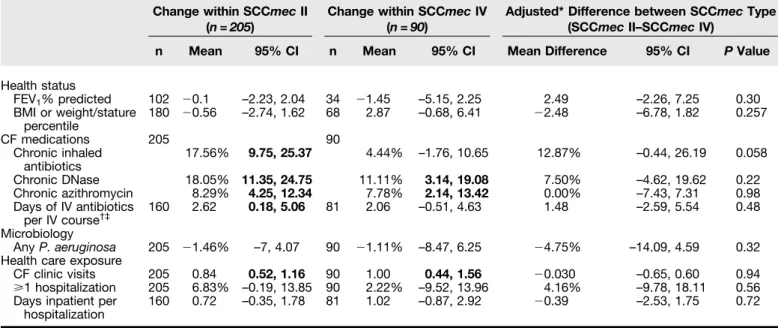
The association of SCCmecII versus SCCmecIV MRSA with changes in clinical care and outcomes from
6 months before to 6 months after initial MRSA detection is shown in Table 3. Differences between the two groups, adjusted for covariates, are also shown. The use of chronic CF medications increased within both groups, with the exception that the use of inhaled antibiotics remained unchanged in those with SCCmecIV strains but increased significantly in those with SCCmecII strains. The greatest percent increase occurred for use of DNase for both groups. The number of CF clinic visits increased regardless of SCCmectype.
P. aeruginosa–positive cultures, hospitalizations, and duration of hospitalization were similar before and after MRSA detection and were similar by SCCmectype. There were no significant changes in lung function or anthropometric parameters.
Among participants with SCCmecIV, those with PVL(–) strains had a significant increase in the use of DNase (15.38%; 95% CI, 1.4, 29.37) and the chronic macrolide agents azithromycin and clarithromycin (12.82%; 95% CI, 1.84, 23.8). In contrast, those with PVL(1) strains had
a significant increase in the use of inhaled antibiotics (7.84%; 95% CI, 0.21, 15.48). However, none of these differences were significant between the groups when adjusted for covariates. Participants having at least one hospitalization significantly increased among those with PVL(–) (17.95%; 95% CI, –0.07, 35.97) compared with those with PVL(1) strains (–9.80%; 95% CI, –24.96, 5.35) and this difference remained significant after adjusting for covariates (adjusted difference, 34.10%; 95% CI, 7.58, 60.61; P= 0.012).
Changes in Clinical Parameters from 2 Years before to after Detection of Various MRSA Types
Lung function, but not anthropometric measures, significantly declined in the 2 years after MRSA detection compared with the 2 years prior, regardless of SCCmec status (Table 4). Similarly, CF medication use and CF clinic visits also significantly increased in all participants compared with 2 years prior. In contrast, hospitalizations and IV antibiotic days per IV course significantly increased only for those with SCCmecII strains, andP. aeruginosa– positive cultures increased significantly in those with SCCmecIV strains. Whereas the number of cultures increased in each group, similar numbers of cultures were obtained before and after detection of MRSA; the mean (SD) cultures/participant/24 months was 5.4 (3.3) versus 5.3 (3.9) for those with SCCmecII versus SCCmecIV strains, respectively (P= 0.98) before MRSA detection and 8.6 (3.9) versus 9.1 (3.8) for those with SCCmecII versus SCCmecIV strains, respectively (P= 0.30) after MRSA acquisition. None of the changes that occurred within SCCmectype were
Table 3. Changes in clinical parameters 6 months before compared with after detection of various methicillin-resistant
Staphylococcus aureustypes
Change within SCCmecII (n=205)
Change within SCCmecIV (n=90)
Adjusted* Difference between SCCmecType (SCCmecII–SCCmecIV)
n Mean 95% CI n Mean 95% CI Mean Difference 95% CI PValue
Health status
FEV1% predicted 102 20.1 –2.23, 2.04 34 21.45 –5.15, 2.25 2.49 –2.26, 7.25 0.30
BMI or weight/stature percentile
180 20.56 –2.74, 1.62 68 2.87 –0.68, 6.41 22.48 –6.78, 1.82 0.257
CF medications 205 90
Chronic inhaled antibiotics
17.56% 9.75, 25.37 4.44% –1.76, 10.65 12.87% –0.44, 26.19 0.058
Chronic DNase 18.05% 11.35, 24.75 11.11% 3.14, 19.08 7.50% –4.62, 19.62 0.22
Chronic azithromycin 8.29% 4.25, 12.34 7.78% 2.14, 13.42 0.00% –7.43, 7.31 0.98
Days of IV antibiotics per IV course†‡
160 2.62 0.18, 5.06 81 2.06 –0.51, 4.63 1.48 –2.59, 5.54 0.48
Microbiology
AnyP. aeruginosa 205 21.46% –7, 4.07 90 21.11% –8.47, 6.25 24.75% –14.09, 4.59 0.32 Health care exposure
CF clinic visits 205 0.84 0.52, 1.16 90 1.00 0.44, 1.56 20.030 –0.65, 0.60 0.94
>1 hospitalization 205 6.83% –0.19, 13.85 90 2.22% –9.52, 13.96 4.16% –9.78, 18.11 0.56
Days inpatient per hospitalization
160 0.72 –0.35, 1.78 81 1.02 –0.87, 2.92 20.39 –2.53, 1.75 0.72
Definition of abbreviations: BMI = body mass index; CF = cystic fibrosis; CI = confidence interval; IV = intravenous; MRSA = methicillin-resistant
Staphylococcus aureus;P. aeruginosa=Pseudomonas aeruginosa; SCCmec= staphylococcal cassette chromosomemec.
Changes are shown for characteristics before compared with after MRSA by SCCmectypes and adjusted changes. Boldface indicates significance at the two-sided 0.05 level.
*Comparisons by SCCmectype are adjusted for site, sex, age, year of MRSA onset, andP. aeruginosaduring the 6 months after MRSA acquisition.
†Evaluable in n = 160 SCCmecII and n = 81 SCCmecIV with data after 2003. ‡
Combined inpatient and outpatient intravenous therapy.
significantly different between the two SCCmectypes, adjusted for covariates. In participants with SCCmecIV, changes in clinical parameters in the 2 years before versus 2 years after MRSA acquisition were similar in those with and without the PVL gene and remained similar when adjusted for covariates (data not shown). Whereas those with PVL(–) versus PVL(1) strains had a similar proportion ofP. aeruginosa–positive cultures, those acquiring PVL(1) isolates had more cultures taken in the 2 years before MRSA detection; the mean (SD) cultures/ participant/24 months for those with PVL(–) versus PVL(1) strains was 4.2 (2.9) versus 6.2 (4.5), respectively (P= 0.02). The number of cultures increased after MRSA detection in those with either PVL(–) and PVL(1) strains; the mean (SD) cultures/ participant/24 months for those with PVL(–) versus PVL(1) strains was 8.9 (3.8) versus 9.2 (3.8), respectively (P= 0.67).
Discussion
In this multicenter study, initial detection of MRSA in children and adolescents with CF occurred at 7 years of age and was similar
among those with different SCCmectypes; 20% of participants were less than 3 years of age at the time of theirfirst MRSA-positive culture. The proportion of SCCmec IV strains, both PVL(–) and PVL(1), increased from 1996 to 2010. The increase in SCCmecIV types during this time interval is consistent with the increase in community-associated (SCCmecIV) MRSA infections in the general U.S. population (8, 33). Our prior study in this CF study population has shown that the SCCmecIV isolates are usually USA300 (19). Further, despite some geographic variation of MRSA prevalence within the United States among non-CF patients (34), we found that the distribution of SCCmecII versus SCCmec IV strains did not differ by region (19).
We explored the association of various SCCmectypes with CF health status within the 2 years before detection of MRSA and with health care exposures and antibiotic use within the 6 months before detection. These two time intervals were selected to assess various risk factors for MRSA (13, 35, 36); underlying health status often shows slower changes over time in contrast to the short-term health care exposures that could result in acquisition of HA-MRSA,
that is, SCCmecII strains. Furthermore, both exposure and outcome can be measured in this shorter interval as patients with CF are seen at regular intervals and need to produce respiratory cultures frequently. Although CF health status was not associated with acquisition of a specific MRSA type,P. aeruginosa–positive cultures and an increased number of CF clinic visits were associated with SCCmecII. Acquisition ofP. aeruginosahas been associated with more clinic visits in newborn screening studies (37, 38), andP. aeruginosa is transmissible from CF patient to CF patient (39). At present, it remains unclear whether CF clinic visits and/orP. aeruginosa are risks for acquiring SCCmecII MRSA.
Outcomes after MRSA acquisition showed a general intensification of care among all participants as evidenced by an increased number of clinic visits and use of CF medications. Of note, SCCmectype and PVL status were not known to the treating physicians in this study, and thus MRSA type did not influence treatment decisions. However, the use of inhaled antibiotics and more IV antibiotic days increased only in participants with SCCmecII strains within 6 months of MRSA acquisition. Both of Table 4. Changes in clinical parameters 2 years before, compared with after, detection of various methicillin-resistant
Staphylococcus aureustypes
Change within SCCmecII (n=205)
Change within SCCmecIV (n=90)
Adjusted* Difference between SCCmecType (SCCmecII–SCCmecIV)
n Mean 95% CI n Mean 95% CI Mean Difference 95% CI PValue
Health status
FEV1% predicted 110 22.40 –3.99,–0.72 43 22.64 –5.29,–0.01 20.17 –4.50, 4.17 0.94
BMI or weight/stature percentile
196 0.22 –2.00, 2.43 80 1.32 –2.19, 4.83 20.022 –5.74, 5.69 0.99
CF medications 205 90
Chronic inhaled antibiotics 32.20% 24.56, 39.83 14.44% 2.88, 26.01 12.31% –7.10, 31.72 0.21
Chronic DNase 27.32% 21.02, 33.62 25.56% 15.85, 35.26 11.16% –3.62, 25.94 0.14
Chronic macrolides 24.88% 18.76, 31.00 21.11% 12.52, 29.71 14.27% –1.51, 30.07 0.076
Days of IV antibiotics per IV course†‡
160 1.66 0.09, 3.23 81 2.45 –0.57, 5.47 20.60 –4.53, 3.33 0.76
Microbiology 205 90
AnyP. aeruginosa 1.00% –7.09, 9.04 17.78% 6.64, 28.91 212.25% –27.76, 3.25 0.12 Health care exposure
CF clinic visits 205 4.23 3.38, 5.08 90 5.44 3.56, 7.31 20.49 –3.07, 2.10 0.71
>1 Hospitalization 205 12.7% 4.8, 20.6 90 7.8% –5.5, 20.0 3.2% –11.7, 18.0 0.67
Days inpatient per hospitalization
160 0.92 –0.23, 2.08 81 2.19 –0.47, 4.85 21.82 –4.90, 1.26 0.25
Definition of abbreviations: BMI = body mass index; CF = cystic fibrosis; CI = confidence interval; IV = intravenous; MRSA = methicillin-resistant
Staphylococcus aureus;P. aeruginosa=Pseudomonas aeruginosa; SCCmec= staphylococcal cassette chromosomemec.
Changes are shown for characteristics 2 years before compared with 2 years after MRSA per SCCmectype. Boldface represents significance at the two-sided 0.05 level.
*Comparisons by SCCmectype are adjusted for site, sex, age, year of MRSA onset, andP. aeruginosaduring the 24 months after MRSA acquisition.
†Evaluable in n = 160 SCCmecII and n = 81 SCCmecIV with data after 2003. ‡Combined inpatient and outpatient intravenous therapy.
these observations may reflect the higher prevalence ofP. aeruginosain this group, and the latter could be explained by the higher rate of antibiotic resistance genes in SCCmecII isolates requiring IV antibiotics. Overall, similar trends in care intensification were noted when the observation time was extended to 2 years. We can only speculate whether intensification of care reflects a response to progression of CF lung disease as evidenced in the decline in lung function observed in both groups, or is related to patient and clinician concerns after detection of MRSA. Others have reported initiation of CF therapies not directly targeting MRSA, use of inhaled tobramycin, was higher in subjects with MRSA compared with MSSA despite similar prevalence ofP. aeruginosa (40, 41).
Ourfindings that participants with PVL(–) isolates had more hospital admissions within the 6 months after MRSA detection than those with PVL(1) isolates are somewhat at odds with prior reports of acute necrotizing pneumonia in children with CF (17) or previously healthy people (15, 16).
In the current analyses we lack information on the use of oral antibiotics targeting MRSA as these data have been available in the CF Patient Registry only since 2012. However, we previously demonstrated that those participants with longstanding SCCmecII MRSA infection had more exacerbations and increased use of oral antibiotics compared with those with SCCmecIV MRSA (25). We suggest that differences in study design may explain the seemingly different results in the current study compared with our prior study that prospectively evaluated exacerbations in the same participants. These differences include the duration of
MRSA infections, that is, 3–4 years in the prior study versus the maximum 2 years in the current study and the outcome measures assessed, that is, symptoms and use of oral antibiotics versus the variables available in the CF Patient Registry. Future multicenter, prospective studies would be necessary to further evaluate the association of MRSA-specific factors, underlying disease severity, and clinical care practices with patient outcomes.
Although we cannot prove causality in this epidemiologic study, the higher rate of clinic visits andP. aeruginosa, which is also transmissible, could imply a health care– related source of infection for those with SCCmecII and thus argue for strict infection control policies. Combined with our prior observation of more exacerbations in subjects with chronic SCCmecII MRSA compared with those with SCCmecIV, knowledge of SCCmecstatus may be beneficial both regarding epidemiologic/risk assessment and subsequent treatment decisions. Again,firm conclusions should be made cautiously, based solely on epidemiologic studies; however, the higher use of antibiotics seen in our prior study and other risks may indicate that MRSA-specific therapies should be intensified in patients acquiring SCCmecII isolates.
There are limitations to this study. Although this is a multicenter study, it is unknown whether ourfindings are generalizable to all patients with CF, including adults, or to those with transient MRSA. Lung function is not reliably tested in children less than 6 years of age, but the proportion of participants without lung function data was similar across MRSA types. Hospitalizations and intravenous antibiotic treatment were not recorded before 2003. These missing data affect
power, but are unlikely to cause bias. Although the ability to use data in the Registry since 1996 can enhance participant inclusion and follow-up, it is likely that changes in medical management that occurred over time can influence outcomes. Finally, being an exploratory study, adjustment for multiple testing was not performed, and therefore spuriousfindings cannot be ruled out.
In conclusion, we demonstrate that first detection of MRSA occurred in early childhood among those who go on to have persistent infection. Presence of any P. aeruginosa–positive culture and an increased number of CF clinic visits 6 months before initial MRSA detection adjusted forP. aeruginosastatus were potential risk factors associated with acquisition of SCCmecII MRSA implicating patient and care-related risks. There was no increased morbidity in those with PVL(1) isolates. Short-term changes after initial MRSA detection showed increases in multiple chronic medications and clinic visits for all participants and, when adjusting for covariates, was similar among the various SCCmectypes. To better delineate changes that occur during transition from early to chronic MRSA infection, translational and ideally prospective studies that study bacterial changes and host factors will be necessary.n
Author disclosuresare available with the text of this article at www.atsjournals.org.
Acknowledgment:The authors thank the Cystic Fibrosis Foundation for the use of CF Foundation Patient Registry data to conduct this study. In addition, the authors thank the patients, care providers, and clinic coordinators at CF centers throughout the United States for their contributions to the CF Foundation Patient Registry.
References
1 Razvi S, Quittell L, Sewall A, Quinton H, Marshall B, Saiman L. Respiratory microbiology of patients with cysticfibrosis in the United States, 1995 to 2005.Chest2009;136:1554–1560.
2 Cystic Fibrosis Foundation. Patient registry reports [accessed 2014 Dec]. Available from: http://www.cff.org/livingwithcf/ qualityimprovement/patientregistryreport/
3 Dasenbrook EC, Checkley W, Merlo CA, Konstan MW, Lechtzin N, Boyle MP. Association between respiratory tract methicillin-resistant
Staphylococcus aureusand survival in cysticfibrosis.JAMA2010; 303:2386–2392.
4 Dasenbrook EC, Merlo CA, Diener-West M, Lechtzin N, Boyle MP. Persistent methicillin-resistantStaphylococcus aureusand rate of FEV1decline in cysticfibrosis.Am J Respir Crit Care Med2008;178: 814–821.
5 Chen SY, Liao CH, Wang JL, Chiang WC, Lai MS, Chie WC, Chen WJ, Chang SC, Hsueh PR. Methicillin-resistantStaphylococcus aureus
(MRSA) staphylococcal cassette chromosomemecgenotype affects outcomes of patients with healthcare-associated MRSA bacteremia independently of vancomycin minimum inhibitory concentration.Clin Infect Dis2012;55:1329–1337.
6 Ito T, Katayama Y, Asada K, Mori N, Tsutsumimoto K, Tiensasitorn C, Hiramatsu K. Structural comparison of three types of staphylococcal cassette chromosomemecintegrated in the chromosome in methicillin-resistantStaphylococcus aureus.Antimicrob Agents Chemother2001;45:1323–1336.
7 Shore AC, Coleman DC. Staphylococcal cassette chromosomemec: recent advances and new insights.Int J Med Microbiol2013;303: 350–359.
8 Tenover FC, McAllister S, Fosheim G, McDougal LK, Carey RB, Limbago B, Lonsway D, Patel JB, Kuehnert MJ, Gorwitz R. Characterization ofStaphylococcus aureusisolates from nasal
cultures collected from individuals in the United States in 2001 to 2004.J Clin Microbiol2008;46:2837–2841.
9 DeLeo FR, Otto M, Kreiswirth BN, Chambers HF. Community-associated methicillin-resistantStaphylococcus aureus.Lancet
2010;375:1557–1568.
10 Deurenberg RH, Stobberingh EE. The molecular evolution of hospital-and community-associated methicillin-resistantStaphylococcus aureus.Curr Mol Med2009;9:100–115.
11 Lowy FD. Methicillin-resistantStaphylococcus aureus: where is it coming from and where is it going?JAMA Intern Med2013;173: 1978–1979.
12 Lowy FD. Antimicrobial resistance: the example ofStaphylococcus aureus.J Clin Invest2003;111:1265–1273.
13 Kuo SC, Chiang MC, Lee WS, Chen LY, Wu HS, Yu KW, Fung CP, Wang FD. Comparison of microbiological and clinical characteristics based on SCCmec typing in patients with community-onset meticillin-resistantStaphylococcus aureus(MRSA) bacteraemia.Int J Antimicrob Agents2011;39:22–26.
14 Klein E, Smith DL, Laxminarayan R. Community-associated methicillin-resistantStaphylococcus aureusin outpatients, United States, 1999–2006.Emerg Infect Dis2009;15:1925–1930.
15 Francis JS, Doherty MC, Lopatin U, Johnston CP, Sinha G, Ross T, Cai M, Hansel NN, Perl T, Ticehurst JR,et al. Severe community-onset pneumonia in healthy adults caused by methicillin-resistant
Staphylococcus aureuscarrying the Panton–Valentine leukocidin genes.Clin Infect Dis2005;40:100–107.
16 Tseng MH, Wei BH, Lin WJ, Lu JJ, Lee SY, Wang SR, Chen SJ, Wang CC. Fatal sepsis and necrotizing pneumonia in a child due to community-acquired methicillin-resistantStaphylococcus aureus: case report and literature review.Scand J Infect Dis2005;37: 504–507.
17 Elizur A, Orscheln RC, Ferkol TW, Atkinson JJ, Dunne WM Jr, Buller RS, Armstrong JR, Mardis ER, Storch GA, Cannon CL. Panton–Valentine leukocidin-positive methicillin-resistantStaphylococcus aureus
lung infection in patients with cysticfibrosis.Chest2007;131: 1718–1725.
18 Voyich JM, Otto M, Mathema B, Braughton KR, Whitney AR, Welty D, Long RD, Dorward DW, Gardner DJ, Lina G,et al. Is Panton– Valentine leukocidin the major virulence determinant in community-associated methicillin-resistantStaphylococcus aureusdisease?
J Infect Dis2006;194:1761–1770.
19 Champion EA, Miller MB, Popowitch EB, Hobbs MM, Saiman L, Muhlebach MS; STAR-CF Study Team. Antimicrobial susceptibility and molecular typing of MRSA in cysticfibrosis.Pediatr Pulmonol
2014;49:230–237.
20 Stone A, Quittell L, Zhou J, Alba L, Bhat M, DeCelie-Germana J, Rajan S, Bonitz L, Welter JJ, Dozor AJ,et al.Staphylococcus aureusnasal colonization among pediatric cysticfibrosis patients and their household contacts.Pediatr Infect Dis J2009;28:895–899. 21 Glikman D, Siegel JD, David MZ, Okoro NM, Boyle-Vavra S, Dowell ML,
Daum RS. Complex molecular epidemiology of methicillin-resistant
Staphylococcus aureusisolates from children with cysticfibrosis in the era of epidemic community-associated methicillin-resistant
S. aureus.Chest2008;133:1381–1387.
22 Goodrich JS, Sutton-Shields TN, Kerr A, Wedd JP, Miller MB, Gilligan PH. Prevalence of community-associated methicillin-resistant
Staphylococcus aureusin patients with cysticfibrosis.J Clin Microbiol2009;47:1231–1233.
23 Al-Zubeidi D, Hogan PG, Boyle M, Burnham CA, Fritz SA. Molecular epidemiology of methicillin-resistantStaphylococcus aureusisolated in serial cultures from the respiratory tract of children with cystic
fibrosis.Pediatr Infect Dis J2014;33:549–553.
24 Muhlebach MS, Miller M, LaVange LM, Mayhew G, Goodrich JS, Miller MB. Treatment intensity and characteristics of MRSA infection in CF.
J Cyst Fibros2011;10:201–206.
25 Heltshe SL, Saiman L, Popowitch EB, Miller MB, Kloster M, Thompson V, Ferkol TW, Hoover WC, Schechter MS, Muhlebach MS. Outcomes and treatment of chronic methicillin-resistantStaphylococcus aureus
differs by staphylococcal cassette chromosomemec(SCCmec) type in children with cysticfibrosis.J Pediatr Infect Dis Soc2014:1–7. 26 Miller MB, Gilligan PH. Laboratory aspects of management of chronic
pulmonary infections in patients with cysticfibrosis.J Clin Microbiol
2003;41:4009–4015.
27 Oliveira DC, de Lencastre H. Multiplex PCR strategy for rapid identification of structural types and variants of themecelement in methicillin-resistantStaphylococcus aureus.Antimicrob Agents Chemother2002;46:2155–2161.
28 Wang X, Dockery DW, Wypij D, Fay ME, Ferris BG Jr. Pulmonary function between 6 and 18 years of age.Pediatr Pulmonol1993;15: 75–88.
29 Hankinson JL, Odencrantz JR, Fedan KB. Spirometric reference values from a sample of the general U.S. population.Am J Respir Crit Care Med1999;159:179–187.
30 Flegal KM, Wei R, Ogden C. Weight-for-stature compared with body mass index-for-age growth charts for the United States from the Centers for Disease Control and Prevention.Am J Clin Nutr2002;75: 761–766.
31 Kuczmarski RJ, Ogden CL, Grummer-Strawn LM, Flegal KM, Guo SS, Wei R, Mei Z, Curtin LR, Roche AF, Johnson CL. CDC growth charts: United States.Adv Data2000;314:1–27.
32 Lee TW, Brownlee KG, Conway SP, Denton M, Littlewood JM. Evaluation of a new definition for chronicPseudomonas aeruginosa
infection in cysticfibrosis patients.J Cyst Fibros2003;2:29–34. 33 Centers for Disease Control and Prevention. ABCs report:
methicillin-resistantStaphylococcus aureus, 2011 [Emerging Infections Program Network] [accessed 2014 Dec]. Available from: http://www. cdc.gov/abcs/reports-findings/survreports/mrsa11.html
34 Sun L, Klein EY, Laxminarayan R. Seasonality and temporal correlation between community antibiotic use and resistance in the United States.Clin Infect Dis2012;55:687–694.
35 Robicsek A, Beaumont JL, Thomson RB Jr, Govindarajan G, Peterson LR. Topical therapy for methicillin-resistantStaphylococcus aureus
colonization: impact on infection risk.Infect Control Hosp Epidemiol
2009;30:623–632.
36 Robicsek A, Beaumont JL, Wright MO, Thomson RB Jr, Kaul KL, Peterson LR. Electronic prediction rules for methicillin-resistant
Staphylococcus aureuscolonization.Infect Control Hosp Epidemiol
2011;32:9–19.
37 Farrell PM, Shen G, Splaingard M, Colby CE, Laxova A, Kosorok MR, Rock MJ, Mischler EH. Acquisition ofPseudomonas aeruginosain children with cysticfibrosis.Pediatrics1997;100:E2.
38 Kosorok MR, Jalaluddin M, Farrell PM, Shen G, Colby CE, Laxova A, Rock MJ, Splaingard M. Comprehensive analysis of risk factors for acquisition ofPseudomonas aeruginosain young children with cystic
fibrosis.Pediatr Pulmonol1998;26:81–88.
39 Fothergill JL, Walshaw MJ, Winstanley C. Transmissible strains of
Pseudomonas aeruginosain cysticfibrosis lung infections.Eur Respir J2012;40:227–238.
40 Ren CL, Morgan WJ, Konstan MW, Schechter MS, Wagener JS, Fisher KA, Regelmann WE; Investigators and Coordinators of the Epidemiologic Study of Cystic Fibrosis. Presence of methicillin resistantStaphylococcus aureusin respiratory cultures from cystic
fibrosis patients is associated with lower lung function.Pediatr Pulmonol2007;42:513–518.
41 Taccetti G, Neri AS, Festini F, Galici V, Cocchi P, Campana S. Methicillin resistantStaphylococcus aureusin cysticfibrosis.Pediatr Pulmonol
2008;43:309, author reply 310.
42 Muhlebach MS, Popwitch E, Miller MB, Peng A, LaVange L, Saiman L; STAR-CF Study Team. Risk factors for MRSA subtypes in CF.
Pediatr Pulmonol2012;33(Suppl):304S.