A Monthly Double-Blind Peer Reviewed (Refereed/Juried) Open Access International e-Journal - Included in the International Serial Directories Indexed & Listed at:
VOLUME NO.4(2014),ISSUE NO.02(FEBRUARY) ISSN2231-5756
INTERNATIONAL JOURNAL OF RESEARCH IN COMMERCE, IT & MANAGEMENT
CONTENTS
Sr.
No.
TITLE & NAME OF THE AUTHOR (S)
Page
No.
1
.
A STUDY OF IMPORTANCE OF ETIQUETTES FOR A PROFESSIONAL
DR. G. SUNITHA & A. K. NEERAJA RANI
1
2
.
COPYRIGHT PROTECTION FOR RGB WATERMARK IMAGE USING IN LSB
RAJNI VERMA & ARCHNA TIWARI
4
3
.
HOW LEADERSHIP AFFECTS ORGANIZATIONAL CHANGE PROCESS
RAJA MUHAMMAD YASIR & DR. HUMAYOUN NAEEM
10
4
.
FACTORS INFLUENCING CUSTOMERS’ LOYALTY IN ONLINE SHOPPING
TUSHAR BHAVSAR & DR. RAJESH M. PATEL
13
5
.
A STUDY ON THE ROLE OF EMOTIONAL SATISFACTION IN RETAIL OUTLETS
T. KALAKUMARI & DR. M. SEKAR
16
6
.
STAFF ATTITUDES TO SHELVING AND SHELF READING IN PUBLIC LIBRARIES IN
NIGERIA
JOHN MUYIWA ADENIYI CLN
20
7
.
A ROAD MAP TOWARDS SECURE CYBER WORLD
SANDEEP YADAV
22
8
.
FDI IN RETAIL: BOON OR BANE
ANNU AGGARWAL
25
9
.
WORKING CAPITAL MANAGEMENT AND ITS IMPACT ON PROFITABILITY: A CASE
STUDY OF DR. REDDY’S LABORATORIES LTD.
NIRMAL CHAKRABORTY
33
10
.
QUALITATIVE ANALYSIS OF FDI IN INDIAN RETAIL INDUSTRY
PALLAVI MANIK & RENU SINGLA
38
11
.
e-COMMERCE IN PUBLIC SECTOR BANKS
IYER SEETHALAKSHMI BALAKRISHNAN
42
12
.
CREATING COMPETITIVE ADVANTAGE THROUGH SUPPLY CHAIN MANAGEMENT
(ROLE OF INFORMATION & COMMUNICATION TECHNOLOGY IN SUPPLY CHAIN
MANAGEMENT TO CREATE COMPETITIVE ADVANTAGE: A LITERATURE BASE
STUDY)
SAIF MAQBOOL, MUHAMMAD RAFIQ, MUHAMMAD IMRAN, ABDUL QADEER &
TAJAMMAL ABBAS
47
13
.
ADOPTION OF INFORMATION TECHNOLOGY AND BANKS PERFORMANCE: A
SURVEY OF SELECTED BANKS IN NIGERIA
SAMSON YIMKA ALALADE, KEMI OMONIYI & BOLANLE O. AMUSA
53
14
.
A STUDY OF UNDERGRADUATE COLLEGE STUDENT’S STUDY HABITS IN RELATION
TO THEIR ACADEMIC ACHIEVEMENT
ISHRAT NAAZ
60
15
.
PACKAGING DESIGN AS NEW INNOVATIVE PROMOTIONAL TOOL
SHRUTI CHAUDHARY
65
CHIEF PATRON
PROF. K. K. AGGARWAL
Chairman, Malaviya National Institute of Technology, Jaipur
(An institute of National Importance & fully funded by Ministry of Human Resource Development, Government of India)
Chancellor, K. R. Mangalam University, Gurgaon
Chancellor, Lingaya’s University, Faridabad
Founder Vice-Chancellor (1998-2008), Guru Gobind Singh Indraprastha University, Delhi
Ex. Pro Vice-Chancellor, Guru Jambheshwar University, Hisar
FOUNDER PATRON
LATE SH. RAM BHAJAN AGGARWAL
Former State Minister for Home & Tourism, Government of Haryana
Former Vice-President, Dadri Education Society, Charkhi Dadri
Former President, Chinar Syntex Ltd. (Textile Mills), Bhiwani
CO-ORDINATOR
AMITA
Faculty, Government M. S., Mohali
ADVISORS
DR. PRIYA RANJAN TRIVEDI
Chancellor, The Global Open University, Nagaland
PROF. M. S. SENAM RAJU
Director A. C. D., School of Management Studies, I.G.N.O.U., New Delhi
PROF. M. N. SHARMA
Chairman, M.B.A., Haryana College of Technology & Management, Kaithal
PROF. S. L. MAHANDRU
Principal (Retd.), Maharaja Agrasen College, Jagadhri
EDITOR
PROF. R. K. SHARMA
Professor, Bharti Vidyapeeth University Institute of Management & Research, New Delhi
CO-EDITOR
DR. BHAVET
Faculty, Shree Ram Institute of Business & Management, Urjani
EDITORIAL ADVISORY BOARD
DR. RAJESH MODI
Faculty, Yanbu Industrial College, Kingdom of Saudi Arabia
PROF. SANJIV MITTAL
University School of Management Studies, Guru Gobind Singh I. P. University, Delhi
PROF. ANIL K. SAINI
VOLUME NO.4(2014),ISSUE NO.02(FEBRUARY) ISSN2231-5756
INTERNATIONAL JOURNAL OF RESEARCH IN COMMERCE, IT & MANAGEMENT
DR. SAMBHAVNA
Faculty, I.I.T.M., Delhi
DR. MOHENDER KUMAR GUPTA
Associate Professor, P. J. L. N. Government College, Faridabad
DR. SHIVAKUMAR DEENE
Asst. Professor, Dept. of Commerce, School of Business Studies, Central University of Karnataka, Gulbarga
ASSOCIATE EDITORS
PROF. NAWAB ALI KHAN
Department of Commerce, Aligarh Muslim University, Aligarh, U.P.
PROF. ABHAY BANSAL
Head, Department of Information Technology, Amity School of Engineering & Technology, Amity
University, Noida
PROF. A. SURYANARAYANA
Department of Business Management, Osmania University, Hyderabad
DR. SAMBHAV GARG
Faculty, Shree Ram Institute of Business & Management, Urjani
PROF. V. SELVAM
SSL, VIT University, Vellore
DR. PARDEEP AHLAWAT
Associate Professor, Institute of Management Studies & Research, Maharshi Dayanand University, Rohtak
DR. S. TABASSUM SULTANA
Associate Professor, Department of Business Management, Matrusri Institute of P.G. Studies, Hyderabad
SURJEET SINGH
Asst. Professor, Department of Computer Science, G. M. N. (P.G.) College, Ambala Cantt.
TECHNICAL ADVISOR
AMITA
Faculty, Government M. S., Mohali
FINANCIAL ADVISORS
DICKIN GOYAL
Advocate & Tax Adviser, Panchkula
NEENA
Investment Consultant, Chambaghat, Solan, Himachal Pradesh
LEGAL ADVISORS
JITENDER S. CHAHAL
Advocate, Punjab & Haryana High Court, Chandigarh U.T.
CHANDER BHUSHAN SHARMA
Advocate & Consultant, District Courts, Yamunanagar at Jagadhri
SUPERINTENDENT
CALL FOR MANUSCRIPTS
We invite unpublished novel, original, empirical and high quality research work pertaining to recent developments & practices in the areas of Computer Science & Applications; Commerce; Business; Finance; Marketing; Human Resource Management; General Management; Banking; Economics; Tourism Administration & Management; Education; Law; Library & Information Science; Defence & Strategic Studies; Electronic Science; Corporate Governance; Industrial Relations; and emerging paradigms in allied subjects like Accounting; Accounting Information Systems; Accounting Theory & Practice; Auditing; Behavioral Accounting; Behavioral Economics; Corporate Finance; Cost Accounting; Econometrics; Economic Development; Economic History; Financial Institutions & Markets; Financial Services; Fiscal Policy; Government & Non Profit Accounting; Industrial Organization; International Economics & Trade; International Finance; Macro Economics; Micro Economics; Rural Economics; Co-operation; Demography: Development Planning; Development Studies; Applied Economics; Development Economics; Business Economics; Monetary Policy; Public Policy Economics; Real Estate; Regional Economics; Political Science; Continuing Education; Labour Welfare; Philosophy; Psychology; Sociology; Tax Accounting; Advertising & Promotion Management; Management Information Systems (MIS); Business Law; Public Responsibility & Ethics; Communication; Direct Marketing; E-Commerce; Global Business; Health Care Administration; Labour Relations & Human Resource Management; Marketing Research; Marketing Theory & Applications; Non-Profit Organizations; Office Administration/Management; Operations Research/Statistics; Organizational Behavior & Theory; Organizational Development; Production/Operations; International Relations; Human Rights & Duties; Public Administration; Population Studies; Purchasing/Materials Management; Retailing; Sales/Selling; Services; Small Business Entrepreneurship; Strategic Management Policy; Technology/Innovation; Tourism & Hospitality; Transportation Distribution; Algorithms; Artificial Intelligence; Compilers & Translation; Computer Aided Design (CAD); Computer Aided Manufacturing; Computer Graphics; Computer Organization & Architecture; Database Structures & Systems; Discrete Structures; Internet; Management Information Systems; Modeling & Simulation; Neural Systems/Neural Networks; Numerical Analysis/Scientific Computing; Object Oriented Programming; Operating Systems; Programming Languages; Robotics; Symbolic & Formal Logic; Web Design and emerging paradigms in allied subjects.
Anybody can submit the soft copy of unpublished novel; original; empirical and high quality research work/manuscriptanytime in M.S. Word format
after preparing the same as per our GUIDELINES FOR SUBMISSION; at our email address i.e. [email protected] or online by clicking the link online submission as given on our website (FOR ONLINE SUBMISSION, CLICK HERE).
GUIDELINES FOR SUBMISSION OF MANUSCRIPT
1. COVERING LETTER FOR SUBMISSION:
DATED: _____________
THE EDITOR IJRCM
Subject: SUBMISSION OF MANUSCRIPT IN THE AREA OF.
(e.g. Finance/Marketing/HRM/General Management/Economics/Psychology/Law/Computer/IT/Engineering/Mathematics/other, please specify) DEAR SIR/MADAM
Please find my submission of manuscript entitled ‘___________________________________________’ for possible publication in your journals.
I hereby affirm that the contents of this manuscript are original. Furthermore, it has neither been published elsewhere in any language fully or partly, nor is it under review for publication elsewhere.
I affirm that all the author (s) have seen and agreed to the submitted version of the manuscript and their inclusion of name (s) as co-author (s).
Also, if my/our manuscript is accepted, I/We agree to comply with the formalities as given on the website of the journal & you are free to publish our contribution in any of your journals.
NAME OF CORRESPONDING AUTHOR: Designation:
Affiliation with full address, contact numbers & Pin Code: Residential address with Pin Code:
Mobile Number (s): Landline Number (s): E-mail Address: Alternate E-mail Address:
NOTES:
a) The whole manuscript is required to be in ONE MS WORD FILE only (pdf. version is liable to be rejected without any consideration), which will start from
the covering letter, inside the manuscript.
b) The sender is required to mentionthe following in the SUBJECT COLUMN of the mail:
New Manuscript for Review in the area of (Finance/Marketing/HRM/General Management/Economics/Psychology/Law/Computer/IT/ Engineering/Mathematics/other, please specify)
c) There is no need to give any text in the body of mail, except the cases where the author wishes to give any specific message w.r.t. to the manuscript. d) The total size of the file containing the manuscript is required to be below 500 KB.
e) Abstract alone will not be considered for review, and the author is required to submit the complete manuscript in the first instance.
f) The journal gives acknowledgement w.r.t. the receipt of every email and in case of non-receipt of acknowledgment from the journal, w.r.t. the submission
of manuscript, within two days of submission, the corresponding author is required to demand for the same by sending separate mail to the journal.
2. MANUSCRIPT TITLE: The title of the paper should be in a 12 point Calibri Font. It should be bold typed, centered and fully capitalised.
3. AUTHOR NAME (S) & AFFILIATIONS: The author (s) full name, designation, affiliation (s), address, mobile/landline numbers, and email/alternate email address should be in italic & 11-point Calibri Font. It must be centered underneath the title.
VOLUME NO.4(2014),ISSUE NO.02(FEBRUARY) ISSN2231-5756
INTERNATIONAL JOURNAL OF RESEARCH IN COMMERCE, IT & MANAGEMENT
5. KEYWORDS: Abstract must be followed by a list of keywords, subject to the maximum of five. These should be arranged in alphabetic order separated bycommas and full stops at the end.
6. MANUSCRIPT: Manuscript must be in BRITISH ENGLISH prepared on a standard A4 size PORTRAIT SETTING PAPER. It must be prepared on a single space and single column with 1” margin set for top, bottom, left and right. It should be typed in 8 point Calibri Font with page numbers at the bottom and centre of every page. It should be free from grammatical, spelling and punctuation errors and must be thoroughly edited.
7. HEADINGS: All the headings should be in a 10 point Calibri Font. These must be bold-faced, aligned left and fully capitalised. Leave a blank line before each heading.
8. SUB-HEADINGS: All the sub-headings should be in a 8 point Calibri Font. These must be bold-faced, aligned left and fully capitalised. 9. MAIN TEXT: The main text should follow the following sequence:
INTRODUCTION
REVIEW OF LITERATURE
NEED/IMPORTANCE OF THE STUDY
STATEMENT OF THE PROBLEM
OBJECTIVES
HYPOTHESES
RESEARCH METHODOLOGY
RESULTS & DISCUSSION
FINDINGS
RECOMMENDATIONS/SUGGESTIONS
CONCLUSIONS
SCOPE FOR FURTHER RESEARCH
ACKNOWLEDGMENTS
REFERENCES
APPENDIX/ANNEXURE
It should be in a 8 point Calibri Font, single spaced and justified. The manuscript should preferably not exceed 5000 WORDS.
10. FIGURES &TABLES: These should be simple, crystal clear, centered, separately numbered & self explained, and titles must be above the table/figure. Sources of data should be mentioned below the table/figure. It should be ensured that the tables/figures are referred to from the main text.
11. EQUATIONS:These should be consecutively numbered in parentheses, horizontally centered with equation number placed at the right.
12. REFERENCES: The list of all references should be alphabetically arranged. The author (s) should mention only the actually utilised references in the preparation of manuscript and they are supposed to follow Harvard Style of Referencing. The author (s) are supposed to follow the references as per the following:
•
All works cited in the text (including sources for tables and figures) should be listed alphabetically.•
Use (ed.) for one editor, and (ed.s) for multiple editors.•
When listing two or more works by one author, use --- (20xx), such as after Kohl (1997), use --- (2001), etc, in chronologically ascending order.•
Indicate (opening and closing) page numbers for articles in journals and for chapters in books.•
The title of books and journals should be in italics. Double quotation marks are used for titles of journal articles, book chapters, dissertations, reports, workingpapers, unpublished material, etc.
•
For titles in a language other than English, provide an English translation in parentheses.•
The location of endnotes within the text should be indicated by superscript numbers.PLEASE USE THE FOLLOWING FOR STYLE AND PUNCTUATION IN REFERENCES: BOOKS
•
Bowersox, Donald J., Closs, David J., (1996), "Logistical Management." Tata McGraw, Hill, New Delhi.•
Hunker, H.L. and A.J. Wright (1963), "Factors of Industrial Location in Ohio" Ohio State University, Nigeria.CONTRIBUTIONS TO BOOKS
•
Sharma T., Kwatra, G. (2008) Effectiveness of Social Advertising: A Study of Selected Campaigns, Corporate Social Responsibility, Edited by David Crowther &Nicholas Capaldi, Ashgate Research Companion to Corporate Social Responsibility, Chapter 15, pp 287-303.
JOURNAL AND OTHER ARTICLES
•
Schemenner, R.W., Huber, J.C. and Cook, R.L. (1987), "Geographic Differences and the Location of New Manufacturing Facilities," Journal of Urban Economics,Vol. 21, No. 1, pp. 83-104.
CONFERENCE PAPERS
•
Garg, Sambhav (2011): "Business Ethics" Paper presented at the Annual International Conference for the All India Management Association, New Delhi, India,19–22 June.
UNPUBLISHED DISSERTATIONS AND THESES
•
Kumar S. (2011): "Customer Value: A Comparative Study of Rural and Urban Customers," Thesis, Kurukshetra University, Kurukshetra.ONLINE RESOURCES
•
Always indicate the date that the source was accessed, as online resources are frequently updated or removed.WEBSITES
A STUDY ON THE ROLE OF EMOTIONAL SATISFACTION IN RETAIL OUTLETS
T. KALAKUMARI
ASST. PROFESSOR
DEPARTMENT OF COMMERCE WITH INFORMATION TECHNOLOGY
SRI KRISHNA ARTS & SCIENCE COLLEGE
COIMBATORE
DR. M. SEKAR
ASST. PROFESSOR
DEPARTMENT OF COMMERCE
CBM COLLEGE
COIMBATORE
ABSTRACT
This study empirically examined the role of emotional satisfaction in service encounters. Specifically, this study seeks to investigate the relationship between emotional satisfaction and key concepts such as service quality, customer loyalty and relationship quality and clarify the role of emotional satisfaction in predicting customer loyalty and relationship quality. In doing so, this study used the relationship between emotional satisfaction, service quality, customer loyalty and the relationship quality as a context, as well as data from a sample survey of Coimbatore retail customers concerning their evaluation of their shopping experiences to address this issue. The result shows that service quality is positively associated with both customer loyalties, while feelings of happiness serve as the best predictor of relationship quality. The findings imply the need for a service firm to strategically leverage on the key antecedents of customer loyalty and relationship quality in its pursuit of customer retention and long term profitability. In its contest, research is been done to find out the role of emotional satisfaction in service encounters.
KEYWORDS
Customer relations, Customer loyalty, Customer emotional satisfaction, Service quality.
INTRODUCTION
he behaviors of frontline service employees are critical to customer evaluations of the service encounter. Unexpectedly, organizations can create a distinct and sustainable competitive edge by providing an excellent service in delivery process. A service involves frequent or extended person-to-person encounters between the contact employee and the consumer. In such instances, the service provided is inseparable from the contact employee; hence the contact employee plays an important role in the delivery of service quality as well as in providing the customer satisfaction. The degree of satisfaction, in turn, influences customers’ behavioral responses in the form of customer loyalty. The role of emotion is gaining attention as a central element in service quality management.
There have been some studies of the effects of emotions on satisfaction with service quality. Recent studies suggest that emotion is a fundamental attribute in satisfaction and that customer satisfaction should include a separate emotional component. Indeed, Stauss and Neuhaus contend that most satisfaction studies have focused mainly on the cognitive component of emotion, while seemingly important affective component has been largely ignored. Further, Liljander and Strandvik argue that customer satisfaction includes both affective and cognitive components. The authors found that negative emotions have a stronger effect on satisfaction with quality than positive emotions. Despite the above, consumer behavior scholars have limited information about the nature of emotions in the consumption environment, and no conclusive guidance for management has yet been found. Consequently, it is integral to understand the role of emotion in service encounters. First, a brief synthesis of the extant literature on key conceptual issues concerning the role of emotion in service encounters is presented. The retailing consists of the sale of goods and merchandise from a fixed location, such as departmental store in small or individual lots for direct consumption by the purchaser. Some retailing business sells combination of goods and services. For example, an automobile dealer that sells automobile (goods) may also be providing automobile repairs (services). Since the last decade, the field of retailing has experienced significant changes. Specialty and discount stores have been edging in departmental stores turf, with cost conscious and breadth of selection strategies.
FIGURE 1: ELEMENTS OF EMOTIONAL SATISFACTION
The marketers at both department stores and hypermarkets have to face seriously, the multi faceted challenge of delivering tangible goods, intangible services and ideas for the purpose of satisfying consumers’ needs. Due to the nature of the service offered, purchasing decisions, consumption experience and post purchase evaluation of services is often problematic to service consumers. When consumers patronize a store, they first encounter the physical environment or service scope; then, they engage in personal interaction with the sales people; finally, the store processes and finishes the transaction. During this transaction, the consumers’ emotional response and perceived monetary value will be impacted by the service scope, service people, and service context or core service. Supermarkets are considered to be the major form of retailing all over the world. Moreover services quality has being long regarded to be a critical element in enhancing the perception of overall merchandise quality in supermarkets. Services quality excellence has been shown to assist in both the retention and expansion of the existing customer base. But only few studies have attempted to identify key dimensions of services quality as well as to investigate the prevailing services quality in the supermarket industry, thus this study attempts to fill this gap by examining the key dimensions of retail service quality across the supermarket industry in Sri Lanka as well as to test the most commonly used scale to measure retail service quality.
T
Emotional Satisfaction
Service Quality Relationship Quality
VOLUME NO.4(2014),ISSUE NO.02(FEBRUARY) ISSN2231-5756
INTERNATIONAL JOURNAL OF RESEARCH IN COMMERCE, IT & MANAGEMENT
REVIEW OF LITERATURE
Parasuraman et al., (1980) conducted an exploratory investigation in the attempt to define service quality and develop a model of service quality, The results showed that regardless of the type of service, consumers used basically the similar criteria in evaluating service quality. They labeled those criteria as “service quality determinants”. Since then, service quality was defined through 10 dimensions: Access, Communication, Competence, Courtesy, Credibility, Reliability, Responsiveness, Security, Tangibles and Understanding the customer. Later they simplified into five dimensions such as Tangibles, Reliability, Responsiveness, Assurance and Empathy.
Izard et al., (1980) suggested the consumption emotions have been conceptualized as distinct categories of emotional experience and expressions, such as joy, anger, fear; or as a limited number of dimensions underlying emotional categories, such as pleasantness/unpleasantness, relaxation/action, or calmness/excitement.
Kotler et al., (1981) suggested customer loyalty constitutes an underlying objective for strategic marketing and management planning Kotler et al., (1984) represents an important basis for developing a sustainable competitive advantage.
Gro¨nroos et al., (1984) define service quality as a perceived judgment, resulting from an evaluation process where customers compare their expectations with the service they perceive to have received.
Shostack et al., (1985) suggested that a service encounter is defined as “a period of time during which a customer directly interacts with a service”. This definition includes discrete, separate, and distinct events and behavior, as well as a customer’s interaction with all the dimensions of a service, such as the physical surroundings and the service contact employees (Bitner, 1990). Subsequently, this study seeks to:
(1) Investigate the relationship between emotional satisfaction and key concepts, such as service quality, customer loyalty, and relationship quality; and (2) Clarify the role of emotional satisfaction in predicting customer loyalty and relationship quality.
Levitt et al., (1986) concluded the marketing literature as relationship quality has been discussed as a bundle of intangible values which augments products or services and results in an expected interchange between buyers and sellers.
STATEMENT OF THE PROBLEM
This research is prepared to find the emotional satisfaction of the customers. The service provided to the customers by the retail outlet should be satisfied by the customers emotionally. On this base, the customer’s opinion and the emotional satisfaction can be found out in this research. By this base, the influence of the retail outlet can be found by the customer’s. The friendliness of the member of staff, politeness and the advice provided to the customers are noted. The customer rating of importance of several attributes associated with supermarket shopping.
OBJECTIVES OF THE STUDY
• To investigate the relationship between emotional satisfaction and service quality, customer loyalty, and relationship quality. • To determine the influential factors of service quality of shopping in retail outlets.
• To determine the relationship between age and emotional satisfaction of shopping in retail outlets.
HYPOTHESIS
H0 1- There is no significant relationship between age of the respondents and shopping in retail.
H0 2- There is no significant relationship between emotional satisfaction and service quality.
RESEARCH METHODOLOGY
The research problem is the preparation of the design of the research project, popularly known as the “research design”. “A research design is the arrangement of conditions for collection and analysis data in a manner that aims to combine relevance to the researcher purpose with economy in procedure”. First hand information i.e. primary data was used for this research and it was collected using questionnaire. Being primary data, the data collected is believed to be original in its characteristics. Secondary data are collected from internet and through book references.
RESULTS AND DISCUSSION
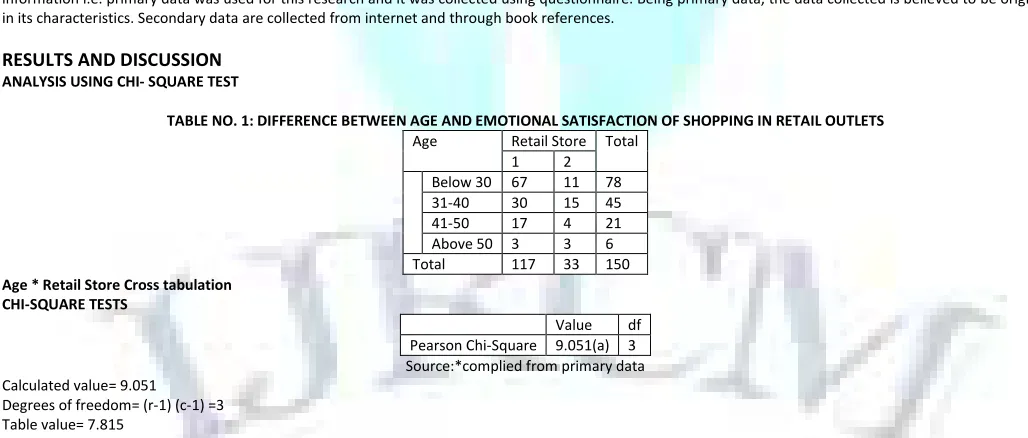
ANALYSIS USING CHI- SQUARE TESTTABLE NO. 1: DIFFERENCE BETWEEN AGE AND EMOTIONAL SATISFACTION OF SHOPPING IN RETAIL OUTLETS
Age Retail Store Total
1 2
Below 30 67 11 78
31-40 30 15 45
41-50 17 4 21
Above 50 3 3 6
Total 117 33 150
Age * Retail Store Cross tabulation CHI-SQUARE TESTS
Value df
Pearson Chi-Square 9.051(a) 3 Source:*complied from primary data Calculated value= 9.051
Degrees of freedom= (r-1) (c-1) =3 Table value= 7.815
INTERPRETATION
The calculated value 9.051 is greater than the table value 7.815, hence we reject the hypothesis. So we conclude that there is a significant relationship between age of the respondents and shopping in retail.
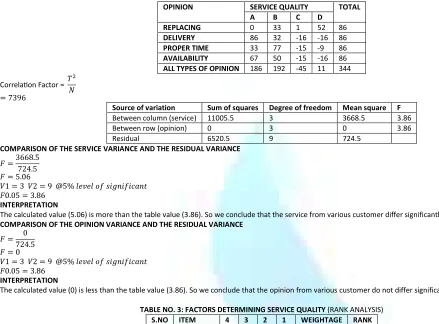
TABLE NO.2: ANALYSIS OF VARIANCE BETWEEN RESPONDENT OPINION AND SERVICE QUALITY OF SHOPPING IN RETAIL OUTLETS OPINION SERVICE QUALITY TOTAL
A B C D
REPLACING 16 49 17 68 150
DELIVERY 102 48 0 0 150
In order to simplify the calculations, we code the data by subtracting 16 from each figure.
OPINION SERVICE QUALITY TOTAL
A B C D
REPLACING 0 33 1 52 86
DELIVERY 86 32 -16 -16 86 PROPER TIME 33 77 -15 -9 86 AVAILABILITY 67 50 -15 -16 86 ALL TYPES OF OPINION 186 192 -45 11 344
CorrelaQon Factor =
= 7396
Source of variation Sum of squares Degree of freedom Mean square F
Between column (service) 11005.5 3 3668.5 3.86
Between row (opinion) 0 3 0 3.86
Residual 6520.5 9 724.5
COMPARISON OF THE SERVICE VARIANCE AND THE RESIDUAL VARIANCE
=3668.5
724.5 = 5.06
1 = 3 2 = 9 @5% 0.05 = 3.86
INTERPRETATION
The calculated value (5.06) is more than the table value (3.86). So we conclude that the service from various customer differ significantly.
COMPARISON OF THE OPINION VARIANCE AND THE RESIDUAL VARIANCE
= 0
724.5 = 0
1 = 3 2 = 9 @5% 0.05 = 3.86
INTERPRETATION
The calculated value (0) is less than the table value (3.86). So we conclude that the opinion from various customer do not differ significantly.
TABLE NO. 3: FACTORS DETERMINING SERVICE QUALITY (RANK ANALYSIS)
S.NO ITEM 4 3 2 1 WEIGHTAGE RANK
1. Price 32 30 33 36 0.98 IV
2. Quantity 45 18 24 44 1.00 II
3. Quality 13 14 56 48 1.01 I
4. Availability 30 50 25 26 0.99 III
INTERPRETATION
The study include an analysis of user preference to the retail outlets for convenient, four character are identified as indicator for the preference to the retail outlets. Four point scales is used in ranking the order of attributes as is found in the tale. This reveals the following findings of all the attributes. Quality ranks first which reveals that users are quality conscious. It suggests that the retail outlets are to pay serious thought for quality to get regular customer. Next to quantity and availability follows. Users are quantity conscious in deciding a particular product. It is followed by price. Price has only fewer roles to play. The analysis reveals that the users give more importance to the quality and less number of importance to quantity, availability, and price.
FINDINGS
The service attitude provided by the retail outlets are much satisfied to the customers. First comparison is with the service variance and the residual variance in that the calculated value (3.98) is more than the table value (3.86). So we conclude that the service from various customer differ significantly. Second comparison is with the opinion variance with the residual variance in that the calculated value (0) is less than the table value (3.86). So we conclude that the opinion from various customer do not differ significantly.The quality provided by the retail outlets are given first rank, while the quantity and the availability of goods provided in the retail store are given second rank. The price rates of the goods are given fourth rank by the retail store.
SUGGESTIONS
The service provided by the retail outlet should be enhanced in a better way that they would not purchase from other retail shops. Replacing the damaged goods should be made satisfactory by the retail outlet to the customers. The retail outlet should provide the overall shopping environment to the customer in a better way. The customers with huge family do not prefer the retail outlet as their expenses is more. Customers prefer the quality to be the best and the quantity and availability to be in the second rank, while price is given last rank.
CONCLUSION
The purpose of this research is to examine the role of retail characteristics on shoppers’ attitudes, and to examine the mediating role of retail-specific emotions in the store characteristic–store attitude relationship. The results clearly show that store characteristics induce shoppers’ in-store emotions. Specifically, the store characteristics examined here to find the emotions, and each of these store characteristics attracts the customers emotionally. When shoppers perceive that the store offers a wide product assortment and that the products offer good value, they feel positive emotions like pleasure, excitement, contentment, pride, and satisfaction. Most of the customers prefer retail outlets than other retail shops. Based on their income and the nature of the family, they prefer the retail outlets. With the income and the times of purchase in retail outlets is positive and favorable. While on the bases of the nature of the family and the shopping in retail outlets are negative and unfavorable. Also there is a significant relationship between age and shopping in retail, income and spend in retail store etc.
LIMITATIONS OF THE STUDY
• Time is not sufficient to collect details from various customer situated in various place.
• Only particular area is been covered to collect the primary data. Area coverage is not possible.
VOLUME NO.4(2014),ISSUE NO.02(FEBRUARY) ISSN2231-5756
INTERNATIONAL JOURNAL OF RESEARCH IN COMMERCE, IT & MANAGEMENT
SCOPE FOR FURTHER STUDY
Emotional satisfaction is one of the important factor in an organization due to increasing competition. This topic is an ever ending one as it plays a vital role in
the development of the organization. Thus there is a lot of scope to carry out further research on this topic. Few variables have been taken into consideration to carry out the analysis on service quality prevailing in the manufacturing concern. Further research can be done by taking other variable in a particular sector and also which have direct/indirect impact on emotional satisfaction in retail sectors.
REFERENCES
1. Bernad Schmitt (1999) “Experiential Marketing”, Journal of Marketing Management, Vol. 15, No. 3, pp. 53-67. 2. Bernad Schmitt (2004) “Experiential Marketing”, Beijing: Tsinghua University Press.
3. Gupta S.P, (1993), “Statistical Methods”, Sultan Chand & Sons, New Delhi.
4. Kothari. C.R., (2004), “Research Methodology- Methods and Techniques” , New Age International (P) Ltd., New Delhi.
5. Lon Zimmerman (2005) “ Ways in which the Client/Agency Relationship is Changing/Evolving-The Agency Perspective”, An American Marketing association-St.Louis Chapter White Paper#13, pp. 1-4.
6. Manju Rani Malik (2011), “Determinants of retail customer satisfaction- A study of Organized retail outlet in Kurukshetra ”, Indian Journal of Marketing ,PP 56.-63
7. Nguyen dang Duy Nhat (2007),” Determinants of Retail Service Quality- a Study of Supermarkets in Vietnam”, University of Vietnam working paper 2007-08 8. Philip Kotler.P (2002), “Marketing Management”, 11th Edition, Prentice Hall of India, New Delhi.
REQUEST FOR FEEDBACK
Dear Readers
At the very outset, International Journal of Research in
Commerce, IT & Management (IJRCM)
acknowledges & appreciates your efforts in showing interest in our present issue under your kind perusal.
I would like to request you tosupply your critical comments and suggestions about the material published
in this issue as well as on the journal as a whole, on our E-mail
for further
improvements in the interest of research.
If youhave any queries please feel free to contact us on our E-mail
.
I am sure that your feedback and deliberations would make future issues better – a result of our joint
effort.
Looking forward an appropriate consideration.
With sincere regards
Thanking you profoundly
Academically yours
Sd/-
Co-ordinator
DISCLAIMER
VOLUME NO.4(2014),ISSUE NO.02(FEBRUARY) ISSN2231-5756