To cite: Brown J, Kyriacou C, Pickett E, et al. Systematic identification and referral of smokers attending HIV ambulatory care highlights the failure of current service provision in an at-risk population. BMJ Open Resp Res 2019;6:e000395. doi:10.1136/ bmjresp-2018-000395
Received 19 December 2018 Revised 3 September 2019 Accepted 3 September 2019
1Respiratory Medicine, Royal Free London NHS Foundation Trust, London, UK
2Respiratory and HIV Medicine, Royal Free London NHS Foundation Trust, London, UK
3Institute for Global Health, University College London Medical School, London, UK 4UCL Respiratory, University College London, London, UK Correspondence to Dr Marc Lipman; marclipman@ nhs. net
Systematic identification and referral of
smokers attending HIV ambulatory care
highlights the failure of current service
provision in an at-risk population
James Brown ,1 Christianna Kyriacou,1 Elisha Pickett,1 Kelly Edwards,1
Hemal Joshi,1 Nafeesah Stewart,1 Andrew Melville,1 Margaret Johnson,2 Jan Flint,1 Angela Bartley,1 Alison Rodger,3 Marc Lipman4
© Author(s) (or their employer(s)) 2019. Re-use permitted under CC BY-NC. No commercial re-use. See rights and permissions. Published by BMJ.
Key messages
► People living with HIV are more likely to smoke than the general population and are at greater risk of harm caused by smoking; interventions are required to improve smoking cessation in this group.
► A simple intervention of asking about smoking and offering referral for smoking cessation was feasi-ble and resulted in a significant uptake of referral; however, a large proportion of those referred did not attend, suggesting that ways of improving uptake of smoking cessation services for HIV-positive people are required.
► This article describes a simple intervention that was associated with increased numbers of smokers iden-tified within an HIV service and an increased number of referrals to smoking cessation services compared with the time period before the intervention.
AbstrAct
Introduction People living with HIV (PLWH) are more likely to smoke than the general population and are at greater risk of smoking-related illness. Healthcare services need to address this burden of preventable disease.
Methods We evaluated the impact of a brief intervention that asked service users about smoking when they attended for ambulatory HIV care in London, UK, and offered referral to smoking cessation.
results Overall, 1548 HIV-positive individuals were asked about their smoking status over a 12-month period. Of this group, 385 (25%) reported that they were current smokers, 372 (97%) were offered referral to smoking cessation services and 154 (40%) accepted this. We established an outcome of referral for 114 (74%) individuals. A total of 36 (10% of smokers) attended stop smoking clinics and 16 (4%) individuals were recorded as having quit smoking. Discussion The simple intervention of asking PLWH about tobacco smoking and offering referral to smoking cessation services rapidly identified current smokers, 40% of whom accepted referral to smoking cessation services. This highlights the importance of promoting behaviour and lifestyle changes with every contact with health services. However, a large proportion of those referred were either not seen in local services or the outcome of referral could not be ascertained. If the risk of smoking-related morbidity among PLWH is to be reduced, more sustainable referral pathways and ways of improving uptake of smoking cessation services must be developed.
bAckgrounD
Tobacco smoking represents the most impor-tant cause of avoidable premature death worldwide.1 Among people living with HIV (PLWH) with good access to antiretroviral therapy (ART), smoking is now estimated to be responsible for the loss of more life-years than HIV infection itself.2 PLWH in most resource-rich settings are more likely to smoke than the general population,3 4 and may be at greater risk of smoking-related comorbid-ities, such as cardiovascular and respiratory
disease,5 6 and some cancers.7 In the UK, while smoking rates have fallen in the general popu-lation, this trend may be less apparent among PLWH,8 for instance, the multisite Antiretro-virals, Sexual Transmission Risk and Attitudes study (which included evaluation of smoking attitudes and behaviours) found that 29% of PLWH were current smokers compared with 19% of the general population.3 There is, therefore, an urgent need to address the high prevalence of tobacco smoking among HIV-positive people and develop cost-effec-tive services to meet this healthcare need.
Smoking cessation interventions have been shown to be cost-effective in many settings.9 These include the provision of very brief advice (VBA) by healthcare workers (a brief structured intervention consisting of assessing smoking behaviours and providing advice and specific recommendations to support smoking cessation), nicotine replace-ment therapy, prescription of bupropion or varenicline and use of stop smoking clinics.10
copyright.
on September 18, 2020 by guest. Protected by
To date, few studies have assessed these interventions in the context of HIV care services and none have done so in the UK.11 We sought to evaluate the impact of asking healthcare workers to systematically identify current smokers attending routine HIV ambulatory care appoint-ments and provide VBA.
MethoDs
We conducted an observational study in an adult HIV care service (Royal Free London NHS Foundation Trust) between October 2014 and October 2015. Healthcare assistants (HCAs) and nursing staff were provided with training regarding the provision of VBA and given details of smoking cessation services prior to the start of the inter-vention. Training was provided by the hospital in-house specialist stop smoking advisers and the National Centre for Smoking Cessation and Training website.12
HIV-positive individuals attending routine HIV ambu-latory care appointments were asked about smoking status by HCAs and nursing staff. This was undertaken when routine observations (blood pressure and weight) were recorded in a cubical allowing patient privacy to be maintained. Patient self-report of whether they consid-ered themselves to be a current smoker was documented; this was not objectively confirmed or more specifically defined. People with a new diagnosis of HIV or those transferring their care from another HIV care provider were specifically evaluated to ascertain whether uptake of stop smoking services in this group differed from the clinic population as a whole.
Individuals who reported that they were current smokers were given VBA and offered referral to smoking cessation services. National Health Service (NHS) stop smoking clinics offer focused support plus provision of nicotine replacement and medications (bupropion or varenicline) where appropriate. In line with national policy, those who accepted this were referred to services in their local area. In-house specialist smoking cessation services were not provided within the HIV care service.
Specific outcomes measured were: (i) the proportion of HIV-positive people reporting current smoking status, (ii) the uptake of smoking cessation referrals and (iii) the outcome of referral to local smoking cessation services.
Data regarding the uptake and outcome of referral to smoking cessation services were obtained by contacting these services directly and by a brief telephone question-naire to the HIV-positive patients referred to services. The costs and yield in terms of smokers identified and numbers attending smoking cessation achieved by this intervention were estimated.
Data were compiled using Microsoft Excel and statis-tical analysis was conducted using SPSS V.22 (IBM). To assess differences in the characteristics among HIV-pos-itive people who smoked compared with those who did not, we performed univariable analysis using two-sided χ2 tests for categorical variables and Mann-Whitney tests for
continuous variables. All tests of significance used p<0.05 as the threshold of statistical significance.
Patient and public involvement
This study was conducted with the intention of evaluating patient referral to smoking cessation clinics, based on feedback from patients that there was a demand for such a service. There was no formal patient/public involve-ment in conduct of the study or analysis of the results.
results
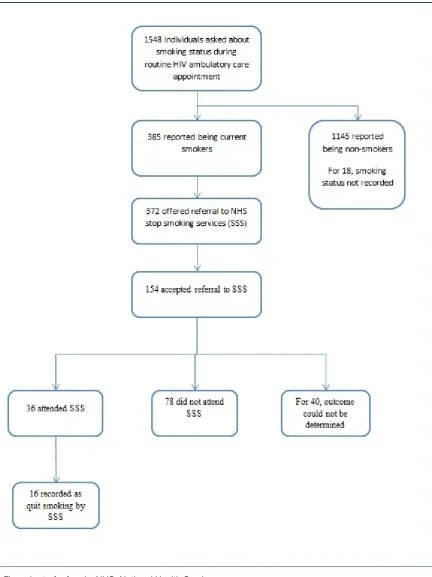
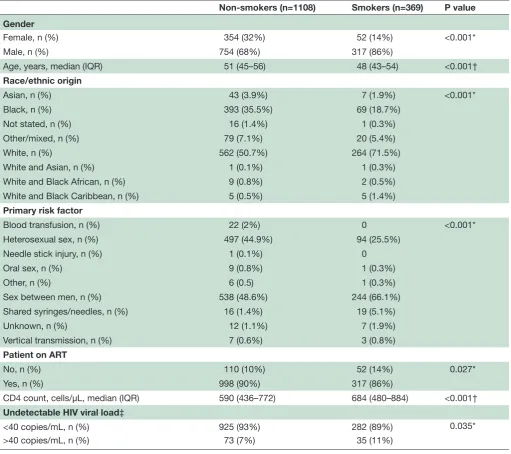
Between October 2014 and October 2015, 1548 HIV-posi-tive patients were asked about their smoking status, repre-senting 47% of the total population served by this HIV clinic. Of these, 385 (25%, 95% CI 23% to 27%) reported being current smokers, 1145 (74%, 95% CI 73% to 76%) being non-smokers and for 18 patients, smoking status was not recorded (figure 1). Patients who smoked were more likely to be male (86% vs 68%, p<0.001), slightly younger (median 48 vs 51 years, p<0.001), more often of White ethnicity (71% vs 51%, p<0.001) and more likely to have acquired HIV through sex between men (66% vs 49%, p<0.001) than non-smokers (table 1). Among those using ART, patients who smoked were more likely to have a detectable HIV viral load than those who did not (11% vs 7%, p=0.03).
Of the 385 people identified as current smokers, 372 (97%) were given VBA regarding smoking cessation and offered referral to smoking cessation services. A total of 154 (40%) of the 372 accepted this referral. There were no significant differences in the age, gender, route of transmission, blood CD4 T-cell count or levels of HIV suppression between those who did and did not accept referral to smoking cessation services. Individuals with a new diagnosis of HIV infection and those transferring their care from another HIV service were specifically evaluated; of the 25 individuals in this group who were offered referral to smoking cessation, 10 (44%) accepted this.
To allow for system delays, after a minimum of 3 months from when the referral was sent, we contacted the local smoking cessation clinics to determine the outcome of referrals. We were able to establish this in 114 (74%) of the 154 individuals referred. A total of 36 (32%) were recorded as having attended the smoking cessation clinic and 16 (14%) as having quit smoking; this, therefore, represents 4% of all smokers identified by the inter-vention. Of the 16 who quit, 10 did so after attending an NHS stop smoking clinic, 2 attended a pharmacy smoking cessation service and 4 quit without any addi-tional specific assistance.
cost and yield of the intervention
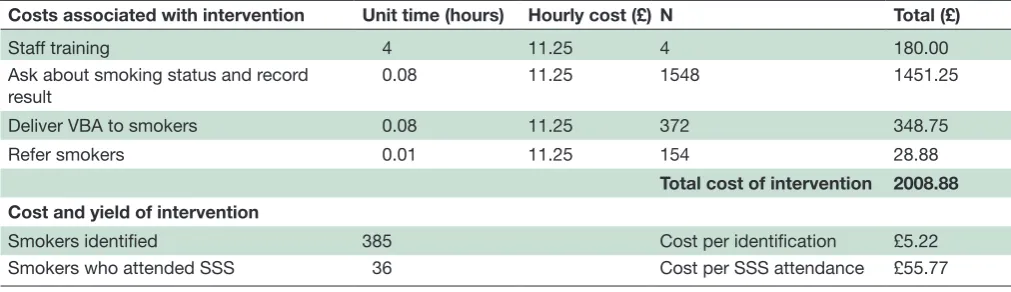
The estimated total cost to HIV care services of providing this additional intervention was estimated to be £2008, based on training three HCAs to deliver VBA, an additional 5 min
copyright.
on September 18, 2020 by guest. Protected by
Figure 1 Flow chart of referrals. NHS, National Health Service.
when taking routine observations to establish and record smoking status and 6 min to deliver VBA for smokers and make referrals to stop smoking services (table 2). Under these conditions, the estimated costs were, therefore, £5.22 for each smoker identified and £55.77 for each individual who attended stop smoking services.
DIscussIon
The harms of smoking and the beneficial effects of smoking cessation on health are well-established. All healthcare staff coming into contact with patients at risk have a role to play in helping smokers to quit, mainly
copyright.
on September 18, 2020 by guest. Protected by
Table 1 Characteristics of smokers and non-smokers
Non-smokers (n=1108) Smokers (n=369) P value Gender
Female, n (%) 354 (32%) 52 (14%) <0.001*
Male, n (%) 754 (68%) 317 (86%)
Age, years, median (IQR) 51 (45–56) 48 (43–54) <0.001†
Race/ethnic origin
Asian, n (%) 43 (3.9%) 7 (1.9%) <0.001*
Black, n (%) 393 (35.5%) 69 (18.7%)
Not stated, n (%) 16 (1.4%) 1 (0.3%)
Other/mixed, n (%) 79 (7.1%) 20 (5.4%)
White, n (%) 562 (50.7%) 264 (71.5%)
White and Asian, n (%) 1 (0.1%) 1 (0.3%)
White and Black African, n (%) 9 (0.8%) 2 (0.5%)
White and Black Caribbean, n (%) 5 (0.5%) 5 (1.4%)
Primary risk factor
Blood transfusion, n (%) 22 (2%) 0 <0.001*
Heterosexual sex, n (%) 497 (44.9%) 94 (25.5%)
Needle stick injury, n (%) 1 (0.1%) 0
Oral sex, n (%) 9 (0.8%) 1 (0.3%)
Other, n (%) 6 (0.5) 1 (0.3%)
Sex between men, n (%) 538 (48.6%) 244 (66.1%)
Shared syringes/needles, n (%) 16 (1.4%) 19 (5.1%)
Unknown, n (%) 12 (1.1%) 7 (1.9%)
Vertical transmission, n (%) 7 (0.6%) 3 (0.8%)
Patient on ART
No, n (%) 110 (10%) 52 (14%) 0.027*
Yes, n (%) 998 (90%) 317 (86%)
CD4 count, cells/µL, median (IQR) 590 (436–772) 684 (480–884) <0.001†
Undetectable HIV viral load‡
<40 copies/mL, n (%) 925 (93%) 282 (89%) 0.035*
>40 copies/mL, n (%) 73 (7%) 35 (11%)
Analysis restricted to 1108 non-smokers and 369 smokers identified in the clinical database. *2 test.
†Mann-Whitney U test.
‡Only data from individuals using ART. ART, antiretroviral therapy.
through triggering quit attempts by asking about smoking, delivering VBA on smoking and referring to stop smoking services.
The simple intervention of asking HIV-positive people about smoking when they attended HIV ambulatory care appointments and offering referral to stop smoking services to identified people who were current smokers, allowed VBA advice to be given and 40% of smokers accepted referral to smoking cessation services. This suggests that this intervention was acceptable to people with HIV and there is a demand for such services.
As with other interventions attempting to increase uptake of stop smoking services,13 most individuals offered
referral did not take this up. The model of service provi-sion in which dedicated smoking cessation services are not provided within HIV care, but instead individuals are referred to local services or primary care (depending on local commissioning decisions) may represent a barrier to their uptake for PLWH. Specifically targeted inter-ventions in other groups with high smoking prevalence or risk of harm from smoking, such as individuals with peripheral vascular disease,14 diabetes15 or mental health problems,16 have been shown to improve uptake of stop smoking services. We believe that interventions tailored to the needs of PLWH should be evaluated. These might include personalised information about risk of harm from
copyright.
on September 18, 2020 by guest. Protected by
Table 2 Cost and yield of intervention
Costs associated with intervention Unit time (hours) Hourly cost (£) N Total (£)
Staff training 4 11.25 4 180.00
Ask about smoking status and record result
0.08 11.25 1548 1451.25
Deliver VBA to smokers 0.08 11.25 372 348.75
Refer smokers 0.01 11.25 154 28.88
Total cost of intervention 2008.88
Cost and yield of intervention
Smokers identified 385 Cost per identification £5.22
Smokers who attended SSS 36 Cost per SSS attendance £55.77
SSS, stop smoking services; VBA, very brief advice.
smoking,13 better communication between HIV care and stop smoking services or minimising barriers to access to such services within HIV care.
In the UK NHS setting, smoking cessation services have been shown to be cost-effective.17 The cost associated with the brief intervention we evaluated (estimated to be £55.77 for each person attending stop smoking clinic) was similar to that estimated in an evaluation by Wu et al of a personalised invitation from primary care to stop smoking clinic and appointment for a taster session, with an estimated mean cost of £54 per person. This was found to be cost-effective from an NHS perspective in the long-term.18 Although few studies have comprehensively eval-uated the economic impact of smoking cessation across a lifetime, available data suggest that there may be net savings from investing in smoking cessation.19 How this differs in HIV-positive groups in resource-rich settings has not been formally assessed, though the higher prev-alence of smoking and greater risk of smoking-related illness is likely to increase these benefits—suggesting that this is a population who should be targeted specifically within smoking cessation policy.
The current means by which smoking cessation inter-ventions are delivered, with few formalised links between HIV and smoking cessation services, may not be suited to the medical, social and psychological needs of PLWH. As a consequence, HIV services could miss this important oppor-tunity to improve health outcomes. Alternative models of care, for instance, facilitating communication between services, training of HIV care providers to deliver smoking cessation assistance or specialist services directly linked to HIV care, should be evaluated. More importantly, asking about smoking and helping smokers to quit must become a core part of the care provided by all healthcare profes-sionals involved with PLWH. Such an approach (described as ‘Making Every Contact Count’) can be a powerful means of generating lifestyle and behaviour change.20
The provision of smoking cessation interventions by the health service in England and Wales has under-gone significant changes in recent years: responsibility for preventative public health interventions has moved from healthcare services to local authorities following
the Health and Social Care Act 2012. Funding provided to local authorities from central government for public health interventions has subsequently been reduced and smoking cessation services have been one of the targets for cuts.21 At the same time, changes, such as the increased availability of e-cigarettes, have altered the way that some people consume nicotine and may be a means for some individuals to stop smoking, although this remains controversial.22 These changes have been associated with a significant reduction in the number of people accessing NHS stop smoking services.23 Within this changing landscape, HIV services must ensure that appropriate support for their patients is available.
This analysis has limitations which should be considered. Data collection was undertaken as part of clinical service evaluation and for a proportion of referrals made to stop smoking services so we could not establish the outcome of the referral, either because the service had no record of the referral or its outcome, or the smoking cessation service had been decommissioned since the time of referral. This illus-trates the current deficiencies in communication between HIV and local smoking cessation services and the reduc-tion in provision of universal smoking cessareduc-tion services in the UK, as documented by recent national surveys.24 The proportion of HIV-positive individuals identified as current smokers by this intervention (25%) is lower than that found in other recent studies of PLWH in London, where around 30% were current smokers3 8—suggesting that not all smokers disclosed this when asked. Finally, the identifi-cation of smokers relied on self-report, rather than being objectively confirmed (for instance with exhaled carbon monoxide measurements) and no objective measurement of quit rates (such as saliva cotinine levels) was performed. Despite these limitations, we believe that our report describing the potential benefit of low-cost smoking cessa-tion intervencessa-tions for the UK HIV-positive populacessa-tions and the difficulties highlighted in the management of those smokers who wish to quit highlights the need for joined-up working to improve personal and public health within the NHS.
copyright.
on September 18, 2020 by guest. Protected by
contributors JB and ML conceived of the study and led the data analysis. CK, EP, KE and HJ completed data collection. NS, AM, EP and JF collated and analysed data regarding referrals to smoking cessation clinic. AB, JF, AR, ML and JB conducted data analyses. All the authors were involved in the preparation of the manuscript for submission.
Funding This work was partly supported by funding from a Gilead Fellowship Programme grant.
competing interests None declared.
Patient consent for publication Not required.
ethics approval This manuscript describes the results of a quality improvement project undertaken within clinical services for which no additional data were collected beyond that collected for clinical purposes. This, therefore, was exempt from the need for research ethics service approval.
Provenance and peer review Not commissioned; externally peer reviewed.
open access This is an open access article distributed in accordance with the Creative Commons Attribution Non Commercial (CC BY-NC 4.0) license, which permits others to distribute, remix, adapt, build upon this work non-commercially, and license their derivative works on different terms, provided the original work is properly cited, appropriate credit is given, any changes made indicated, and the use is non-commercial. See: http:// creativecommons. org/ licenses/ by- nc/ 4. 0/.
orcID iD
James Brown http:// orcid. org/ 0000- 0002- 2820- 5847
RefeRenCes
1. Jha P. Avoidable deaths from smoking: a global perspective. Public Health Rev 2011;33:569–600.
2. Helleberg M, Afzal S, Kronborg G, et al. Mortality attributable to smoking among HIV-1-infected individuals: a nationwide, population-based cohort study. Clin Infect Dis 2013;56:727–34. 3. Miners A, Phillips A, Kreif N, et al. Health-related quality-of-life of
people with HIV in the era of combination antiretroviral treatment: a cross-sectional comparison with the general population. Lancet HIV
2014;1:e32–40.
4. Katz MH. If we are smart enough to stop HIV from replicating, why can't we help people to stop smoking? JAMA Intern Med
2017;177:1622.
5. Triant VA, Grinspoon SK. Epidemiology of ischemic heart disease in HIV. Curr Opin HIV AIDS 2017;12:540–7.
6. Brown J, Roy A, Harris R, et al. Respiratory symptoms in people living with HIV and the effect of antiretroviral therapy: a systematic review and meta-analysis. Thorax 2016.
7. Altekruse SF, Shiels MS, Modur SP, et al. Cancer burden attributable to cigarette smoking among HIV-infected people in North America.
AIDS 2017.
8. Brown JMJ, Chouial H, Capocci S, et al. Impaired respiratory health status in UK HIV positive adults with high uptake of antiretroviral therapy. HIV Med. In Press 2017.
9. West R, Coyle K, Owen L, et al. Estimates of effectiveness and reach for 'return on investment' modelling of smoking cessation interventions using data from England. Addiction 2018;113(Suppl 1):19–31.
10. West R, May S, West M, et al. Performance of English stop smoking services in first 10 years: analysis of service monitoring data. BMJ
2013;347:f4921.
11. Vidrine DJ, Frank SG, Savin MJ, et al. Hiv care initiation: a teachable moment for smoking cessation? Nicotine Tob Res 2018;20:1109–16. 12. NCSCT. Available: http://www. ncsct. co. uk/
13. Gilbert H, Sutton S, Morris R, et al. Effectiveness of personalised risk information and taster sessions to increase the uptake of smoking cessation services (Start2quit): a randomised controlled trial. The Lancet 2017;389:823–33.
14. Newhall K, Suckow B, Spangler E, et al. Impact and duration of brief surgeon-delivered smoking cessation advice on attitudes regarding nicotine dependence and tobacco harms for patients with peripheral arterial disease. Ann Vasc Surg 2017;38:113–21.
15. Nagrebetsky A, Brettell R, Roberts N, et al. Smoking cessation in adults with diabetes: a systematic review and meta-analysis of data from randomised controlled trials. BMJ Open 2014;4:e004107. 16. Barnett PG, Wong W, Jeffers A, et al. Cost-effectiveness of smoking
cessation treatment initiated during psychiatric hospitalization: analysis from a randomized, controlled trial. J Clin Psychiatry
2015;76:e1285–91.
17. Parrott S, Godfrey C, Raw M, et al. Guidance for commissioners on the cost effectiveness of smoking cessation interventions. health educational authority. Thorax 1998;53(Suppl 5 Pt 2):S1–38. 18. Wu Q, Gilbert H, Nazareth I, et al. Cost-effectiveness of personal
tailored risk information and taster sessions to increase the uptake of the NHS stop smoking services: the Start2quit randomized controlled trial. Addiction 2018;113:708–18.
19. Rasmussen SR, Prescott E, Sørensen TIA, et al. The total lifetime health cost savings of smoking cessation to society. Eur J Public Health 2005;15:601–6.
20. NHS Health Education England. Available: http://www. maki ngev eryc onta ctcount. co. uk/ [Accessed 22 Feb 2018].
21. Fund TK. Chickens coming home to roost: local government public health budgets for 2017/18, 2017. Available: https://www. kingsfund. org. uk/ blog/ 2017/ 07/ local- government- public- health- budgets- 2017- 18
22. Hartmann-Boyce J, McRobbie H, Bullen C, et al. Electronic cigarettes for smoking cessation. Cochrane Database of Systematic Reviews 2016;11.
23. Iacobucci G. Number of people using NHS stop smoking services continues to fall. BMJ 2017;358.
24. UK CR. Feeling the heat: the decline of smoking cessation services in England, findings from a survey of local authority tobacco control leads. London, 2018.
copyright.
on September 18, 2020 by guest. Protected by