Open Access
R E S E A R C H A R T I C L E
Bio
Med
Central
© 2010 Delanaye et al; licensee BioMed Central Ltd. This is an Open Access article distributed under the terms of the Creative CommonsAttribution License (http://creativecommons.org/licenses/by/2.0), which permits unrestricted use, distribution, and reproduction in any medium, provided the original work is properly cited.Research article
MDRD or CKD-EPI study equations for estimating
prevalence of stage 3 CKD in epidemiological
studies: which difference? Is this difference
relevant?
Pierre Delanaye*
1, Etienne Cavalier
2, Christophe Mariat
3, Nicolas Maillard
3and Jean-Marie Krzesinski
1Abstract
Background: Prevalence of stage 3 chronic kidney disease (CKD) is increasing according to the NHANES study. Prevalence has been calculated using the MDRD study equation for estimating glomerular filtration rate (GFR). Recently, a new estimator based on creatinine, the CKD-EPI equation, has been proposed which is presumed to better perform in normal GFR ranges. The aim of the study was to measure the difference in prevalence of stage 3 CKD in a population using either the MDRD or the CKD-EPI study equations.
Methods: CKD screening is organized in the Province of Liège, Belgium. On a voluntary basis, people aged between 45 and 75 years are invited to be screened. GFR is estimated by the MDRD study equation and by the "new" CKD-EPI equations.
Results: The population screened consisted in 1992 people (47% of men). Mean serum creatinine was 0.86 ± 0.20 mg/ dL. The prevalence of stage 3 CKD in this population using the MDRD or the CKD-EPI equations was 11.04 and 7.98%, respectively. The prevalence of stage 3 CKD is significantly higher with the MDRD study equation (p < 0,0012).
Conclusions: Prevalence of stage 3 CKD varies strongly following the method used for estimating GFR, MDRD or CKD-EPI study equations. Such discrepancies are of importance and must be confirmed and explained by additional studies using GFR measured with a reference method.
Background
Prevalence of end-stage renal failure is increasing in Western Countries [1] even if this fact has been recently questioned [2]. In this context, prevention of chronic kid-ney disease (CKD) is of importance [3]. The first step for efficient prevention is an early diagnosis. However, serum creatinine is of limited value for such a task, as it is classi-cally known that creatinine will rise over normal values only when 50% of glomerular filtration rate (GFR) have already been lost [4,5]. This creatinine lack of sensitivity is especially due to its relationship with muscular mass and will be noted particularly in population with lower muscular mass, notably the older population [4,6]. Sev-eral authors have proposed creatinine-based equation to
improve GFR estimation. The MDRD study equation is one of the most used for this purpose [7]. So, epidemio-logical data have shown that nearly 10% of the population in the USA has stage 3 CKD or worse, defined as esti-mated GFR lower than 60 mL/min/1.73 m2 with the
MDRD study equation [1]. However, we and others have underlined that MDRD equation is not accurate and especially not precise for the estimation of GFR in healthy population and, more obviously, when it is applied to nor-mal creatinine values [2,8,9]. There are several good rea-sons to believe that MDRD study equation underestimates GFR (and thus overestimate CKD preva-lence) in these populations with normal or near-normal creatinine values [2,10,11].
According to these limitations, Levey's group who is already at the origin of the MDRD study equation has built a new creatinine-based equation from a large sam-* Correspondence: [email protected]
1 Department of Nephrology-Dialysis-Transplantation, University of Liège, CHU Sart Tilman, Liège, Belgium
ple of CKD and healthy subjects. This CKD-EPI study equation includes, in fact, four different equations follow-ing the sex and the ethnicity (Table 1) [12]. It seems thus interesting to evaluate the prevalence of CKD (defined as estimated GFR under 60 ml/min/1.73 m2) with the
MDRD study equation on one hand and with the CKD-EPI equation on the other hand.
Methods
This study has been approved by the Ethic Committee of our University Hospital. The Belgian number study is B70720071509. This prospective study was driven in the context of the CKD screening program organized by the Province of Liège's Health deputation. Province of Liège is one of the ten provinces in Belgium. Its area is 3862 km2 and its population from 2005 data has been
calcu-lated to reach a total of 1.037.161 inhabitants. The CKD screening is organized by a medical bus that travels through the 84 communes of that Province. On a volun-tary basis, people aged over 45 years are invited to be screened. All patients have been informed and have signed informed consent. Data have been anonymously analyzed. Blood samples and anthropometrical data are collected and a short interview is done. Between June 2008 and April 2009, frozen blood samples were sent to the Clinical Chemistry laboratory of the University of Liège where they were immediately thawed and assayed. Serum creatinine was measured by the IDMS traceable Jaffé method from Roche (compensated Jaffé, Roche Diagnostics, Mannheim, Germany) on Modular [13,14]. Our university laboratory is currently accredited against the ISO 15189 Standard. As our creatinine is IDMS trace-able, the new "175" MDRD study equation was used [7].
All results are expressed as mean ± SD. We have calcu-lated and compared the percentage of patients with stage 3 CKD or worse obtained with the two equations, but also the coefficients of correlation between the different equations. Agreement between equations to discriminate GFR over and less than 60 mL/min/1.73 m2 has been
evaluated by Kappa statistics.
The results of GFR estimated by the MDRD study and the CKD-EPI equations have also been compared by Bland and Altman analysis [15]. In these analyses, we have arbitrarily chosen the MDRD study equation results as the referent. Bias between equations was defined as the mean of the differences. The SD around the mean reflected the dispersion and the precision of the equa-tions. P < 0.05 was considered as significant. We have also evaluated if difference between equations might be corre-lated to variables such as age, sex, creatinine or estimated GFR levels. We also repeated Bland and Altman analysis in subgroups according to sex and level of estimated GFR (over or below 60 ml/min/1.73 m2). All analyses were
per-formed using MedCalc® (MedCalc Software, Mariakerke,
Belgium).
Results
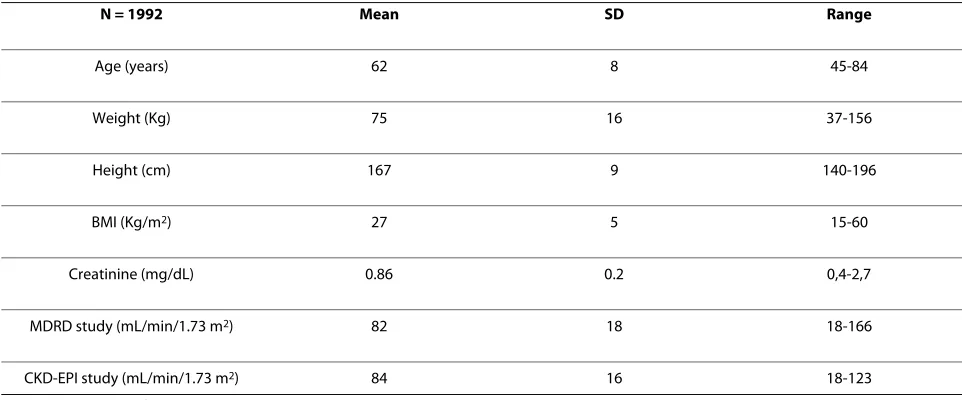
During the study period, 1992 people were screened (47% male and 53% women). Anthropometric, clinical and bio-logical characteristics of the global population are shown in Table 2. By paired samples t-test, the estimated GFR by the MDRD and the CKD-EPI study equations were differ-ent from each other (p < 0.0001). Prevalence of stage 3 CKD when GFR was estimated by the MDRD equation study was 11.04% (n = 220). This prevalence was signifi-cantly and strongly higher than the prevalence obtained when the CKD-EPI study equation which was 7.98% (n = 159)(p = 0.0012). However, Kappa statistics showed very good agreement between the two equations (κ = 0.82).
Results given by the two equations were highly corre-lated (p < 0.0001)(r = 0,93).
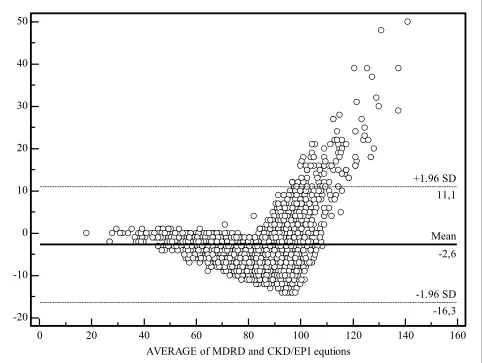
The Bland and Altman analysis results are summarized in Figure 1. The mean difference between the MDRD study and the CKD-EPI equation was -2.6 ± 7 mL/min/ 1.73 m2.
By multinear regression analysis, difference between MDRD and CKD-EPI results was dependent upon age (the greater the age, the greater the difference, r = 0.4, p < 0.0001) and creatinine concentration (the lower the crea-tinine, the greater the difference, r = -0.2, p < 0.0001).
Two subgroups analyses were conducted following sex and estimated GFR. If we restricted analysis to estimated GFR under 60 mL/min/1.73 m2 (with the MDRD study
equation)(n = 220), the paired samples t-test still showed significant difference between the estimated GFR by the MDRD and the CKD-EPI study equations (p < 0.0001). Of course, this is still the case when results over 60 mL/
Table 1: Creatinine- (SCr; mg/dL) based equations for glomerular filtration rate (GFR) estimation.
4-variable MDRD Study equation
GFR (mL/min/1.73 m2) = 175 × SCr -1.154 × Age -0.203 × 0.742 (if
woman) × 1.21 (if black)
CKD-EPI Study equation (white subjects)
If woman:
if creatinine < 0.7 mg/dL:
GFR (mL/min/1.73 m2) = 144 × SCr/0.7 -0.329 × 0.993age
if creatinine > 0.7 mg/dL:
GFR (mL/min/1.73 m2) = 144 × SCr/0.7 -1.209 × 0.993age
If man:
if creatinine < 0.9 mg/dL:
GFR (mL/min/1.73 m2) = 141 × SCr/0.9 -0.411 × 0.993age
if creatinine > 0.9 mg/dL:
min/1.73 m2 were analyzed (n = 1772). The results of the
Bland and Altman analyses were more interesting. Indeed, the mean difference between the MDRD study and the CKD-EPI equation was -2.3 ± 1.9 mL/min/1.73 m2 and -2.7 ± 7.4 mL/min/1.73 m2 when analysis
con-cerned estimated GFR under and over 60 mL/min/1.73 m2, respectively. If the bias was equivalent in these two
subgroups, deviation around the bias was significantly lower in the subgroup with estimated GFR less than 60 mL/min/1.73 m2 compared to global population or the
subgroup with GFR higher than 60 mL/min/1.73 m2
(F-test, p < 0,001).
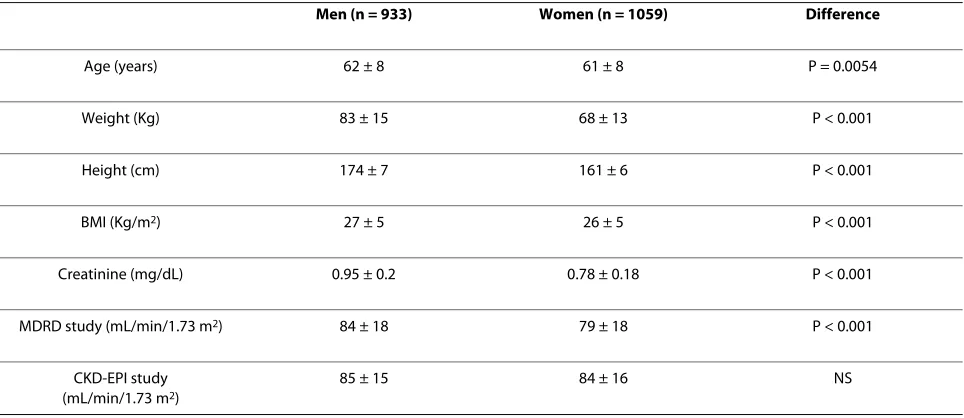
Anthropometrical and biological values were different between men and women, as it was illustrated in Table 3. Only, the mean results of the CKD-EPI equations were not different between men and women. Kappa statistics showed very good agreement between the two equations but agreement seemed slightly better for men than for women (κ = 0.92 and 0.76, respectively). The mean differ-ence between the MDRD study and the CKD-EPI equa-tion was -0.8 ± 7 mL/min/1.73 m2 and -4.4 ± 6.5 mL/min/
1.73 m2 when analysis concerned men and women,
respectively. The difference between these last results was highly significant (p < 0.0001). In the same way, prev-alence of stage 3 CKD in men was 8.47% and 7.29% with the MDRD and the CKD-EPI equations, respectively (non significant difference). In women, prevalence of stage 3 CKD was highly different using either the MDRD or the CKD-EPI equations (13.31% versus 8.59%, p = 0.0007).
Discussion
Epidemiologic studies in different Western countries have recently shown that prevalence of CKD, defined as
GFR under 60 mL/min/1.73 m2, is about 10% in the global
population [1,16]. These data have been obtained with the MDRD study equation using a well calibrated serum creatinine [17,18]. However, the use of this equation is not free from criticisms. We, and others, have demon-strated that this equation tends to strongly underestimate GFR in healthy populations and, more generally, in patients with normal or near normal creatinine values [2,10,11,19]. Admitting this fact, the Levey's group has recently proposed a new equation which is thought to be especially better in the higher GFR range (over 60 ml/ min/1.73 m2). In this view, the new CKD-EPI equations
are different following the creatinine value (0.7 mg/dL for the women and 0.9 mg/dL for the men). This adaptation seems logical as relationship between GFR and creatinine is different in healthy as compared to CKD subjects. The better accuracy of the new equation is also certainly explained by the authors because the inclusion of healthy subjects in the equations development study (13% i.e. 694 healthy kidney donors). Logically, using the new CKD-EPI equations, the prevalence of stage 3 CKD in our pop-ulation is significantly lower than if the MDRD study equation is used (7.98% versus 11.04%). Over 1992 patients screened, 61 (3.06%) were classified as having stage 3 CKD with the MDRD study equation compared to the CKD-EPI study equation. These data are not negligi-ble from an epidemiological point of view.
Differences between MDRD and CKD-EPI equations are especially larger for the highest estimated GFR values. If we arbitrary fix a limit of 60 ml/min/1.73 m2 estimated
by the MDRD study equations, differences between the two equations are significantly higher for the values over than below 60 ml/min/1.73 m2 (-2.3 ± 1.9 versus -2.7 ± 7.4
ml/min/1.73 m2, respectively). These differences are
logi-Table 2: Anthropometrical and biological description of the population (n = 1992).
N = 1992 Mean SD Range
Age (years) 62 8 45-84
Weight (Kg) 75 16 37-156
Height (cm) 167 9 140-196
BMI (Kg/m2) 27 5 15-60
Creatinine (mg/dL) 0.86 0.2 0,4-2,7
MDRD study (mL/min/1.73 m2) 82 18 18-166
CKD-EPI study (mL/min/1.73 m2) 84 16 18-123
cal according to differences between equations. More astonishing is the difference observed in subgroup analy-sis according to gender. The difference between the two equations seems more impressive in women than in men. This is not explained by the GFR level or age as women have higher mean GFR and are younger (see below for the age effect). This difference could be explained by the lower cut-off chosen in women for the CKD-EPI equa-tions. As relationship between creatinine and GFR is exponential, it could be logical that consequences on dif-ference results between the two equations are more important in women. Nevertheless, more studies in the future are needed to explain such discrepancies between estimators regarding to gender because, obviously, one of the two equations is especially inaccurate in women.
In their presenting CKD-EPI article, Levey et al have also compared prevalence of CKD in the NHANES study. If we consider the same definition of stage 3 CKD, these
authors have found that prevalence of CKD in the NHANES study was 9.88% with the CKD-EPI equation and 10.82% with the MDRD study equations (Appendix Table 6 in [12]). Difference in prevalence is more impres-sive in our own study. One explanation could be the higher mean age in our population. Indeed, one major difference between the two equations is the "age factor". In the MDRD study equation, a constant exponent is applied to age (age-0.203) whereas age is an exponent in the
CKD-EPI equation (0.993age). Indeed, we find a
signifi-cant correlation between age and difference between MDRD and CKD-EPI results (regression coefficient of 0.39 in multiple regression analysis). However, even if the MDRD study equation's performance in older population remains controversial [20,21], the performance of the CKD-EPI equation in patients or subjects over 70 years old has not been studied (only 3% of patients between 70 and 75 years old in development data of the CKD-EPI
Figure 1 Bland and Altman analysis between the MDRD study equation and the new CKD-EPI equations. The continuous line represents the mean difference between estimated GFRs, whereas the dashed lines represent the limits of agreement (mean difference ± 2SD). All values are ex-pressed in mL/min/1.73 m2.
0
20
40
60
80
100
120
140
160
50
40
30
20
10
0
-10
-20
AVERAGE of MDRD and CKD/EPI equtions
Mean
-2,6
equations study). Discrepancy between our results and NHANES study results could also be the result of poten-tial anthropometrical differences between American and European populations.
The new CKD-EPI equation is certainly interesting and its performance will probably be better than the MDRD study equation in population free from renal disease. Yet, some limitations may be advanced. Firstly, the choice of the creatinine cut-off is logically different according to sex (0.9 mg/dL for men and 0.7 mg/dL for women). How-ever, it would be also logical that equations vary with age as relationship between creatinine levels is also strongly influenced by age [4]. Secondly, we underline, once again, the lack of data regarding older patients (more than 70 years old) that are clearly underrepresented in the CKD-EPI study. Thirdly, we have recently criticized the way the new "IDMS" traceable MDRD and more precisely the fac-tor 175 has been obtained to make results IDMS trace-able [9,10]. This criticism is also valid for the CKD-EPI equation because serum creatinine measurements from the development data are coming from studies (MDRD and AASK for example) where creatinine had been mea-sured with Jaffé methods. So, from our point of view, the factors used in the CKD-EPI equations (144 for women and 141 for men) are too low inducing a systematic over-estimation of CKD prevalence. Lastly, the major criticism for the new CKD-EPI equations is its lack of advantage regarding its precision in estimating GFR. Indeed, in the Levey study, if for subjects with GFR over 60 ml/min/1.73 m2, the bias with measured GFR is improved when using
the CKD-EPI equations as compared to the MDRD equa-tion (median difference of 3.5 versus 10.6 mL/min/1.73 m2), however, the precision of the CKD-EPI equation in
the same range of GFR doesn't appear better (and even seems slightly worse) than those of the MDRD (precision is reflected by interquartile range for differences: 25.7
versus 24.2 mL/min/1.73 m2, respectively) [12]. So, if GFR
estimation by CKD-EPI equation has an improved sys-tematic bias and accuracy, this equation does not improve the precision of the estimation. This is disap-pointing but not astonishing as bias is, by nature, system-atic although precision is random and especially linked to the precision of the creatinine measurement. The latter is not improved in the CKD-EPI equation in comparison with the MDRD equation (as already mentioned, creati-nine has been measured with Jaffé methods) [8,9].
There are some limitations to our study. First, the main limitation is linked to the fact that we have not measured GFR with a reference method. So, even if we have indirect arguments to affirm that MDRD study equations overes-timate CKD prevalence in global populations, such an assertion can only be checked if a reference method GFR is used. Our data only underline potential strong discrep-ancies between results in epidemiological studies when either the MDRD or the CKD-EPI study equations are used. Epidemiological studies on renal function in the global population are still urgently waited but it repre-sents heavy work. Second, our stage 3 CKD prevalence data are of interest only because they illustrate these dis-crepancies. As our population is clearly not representa-tive of the Belgian population (because only volunteers are included), our stage 3 CKD prevalence results must not be considered for epidemiological considerations. For this reason, data regarding proteinuria or hypertension status that are lacking in this study are of relatively poor interest in our study. Third, we have no data on the
eth-Table 3: Anthropometrical and biological description of the population according to gender.
Men (n = 933) Women (n = 1059) Difference
Age (years) 62 ± 8 61 ± 8 P = 0.0054
Weight (Kg) 83 ± 15 68 ± 13 P < 0.001
Height (cm) 174 ± 7 161 ± 6 P < 0.001
BMI (Kg/m2) 27 ± 5 26 ± 5 P < 0.001
Creatinine (mg/dL) 0.95 ± 0.2 0.78 ± 0.18 P < 0.001
MDRD study (mL/min/1.73 m2) 84 ± 18 79 ± 18 P < 0.001
CKD-EPI study (mL/min/1.73 m2)
85 ± 15 84 ± 16 NS
nicity. As the ethnicity factor varies following the equa-tions, this could be source of bias. However, in Belgium, Caucasians are, from far, the dominant ethnic group. Moreover, there is little doubt that differences observed in our study are not due to the ethnic factor (1.21 in the MDRD study equation and 1.16 in the CKD-EPI equa-tions). Four, like in several epidemiological studies, our subjects have been tested only once, although definition of CKD sensu stricto implies that two or three testing have been undertaken over a three months period. Last, we have defined CKD as GFR less than 60 mL/min/1.73 m2. The definition of CKD is however subject of debate,
notably in elderly population [2,22]. Whatever, our data do not permit to bring to close this debate.
Conclusions
The present study has illustrated large discrepancies observed in the prevalence of stage 3 CKD in a popula-tion according to the method used for estimating GFR. These differences seem especially relevant in women, older and subjects with estimated GFR over 60 ml/min/ 1.73 m2. We have argument to disfavour MDRD study
equations in epidemiological studies but it must not be concluded that the CKD-EPI equations is absolutely free from criticisms. For example, we have recently illustrated discrepancies in CKD prevalence using either the MDRD and the cystatin C-based equations [8,23]. We have also strong discrepancies between CKD prevalence using either CKD-EPI or the cystatine C-based equations (in our population, prevalence of stage 3 CKD with the Levey cystatin C-based equations (GFR = 76.7 × CC (mg/L) -1.19) is as low as 1.1%, data not detailed). More studies are
urgently needed to confirm and explain these discrepan-cies. Epidemiological population studies using GFR mea-surements with a reference method are, once again, urgently required.
Abbreviations
CKD: chronic kidney disease; GFR: glomerular filtration rate; SCr: serum creati-nine.
Competing interests
The authors declare that they have no competing interests. Authors' contributions
PD is the principal investigator and the first author of this manuscript. EC is the Biochemist who has measured serum creatinine. CM and NM have analyzed the data. JMK has critically corrected the manuscript as the Chief of the Depart-ment of Nephrology. All authors have read and approved the final manuscript Acknowledgements
We want to thank Mrs Rosalie Bonmariage for her help in the redaction of this manuscript. We want to thank Mr G. Pire, Deputy of the Health Department of the Province of Liège, and Dr Ph. Maasen. We also thank the Guy Mathot's foundation and our data nurses Michèle Focan and Marie-Antoinette Graceffa for their great help.
Author Details
1Department of Nephrology-Dialysis-Transplantation, University of Liège, CHU Sart Tilman, Liège, Belgium, 2Department of Clinical Chemistry, University of Liège, CHU Sart Tilman, Liège, Belgium and 3Department of Nephrology, Dialysis and Transplantation, University of Etienne, Hopital Nord, Saint-Etienne, France
References
1. Coresh J, Selvin E, Stevens LA, Manzi J, Kusek JW, Eggers P, Van Lente F, Levey AS: Prevalence of chronic kidney disease in the United States.
JAMA 2007, 298:2038-2047.
2. Glassock RJ, Winearls C: An epidemic of chronic kidney disease: fact or fiction? Nephrol Dial Transplant 2008, 23:1117-1121.
3. Hallan SI, Vikse BE: Relationship between chronic kidney disease prevalence and end-stage renal disease risk. Curr Opin Nephrol Hypertens 2008, 17:286-291.
4. Perrone RD, Madias NE, Levey AS: Serum creatinine as an index of renal function: new insights into old concepts. Clin Chem 1992, 38:1933-1953. 5. Petri M, Bockenstedt L, Colman J, Whiting-O'Keefe Q, Fitz G, Sebastian A,
Hellmann D: Serial assessment of glomerular filtration rate in lupus nephropathy. Kidney Int 1988, 34:832-839.
6. Lamb EJ, O'Riordan SE, Delaney MP: Kidney function in older people: pathology, assessment and management. Clin Chim Acta 2003, 334:25-40.
7. Levey AS, Coresh J, Greene T, Stevens LA, Zhang YL, Hendriksen S, Kusek JW, Van Lente F: Using standardized serum creatinine values in the modification of diet in renal disease study equation for estimating glomerular filtration rate. Ann Intern Med 2006, 145:247-254. 8. Delanaye P, Cavalier E, Krzesinski JM, Chapelle JP: Why the MDRD
equation should not be used in patients with normal renal function (and normal creatinine values)? Clin Nephrol 2006, 66:147-148. 9. Delanaye P, Cohen EP: Formula-based estimates of the GFR: equations
variable and uncertain. Nephron Clin Pract 2008, 110:c48-c53. 10. Delanaye P, Cavalier E, Maillard N, Krzesinski JM, Mariat C: Creatinine
calibration in NHANES: is a revised MDRD study formula needed? Am J Kidney Dis 2008, 51:709-710.
11. Delanaye P, Cavalier E, Krzesinski JM: Determining prevalence of chronic kidney disease using estimated glomerular filtration rate. JAMA 2008, 299:631.
12. Levey AS, Stevens LA, Schmid CH, Zhang YL, Castro AF III, Feldman HI, Kusek JW, Eggers P, Van Lente F, Greene T, Coresh J: A new equation to estimate glomerular filtration rate. Ann Intern Med 2009, 150:604-612. 13. Mazzachi BC, Peake MJ, Ehrhardt V: Reference range and method
comparison studies for enzymatic and Jaffe creatinine assays in plasma and serum and early morning urine. Clin Lab 2000, 46:53-55.
14. Vickery S, Stevens PE, Dalton RN, Van Lente F, Lamb EJ: Does the ID-MS traceable MDRD equation work and is it suitable for use with compensated Jaffe and enzymatic creatinine assays? Nephrol Dial Transplant 2006, 21:2439-2445.
15. Bland JM, Altman DG: Statistical methods for assessing agreement between two methods of clinical measurement. Lancet 1986, 1:307-310.
16. Hallan SI, Coresh J, Astor BC, Asberg A, Powe NR, Romundstad S, Hallan HA, Lydersen S, Holmen J: International comparison of the relationship of chronic kidney disease prevalence and ESRD risk. J Am Soc Nephrol
2006, 17:2275-2284.
17. Hallan S, Asberg A, Lindberg M, Johnsen H: Validation of the
Modification of Diet in Renal Disease formula for estimating GFR with special emphasis on calibration of the serum creatinine assay. Am J Kidney Dis 2004, 44:84-93.
18. Selvin E, Manzi J, Stevens LA, Van Lente F, Lacher DA, Levey AS, Coresh J: Calibration of serum creatinine in the National Health and Nutrition Examination Surveys (NHANES) 1988-1994, 1999-2004. Am J Kidney Dis
2007, 50:918-926.
19. Froissart M, Rossert J, Jacquot C, Paillard M, Houillier P: Predictive performance of the modification of diet in renal disease and Cockcroft-Gault equations for estimating renal function. J Am Soc Nephrol 2005, 16:763-773.
Received: 21 September 2009 Accepted: 1 June 2010 Published: 1 June 2010
This article is available from: http://www.biomedcentral.com/1471-2369/11/8 © 2010 Delanaye et al; licensee BioMed Central Ltd.
20. Lamb EJ, Webb MC, O'Riordan SE: Using the modification of diet in renal disease (MDRD) and Cockcroft and Gault equations to estimate glomerular filtration rate (GFR) in older people. Age Ageing 2007, 36:689-692.
21. Verhave JC, Fesler P, Ribstein J, du CG, Mimran A: Estimation of renal function in subjects with normal serum creatinine levels: influence of age and body mass index. Am J Kidney Dis 2005, 46:233-241. 22. Douville P, Martel AR, Talbot J, Desmeules S, Langlois S, Agharazii M:
Impact of age on glomerular filtration estimates. Nephrol Dial Transplant 2009, 24:97-103.
23. Delanaye P, Cavalier E, Saint-Remy A, Lutteri L, Krzesinski JM: Discrepancies between creatinine-based and cystatin C-based equations in estimating prevalence of stage 3 chronic kidney disease in an elderly population. Scand J Clin Lab Invest 2009, 69:344-349. Pre-publication history
The pre-publication history for this paper can be accessed here: http://www.biomedcentral.com/1471-2369/11/8/prepub
doi: 10.1186/1471-2369-11-8