R E S E A R C H A R T I C L E
Open Access
A descriptive analysis of the characteristics
and the peer review process of systematic
review protocols published in an open peer
review journal from 2012 to 2017
Tanja Rombey
1*, Katharina Allers
2, Tim Mathes
1, Falk Hoffmann
2and Dawid Pieper
1Abstract
Background:An a priori design is essential to reduce the risk of bias in systematic reviews (SRs). To this end, authors can register their SR with PROSPERO, and/or publish a SR protocol in an academic journal. The latter has the advantage that the manuscript for the SR protocol is usually peer-reviewed. However, since authors ought not to begin/continue the SR before their protocol has been accepted for publication, it is crucial that SR protocols are processed in a timely manner.
Our main aim was to descriptively analyse the peer review process of SR protocols published in‘BMC Systematic Reviews’from 2012 to 2017.
Methods:We systematically searched MEDLINE via PubMed for all SR protocols published in‘BMC Systematic Reviews’ between 2012 and 2017, except for protocols for overviews, scoping reviews or realist reviews. Data were extracted from the SR protocols and Open Peer Review reports. For each round of peer review, two researchers judged the extent of revision (minor/major) based on the reviewer reports. Their content was further investigated by two researchers in a random 10%-sample using PRISMA-P as a guideline. All data were analysed descriptively.
Results:We identified 544 eligible protocols published in‘BMC Systematic Reviews’between 2012 and 2017. Of those, 485 (89.2%) also registered the SR in PROSPERO, the majority (87.4%) before first submission of the manuscript for the SR protocol (median 49 days). The absolute number of published SR protocols increased from 2012 to 2017 (21 vs 145 protocols), as did the median processing time (61 vs 142 days from submission to acceptance) and the proportion of protocols requiring a major revision after first peer review (19.1% vs 52.4%). Reviewer comments most frequently addressed the PRISMA-P item‘Eligibility criteria’. Overall, 76.0% of the reviewer comments suggested more transparency. Conclusions:The number of published SR protocols increased over the years, but so did the processing time. In 2017, it took several months from submission to acceptance, which is critical from an author’s perspective. New models of peer review such as post publication peer review for SR protocols should be investigated. This could probably be realized with PROSPERO.
Keywords:Peer review, Protocol, Systematic review, Meta-analysis, PROSPERO
* Correspondence:[email protected]
1Institute for Research in Operative Medicine, Witten/Herdecke University,
Ostmerheimer Str. 200, 51109 Cologne, Germany
Full list of author information is available at the end of the article
Background
Systematic reviews (SRs) are conducted to inform clin-ical practice and decision-making by synthesising and contextualising all relevant evidence that is available re-garding a specific research question. Since SRs are typic-ally retrospective in nature [1], it is crucial that their methods, such as the in- and exclusion criteria, out-comes and analyses, are determined a priori, and that deviations from the proposed methods are being re-ported and justified [2]. Otherwise, methods might be modified post hoc according to the observed results, reflecting an arbitrary, not a systematic approach [3].
One way to establish one’s methods a priori is to de-velop a SR protocol, that is ‘[…] a document that pre-sents an explicit scientific ‘road map’ of a planned, uninitiated systematic review’ (p. 3) [4]. If SR protocols are publicly available, they can be compared with the completed SR to assess if deviations from planned methods occurred and whether these biased the results [5]. Some organisations, for example Cochrane [6], the Campbell Collaboration [7], and the Joanna Briggs Insti-tute [8], require that a SR protocol is published before the review is initiated, e.g. in the organisations’ own peer-reviewed journals. Apart from that, it is optional to publish a SR protocol in a peer-reviewed journal. How-ever, in a recent study, we showed that SRs with pub-lished protocols tend to be of higher reporting and methodological quality than SRs without published pro-tocols [9].
Authors can also register their SR free of charge with the International Prospective Register of Systematic Re-views, PROSPERO, to establish their methods a priori. To date, over 30,000 SRs are registered in PROSPERO [10]. Registration records are checked against the regis-try’s eligibility criteria after submission, but there are no further mechanisms of quality assurance (like peer re-view), leaving the authors responsible for the quality, ac-curacy and up-to-dateness of their record [11]. Nevertheless, like published protocols, PROSPERO re-cords can be used to assess if deviations from planned methods occurred.
Both, publishing protocols or registering SRs, helps to avoid unnecessary duplication as it allows other re-searchers to systematically search for them [12,13]. The advantage of publishing a protocol in an academic jour-nal compared to registration alone is that the manu-script for the SR protocol is usually peer-reviewed before publication. So, in addition to the editor, independent re-viewers critically appraise the proposed methods and the protocol’s completeness and transparency. This not only ensures the reporting quality of the SR protocol, but also the methodological quality of the planned SR.
A good peer review takes time. In the context of SR protocols, having a manuscript peer-reviewed means a
delay in the generation of new knowledge. This is be-cause it is not advisable for authors to begin or continue conducting their SR before the protocol has been ac-cepted for publication as changes to the planned methods (protocol amendments) may be required. A delay in the generation of new knowledge consequently causes a delay in the dissemination of new knowledge. This is costly for the research community and general public [14] and may even affect the author’s careers [15], hence why it is crucial that SR protocols are processed in a timely manner.
‘BMC Systematic Reviews’is an open peer review
jour-nal established in 2012. As we have recently shown, it is among the journals publishing the majority of SR proto-cols [9]. As the journal publishes both, SR protocols and completed SRs with findings, as well as other types of studies related to SRs [16], the peer review statistics published on the journal’s website do not tell us how long the peer review process takes for a SR protocol specifically.
Therefore, the aim of our study was to descriptively analyse the peer review process of SR protocols pub-lished in ‘BMC Systematic Reviews’ from 2012 to 2017. Furthermore, we descriptively analysed the characteris-tics of these protocols and present trends over time.
Methods Study design
This was a retrospective, observational study based on SR protocols published in‘BMC Systematic Reviews’and their Open Peer Review reports, which are all available in open access. There was no a priori study protocol for this study.
Search strategy
We searched for SR protocols published in ‘BMC
Sys-tematic Reviews’ in MEDLINE via PubMed (date of
search 8 January 2018) using the following strategy:
‘protocol AND syst rev [journal]’.
Eligibility criteria
We included all SR protocols that were labelled as such and published in‘BMC Systematic Reviews’up to and in-cluding 2017 regardless of their topic area. Protocols for overviews, scoping- or realist reviews as well as articles that were not SR protocols were excluded.
Data management and study selection
(DP) screened only the records excluded by the first re-searcher. Discrepancies were resolved by discussion.
Data extraction and data items
Data were extracted from the protocols and Open Peer Review reports (reviewer reports and author comments) into a piloted Excel spreadsheet by one researcher (TR). Where TR was in doubt and in a 10%-sample of all pro-tocols (every tenth protocol), another researcher (KA/ TM/DP) double-checked the data. Discrepancies were resolved by discussion. For data items requiring our judgement (e.g. the topic area), we a priori set a cut-off value for the minimum level of inter-rater reliability of 0.8. Items in which the minimum level was not achieved in the 10%-sample were double-checked by another re-searcher (KA/TM/DP) in every protocol.
The following characteristics were extracted for every protocol: publication year, country of first author’s first affiliation, topic area, whether the authors reported in-formation on competing interests, whether the protocol had already undergone full external peer review as part of an external and non-industry funding process, source of funding (with regard to review), number of authors, date protocol received, number of reviewers, number of revisions, date authors responded (for each revision), date protocol was accepted, date protocol was published and date of PROSPERO registration (if available). The date peer review was completed, level of interest, quality of written English and competing interests were ex-tracted for each reviewer and each revision. We did not investigate any revisions required by the editors.
In addition, we judged the extent of each revision by assessing the reviewer reports in detail. As a rule of thumb, the extent of a revision was classified as ‘major’
if changes to the planned methods (protocol amend-ments) had to be made which would have prevented to begin or continue the review. It was classified as‘minor’
if more transparency was required, e.g. by justifying or describing any of the planned methods in greater detail. These judgements were made independently by two re-searchers (TR, TM/DP) for every protocol.
In a randomly selected 10%-sample of the included protocols, one researcher (TR, KA) allocated every methods-related comment the PRISMA-P item (no. 8 to 17) that best described it [5]. For each item, we also cap-tured whether a reviewer’s comment suggested a proto-col amendment or more transparency. By assessing the reports of author comments, we then checked whether the authors had implemented the proposed changes or not.
Statistical analysis
All data were descriptively analysed. For continuous data, we calculated means and standard deviations (SDs),
medians and its interquartile ranges (IQRs). For categor-ical data, we calculated frequencies and proportions.
We used the dates a protocol was first submitted, peer-reviewed (for each reviewer), the authors responded (for each revision), accepted and published to calculate the following durations: Submission to first peer review, submission to acceptance, submission to publication, acceptance to publication.
All statistical analyses were performed using SAS for Windows, version 9.4 (SAS Institute Inc., Cary, NC).
Results Search results
Our literature search resulted in 693 records, of which 544 (78.5%) were SR protocols that fulfilled the inclusion criteria of our study. The remaining records were either not a protocol or were protocols for primary studies, overviews, scoping- or realist reviews.
Basic characteristics of the included protocols
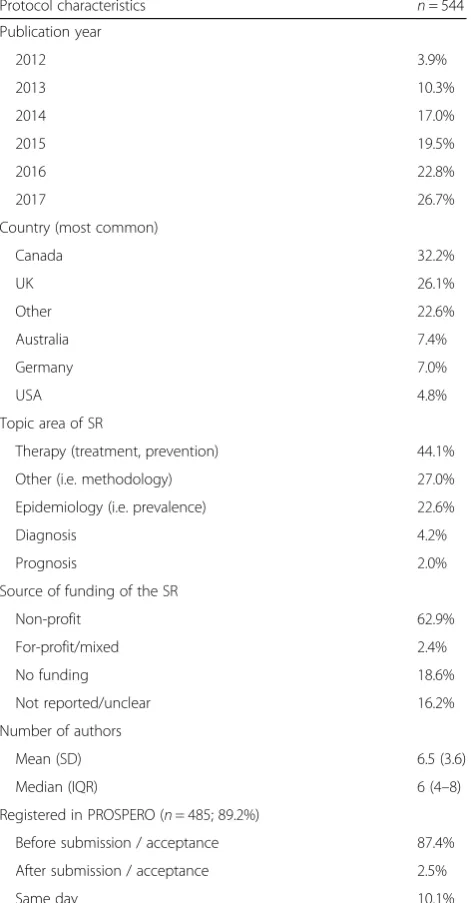
Almost half of the 544 protocols (n= 269) were pub-lished in 2016 or 2017, and most first authors were affili-ated with an institution from Canada or the UK (in total 58.3%). Nearly half the protocols (44.1%) were for thera-peutic reviews. There was a competing interest state-ment in every protocol (100%). Ten protocols (1.8%) had already undergone full external peer review, which means they only underwent editorial peer review as per the journal policy [18]. In almost two thirds of the pro-tocols (62.9%) the source of funding for the review was a non-profit institution. The median number of authors was 6. The majority of all protocols (89.2%) were also registered in PROSPERO, 87.4% of those before submis-sion of the protocol (Table1).
Peer review characteristics and processing time
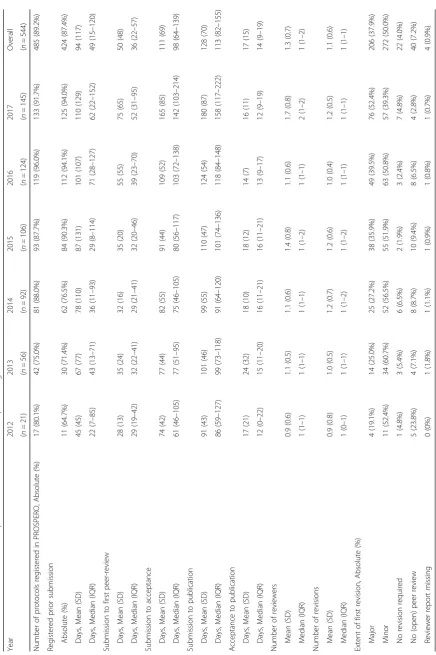
Overall, there were 1.3 ± 0.7 reviewers and 1.1 ± 0.6 revi-sions per protocol. For 50.0% of all protocols, we classi-fied the extent of revision after the first round of peer-review as ‘minor’, for 37.9% as ‘major’. In the remaining protocols, there was no (open) peer-review (7.2%), no revision was required by the reviewer(s) (4.0%), or the reviewer report was missing (0.9%). After the second round of peer review, 9.3% of the 162 proto-cols that were not accepted after the first revision re-quired a major revision. 50.6% rere-quired a minor revision and 40.1% did not require a further revision. Ten proto-cols were peer-reviewed three times or more often.
The median processing time from submission to first peer review, from submission to acceptance, from sub-mission to publication and from acceptance to publica-tion was 36, 98, 113 and 14 days, respectively. Processing times were longer in protocols requiring a major revi-sion after first peer review compared to protocols requir-ing a minor revision (see Table2).
Trends over time
There was a steady increase in the number of protocols published in ‘BMC Systematic Reviews’ over the years. The proportion of protocols whose corresponding SR
was registered in PROSPERO increased from 2012 to 2017 (80.1 to 91.7%), with a peak in 2016 with 96% (Table 3). Of those published between 2015 and 2017, 90–94% were registered prior to submission of the protocol. Between 2012 and 2014 it was 65–77%. The median time from registration in PROSPERO to proto-col submission was much longer in 2017 compared to 2012 (62 vs 22 days, respectively) in SRs registered prior to protocol submission (n= 424).
The mean number of reviewers almost doubled be-tween 2012 and 2017 (0.9 and 1.7, respectively) although it did not increase continuously over time. However, there was a large difference between 2016 and 2017 (in-crease from 1.1 to 1.7). There were no apparent trends in the proportion of protocols which did not require a revision, nor in the proportion of protocols that require one revision, two revisions and three or more revisions (Additional file2). The proportion of protocols requiring a major revision as per our judgement increased steadily over the years (from 19.0% in 2012 to 52.4%), but the largest difference occurred between 2016 and 2017 (from 39.5 to 52.4%). The proportion needing language corrections increased from 23.1 to 40.7% between 2012 and 2017 (Additional file1).
Median processing times also increased over time. In the years 2012 to 2015, it took about one month from submission to first peer review (values ranged from 29 to 32 days), while in 2017 it was 52 days. The median duration from submission to acceptance was 2.5 times higher in 2017 (142 days) than in 2012 (61 days) and the median duration from submission to publication of 86 days in 2012 almost doubled to 158 days in 2017. For the time between acceptance and publication, there was Table 1Basic characteristics of the included protocols
Protocol characteristics n= 544
Publication year
2012 3.9%
2013 10.3%
2014 17.0%
2015 19.5%
2016 22.8%
2017 26.7%
Country (most common)
Canada 32.2%
UK 26.1%
Other 22.6%
Australia 7.4%
Germany 7.0%
USA 4.8%
Topic area of SR
Therapy (treatment, prevention) 44.1%
Other (i.e. methodology) 27.0%
Epidemiology (i.e. prevalence) 22.6%
Diagnosis 4.2%
Prognosis 2.0%
Source of funding of the SR
Non-profit 62.9%
For-profit/mixed 2.4%
No funding 18.6%
Not reported/unclear 16.2%
Number of authors
Mean (SD) 6.5 (3.6)
Median (IQR) 6 (4–8)
Registered in PROSPERO (n= 485; 89.2%)
Before submission / acceptance 87.4%
After submission / acceptance 2.5%
Same day 10.1%
Abbreviations:SRSystematic review;SDStandard deviation;IQR Interquartile range
Table 2Extent of revision after first round of peer-review and processing times (in days)
Extent of revision major (n= 206) minor (n= 272) Submission to first peer-review
Days, mean (SD) 52 (44) 48 (48)
Days, median (IQR) 40 (25–60) 33 (21–54)
Submission to publication
Days, mean (SD) 150 (69) 119 (65)
Days, median (IQR) 134 (103–177) 105 (77–143)
Submission to acceptance
Days, mean (SD) 134 (69) 104 (65)
Days, median (IQR) 120 (87–157) 87 (60–124)
Acceptance to publication
Days, mean (SD) 17 (12) 15 (9)
Days, median (IQR) 13 (9–20) 14 (9–18)
no consistent trend over the years (ranging from 12 to 16 days).
For comparison, the time from submission to accept-ance across all manuscripts submitted to‘BMC
System-atic Reviews’ in 2017 was 168 days and 16 days from
acceptance to publication [19].
Content of reviewer comments
From our random 10%-sample, we had to exclude one protocol for which no reviewer comments were available, resulting in 53 protocols for further analyses based on PRISMA-P. Overall, there were 450 comments (on aver-age 8.5 ± 9.0 per protocol), 342 of which suggested more transparency (76.0%) and 108 which suggested a protocol amendment (24.0%). Suggestions for more transparency were implemented in 85.1% and protocol amendments in 73.7%; non-implementation was justified by the authors for all but two comments, both which suggested a proto-col amendment.
More than half of the protocols received comments re-garding PRISMA-P item 8 ‘Eligibility criteria’ (66.0%; with an average of 2.1 ± 2.7 comments per protocol) and item 9 ‘Information source’ (52.8%). With 13.2% each, comments on ‘Data management’, Criteria for
quantita-tive synthesis’ and ‘Confidence in cumulative evidence’
were least common (Table4).
The proportion of comments suggesting protocol amendments was highest for PRISMA-P item 10‘Search
strategy’, where 50.0% of all comments suggested
protocol amendments, followed by item 17 ‘Confidence
in cumulative evidence’(42.9%) and item 9 ‘Information
sources’ (39.6%). They were implemented in 56.3, 100
and 93.8% of the time, respectively.
Discussion
Our study shows that the number of protocols published
in‘BMC Systematic Reviews’has increased tremendously
since the journal’s launch, fromn= 21 in 2012 ton= 145 in 2017 (overall n= 544). The proportion of protocols requiring a major revision was 37.9% and has also in-creased with time. Three quarters of reviewer comments suggested more transparency. Most protocols were also registered with PROSPERO (89.2%), an increasing pro-portion before the manuscript had been submitted (reaching 94.0% in 2017).
While the time from acceptance to publication was constantly about two weeks over the years, the time from submission to publication almost doubled and went from just under three months in 2012 to over five months in 2017. This is how long it takes for a primary study from first submission to acceptance [20]. Since it takes about 1.3 years on average to conduct and publish an entire SR on medical interventions [21], the time it takes to publish a SR protocol seems to be dispropor-tionately high.
From an author’s perspective, long processing times might have far-reaching implications. Although authors should wait until their protocol is accepted for publica-tion, they might choose to continue working on their SR
Table 4Content of reviewers’comments (including each reviewer and revision)
Content of reviewers’comments Proportion of protocols with comments (n= 53)
Comments per protocol (mean ± SD) (n= 53)
Proportion of comments suggesting amendments (n= 450)
PRISMA-P item
8 Eligibility criteria 66.0% 2.1 ± 2.7 16.1%
9 Information sources 52.8% 0.9 ± 1.1 39.6%
10 Search strategy 34.0% 0.6 ± 1.2 50.0%
11a Data management 13.2% 0.1 ± 0.3 0.0%
11b Selection process 30.2% 0.5 ± 0.9 12.5%
11c Data collection process 24.5% 0.3 ± 0.7 11.1%
12 Data items 34.0% 0.5 ± 0.9 31.0%
13 Outcomes and priorization 20.8% 0.4 ± 0.9 21.1%
14 Risk of bias in individual studies 49.1% 0.7 ± 0.9 31.6%
15a Criteria for quantitative synthesis 13.2% 0.2 ± 0.5 11.1%
15b Aspects of quantitative synthesis 41.5% 0.9 ± 1.5 14.0%
15c Additional analyses 39.6% 0.7 ± 1.4 31.4%
15d Type of summary if quantitative synthesis not appropriate
15.1% 0.2 ± 0.6 16.7%
16 Meta-bias (es) 17.0% 0.2 ± 0.4 10.0%
in the meanwhile. This holds the risk that valuable com-ments from the peer review might not lead to changes in the SR’s methodology, which might be critical unless the part requiring a revision has not been commenced or finished by then. For example, a revision of the eligi-bility criteria might result in a new search strategy.
Waiting for the protocol to be accepted causes a delay in the conduct of the SR and consequently in the dis-semination of new knowledge [14]. Moreover, it is likely to complicate budget and project planning for authors of SRs for several reasons. People who have worked on the protocol might change or the project may simply run out of money due to the long time that publication of the protocol takes. This in turn might entail that the corresponding SR will never be published [22]. In an-other study, we found that about one-third of SRs re-mains unpublished 3–5 years after the protocol has been available [9], thus it remains unclear whether submitted but unpublished protocols exist.
The most likely reason for the increased duration from submission to publication is the increase in the propor-tion of protocols that required major revisions. As we have shown, protocols requiring a major revision after the first round of peer review took about a month longer (median 29 days) to get published than those requiring a minor revision. But why did more protocols require a major revision?
One explanation might be that the quality of initially submitted manuscripts for SR protocols became slightly worse over time, perhaps due to a change in the authors who submit SR protocols. One can assume that publish-ing protocols has become more popular over the years, while in the beginning only groups which are experi-enced in performing SRs submitted protocols. This is supported by the fact that the geographical scope in PROSPERO [10], as well as in our study (Additional file 2) has changed with time. Other aspects, such as the number of reviewers/revisions or the time from accept-ance to publication, did not follow a clear trend over time in our study, although we found a large increase in the number of reviewers between 2016 and 2017. This suggests that the peer review policy may have been changed during recent years.
Another explanation why more and more protocols re-quired a major revision might be the introduction of PRISMA-P in 2015. Nowadays, it is required by ‘BMC
Systematic Reviews’that the authors follow the checklist
and submit it as an additional file [18]. Otherwise their submission will be returned as incomplete, which of course delays the peer review process. Furthermore, peer reviewers may have become more critical as it is likely that the 17-item checklist goes beyond what they had previously looked for. This would also explain why most reviewer comments suggest more transparency.
Because the time from submission to first peer review has also steadily increased from 2015 onwards, another explanation might be the increasing difficulties in find-ing appropriate peer reviewers given the increase in sci-entific publications in general [23]. However, it is important to note that there is not only a high burden on peer reviewers, but also on all editors (in-chief, asso-ciate, handling) [24].
About 9 out of 10 protocols were also registered in PROSPERO. It is known, that SRs with published proto-cols are more often registered with PROSPERO than SRs without [9]. However, an interesting finding was that the majority (87.4%) of SRs was registered with PROS-PERO before the protocol had been submitted. Paradox-ically, PROSPERO urges caution not to register too early and that the review protocol should be complete before submitting the registration request [25]. But this is just the case after peer review is completed. PRISMA-P rec-ommends that, if the SR is registered in a publicly ac-cessible registry, the name of the registry and registration number should be included in the protocol. Although these statements are not contradicting, they do not provide clear instructions for authors of SR protocols.
One major argument for publishing a protocol of a SR is to receive input regarding the review scope and review methodology from independent peer reviewers, who themselves are experienced researchers. However, in a recent study we found that SRs with published protocols had older searches compared to SRs without a published protocol; in 52.2% of the SRs, the final search had already been performed before submitting the protocol for publication [9]. This fits to the finding of this study, that authors only implemented protocol amendments re-garding the search strategy in 56.3%, while overall proto-col amendments were implemented in 73.7%.
Naturally, authors play an important role in the peer review process, too. We found that most of the re-viewer’s comments on methodological issues suggested more transparency, not amendments to the protocol. The former could be avoided to some extent if authors paid more attention to this matter in the preparation of their manuscript, and described and justified their methods more carefully in the initial submission.
However, in practice it would turn out to be very dif-ficult to identify protocols that will benefit most from a peer review a priori. In a random sample of 300 re-views published in 2014, only 4% mentioned that the SR has been registered [27]. However, another study found that, in a random sample of 150 SRs published in 2015, 19% all reviews actually were registered [28].
An advantage of PROSPERO is that the registration and status of the SR can be easily updated and details or the reference for the published review can be added. If the SR has never been completed, another possibility is to switch its status to ‘abandoned’ including details on reasons for that, although this is seldom done [29]. Since any previous versions of an entry are kept, amendments can be made transparent. This is not feasible with pub-lished protocols and authors therefore need to report all protocol amendments in the actual review. Despite these useful features, we feel that PROSPERO could be further optimised; the structure of PROSPERO records should be aligned with the PRIMSA-P checklist to facilitate registration for authors of SR protocols.
Strengths and limitations
This was a study of all SR protocols published in ‘BMC
Systematic Reviews’since it was launched in 2012 up to
and including 2017. Despite the large number of ana-lysed protocols (n= 544), the journal only served an ex-ample. However, it is the open peer review journal, in which most SR protocols are published (39.7%), followed by BMJ Open (23.4%) [9]. It is also important to notice that our data only come from published protocols and the associated reviewer reports and author comments. Thus, it remains unclear how protocols have been dealt with that did not get published.
Although most endpoints of this study were based on data like dates and frequencies, we had to make judge-ments regarding some endpoints. To be as objective as possible, we did not check back with any peer reviewers, protocol authors or the editors, which means that our judgements might vary from the original ones. To in-crease internal validity, the reviewer reports for each protocol were assessed by two researchers independently regarding their extent of revision, though.
We used PRISMA-P as a simplified method of con-tent analysis and we might have misclassified some comments. Moreover, the 10%-sample of protocols might be too small for meaningful analysis. However, we had the opportunity to include a total of 450 re-viewer comments. Lastly, we did not analyse whether changes in PROSPERO were made after the protocol had been finally approved. Status updates are not often done in PROSPERO [9], though, so their extent should be small.
Conclusions
The increasing number of published protocols can be interpreted as a desirable trend, but the long and steadily increasing processing time is not acceptable from an au-thor’s perspective. When protocols are submitted, a timely and well-performing peer review system is needed. It has been stressed that due to the increasing number of scientific articles the workload imposed on individual reviewers appears to be reaching a `breaking point’; for protocols of SRs it has already been reached [24]. New models of peer review for SR protocols, such as post publication peer review [30], should be investi-gated. This could probably be realized with PROSPERO. What authors of SR protocols can do now, is to pay spe-cial attention to be transparent when describing and jus-tifying the planned methods.
Additional files
Additional file 1: Time trends in judgement of level of interest and
quality of written English. (PDF 16 kb)
Additional file 2: Time trends in basic and peer-review characteristics
and processing times–additional data. (PDF 19 kb)
Abbreviations
BMC:BioMed Central; BMJ: British Medical Journal; IQR: Interquartile range; OR: Odds Ratio; PRISMA-P: Preferred Reporting Items for Systematic Review and Meta-Analysis; SAS: Statistical Analysis System; SD: Standard deviation; SR: Systematic review
Acknowledgements
Not applicable.
Funding
There was no funding.
Availability of data and materials
The datasets used and/or analysed during the current study are available from the corresponding author on reasonable request.
Authors’contributions
TR collected all data and was a major contributor in writing the manuscript. KA, DP or TM checked 10% of the data, and KA and FH analysed all data. All authors were involved in interpreting the data, and have read and approved the final manuscript.
Ethics approval and consent to participate
Not applicable.
Consent for publication
Not applicable.
Competing interests
DP became an associate editor with BMC SR in August 2018. The other authors declare that they have no competing interests.
Publisher’s Note
Springer Nature remains neutral with regard to jurisdictional claims in published maps and institutional affiliations.
Author details
1Institute for Research in Operative Medicine, Witten/Herdecke University,
Services Research, Carl von Ossietzky University Oldenburg, 26111 Oldenburg, Germany.
Received: 20 June 2018 Accepted: 28 February 2019
References
1. Pieper D, Allers K. Differences between protocols for randomized controlled trials and systematic reviews. J Clin Epidemiol. 2017.
2. Shea BJ, Reeves BC, Wells G, Thuku M, Hamel C, Moran J, Moher D, Tugwell P, Welch V, Kristjansson E, et al. AMSTAR 2: a critical appraisal tool for systematic reviews that include randomised or non-randomised studies of healthcare interventions, or both. BMJ. 2017;358:j4008.
3. Klugar M. A protocol is essential for a systematic review as randomization is for randomized controlled trials. JBI Database System Rev Implement Rep. 2016;14(7):1–2.
4. Shamseer L, Moher D, Clarke M, Ghersi D, Liberati A, Petticrew M, Shekelle P, Stewart LA. Preferred reporting items for systematic review and meta-analysis protocols (PRISMA-P) 2015: elaboration and explanation. BMJ. 2015:349.
5. Moher D, Shamseer L, Clarke M, Ghersi D, Liberati A, Petticrew M, Shekelle P, Stewart LA. Preferred reporting items for systematic review and meta-analysis protocols (PRISMA-P) 2015 statement. Syst Rev. 2015;4(1). 6. Higgins JPT, Green S (editors). Cochrane Handbook for Systematic Reviews
of Interventions Version 5.1.0 [updated March 2011]. The Cochrane Collaboration, 2011. Available fromhttps://handbook-5-1.cochrane.org/. 7. Writing a Campbell Review [
https://campbellcollaboration.org/research-resources/instructions-for-authors.html].
8. The Joanna Briggs Institute: Joanna Briggs institute reviewers’manual: 2014 edition: the Joanna Briggs institute; 2014.
9. Allers K, Hoffmann F, Mathes T, Pieper D. Systematic reviews with published protocols compared to those without: more effort, older search. J Clin Epidemiol. 2018;95:102–10.
10. Page MJ, Shamseer L, Tricco AC. Registration of systematic reviews in PROSPERO: 30,000 records and counting. Syst Rev. 2018;7(1):32.
11. Guidance notes for registering a systematic review protocol with PROSPERO [https://www.crd.york.ac.uk/prospero/documents/Registeringa review on PROSPERO.pdf].
12. Stewart L, Moher D, Shekelle P. Why prospective registration of systematic reviews makes sense. Syst Rev. 2012;1:7.
13. Chang SM, Slutsky J. Debunking myths of protocol registration. Syst Rev. 2012;1(1):4.
14. Quality and value: the true purpose of peer review [https://www.nature. com/nature/peerreview/debate/nature05032.html].
15. Vosshall LB. The glacial pace of scientific publishing: why it hurts everyone and what we can do to fix it. FASEB J. 2012;26(9):3589–93.
16. Systematic Reviews: About [https://systematicreviewsjournal.biomedcentral. com/about].
17. Khangura S, Konnyu K, Cushman R, Grimshaw J, Moher D. Evidence summaries: the evolution of a rapid review approach. Systematic reviews. 2012;1:10.
18. Systematic Reviews: Protocol [https://systematicreviewsjournal. biomedcentral.com/submission-guidelines/preparing-your-manuscript/ protocol].
19. Systematic Reviews: Home [https://systematicreviewsjournal.biomedcentral.com/]. 20. Wallach JD, Egilman AC, Gopal AD, Swami N, Krumholz HM, Ross JS.
Biomedical journal speed and efficiency: a cross-sectional pilot survey of author experiences. Res Integr Peer Rev. 2018;3(1).
21. Borah R, Brown AW, Capers PL, Kaiser KA. Analysis of the time and workers needed to conduct systematic reviews of medical interventions using data from the PROSPERO registry. BMJ Open. 2017;7(2):e012545.
22. Tricco AC, Pham B, Brehaut J, Tetroe J, Cappelli M, Hopewell S, Lavis JN, Berlin JA, Moher D. An international survey indicated that unpublished systematic reviews exist. J Clin Epidemiol. 2009;62(6):617–623.e615. 23. Kovanis M, Porcher R, Ravaud P, Trinquart L. The global burden of journal
peer review in the biomedical literature: strong imbalance in the collective Enterprise. PLoS One. 2016;11(11):e0166387.
24. Stahel PF, Moore EE. Peer review for biomedical publications: we can improve the system. BMC Med. 2014;12(1):179.
25. Guidance notes for registering a systematic review on human studies [https://www.crd.york.ac.uk/prospero/#guidancenotes- guidancenotes].
26. Sideri S, Papageorgiou SN, Eliades T. Registration in the international prospective register of systematic reviews (PROSPERO) of systematic review protocols was associated with increased review quality. J Clin Epidemiol. 2018.
27. Page MJ, Shamseer L, Altman DG, Tetzlaff J, Sampson M, Tricco AC, Catala-Lopez F, Li L, Reid EK, Sarkis-Onofre R, et al. Epidemiology and reporting characteristics of systematic Reviews of biomedical research: a cross-sectional study. PLoS Med. 2016;13(5):e1002028.
28. Oliveira CB, Elkins MR, Lemes IR, de Oliveira Silva D, Briani RV, Monteiro HL, Azevedo FM, Pinto RZ. A low proportion of systematic reviews in physical therapy are registered: a survey of 150 published systematic reviews. Braz J Phys Ther. 2017.
29. Andrade R, Pereira R, Weir A, Ardern CL, Espregueira-Mendes J. Zombie reviews taking over the PROSPERO systematic review registry. It's time to fight back! Br J Sports Med. 2017.