INTRODUCTION
Hydration and hydrolysis of metal ions in aqueous solution play a fundamental role in the reactivity and mobility of these species in aquatic environment1 and biological2 systems. Despite the progress in the recent years, current instrumental methods are still far from being able to determine microstructures and stoichiometry of different species arising from hydration and hydrolysis of metal ions. The study of these species at the molecular level is the first step to understanding the chemical, biological, and surface reactivity of metal ions3.
Theoretical study of Cr (III) hydrolysis in aqueous
solution by means of Density-functional method
A. RAHMAN
1*, A. ISMAIL
2, H. SUDRAJAT
3and T.F. MARIA
41Department of Mechanical Engineering, 2Department of Chemical Engineering, Faculty of Engineering, Malikussaleh University, Lancang Garam, PO. Box 141,
Lhokseumawe 24351, Nanggroe Aceh Darussalam (Indonesia). 3Austrian-Indonesian Centre for Computational Chemistry,
Kaliurang Street, KM-3, 55281 Yogyakarta (Indonesia). 4Institute for Theoretical Chemistry, University of Vienna
Währingerstrabe 17, A-1090 Vienna (Austria).
(Received: March 10, 2009; Accepted: May 03, 2009)
ABSTRACT
Cr(III) hydrolysis in aqueous solution has been studied theoretically by means of density-functional method (DFT). All possible structures arising from different tautomers have been determined. The solvation energy has been calculated using the UAHF-PCM method. The hydrolysis reaction free energies have been calculated and compared with the available experimental data. The different hydrolysis species have distinct geometries and electronic structures. Improvement of theory level in calculating the electronic energy does not necessarily improve the calculated free energies in aqueous solution since the UAHF-PCM is a simple method that neglects specific interactions with the solvent. Therefore, it is important to have the correct balance between theory level used in the electronic properties calculation especially in the UAHF-PCM method. The PBE/TZVP/UAHF-PCM method has been found to calculate correctly the hydrolysis energies of Cr(III), deviating about 2.7 kcal/mol from experimental values.
Key words: Theoretical study, Cr(III) hydrolysis, UAHF-PCM method.
Cr(III) is one of these metal ions that are important in many different processes related to biology and environment4. Trivalent chromium is required in trace amounts for sugar metabolism in humans (Glucose Tolerance Factor) and its deficiency may cause a disease called chromium deficiency. In plasma, absorbed chromium(III) is bound mostly to transferrin and to other plasma proteins, which are responsible for its transport in the body. Long-term storage occurs particularly in the liver, spleen, bones and other organs4.
solution as pH increases. [Cr(OH)x(H2O)m]3-xspecies
are formed; however, the favorable geometries, isomers, and conformations are difficult to be determined. The number of water molecules in the first sphere of solvation has to be determined. These factors must be taken into account for the understanding of the Cr(III) adsorption mechanism on the mineral and its mobility in the environment. Therefore, a theoretical investigation of Cr(III) hydrolysis can be helpful to improve our knowledge on Cr(III) species in aqueous solutions.
Density-functional theor y (DFT) calculations have been successfully applied to study metal ions in solution5-7. Most of the theoretical studies in this field are based on hydrated ions5,6, and only a little attention has been given to the hydrolyzed species7 which are much more complex. In the present wor k, we have studied all conformations, isomers, and geometries of the [Cr(OH)x(H2O)m]3-x(x = 0-4) species and their low
lying excited states through DFT calculations. The stepwise hydrolysis equilibrium constants have been estimated and compared with the available experimental values.
Computational methods
Density-Functional Calculations
All calculations were performed using the density-functional method (DFT) implemented in the Gaussian 03 program package. The following generalized gradient approximations (GGA) for the exchange and correlation (XC) functional have been used: BP86 scheme with the Becke8 expression for exchange and Perdew9 expression for correlation, and PBE scheme with Perdew, Bur ke, and Er nzerhof10 expression for exchange and correlation. We have used the DZVP and TZVP basis sets optimized explicitly for DFT by Godbout et al.11 and the Ahlrichs basis sets (A-PVTZ)12-15. Har monic frequency calculations have been performed. The thermodynamic properties at gas phase have been evaluated using the canonical formalism16 at 298 K.
Solvation Model
Nonspecific solvent effects have been estimated using the united atoms Hartree-Fock/ polarizable continuum model (UAHF/PCM)17-18. As described by Saracino et al.,19,20, we have used
for all calculations the UAHF radii obtained by single point calculations at the HF/6-31G(d,p) level of theory using DFT optimized structures in gas phase. In the UAHF/PCM approach the solute is placed in a polarizable cavity formed of spheres centered in the atomic groups. Inside the cavity, the dielectric constant is the same in a vacuum, and outside it takes the solvent value (ª = 78.4 for water). Initial species
The Cr(III) hydrolysis products, [Cr(OH)x(H2O)m]3-x(x = 0-4) complexes, have been
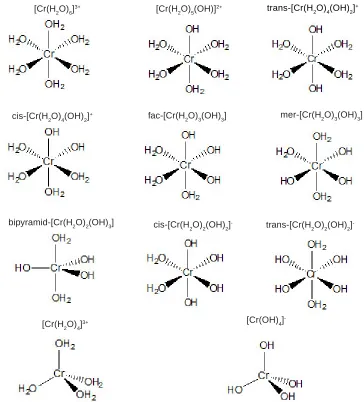
investigated in an attempt to contribute to the understanding of Cr(III) speciation in aqueous solution at a molecular level. Pappalardo and co-workers21 showed that DFT can yield reasonable aqueous Cr(III) ground-state structures and also the excited-state properties. It is possible to simulate the distribution of the species with respect to pH; however, information about their geometries and electronic structures are difficult to be gathered on the sole basis of experimental studies. In the present work, the Cr(III) first sphere of coordination was filled with water molecules in such a way that all structures used as starting geometries for the optimization had coordination number 6, as shown in Fig. 1.
RESULTS AND DISCUSSION Structural Properties
[Cr(H2O)6]3+
[Cr(H2O)6]3+ [Cr(H
2O)5(OH)]
2+ trans-[Cr(H
2O)4(OH)2] +
cis-[Cr(H2O)4(OH)2]+ fac-[Cr(H
2O)3(OH)3] mer-[Cr(H2O)3(OH)3]
bipyramid-[Cr(H2O)2(OH)3] cis-[Cr(H
2O)2(OH)2]
- trans-[Cr(H
2O)2(OH)2]
-[Cr(H2O)4]3+ [Cr(OH)4]
-Fig. 1: Initial structures used to perform geometry optimization in such systems in which the electronic correlation
effects are important, the Cr-O bond distances can differ by about 0.02 Å depending on the XC scheme used. The UMP2/A-PVTZ Cr-O bond distance is predicted to be 2.06 Å, 0.007 Å smaller than our DFT value.
[Cr(OH)(H2O)5]2+
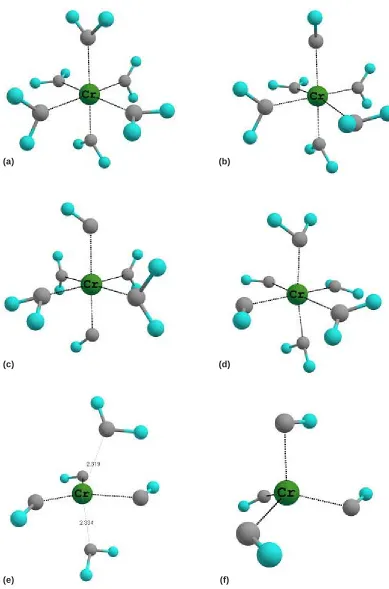
The Cr(OH)(H2O)5]2+ optimized structure is shown in Figure 2b. The Cr-OH bond distance is predicted to be 1.764 Å and Cr-OH2 bond distances are predicted to be in the range of 2.100-2.162 Å. Read and coworkers27, using the B3LYP/6-31G*
(a) (b)
(c) (d)
(e) (f)
[Cr(OH)2(H2O)4]+
The second deprotonation process produces two different species the trans- and cis -[Cr(OH)2(H2O)4]+. The cis isomer is the most stable species being about 5 kcal/mol lower in energy than the trans isomer. The replacement of water ligands to weaker-field ligands OH- breaks the octahedral symmetry, and consequently, different states as quar tet can become more stable. The cis -[Cr(OH)2(H2O)4]+ species is shown in Figure 2d, which presents Cr-OH and Cr-OH2 bond distances predicted to be 1.794 and 2.054-2.315 Å, respectively. Bleuzen and Foglia [28] have also
studied this species. He found a stable octahedral species only when using a supermolecule model with 10 water molecules surrounding the solvated complex. Their Cr-OH and Cr-OH2 bond distances are predicted to be 1.80 and 2.11 Å, respectively, using ab initio QM/MM-MD method. Even though he has performed this study with a second solvation shell, it is important to note that his results support our Cr3+ hydrolysis model.
Concerning the trans isomer (Figure 2c), it is interesting to note the presence of the trans effect evidenced by the lengthening of the Cr-OH
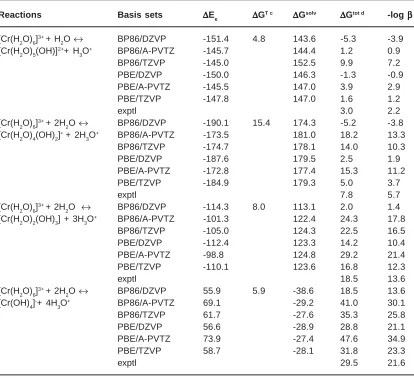
Table 1: Reaction free energies of the Cr(III) hydrolysis using different levels of theorya,b
Reactions Basis sets ΔΔΔΔΔEe ΔΔΔΔΔGT c ΔΔΔΔΔGsolv ΔΔΔΔΔGtot d -log βββββ [Cr(H2O)6]3+ + H
2O ↔ BP86/DZVP -151.4 4.8 143.6 -5.3 -3.9
[Cr(H2O)5(OH)]2++ H 3O
+ BP86/A-PVTZ -145.7 144.4 1.2 0.9
BP86/TZVP -145.0 152.5 9.9 7.2
PBE/DZVP -150.0 146.3 -1.3 -0.9
PBE/A-PVTZ -145.5 147.0 3.9 2.9
PBE/TZVP -147.8 147.0 1.6 1.2
exptl 3.0 2.2
[Cr(H2O)6]3+ + 2H
2O ↔ BP86/DZVP -190.1 15.4 174.3 -5.2 -3.8
[Cr(H2O)4(OH)2]+ + 2H 3O
+ BP86/A-PVTZ -173.5 181.0 18.2 13.3
BP86/TZVP -174.7 178.1 14.0 10.3
PBE/DZVP -187.6 179.5 2.5 1.9
PBE/A-PVTZ -172.8 177.4 15.3 11.2
PBE/TZVP -184.9 179.3 5.0 3.7
exptl 7.8 5.7
[Cr(H2O)6]3+ + 2H
2O ↔ BP86/DZVP -114.3 8.0 113.1 2.0 1.4
[Cr(H2O)2(OH)3] + 3H3O+ BP86/A-PVTZ -101.3 122.4 24.3 17.8
BP86/TZVP -105.0 124.3 22.5 16.5
PBE/DZVP -112.4 123.3 14.2 10.4
PBE/A-PVTZ -98.8 124.8 29.2 21.4
PBE/TZVP -110.1 123.6 16.8 12.3
exptl 18.5 13.6
[Cr(H2O)6]3+ + 2H
2O ↔ BP86/DZVP 55.9 5.9 -38.6 18.5 13.6
[Cr(OH)4]-+ 4H 3O
+ BP86/A-PVTZ 69.1 -29.2 41.0 30.1
BP86/TZVP 61.7 -27.6 35.3 25.8
PBE/DZVP 56.6 -28.9 28.8 21.1
PBE/A-PVTZ 73.9 -27.4 47.6 34.9
PBE/TZVP 58.7 -28.1 31.8 23.3
exptl 29.5 21.6
aAll energies are in kcal mol-1. bMedium used in PCM model is water (ª = 78.4). cThermal contribution at 298 K. The
zero-point energy is included. dΔG
bonds which are predicted to be 1.843 Å. One can compare these distances with that present in the [Cr(H2O)5(OH)]2+ species, that is about 0.079 Å shorter. Two different works28, 29 show the same Cr-OH bond distances equal to 1.851 Å. That is in very good agreement with our results.
Using 10 water molecules in a supermolecule model, Best [30] found a difference between the isomeric species equal to 4.8 kcal/mol, in good agreement with our results. However, it is important to note that, in the supermolecule model, water molecules are added forming a second solvation shell which can lead to artifacts since the dynamical behavior of the solvent is not included in such a model. The water molecule or hydroxyl ion bound to the Cr center can be rich or deficient of hydrogen bonding depending how water molecules of the second shell are placed, and, consequently, the Cr-O bond distances can increase or decrease.
[Cr(OH)3(H2O)2]
The fac-[Cr(H2O)3(OH)3] and mer -[Cr(H2O)3(OH)3] species are not minima in the potential-energy surface. The optimized structure is pentacoordinated presenting trigonal bipyramid geometry. The remaining water molecule is not bonded to the Cr atom. The OH- ligands prefer to stay in the equatorial positions, and H2O ligands
are bonded at axial positions. It is important to note that the axial axis is distorted presenting an angle of 75.3° with respect to the equatorial plane formed by the OH- groups (Figure 2e). According to previous data obtained by Best30, considering the second shell of solvation with eight water molecules, the average value for the Cr-OH distances is equal to 1.89 Å, which may be compared to our average value of 1.86 Å.
Other possible structures can be envisaged for the [Cr(OH)3] complex in aqueous solution. The tetrahedral geometry, with one water ligand bonded to the chromium center, is also possible. To deter mine which species is the preferred one in aqueous medium, we have calculated the reaction free energy described at
[Cr(H2O)2(OH)3]↔[Cr(H2O)(OH)3]+H2O ...(1)
At the BP86/DZVP level of theory, the ΔEelec, ΔGtherm, and ΔGsolv are estimated to be 5.7, 16.1, and -9.3 kcal/mol, respectively, leading to ΔGtot
(aq) equal to 12.5 kcal/mol. This means that the pentacoordinated bipyramid structure is favored in aqueous solution.
[Cr(OH)4]
-The cis- and trans-[Cr(H2O)2(OH)4]- are
also not minima in the potential energy surface, and both converged to the tetrahedral for m [Cr(OH)4]- (Figure 2f). In contrast to octahedral species predicted by hydrolysis data31, we found a tetrahedral form to be the most stable species. We can compare our geometrical parameters with those calculated early by Best30 that studied a very similar species, [Cr(H2O)2(OH)4]-, being the water molecules in the first solvation shell and having specific interactions with the OH- groups. In this way he found the medium distances Cr-OH to be equal to 1.88 Å. Our values are again longer than those by less than 0.02 Å, and this deviance is probably due to both the XC scheme used and the specific interactions considered by Best in his work.
pKa Estimate
Hex a a q u a c h r o m i u m ( I I I ) i s a n a c i d which deprotonates according to the solution pH. The many hydrolysis species formed in the medium are the blocks to form the polynuclear hydroxylated species of chromium(III). The pKa values of [Cr(H2O)6]3+ allow us to simulate the species distribution with respect to the pH; however, information concerning electronic and g e o m e t r i c a l s t r u c t u r e o f t h e s e s p e c i e s i s difficult to investigate. It has been shown that theoretically estimated reaction energies of the deprotonation process follow the correct trends and correlate with the equilibrium constants reasonably well. It is impor tant to correctly determine the predominant species and their solvation energies. The treatment of the proton solvation is still a challenge, even though the simple H3O+ model seems to work reasonably well32,33. Most of the theoretical pKa estimates have been performed for closed shell systems a s c a r b ox y l i c a c i d s , a n d o t h e r o r g a n i c systems32,34,35. Despite this effor t, it is still necessary to show the reliability of this method for open shell systems. The pKa estimate of -4.0 deviated significantly from the experimental va l u e o f 2 . 2 . R u s t a d a n d c o - wo r ke r s [ 3 6 ] showed that DFT calculated hydrolysis energies have good correlation with the observed first pKa of aqueous trivalent ions. Best30 extended the study to the successive pKa values showing that correlations of deprotonation energies with o b s e r ve d pKa va l u e s fo l l ow t h e ex p e c t e d
behavior for individual Al3+, Cr3+, and Si4 + c a t i o n s. H o w eve r, t h e l i n e a r f r e e e n e r g y relationship for Cr(III) hydrolysis leads to a slope that corresponds to 481 K, which is too high. This corresponds to an error of 50 kcal/ mol in the fourth hydrolysis constant (-log â = 21.6). He pointed out four factors for this d i s a g r e e m e n t : i n a d e q u a t e m e t h o d , m o d e l structures which do not reflect the aqueous Cr(III) species, Cr(III) complexes in solution, or uncertainties in the log â for Cr(III) hydrolysis [30]. The energetics is adequately described using the following equations:
[Cr(H2O)6]3+ + H
2O ↔ [Cr(H2O)5(OH)] 2++ H
3O +
-log β = 2.2 ...(2)
[Cr(H2O)6]3+ + 2H
2O ↔ [Cr(H2O)4(OH)2] + + 2H
3O +
-log β = 5.7 ...(3)
[Cr(H2O)6]3+ + 2H
2O ↔ [Cr(H2O)2(OH)3] + 3H3O +
-log β= 13.6 ...(4)
[Cr(H2O)6]3+ + 2H
2O ↔ [Cr(OH)4] -+ 4H
3O +
-log β = 21.6 (5)
It is worthwhile to separate the reaction free energies in each contribution according to eq 6.
ΔGtot (aq) = ΔE
elect (g) + ΔG
therm + ΔGsolv
...
(6)establish a manner to improve the results in order to estimate exper imental equilibr ium constants and free reaction energies in aqueous solution. However, it has been speculated that a gr e a t p a r t o f t h e s u c c e s s o f e s t i m a t i n g equilibrium constant values is due to a good synergism between level of theory, basis sets, and the continuum method leading to error compensation32. For open shell systems, it is important to ensure that the converged electronic density is free of spin contamination, since this can significantly interfere in the solvation energy estimated by the UAHF/PCM. Therefore we have used the restricted open shell Har tree-Fock (ROHF) method for calculating the open-shell systems.
According to Table 1, the solvation energy has the same magnitude as the electronic energy. Hence, it is an important contribution that can favor or not a specific reaction. Therefore, the good balance between the theoretical method that calculates the electronic energy and the UAHF/PCM model for salvation energy is impor tant. It is observed that slight differences in the geometry can change the solvation energy estimates up to 10 kcal/ mol. This is particularly true when the DZVP and TZVP basis sets results are compared. The compacted A-PVTZ basis sets do not follow the same trends as the other basis sets with respect to the electronic energy. For all reactions studied, the PBE XC functional performs much better compared to the BP86 scheme. PBE results are closer to the experimental values. It is important to note that PBE describes better weak interactions such as those related to the hydrolysis of Cr(III) species.
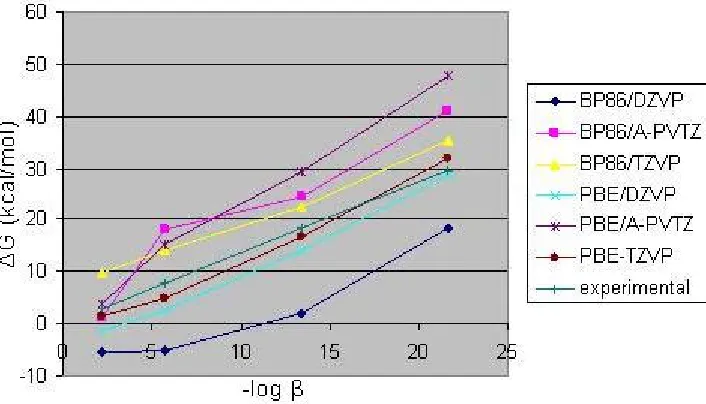
In Figure 3, the experimental –log β is plotted against the estimated hydrolysis free energies. The successive reaction energies must lie in a straight line according to the thermodynamics. The BP86/DZVP does not follow a line as it is expected. However, the other methods follow the same tendency having different shifts with respect to the experimental values. It can be observed that the PBE/TZVP provides the results that are closest to the experimental line with error bars about 2.7 kcal/mol. It is important to note that we are neglecting the ionic strength of the solution,
and also that the error bar of the experimental free energies quoted from the experimental hydrolysis constants are normally about 1 logarithmic unit, that is, about 1.4 kcal/mol.
CONCLUSION
The geometr ical, electronic, and ther modynamic proper ties of Cr(III) species arising from its hydrolysis in aqueous solution have been repor ted. The solvation energy estimate is very impor tant since it accounts roughly for a half of the reaction energy. However, continuum methods as the UAHF-PCM are based in simple models and cannot be improved easily. Therefore, the use of such an approach has to be combined with a method for the electronic calculations that provides the best results. Simply increasing the level of theory does not ensure that one is improving the reaction free energy in solution. While the gas-phase reaction free energy can be improved, in the aqueous solution one has to face the challenge of calculating the solvation energy of the reactants. In our approach, the PBE/ TZVP/UAHF-PCM provided the best results for all hydrolysis reactions studied following the expected behavior. The PBE/TZVP/UAHF-PCM estimated hydrolysis reaction energies are about 2.7 kcal/mol different from the respective experimental values. It is important to mention that electronic and geometrical parameters of these species in solution are cr ucial for understanding many reactions and processes related to the environment. Our approach can provide impor tant insights about systems of increasing complexity as those related to the adsor ption on minerals, complexation and nucleation modeling, and the pKa determination of mineral surfaces.
ACKNOWLEDGEMENTS
1. Bernhard, M., Brinckman, F. E. and Sadler, P. J., The Importance of Chemical Speciation in Environmental Processes; Springer-Verlag: Berlin, Germany, 213-215 (1986). 2. Sigel, H., Metal Ions in Biological Systems;
Marcel Dekker: New York, 14: 76-79 (1982). 3. Dhungana, S., Ratledge, C. and Crumbliss,
A. L., Inorg. Chem., 43: 6274 (2004). 4. Hewish, N. A., Neilson, G. W. and Enderby,
J. E., Nature, 297: 138 (1982).
5. Harris, D., Loew, G. H. and Komornicki, A., J. Phys. Chem. A., 103: 3959 (1999). 6. Kallies, B. and Meier, R., Inorg. Chem., 40:
3101 (2001).
7. Martin, R. L., Hay, P. J. and Pratt, L. R., J. Phys. Chem. A., 102: 3565 (1998).
8. Becke, A. D., Phys. Rev. A: At., Mol., Opt. Phys., 38: 3098 (1988).
9. Perdew, J. P., Phys. Rev. B: Condens. Matter., 33: 8822 (1986).
10. Perdew, J. P., Burke, K. and Ernzerhof, M., Phys. Rev. Lett., 77: 3865 (1996).
11. Godbout, N., Salahub, D. R., Andzelm, J. and Wimmer, E., Can. J. Chem. Rev., 70: 560 (1992).
12. Schafer, A., Horn, H. and Ahlrichs, R., J. Chem. Phys., 97: 2571 (1992).
13. Krack, M. and Koster, A. M., J. Chem. Phys., 108: 3226 (1998).
14. Koster, A. M., Flores-Moreno, R. and Reveles, J. U., J. Chem. Phys., 121: 681 (2004).
15. Fletcher, R., Comput. J., 13: 317 (1970). 16. McQuarrie, D. A. and Simon, J. D., Molecular
Thermodynamics; University Science Books: Sausalito, CA, 204-207 (1999).
17. Cossi, M., Barone, V., Cammi, R. and Tomasi, J., Chem. Phys. Lett., 255: 327 (1996). 18. Tomasi, J. and Persico, M., Chem. Rev., 94:
2027 (1994).
19. Saracino, G. A. A., Improta, R. and Barone, V., Chem. Phys. Lett., 373: 411 (2003).
20. Barone, V., Cossi, M. and Tomasi, J., J. Chem. Phys., 107: 3210 (1997).
21. Pappalardo, R. R., Martý´nez, J. M. and Marcos, E. S., J. Phys. Chem., 100: 11748 (1996).
22. Bleuzen, A., Foglia, F., Furet, E., Helm, L., Merbach, A. E. and Weber, J., J. Am. Chem. Soc., 118: 12777 (1996).
23. Ohtaki, H. and Radnai, T., Chem. Rev., 93: 1157 (1993).
24. Bol, W. and Welzen, T., Chem. Phys. Lett., 49: 189 (1977).
25. Camaniti, R., Licheri, G., Piccagula, G. and Pinna, G., J. Chem. Phys., 69: 1 (1978). 26. Magini, M., 1980, J. Chem. Phys., 73, 2499. 27. Read, M. C. and Sandstorm, M., Acta. Chem.
Scand., 46: 1177 (1992).
28. Bleuzen, A. and Foglia, F., J. Am. Chem. Soc., 118: 12777-12787 (1996).
29. Bertini, I., Fragai, M., Luchinat, C. and Pargi, G., Inorg. Chem., 40: 4030 (2001).
30. Best, S. P. and Forsyth, J. B., J. Chem. Soc. Dalton. Trans., 1721 (1991).
31. Martin, R. B., J. Inorg. Biochem., 44: 141 (1991).
32. De Abreu, H. A., De Almeida, W. B. and Duarte, H. A., Chem. Phys.Lett., 383: 47 (2004).
33. Schuurmann, G., Cossi, M., Barone, V. and Tomasi, J., J. Phys. Chem. A., 102: 6706 (1998).
34. Liptak, M. D., Gross, K. C., Seybold, P. G., Feldgus, S. and Shields, G. C., J. Am. Chem. Soc., 124: 6421 (2002).
35. Silva, C. O., da Silva, E. C. and Nascimento, M. A. C., J. Phys. Chem. A., 104: 2402 (2002). 36. Rustad, J. R., Dixon, D. A., Rosso, K. M. and Felmy, A. R., J. Am.Chem. Soc., 121: 3234 (1999).
37. Pliego, J. R., Chem. Phys. Lett., 367: 145 (2003).