Drillability of Titanium Alloy 6246 from
Surface Quality Perspective
M. DARSIN*
1and T. PASANG
21Mechanical Engineering Department, University of Jember, Jalan Kalimantan 37, Jember 68121, Indonesia.
2Mechanical Engineering Department, Auckland University of Technology, 55 Wellesley St. Auckland 1010, New Zealand.
Abstract
Drillablity derived from term of machinability, which is applied in drilling. In this study, drillability of titanium alloy 6246 has been investigated through observation of two responses of drilled holes quality, i.e. surface roughness and holes roundness. Taguchi L18 Design Experiment-based approach was used to gain an optimum setting of five drilling parameters: coolant, heat treatment variation, depth of drilling, cutting speed and feed rate. The tool used was TiAlN coated carbide drill insert. Minitab 17 was employed for processing the data; analysis of S/N ratio to find effect of each parameter and ANOVA were employed for analysing the significant of each parameter to the surface quality respectively. ANOVA shows that depth of drilling contributes 55% to the roughness, followed by heat treatment (25%), while coolant only affects the roughness quality by 2%. All the 5 parameters chosen in this research has no statistically significant effect to the roundness. The predicted optimum value of surface roughness of between 0.591 µm to 0.803 µm would be achieved when drilling Ti-6246 at a maximum depth of 10 mm, without coolant, cutting speed of 35 m/min and feed rate of 0.08 mm/min on the as received block.
Material Science Research India
www.materialsciencejournal.org
CONTACT M. Darsin [email protected] Mechanical Engineering Department, University of Jember, Jalan Kalimantan 37, Jember 68121, Indonesia.
© 2019 The Author(s). Published by Oriental Scientific Publishing Company
This is an Open Access article licensed under a Creative Commons Attribution-NonCommercial-ShareAlike 4.0 International License Doi: http://dx.doi.org/10.13005/msri/160111
Article History
Received: 01 April 2019 Accepted: 18 April 2019
Keywords:
Drillability; Drilling; Taguchi Method Roughness; Titanium 6246.
Introduction
Manufacturing industries always concern about the quality of their products. In drilling, a good surface roughness and roundness of the holes are among the quality that cannot be ignored.
Whereas, roundness measurement determining how much something aparts from being an ideal circle. Both specifications are crucial in determining the quality of drilled holes.
Some research have been carried out to correlate between holes quality and mechanical properties of their functions. Kahles et al.1 noticed that a dramatic loss of mechanical property such as fatigue and loss of surface integrity might be happened in machining titanium. A study on effect of drilling process on fatigue life from open holes has been carried out by Weiping et al.2 proved that the crack was initiated at the counter holes edge in which it would energize the fatigue crack nucleation. In regards to fastener holes, the crack life accounts for 80 % of total fatigue form. A research by Castle3 on drilling-induced fatigue damaged in Ti - 6Al4V concluded that surface finish affect the fatigue life.
There is no certain roughness value reported in drilling titanium alloys. As a general pictures the achieved roughness of other materials are presented. Amran et al4 achieved roughness of between 1.06 and 2.59 µm on drilling aluminium alloy with HSS twist drill. Surface roughness value of 5.0 µm was used as one criteria of replacing the drill, as a sign of tool worn (Lin (2002) in Sharif et al.5). According to Amiss and Milton6 the surface roughness attainable by drilling for common applications is between 6.3 µm (max) to 1.6 µm (min).
In conventional drilling of hard-to-machine metal such as titanium alloys, it is difficult to achieve a reliable surface finish due to rapid tool deterioration. As per industrial view it is advised to use low cutting speed and high feed rate while maintaining abundant cutting fluids in machining titanium alloys.7 However, this advice may not applicable for drilling for some reasons. Firstly, the cutting speed in drilling is changed from null at the chisel to full speed at the heel. Secondly, using a higher feed rate increased the torque significantly. Moreover, increasing both cutting speed and feed rate would accelerate the axial force.8 Thirdly, the coolant is not easily applied during drilling as it has to go to the interface of tool-workpiece through the helical flutes in the opposite direction of chips that come out from the cutting area. Parameters of drilling have been studied as the main input that affected the surface finish by a few
researchers. Kurt et al.9 stated that surface quality of drilled Al-2024 was affected in order by feed rate, cutting speed and depth of cut respectively. Kilickap et al.10 in their effort to optimise the drilling parameters (cutting speed, feed rate and cutting fluids) concluded that the best surface roughness was achieved when using low cutting speed and feed rate together with applying MQL condition. Whereas, Zhu et al.11 investigated the relation between speed & feed rate to the performance characteristic in drilling Ti-6Al4V with the conclusion that applying higher cutting speed resulted in smaller holes roundness values.
Titanium alloy 6Al-2Zr-4Sn-6Mo (Ti-6246) is among α + β titanium alloy and it has better heat treatable and excellent corrosion resistance than the most widely used Ti-6Al-4V.12 This alloy was designed to combine the long term elevated strength properties with the high improved short term strength properties of a fully hardened α + β alloy. Its application is for forging parts in intermediate temperature sections of gas turbine, particularly in compressor disks and blades13 and also for seals and airframe components. Ti-6246 is also under evaluation for deep, sour-well applications.14
To the extent of authors knowledge, there is no published paper discussing drillability of Ti-6246, neither from cutting forces nor from drilled surface perspective. Drillability is a term derived from machinability, which means how easy a material be drilled from different aspect of views. This current research aim is to study drillability of a difficult-to machine material, Ti-6246 alloy, with TiAlN drill insert. In this study, drillability of Ti-6246 was focused on drilled hole surface roughness and hole roundness perspective.
Methodology
were WEDM - machined to the shape of 25 mm x 25 mm with three variation of height: 15, 35 and 50 mm (Figure 1a). The tools used were TiAlN-(submicron) coated carbide insert with point angle of 140o and diameter of 10 mm. The insert is mounted on the top the HSS body drill as depicted on Figures 1b and c.
Heat treatments were carried out to make the material be softer and be easier to machine. Some blocks were drilled in the as received condition. Some other samples were heat treated with the following condition: heating at 870 oC for 3 hours then followed by either air cooling (AC) or water quenching
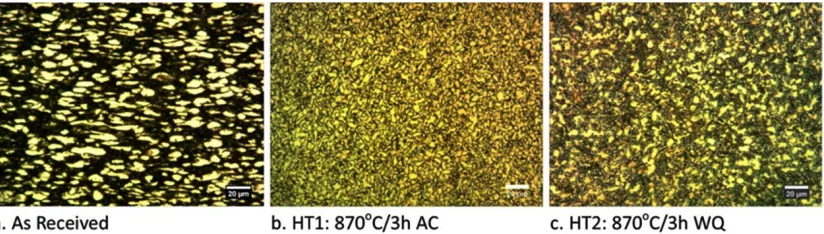
(WQ). These samples are called as AR, HT1 and HT2. The hardness of each condition were 318HV, 311HV and 289HV respectively. Microstructure of these blocks are presented on Figure 2 (a-c). A CNC universal milling machine was used for running the experiments.
The holes were measured for their surface roughness at the circumference side at the vicinity of the bottom. Measurement at four quadrants with 3 times replication for each position. The arithmetic surface roughness (Ra) values were measured in order to characterize the surface quality with a surface
Fig. 2: Microstructure of Ti-6246 of different heat treatment: (a) as received (AR), (b) heat treated at 870 oC for 3 hours then followed by air cooling, and
(c) heat treated at 870 oC for 3 hours followed by water quenching.
roughness device with the stroke of probe 0.8 mm (cut off) and range 99.9 µm. The total average of surface roughness for one hole were used for input of analyses of Taguchi with Minitab 17 software. The Ra surface roughness equation for this experimental study can be written as:
...(1)
where xi is the measured surface value and N is number of measurement = 12.
The roundness was measured with a CMM machine as the least square error of the fitted circle to the entire set of points. The least square circle (LSC) is a circle, which separates the roundness profile of an object by separating the sum of total areas of the inside and outside it in equal amounts. The roundness error then can be estimated as the difference between the maximum and minimum distance from this reference circle. Roundness (Rd) is expressed in mathematical equation 2 as follow:
...(2)
where N is number of measurement. In this experiment N = 3 in regards to three position of measurement: at the top, at the middle and at the bottom of the holes circumference; and Ri is value of roundness.
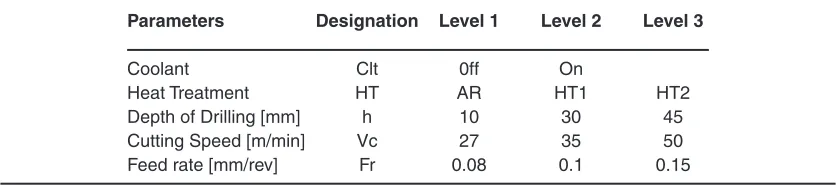
Taguchi Method and Design of Experiments In this research, four drilling parameters with three levels and one parameter of block with two levels were used as shown in Table 1.
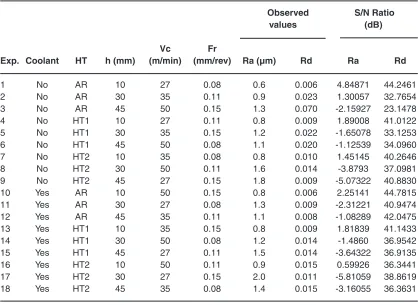
An L18 Taguchi array was employed in this research (Table 2), which represents 18 number
of experiments. This is significantly less compared with Full Factorial Design (FFD), which will need 2x3x3x3x3 = 162 runs.
Results and Discussion Analysis of S/N Ratio
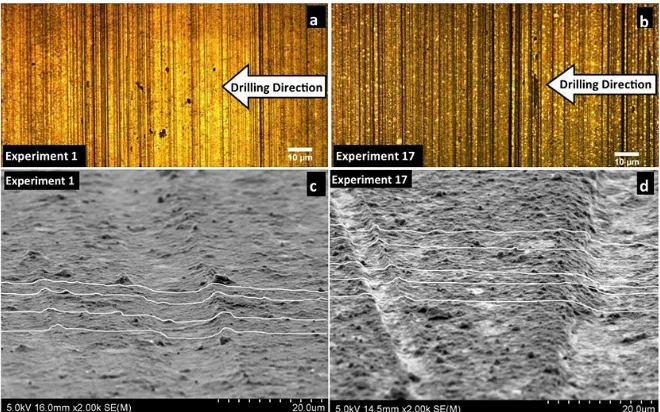
Table 2 presents the roughness and roundness of the holes after drilling. Experiments 1 represent the smallest roughness while experiment 17 resulted in the maximum roughness. The maximum roughness is related to the maximum tool deterioration [8]. Figure 3 exhibits the optical microscopy of both experiments (1 and 17). The rougher of surface of experiment 17 is obvious than that of experiment 1. The pattern of surface were outlined by the white lines (scratches). There are obvious two pattern of valleys in Figure 3d , the right one is of the tool when it rotating forward and another one (left) is of the retreated tool which is usually faster. Therefore, the configuration are more oblique.
Figure 4 shows a sample of roundness measurement from experiment 16 at the top hole position with the roundness value of 0.0196. This value, then, was averaged with another two result of roundness measurements at the middle and at the bottom of the holes.
The S/N ratio, as the transferred value from the lost function in Taguchi design, of both measured parameters was analysed using Minitab 17 and the result is presented in last two columns of Table 2. The arithmetic mean of Ra and Rd were computed as 1.173 µm and 0.016 respectively. Correspondingly, the average of S/N ratio values for Ra and Rd were found to be -0.96 dB and 37.83 dB.
The signal value represents the actual value of the optimum levels of the control factors, the highest S/N ratio was used. Depending on the combination
Table 1: Drilling parameters and their levels
Parameters Designation Level 1 Level 2 Level 3
Coolant Clt 0ff On
Heat Treatment HT AR HT1 HT2
Depth of Drilling [mm] h 10 30 45
Cutting Speed [m/min] Vc 27 35 50
control factors, the S/N ratio was calculated to be 4.84871 dB for the lowest Ra value of 0.6 µm. Similarly, the S/N ratio was calculated to be 44.7815 dB for the Roundness of 0.006 (Table 2).
Table 3 presents the level values of the control factors for Ra and Rd according to Taguchi Method. The five input parameters influenced the roughness
by order are depth of drilling (h), heat treatment (HT), cutting speed (Vc), feed rate (Fr) and coolant (Clt). It is apparent that the result was different to that of influencing the roundness, in order they are h, Vc, HT, Clt and Fr. The optimum drilling condition for the smallest Ra were determined as CltoffHTARh10Vc35Fr0.08, whereas for the tiniest Rd values they were CltonHTARh10Vc27Fr0.08.
Fig. 3: Optical micrographs of drilled surface roughness with magnification of 100X from experiments 1 & 17 (a and b) and SEM images at 2000X magnification
(c and d) showing the surface roughness and the pattern of surface. Ra of 0.6 and 2.0 µm for experiment 1 and 17 respectively
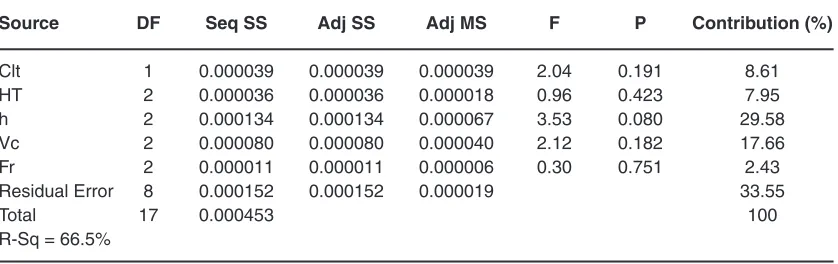
To observe the significance of each parameters the statistical analysis of variance (ANOVA) was implemented. Table 4 and 5 show the ANOVA of the raw data (Ra and Rd).
P-value of 0.05 is the threshold of the significant level of the input parameter; if P-value < 0.05, the effect of input parameter is considerably significant and vice versa [16]. Consequently, all the input parameters are statistically significant influence the roughness (Table 4). In the contrary, all factors on roundness is found to be statistically insignificant (P-value > 0.05) (Table 5).
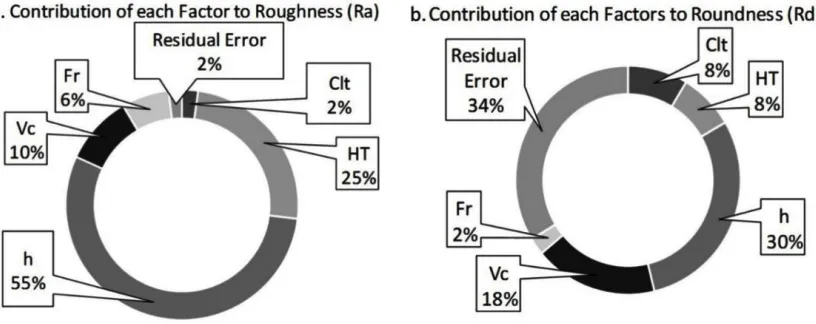
It is obvious that the most influencing parameter of the control factor on Ra is depth of drilling (h), with the contribution up to 55% (Table 4 and Figure 5a). This can be ascribed to the damaged surface integrity when drilling deeper, which means the deeper the drilling the coarser is the drilled surface. Therefore, it is advised when determining drilled holes surface roughness, we should consider to
quantify in different depth then compute the average as it will potentially result in different value between the top and the bottom of the holes. Alternatively, the measurement should be carried out only at the vicinity of the bottom surface if the maximum roughness is the concern.
The influencing factor to the roughness is heat treatment with the level of 25% (Figure 5a). It may be related to the different hardness resulted from the different heat treatment. The as HT2-ed material is the softest in compare to that of AR and as HT1-ed ones. The softer the material the rougher is the surface after drilling. It is accordance to the generally understanding in machining that softer material is easier to be machined than the harder one.
Coolant, in contrast, contributes only 2% to the roughness of the drilled holes. The least contribution of coolant may be because coolant applying method was not effective. In external cooling type, it is hard for the coolant to reach the interface of tool-material.
Table 2: Drilling parameters and their levels on Taguchi Design L18
Observed S/N Ratio values (dB)
Vc Fr
Exp. Coolant HT h (mm) (m/min) (mm/rev) Ra (µm) Rd Ra Rd
1 No AR 10 27 0.08 0.6 0.006 4.84871 44.2461
2 No AR 30 35 0.11 0.9 0.023 1.30057 32.7654
3 No AR 45 50 0.15 1.3 0.070 -2.15927 23.1478
4 No HT1 10 27 0.11 0.8 0.009 1.89008 41.0122
5 No HT1 30 35 0.15 1.2 0.022 -1.65078 33.1253
6 No HT1 45 50 0.08 1.1 0.020 -1.12539 34.0960
7 No HT2 10 35 0.08 0.8 0.010 1.45145 40.2646
8 No HT2 30 50 0.11 1.6 0.014 -3.8793 37.0981
9 No HT2 45 27 0.15 1.8 0.009 -5.07322 40.8830
10 Yes AR 10 50 0.15 0.8 0.006 2.25141 44.7815
11 Yes AR 30 27 0.08 1.3 0.009 -2.31221 40.9474
12 Yes AR 45 35 0.11 1.1 0.008 -1.08289 42.0475
13 Yes HT1 10 35 0.15 0.8 0.009 1.81839 41.1433
14 Yes HT1 30 50 0.08 1.2 0.014 -1.4860 36.9542
15 Yes HT1 45 27 0.11 1.5 0.014 -3.64322 36.9135
16 Yes HT2 10 50 0.11 0.9 0.015 0.59926 36.3441
17 Yes HT2 30 27 0.15 2.0 0.011 -5.81059 38.8619
Table 3: The Mean Response for Ra and Rd
The Surface Roughness (Ra) Roundness (Rd) controlled
parameters Level 1 Level 2 Level 3 Delta Rank Level 1 Level 2 Level 3 Delta Rank
Clt 1.1189a 1.2281 0.1092 5 0.014233 0.011300a 0.002933 4 HT 0.9875a 1.1118 1.4212 0.4337 2 0.011222a 0.014656 0.012422 0.003433 3 h 0.7898a 1.3462 1.3844 0.5946 1 0.009083a 0.015600 0.013617 0.006517 1 Vc 1.3247 1.0499a 1.1459 0.2749 3 0.009783a 0.014439 0.014078 0.004656 2 Fr 1.0812a 1.1359 1.3033 0.2221 4 0.012322a 0.013878 0.012100 0.001778 5
a Optimum level, Delta = difference between maximum and minimum
The coolant and the chips flowing in the same cutting flutes at the opposite direction. Therefore, it may only a little or no coolant reach the interface. Therefore, drilling with or without coolant did not affect the roughness.
The fact that the most influencing factors to roughness are depth of drilling and heat treatment is an outstanding result because previous researchers such as17,18,19,20,21 only considered the cutting speed and feed rate as the main parameters to improve
Table 4: Analysis of Variance ANOVA for Means of Ra
Source DF Seq SS Adj SS Adj MS F P Contribution (%)
Clt 1 0.05366 0.05366 0.053657 9.62 0.015 2.22
HT 2 0.59846 0.59846 0.299229 53.63 0.000 24.73
h 2 1.32918 1.32918 0.664591 119.12 0.000 54.92
Vc 2 0.23352 0.23352 0.116759 20.93 0.001 9.65
Fr 2 0.16070 0.16070 0.080349 14.40 0.002 6.64
Residual Error 8 0.04463 0.04463 0.005579 1.84
Total 17 2.42015 100
R-Sq = 98.2%
Table 5: Analysis of Variance ANOVA for Means of Rd
Source DF Seq SS Adj SS Adj MS F P Contribution (%)
Clt 1 0.000039 0.000039 0.000039 2.04 0.191 8.61
HT 2 0.000036 0.000036 0.000018 0.96 0.423 7.95
h 2 0.000134 0.000134 0.000067 3.53 0.080 29.58
Vc 2 0.000080 0.000080 0.000040 2.12 0.182 17.66
Fr 2 0.000011 0.000011 0.000006 0.30 0.751 2.43
Residual Error 8 0.000152 0.000152 0.000019 33.55
Total 17 0.000453 100
the surface roughness in drilling titanium alloys. The newly published papers22,23 have also not taken the depth of drilling into account in optimizing hole quality in drilling Ti-64. In this research, accumulation of both parameters (cutting speed and feed rate) only contribute 16% to the roughness.
In regard to roundness, it was not statistically influenced significantly by the designated factors used in these experiments as the P-value of all factors are bigger than 0.05. The residual error contributes 34% to the roundness which means other factors, which were not chosen in this experiments more influencing than those 5 factors. The depth of drilling influenced 30% to the roundness. Nevertheles, as the P is 0.08 (or higher than 0.05), statistically the influence of depth of drilling is not significant to the roundness. The results is compliant with what was found by Sultan et al.24 that there was no significant different on roundness by varying cutting speed and feed rate. Abdelhafeez et al.25 found that though there were some inaccuracy of roundness when drilling titanium and aluminium alloys but cutting speed and feed rate (as individual factor or their interactions) did not statistically significant affect the hole diameter accuracy.
Estimation of Optimum Performance of Characteristics The optimum surface roughness (Ra) is predicted at the selected levels of significant parameters. The significant parameters with optimum levels were already selected as Cltoff, HTAR, h10, Vc35, Fr0.08 for
roughness. In this study the interactions between factors was not in concerned. The estimated mean of response characteristic and Ra can be computed as equation (3)26,27:
...(3)
where TRa is overall mean of surface roughness = 1.1 (Table 2), while Cltoff, HTAR, h10, Vc35, Fr0.08 are the average values of roughness with parameters at optimal levels. From Table 3 it is revealed that Cltoff = 1.189, HTAR = 0.9875, h10 = 0.7898, Vc35 = 1.0499, Fr0.08 = 1.0812. Therefore, µRa = 1.189 + 0.9875 + 0.7898 + 1.0499 + 1.0812 - 4(1.1) = 0.697.
A confidence interval for the predicted mean on a confirmation run, can be calculated using the following equation:
...(4)
where, Fα(1, fe) is F ratio required for α, α is risk the opposite meaning of confidence level, fe is error DOF, Ve is error variance, Neff is effective number of replications. Table 4 revealed that Ve = 0.005579, fe = 8, F0.05(1, 8) = 5.3177. Whereas, effective number of replication (Neff) is formulated as
...(5)
R is number of repetitions for confirmation experiment and N is total number of measurements = 4 quadrants X 3 repetition X 18 (experiments) = 216 times. While, Tdof is total degrees of freedom associated with the mean optimum = 9. Thus, Neff = 21.6.
Therefore,
Thus, 95% confidence level interval predicted surface roughness to be 0.697 ± 0.106 µm i.e. the confirmation result should be between 0.591 µm < µRa < 0.803 µm.
Conclusion
The following conclusion can be drawn from the study of drillablity of Ti-6246 alloy with TiAlN carbide coated tools with the focus on drilled surface quality:
a. Depth of drilling exerted the greatest effect on the surface roughness by 55%, followed heat treatment (25%), cutting speed (10%), feed rate (6%) and coolant application (2%). b. All of the above parameters did not significantly
affect the roundness of the holes.
c. The optimum surface roughness between 0.591 µm to 0.803 µm was achieved when drilling with these parameters: Cltoff, HTAR, h10, Vc35, Fr0.08.
For the future research in drilling, the depth of drilling should be considered as the main parameter when the surface roughness is the focus of investigation.
Acknowledgement and Funding Source
We would like to thank Ministry of Research, Technology and Higher Education of Republic Indonesia through the DIKTI scholarship and AUT University that financially supports the main author to pursue his PhD degree at the Auckland University of Technology.
References
1. Kahles J. F., Field M., Eylon D. and Froes F. H., “Machining of titanium alloys,” J. Met., 1985;vol. 37,no. 4:pp. 27–35.
2. Weiping G., Honglu X., Jun L., and Zhufeng Y., “Effect of drilling process on fatigue life of open holes,” Tsinghua Sci. Technol., 2009;vol. 14, no. Supplement 2: pp. 54–57.
3. Castle J., “Drilling Induced Fatigue Damage in Ti-6Al-4V,” Washington University in St. Louis. 2010.
4. M.A. Amran, S. Salmah, N.I.S. Hussein, R. Izamshah, M. Hadzley, Sivaraos, M.S. Kasim, M.A. Sulaiman. “Effects of machine parameters on surface roughness using response surface method in drilling process,”
Procedia Eng., vol. 68, 2013.
5. Sharif S., Rahim E. A., and Sasahara H., “Machinability of Titanium Alloys in Drilling,” in Intech, vol. 3, no. c, 1994.
6. Amiss and Milton J., Machinery’s Handbook. 25th edition, 25th ed. New York: Industrial Press, 1996.
7. Milacron, “Machining Titanium,” Cimcool Technical Report, pp. 1–3, 2007.
8. Darsin M., Pasang T. and Chen Z.,
“Performance of TiAlN PVD coated carbide drill when drilling titanium 6246 alloy,” in MATEC Web of Conferences, 2017;vol. 109. 9. Kurt M., Bagci E. and Kaynak Y., “Application
of Taguchi methods in the optimization of cutting parameters for surface finish and hole diameter accuracy in dry drilling processes,”
Int. J. Adv. Manuf. Technol. 2009;vol. 40, no. 5–6:pp. 458–469.
10. Kilickap E., Huseyinoglu M., and Yardimeden A. “Optimization of drilling parameters on surface roughness in drilling of AISI 1045 using response surface methodology and genetic algorithm,” Int. J. Adv. Manuf. Technol., 2011;vol. 52, no. 1–4:pp. 79–88.
11. Zhu Z., Sui S., Sun J., Li J., and Li Y. “Investigation on performance characteristics in drilling of Ti6Al4V alloy,” Int. J. Adv. Manuf. Technol. 2017.
12. Titanium Engineers, “Titanium 6Al-2Sn-4Zr-6Mo Ti 6246 (UNS R56260).” Titanium Engineers, pp. 5–6, 2015.
Ti-6Al-4V and Ti-6Al-2Sn-4Zr-6Mo and their relationship to processing and properties,” Luleå University of Technology. 2004. 14. Boyer R., Welsch G. and Collings E. W.,
Materials Properties Handbook: Titanium Alloys. 1994.
15. Lutjering G. and Williams J. C., Titanium, 2nd ed. Springer-Verlag BerlinHeidelberg, 2007. 16. Khanna N. and Davim J. P., “Design-of-experiments application in machining titanium alloys for aerospace structural components,”
Measurement. 2015;vol. 61:pp. 280–290. 17. Kumar B. S. and Baskar N., “Integration
of fuzzy logic with response surface methodology for thrust force and surface roughness modeling of drilling on titanium alloy,” Int. J. Adv. Manuf. Technol. 2013;vol. 65, no. 9–12:pp. 1501–1514.
18. Sharif S. and Rahim E. A., “Performance of coated- and uncoated-carbide tools when drilling titanium alloy-Ti-6Al4V,” J. Mater. Process. Technol. 2007;vol. 185, no. 1–3: pp. 72–76.
19. Rahim E. A., Kamdani K. and Sharif S. “Performance evaluation of uncoated carbide tool in high speed drilling of Ti6Al4V,” J. Adv. Mech. Des. Syst. Manuf. 2008;vol. 2, no. 4: pp. 522–531.
20. Ramulu M., Branson T., and Kim D., “A study on the drilling of composite and titanium stacks,” Compos. Struct. 2001;vol. 54, no. 1: pp. 67–77.
21. Kim D., Ramulu M. and Garbini J. “Hole
quality in drilling of graphite/bismalemide-titanium stacks,” in 33rd International SAMPE Technical Conference -Advancing Affordable
Materials Technology. 200;pp. 1315–1326. 22. Y. H. Çelik, H. Yildiz, and C. Özek, “Effect of
cutting parameters on workpiece and tool properties during drilling of Ti-6AI-4V,” vol. 58, no. 6, pp. 519–525, 2016.
23. Waqar S., Asad S., Ahmad S., Abbas C. A., and Elahi H. “Effect of drilling parameters on hole quality of Ti-6Al-4V titanium alloy in dry drilling,” Mater. Sci. Forum 2016;vol. 880, no. December:pp. 33–36.
24. Sultan A. Z., Sharif S., and Kurniawan D., “Effect of machining parameters on tool wear and hole quality of AISI 316L stainless steel in conventional drilling,” Procedia Manuf. 2015; vol. 2, no. February:pp. 202–207.
25. Abdelhafeez A. M., Soo S. L., Aspinwall D. K., Dowson A., and Arnold D. “A coupled Eulerian Lagrangian finite element model of drilling titanium and aluminium alloys,” SAE Int. J. Aerosp. 2016;vol. 9, no. 1:pp. 198–207. 26. Khanna N. “Design of Experiments in
Titanium Metal Cutting Research,” in Design of Experiments in Production Engineering, 1st ed., no. November, J. P. Davim, Ed. Aviero, Portugal: Springer 2016;pp. 165–182. 27. Singh H. and Kumar P. “Tool wear optimization
in turning operation by Taguchi method,”