DOI: 10.7324/JAPS.2019.90203 ISSN 2231-3354
In silico predictive for modification of chalcone with pyrazole
derivatives as a novel therapeutic compound for targeted breast
cancer treatment
Riska Prasetiawati1,3, Adel Zamri2, Melisa Intan Barliana1, Muchtaridi Muchtaridi1*
1Department of Pharmaceutical Analysis and Medicinal Chemistry, Faculty of Pharmacy, Universitas Padjadjaran, Jatinangor-Sumedang, West Java, Indonesia. 2Department of Chemistry, Faculty of Mathematics and Natural Science, Universitas Riau, Simpang Panam, Pekanbaru, Riau, Indonesia.
3Department of Pharmacy, Faculty of Mathematics and Natural Science, Universitas Garut, West Java, Indonesia.
ARTICLE INFO
Received on: 01/11/2018 Accepted on: 22/01/2019 Available online: 28/02/2019
Key words:
Chalcone, Modifina3, breast cancer, pharmacophore modeling, molecular docking.
ABSTRACT
One of the most common triggers of breast cancer is over-expression of estrogen receptor alpha (ERα). Long-term therapy of tamoxifen, an ERα antagonist, can reduce patient’s quality of life because of its side effects. In the previous study, 2’,4’-dihydroxy-6-methoxy-3,5-dimethylchalcone (ChalcEA) was isolated as an active compound from the
Eugenia aquea leaves that is responsible for breast cancer treatment with positive ERα, however, the potency is lower than tamoxifen. The aim of this study is to find the best-modified chalcone that binds well with the ERα. Drug design approaches used in this study were Structure-Based (Autodock 4.1) and Ligand-Based (LiganScout 4.1). Prediction of absorption, distribution, and toxicity parameters was employed using preADMET and Toxtree. Interactions between tamoxifen and ERα were determined and the differences in the binding modes between tamoxifen and chalcones were observed. Modifina3 had pharmacophore fit score value of 76.42% and the molecular docking studies showed the lowest free energy binding (∆G) of −11.07 kcal/mol while tamoxifen of −10.15 kcal/mol. Modifina3 had absorption and distribution properties with the percentage human intestinal absorption of 95.90%, CaCO2 of 46.95%, and protein plasma binding of 93.55%. Toxicity prediction of Modifina3 was categorized in class III and risk assessment requires compound specific toxicity data. These results suggest that Modifina3 has the potency to be a novel therapeutic compound for potent ERα inhibitor targeted breast cancer.
INTRODUCTION
Base on International Agency for Research on cancer, with emphasis on geographical differences in 20 countries in the
world, The GLOBOCAN 2018 estimates of cancer mortality and
incidence (Bergman et al., 2000). The first prevalence of cancer in
women is breast cancer, the second is colorectal and lung cancer
(for incidence), followed by vice versa (for mortality), and the
fourth, for mortality and incidence, is cervical cancer (Ferlay et al., 2010).
Breast tissues differentiation and development influence
by ovarian hormones (Bernstein and Press, 1998). Breast is
one of the estrogen-responsive target tissue induces of cancer development. Tamoxifen is one of the nonsteroidal compounds (Bentrem and Craig Jordan, 2002), which has been studied, whose
effect is varied as agonists or antagonists based on the investigation of a gene or particular organ system (Rojas and Stuckey, 2016).
Estrogen has a play role in growth, development, and in the pathology of bones, breast, and uterus. Estrogen receptor
is classified into two subtypes, ERα (Estrogen Receptor-α) and Erβ (Payne et al., 2008). The role of ERα is in cell proliferation
(Fox et al., 2008), and ERα found in endometrial, mammary
epithelial cells which are the origin cell for growth in most breast
*Corresponding Author
Muchtaridi Muchtaridi, Department of Pharmaceutical Analysis and Medicinal Chemistry, Faculty of Pharmacy, Universitas Padjadjaran, Jatinangor-Sumedang, West Java, Indonesia.
E-mail: muchtaridi @ unpad.ac.id
cancers, ovarian stromal cell, and hypothalamus (Levin, 2005). ERα plays an important and responsible role as the most common
trigger of breast cancer (Narod, 2011). Various molecules have been an investigation to find out compounds that bind well with ERα, as a crucial receptor for breast cancer (Cragg et al., 1997).
The most widely used as hormonal therapy of breast cancer is tamoxifen. The risk of recurrence and death of breast cancer are reduced by tamoxifen when given as adjuvant therapy. It also provides effective palliation for patients with metastatic breast cancer (Yang et al., 2013). Tamoxifen is a Selective Estrogen Receptor Modulator (SERM) that has antagonist activity to
breast cancer but agonist activity to other receptors, especially in the uterus (Fisher et al., 2005). Tamoxifen is given to women who have stopped menstruation with ERα+ tumors. Tamoxifen
plays a crucial role in breast cancer therapy. Tamoxifen can
reduce breast cancer relapse significantly (Davies et al., 2013).
Tamoxifen interacts with co-repressors, thus inhibiting expression of estrogen-dependent response genes (Chang, 2012). Besides the benefit of tamoxifen, there are adverse effects in the uterus (Fisher et al., 2005). Depending on the results of the study, endometrial cancer risk increased from 1.5 to 6.9 fold (Cohen, 2004). The risk
of adverse effect in the uterus increases with accumulative usage and longer duration of tamoxifen therapy (Bergman et al., 2000). The risk of endometrial malignancy increases significantly with
an increased body weight of postmenopausal females. Besides that, patients with ER+ show the intrinsic resistance to SERM
not depend on ER increased (Fan et al., 2015). The mechanism of tamoxifen resistance occurs by loss of ERα expression, which
leads to the removal of ligand for tamoxifen, change mechanism of co-activators or co-regulators, stimulate kinases and ER
phosphorylation, change profile pharmacokinetic of metabolites
active of tamoxifen, regulation of apoptosis, and antioxidant protein-mediated cell survival (Chang, 2012). Because of
these cases, an alternative treatment was needed through the natural compound. Drug discovery from medicinal plants has played an important role in cancer treatment and, indeed, the
newest therapy of herbal medicine practiced in fighting cancer
(Prasad et al., 2006).
Rational drug discovery and development of new
active agents or leads is utilizing in silico study. Ligand-based drug design and structure-based drug design (SBDD) were used
as a modern method in drug discovery (Dror et al., 2004). One
of the natural compound, which has potential as anti-breast
cancer, is chalcone. Chalcone is one of the flavonoid groups
secondary metabolite that is found in many plants (Prasad et al., 2006). In the previous study,
2’,4’-dihydroxy-6-methoxy-3,5-dimethylchalcone was isolated from leaves of Eugenia aquea and was further investigated on to breast cancer therapy (Subarnas et al., 2015). The results showed that the chalcone isolates reduce cell proliferation against Michigan Cancer Foundation-7 human breast cell using 3-(4,5-dimethylthiazol-2-yl)-2,5-diphenyltetrazolium bromide bioassay in a dose-dependent
manner with the half maximal inhibitory concentration (IC50)
of 74.5 μg/ml (250 μM) and induce apoptosis via the activation of poly (adenosine diphosphate-ribose) polymerase (Subarnas et al., 2015). However, this IC50 was categorized in moderate
potential and this compound cannot compete with tamoxifen due to its lack of hydrophobic tail. So, we need an effort to improve
2’,4’-dihydroxy-6-methoxy-3,5-dimethylchalcone potency and the aim of this study is to find the best-modified chalcone that binds well with ERα by replacement of the carbonyl group of that chalcone that binds well with the ERα.
MATERIALS AND METHODS Molecular docking simulation
3ERT taken from protein data bank (PDB) used as a standard was complex ERα with 4-hydroxytamoxifen (4-OHT).
The ligand and macromolecule structures were separated using
Discovery Studio 4.0. The SBDD using molecular docking
simulation methods has been carried out in the previous study (Muchtaridi et al., 2014;2017). Using AutoDockTools 1.5.6, all
the ligands and receptor were prepared for docking simulation and protonated. The solvation and default Kollman charge parameters were designate to the macromolecule atoms. Addition of Gasteiger charges to molecule as a ligand atom A grid box comprised of
40 × 40 × 40 points distance by 0.375 Å and was focused on the
ER binding site (x = 30.282, y = −1.913, and z = 24.207). The
bond strength of the atom in the ligand was calculated using an Autogrid (Morris et al., 2009). The Lamarckian genetic algorithm (LGA) specifications were 100 runs, elitism of 1, the mutation rate of 0.02, the population size of 100, and a crossover rate of
0.08 band 10,000,000 energy evaluations (Ikram et al., 2015). A root means square deviation was used for clustering the results of docked conformation, tolerance of 1.0 Å. The docking outcomes were imaged using Discovery Studio Visualizer 4.0.
Pharmacophore modeling
Ligand-based drug design using pharmacophore fit score calculated the qualified element of the corresponding site
of the compound to the features of pharmacophore model and was used to interpret the value of the corresponding site from the pharmacophore model. A 3-D pharmacophore model using
LiganScout 4.1 was derived from the X-ray derived structure of ERα that binds with 4-OHT (Wolber and Langer, 2005).
preADMET and Toxtree
In silico, pharmacokinetic properties and toxicities were predicted using preADMET and Toxtree software, which are available online (Lee et al., 2003). preADMET (v2.0) online
at https://preadmet.bmdrc.kr/ is a web-based application for predicting absorption and distribution data using in silico method.
The Toxtree v2.3.16 that we used was available online at https:// sourceforge.net/projects/toxtree/files/toxtree/Toxtree-v.2.6.13/ Toxtree-v2.6.13-setup.exe/download, used to predict the toxicity
of compounds.
RESULTS AND DISCUSSION Modification of chalcone
Molecular docking of protein that binds with ligand is
most widely used as Structure-Based Virtual Screening method. It is estimated affinity of the ligand and protein derived on its
chalcone as a new drug based on its chemical properties. The in silico study base on computer-aided drug design, especially to chalcone is needed for more valuable research (Gomes et al., 2017).
A number of compounds of pyrazolic chalcone
derivatives were shown to have anticancer activity, based on
50% inhibitory concentration (IC50) values (Hawash et al., 2017).
Extension of the functional group to ring A and/or ring B (Fig. 1)
can induce the activity of chalcone (Lahsasni et al., 2014). In our study, in order to find the best-modified chalcone,
we were replaced the carbonyl group of ChalcEA, to increase hydrophobicity, which is the important pharmacophore using
hydrazine to produce pyrazole derivatives, to increase selectivity and activity against the ERα using rational drug design. The design of chalcone modifications is presented in Table 1.
Pharmacophore modeling
The important feature that provides to biological activity is represented by pharmacophore (Wolber, 2008). Complexes
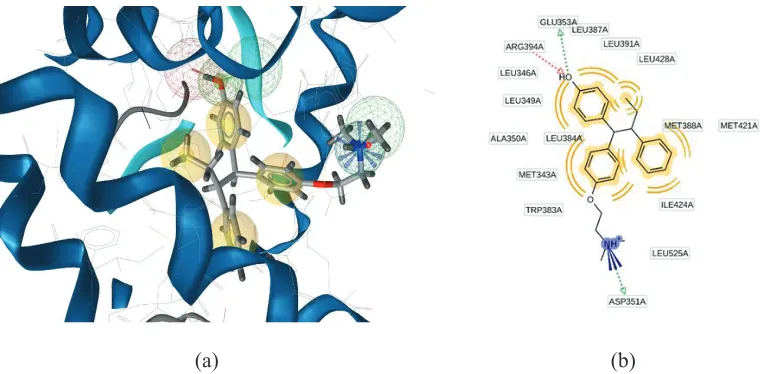
of ligand-protein in PDB, the compound as a ligand separated from the protein and elucidated chemical properties of the ligand. Pharmacophore modeling representing the interaction of ligand and receptor which are generated from every one of these molecules and its surrounding them (Wolber and Langer, 2005). Figure 2a shows the pharmacophore of 4-OHT. The interaction between ERα (PDB code: 3ERT) with 4-OHT forms hydrophobic
interactions predominantly with aromatic rings, hydrogen bond
interactions, and positive ionizable interaction. The 2-D (Fig. 2b)
pharmacophore modeling illustrates the interaction between a hydrophobic pocket with amino acids residue.
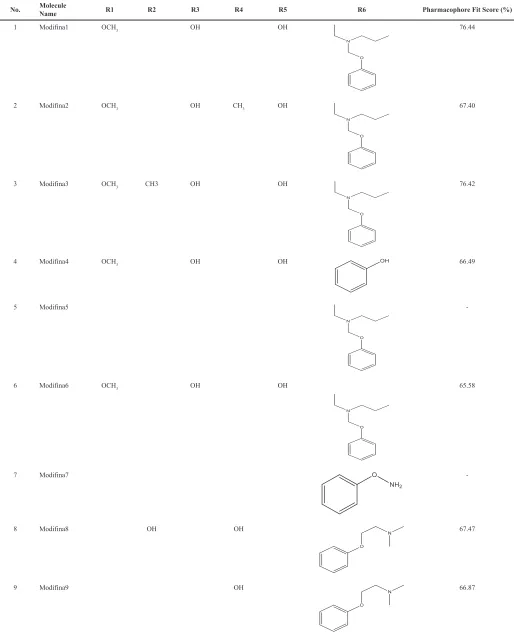
Pharmacophore fit scores indicate that chemical properties of the ligands are suitable to the feature of the 4-OHT
structure-based pharmacophore model. Table 2 showed that
Modifina1 and Modifina3 were the best two pharmacophores fit
score, which means the chemical properties of that ligands are most
suitable with the features of the 4-OHT pharmacophore model. However, Modifina5 and Modifina7 do not have pharmacophore fit
score, which means that chemical features of those compounds are
not aligned to the feature of the 4-OHT pharmacophore modeling. Molecular docking results
SBDD is a method that depends on possessing the knowledge of the 3-D structure of the receptor as a biological target
Table 1. Modification of chalcone.
ChalcEA ChalcEA Derivatives (Modifina1-9) Figure 1. Basic structure of chalcone.
Table 2. Pharmacophore fit score result.
No. Molecule Name R1 R2 R3 R4 R5 R6 Pharmacophore Fit Score (%)
1 Modifina1 OCH3 OH OH 76.44
2 Modifina2 OCH3 OH CH3 OH 67.40
3 Modifina3 OCH3 CH3 OH OH 76.42
4 Modifina4 OCH3 OH OH 66.49
5 Modifina5
-6 Modifina6 OCH3 OH OH 65.58
7 Modifina7
-8 Modifina8 OH OH 67.47
(Kalyaanamoorthy and Chen, 2011). Structural determination of biological macromolecules by using X-Ray crystallographic is
currently the most favored method (Smyth and Martin, 2000). Crystallographic ERα structure a that binds with 4-OHT from
PDB code: 3ERT was preferred for molecular docking simulation of chalcone and its derivatives since they have suitable criteria
for research resolution (1.9 Å). Molecular docking is commonly
used for prediction of biology molecules complexes in molecular design. The fast results of free energy binding in Autodock come
from combining a force field of empirical free energy with an LGA
(Morris et al., 2009).
Validation of molecular docking is done first, before
performing molecular docking simulation of ligand that will be
tested, conducted by separating 4-OHT from ERα in PDB and
docking it into active site to verify that the method running well as
the bioactive conformation antagonist of 4-OHT. The best-docked
antagonist bioactive ligand conformation is shown in Figure 3. Chalcone is a secondary metabolite and its derivatives have several anticancer activities. In addition, other advantages of chalcone are ic hardly interact with DNA and less mutagenic (Xu et al., 2015).
Both synthesis and natural products chalcones have been proven in the various studies for important pathway or molecular targets in cancers. Chalcone has the advantages of being inexpensive, easily
available, and less toxic. Moreover, chalcones are not difficult to synthesize, which makes them an attractive drug scaffold (Jandial et al., 2014). Chalcone was discovered in recent time as a potential and specific inhibitor. However, chalcone has cytotoxic activity. Replacement at positions 3, 4, and 5 of chalcone induced cytotoxic
activity (Rangel et al., 2013). Modifying the carbonyl group of the chalcone with pyrazole group was proved to induce better
cytotoxicity against many cancer cell line (Hawash et al., 2017). The aim of this study was to find the best-modified chalcone that binds well with the ERα and to focus on the modification at the position of the carbonyl group by pyrazole derivate to increase the
hydrophobicity.
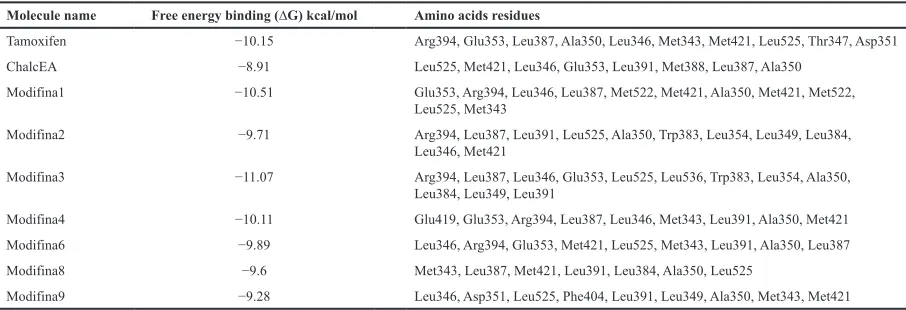
Chalcone modification based on ERα interaction with 4-OHT (Fig. 2a), molecular bond acceptors, and less than five hydrogen bond donor base on Lipinski’s Rule of Five. Table 3 below shows molecular docking results using Autodock 4.2. The dimethylamino ethoxy group of 4-OHT elongated than the
Table 3. Molecular docking result.
Molecule name Free energy binding (∆G) kcal/mol Amino acids residues
Tamoxifen −10.15 Arg394, Glu353, Leu387, Ala350, Leu346, Met343, Met421, Leu525, Thr347, Asp351
ChalcEA −8.91 Leu525, Met421, Leu346, Glu353, Leu391, Met388, Leu387, Ala350
Modifina1 −10.51 Glu353, Arg394, Leu346, Leu387, Met522, Met421, Ala350, Met421, Met522, Leu525, Met343
Modifina2 −9.71 Arg394, Leu387, Leu391, Leu525, Ala350, Trp383, Leu354, Leu349, Leu384, Leu346, Met421
Modifina3 −11.07 Arg394, Leu387, Leu346, Glu353, Leu525, Leu536, Trp383, Leu354, Ala350, Leu384, Leu349, Leu391
Modifina4 −10.11 Glu419, Glu353, Arg394, Leu387, Leu346, Met343, Leu391, Ala350, Met421
Modifina6 −9.89 Leu346, Arg394, Glu353, Met421, Leu525, Met343, Leu391, Ala350, Leu387
Modifina8 −9.6 Met343, Leu387, Met421, Leu391, Leu384, Ala350, Leu525
carbonyl group of ChalcEA. This unlikeness makes it possible for
higher computer free energy of binding (∆G) of 4-OHT lower than
ChalcEA (Muchtaridi et al., 2017). All of the modified chalcones have a free energy of binding (∆G) lower than ChalcEA, except Modifina8 and 9, formed hydrogen bonds with Arg394 similar to 4-OHT. Modifina3 was the best compound with lowest free energy binding, so it has the highest affinity to bind properly with the ERα and interacted with Arg394, Leu387, Leu346, Glu353, Leu525, Leu536, Trp383, Leu354, Ala350, Leu384, Leu349, and Leu391. However, Modifina3 has more Leusin, which is hydrophobic amino acids residue, and amino acids residue polar Met421, Met343, and Asp351 interacted with 4-OHT which made the free energy binding (∆G) of Modifina3 lower than 4-OHT which cause Modifina3 has the highest affinity to ERα. The hydrogen bonds formation with Arg394 and Glu353 is essential to ERα.
Interpretation of the in silico results
Modifina1 and Modifina3 show the best two pharmacophore fit scores (Fig. 4) of derivatives and Modifina3
has lowest ∆G free energy of binding (−11.07 kcal.mol−1) than
Modifina1 (−10.51 kcal.mol−1) and 4-OHT (−10.15 kcal.mol−1), respectively.
Figure 3 shows that the modification of carbonyl groups on Modifina1 blocking complete interaction with all three hydrophobic features of 4-OHT (Fig. 4a). On the other hand, the meta position of methyl groups on the ring of Modifina3 enables
better alignment with the center of the hydrophobic features, thus
resulting in a better pharmacophore fit score (Fig. 4b)
Modifina3 formed 10 hydrophobic interactions with Leu387, Leu346, Leu525, Leu536, Leu354, Ala350, Leu384, Leu349, Tryptopan383, and Leu391, and two hydrogen bonds with Leu387 and Arg394 (Fig. 5). The interaction of hydrogen bonds with Glu353 and Arg394 is necessary for binding to ER
(Wang et al., 2010), which is in suitable with the results of previous docking studies requiring chalcone (Vasanthi, Reuben and Usha, 2016). Hydrophobic interactions were the most important site of binding of ChalcEA derivatives with ERα. Role of aromatics ring
in binding interaction was shown in Fig. 4.
Figure 4. Fit of the (a)Modifina1 and (b) Modifina3 were derived from 4-OHT pharmacophore models with ERα (3ERT) by LigandScout 4.1 Advanced. Virtual screening was conducted leaving at least two features out.
The cyclic compound of Modifina3 formed CH-pi hydrophobic binding with Ala350, Met421, and Leu525 (Fig. 6).
In the previous study, the substituent of ring A and B of chalcone plays a role in the activity (Wang et al., 2010).
In silico prediction of absorption, distribution, and toxicity
In the latest decades, in silico absorption, distribution,
metabolism, excretion/toxicity (ADME/T) modeling as a
computation method for rational drug design with various models has been used by pharmaceutical scientists. The high analysis results and
the efficient cost of the method made the simultaneous investigations of the compounds, including pharmacokinetic profile, safety, and
activity. The compounds that used as a drug must have good ADME properties. The complex mechanism of in vivo process of a drug made the ADME prediction method more simple using major component or as several single processes (Thomas et al., 2008).
Determination of permeation across a monolayer of the human adenocarcinoma cell line, Caco-2 is a popular surrogate for ligands permeation across the human intestinal epithelium.
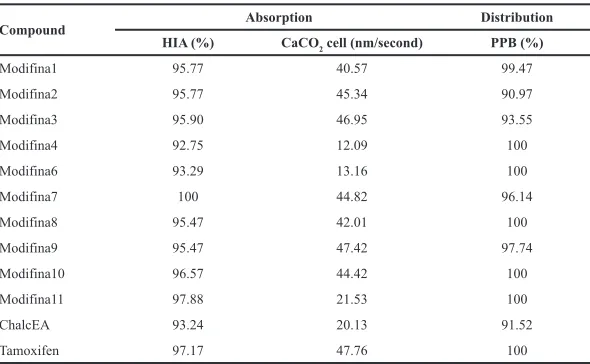
Human intestinal absorption (HIA%) of compounds was predicted
very important for identifying a potential drug candidate. Among
HIA of all the modified chalcones, more than 90% represented well-absorbed compounds (70%–100%) in the intestines. The
parameter of CaCO2 cell permeability capability shows all the
compounds have a medium permeability (20%–70%) (Thomas et al., 2008).
Protein plasma binding (PPB) is a significantly
pharmacokinetic property of compounds in drug discovery
and design. Effective and efficient in silico method for a
pharmacokinetic profile of compounds. PPB is exactly related to drug distribution, metabolism, and clearance, which influence the efficacy and potency of drugs (Sun et al., 2018). A degree of PPB of a compound influences on the drug disposition, its action, and efficacy. PPB of all the compounds in Table 4 was more than
90%, which means all compounds will be well distributed in the body, chemical’s strongly bound. However, transport across cell
membranes or diffusion, and bind with a pharmacological target
(receptor) only requires the unbound drug. If there is reversible
Table 4. ADME prediction result.
Compound Absorption Distribution
HIA (%) CaCO2 cell (nm/second) PPB (%)
Modifina1 95.77 40.57 99.47
Modifina2 95.77 45.34 90.97
Modifina3 95.90 46.95 93.55
Modifina4 92.75 12.09 100
Modifina6 93.29 13.16 100
Modifina7 100 44.82 96.14
Modifina8 95.47 42.01 100
Modifina9 95.47 47.42 97.74
Modifina10 96.57 44.42 100
Modifina11 97.88 21.53 100
ChalcEA 93.24 20.13 91.52
Tamoxifen 97.17 47.76 100
protein plasma-drug binding, there will be a chemical balance between protein plasma-drug binding with the unbound drug. The bound part of the drug will become a reservoir and then release as
unbound drug to maintain equilibrium. In silico toxicity prediction
Prediction toxicity using a computational method is needed in the early step of drug development. Toxicity is the concentration level of the compounds which disturbs an organism or its substructure (Wang et al., 2015).
In the drug design and development, genotoxicity is the critical point in the in vitro toxicity assay. Information Technology development and growing experimental data made in silico screening and toxicity prediction interesting (Wang et al., 2015).
In silico toxicity risk was performed to check the genotoxic and carcinogenic effect of the compound. In Table 5
shown that the Modifina3 has nongenotoxic and
non-carcinogenicity properties.
In order to improve the patient’s quality of life through
reduced side effect of the chemotherapeutic agents for breast
cancer, Modifina3 is possibly potent for that activity. The
molecular docking results showed that most of the residue which
interacted with Modifina3 and 4-OHT were Arg394, Glu353, Leu387, Ala350, Leu346, and Leu525 almost similar. Agonistic effect of 4-OHT can be eliminated by Modifina3. In the previous study, molecular dynamic simulations on ERα showed that between Helix-11 and Helix-12 was very adjustable which made
support the different conformations (for examples: apo-, agonist-,
and antagonist-form) (Musfiroh et al., 2013). A hydrophobic cavity of the ligand binding domain (LBD) of ERα consists of residues from helices 3, 6, 7, 8, 11, and 12 (Morris et al., 2009). Based on the previous study, residues 536-544 in Helix-12 of the
ER is the important thing responsible for the activity of agonist or
antagonist of a ligand. For example, an antagonist such as 4-OHT is accommodated by helix-12 of the ERα LBD occludes the
co-activator recognition channel resulting in antagonist activity. As shown in Fig. 4, Modifina3 lacks hydrogen bond with His524. Interestingly, the loss of hydrogen bonding with His524 when 4-OHT is bound while agonist activity existing when the hydrogen bonding with His524 and the ERα agonist
estradiol (Muchtaridi et al., 2014;2017;Musfiroh et al., 2013). It is predicted that the Modifina3 has no agonist effect on ERα due to the loss of the hydrogen bonding with His524 when Modifina3
is bound.
CONCLUSION
Modifina3 has the potential to be a novel therapeutic
compound for targeted breast cancer treatment due to its highest
affinity, with high-class category toxicity but still can be used as a
compound for drugs. Based on the further biological investigation,
Modifina3 represents rational computationally designed compound prioritized.
ACKNOWLEDGMENTS
This study was supported by The Directorate General
of Higher Education of the Ministry of Research and Technology
of Indonesia through International Research Collaborations
and Publications Grants 2017 no. 006/ADD/SP2H/LT/DRPM/ VIII/2017.
REFERENCES
Bentrem DJ, Craig Jordan V. Tamoxifen, raloxifene and the prevention of breast cancer. Minerva Endocrinol, 2002; 27(2):127–39.
Bergman L, Beelen ML, Gallee MP, Hollema H, Benraadt J, Van Leeuwen FE. Risk and prognosis of endometrial cancer after tamoxifen for breast cancer. Comprehensive cancer centres’ ALERT Group. Assessment of liver and endometrial cancer risk following tamoxifen. Lancet, 2000; 356(9233):881–7.
Bernstein L, Press MF. Does estrogen receptor expression in normal breast tissue predict breast cancer risk? J Natl Cancer Inst, 1998; 90(1):5–7.
Chang M. Tamoxifen resistance in breast cancer. Biomol Therap, 2012; 20(3):256–67.
Cohen I. Endometrial pathologies associated with postmenopausal tamoxifen treatment. Gynecol Oncol, 2004; 94(2):256–66.
Cragg GM, Newman DJ, Snader KM. Natural products in drug discovery and development. J Nat Prod, 1997; 60(1):52–60.
Davies C, Pan H, Godwin J, Gray R, Arriagada R, Raina V, Abraham M, Medeiros Alencar VH, Badran A, Bonfill X, Bradbury J, Clarke M, Collins R, Davis SR, Delmestri A, Forbes JF, Haddad P, Hou MF, Inbar M, Khaled H, Kielanowska J, Kwan WH, Mathew BS, Mittra I, Muller B, Nicolucci A, Peralta O, Pernas F, Petruzelka L, Pienkowski T, Radhika R, Rajan B, Rubach MT, Tort S, Urrutia G, Valentini M, Wang Y, Peto R. Long-term effects of continuing adjuvant tamoxifen to 10 years versus stopping at 5 years after diagnosis of oestrogen receptor-positive breast cancer: ATLAS, a randomised trial. Lancet, 2013; 381(9869):805–16.
Dror O, Shulman-Peleg A, Nussinov R, Wolfson HJ. Predicting molecular interactions in silico: I. A guide to pharmacophore identification and its applications to drug design. Curr Med Chem, 2004; 11(1):71–90.
Fan W, Chang J, Fu P. Endocrine therapy resistance in breast cancer: current status, possible mechanisms and overcoming strategies. Fut Med Chem, 2015; 7(12):1511–9.
Ferlay J, Shin HR, Bray F, Forman D, Mathers C, Parkin DM. Estimates of worldwide burden of cancer in 2008: GLOBOCAN 2008. Int J Cancer, 2010; 127(12):2893–917.
Fisher B, Costantino JP, Wickerham DL, Cecchini RS, Cronin WM, Robidoux A, Bevers TB, Kavanah MT, Atkins JN, Margolese RG, Runowicz CD, James JM, Ford LG, Wolmark N. Tamoxifen for the prevention of breast cancer: current status of the national surgical adjuvant breast and bowel project P-1 study. J Natl Cancer Inst, 2005; 97(22):1652–62.
Table 5. Toxtree result.
Parameter Tamoxifen ChalcEA Modifina3
Cramer rules High class 3 High class 3 High class 3
Kroess thresholds of toxicological concern Decision tree
Negligible risk
Risk assessment requires
compound specific toxicity data
Negligible risk
Risk assessment requires
compound specific toxicity data
Negligible risk
Risk assessment requires
compound specific toxicity data Benigni and Bosa Negative for genotoxic and
Fox EM, Davis RJ, Shupnik MA. ERβ in Breast Cancer— Onlooker, Passive Player, or Active Protector? Steroids, 2008; 73(11): 1039–51.
Gomes MN, Muratov EN, Pereira M, Peixoto JC, Rosseto LP, Cravo PVL, Andrade CH, Neves BJ. Chalcone derivatives: Promising starting points for drug design. Molecules, 2017; 22(8):1–25.
Hawash MMA, Kahraman DC, Eren F, Cetin Atalay R, Baytas SN. Synthesis and biological evaluation of novel pyrazolic chalcone derivatives as novel hepatocellular carcinoma therapeutics. Eur J Med Chem, 2017; 129:12–26.
Ikram NKK, Durrant JD, Muchtaridi M, Zalaludin AS, Purwitasari N, Mohamed N, Rahim ASA, Lam CK, Normi YM, Rahman NA, Amaro RE, Wahab HA. A virtual screening approach for identifying plants with anti H5N1 neuraminidase activity. J Chem Inform Model, 2015; 55(2):308–16.
Jandial DD, Blair CA, Zhang S, Krill LS, Zhang YB, Zi X. Molecular targeted approaches to cancer therapy and prevention using chalcones. Curr Cancer Drug Targets, 2014; 14(2):181–200.
Kalyaanamoorthy S, Chen Y-PP. Structure-based drug design to augment hit discovery. Drug Discov Today, 2011; 16(17):831–9.
Lahsasni SA, Al Korbi FH, Aljaber NA. Synthesis, characterization and evaluation of antioxidant activities of some novel chalcones analogues. Chem Cent J, 2014; 8:32.
Lee S, Lee I, Kim H, Chang G, Chung J, No K. The PreADME approach: web-based program for rapid prediction of physico-chemical, drug absorption and drug-like properties. Paper read at EuroQSAR 2002 Designing Drugs and Crop Protectants: processes, problems and solutions, Massachusetts, MA, 2003.
Levin ER. Integration of the extranuclear and nuclear actions of estrogen. Mol Endocrinol, 2005; 19(8):1951–9.
Morris GM, Huey R, Lindstrom W, Sanner MF, Belew RK, Goodsell DS, Olson AJ. AutoDock4 and autodocktools4: Automated docking with selective receptor flexibility. J Comput Chem, 2009; 30(16):2785–91.
Muchtaridi M, Syahidah H, Subarnas A, Yusuf M, Bryant S, Langer T. Molecular docking and 3-D-pharmacophore modeling to study the interactions of chalcone derivatives with estrogen receptor alpha. Pharmaceuticals, 2017; 10(4):81.
Muchtaridi M, Yusuf M, Diantini A, Choi S, Al-Najjar B, Manurung J, Subarnas A, Achmad T, Wardhani S, Wahab H. Potential activity of fevicordin-A from phaleria macrocarpa (Scheff) boerl. Seeds as estrogen receptor antagonist based on cytotoxicity and molecular modelling studies. Int J Mol Sci, 2014; 15(5):7225.
Musfiroh I, Muchtaridi M, Muhtadi A, Diantini A, Hasanah AN, Udin LZ, Susilawati Y, Mustarichie R, Kartasasmita RE, Ibrahim S. Cytotoxicity studies of xanthorrhizol and its mechanism using molecular docking simulation and pharmacophore modelling. J Appl Pharm Sci, 2013; 3(06):007–15.
Narod SA. Hormone replacement therapy and the risk of breast cancer. Nat Rev Clin Oncol, 2011; 8(11):669–76.
Payne SJ, Bowen RL, Jones JL, Wells CA. Predictive markers in breast cancer–the present. Histopathology, 2008; 52(1):82–90.
Prasad YR, Kumar PR, Deepti CA, Ramana MV. Synthesis and antimicrobial activity of some novel chalcones of 2-Hydroxy -1-Acetonapthone and 3-Acetyl coumarin. E-J Chem, 2006; 3(4):236–41.
Rangel LP, Winter E, Gauthier C, Terreux R, Chiaradia-Delatorre LD, Mascarello A, Nunes RJ, Yunes RA, Creczynski-Pasa TB,
Macalou S, Lorendeau D, Baubichon-Cortay H, Ferreira-Pereira A, Di Pietro A. New structure-activity relationships of chalcone inhibitors of breast cancer resistance protein: polyspecificity toward inhibition and critical substitutions against cytotoxicity. Drug Design Develop Ther, 2013; 7:1043–52.
Rojas K, Stuckey A. Breast cancer epidemiology and risk factors. Clin Obstet Gynecol, 2016; 59(4):651–72.
Smyth MS, Martin JHJ. X-ray crystallography. Mol Pathol, 2000; 53(1):8–14.
Subarnas A, Diantini A, Abdulah R, Zuhrotun A, Hadisaputri YE, Puspitasari IM, Yamazaki C, Kuwano H, Koyama H. Apoptosis induced in MCF-7 human breast cancer cells by 2’, 4’-dihydroxy-6-methoxy-3, 5-dimethylchalcone isolated from Eugenia aquea Burm f leaves. Oncol Lett, 2015; 9(5):2303–6.
Sun L, Yang H, Li J, Wang T, Li W, Liu G, Tang Y. In silico prediction of compounds binding to human plasma proteins by QSAR models. Chem Med Chem, 2018; 13(6):572–81.
Thomas S, Brightman F, Gill H, Lee S, Pufong B. Simulation modelling of human intestinal absorption using Caco-2 permeability and kinetic solubility data for early drug discovery. J Pharm Sci, 2008; 97(10):4557–74.
Todorova IT, Batovska DI. Trends in utilization of the pharmacological potential of chalcones. Curr Clin Pharmacol, 2010; 1–29; doi: 10.2174/157488410790410579.
Wang Z, Li Y, Ai C, Wang Y. In silico prediction of estrogen receptor subtype binding affinity and selectivity using statistical methods and molecular docking with 2-arylnaphthalenes and 2-arylquinolines. Int J Mol Sci, 2010; 11(9):3434–58.
Wang Y, Xing J, Xu Y, Zhou N, Peng J, Xiong Z, Liu X, Luo X, Luo C, Chen K, Zheng M, Jiang H. In silico ADME/T modelling for rational drug design. Q Rev Biophys, 2015; 48(4):488–515.
Wolber G. Efficient 3-D pharmacophore alignment as a tool for structure-based modeling and scoring. Chem Cent J, 2008; 2(1):49.
Wolber G, Langer T. LigandScout: 3-D pharmacophores derived from protein-bound ligands and their use as virtual screening filters. J Chem Inf Model, 2005; 45(1):160–9.
Xu S, Chen M, Chen W, Hui J, Ji J, Hu S, Zhou J, Wang Y, Liang G. Chemopreventive effect of chalcone derivative, L2H17, in colon cancer development. BMC Cancer, 2015; 15:870.
Yang G, Nowsheen S, Aziz K, Georgakilas AG. Toxicity and adverse effects of Tamoxifen and other anti-estrogen drugs. Pharmacol Ther, 2013; 139(3):392–404.
How to cite this article:
Prasetiawati R, Zamri A, Barliana MI, Muchtaridi M. In silico predictive for modification of chalcone with pyrazole derivatives as a novel therapeutic compound for
targeted breast cancer treatment. J Appl Pharm Sci, 2019;