Volume – 2, Issue -2, March - April – 2016, Page No. 47 - 56
e
47
Effectiveness and Applications of Phase Change Material in Vapour Absorption Refrigeration System:
An Extensive Review
Manpreet Singh1, Vikul Vasudev2, Babool Rai3
1
Assistant Professor, Lovely Professional University, School of Mechanical, Phagwara, Punjab, India
E-Mail id: [email protected]
2,3
Research Scholar, Lovely Professional University, School of Mechanical, Phagwara, Punjab, India
E-Mail id : [email protected], [email protected] Abstract
Absorption refrigeration systems have been considered to replace the conventional compression systems by many researchers in the recent years. The usage of environment friendly refrigerants in the absorption systems has been a major reason behind these studies. Global Warming Potential (GWP) and Ozone Depletion Potential (ODP) of Ammonia/Water refrigerant solution are significantly lower than the Chlorofluorocarbons (CFCs) or Hydro fluorocarbons (HFCs). Moreover, the usage of low grade heat energy, less power input due to removal of compressor unit and less moving parts in the absorption refrigeration system makes it a more suitable cycle to adapt for cooling purposes. Due to unavailability of source heat, temperature fluctuations in the evaporator chamber occur which is considered to be one of the drawbacks in this system. To avoid this issue, use of Phase Change Material (PCM) in the evaporator unit has been suggested. PCM is a latent heat storage device which absorbs the additional heat being generated in the evaporator chamber. Also, if the system is in switched off condition due to uncertain reasons, PCM acts as a backup heat absorber as it absorbs all the heat being generated for some specific time period and prevents the rise in temperature. A review approach on the utilization of PCM has been made in the absorption refrigeration system. An Exergy analysis of such systems has also been discussed in this review paper. Different approaches are presented to improve the thermal efficiency of an absorption system by integrating PCM device in the conventional system. The combination of absorption system with compression system called hybrid cycle is also analyzed in order to increase the overall efficiency of the system.
Key Words: Absorption Refrigeration System, Phase Change Material (PCM), Hybrid Cycle, Exergy Analysis, Coefficient of Performance.
1. Introduction
Vapor absorption system is an attractive method for using the low grade energy directly for cooling. This is an important advantage as compared to the conventional vapor compression system which operates on high grade energy. Another important feature is that the vapour absorption system does not use any moving component except for a very small liquid pump. Vapor absorption system comprises of variety of components such as an evaporator, an absorber, a generator and a condenser. Refrigerant flows from the condenser part to the main component known as evaporator, then through the next component called absorber. Afterwards, refrigerant travels towards the generator and then again enters the condenser, while the absorbent travels inside the sealed pipes from absorber to the heat generating component known as generator followed by absorber. For maximum efficiency, the pressure difference between the low pressure side and high pressure side is maintained as small as possible. In some places, there is a fluctuation in the amount of heat availability which generates cyclic temperature changes in the cooling volume. This change alters the quality of the stored materials like fruits, meat, bakery products etc. So, maintaining this temperature is an issue faced by an absorption system.
2. Lithium Bromide - Water Absorption System
48
48
48
48
48
48
48
48
48
48
48
48
48
48
48
48
48
48
48
48
48
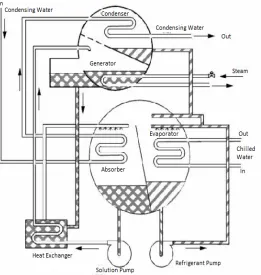
in air conditioning systems due to not very low temperature (above 0˚C) requirements. Fig. 1 demonstrates a lithium bromide vapor absorption system. The low system pressure is maintained along the absorber and the chilled evaporator that are sealed in a single compartment. Similarly, the high system pressure is maintained along the generator and condenser components. The water acts as a refrigerant is absorbed by lithium bromide solution in the absorber section creating weak mixture of water solution and lithium bromide solution. The pump pressurizes the weak solution towards the generator and some sort of renewable heat energy or waste energy is used for heating the weak solution. The liquid water changed its phase into vapor phase and these water vapors enter the condenser. The strong solution of lithium bromide moves to the absorber and absorbs the water refrigerant which is coming out from the evaporator. In condenser, water refrigerant loses heat and changes its phase into liquid. The pressure of the water is drastically decreased upon passing through the expansion valve. In evaporator, water gets the heat from the system and gets converted into vapour state that results a chilling effect in the system.
Figure 1: Lithium Bromide Absorption System Figure 2: Practical Lithium Bromide Absorption System
To eliminate the energy losses, the whole system is combined in two operating vessels as shown in Fig. 2. Combining the high pressure components and low pressure components together reduces the pressure drop occurring at the pipe bends and valves. This system is used in air conditioning devices generally. There is no issue of choking in this type of refrigeration system as the working refrigerant in this case is water itself. Crystallization problems may occur in the absorber unit, where the lithium bromide crystallizes after reaching a certain temperature if not controlled. Absence of a compressor makes it a noise free system and due to less moving parts, maintenance costs are also very low. Cooling temperature obtained in the evaporator is higher as compared to the compressor enabled systems due to less pressure ratio; hence it is used in cooling areas where temperature requirements are generally high
e
49
e
49
e49
e
49
e49
e
49
e49
e
49
e49
e
49
e
49
e
49
e
49
e49
e
49
e49
e
49
e49
e
49
e49
e
49
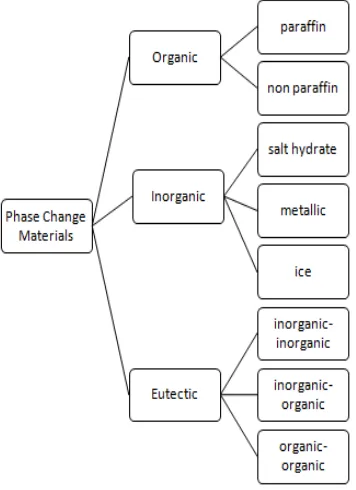
the system is not working or it can prevent temperature fluctuations inside the evaporator box. Types of Phase change materials are shown in Fig. 3.
Figure 3: Phase Change Material Classification
C. Incorporation of Phase Change Material in Evaporator: Phase change material can be incorporated into either of the two heat exchangers such as condenser and the evaporator. On investigating the use of PCM in both the heat exchangers, it was found that, the coefficient of performance (COP) of the system increases more significantly by using the PCM in the evaporator rather than using it in the condenser [1]. So, phase change material is used in the evaporator to reduce the work input given to the system. In the evaporator, water as a refrigerant is sprayed at very low pressure so that the heat is absorbed by the refrigerant easily. If the phase change material is incorporated in the evaporator, it can take away the heat generated inside the evaporator when the system is not working. This can reduce the amount of heat required at the generator for a long period of time. Therefore, this system can work in the areas where only low grade heat energy is available. This system can also be utilized in cold storage plants to reduce the overall work input to the system for a considerable amount of time.
3. Literature Review
An extensive literature survey on phase change material (PCM) in vapour absorption refrigeration system is carried out in order to ascertain the effectiveness and variation of refrigerating effect attained from the system.
Joybari et al. [1] had analyzed different ways of reducing the Exergy destruction in a domestic refrigerator. The main focus was on using the Phase Change Material (PCM) in the evaporator. The different comparisons of PCM types, thickness and their locations in the system had been done. It was found that using the PCM at the evaporator side was much better than applying it on the condenser side, but still some modifications were needed to select the most appropriate PCM type to be used in the evaporator side due to some undesirable results.
50
50
50
50
50
50
50
50
50
50
50
50
50
50
50
50
50
50
50
50
50
It was proved that during the switched off compressor time, the temperature inside the evaporator increased very slowly as compared to without PCM installation.
Rehman et al. [3] investigated the performance improvement of a simple vapor compression refrigeration system by using a Phase Change Material at the evaporator. A PCM box was built in which the liquid PCM would flow and circulate. The evaporator was kept within the PCM box so that a conductive heat transfer between the refrigerant and the PCM could take place. Due to the enhanced heat transfer, the COP of the system was increased. The use of water as the PCM had been suggested, but there could be an improvement in the selection of the PCM material.
Loaiza et al. [4] worked on the use of nano fluids as the secondary coolants in the vapor compression refrigeration system. The heat exchangers (condenser and evaporator) were multi-zoned in order to maintain the flow of both refrigerant and the nano-fluid. In condenser, nano fluid circulated through the outer circular section and inside circular section at the evaporator. The results in the simulation showed that with increase in volume fraction of nanoparticles and decrease in diameter of nanoparticles, the evaporator area and refrigerant pressure drop was reduced.
Sharma et al. [5] had analyzed the changes in COP and exergetic efficiency of the LiBr/H2O absorption refrigeration
system. The varying parameters in the analysis were the temperatures of the cooling water in condenser, absorber and generator. The results obtained showed that with decrease in the cooling water temperature, COP increased along with exergetic efficiency. Also, by increasing the heat source temperature, the COP increased up to a certain value of temperature, after that it stabilized and started decreasing further ahead. This was due to the loss of exergy in further increasing the heat input to the generator.
Kumar et al. [6] showed the comparisons between the pure POE oil, mineral oil and combination of mineral oil and alumina nanoparticles as lubricants in the vapor compression refrigeration system. It had been found that when the nanoparticles Al2O3 were used, the freezing efficiency of the system increased significantly. This was due to the
enhancement of the thermal properties of the refrigerant.
Yu et al. [7] worked on increasing the COP of Ejector Refrigeration system (ERS) and replaced with the new Ejector Refrigeration system (NERS). Same operating conditions were kept for both the systems. A better COP could be attained by incorporating NERS at the sake of higher pump work. Higher exergetic was also obtained in the new system.
Seara et al. [8] used the flooded evaporator in a conventional ammonia-water absorption system. The motive was to remove the trapped liquid from inside of the evaporator coils. A blow down system was used to remove the liquid content and also liquid entrainment occurred naturally due to the pressure difference in the system. COP was increased by incorporating the blow down system.
Kim et al. [9] performed various experiments to visualize the dispersion of SiO2 nano particles in binary nano fluids.
Distribution stability test, falling film absorption experiments and data reduction were done to analyze the improvements of heat transfer rate and mass transfer rate, which was calculated to be 46.8% and 18% respectively, keeping the SiO2
nanoparticle concentration up to 0.005 percentage of volume.
Arun et al. [10] found the finest value of the low pressure generator temperature that signified the vapour generated in the high pressure generator. R32-DMAC was found to be the best refrigerant at high evaporator temperature among all the environment friendly refrigerants.
e
51
e
51
e51
e
51
e51
e
51
e51
e
51
e51
e
51
e
51
e
51
e
51
e51
e
51
e51
e
51
e51
e
51
e51
e
51
capsules of different shapes in order to analyze the best possible shape for better heat transfer. A heat transfer fluid (water in this case) was used to transfer heat energy into the PCM capsules. Higher temperature and mass flow rate, combination of latent heat and sensible heat and cylindrical capsule shape were the recommendations made for better heat transfer according to the experiment results.
Lee et al. [12] simulated a lithium bromide and water absorption system to analyze the coefficient of performance (COP). First and second laws of thermodynamics and the mass conservation law were applied to each component such as generator, absorber, condenser, evaporator and expansion valve mathematically. Effect of rise in heat source temperature on COP and exergetic efficiency was studied.
Hosoz et al. [13] compared three types of condensers air-cooled, the water-cooled and the evaporative condensers. Vapour-compression refrigeration system was used to analyze the three types of condensers. It was concluded that the water cooled condenser showed a higher performance significantly over the other two. However, evaporative cooled condenser also showed some comparable results. Evaporative cooling was a better to handle process compared to the water cooled condenser, as it required less maintenance.
Wang et al. [14] performed an analysis of a novel solar bi-ejector refrigeration system. A new component called injector was added to the system and the pump was removed. Energy and exergy balance was performed on this system using R-123 refrigerant. Exergy losses were calculated for each component and comparisons were made.
A simulation was performed by Kabul et al. [15] using isobutene (R600a) as a refrigerant in the vapour compression refrigeration system. An internal heat exchanger was used in the conventional system and first and second laws of thermodynamics were applied on each component of the system. Results showed that with increase in condenser temperature, coefficient of performance, efficiency ratio and exergy of the system decreased. Furthermore, increase in evaporator temperature, all these parameters increased and the irreversibility rate decreased.
Simulation for an air cooled lithium bromide/water absorption refrigeration system was carried out by Oh et al. [16]. Parallel flow heat exchanger of compact size was used for simulation. Energy and mass balance equations were analyzed for each component of the absorption system. Effects of various parameters like solution concentration, air inlet temperature on the system performance were observed and analyzed.
Sayyaadi et al. [17] presented different optimization schemes for a cooling tower assisted conventional vapour compression refrigeration system. One of them was thermodynamic single objective optimization in which energy and exergy analysis was done. The cost analysis was done on each component and the whole system was based upon Total Revenue Requirement (TRR) method. Third optimization scenario was the multi-objective optimization which was the combination of both thermodynamic and economic optimizations.
Qureshi et al. [18] used different refrigerants in a conventional vapour compression refrigeration system and their results were compared. A dedicated mechanical sub-cooling instrument was used for two kinds of systems such as scratch and retrofit. R134a and R717 were used as the main cycle refrigerant one by one and results were analyzed. Effects of compressor sizing and fouling were also observed in the respective refrigeration system.
52
52
52
52
52
52
52
52
52
52
52
52
52
52
52
52
52
52
52
52
52
exergy was happened in the pump, heat exchanger and expansion valve and the highest exergy loss was taken place in the generator.
Gomri et al. [20] made a thermodynamic analysis of a double-effect vapour absorption refrigeration system. This system consisted of two heat exchangers and two generators such as high pressure generator and low pressure generator. Second law analysis was performed and energy/exergy balance equations were derived for the system. Analysis of each component of the system was done and it was observed that the maximum loss of exergy was corresponding to the absorber and the high pressure generator, therefore optimization of these two components should be done.
Zhu et al. [21] performed the first and second law thermodynamic analysis on a single staged ammonia/sodium thiocyanate absorption system. Sodium cyanate was used as an absorbent while ammonia was the absorptive. Each component was considered for mathematical modeling and exergy loss by each component was calculated separately. The coefficient of performance and exergetic efficiency were calculated by varying the operating parameters of the system.
Farshi et al [22] studied the possibility and risks of crystallization in a lithium bromide and water absorption refrigeration system. A simulation model of mathematical equations was developed to study the effects of operating conditions on crystallization process in the absorber. A comparative study of three cycles such as series, parallel and reverse parallel was done. Series flow system had greater possibility of crystallization as compared to parallel and reverse parallel cycles.
A parametric analysis of a diffusion absorption refrigeration heat pump system was done by Ziapour et al. [23]. Energy and mass balance equations for each component was derived and solved by simulation software EEP. The concentrations of strong and weak solutions were varied in order to compare the coefficient of performance at different concentrations. Thermo-syphon and absorber contributed to the maximum exergy losses, therefore their optimization was suggested.
Khaliq et al. [24] proposed a cogeneration cycle in a lithium bromide and water absorption system. Exergy analysis of the system was performed along with the thermal efficiency analysis. A comparison between the combined power and ejector refrigeration cycle and the proposed power and ejector-absorption refrigeration cycle was done and various conclusions were drawn from it. The calculations of energy and exergy losses by each component due to irreversibility were made. The proposed combined system showed an improvement in the exergetic and thermal efficiencies.
Nikolaidis et al. [25] checked the irreversibility rates of the condenser and evaporator of a two staged compound compression refrigeration system. Refrigerant R22 with flash intercooling was used in this system. A variation in the temperature of the condenser and evaporator units was made in order to check the irreversibility rates of these components. It was observed that even a small change in the irreversibility of these components could affect the whole system significantly. Hence, there was a room for improvement in the condenser of this refrigeration system.
An environment friendly substitute to the R502 refrigerant was presented by Xuan et al. [26]. This experimental study revealed that the physical properties of the ternary near azeotropic mixture of HFC-161 refrigerant were similar to R502 physical properties. The comparisons of coefficient of performances by using different refrigerants in the same system under different operating conditions were made. The Ozone Depletion Potential (ODP) and the Global Warming Potential (GWP) of HFC-161 was found to be lower than the R502, R507 and R404a.
e
53
e
53
e53
e
53
e53
e
53
e53
e
53
e53
e
53
e
53
e
53
e
53
e53
e
53
e53
e
53
e53
e
53
e53
e
53
Mafi et al. [28] did an experimental exergy analysis of a multistage cascaded refrigeration system used in the olefin plants. Exergy efficiency and exergy destruction of the main components like compressors, heat exchangers of the system were calculated, then the overall exergy analysis of the whole system was done. Two possible solutions to improve the exergy efficiency were discussed such as pinch and exergy analysis based and the mathematical modeling based. Development of a mixed refrigerant was also discussed while operating the system at the optimal operating pressure in order to improve the thermal efficiency of the system.
Dopazo et al. [29] reported the investigation of the designing variables of a carbon dioxide/ammonia cascaded cooling system. The study concentrated on the mathematical model and compared with the actual experimental results.
Herold et al. [30] worked on a hybrid refrigeration cycle which combined a mechanical compressor and an absorption system sharing a common evaporator. Lithium bromide/Water were utilized as the working fluids with water as the refrigerant. The refrigeration cycle had been worked upon using an oil free steam compressor. These types of compressors were not being used commonly due to their high capital cost and low isentropic efficiency. High setup cost and lower performance caused poor efficiency of the hybrid cycles. The internal behavior of the cycle was observed and outside temperatures were not taken into account.
Ahlby et al. [31] studied the working and performance of a compression/absorption heat pump with NH3-H2O-LiBr as the
ternary working liquid. It was observed that at 60% by mass salt concentration, the ternary mixture showed 10% better cycle performance than the binary fluid NH3/H2O. The properties of such mixtures were estimated from properties for
NH3-H2O. NH3-H2O-60% LiBr was not verified experimentally and the calculations were said to be unreliable. Results led
to infer that the best mixture would be a solution with salt concentration of 40-50% by mass.
Riffat et al. [32] presented the combination of vapour absorption and vapour compression refrigeration systems. Thermodynamic analyses of these systems using different pairs of working fluids were performed. Intermittent absorption system, the intermittent absorption/vapour recompression and the intermittent absorption/vapour compression system were analyzed in this experiment. Integration of vapour compression system with single effect, double effect series and double effect parallel continuous absorption system was discussed. It was concluded that integrated compression absorption systems could provide higher COP than individual systems.
Rane et al. [33] made a comparison of the effectiveness of double staged vapour compression heat pump. The equations of heat and mass balances of each part by developing computer simulation software were analyzed. Some values were taken as input parameter for heat exchanger calculations. It was found that the sequence having de-superheater led to the 40-50% higher coefficient of performance than the cycle with rectifier.
Itard et al. [34] studied the problems faced while modeling the compression/resorption heat pumps. An observation was made that log mean temperature difference (LMTD) process could not be used for modeling of heat exchanger and for COP calculations when working at high temperature ranges. It was inferred that a mixture of refrigerants was more advantageous than a pure refrigerant. The conclusion was that for a definite outside condition, an optimum overall concentration for the refrigerants existed which was the determining factor for the COP of the system.
54
54
54
54
54
54
54
54
54
54
54
54
54
54
54
54
54
54
54
54
54
Swinney et al. [36] inquired the variation of the composition variation of a refrigerant mixture that led to the reduction in compression ratio. The results revealed that the effectiveness of this absorption system could be compared with the conventional system.
Satapathy et al [37] made a thermodynamic analysis of a compression-absorption heat pump working on R-22-DMETEG for simultaneous heating and cooling. It was concluded that by operating the cycle at slightly higher discharge pressures than normal, excellent performance was achieved despite the necessary massive temperature lift.
Kairouani et al. [38] developed a novel combined refrigeration method and discussed the thermodynamic study of the particular cycle. The chance of using geothermal energy for hybrid method was studied. The R-717, R-22 and R-134a were used as working fluids. It was observed that COP of newly investigated system was higher than the single absorption unit when operating in the temperature range of 343- 349 K.
Yari et al [39] studied the hybrid absorption refrigeration systems by implementing first and second law of thermodynamics. Exergy analysis was followed in order to estimate the exergy destruction in each component. A marginal rise in efficiency (75%) was observed when the generator supplied the heat at a temperature ranged from 400 to 440 K.
4. Conclusion
A review of vapor absorption refrigeration system integrated with Phase Change Material (PCM) in the evaporator chamber has been presented. Physical and chemical properties of different types of PCM are studied and its application in the system are also analyzed. Some major conclusions drawn from this study are listed below:
• Absorption refrigeration system has significantly less harmful effect on the environment as compared to the compression refrigeration system.
• Phase Change material can be used to minimize or even nullify the temperature fluctuations in the evaporator chamber.
• Ethylene Glycol is one of the most effective Phase change materials that can be used for this purpose.
• Absorption refrigeration system requires less power input to work and it even works on waste heat rather than using electric current for a compressor.
• The Ozone Depletion Potential (ODP) and the Global Warming Potential (GWP) of HFC-161 is found to be lower than the R502, R507 and R404a.
• During switched off system condition, the Phase Change Material provides cooling inside the evaporator chamber for a long period of time.
• The sequence having de-superheater leads to the 40-50% higher coefficient of performance than the cycle with rectifier.
• Exergy analysis can be done on the PCM integrated system to find the contribution of each component in exergy destruction of the system.
• Hybrid systems containing both absorption and compression refrigeration cycle has a better coefficient of performance and energy efficiency as compared to the individual systems. Effectiveness can be improved by 10% by using hybrid system.
5. References
[1] M. M. Joybari, F. Haghighat, J. Moffat, P. Sra, “Heat and Cold Storage using Phase Change Materials in Domestic Refrigeration Systems: The State-of-the-Art Review”, Energy and Buildings, vol. 106, pp. 111-124, November 2015.
e
55
e
55
e55
e
55
e55
e
55
e55
e
55
e55
e
55
e
55
e
55
e
55
e55
e
55
e55
e
55
e55
e
55
e55
e
55
[3] Rezaur Rehman, Adnan Hasan, Shubhra Kanti Das, Md. Arafat Hossain, “Performance Improvement of a Domestic Refrigerator Using Phase change Material (PCM)”, IOSR Journal of Mechanical and Civil Engineering (IOSR-JMCE), vol. 10, Issue 4, Nov. - Dec., 2013.
[4] Loaiza, Pruzaeski and Parise, “A Numerical Study on the Application of Nanofluids in Refrigeration Systems”, International Refrigeration and Air Conditioning Conference Purdue University, 2010.
[5] Prashant Sharma, S. P. S. Rajput and Mukesh Pandey, “Exergetic analysis of LiBr-Water absorption system for Air conditioning applications”, International Journal of Latest Trends in Engineering and Technology (IJLTET), vol. 1, Issue 2, July 2012.
[6] R. Reji Kumar, K. Sridhar, M. Narasimha, “Heat transfer enhancement in domestic refrigerator using R600a/mineral oil/nano-Al2O3 as working fluid”, International Journal of Computational Engineering Research, vol. 03 Issue 4, 2013.
[7] Jianlin Yu, Hua Chen, Yunfeng Ren, Yanzhong Li, “A new ejector refrigeration system with an additional jet pump”, Applied Thermal Engineering vol. 26, pp. 312–319, February 2006,.
[8] Jose Fernandez-Seara and Jaime Sieres, “Ammonia–water absorption refrigeration systems with flooded evaporators”, Applied Thermal Engineering, vol. 26, pp. 2236–2246, December 2006.
[9] Hyundae Kim, Jinhee Jeong, Yong Tae Kang, “Heat and mass transfer enhancement for falling film absorption process by SiO2 binary nanofluids”, International Journal of Refrigeration vol. 35, pp. 645-651, May 2012.
[10] M. B. Arun, M. P. Mayia, S. Srinivasa Murthy, “Optimal performance of Double Effect series flow vapour absorption refrigeration systems with new working fluid”, International Journal of Energy Research, vol. 22, pp. 1001-1017, 1998.
[11] Kondakkagari Dharma Reddy, Pathi Venkataramaiah, Tupakula Reddy Lokesh, “Parametric Study on Phase
Change Material Based Thermal Energy Storage System”, Energy and Power Engineering, vol. 6, pp. 537-549, 2014.
[12] Shun-Fu Lee and S. A. Sherif, “Thermodynamic analysis of a lithium bromide/water absorption system for cooling and heating applications”, International Journal of Energy Research, vol. 25, pp. 1019-1031, 2001.
[13] M. Hosoz and A. Kilicarslan, “Performance evaluations of refrigeration systems with air-cooled, water-cooled and evaporative condensers”, International Journal of Energy Research, vol. 28 pp. 683–696, 2004.
[14] Fei Wang and Shengqiang Shen, “Energy and exergy analysis of novel solar bi-ejector refrigeration system with injector”, International Journal of Energy Research, vol. 34, pp. 815–826, 2010.
[15] Ahmet Kabul, Onder Kizilkan and Ali Kemal Yakut, “Performance and exergetic analysis of vapor compression refrigeration system with an internal heat exchanger using a hydrocarbon”, isobutane (R600a), International Journal of Energy Research, vol. 32, pp. 824–836, 2008.
[16] M. D. Oh, S. C. Kim, Y. L. Kim and Y. I. Kim, “Cycle analysis of an air-cooled LiBr/H2O absorption heat pump
of parallel-flow type”, Rev. International Froid, Numero 8, vol. 17, 1998.
[17] Hoseyn Sayyaadi, Mostafa Nejatolahi, “Multi-objective optimization of a cooling tower assisted vapor compression refrigeration system”, International Journal of Refrigeration, vol. 34, pp. 243-256, 2011.
[18] Bilal Ahmed Qureshi, Syed M. Zubair, “The effect of refrigerant combinations on performance of a vapor compression refrigeration system with dedicated mechanical sub-cooling”, International Journal of Refrigeration, vol. 35, pp. 47-57, 2012.
[19] Muhsin Kilic, Omer Kaynakli, “Second law-based thermodynamic analysis of water-lithium bromide absorption refrigeration system”, Energy, vol. 32, pp. 1505–1512, 2007.
[20] Rabah Gomri, Riad Hakimi, “Second law analysis of double effect vapour absorption cooler system, Energy Conversion and Management”, vol. 49, pp. 3343–3348, 2008.
56
56
56
56
56
56
56
56
56
56
56
56
56
56
56
56
56
56
56
56
56
[22] L. Garousi Farshi , S.M. Seyed Mahmoudi, M.A. Rosen, “Analysis of crystallization risk in double effect absorption refrigeration systems”, Applied Thermal Engineering, vol. 31, pp. 1712-1717, 2011.
[23] Behrooz M. Ziapour, Mohsen Tavakoli, “Performance study on a diffusion absorption refrigeration heat pipe cycle”, International Journal of Thermal Sciences, vol. 50, pp. 592-598, 2011.
[24] Abdul Khaliq, Basant K. Agrawal, Rajesh Kumar, “First and second law investigation of waste heat based combined power and ejector-absorption refrigeration cycle”, International Journal of Refrigeration, vol. 35, pp. 88-97, 2012.
[25] Nikolaidis and Probert, “Exergy-method analysis of a two-stage vapor-compression refrigeration-plants performance”, Applied Energy, vol. 60, pp. 241-256, 1998.
[26] Yongmei Xuan, Guangming Chen, “Experimental study on HFC-161 mixture as an alternative refrigerant to R502”, International Journal of Refrigeration, vol. 28, Issue 3, pp. 436-441, 2005
[27] Bjorn Palm, “Hydrocarbons as refrigerants in small heat pump and refrigeration systems –A review”,
International Journal of Refrigeration, vol. 31, pp. 552-563, 2008.
[28] M. Mafi, S.M. Mousavi Naeynian, M. Amidpour, “Exergy analysis of multistage cascade low temperature refrigeration systems used in olefin plants”, International Journal of Refrigeration, vol. 32, pp. 279-294, 2009.
[29] J. Alberto Dopazo, José Fernández-Seara , Jaime Sieres, Francisco J. Uhía, “Theoretical analysis of a CO2–NH3
cascade refrigeration system for cooling applications at low temperatures”, Applied Thermal Engineering, vol. 29, pp. 1577–1583, 2009.
[30] Keith E. Herold, Lawrence A. Howe and Reinhard Radermacher, “Analysis of a hybrid compression- absorption cycle using lithium bromide and water as the working fluid”, International Journal of Refrigeration, vol. 14, Issue 5, pp. 264-272, 1991.
[31] Lena Ahlby and David Hodgett, “NH3/H2O-LiBr as working fluid for the compression/absorption cycle”, Rev.
International Froid, vol. 16, No. 4, 1993.
[32] S.B. Riffat and N. Shankland, “Integration of Absorption and Vapour Compression systems”, Applied Energy, vol. 46, pp. 303-316, 1993.
[33] Milind V. Rane, Karim Amrane, Reinhard Radermacher, ”Performance enhancement of a two stage vapour
compression heat pump with solution circuits by eliminating the rectifier”, Rev. International Froid, vol. 16, No. 4, 1993.
[34] L. C. M. Itard and C. H. M. Machielsen, “Considerations when modeling compression/resorption heat pumps”, Rev. International Froid, vol. 17, No. 7, 1997.
[35] R. Ayala, C. L. Heard, F. A. Holland, “Ammonia/Lithium Nitrate Absorption/Compression Refrigeration cycle. Part 1 Simulation”, Applied Thermal Engineering, vol. 17, No. 3, pp. 223-233, 1997.
[36] J. Swinney, W.E. Jones and J.A. Wilson, “A novel hybrid absorption-compression refrigeration cycle”, International Journal of Refrigeration, vol. 24, pp. 208-219, 2001.
[37] P. K. Satapathy, M. Ram Gopal, R. C. Arora, “A comparative study of R22–E181 and R134a–E181 working pairs for a compression–absorption system for simultaneous heating and cooling applications”, Journal of Food Engineering, vol. 80, pp. 939–946, 2007.
[38] L. Kairouani, E. Nehdi, “Cooling performance and energy saving of a compression– absorption refrigeration system assisted by geothermal energy”, Applied Thermal Engineering, vol. 26, pp. 288–294, 2006.