14
Copyright © 2016. Vandana Publications. All Rights Reserved.
Volume-6, Issue-6, November-December 2016
International Journal of Engineering and Management Research
Page Number: 14-18
A Study on the Factors Influencing the Performance of LIC of India
during the Post Reform Period
Suganthamani C.V1, Dr. M.Nagesh Kumari2 1
Assistant Professor, Ahalia School of Management, Palakkad, INDIA 2Assistant Professor, P.S.G.R Krishnamaal College for Women, Coimbatore, INDIA
ABSTRACT
The structure of the service sectors have undergone
a drastic change after liberalization, privatization
andglobalization of the Indian economy, in general, and the insurance sector in particular. For almost four decades LIC had been the sole player with virtual monopoly in the life insurance sector. In the early 90’s the Government of India ventured into the policy of liberalization, privatization and globalization. It was assumed that the entry of so many companies in this sector was likely to affect the performance of Life Insurance Corporation. Thus, the Life Insurance public sector giant, i.e. LIC, which never faced competition earlier, would compete with the private players who boast the rich and long experience of their partners from the developed countries of the world. They are also coming up with different types of innovative policies and other strategic plans. It is also expected that the total business of Life Insurance Corporation, in terms of premium, sum assured and number of policies and its market share would get affected. It is, therefore, necessary to study the business performance of Life Insurance Corporation (LIC) after the liberalization policy regime and also the changes that might have occurred or any restructuring that might have been done by the LIC in the wake of entry of private players in the Life Insurance Sector. Hence, it becomes imperative to evaluate the performance of Life Insurance Corporation of India and its determinants.
Keywords--- Globalization, Insurance Penetration, Density, savings and Investment
I.
INTRODUCTION
A thriving insurance sector is of vital importance to every modern economy. Firstly it encourages the habit of savings, secondly it provides a safety net to rural and urban enterprises and perhaps most importantly it generates long - term invisible funds for infrastructure building. The nature of the insurance business is such that the cash inflow of insurance companies is constant while
the payout is deferred and contingency related. This characteristic feature of their business makes insurance companies the biggest investors in long-gestation infrastructure development projects in all developed and aspiring nations.
With the globalization of financial services and liberalization of economy, wider ramifications and rapid development in insurance have been taken place. Insurance business is one of the fast emerging financial services, predominantly in the developing nation like India, in terms of the population it services. In the new economic reality of globalization, insurance companies face a dynamic global business environment. Radical changes are taking place owing to the internationalization of activities, the appearance of new risks, and new types of covers to match with new risk situations, unconventional and innovative ideas on customer services. Low growth rates in developed markets, changing customer needs, and the uncertain economic conditions in the developing world are exerting pressure on insurer’s resources while testing their ability to survive.
II.
OBJECTIVES OF THE STUDY
To understand the importance of insurance sector in the Indian economy.
To know the key determinants for evaluating the performance of Life Insurance Corporation of India during the post- LPG era
To identifyall the factors influencing the performance of LIC of India.
III
.
RESEARCH METHODOLOGY
15
Copyright © 2016. Vandana Publications. All Rights Reserved.
Secondary data. Secondary data have been collected fromthe relevant annual reports of Life Insurance Corporation of India, statistical year book of LIC, Yogakshema and various news bulletins of the LIC. The annual reports of IRDA and other related literature are used for the collection of data. Apart from these various magazines devoted to the issues related to insurance like Insurance Chronical, Insurance Times, Business Today, Business World etc. have also been used to supplement data and information required for the study. A number of other websites relating to insurance business such as www.licindia.com, www.irdaindia.com etc have also been visited for the purpose of data collection. These variables have been identified as per the objectives of the study.
In spite of having many parameters for analyzing the performance of Insurance Industry the paper analyses the parameters like Insurance Penetration, Insurance Density, total premium underwritten, Market share, total number of policies and few important parameters which are considered as universally assessed parameters.
IV.
GROWTH AND PERFORMANCE
OF LIFE INSURANCE CORPORATION
At the end of March 2015, there are fifty-three insurance companies operating in India; of which twenty four are in the life insurance business and twenty-eight are in non-life insurance business. In addition, General Insurance Corporation (GIC) is the sole national reinsurer. The life insurance industry recorded a premium income of 3,28,101.14crore during 2014-15 as against 3, 14,301.66crore during 2013-14 , registering a growth of
4.39 per cent. While private sector insurers posted 14.32 per cent decline (1.33 per cent decline in previous year) in their premium income, Life Insurance Corporation (LIC), the fully state owned insurance company, recorded 1.15 per cent growth (13.48 per cent growth in previous year). While the renewal premium accounted for 65.46 per cent (61.72 per cent in 2013-14) of the total premium received by the life insurers, first year premium contributed the remaining 34.54 per cent (38.28 per cent in 2013-14).During 2014-15, the growth in renewal premium was 10.72 per cent (7.85 per cent in 2013-14). First year premium registered a decline of 5.82 per cent in comparison to a growth of 12.08 per cent during 2013-14.
The fact that LIC has stood up to competition in a decade and continues to occupy a major share of the market space is a testimony to the commitment of its employees and agents and to the quickness with which it has adapted to the changing environment. LIC’s performance in all spheres thus has been excellent. However a closer scrutiny would reveal that performance is not uniform across sections, particularly amongst the marketing force and the huge variation in productivity is a cause for concern. Appropriate HRD interventions and training can help raise the overall level of performance. It is important that the administrative teams and marketing teams work with greater cohesion and activities are carried out with due co ordination. It is felt that LIC is able to realize these two objectives of focusing on the bottom of the pyramid and making its operating units even more customer centric and agent friendly, the results can be phenomenal and will enable LIC to continue to outwit and outmaneuver its competitors and improve its market share.
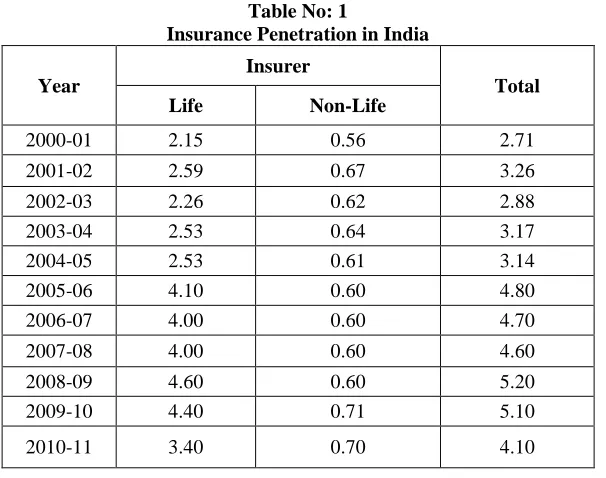
Table No: 1
Insurance Penetration in India
Year
Insurer
Total Life Non-Life
2000-01 2.15 0.56 2.71
2001-02 2.59 0.67 3.26
2002-03 2.26 0.62 2.88
2003-04 2.53 0.64 3.17
2004-05 2.53 0.61 3.14
2005-06 4.10 0.60 4.80
2006-07 4.00 0.60 4.70
2007-08 4.00 0.60 4.60
2008-09 4.60 0.60 5.20
2009-10 4.40 0.71 5.10
16
Copyright © 2016. Vandana Publications. All Rights Reserved.
2011-12 3.17 0.78 3.96
2012-13 3.1 0.8 3.9
2013-14 2.6 0.7 3.3
Insurance penetration is measured as ratio of premium (in US Dollars) to GDP (in US Dollars). Source: Swiss Re, Various Issues
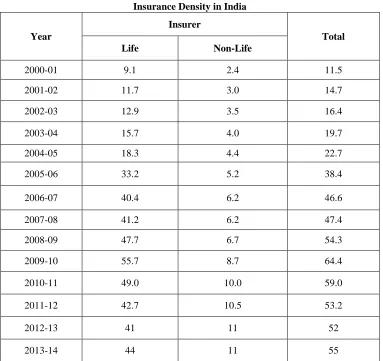
Table no.1 reveals the insurance penetration in India for the year 2000 to 2014. The potential and performance of the insurance sector is assessed through insurance penetration and insurance density. Insurance penetration is defined as the ratio of premium underwritten in a given year to the gross domestic product (GDP). Insurance density is defined as the ratio of premium underwritten in a given year to the total population
(measured in USD for convenience of comparison). The insurance penetration was 2.71 per cent (Life 2.15 per cent and Non life 0.56 per cent) in the year 2000-01 when the sector was opened up for private sector. It had increased at a diminishing phase of about3.3 per cent in 2013-14 (Life: 2.6 per cent and Nonlife: 0.70per cent), in spite of having a good premium record during 2009 to 2010.
Table No.2 Insurance Density in India
Year
Insurer
Total
Life Non-Life
2000-01 9.1 2.4 11.5
2001-02 11.7 3.0 14.7
2002-03 12.9 3.5 16.4
2003-04 15.7 4.0 19.7
2004-05 18.3 4.4 22.7
2005-06 33.2 5.2 38.4
2006-07 40.4 6.2 46.6
2007-08 41.2 6.2 47.4
2008-09 47.7 6.7 54.3
2009-10 55.7 8.7 64.4
2010-11 49.0 10.0 59.0
2011-12 42.7 10.5 53.2
2012-13 41 11 52
2013-14 44 11 55
Insurance density is measured as ratio of premium (in US Dollar) to total population Source: Swiss Re, Various Issues
Table No.2 reveals that the insurance density stood at USD 55 in 2013-14 (Life USD 44 and Non-life
17
Copyright © 2016. Vandana Publications. All Rights Reserved.
TABLE No: 3
Gross Direct Premium Underwritten By Life Insurers
Rs. In Crores
Year LIC Growth Rate Total
2000-01 34892.02 - 34898.47
2001-02 49821.91 42.79 50094.46
2002-03 54628.49 9.65 55747.55
2003-04 63533.43 16.30 66653.75
2004-05 75127.29 18.25 82854.80
2005-06 90792.22 20.85 105875.76
2006-07 127822.84 40.79 156065.32
2007-08 149789.99 17.19 201351.41
2008-09 157288.04 5.01 221785.47
2009-10 186077.31 18.30 265450.37
2010-11 203473.40 9.35 291638.64
2011-12 202889.28 -0.29 287072.11
2012-`13 208803.58 2.92 287202.9
2013-14 236942.30 13.48 31301.66
Source: IRDA Annual Report 2011-12
The above table reveals that Life Insurance Corporation of India recorded a growth rate of 13.48% during the year 2013-14 as against 2.92 % during 2012-13. Gross Direct Premium of LIC registered 23692.30crores during the year 2013-14 as against Rs.208803.58 crores during 2012-13.
V.
CONCEPTUAL FRAMEWORK OF
PERFORMANCE OF LIC DURING
POST-LIBERALIZATION
To study the performance of the entity, the three basic diagnostic tools referred by the Management Guru, Peter Drucker in his book “Essential wisdom of Peter Drucker from the pages of Harvard Business Review ” namely Competence, Productivity and Allocation was taken as the base in terms of Performance, Productivity and Investment. The following are the list of key determinants sourced from the balance sheets and the annual reports of Insurance Regulatory and Development Authority of
India, the sole governing body of Insurance apart from Insurance Penetration and density.
Determinants for assessing the Performance of LIC: The performance of LIC can be evaluated on the basis of the following indices:
New Business in India New Business out of India Business in force in India Business in force out of India New Rural Business
Gross Direct Premium Underwritten Market Share of LIC
Total Number of New Policies of LIC Number of Offices of LIC
First Year (Including single Premium) of LIC Solvency Ratio of LIC
Life Insurance fund Claim settlement operations
Number of Individual and Corporate agents Status of Grievances
18
Copyright © 2016. Vandana Publications. All Rights Reserved.
Total Income of LIC Total Outgo of LIC
Ratio of Total Outgo to Total Income
Share of Life Fund in Total Assets under Management of LIC
Total Investments of LIC Total Assets of LIC
Determinants for assessing the Productivity of LIC: New business per branch
New business per agent Number of policies per branc Number of policies per agent Premium income per agen Premium income per branch
Determinants for assessing the Profitability of LIC Profit Before Tax
Profit After Tax
VI.
CONCLUSION
The Insurance Industry in India has witnessed a sea-change ever since it was opened to private players in 1999. The Life Insurance Corporation of India needs to welcome competition with open arms and treat it as an opportunity rather than a threat. The ultimate objective of reforms is to increase insurance density and penetration levels by designing more tailor made products for customers. LIC now needs to use its reach and visibility to penetrate deeper into the Indian market. Thus it becomes
imperative to know and assess the various parameters which are used in evaluating the performance of LIC as needed in this competitive industry.
REFERENCES
[1] N.C.Sharma(2011),“A Decade of Competition ( 2001-02 to 2010-11 ) LIC is the Clear WinnerII”Yogakshema Vol. 55 No 8 August 2011.
[2] NeelamGulati and C.M. Jain (2013) “A Study of Impact of Liberalization of Indian Insurance Sector on the strategies of Life Insurance Corporation of India Since 2001” VSRD International Journal of Business and Management Research, Vol. 3 No. 2 February 2013 [3] Mr. BidyadharPadhi and DrMayadharSatpathy (2013) “Performance of LIC of India after Liberalization” International Journal of Engineering Research & Technology (IJERT) Vol. 2 Issue 4, April - 2013
[4] V. Prabakaran and J. M.Velmurugan (2012), “An analysis of the Growth of Life Insurance Corporation of India – in the context of post liberalization era”, IJMIE Volume 2, Issue 5 May 2012
[5] Dr. SangeethaNatarajan (2013),“Determinants For Evaluating Life Insurance Corporation of India” Journal of Business Management & Social Sciences Research (JBM&SSR)Volume 2, No.9, September 2013