6858 FORMULATION AND EVALUATION OF SOLID DISPERSION OF
RIVAROXABAN CAPSULE
S. D Mankar1*M.S.Bhosale2
Department of Pharmaceutics, Pravara Rural College of Pharmacy, Pravaranagar, Maharashtra India
*Corresponding author E-mail: [email protected]
ARTICLE INFO ABSTRACT
Key Words
Solid Dispersion, Rivaroxaban, Permeability, Solubility,
stability studies.
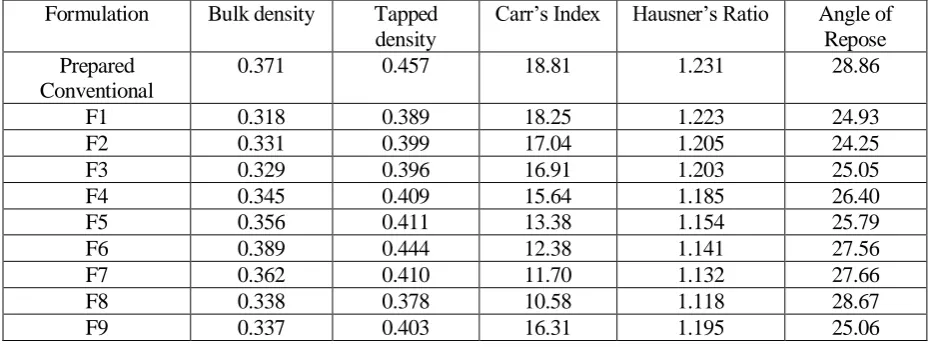
The present study was aimed at preparing solid dispersion of Rivaroxabanto enhance its dissolution rate. Rivaroxaban is a poorly water soluble anti-diabetic drug which belongs to BCS class II drugs. Hence, it will be beneficial to increase its dissolution rate in order to improve its bioavailability by solid dispersion technique. The flow properties of the solid dispersions were influenced by physical, mechanical as well as environmental factors. The powder flowability can be determined by evaluating parameters such as the Bulk & Tapped densities, compressibility or Carr’s index, Hauser’s ratio and the Angle of repose. The bulk and tapped densities for solid dispersions powders were illustrated, the mean densities of liquid-solid powders were found to be from 0.318 to 0.389 g/cm3 for bulk density and from 0.378 to 0.444 g/cm3 for tapped density. Stability studies
were carried out at 25˚C/60% RH, 30˚C/75% RH, 40˚C/75% RH for 3 months and there were no significant changes in physical and chemical properties of capsule of formulation F12 after 3 months. Based on the result F8 formulation was considered as the optimized formulation to design the solid dispersion by kneading method.
INTRODUCTION
The oral route of drug administration is the route of choice for the formulators and continues to dominate the area of drug delivery technologies. However, though popular, this route is not free from limitations of absorption and bioavailability in the milieu of gastrointestinal tract. Whenever a dosage form is administered orally, drug in the dosage form is released and dissolves in the surrounding gastrointestinal fluid to form a solution. This process is solubility limited. Once the drug is in the solution form, it passes across the membranes of the cells lining the gastro-Intestinal tract. This process is permeability limited. Then onwards the drug is absorbed into systemic circulation. In short, the oral
absorption and hence bioavailability of drug is determined by the extent of drug solubility and permeability. [1]
A drug with poor bioavailability is the one with [2]
1. Poor aqueous solubility and slow dissolution rate in the biological fluids. 2. Poor stability of the dissolved drug at the physiological pH.
3. Inadequate partition coefficient and thus poor permeation through the biomembrane. 4. Extensive pre-systematic metabolism. Three approaches in overcoming the bioavailability problems due to such causes are
1. The pharmaceutics approach which involves modification of formulation, manufacturing process, or the
Journal of Global Trends in Pharmaceutical Sciences
6859 physiochemical properties of the drug
without changing the chemical structure. 2. The pharmacokinetic approaches in which the pharmacokinetics of the drug is altered by the modifying its chemical structure.
3. The biological approach whereby the route of the drug administration may be changed such as changing from oral to parental route.
The second approach of chemical modification has a number of drawbacks of being very expensive and time consuming, require repetition of clinical study and long time for regulatory aspects. Figure 1 illustrate the two rate determining steps (RDS) in the absorption of drugs from orally administered formulations
Solid Dispersions
The term solid dispersion refers to a group of solid products consisting of at least two different components generally a hydrophilic matrix and a hydrophobic drug. The matrix can be either crystalline or amorphous. The drug can be dispersed molecularly, in amorphous particles (clusters) or in crystalline particles. Chiou and Riegelman defined solid dispersions as “The dispersion of one or more active ingredients in an inert excipients or matrix, where the active ingredients could exist in finely crystalline, solubilized, or amorphous states” [17]
. Sekiguchi and Obi in 1961 first developed the concept of solid dispersion to enhance absorption of poorly water-soluble drugs. It involved the formation of eutectic mixtures of drugs with water-soluble carriers by melting of their physical mixtures, and once the carriers dissolved, the drug precipitated in a finely divided state in water. Later, Goldberg et al. demonstrated that a certain fraction of the drug might also be molecularly dispersed in the matrix, forming solid solutions, while other investigators reported that the drug might be embedded in the matrix as amorphous materials [19].
Drug Profile MATERIALS:
Rivaroxaban bulk drug was supplied as a gift sample from Mega-Fine Pharma Pvt Ltd. PEG 6000, PEG 20000, HPMC E15 were
procured from S D Fine chem. Ltd. Mumbai ,HPC LH21, SOLUPLUS were procured from Colorcon, Mumbai and β-Cyclodextrin from Himedialaboratotypvt. Mumbai.
Determination of solubility
The solubility of Rivaroxaban in water, 0.1N HCL buffer, 6.8 Phosphate buffer, 4.5 Acetate buffer and six carriers tried to prepare the solid dispersions, namely, Polyethylene glycol 6000, Polyethylene glycol 20000, HPMC E15, HPC LH21, SOLUPLUS, β-Cyclodextrin were studied by preparing saturated solutions of the drug in these solvents and analyzing their drug content spectrophotometrically. Specially, Rivaroxaban was mixed in 7ml screw capped vials with such amounts of each of the above solvents in order to produce systems containing an excess of drug. The mixtures were shaken on an automatic test tube shaking machine for 24 hours and then settled for another 2 hours. The screw capped vials were centrifuged at 2500 Rpm for further settling of un-dissolved crystalline material and thereby obtaining a clear supernatant. After centrifugation, accurately measured quantities of the filtered supernatant solutions were further diluted with methanol and analyzed spectrophotometrically at 270 nm for their drug content. The results were extrapolated to determine the percent mg/ml of Rivaroxaban in its saturated solution with the solvents under investigation.
Melting point determination:
Melting point of the drug sample was determined by capillary method by using Melting point apparatus.
METHOD Physical Method:
6860 dried properly using hot air oven at 45ºC for
1 hour. The dried mixture was passed through sieve no 80 and stored in desiccators for further study.
Kneading Method:
The kneading complexes were prepared using Rivaroxaban drug andPolyethylene glycol 6000, Polyethylene glycol 20000, HPMC E15, HPC LH21, SOLUPLUS, β-Cyclodextrin as carriers. The pure drug was considered as formulation F0. The required quantity of carriers was weighed in electronic balance, taken in a mortar and it was dissolved in Isopropyl alcohol by using pestle. Accurately weighed quantity of drug was then added to isopropyl alcohol solution of carrier. The dispersion was then continuously stirred to form a paste was prepared. Above paste thus prepared was kneaded properly and kneaded complex was dried properly using hot air oven at 45ºC for 1Hour. Then dried kneaded complex was passed through sieve no 80 and stored in desiccators for further study.Composition of each ingredient is shown in table 1.
Encapsulation:
The prepared solid dispersion were mixed with lactose, magnesium Stearate and Aerosil and filled into capsules.
EVALUATION OF POWDER BLEND: Determination of bulk density & tapped density:
An accurately weighed quantity of the granules/ powder (W) was carefully poured into the graduated cylinder and volume (V0) was measured. Then the
graduated cylinder was closed with lid and set into the tap density tester (USP). The density apparatus was set for 100 tabs and after that the volume (Vf) was measured and
continued operation till the two consecutive readings were equal (Lachman et al., 1987). The bulk density and the tapped density were calculated using the following formulae:
Bulk density = W/V0
Tapped density = W/Vf
Where, W= Weight of the powder V0 = Initial volume
Vf = final volume
Compressibility Index (Carr’s index): Carr’s index (CI) is an important measure that can be obtained from the bulk and tapped densities. The less compressible material is the more flowable. (Lachman et al., 1987).
CI = (TD-BD) x 100/TD
Where, TD is the tapped density and BD is the bulk density.
Hausner’s Ratio: It is the ratio of tapped density and bulk density. Generally, a value less than 1.25 indicates good flow properties, which is equivalent to 20% of Carr’s index.
Angle of repose: The angle of repose of powder blend was determined by the funnel method. The diameter of the powder cone was measured and angle of repose (θ) was calculated using the following equation:
θ=tan
-1
h/r
Where, h and r are the height and radius of the powder cone.
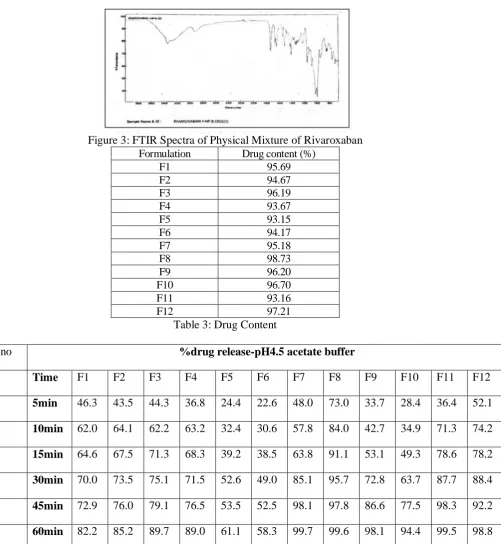
Compatibility studies: IR spectra matching approach was used for detection of any possible chemical interaction between drug and polymer. A physical mixture (1:1) of drug and polymer was prepared and mixed with the suitable quantity of potassium bromide. About 100mg of mixture was compressed to form a transparent pellet using a hydraulic press at 6tons pressure .It was scanned from 4000 to 400 cm-1 in FTIR spectrometer. The IR spectrum of the physical mixture was compared with those of pure drug and polymers and matching was done to detect any appearance or disappearance of peaks.
EVALUATION OF CAPSULES:
6861 resulting solution at 270nm in UV. Results
are shown in Table no (15).
In-vitro drug release studies: In vitro drug release of the samples was carried out using USP-type I dissolution apparatus (Basket type). The dissolution mediums, used was 4.5 Acetate buffer 900ml (as specified by the office of generic drugs USFDA), placed into the dissolution flask maintaining the temperature of 37±0.5oC.
Rivaroxabancapsule were placed in each flask of dissolution apparatus. The apparatus was allowed to run for 1 hour at 50 RPM. Samples measuring 10ml were withdrawn at specified time intervals. The samples were filtered and analyzed at 270 nm. The cumulative percentage drug release was calculated.
Release kinetics: The results of in vitro
release profile obtained for all the
formulations were plotted in modes of data treatment as follows.
1. Log cumulative percent drug remaining versus time (first order kinetic model) 2. Cumulative percent drug release versus time. (Zero order kinetic model)
Zero-Order Kinetics:
A zero-order release would be predicted by the following equation.
At = Ao- Kot
Where, At = Drug release at time t Ao = Initial drug concentration
Ko = Zero-order rate constant
(hr)
When the data is plotted as cumulative percent drug release versus time if the plot is linear then the data obeys zero-order release kinetics, with a slope equal to ko..
First-Order Kinetics:
A first order release would be predicted by the following equation.
Log C = Log Co - Kt / 2.303 Where, C = Amount of drug remained at time t
Co = Initial amount of drug
K = First-order rate constant When the data is plotted as log cumulative percent drug remaining versus time yields a straight line indicating the release follows first-order kinetics, the
constant k can be obtained by multiplying 2.303 with slope values
Stability Studies:
For all the pharmaceutical dosage forms it is important to determine the stability of the dosage form. This will include storage at exaggerated temperature conditions, with the necessary extrapolations to ensure the product will, over its designed shelf life, provide medication for absorption at the same rate as when originally formulated.
Selected Formulation was subjected to stability studies as per ICH guidelines. Following conditions were used for Stability Testing:
1. 25˚C/60% RH analyzed every month for period of three months.
2. 30˚C/75% RH analyzed every month for period of three months.
3. 40˚C/75% RH analyzed every month for period of three months.
RESULT & DISCUSSION:
Evaluation of flowability and compressibility of solid dispersion powders:
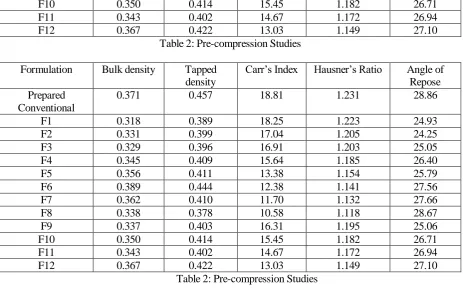
Powder flow properties are crucial in handling and processing operations such as flow from hoppers, mixing and compression. The flow properties of the solid dispersions were influenced by physical, mechanical as well as environmental factors. The powder flowability can be determined by evaluating parameters such as the Bulk & Tapped densities, compressibility or Carr’s index, Hausner’s ratio and the Angle of repose. The results obtained for evaluation of compressibility index and Hausner’s ratio is in Table 2
Compatibility studies:
6862
Table 1. Formulation of solid dispersion
Formulation Bulk density Tapped density
Carr’s Index Hausner’s Ratio Angle of Repose Prepared
Conventional
0.371 0.457 18.81 1.231 28.86
F1 0.318 0.389 18.25 1.223 24.93
F2 0.331 0.399 17.04 1.205 24.25
F3 0.329 0.396 16.91 1.203 25.05
F4 0.345 0.409 15.64 1.185 26.40
F5 0.356 0.411 13.38 1.154 25.79
F6 0.389 0.444 12.38 1.141 27.56
F7 0.362 0.410 11.70 1.132 27.66
F8 0.338 0.378 10.58 1.118 28.67
F9 0.337 0.403 16.31 1.195 25.06
Ingredients mg/ tab mg/t ab mg/t ab mg/t ab mg/t ab mg/t ab mg/t ab mg/ tab mg/t ab mg/t ab mg/t ab mg/t ab
F1 F2 F3 F4 F5 F6 F7 F8 F9 F10 F11 F12
1 Rivaroxaban 20m g 20m g 20m g 20m g 20m g 20m g 20m g 20 mg 20m g 20m g 20m g 20m g
2 PEG6000 30m
g
30m
g - - - -
3 PEG20000 - - 30m
g
30m
g - - - -
4 HPMC E15 - - - - 30m
g
30m
g - - - -
5 Soluplus - - - 30m
g 30
mg - - - -
6
Β-Cyclodextrin - - - -
30m g
30m
g - -
7 HPC L21 - - - 30m
g
30m g
8 Lactose 38m
g 38m g 38m g 38m g 38m g 38m g 38m g 38 mg 38m g 38m g 38m g 38m g
9 Aerosil 1mg 1mg 1mg 1mg 1mg 1mg 1mg 1m
g 1mg 1mg 1mg 1mg
10 Mg Sterate 1mg 1mg 1mg 1mg 1mg 1mg 1mg 1m
g 1mg 1mg 1mg 1mg
11 Iso Propyl
Alcohol -
0.2m
l -
0.2m
l -
0.2m
l -
0.2 ml -
0.2m
l -
0.2m l
12 Wt of
Ingredients 100 100 100 100 100 100 100 100 100 100 100 100
13 Method of Preparation Phys ical Met hod Kne adin g Met hod Phys ical Met hod Kne adin g Met hod Phys ical Met hod Kne adin g Met hod Phys ical Met hod Kn ead ing Me tho d Phys ical Met hod Kne adin g Met hod Phys ical Met hod Kne adin g Met hod
6863
F10 0.350 0.414 15.45 1.182 26.71
F11 0.343 0.402 14.67 1.172 26.94
F12 0.367 0.422 13.03 1.149 27.10
Table 2: Pre-compression Studies
Formulation Bulk density Tapped density
Carr’s Index Hausner’s Ratio Angle of Repose Prepared
Conventional
0.371 0.457 18.81 1.231 28.86
F1 0.318 0.389 18.25 1.223 24.93
F2 0.331 0.399 17.04 1.205 24.25
F3 0.329 0.396 16.91 1.203 25.05
F4 0.345 0.409 15.64 1.185 26.40
F5 0.356 0.411 13.38 1.154 25.79
F6 0.389 0.444 12.38 1.141 27.56
F7 0.362 0.410 11.70 1.132 27.66
F8 0.338 0.378 10.58 1.118 28.67
F9 0.337 0.403 16.31 1.195 25.06
F10 0.350 0.414 15.45 1.182 26.71
F11 0.343 0.402 14.67 1.172 26.94
F12 0.367 0.422 13.03 1.149 27.10
Table 2: Pre-compression Studies
Figure 1: Two rate determining steps (RDS) in the absorption of drugs from orally administered formulations
6864 Figure 3: FTIR Spectra of Physical Mixture of Rivaroxaban
Formulation Drug content (%)
F1 95.69
F2 94.67
F3 96.19
F4 93.67
F5 93.15
F6 94.17
F7 95.18
F8 98.73
F9 96.20
F10 96.70
F11 93.16
F12 97.21
Table 3: Drug Content
Sr.no %drug release-pH4.5 acetate buffer
Time F1 F2 F3 F4 F5 F6 F7 F8 F9 F10 F11 F12
1 5min 46.3 43.5 44.3 36.8 24.4 22.6 48.0 73.0 33.7 28.4 36.4 52.1
2 10min 62.0 64.1 62.2 63.2 32.4 30.6 57.8 84.0 42.7 34.9 71.3 74.2
3 15min 64.6 67.5 71.3 68.3 39.2 38.5 63.8 91.1 53.1 49.3 78.6 78.2
4 30min 70.0 73.5 75.1 71.5 52.6 49.0 85.1 95.7 72.8 63.7 87.7 88.4
5 45min 72.9 76.0 79.1 76.5 53.5 52.5 98.1 97.8 86.6 77.5 98.3 92.2
6 60min 82.2 85.2 89.7 89.0 61.1 58.3 99.7 99.6 98.1 94.4 99.5 98.8
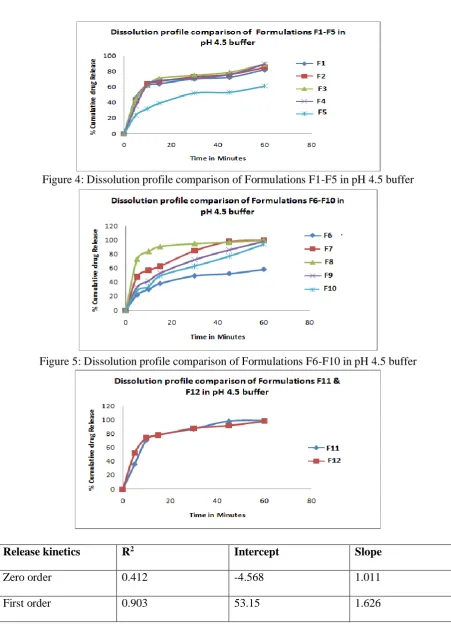
6865 Figure 4: Dissolution profile comparison of Formulations F1-F5 in pH 4.5 buffer
Figure 5: Dissolution profile comparison of Formulations F6-F10 in pH 4.5 buffer
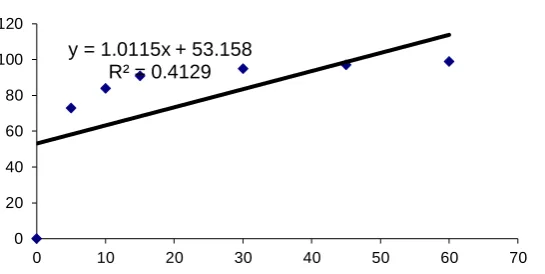
Release kinetics R2 Intercept Slope
Zero order 0.412 -4.568 1.011
First order 0.903 53.15 1.626
6866
Zero Order:
Figure 7: Release profile of Rivaroxaban solid dispersion according to Zero Order
First Order:
Figure 8: Release profile of Rivaroxaban solid dispersion according to First Order Formulation
code
Parameters Initial 1st Month 2nd Month 3rd Month Limits as per specifications
F8 25˚C/60%RH
% Release
97.11 96.87 96.66 96.64 NLT 85%
F8 30˚C/75%RH %
Release
97.05 96.89 96.88 96.41 NLT 85%
F8 40˚C/75%RH %
Release
97.11 96.92 96.63 96.62 NLT 85%
F8 25˚C/60%RH
Assay value
97.72 96.70 96.19 95.69 NLT 90%
NMT 110%
F8 30˚C/75%RH
Assay value
97.72 97.71 96.20 95.69 NLT 90%
NMT 110%
F8 40˚C/75%RH
Assay value
97.21 97.20 96.70 96.19 NLT 90%
NMT 110%
Figure 9: Stability Dissolution Profile of F8 for 1st, 2nd& 3rd months with Innovator y = 1.0115x + 53.158
R² = 0.4129
0 20 40 60 80 100 120
0 10 20 30 40 50 60 70
y = -0.028x + 1.626 R² = 0.9036
-0.5 0 0.5 1 1.5 2 2.5
6867 Table 6: Results of stability studies of optimized formulation F8:
Sr.No Time
(in minutes)
Innovator F8
1st Month
F8 2nd Month
F8 3rd Month
1 0 0 0 0 0
2 5 15.448 73.12 72.46 73.69
3 10 16.588 84.23 86.95 83.26
4 15 20.481 91.34 92.03 91.57
5 30 21.526 95.82 96.52 95.59
6 45 21.621 97.79 97.12 96.85
7 60 22.38 99.67 98.66 99.64
Table 7: Stability dissolution profile of F8 for 1st, 2nd& 3rd month
Evaluation of post compression parameters:
Drug content estimation: F8 showing maximum drug content and F5 shows least content. Results showed in table no (15).It was clear from Table (15) that all the investigated solid dispersion capsules complied with the Pharmacopoeial requirements with regard to their content uniformity, which was found to lie within the range of 93.15% to 98.73%.
IN VITRO DISSOLUTION STUDY:
The dissolution study for all the 12 formulations was carried out in pH 4.5 Acetate buffer. Fig 12-18 shows the dissolution profile of 12 formulations and conventional capsule of pure drug. Solid dispersions displayed more distinct in-vitro
release characteristics than the conventional drug. Among all, F8 showed higher release rate (99.645% at the end of the 60th minute. Pure drug showed only 22.38% cumulative release
Dissolution conditions: Apparatus: I
Dissolution Medium: (4.5 Acetate buffer) Volume: 900 ml, Rpm: 50
Temperature: 37 ± 5˚C, λmax: 270 nm
Figure 6: Dissolution profile comparison of Formulations F11 & F12 in pH 4.5 buffer For the pure drug the % release was found to be very less due to its poor solubility characteristic nature. Hence in order to improve the solubility nature, the drug was formulated as solid dispersions
in two different methods i.e., physical method and kneading method by using various solubility enhancing polymers like PEG6000,PEG20000,HPMC E15,HPC LH21,β-Cyclodextrin &Soluplus.
The prepared solid dispersions where performed for dissolution studies in pH 4.5 acetate buffer.
From the above results it has been concluded that formulations prepared with Soluplus has greater dissolution rate followed by PEG 20000 and other polymers based upon the respective saturation solubility studies. RELEASE KINETICS:
In vitro release data obtained for the formulation F8 are shown in table no 23: shows release kinetics of Rivaroxaban compacts. The cumulative percentage drug release data obtained were fitted to Zero order, first order. (Fig no: 21 to 24). The slopes and the regression coefficient of determinations (r2) were listed in table no:
24. The coefficient of determination indicated that the release data was best fitted with first order kinetics.
6852
CONCLUSION
Solubility is the major criteria to achieve the desired concentration of the drug in the systemic circulation. About 80% of the drugs are poorly soluble. To overcome such a problem, several techniques have been developed to enhance the solubility of those drugs. Among them, solid dispersion is one of the most promising and new technique which promotes the dissolution rate of water-insoluble drugs. For the pure drug, the percentage of drug release was found to be very less due to its poor solubility characteristic nature. Hence in order to improve the solubility nature, the drug was formulated as solid dispersions in two different methods i.e., physical method and kneading method by using various
solubility enhancing polymers like
PEG6000, PEG20000, HPMC E15, HPC LH21,β-CYCLODEXTRIN &, SOLUPLUS. It was clear that all the investigated solid dispersion capsules complied with the Pharmacopoeial requirements concerning their content uniformity, which was found to lie within the range of 93.15% to 98.73%. Based on mathematical data revealed from models, it was concluded that the release data were best fitted with First-order kinetics. Stability studies showed that there were no significant changes in the physical and chemical properties of a formulation F8 after 3 months.
This research work has produced
encouraging results in terms of increasing the in vitro dissolution of poorly soluble drugs such as Rivaroxaban using solid dispersion technology and we expect a good
correlation between the in vitro and in
vivo performance of the formulations.
Acknowledgement: Author is thankful to Dr. Priya Rao, Principal of Pravara Rural College of Pharmacy, Pravaranagar for providing necessary facilities for study. The author is also thankful to Prof. Salim G. Patel, Dept of Quality Assurance & Techniques, Vishal Institute of Pharmaceutical Education & Research for his direct and indirect help for the said Research article.
REFERENCES:
1. Alfred martin, physical pharmacy, fifth edition, Lippincott, Williams and wilking, Newyork, 2007: pp – 337 to 345 and 230 to 245.
2. Michael E. Aulton ., 2002. Pharmaceutics the science of dosage form design, second edition, Churchill Living stone, New York.:pp- 15to32.
3. James swarbrick, James Boylan,2002. Encyclopedia of pharmaceutical technology second edition, marcel Dakker, Ic, Vol 1.:pp 717to 727.
4. D.M Brahmankar, Sunil B jaiswal ., 1995. Biopharmaceutics and pharmacokinetics A treatise, first edition,Vallabhprakashan, Delhi.:pp-19-25.
5. Gong Y, Grant DJW, BrittainHG ., 2007. Principles of Solubility, in: P. Augustijns, M. E. Brewster (Eds.), Solvent Systems and Their Selection in Pharmaceutics and Biopharmaceutics, Springer Science + Business Media, LLC, New York.,pp. 1- 27.
6. USP 28-NF 23, 2005The United States Pharmacopoeial Convention, Rockville, MD:pp. 2875.
7. Zamora I, et.al. Progress in ADME Prediction Using GRID-Molecular Interaction Fields, in: G. Cruciani (Ed.), Molecular Interaction Fields - , Wiley-VCH, Verlag, GmbH & Co. KGaA, Weinheim, 2006. Applications in Drug Discovery and ADME Prediction.:pp. 228.
8. Mannhold R, et.al. Use of MIF-based VolSurf Descriptors in
Physicochemical and
Pharmacokinetic Studies, in: G. Cruciani (Ed.), Molecular Interaction Fields - Applications in Drug Discovery and ADME Prediction, Wiley-VCH, Verlag, GmbH & Co. KGaA, Weinheim, 2006.: pp. 180. 9. H. G. Brittain, Ionic Equilibria and
6853 .,2007. Solvent Systems and Their
Selection in Pharmaceutics and Biopharmaceutics, Springer Science + Business Media, LLC, New York.:pp. 43.
10. Yu L., 1999. An Integrated Model for Determining Causes for Poor Oral Drug Absorption. Pharm. Res., 16:1883–1887.
11. Prentis RA, et.al., 1988. Pharmaceutical Innovation by Seven UK owned Pharmaceutical Companies. Br. J. Clin. Pharmacol., 25:387–396.
12. J. P. F. Bai, et.al., 2006. Use of Nonactive Pharmaceutical Excipients in Oral Drug Formulations: Biopharmaceutical Classification System Considerations, in: Katdare, M. V. Chaubal (Eds.), Excipient Development for Pharmaceutical, Biotechnology, and Drug Delivery Systems, Informa Healthcare, USA:182-188.
13. M. E. Brewster, et.al, The Use of Solubilizing Excipients and Approaches to Generate Toxicology Vehicles for Contemporary Drug 14. Pipelines, in: P. Augustijns, M. E.
Brewster (Eds.), 2007. Solvent Systems and Their Selection in
Pharmaceutics and
Biopharmaceutics, Springer Science + Business Media, LLC, New York: pp.222.
15. Guidance for Industry, Waiver of In Vivo Bioavailability and Bioequivalence Studies for Immediate-Release Solid Oral Dosage Forms Based on a Biopharmaceutics Classification System, U.S. Department of Health and Human Services, Food and Drug Administration Center for Drug Evaluation and Research (CDER), August 2000.
16. ShindeAJ ., 2007. Solubilization of Poorly Soluble Drugs: A Review. Latest Reviews., 5 (6)
17. Leuner C, et.al ., 2000. Improving drug solubility for oral delivery
using solid dispersions. Eur. J. Pharm. Biopharm.,50: 47-60.
18. Chiou, ., 1971. Pharmaceutical application of solid dispersion systems. J. Pharm. Science.,(9) 60: 1281-1302.
19. Vasanthavada M, et.al .,2008. Development of Solid Dispersion for Poorly Water-Soluble Drugs, in: R. Liu (Ed.), Water-Insoluble Drug Formulation, second edition., CRC Press, Taylor and Francis Group, Boca Raton, FL:499-529.
20. VasconcelosT,et.al., 2007. Solid dispersions as strategy to improve oral bioavailability of poor water soluble drugs, Drug Discov. Today.,12: 1068-1075.
21. SerajuddinATM ., 1999. Solid dispersion of poorly water-soluble drugs: Early promises, subsequent problems, and recent breakthroughs. J. Pharm. Sci.,88: 1058–1066. 22. Sharma DK, 2007. Solubility
Enhancement Strategies for Poorly Water-Soluble Drugs in Solid Dispersions: A Review, Asian J. Pharm.,1: 9-19.
23. Jung KE, 2006. Preparation of a solid dispersion of felodipine using a solvent wetting method, Eur. J. Pharm. Biopharm., 64: 200–205. 24. Udupa,,Atin K ., 2009. Solid
Dispersions: A Review, Pak. J. Pharm. Sci. 22 (2) :234-246.
25. Thompson,2006. Cyclodextrins— Enabling Excipients: A Case Study of the Development of a New Excipient—Sulfobutylether β-Cyclodextrin (Captisol), in: A. Katdare, M. V. Chaubal (Eds.), Excipient Development for Pharmaceutical, Biotechnology, and Drug Delivery Systems, Informa Healthcare, USA:51-67.