Available Online at www.ijpret.com 680
INTERNATIONAL JOURNAL OF PURE AND
APPLIED RESEARCH IN ENGINEERING AND
TECHNOLOGY
A PATH FOR HORIZING YOUR INNOVATIVE WORK
A STUDY ON AUTOMATIC SEGMENTATION OF LIVER REGION FOR TUMOR
DETECTION AND GRADING OF TUMOR USING TUMOR BURDEN PARAMETER
G. G. RAJPUT1, MR. ANAND M. CHAVAN2
1. Associate Professor, Department of Computer Science, Rani Channamma University, Belagavi, India. 2. Department of Computer Science, Solapur University, Solapur, India.
Accepted Date: 15/03/2016; Published Date: 01/05/2016
\
Abstract: This paper presents segmentation techniques for liver tumor segmentation from
abdominal/liver CT scan images using region growing approach. Gaussian filtering is used to remove the noise from the CT scan images. Region growing, Otsu, Clustering and FCM techniques, respectively, are used for the segmentation of abdomen / liver structure. Morphological operations are used for post processing purpose. Tumor is segmented from CT image by performing thresholding operations. Experiments are performed on clinical data and tumor burden is calculated to present the severity of the tumor in images for all the segmentation methods studied.
Keywords: Region growing, Otsu, Clustering, FCM, Morphological operations, Tumor burden
.
Corresponding Author: DR. G. G. RAJPUT Access Online On:
www.ijpret.com
How to Cite This Article:
G. G. Rajput, IJPRET, 2016; Volume 4 (9): 680-696
Available Online at www.ijpret.com 681
INTRODUCTION
Liver cancer is the fifth most frequently diagnosed cancer and third highest death cause cancer in the world. Liver cancer incidence rates about three times higher in men than in women, and have doubled in each sex over the past two decades from 2007 to 2011. The overall rate is increased by 3.4 % per year [1]. The World Cancer Research has estimated that up to one- third of the cancer cases that occur in economically developed countries like the US are related to overweight or obesity, physical inactivity, and/or poor nutrition [2].
Imaging techniques namely Computed Tomography (CT), Magnetic Resonance Imaging (MRI) or Positron Emission Tomography (PET) provide the accurate anatomical information of liver/abdomen images under investigation. Computed Tomography is widely used for imaging abdominal organs for diagnosis, planning and three-dimensional rendering. This technique is more useful to radiologist and surgeon for the measurement of organ and 3-D visualization. The Computed Tomography (CT) is widely used imaging technique because of fully automated which is readily available, faster, safe, comfortable and performs operations without human interference.
Tumor segmentation from liver/abdomen images is an important prerequisite for surgical interventions planning. Segmentation of liver tumor is very difficult and challenging task due to homogeneity, high intensity, characteristics of image, different shapes of the liver and similarity between abdomen / liver tissues and nearby organs of liver [4]. Also medical images are complex in nature and noisy, therefore liver and tumor segmentation is very difficult.
I. Related Work
Available Online at www.ijpret.com 682 done by using anisotropic filter and Gaussian function to form a liver likelihood image for further processing. Next, region growing method is combined with the centroid detection and intensity distribution analysis. Mathematical morphological operation is then used to extract liver region. Xing et al. [9] proposed interactive method for tumor segmentation from Computed Tomography (CT) scans. After preprocessing, CT volume is partitioned into a large number of catchment basin under watershed transforms along with liver parenchyma segmentation and liver contrast enhancement. SVM classifier is used to extract tumor from liver. Finally, morphological operations are used to refine the rough segmentation results of SVM classification. In this paper, we present a study on tumor segmentation from liver/abdomen CT scan images based on region growing, Otsu, Clustering and FCM techniques, respectively. Tumor burden is used as parameter to describe the severity of the disease and comparison of the methods is presented in terms of tumor burden value obtained.
II. Proposed Method
The workflow of the proposed system consists of the following steps:
i.Gaussian filtering to remove the noise.
ii.Region of interest (ROI) i.e. liver region is to found with the help of region growing method.
iii.Post-Processing by using morphological operations.
iv.Liver / Abdomen segmentation.
v.Tumor segmentation.
vi.Computation of Tumor burden.
A.Preprocessing:-
Gaussian filter is used to remove noise and get the region of interest i.e. liver / abdomen region.
𝐺(𝑥, 𝑦) = 1
√2𝜋𝜎2 𝑒 − 𝑥2+𝑦2
2𝜎2 1)
Available Online at www.ijpret.com 683 Let I be the liver / abdomen image which contains the primal intensity information of the liver / abdomen.
𝐼 = 𝐼0 𝑒 | 𝐼0− 𝜇2|
2𝜎2 2)
Where I represent liver / abdomen likelihood image, 𝜇 is Average intensity of liver / abdomen
region, and 𝜎 , the Standard deviation of corresponding intensity of liver / abdomen region.
B. Region Growing Method:-
This region based segmentation technique partitions an image into a set of connected homogeneous regions of specific criteria such as intensity value, area, shape and texture. The purpose of detection of region is to provide the possibility to characterize the detected object by parameter analysis (shape, size and position etc.). Region growing method is based on the clustering of neighboring pixels of a region that verify a specific assumption [10]. This is one of the most popular techniques for segmentation due to simplicity, fast and better result for liver and tumor segmentation. The region growing techniques requires a seed point to start with and utilizes similarity constraints to partition the space.
Region growing algorithm works as follows,
i. Select seed pixels within the image [11].
ii. Select similarity criteria on the basis of grey level intensity or color.
iii. The regions are grown by appending each seed with neighboring pixels having predefined
properties similar to seed pixel in to the region.
iv. This process still continues until no more pixels are met the criteria for allocation into the
regions.
Available Online at www.ijpret.com 684
C. Otsu Method
This method selects the threshold value by minimizing the within-class variance of the two groups of pixels which is separated by the thresholding operator. The separability of two classes is given by-
n(k) =σB2(k)
σG2 3)
AND
σB2(k) = mG P1 (k)−m(k)2
P1 (k)[1−P1 (k)] 4)
The optimum threshold is that value of k that maximizes σB2(k) [14].
Image is preprocessed by applying a high pass filter and median filter is applied to the image and segmentation is done. It is implemented using the graythresh function, a threshold value is found and since tumor region is highly illuminated region, a value of 0.3 is added to the threshold value computed so it can correctly diagnose the tumor area. The final threshold value is obtained by converting preprocessed image in to a binary image. The image is segmented and is ready for post processing to obtain final tumor image which involves repeated use of dilation and erosion operation.
D.Clustering Method
Available Online at www.ijpret.com 685 The k means algorithm consist of following steps [15]-
i. Place k points into the space represented by the objects that are being clustered. These
points represent initial group centroid.
ii. Assign every object to the group that has the closest centroid.
iii. When all objects have been assigned, recalculate the position of the k centroids.
iv. Repeat step 2 and 3 until the centroids no longer move.
E. Fuzzy C-Means Algorithm
This algorithm [17] is the most popular method used in image segmentation because it has robust characteristic for ambiguity and retain much more information than hard segmentation method [18]. The fuzzy c means algorithm was first introduced by Dunn [19] and extended by Bezdek [17]. Test pixel in this algorithm is allowed to be the member of two or more clusters with different membership coefficient. This algorithm is an iterative in nature, generates fuzzy partition matrix and requires cluster center along with objective function. Cluster center value and objective function are updated for every single iteration and stopped when difference between two successive object function values is less than some predefined threshold value is less than some predefined threshold value. This algorithm produces an optimal C partition by minimizing the weighted within group sum of squared error objective function [20] and are shown as given below,
JFCM = ∑nk=1 ∑ci=1(Vik)q d2 ( Xk , Vi) 5)
Where, x = { x1, x2,− − − xn} ⊆ R dataset
n= number of data items
c= number of clusters; 2 ≤ c < n
Vik = degree of membership of Xk in ith cluster
q= weighting exponent of each fuzzy member
Vi= prototype of center cluster i
A solution of the object function JFCM is carried through iterative process, which is explained as
Available Online at www.ijpret.com 686
1. Assign the values for c, q and threshold value ϵ. Also initialize the partition matrix U = [vik].
2. Initialize the cluster centers and a counter p.
3. Calculate the membership values and store in an array.
4. For each iteration calculate the parameters aip and bip till all pixels are processed where
api = api + ViXk
bip = bip+ Vi
5. After each iteration update cluster center and compare it with the previous value (Ub−
Ub−1)
6. If the difference of comparison is less than the defined threshold value stop iteration else
repeat the procedure.
F. Post-Processing – Morphological Operations
The abdomen/liver and tumor segmentation may contain holes, gaps, protrusion and connected neighbor tissues. To remove this, mathematical morphological operations such as opening, dilation and filling are performed [5].
Opening: - The opening of set A by structuring element B, denoted 𝐴 𝑜 𝐵 is defined as,
𝐴 𝑜 𝐵 = (𝐴 𝛩 𝐵 ) ⊕ 𝐵 6)
Where, Θ and ⊕ denote erosion and dilation respectively. Thus, the opening A by B is the
erosion of A by B, followed by a dilation of the result by B. Opening removes the small objects from the foreground , placing them in the background, eliminates thin protrusion, smoothens the contour, break narrow isthmuses and also it is used to find specific shapes in an image [23].
Dilation: - Dilation is mainly used for expanding an element A by using element B. Dilation helps
in clearing the border of the image. Dilation of A by B is, denoted 𝐴 ⊕ 𝐵, is defined as,
𝐴 ⊕ 𝐵 = { 𝑍 |( 𝐵)𝑧∩ 𝐴 ≠ ∅ } 7)
Available Online at www.ijpret.com 687 The above equation 7) may be rewritten as,
𝐴 ⊕ 𝐵 = { 𝑍 |( 𝐵)𝑧∩ 𝐴 ⊆ 𝐴 } 8)
Filling: - Filling is used to fill the gaps and holes in the binary image. Filling is defined as,
𝐹(𝑥, 𝑦) = { 1 − 𝐼(𝑥, 𝑦), 𝑖𝑓 (𝑥, 𝑦)𝑖𝑠 𝑜𝑛 𝑡ℎ𝑒 𝑏𝑜𝑟𝑑𝑒𝑟 𝑜𝑓 𝐼
O, Otherwise. 9)
Where, I is a binary image.
F is a marker image [19].
G.Tumor segmentation
After segmenting the abdomen/liver from the CT image, tumor is detected from the liver image. Intensity of the tumor in the abdomen/liver part is different, so threshold value is set to detect the tumor part from the abdomen/liver part. The threshold value is different for different images. If the value of an area is greater than threshold value then it indicates as a tumor region in the abdomen/liver part [5].
H.Tumor burden
The percentage of the total tumor present in the abdomen/liver is known as tumor burden, which helps in monitoring the evaluation of disease. It helps in distinguishing whether the tumor is cancerous or non-cancerous [13]. It is calculated by using the following formula,
𝑇𝑢𝑚𝑜𝑟 𝐵𝑢𝑟𝑑𝑒𝑛 = 𝑆𝑢𝑚 𝑜𝑓 𝑡ℎ𝑒 𝑎𝑟𝑒𝑎 𝑜𝑓 𝑡𝑜𝑡𝑎𝑙 𝑡𝑢𝑚𝑜𝑟 𝑖𝑛 𝑙𝑖𝑣𝑒𝑟
𝐴𝑟𝑒𝑎 𝑜𝑓 𝑡ℎ𝑒 𝑙𝑖𝑣𝑒𝑟 ∗ 100 10)
III. Experimental Results:-
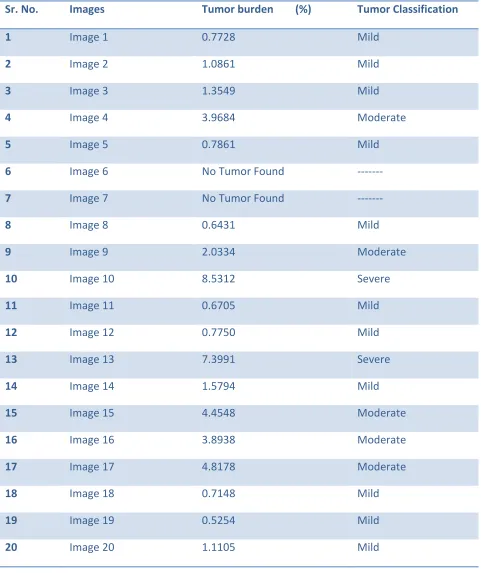
Available Online at www.ijpret.com 688 broadly classified in to three groups such as Mild, Moderate and Severe. The range is defined as, Mild= 0-2 tumor burden, Moderate= 2-5 tumor burden and Severe= 5 and above tumor burden.
i. Region Growing Results
(a) (b) (c)
Fig. 1. (a) Original CT Image; (b) Liver Segmentation Image; (c) Tumor Segmentation Image.
TABLE I. Tumor Burden Analysis using Region Growing Method
Sr. No. Images Tumor burden (%) Tumor Classification
1 Image 1 1.1239 Mild
2 Image 2 1.1403 Mild
3 Image 3 0.8960 Mild
4 Image 4 5.3589 Severe
5 Image 5 0.8049 Mild
6 Image 6 No Tumor Found ----
7 Image 7 No Tumor Found ----
8 Image 8 0.6092 Mild
Available Online at www.ijpret.com 689
10 Image 10 13.6429 Severe
11 Image 11 0.4470 Mild
12 Image 12 0.5992 Mild
13 Image 13 13.7544 Severe
14 Image 14 1.1538 Mild
15 Image 15 3.7159 Moderate
16 Image 16 2.5480 Moderate
17 Image 17 2.4031 Moderate
18 Image 18 0.5957 Mild
19 Image 19 0.4845 Mild
20 Image 20 1.1445 Mild
21 Image 21 1.0236 Mild
22 Image 22 1.4850 Mild
23 Image 23 4.5347 Moderate
ii. Otsu Method :-
(a) (b) (c)
Available Online at www.ijpret.com 690
TABLE II. Tumor Burden Analysis using Otsu
Sr. No. Images Tumor burden (%) Tumor Classification
1 Image 1 0.7728 Mild
2 Image 2 1.0861 Mild
3 Image 3 1.3549 Mild
4 Image 4 3.9684 Moderate
5 Image 5 0.7861 Mild
6 Image 6 No Tumor Found ---
7 Image 7 No Tumor Found ---
8 Image 8 0.6431 Mild
9 Image 9 2.0334 Moderate
10 Image 10 8.5312 Severe
11 Image 11 0.6705 Mild
12 Image 12 0.7750 Mild
13 Image 13 7.3991 Severe
14 Image 14 1.5794 Mild
15 Image 15 4.4548 Moderate
16 Image 16 3.8938 Moderate
17 Image 17 4.8178 Moderate
18 Image 18 0.7148 Mild
19 Image 19 0.5254 Mild
Available Online at www.ijpret.com 691
21 Image 21 0.5540 Mild
22 Image 22 1.9685 Mild
23 Image 23 5.2308 Severe
iii. Clustering Method :-
(a) (b) (c)
Fig. 3. (a) Original CT image; (b) Segmentation Image; (c) Tumor Segmentation Image
TABLE III. Tumor Burden Analysis using Clustering
Sr. No. Images Tumor burden (%) Tumor Classification
1 Image 1 0.7098 Mild
2 Image 2 0.7049 Mild
3 Image 3 0.4978 Mild
4 Image 4 2.5310 Moderate
5 Image 5 0.8218 Mild
6 Image 6 No Tumor Found ---
7 Image 7 No Tumor Found ---
Available Online at www.ijpret.com 692
9 Image 9 1.3137 Mild
10 Image 10 7.5415 Severe
11 Image 11 0.3168 Mild
12 Image 12 0.5655 Mild
13 Image 13 11.9595 Severe
14 Image 14 0.7504 Mild
15 Image 15 4.2727 Moderate
16 Image 16 3.3282 Moderate
17 Image 17 4.6729 Moderate
18 Image 18 0.5750 Mild
19 Image 19 0.8525 Mild
20 Image 20 0.5080 Mild
21 Image 21 1.5424 Mild
22 Image 22 1.5308 Mild
23 Image 23 2.6086 Moderate
iv. Fuzzy C-Means Algorithm :-
(a) (b) (c)
Available Online at www.ijpret.com 693
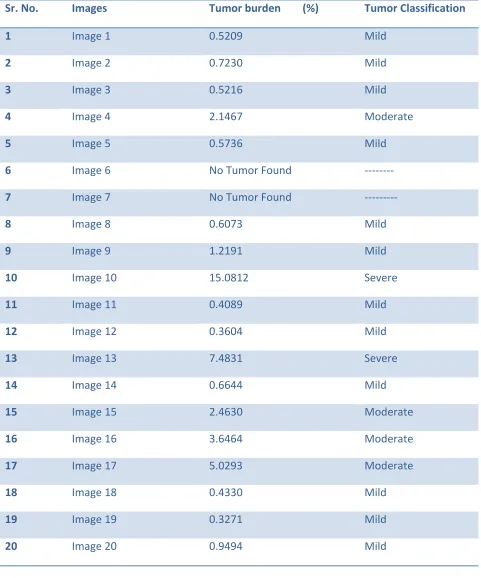
TABLE IV. Tumor Burden Analysis using FCM
Sr. No. Images Tumor burden (%) Tumor Classification
1 Image 1 0.5209 Mild
2 Image 2 0.7230 Mild
3 Image 3 0.5216 Mild
4 Image 4 2.1467 Moderate
5 Image 5 0.5736 Mild
6 Image 6 No Tumor Found ---
7 Image 7 No Tumor Found ---
8 Image 8 0.6073 Mild
9 Image 9 1.2191 Mild
10 Image 10 15.0812 Severe
11 Image 11 0.4089 Mild
12 Image 12 0.3604 Mild
13 Image 13 7.4831 Severe
14 Image 14 0.6644 Mild
15 Image 15 2.4630 Moderate
16 Image 16 3.6464 Moderate
17 Image 17 5.0293 Moderate
18 Image 18 0.4330 Mild
19 Image 19 0.3271 Mild
Available Online at www.ijpret.com 694
21 Image 21 0.4738 Mild
22 Image 22 0.9480 Mild
23 Image 23 3.5953 Moderate
CONCLUSION:-
Effective segmentation of liver/abdomen CT images has been investigated in this paper. Popular segmentation techniques namely region growing, Otsu, Clustering and FCM, respectively, are implemented for the segmentation of abdomen / liver structure. Thresholding is used for tumor segmentation from abdomen/liver. Apart from this morphological operations are used to get fast and accurate abdomen/liver and tumor segmentation. The detected tumor has been graded using tumor burden as parameter. It is evident from the tabular results that region growing approach gives good results compared to other segmentation techniques. Tumor burden values helps in monitoring the severity of disease.
ACKNOWLEDGEMENT:
We thank PRISM Medical Diagnostic, Solapur, Maharashtra for providing CT images for performing experiments and validating the results obtained by automatic segmentation.
REFERENCES:
1. American Cancer Society. Cancer facts & figure 2013. Atlanta GA: Am. Cancer Soc., 2013.
2. American Cancer Society. Liver Cancer ; Am. Cancer Soc.,2014.
3. International Agency for Research on Cancer “GLOBAL 2012” World Health Organization.
4. Dzung L. Pham, ChenyangXu, and Jerry L. Princ,”Current Methods In Medical Image
Segmentation,” Department of Electrical and Computer Engineering, The Johns Hopkins University,Annu. Rev. Biomed. Eng. 2000. 02:315-37.
5. Nader H. Abdel-massieh, Mohiy M. Hadhoud, Khalid M. Amin, “Fully Automatic Liver Tumor
Available Online at www.ijpret.com 695
6. Paola Campadelli, Elene casiraghi, Gabriede Lombardi, “Automatic liver segmentation from
abdominal CT scans” 14th International Conference on Image Analysis and processing(ICIAP
2007) , IEEE 2007.
7. Takeshi Saitoh, Yuta Tamura and Toyohisa Kaneko, “Automatic Segmentation of Liver Region
through Blood Vessels on Multi-Phase CT”, IEEE 2002.
8. Yufei chen, Zhincheng Wang, Weidong Zhao, Xiaochun Yang, “ Liver Segmentation from CT
Images Based on Region Growing Method” , IEEE 2009.
9. Xing Zhang, Jie Tian, Dehui Xing, Xiuli Li and Kein deng , “ Interactive Liver Tumour
Segmentation from CT Scans Using Support Vector Classification with Watershed” , 33rd Annual
International Conference of the IEEE EMBS Boston, Massachusetts USA, August30-September 3,2011.
10. Aminah Abdul Malek, Wan EnyZarina Wan Abdul Rahman, SitiSalmah Yasiran, Abdul Kadir
Jumaat, Ummu Mardhiah Abdul Jalil , “Seed Point Selection for Seed-Based Region Growing in Segmenting Micro calcifications” , International Conference of the IEEE SSBELangkawi ,Sep 10-12 ,2010-12.
11. K. K. Singh, A. Singh, “A Study of Image Segmentation Algorithms for Different Types of
Images”, International Journal of Computer Science Issues, Vol. 7, Issue 5, 2010
12. R. C. Gonzalez, R.E.Woods, “Digital Image Processing”, Addison Wesley, 1993.
13. Marius George Linguraru, William J. Richbourg, Jianfei Liu, Jeremy M. Watt, Vivek
Pamulapati, Shijun Wang, and Ronald M. Summers, “Tumour Burden Analysis on Computed Tomographyby Automated Liver and Tumour Segmentation” , IEEE TRANSACTIONS ON MEDICAL IMAGING, VOL. 31, NO. 10, OCTOBER 2012.
14. Dr. N. Nandha Gopal, Automatic Detection Of Brain Tumor Through Magnetic Resonance
Image, International Journal of Advanced Research in Computer and Communication Engineering Vol. 2, Issue 4
15. A.K. Jain and R.C. Dubes, Algorithms for Clustering Data, Prentice Hall, 1988.
16. A. K. Jain, M. N. Murty, and P. J. Flynn, “Data clustering: a review,” ACM Computing
Available Online at www.ijpret.com 696
17. Bezdek, J.C.: Pattern Recognition with Fuzzy Objective Function Algorithms. New York:
Plenum Press, 1981.
18. Bezdek, J.C.—Hall, L.O.—Clarke, L.P.: Review of MR Image Segmentation Techniques Using
Pattern Recognition. Med. Phys., Vol. 20, 1993, pp. 1033–1048.
19. Dunn, J.C.: A Fuzzy Relative of the ISODATA Process and its Use in Detecting Compact Well
Separated Clusters. Journal of Cybernetics, Vol. 3, 1974, pp. 32–57.
20. Yong Yang “Image Segmentation By Fuzzy C Means Clustering Algorithm With A Novel