Development of a portable system for detection of leaf area in
plants
Jhonatan Bonilla-González
1, Edgar E. Roa-Guerrero
1,2*, Humberto Numpaque
2,
Pedro Cifuentes
2(1. Kinestasis Hotbed of Research in Signal Processing and Artificial Vision, University of Cundinamarca, Colombia;
2. Giteinco Research Group in Information Technology and Communications, University of Cundinamarca, Colombia)
Abstract: Recently, the determination of leaf area and growth rates in plants through portable devices has become popular, due to the advantages offered by artificial vision systems to identify and classify objects using image processing. The purpose of the research was to develop a portable system by mobile device for measuring leaf area through image recognition. The methodology includes 3D designs, acrylic device building, determining the area in pixels by the technique of radial basis neural networks (RBFN) directly in the RGB color space and pixel conversion to cm2. The results obtained by analysis of variance for each species showed that the p-value was greater than 0.86 for each class of plants. Moreover, the system obtained coefficients of determination higher to 0.90, 0.95 y 0.99 for leaves of orange, patevaca and chirimoya respectively, from a set of 30 leaves belonging to three species of plants with different sizes and areas compared to manual analysis. This system is a useful tool for the objective determination of leaf area in plants and becomes a nationwide alternative compared to existing expensive systems. Furthermore, the system is reprogrammable, flexible, not destructive and low cost.
Keywords: leaf area, artificial vision system, mobile device, radial basis neural networks, image processing
Citation: Bonilla-González, J., E. E. Roa-Guerrero, H. Numpaque, and P. Cifuentes. 2016. Development of a portable system for detection of leaf area in plants. Agricultural Engineering International: CIGR Journal, 18(4):87-96.
1 Introduction
1Nowadays, fruit production and demand has
increased due to favorable weather conditions present in
tropical countries like Colombia (Ministry of
environment, housing and territorial development, 2016);
however, the supply of fruit depends on their quality and
the conditions in which crops are, caused by global
climate change (GreenFacts, 2016).
Recently, there have been advances in systems for
determining leaf area in plants, such a case of using a
known reference to determine the leaf area without
depending on the camera position (Hajjdiab and Obaid,
2010; Easlon and Bloom, 2014). Likewise, there have
been systems where conventional techniques that have
Received date: 2016-08-19 Accepted date:2016-09-03 *Corresponding author: Edgar E. Roa-Guerrero, Ingeniería Electrónica; Facultad de Ingeniería, Universidad de Cundinamarca, Colombia.Email: [email protected].
high rates of correlation are used with respect to an expert,
like by Shivling et al.(2011) or by default, where it is
used learning algorithms for leaf sorting, as described by
Wang et al.(2012); Sharma and Gupta (2015). Finally,
there have been developed mobile applications such as
App PocketLAI, being the pioneer in the estimation of
leaf area rate for Smartphone (Confalonieri et al., 2013;
Vesali et al., 2015).
To date in Colombia, this process is manually
performed in a destructive form, which involves taking a
sample of the leaf with an area of 1 cm2; then identify its
weight through a precision weighing scale, resulting in a
linearity between the weight and area (g/cm2); and then
get the approximate measurement of the total leaf area
through a direct rule of three.
This method has problems such as imprecision in the
measurements, which leads to the destruction of crops
and abnormal plant growth because they don’t have the
(Kozlowski et al., 1991). The purpose of this research
was to develop a portable system to determine the leaf
area of plants through artificial vision systems objectively
and without destroying the plant.
The proposed methodology consisted in the
application of computer vision techniques, which are
composed of different methods of image and video
processing, such as methodologies for image acquisition,
implementation of filtering operations, object
segmentation through radial basis functions directly in the
RGB color space, and others. Finally, the mobile device
identifies the leaf area in the leaves on images.
2 Materials and methods
In the project development, the process for leaf area
detection in plants using image processing and mobile
systems was described. The following describes each of
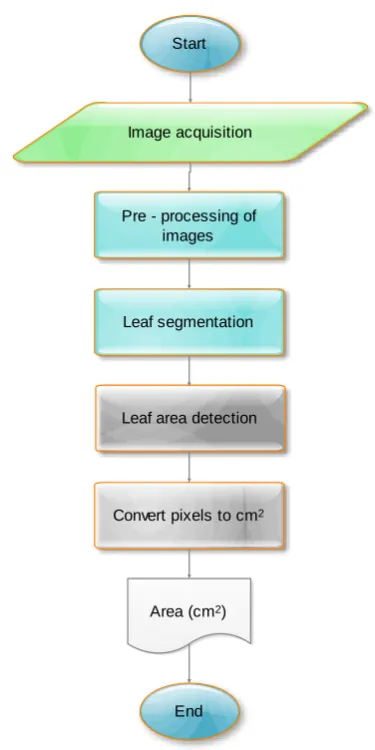
the steps of the process, as evidenced in Figure 1.
At a first instance, 3D designs were developed using
software Solid Works 2013 from the analysis of user
requirements and restrictions. Later, each of the parts
were assembled and were implemented the algorithms for
image acquisition and processing through mobile device.
The methodology proposes the identification the foliar
area on plants, through image processing techniques
compatible with the android 5.0 operating system and
implemented on mobile devices such as tablets or
Smartphone, for this particular research was used the
Samsung Galaxy Tab Tablet with memory 3 GB of RAM
and Octa-Core processor at 1.9 GHz. In first step, the
focus of the image was made using the auto focus
function available in the camera application and the
camera lens was adjusted with an exposure value of 2.0
for capturing images, then the filtering step was applied
by median filter 3×3 to reduce the abrupt changes in
pixel intensity. The criterion of radial basis neural
functions (RBNF) was applied (Lopéz and Consularo,
2005) to identify objects in the image. Finally, the leaf
area was determined by a direct ratio between pixel
quantity and centimeters, rapidly, objectively and with
repeatability in the plant physiology analysis.
Figure 1 Proposed methodology
2.1 Design of portable system
For the project development, it was taken into
account the restrictions and requirements demanded by
experts in plant physiology from University of
Cundinamarca, where a prototype called leaf detector was
set to measure leaf area in plants with a maximum leaf
size of 15cm×30cm, portable, non-destructive and
programmable, with controlled parameters of
illumination.
The used material for making the portable device
was acrylic, due to the physical characteristics it
possesses, such as resistance to water and sunlight. In
addition, its construction in lightweight material makes it
possible the mobilization in all circumstances. For this, it
was taken into account 5mm of thickness throughout the
prototype. Likewise, the hardware design for the module
Start
Image acquisition
Leaf segmentation
Leaf area detection
Convert pixels to cm2
Area (cm2)
End Pre - processing of
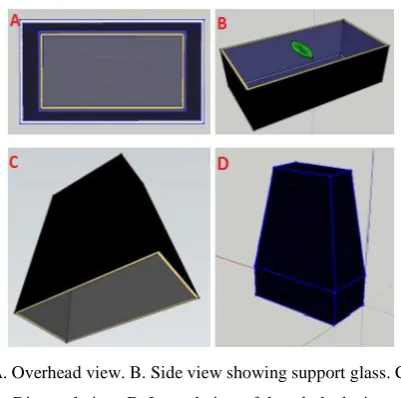
(leaf detector) was constructed cone shaped in order to
reduce weight and space; also it has a height of 30cm to
locate the light sources stage internally and to adapt the
space needed by the camera to capture leaf images
properly.
A. Overhead view. B. Side view showing support glass. C. Diagonal view. D. Lateral view of the whole device.
Figure 2 3D module design (leaf detector)
Moreover, the image acquisition step in the central
part of the module was conditioned. It is worth noting
that the device was made in black, so that certain external
factors such as natural light cannot affect capture and
image acquisition directly on plantations, then Figure 2
shows the module design in Solid Works 2013.
2.2 Image acquisition and pre-processing
The image acquisition stage for the module (leaf
detector) was based on a graphical interface on Android
system, which complies with the following features: user
authentication, image capture, image storage, image
removal, leaf area calculation in a controlled manner, leaf
area calculation with a square of reference, measurement
registration and consultation of measurements made. For
this module the image was captured with a Samsung
Galaxy S Tablet with the following characteristics: Main
camera 8 MP CMOS, screen resolution of 2560 × 1600
(WQXGA), screen size (8.4 "(212.8mm)), Octa-Core
processor 1.9GHz, 1.3GHz, 3GB RAM, internal (16GB)
and external Micro SD (up to 128GB) Android operating
system, physical dimensions (212.8 height × 125.6
width × 6.6 depth), weight of 294 g, which capture
images wirelessly with 16 Mpx resolution and an aspect
ratio of 16:9 in JPG format. Later, it was fragmented into
its three RGB color components for filtering each one
using a median filter (Alfaro, 2014).This filter allows to
attenuate the noise on images and usually it is applied to
grayscale images.
2.3 Image segmentation
For the leaf extraction by the module (leaf detector)
the method of radial basis functions network (RBFN) was
implemented (Lopéz and Consularo, 2005) which consists
of comparing image values in the RGB color spectrum
through a distance in color space to a determined point (Xu
and Wunsch, 2010), using Equation 1:
Where: ima is the original image in each of its color
components and px is the reference pixel for each color
components. Then, each of the distances found is
evaluated by the Gaussian function shown in Equation 2.
( ) ( ) (2)
Finally, pixels belonging to the leaf are extracted
and assigned in white if it exceeds an estimated
percentage and others are assigned in black color.
2.4 Leaf area detection
The leaf area detection stage was conducted in two
ways to the module (leaf detector): with reference and
without known reference. In the case where there was not
a known reference the process was based on counting the
number of white pixels belonging to the leaf area and
multiplied by a factor as is shown in Equation 3 and for
the case that there was a known reference, the process
was based on counting the number of pixels of the object
and multiplied by a factor as is shown in Equation 4.
( ) ( ) ( ) ( )
(3)
( ) ( )
(4)
3 Results and discussion
In order to standardize a methodology for
identification of leaf area in plants by mobile devices and
prior to the development of the algorithm, design and
assembly of the portable system (leaf detector) was
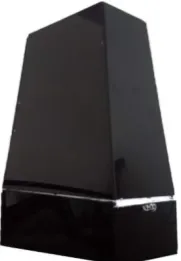
realized for determining the leaf area. Figure 3 shows the
results with Solid Works design of the portable device.
Figure 3 Module construction (leaf detector)
The first stage tested was the process of image
acquisition and pre-processing, to get the leaf area easily
without distortions that affect the measurement. For
which, the performance of three different filters was
evaluated in test images obtained with the system (leaf
detector), comparing the filters’ performance. It was
found that the median filter showed better results in terms
of preserving the edges and decrease of abrupt variations
in pixel intensities in the images.
A. Original image B. Filtered image
Figure 4 Image acquisition
In Figures 4A and 4B, the results of the image
acquisition and pre-processing are shown respectively.
Later, the extraction stage of the regions belonging to the
leaf was evaluated. Through the system (leaf detector),
radial basis neural networks were applied to extract the
region of the leaf and the results were satisfactory
compared with other traditional methods of segmentation,
because neural networks allowed to segment directly in
the RGB space color. Then in Figures 5A, 5B and 5C
original leaf images with holes and damaged edges are
shown and in Figures 5D, 5E and 5F the results of the
segmentation process are illustrated by the portable
system (leaf detector), showing very good results in
which no relevant leaf information is lost even when this
has holes or other abnormalities as evidenced in Figures
5E and 5F respectively.
A. Leaf with hole B. Leaf with damaged edge C. Complete leaf D. Segmentation of leaf with hole E. Segmentation of leaf with damaged edge F. Segmentation of complete leaf
Finally, the identification stage of leaf area was
tested and was determined by a ratio of pixel quantity to
centimeters as is shown in Equations 3 and 4.
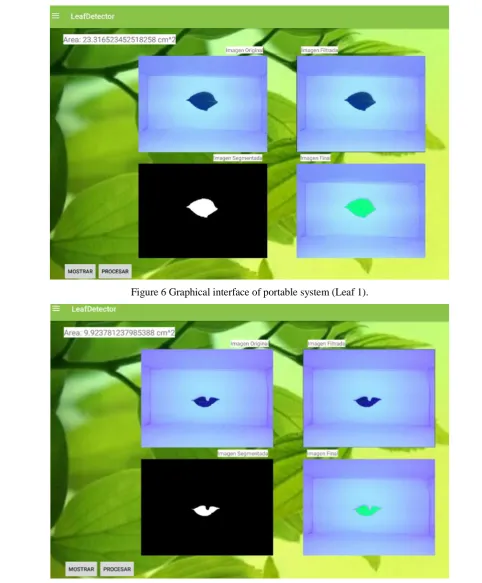
Subsequently, a graphical interface for displaying results
was implemented as evidenced in Figures 6 and 7,
showing different leaves with good results. It is also easy
to be handled for users.
To validate the proposed portable system, the
analysis of leaf area for three different plant species with
ten leaves each with different sizes, holes and damaged
areas was performed, in order to determine the system Figure 6 Graphical interface of portable system (Leaf 1).
accuracy (leaf detector) with known reference and
without reference in such situations where the leaf has
different conditions with respect to the manual method
and the precision weighing scale by the expert in
agronomy currently used in University of Cundinamarca.
Initially, the statistical validation was performed on
the software InfoStat, which allowed to evidence that for
Orange leaves the developed system showed high
correlation with a p-value of 0.8704 exceeding the limit
of 0.05 with respect to conventional methods. In addition,
it was verified by Tukey significance test that the
measurements of leaf area showed no significant
differences and remained in the same class A, as
evidenced in Figure 7.
Figure 7 Statistical results for Orange leaves using
software InfoStat
Subsequently, for Patevaca leaves, the software
InfoStat allowed to prove that the developed system
showed high correlation with a p-value of 0.9973
exceeding the limit of 0.05 with respect to conventional
methods. It was also verified by Tukey significance test
that measurements of leaf area showed no significant
differences and remained in the same class A, as is shown
in Figure 8.
Figure 8 Statistical results for Patevaca leaves using
software InfoStat.
Finally, for Chirimoya leaves the system showed
high correlation with a P-value of 0.7561 exceeding the
limit of 0.05. And it was verified by Tukey test that leaf
area measurements showed no significant differences and
remained in the same class A, as is shown in Figure 9.
Figure 9 Statistical results for Chirimoya leaves using
software InfoStat.
On the other hand, an analysis of correlation
between manual measurement by the expert with respect
to the portable system with and without reference was
performed. It was found that coefficients of determination
more than 0.90 for Orange leaves, more than 0.95 for
Patevaca leaves and more than 0.99 for Chirimoya leaves.
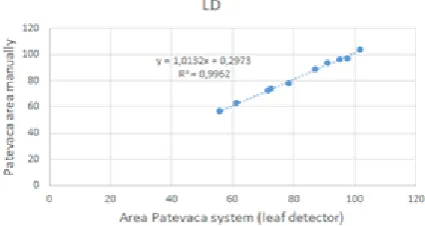
Below, the results without reference (LD) and known
reference (LDP) are shown by Figures 10, 11, 12, l3, 14
Figure 10 Correlation for Orange leaves
Figure 11 Correlation for Orange leaves with reference
Figure 12 Correlation for Patevaca leaves
Figure 13 Correlation for Orange leaves with reference
Figure 14 Correlation for Chirimoya leaves
Figure 15 Correlation for Chirimoya leaves with
reference
Subsequently, the statistical correlations for the
system (leaf detector) without reference and known
reference regarding the manual method and the method of
the precision weighing scale were performed, as is shown
in Figures 16, 17 and 18 for each plant species.
Figure 16 Correlation between Leaf detector (LD and
Figure 17 Correlation between Leaf detector (LD and
LDP) regarding to manual method for Patevaca leaves
Figure 18 Correlation between Leaf detector (LD and
LDP) regarding to manual method for Chirimoya leaves
The results obtained with the system (leaf detector)
show in figures 10 to 15, determination coefficients
higher than 0.9 for orange tree leaves, patevaca tree
leaves and chirimoya tree leaves, indicating a high degree
of accuracy with respect to the reference method
(manual). Likewise, the results obtained with respect to
the scale precision and the manual reference method were
compared in Figures 16, 17 and 18 and the trend was
maintained for the 10 leaves in each plant species,
allowing the obtaining of reliable measurements for the
leaf area.
Finally, the obtained results of the system (Leaf
detector) with respect to the manual method where
validated through the Bland-Altman verification test and
no significant variability was found between the
measured leaf area assigned by the expert and the
portable system. The results show a ratio of 0.96 in a
confidence interval of 95% (-3.9 to 2.5) for Orange tree
leaves. Also, they show a ratio of 0.99 in a confidence
interval of 95% (-0.61 to 3.35) for Patevaca tree leaves
and a ratio of 0.96 in a confidence interval of 95% (-1.49
to 3.67) for Chirimoya tree leaves as is shown in Figures
19 to 21 respectively.
D if fe r e n c e B la n d A lm a n t: O r a n g e L e a f d e te c t o r v s M a n u a l m e t h o d
1 0 2 0 3 0 4 0 5 0
- 6 - 4 - 2 0 2 4
d
if
fe
r
e
n
c
e
Figure 19 Bland-Altman test for Orange leaves
Figure 20 Bland-Altman test for Patevaca leaves
Figure 21 Bland-Altman test for Chirimoya leaves
D if f e r e n c e B la n d A lm a n t : P a t e v a c a
L e a f d e t e c t o r v s M a n u a l m e t h o d
5 0 1 0 0 1 5 0
- 1 0 1 2 3 4
d
if
fe
r
e
n
c
e
D if f e r e n c e B la n d A lm a n t : C h ir im o y a L e a f d e t e c t o r v s M a n u a l m e t h o d
2 0 4 0 6 0 8 0 1 0 0
- 2 0 2 4 6
d
if
fe
r
e
n
c
The results with the concordance test Bland-Altman
between two measurement methods showed that the
portable system presented high correlation indices
compared to the method (manual), in Figures 19, 20 and
21 was evidence that difference between measurements
were not significant because the differences remained
within the confidence interval of 95%, obtaining a
solution to problems of accuracy in plant growth analysis.
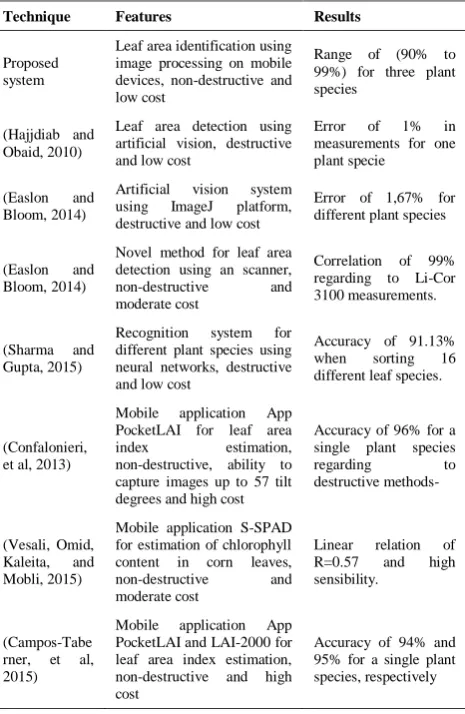
Finally, the precision of the results and characteristics of
the developed system was compared with regard to
current portable systems as shown in Table 1. The
proposed system was implemented in free software as
solution to low cost, obtaining accuracy percentages
greater than 90% in measurements leaf area similar to
current studies and avoiding the destruction of the plant.
Table 1 Comparison between portable systems and
mobile applications for leaf area identification
Technique Features Results
Proposed system
Leaf area identification using image processing on mobile devices, non-destructive and low cost
Range of (90% to 99%) for three plant species
(Hajjdiab and Obaid, 2010)
Leaf area detection using artificial vision, destructive and low cost
Error of 1% in measurements for one plant specie
(Easlon and Bloom, 2014)
Artificial vision system using ImageJ platform, destructive and low cost
Error of 1,67% for different plant species
(Easlon and Bloom, 2014)
Novel method for leaf area detection using an scanner, non-destructive and moderate cost
Correlation of 99% regarding to Li-Cor 3100 measurements.
(Sharma and Gupta, 2015)
Recognition system for different plant species using neural networks, destructive and low cost
Accuracy of 91.13% when sorting 16 different leaf species.
(Confalonieri, et al, 2013)
Mobile application App PocketLAI for leaf area index estimation, non-destructive, ability to capture images up to 57 tilt degrees and high cost
Accuracy of 96% for a single plant species regarding to destructive methods-
(Vesali, Omid, Kaleita, and Mobli, 2015)
Mobile application S-SPAD for estimation of chlorophyll content in corn leaves, non-destructive and moderate cost
Linear relation of R=0.57 and high sensibility.
(Campos-Tabe rner, et al, 2015)
Mobile application App PocketLAI and LAI-2000 for leaf area index estimation, non-destructive and high cost
Accuracy of 94% and 95% for a single plant species, respectively
4 Conclusions
In this article, the development of a portable system
is shown based on techniques of digital image processing
on mobile devices for determining the leaf area in plants
with known reference and without it, which has the
advantage of adaptability for the determination of other
parameters shown on leaves, as abnormalities or
nutritional deficiencies, among others.
The results were validated by variance analysis in
which a p-value of 0.8704 for Orange leaves, a p-value of
0.9973 for Patevaca leaves and a p-value of 0.7561 for
Chirimoya were obtained using Tukey test present in
InfoStat software. This test showed that for the three
kinds of plants the p-value was greater than 0.05,
indicating the similarity in portable measurement system
with respect to manual method.
The proposed system allowed determining the leaf
area in plants in two ways: by known reference and
without reference with high accuracy compared with
conventional methods used in Universidad de
Cundinamarca by technical experts. The system obtained
coefficients of determination greater than 0.90 with
known reference and 0.9527 without reference to Orange
leaves, coefficients of determination greater than 0.95
with known reference and 0.9962 without reference for
Patevaca leaves and coefficients of determination greater
than 0.99 with known reference and 0.9982 without
reference for Chirimoya leaves, denoting good
performance by the portable system.
Through Bland-Altman validation, it was found that
the portable system (Leaf detector) did not show
significant variability with respect to the results obtained
by experts in plant physiology, with significance ratios
greater than 0.96 in a confidence interval of 95% for all
the three plant species. For this reason, the system is a
useful tool for the objective determination of leaf area in
plants and presents an alternative at a national level for
the existing expensive systems for leaf area parameters
Future researching work will focus on identifying
growth rates for plants in normal and severe conditions,
like plants that have leaves with holes in his body, edge
deformity and partially damaged. As well as, the
adaptability and application of our portable system in
other similar fields such as detection of nutritional
deficiencies, among others.
Acknowledgments
The authors give thanks to Universidad de
Cundinamarca for the financial support and for the expert
staff in detection of leaf parameters. Thanks to teacher
Cristina Mendoza for her valuable collaboration in the
manual analysis for the leaf area determination in plants,
in which allowed the validation of the proposed system.
References
Campos-Taberner, M., F. García-Haro, A. Moreno, M. Gilabert,S. Sánchez-Ruiz, B. Martínez, and G. Camps-Valls. 2015. Mapping leaf area index with a smartphone and Gaussian processes. IEEE Geoscience and Remote Sensing Letters, 12(12):2501-2505.
Confalonieri, R., M. Foi, R. Casa; S. Aquaro, E. Tona, M. Peterle, and M. Acutis. 2013. Development of an app for estimating leaf area index using a smartphone. Trueness and precision determination and comparison with other indirect methods. Computers and Electronics in Agriculture, 96(1):67-74.
Easlon, H. M., and A. J. Bloom. 2014. Easy leaf area: automated digital image analysis for rapid and accurate measurement of leaf area. Applications in plant Sciences, 2(7):1-4.
Gonzalez, R., and R. Woods. 2002. Digital image processing. New Jersey: Prentice Hall.
Green Facts. (18 de 02 de 2016). Facts on health and the environment. Obtained of Facts on health and the environment:
http://www.greenfacts.org/es/cambio-climatico-ie5-base-cienc ia/. Accessed on 2:30pm.
Hajjdiab, H., and A. Obaid. 2010. A vision-based approach for nondestructive leaf area estimation.2nd Conference on Environmental Science and Information Application Technology. Pp. 53-56.
Kozlowski, T., P. Kramer, and S. Pallardy. 1991. The physiological ecology of woody plants. New York.
Lopéz, F., and L. Consularo. 2005. A RBFN perceptive model for image thresholding. Proceedings of the XVIII Brazilian Symposium on Computer Graphics and Image Processing (SIBGRAPI’05), IEE Explore.
MathWorks. (09 de 06 de 2016). 2 D-median filtering. Obtained of http://www.mathworks.com/help/images/ref/medfilt2.html. Accessed on 11:45am.
Ministerio de ambiente, vivienda y desarrollo territorial. (18 de 02 de 2016). Guia ambiental hortifruticula de Colombia. Obtenido de Guia ambiental hortifruticula de Colombia: http://www.asohofrucol.com.co/archivos/biblioteca/biblioteca _30_guiaambiental.pdf. Accessed on 3:42pm.
Rodríguez Alfaro, L. 2014. Filtrado de imagen utilizando el algoritmo Non-Local Means. Application Android. Pamplona. Sharma, S., and C. Gupta. 2015. Recognition of plant species
based on leaf images using multilayer feed forward neural network. International Journal of Innovative Research in Advanced Engineering (IJIRAE), 2(6):104-110.
Shivling, V., A. Singla, C. Ghanshyam, and P. Kapur. 2011. Planté leaf imaging technique for agronomy. International conference on image information processing.
Vesali, F., M. Omid, A. Kaleita, and H. Mobli. 2015. Development of an android app to estimate chlorophyll content of corn leaves based on contact imaging. Computers and Electronics in Agriculture, 116(1):211-220.
Wang, H., G. Li, Z. Ma, and X. Li. 2012. Application of neural networks to image recognition of plant diseases. International Conference on Systems and Informatics, 2159-2164.