World Maritime University
The Maritime Commons: Digital Repository of the World
Maritime University
World Maritime University Dissertations Dissertations
2000
Issues of safety in the Alaskan commercial fishing
fleet : where do we go from here?
Jane Maria Eisemann World Maritime University
Follow this and additional works at:http://commons.wmu.se/all_dissertations
This Dissertation is brought to you courtesy of Maritime Commons. Open Access items may be downloaded for non-commercial, fair use academic purposes. No items may be hosted on another server or web site without express written permission from the World Maritime University. For more Recommended Citation
Eisemann, Jane Maria, "Issues of safety in the Alaskan commercial fishing fleet : where do we go from here?" (2000).World Maritime University Dissertations. 136.
WORLD MARITIME UNIVERSITY
Malmö, Sweden
ISSUES OF SAFETY IN THE ALASKAN
COMMERCIAL FISHING FLEET
Where do we go from here?
By
JANE MARIA EISEMANN
United States of AmericaA dissertation submitted to the World Maritime University in partial fulfilment of the requirements for the award of the degree of
MASTER OF SCIENCE
in
MARITIME EDUCATION AND TRAINING
2000
DECLARATION
I certify that all the material in this dissertation that is not my own work has been identified, and that no material is included for which a degree has previously been conferred on me.
The contents of this dissertation reflect my own personal views, and are not necessarily endorsed by the University.
_____________________________________ (Signature)
_____________________________________ (Date)
Supervised by:
Name:________________________________
Office: _______________________________
World Maritime University
Assessor:
Name: _____________________________________
Office: _____________________________________
Institution/Organisation: _____________________________________
Co-assessor:
Name: _____________________________________
Office: _____________________________________
ACKNOWLEDGMENTS
The author wishes to express extreme gratitude to her parents, George Eisemann and Bonnie Carey for their endless support and for instilling in her the confidence to achieve any goal she sets for herself.
To Bob Bowhay, her life companion, for always listening and giving constructive comments and advice when she needed them most, as well as holding her hand the whole way. Thank you.
For two women who will always be her mentors and dearest friends, Stacy Studebaker and Cindy Amberfield, the author’s unending admiration and appreciation.
Heartfelt appreciation to her fellow MET classmates for their friendship, as well as helping the author to broaden her horizons.
The author’s thanks to Jerry Dzugan for paving the way.
Title of dissertation: Issues of Safety in the Alaskan Commercial Fishing Fleet: Where Do We Go From Here?
Degree: MSc
The dissertation is a study of today’s Alaskan Commercial Fishing Industry with regard to safety. Statistics support the thought that commercial fishing is the most dangerous occupation in the United States and government is looking at ways to enhance the safety of that industry. Increased safety legislation has been a recent recommendation for the fleet.
Specific factors that affect the Alaskan Fleet in particular will be examined as well as a brief discussion of International and National Initiatives to enhance safety. The initiatives’ strengths and weaknesses as well as their respective influences on the United States’ Commercial Fishing Fleet and the Alaskan Commercial Fishing Fleet are investigated.
The author believes that there are other, more affective ways other than legislation to increase commercial fishing vessel safety. Individual non-legislative strategies in the United States and abroad for making the commercial fishing industry a safer one are explored for their affectiveness as well as their applicability within the Alaskan Commercial Fishing Fleet.
The concluding chapter puts forth a plan for combining these strategies into one cohesive plan that may be implemented on a community level, as well as
recommendations for the United States Government, United States Coast Guard, and the Alaskan Commercial Fishing Fleet.
TABLE OF CONTENTS
Declaration ii
Acknowledgements iii
Abstract iv
Table of Contents v
List of Figures and Abbreviations viii
1 The problem of fishing vessel safety
1.1 Introduction 1
1.2 The author’s relationship to the Alaskan Commercial
Fishing Industry 3
1.3 Purpose of study and research methodology 4
1.4 Definitions 5
1.5 The ‘Highliner’ 6
2. Safety issues in the Alaskan Commercial Fleet
2.1 Specific issues affecting fishing vessel safety 8 2.2 Uninspected vessels 10 2.3 Remoteness of fleet 12 2.4 Weather conditions 14 2.5 Fishermen’s attitudes toward safety 16 2.6 Economic issues 19 2.6.1 Shortened fishing seasons 19
2.6.2 Fatigue 20
2.6.3 Drop in price 21 2.7 Diversity of fishery participation 22 2.7.1 Technology advancement with regard to stability 23 2.8 Inexperienced Crew 25 3. International and national initiatives to enhance fishing vessel
safety
3.1 Overview 28
3.1.1 International Convention for the Safety of Life at Sea 29 3.1.2 Torremolinos International Convention for the Safety
Table of Contents Continued
3.2.1 Draft Legislation of the 1930s 32 3.2.2 Fishing Vessel Safety Bill – 1941 33 3.2.3 The Commercial fishing Vessel Safety Act of 1988 34 3.2.4 Fisheries management 35 3.2.5 The Fishing Vessel Casualty Task Force: 1999 35
4. Affects of legislation on commercial fishing vessel casualty data
4.1 Torremolinos Convention 37
4.2 STCW-F 38
4.3 The Commercial fishing Vessel Safety Act of 1988 39 4.4 Fisheries management 41 4.5 The Fishing Vessel Casualty Task Force 42
5. Strategies for improving fishing vessel safety in Alaska
5.1 More legislation is not the answer 45 5.2 Creating a ‘professional’ fleet 46 5.2.1 Professional commercial fishermen’s organisations 48 5.2.2 Fishermen’s Wives Associations 49 5.2.3 National trade associations 50
5.3 Creating a more positive relationship between the United
States Coast Guard and the commercial fishing industry 51 5.4 Enforcing current legislation 53 5.4.1 Operation Safe Catch 57 5.4.2 District 17 – Ready for Sea 58 5.5 Education 59 5.5.1 The North Pacific Fishing Vessel Owners’ Association 59 5.5.2 The Alaska Marine Safety Education Association 60 5.5.3 United States Coast Guard Fishing Vessel Safety Program 63 5.6 Positive relationship between safety and economics 63 5.6.1 Insurance 65 5.6.2 Insurance pools 66
6. Conclusion
6.1 Defining a direction 68
6.1.1 A solution 68
6.1.2 The program 71
6.1.3 Training 72
6.1.4 Training costs 73
6.1.5 Coast Guard liaison 73
6.2 Conclusion 74
Table of Contents Continued
References 76
Appendices
LIST OF FIGURES
Figure 1.1 Dead and Missing Fishermen by District 2 Figure 2.1 United States Coast Guard Districts 13 Figure 2.2 Iced Vessel in Alaskan Waters 15 Figure 4.1 Total Fishing Vessel Losses Comparison
Before and After the Commercial Fishing
Vessel Safety Act of 1988 39 Figure 4.2 Exams Conducted and Decals Issued by
The USCG in District 17 41 Figure 4.3 Halibut Fishery-Related Search and
Rescue Missions and Fatalities by Year
In Alaska, 1992-1996 42
LIST OF ABBREVIATIONS
ADF&G Alaska Department of Fish and Game
AMSEA Alaska Marine Safety Education Association AWO American Waterways Operators
CFR Code of Federal Regulations F/V Fishing Vessel
FAO Food and Agricultural Organisation IFQ Individual Fishing Quota
IMO International Maritime Organisation ILO International Labor Organisation
NIOSH National Institute for Occupational Safety and Health
NRC National Research Council
NTSB National Transportation Safety Board NPFVOA North Pacific Fishing Vessel Owners’ Association
SOLAS International Convention for the Safety of Life at Sea
STCW International Convention on Standards of Training. Certification and Watchkeeping STCW-F International Convention on Standards of Training, Certification and Watchkeeping for Fishing Personnel
CHAPTER ONE
THE PROBLEM OF FISHING VESSEL SAFETY
1.1 Introduction
The commercial fishing industry worldwide has always been a dangerous one, claiming a high percentage of lives and vessels since the first fishermen put to sea. In 1987 the National Transportation Safety Board (U.S.) undertook a study to address commercial fishing vessel safety in the United States. The study focused on data, which included United States Coast Guard information from 1981 through 1983 as well as a review of the NTSB’s investigation activities from the previous 18 years. National statistics provided by the USCG in testimony before the U.S. Congress indicated the following:
- There are 33,000 documented U.S. commercial fishing vessels.
- Annual losses of documented fishing vessels of more than 5 net tons averaged nearly
250 between 1981 and 1984. During the previous 10 years, losses had ranged
between 150 and 200 each year.
- The number of large (more than 100 gross ton) fishing vessels lost is five to seven
- The death rate for fishermen is seven times the national average for all industry
groups. Between 1981 and 1984, an average of 75 lives per year were lost in fishing
vessel casualties.
The study concluded “the commercial fishing industry is one of the highest risk industries in the world and has the poorest safety record of any industry in the United States.” (NTSB,9,1987)
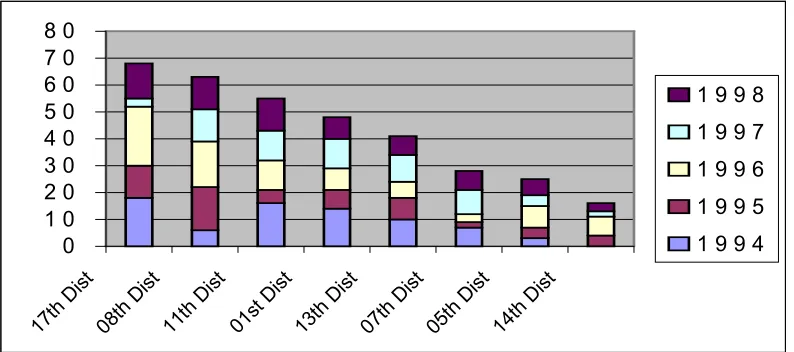
Alaska’s commercial fishing fleet has been and continues to be a major contributor to the statistics that have caused the NTSB to make such a dramatic statement. The following graph (Figure 1.1) illustrates where the United States Coast Guard’s 17th District (Alaskan waters) falls in relation to the seven other United States Coast Guard District with regards to dead and missing fishermen from the year 1994 through 1998. Clearly one can see that the 17th District ranks the highest.
Source: USCG (1999)
Figure 1.1 Dead and Missing Fishermen by District
0 1 0 2 0 3 0 4 0 5 0 6 0 7 0 8 0 17th Dist 08th Dist 11th Dist
01st D ist 13th Dist 07th Dist 05th Dist
14th Di st
1.2 The author’s relationship to the Alaskan Commercial Fishing Industry
Fishing Vessel Safety is an issue of significant importance to the author on a personal level, as she has been a commercial fisherman in Alaska for the past 22 years, participating in the majority of the fisheries Alaskan waters offer. These fisheries include salmon and herring seining, longlining halibut, pot fishing for king, tanner and dungeness crab, as well as trawling for shrimp, cod and pollock. She has been personally involved in casualties that have fortunately not ended in any loss of life, but many of her friends and acquaintances made during her fishing career have not been so fortunate.
Having served recently as a member of the United States Coast Guard Commercial Fishing Industry Vessel Advisory Committee, she has been forced to look at and analyze these casualties, and by doing so has come to the conclusion that most of the casualties could have been prevented. Of course, she `straddles the fence´ so to speak, when it comes to debating the issue of more safety regulations in the commercial fleet. Having been a commercial fisherman for half of her life, she has the typical last frontier, ‘leave us alone’ attitude with regard to legislation, but as a teacher of fishing vessel safety and being one familiar with the issues of fishing vessel safety on a broader level than most fisherman, she has concerns about what more can be done to make the fishing industry, primarily Alaska’s fishing industry, a safer one.
She is in a unique position with regard to fishing vessel safety. She has been employed as a commercial fisherman and has made her living on the fishing grounds for many years. She has real life fishing experience, which is something many fishing safety policy makers do not have. She has also worked with policy makers on a governmental level and has an understanding of the issues beyond the fishing grounds. It is her hope that by exploring the Alaskan fishing industry in depth, that she may develop a broader perspective of the Alaskan commercial fishing fleet and its specific issues of safety. The added benefit will be that she will improve her teaching skills and provide useful information and suggestions to fishermen as well as legislative bodies with regard to making the commercial fishing industry a safer one.
She does not believe that more legislation is the answer. In this paper the author will identify other strategies that might be just as beneficial if not more so, towards making the commercial fishing industry a safer on.
1.3 Purpose of study and research methodology
The objectives of this paper in addition to the author’s own enhanced understanding of fishing vessel safety is to:
1. Identify and explain specific safety issues relevant to the Alaskan Commercial Fishing Fleet;
2. Identify and discuss International and National Safety Legislation and events that have had influence on the safety of the Alaskan Commercial Fishing Fleet; and 3. Consider strategies for improving the safety of the Alaskan Commercial Fishing
Fleet.
correspondence with fishing industry leaders including fishermen, insurance providers, safety consultants, safety instructors as well as USCG personnel has also been extremely valuable in helping to shape her ideas and conclusions presented in this study. Fundamentally, of course my own working experience of over 20 years in the commercial fishing industry of Alaska provides the underlying basis of her analysis and conclusions.
1.4Definitions
1.5 The 'Highliner'
When the author first moved to Kodiak, Alaska in 1976, she was awed by the commercial fishing industry. She was amazed at the tales that were told regarding fishing exploits, adventures and the money that could be made. She also heard about the few fishermen known as ‘Highliners’. There was a book published about a Kodiak ‘Highliner’, an alcohol laden drink, popular at Kodiak drinking establishments named the ‘Highliner’ as well as a prestigious award given out every two years at the annual Northwest Fish Expo, recognizing the ‘highliner’ of the year. Every fisherman strives to be a ‘Highliner’.
The author came across a short description of what it takes to be a 'Highliner', taken from a book written by a Pacific Northwest fisherman.
This is what it takes to be a highliner. You have to be the first boat on the
grounds in the morning and the last one to leave at night. You have to keep
your lines clean at all times: you can’t fish if you have jellyfish or junk fish
hanging on your hooks. You have to go to find the fish before the other guy
finds them and when you do you have got to make them bite better than the
other guy. When the bite is on, you have to work your gear faster than the
other guy. And you don’t stop to eat as often as the other guy; better yet,
you don’t eat at all. Most of the time this will give you the little edge you
CHAPTER TWO
SAFETY ISSUES IN THE ALASKAN
COMMERCIAL FISHING FLEET
2.1 Specific issues affecting fishing vessel safety
The impressive progress made during the early 1990s in reducing mortality has occurred primarily by the use of immersion suits and life rafts, keeping
fishermen afloat and warm after evacuating capsized or sinking vessels and being able to locate them readily via EPIRBS. (Emergency Position Indicator Radio Beacon) (Niosh,1997,7)
Many of the casualties are due to the fact that a substantial number of fishermen are not adhering to the mandatory requirements for safety equipment and training. Initially, more fishermen were living through their ordeals, but the number of incidents is on the rise, and unfortunately the number of deaths.
Each year in Alaskan waters, an average of 34 vessels and 24 lives are lost in the commercial fishing industry, which equates to an occupational fatality rate of 140 per100,000 workers/year, 20 times the national average. Within Alaska, during 1991 – 1996, a total of 427 occupational fatalities occurred Commercial fishermen made up 146 (34%) of these fatalities. (NIOSH, 1997,iii)
2.2 Uninspected vessels
In the United States, attempts were made during the 1930s to enact safety legislation for motorized fishing vessels. The fishing vessel and towboat interests defeated these attempts and, as a result, the classification known as “uninspected vessel” was established. With the classification, of “uninspected vessel”, (vessels under 300 gross tons) came serious limitations on the ability to develop safety regulations pertaining to fishing vessels. For example, the problem of requiring equipment on board a vessel if there is no mandate for authority to check to see if the equipment is actually there, which is what takes place on an inspected vessel.
Another issue related to the uninspected classification of a vessel is that tonnage measurement rules for vessels permit many large fishing vessels to measure just under 200 gross tons, (vessels above this tonnage are required to have a licensed master) thereby avoiding licensed operator requirements as well.
Alaska’s commercial fishing fleet is comprised of 11,913 vessels, of those vessels 10,476 are catcher vessels, 1,248 are fish tender vessels and 189 catcher processors. Of all these vessels, there is only one vessel, a catcher processor that is classified as inspected. This issue of uninspected vessels is not unique to the Alaskan commercial fishing fleet, as the majority of the United States’ commercial fishing fleet is classified as uninspected.
boarded and inspected at sea and found deficient with regard to safety can have their voyage terminated.
This poses a strategic nightmare for the USCG as their missions at sea are primarily geared towards illegal activity pertaining to species of fish on board, drugs and illegal immigration. These are all ‘high seas’ activities pertaining to the large vessel trawl fleet as well as the catcher processors who operate off shore. The majority of Alaska’s commercial fleet operate near shore. It is the author’s opinion that not only does the USCG have inadequate access to the fleet they do not have the number of vessels or required personnel in District 17 to be affective for at sea safety inspections.
Facing financial cutbacks, the Coast Guard is struggling to maintain its present services. In a recent editorial in the CAPE COD TIMES entitled “ALWAYS PREPARED, CONGRESS SHOULD FULLY FUND THE COAST GUARD; A 10 PERCENT CUT IS UNACCEPTABLE.” The author states “Here is the reality:
- The Coast Guard’s staffing is at 1963 levels. It has 4,000 fewer billets than it did just five years ago.
- Despite the lack of personnel, the Coast Guard has been mandated by Congress to pick up more and more responsibilities. In 1963, the Coast Guard was not involved in migrant interdiction, drug enforcement, marine environmental protection and pollution prevention, all major components of its work today.” (Cape Cod Times, April,26,2000)
In another article READINESS PROBLEMS PLAGUE COAST GUARD in the May 16th addition of USA TODAY, Andrea Stone states “ ‘Coasties’ will still answer every call for help, but safety inspections and patrols to catch drug smugglers, illegal migrants and foreign vessels illegally fishing in U.S waters have been scaled back. (Stone, 2000)
2.3 Remoteness of the fleet
The United States is divided into nine districts, which are served by the United States Coast Guard. Each district has its own USCG Commander and personnel. To give the reader an idea of the vastness of District 17, which comprises the whole of the state of Alaska, the author offers the following quote.
Nearly nine hundred thousand square miles of open water fell within the station’s watch, nearly twice as much as the entire land mass of the continental U.S. Add in tens of thousands of islands within the two-hundred-mile U.S. coastal boundary, and the Coast Guard station’s responsibility can be compared to watching over a small galaxy. (Dillon,1998,80)
Source: USCG
FIGURE 2.1 United States Coast Guard Districts
has been low for owners to have their vessels inspected. Of the 11,913 commercial fishing vessels in Alaska, only 5278 of them have met the safety requirements and been awarded Safety Exam decals by the United States Coast Guard after a voluntary examination.
2.4 Weather conditions
Weather itself is often a factor in fishing vessel casualties. Fishing conditions with regard to weather in Alaskan waters are extremely challenging. First, all waters in Alaska have been classified as “cold” waters in which hypothermia can lead to death by drowning within minutes of immersion. Secondly, although Alaskan fishermen do experience flat calm conditions, this is the exception rather than the rule. Alaska is situated in the North Pacific where cold, dry polar air moves south and then collides with the warm, moist air over the Japanese current. During winter months these air masses meet near the Aleutian Chain and create great storms that move into the Gulf of Alaska. Weather conditions can also change quickly, and for the most part, whether fishing in winter or summer, weather conditions can be extreme. Fishing and traveling to and from the fishing grounds during a gale warning is a common practice and is considered business as usual.
Icing conditions during the winter months are frequent and often crews are forced to put down their fishing tools and pick up bats, which are used to pound off ice that has built up on their vessel. Icing of a ship’s superstructure can rapidly compromise the stability of any vessel and predispose it to capsizing.
salvaged. Unfortunately, the crew abandoned ship before she reached the shore and did not live through their ordeal.
Source: National Research Council
Figure 2.2 Iced Vessel in Alaskan Waters
An example of the tragic effects of icing as well as the swiftness that the problem can get out of control is illustrated in the following incident taken from the National Transportation and Safety Board study of Uninspected Commercial Fishing Vessel Safety.
his vessel, he had changed course and was heading for safe refuge in Bumble Bay which is situated on the south end of Kodiak Island. The captain of the MARGARET LYN reported that there were 100-mph winds from the northwest, heavy freezing spray, extremely low temperatures, and blowing snow. About 0400, the captain of the MARGARET LYN, which was about 10 nautical miles north of the ALERT stated, he likewise was going to head for Bumble Bay and they agreed to hourly communications. However, the ALERT never made another communication. The five crewmembers were never found. The Safety Board determined that the probable cause of the catastrophic loss of the ALERT was capsizing due to icing during severe weather. (NTSB,1987,23-24)
2.5 Fishermen’s attitude toward safety
Some ten years ago the author was listening to a radio interview with a Coast Guard official who was taking over a command of one of the airbases in Alaska. During the interview he was asked about his thoughts on fishing vessel safety, and he related the experience of visiting a ship’s chandler on the East Coast, looking for the safety department. After looking up and down the aisles for quite some time and not seeing the familiar safety orange colors of safety equipment, he decided to ask the proprietor of the store for help. The proprietor gave directions, telling him that it was at the end of a specific aisle. When the Coast Guard official went to that aisle, where all he found were lead weights attached to leather straps. When he asked the clerk what they were for, the clerk explained that they were boot weights. They were to be put on when a situation got out of control, so as to not prolong the mariner’s suffering!
fatality rates remain high. The author feels that one of the main reasons for the continuous high fatality rates is fishermen’s attitudes towards safety and safety regulations. Many fishermen came to Alaska to escape the world of rules and regulations that other states were so inundated with. The Alaskan fishing grounds were essentially open game for anyone with drive and the ability to work hard.
In 1983, Dennis Petersen, an Alaskan crab fisherman was quoted in the book “Lost At Sea – An American Tragedy” as follows,
It’s a hard life. Every year you lose fifteen to twenty guys. Both my brother and I have been overboard, and we know what it’s like. I don’t care what kind of model you come up with, you’re not going to solve the problem, I don’t think. When it’s your turn to go, you go.” (Dillan, 1998, 141,142)
Another issue with regards to attitudes toward safety is the age of crewmen. Commercial fishing in Alaska is primarily a ‘young mans’ game. Crewmen on board vessels tend to be in their 20’s and early 30’s. There may be a connection between age of crew and perception of risk. Young people tend to think that they are impervious to accident, fatality and may take more risk. One observation the author has made, that is purely anecdotal, is that most of the fishermen she has met, tend to engage in risky forms of activity during their vacations or leisure time. Extreme skiing, snowboarding, mountain climbing, para-sailing and scuba diving are just a few of the ‘risky’ sports commercial fishermen engage in.
Fishing Vessel Owners’ Association, upon her being awarded the U.S. Coast Guard’s Meritorious Public Service Award for her work in promoting fishing vessel safety. Robert Desautel of Nina Fisheries, Inc. writes “We Fishermen used to have a more fatalistic attitude to our profession: we knew it was dangerous, and we knew lives were often lost. But we accepted this, thinking that this was simply the way of fishing and not much could be done about it, but we were wrong and you helped prove us wrong.” (USCG Fishing Vessel Casualty Task Force Report,1999,5-1)
Even in light of this shift of attitude, deaths and casualties are still considered part of doing business. The author does not mean to imply that casualty is taken lightly within the Alaskan commercial fishing community, but she has heard the statement made many times “ We never thought it would happen to us.” Fishing in Alaska is still a high stakes game with regard to finances where fortunes can be won and lost within a fishing season. Fishermen are constantly pushing the envelope, taking chances, so much so that it is no longer considered risk taking, but falls into the category of business as usual. This is especially true regarding stability issues. Fishermen want to haul the largest amount of fishing gear and fish that they possibly can, sometimes exceeding stability safety. Risk taking behavior becomes habit; habits are no longer considered risks. This is especially true when the habit equates to a positive economic outcome. As fish stocks decline, a fisherman’s thoughts are more concerned with management issues, making boat payments and supporting a family. Safety typically, though not consciously, lies at the end of the list of things to worry about.
actions, etc). Regulatory (safety) changes have not made it to the top of the list.” (UFA email correspondence, May11, 2000)
2.6 Economic issues
There are many issues related to the economics of staying in the commercial fishing business. Decline of resource, drop in price and shortened fishing seasons all affect the commercial fisherman’s ability to make a profit and be the safest he or she can possibly be. Safety risks are taken because of economic necessity or to maximize economic gains.
2.6.1 Shortened fishing seasons
The author remembers a time many years ago during a red salmon season when the boat she was working on was putting its net out, off a cape in an area known for its currents and winds. In this particular area, a vessel could be fishing in flat calm waters one hour, and then the next be faced with 8-foot seas and a 30-knot wind. The fish were running well on that particular day, and each time the crew put their net out and brought it back in, a process which takes approximately an hour and fifteen minutes, the boat was rewarded with a financial gain of approximately US$2000.00. The author’s share of that was US $200.00. If the process is repeated enough times in one day, a crewman makes a good wage. One must remember that they do no have this great harvesting opportunity all summer long. These red salmon openers may only last for a few days, and then the chance of making a profitable red salmon season are over.
the weather is working against you, which may include rendering your vessel dead in the water if the net gets fouled in the propeller. She distinctly remembers that she had doubts as to whether the set worth making, as she knew the crew would get physically “beat up” and may catch nothing in the process. But there is a certain adrenaline rush that comes with working on the edge and so was supportive of her skipper’s decision.
They did make another set, they did get “beat up”, they did not catch enough fish to say it was worth it and they did call it a day when finished with the set. The storm worsened enough that night, that in that particular anchorage three vessels broke their anchor lines and ended washed up on the beach. Would her skipper make the same decision again to take chances that may jeopardize the safety of the boat and crew? Yes, if the possible financial gain was big enough. This story typifies a scenario or similar ones that happen over and over in the commercial fishing industry. Some vessels and crews are not as lucky as the author’s crew were that particular day, counting their losses in fish only. As fish resources decline, fishery openings become shorter and sometimes nonexistent. ‘Making hay while the sun shines’ is a common attitude, and a necessary one if a person is to make a living in the commercial fishing industry. As most of the fisheries in Alaska are managed by a common property resource regime, there is always a race to harvest the resource that is available. Because of this, fishermen find themselves and their vessels in sea conditions that they and their vessels are not prepared for.
2.6.2 Fatigue
seasons where the average sleep per day is 4 hours, “ You have all winter to sleep, now is the time to work.” This statement is made during a three-month season so you can imagine the fatigue that goes along with a three-week crab season during the winter months in the Bering Sea. Crab Fishermen have to contend with constant wind, waves and icing, working on a slippery platform that is constantly in motion. When sleep is allowed it is only when traveling to and from the fishing grounds and short naps between sets of gear.
It is a proven fact that fatigue dulls the senses and that decisions made under fatigue may not always be the safest ones. A person’s ability to react appropriately to a safety-threatening situation is also jeopardized. Add these issues to the reality that fishermen are going to take chances anyway and the safety issue compounds itself.
2.6.3 Drop in price
could put a squeeze on capital available for vessel maintenance or delay the upgrading of equipment.
2.7 Diversity of fishery participation
Because of a decline in resources, and its negative economic implications, fishermen are forced to diversify and participate with the same vessel in more than one fishery. This often is accompanied by changing deck configurations and types of fishing gear. Each of these issues can adversely effect the vessel’s stability in such a way that the fisherman may be unaware of. In 1983, two fishing vessels, the ALTAIR and AMERICUS capsized and sank in the Bering Sea taking 14 men with them. Following is an excerpt from the national Transportation Board’s marine Accident Report.
About 0230 on February 14, 1983, the fishing vessel ALTAIR departed Dutch Harbor, Alaska, for the crab fishing grounds near the Pribilof Islands in the Bering Sea. About 0330, the helmsman of another fishing vessel en route to Dutch harbor saw the ALTAIR proceeding on a course toward the Pribilof Islands at about 10 knots. About 0830, the fishing vessel AMERICUS a sistership to the ALTAIR, departed Dutch harbor for the same crab fishing grounds. Both the AMERICUS and the ALTAIR were fully loaded with crab pots. About 1430, the capsized
Both vessels were originally built as crab vessels but with the decline of the crab stocks, both had been refitted and modified to trawl fish as well. Net reels and stantions were added to the decks of both vessels. but neither vessel had any stability tests done after the addition of the trawl gear which occurred right before the vessels left for the 1983 crab season. After a two-year investigation, the NTSB report concluded that, because of the changes made to the vessels which increased their lightship displacement by 35 tons and raised the center of gravity about 1 foot, they were no longer able to carry out their usual fishing operations safely with regards to stability.
2.7.1 Technology advancement with regard to stability
seawater systems in their fish holds, enabling them to get a better price for their chilled product at delivery time. The author is not aware of any salmon fisherman who has had his or her stability booklet reworked to reflect the changes made to their specific fishing vessel.
New seining vessels are being built, but skippers still want the attributes of the older vessels and the ability to fish shallow waters if necessary as important salmon area fishing openers still take place at the head of bays. Quite frequently throughout the Kodiak salmon season, new areas will open where thousands of salmon have had the chance to make it up into shallow water, close to their final destination, the creeks and rivers that support their spawning cycle. It is not unusual to see up to thirty vessels at the head of a small bay waiting for the starting gun to go off, signaling the start of an opener. If the fishermen is lucky and manages to get his or her net around a substantial amount of salmon, thousands of dollars may be made in a matter of one or two hours.
Salmon fishermen also want the ability to pack as much fish as possible. When the fish are running hard, a vessel’s hold can fill up fast with product. Unloading, even if on the fishing grounds to tenders that are standing by to take fish, can be a time costly task, taking as much time as two to three hours away from harvesting. The more fish a vessel can hold, the more time the vessel can spend fishing. To facilitate the issue of packing more fish as well as having a shallow draft, vessels have no where to grow but out. Seining vessels are becoming beamier, shallower as well as lighter to accommodate a faster speed through the water. Although by law, seaworthiness must be a factor of the design, seiners have truly become fish catching machines that are pushing the limits of stability when traveling and working in marginal weather.
journey which takes about 5 days, a journey that the operator of the vessel had made many times with the same vessel, the Evanick was caught in a rough following sea. On board the back deck the Evanick had a new seine skiff that weighed approximately 5,000 lbs., quite a bit heavier than the one he usually fished with. The Evanick rolled over so swiftly that it is the author’s belief that they probably didn’t know the extent of the danger they were in until the vessel rolled over. The capsize happened so fast that the crew had no time to get to the survival suits, which were still in their storage area when divers examined the overturned vessel. No crewmembers were ever found. (NTSB, DCA-98-mm-029)
2.8 Inexperienced crew
In the earlier years of the Alaskan fishing industry, vessels would maintain the same crews for years at a time. A deckhand could make a career out of fishing and earn enough money to support a family. Patrick Dillon writes in his novel “Lost At Sea – An American Tragedy” about the experiences of a long time Coastguardsman named Captain John De Carteret.
De Carteret was acquainted with dozens of fishing families and know that in the old days, fishing had been a father-son occupation, a family enterprise. From their fathers, uncles, and other relatives, young men learned respect for what the sea was capable of doing to even the best boats. (Dillon, 1998, 115)
that will lead them into the a skipper position, as well as adventure, an escape or a good amount of income in a relatively short amount of time. Because of this, significant proportions of crews are not experienced and frequently change. There is little if any time to properly train new crew persons with regard to safety during a hectic season and skippers often rely on a new crewmember’s common sense to keep him/her out of harm’s way or to react correctly during an emergency. All to often ‘green’ crew are the victims of marine casualties.
These were the days before mandatory safety equipment, so the author’s skipper was not breaking any laws. The skipper and crew were not fully aware of what they could do to make their situations safer.
CHAPTER THREE
INTERNATIONAL AND NATIONAL
INITIATIVES TO ENHANCE FISHING VESSEL
SAFETY
“Those who cannot remember the past are condemned to repeat it.”
The Life of Reason,
George Santayana, (1863 – 1952)
3.1 Overview
Although the fishing industry has been without strong safety legislation in the past, it has not been without an ongoing struggle to mandate safety. The battle between fishermen, who are fiercely independent and reject attempts to control their industry with regard to safety, and those within and outside the industry who have tried to exert control, continues to this day. The International Maritime Organisation as well as other United Nations agencies has produced an impressive list of documents relating to commercial fishing vessel safety which includes:
1. The International Convention for the Safety of life at Sea (SOLAS)
2. The Torremolinos International Convention for the Safety of Fishing Vessels, 1977, and the Torremolinos Protocol of 1993
3. International Convention of Standards of Training, Certification and Watchkeeping for Fishing Vessel Personnel, 1995 (STCW-Convention)
6. Code of Conduct for Responsible Fisheries
7. FAO/ILO/IMO Code of Safety for Fishermen and Fishing Vessels
8. FAO/ILO/IMCO Voluntary Guidelines for the Design, Construction and Equipment of Small Fishing Vessels, 1980
9. FAO/ILO/IMO Document for Guidance on Fishermen’s Training and Certification , 1985
Although there have been many attempts at guiding and mandating a safer commercial fishing industry, the author has selected a few, international and national (USA) initiatives to briefly describe what she believes have had an influence towards a safer fishing industry. The items following will be labelled as to whether they are mandatory or voluntary, and also what agencies are responsible for them.
3.1.1 International Convention for the Safety of Life at Sea – SOLAS
Mandatory
International Maritime Organisation
requirements as well as distress messages apply to smaller vessels that could be involved in commercial fishing are provided for.
Specific standards have also been taken from the SOLAS Convention by the US’s fishing fleet with regard to liferafts, visual distress signals, personal flotation devices as well as immersion suits.
3.1.2 Torremolinos International Convention for the Safety of Fishing Vessels, 1977 and the Torremolinos Protocol of 1993
Mandatory, as yet not ratified International Maritime Organisation
It is the author’s opinion that the most comprehensive and ambitious instrument for fishing vessel safety on a world-wide level, is the Torremolinos International Convention for the Safety of Fishing Vessels. It is named the Torremolinos Convention, as the International Conference on Safety of Fishing Vessels took place in Torremolinos, Spain in March – April 1997. This convention marked the first time that compulsory safety regulations aimed at fishing vessels, specifically fishing vessels of 24 meters and over, were internationally agreed upon. This convention was never ratified as many of the states felt that the convention was too stringent. As of the year 1990, the ratifications represented only 19% of the world’s fleet of fishing vessels 24 meters of length and over. (50% representation needed to ratify)
industry as evidenced by an excerpt from the Safety at Sea International Magazine. In an article intitled The 1993 Torremolinos Protocol the following was written;
At the 1993 conference, a protocol was adopted which amends
and absorbs the parent Convention. It takes into account technological evolutions in recent years and the need to take a pragmatic approach towards the early ratification of an instrument which provides the appropriate
legal regime needed to regulate the safety of fishing vessels and those who sail in them. Its purpose is to eliminate the provisions incorporated in the 1977 Convention which have caused difficulties for states, and to enable the protocol to be brought into force as soon as possible.
Again an attempt at making the fishing industry safer failed. As of February 2, 1999, only five countries; Cuba, Denmark, Iceland, Norway and Sweden have ratified the Protocol.
3.1.3 STCW-F - Convention - 1995
International Convention on Standards of Training, Certification and Watchkeeping for Fishing Vessel Personnel
Mandatory once Adopted
International Maritime Organisation
authority of the convention's scope. As of February 2, 1999, Denmark and the Russian Federation are the only countries to have ratified.
3.1.4 Code of Conduct for Responsible Fisheries - 1995
Voluntary
Food and Agriculture Organisation of the United Nations
The Code of Conduct for Responsible Fisheries was manifested in part due to the widespread overcapacity of the world’s fishing fleets. The introduction in the mid-seventies of the exclusive economic zone (EEZ), gave rights and responsibilities to coastal states that had not, up until that time controlled the exploitation of their own fisheries resources. Many coastal states did not have the physical and financial resources as well as experience to manage there own fisheries affectively. (FAO, Code, 1995.v) Other countries, such as the United States, built up their own fleets to the point of overcapitalisation and in some cases overfishing has been the result.
The issues above, as well as others, “all of which threatened the long-term sustainability of fisheries and, in turn, harmed the contribution of fisheries to food supply”, (FAO, Code, 1995,35) influenced the adoption of the Code of Conduct for Responsible Fisheries on October 31, 1995. Although this document is aimed at the responsible management of resource, in Article 8 - Fishing Operations, vessel safety as well as crew safety and health are specifically addressed. (FAO, Code, 1995 16,17)
3.2 Initiatives in the United States of America
3.2.1 Draft Safety Legislation of the 1930s
“Uninspected vessel’. Only vessels over 300 gross tons are required to be inspected by the United States Coast Guard. As the majority of the American commercial fishing fleet is under 300 gross tons and because of the nature of this classification, lawmakers were and continue to be limited in their ability to develop safety regulations that will pertain to the fishing fleet.
This may well be the most affective legislation in a negative sense to have influenced the safety of the United States commercial fishing fleet, having placed the majority of the vessels out of the scrutiny of safety inspectors.
3.2.2 Fishing Vessel Safety Bill - 1941 Voluntary
United States Congress
In 1941, a bill (H.R. 3254) that specifically addressed fishing vessels was introduced to the United States House of Representatives. It proposed to “place fishing boats [15 gross tons or over, fishing outside inland waters] under the supervision of the Bureau of Marine Inspection and Navigation.” This bill outlined specific requirements for watertight bulkheads, bilge pumps, ring buoys, life preservers, lifeboats, radio telephone, first aid kits, line throwing guns, annual inspection, and the licensing of operators. Although the Atlantic Fishermen’s Union of Boston supported the bill, most other segments of the fishing industry opposed the measure, particularly the provisions for the watertight bulkheads and the licensing of operators. This initiative died in part due to the outbreak of WWII.
3.2.3 The Commercial Fishing Vessel Safety Act of 1988 Mandatory
United States Department of Transportation / United States Coast Guard
By far, the document that has had the most profound positive affect on the Alaskan Commercial Fishing Fleet is the Commercial Fishing Vessel Safety Act of 1988. The act was spearheaded by the parents of Peter Barry, a young man who lost his life while on a fishing vessel during the Kodiak, Alaska salmon season of 1985. As a result of the investigation that followed the tragedy, Peter’s parents found out that commercial fishing vessels in the United States were virtually unregulated when it came to safety. The timing was right for a grass roots campaign to change the status of safety in the commercial fishing fleet with regard to legislation. Mrs. Barry started a grass-roots campaign; enlisting other parents whom had suffered losses as well as other concerned citizens. Mrs. Barry worked hard campaigning through a growing list of political and journalistic contacts, pressuring lawmakers for mandatory safety measures. In the end the plea was heard and answered with the enactment of the Commercial Fishing Vessel Safety Act of 1988.
3.2.4 Fisheries Management – Individual Fishing Quotas - 1995
Individual Fishing Quotas were originally conceived as a tool to prevent over harvesting in the Alaskan halibut fisheries. As catch effort increased, less time was given the fleet to harvest a declining stock. Even with the short fishery openers, harvest levels were consistently being exceeded. Fisheries’ managers were unable to control the amount of fish caught during a specified amount of time (the last unregulated opener lasted only 12 hours) and the fleet had to fish in whatever weather presented itself during that opener. Many vessels were not suited to the storms that would appear during an opener, but skippers and crews felt pressured to fish anyway, as it might be their last chance for the year. Needless to say there was a high incident of marine casualty during these openers.
Fisheries’ managers decided to award Individual Fishing Quotas to the vessels with the appropriate past history in the fishery. Basically, the vessels that received the quotas were guaranteed a percentage of each year's total allowable catch. They were also given the right to fish for them at their leisure over an 8-month season. Halibut fishermen are now able to choose the weather they will fish in and are not forced to participate in frenzied derby style fishing that accompanied the short openers. The lowering of casualties in that fishery has been significant over the past three years. (NRC, Sharing the Fish – Toward a National Policy on Individual fishing Quotas, 1999)
3.2.5 The Fishing Vessel Casualty Task Force: March 1999
time and in a geographically small area emphasised the need for concern. These incidents were brought to the attention of legislators on the East Coast, who then in turn asked that a task force be formed to look once again at the issues of commercial fishing vessel safety. The task force was made up of twelve members who represented the United States Coast Guard, National Marine Fisheries Service, Department of Labor, Occupational Safety and Health Administration, National Transportation Safety Board and The National Oceanic Atmospheric Administration. There were also five advisors that represented commercial fishermen, commercial fishing vessel insurers. The objectives of the task force were to:
1. evaluate recent serious casualties;
2. examine recent casualties in the context of historical dates; 3. provide quick feed back to the industry;
4. review the current fishing vessel safety program and past safety initiatives; 5. recommend significant measures to reduce loss of life and vessels; and, 6. develop direction for government in industry.
Although there were many recommendations made in the report, ranging from requiring safety warning signs being put on deck equipment, to legislating required training for crewmembers, the overall recommendation was that the industry needed stricter guidelines, tougher enforcement of what is already in place, and more legislative requirements regarding inspections, training and licensing.
CHAPTER FOUR
AFFECTS OF LEGISLATION ON COMMERCIAL
FISHING VESSEL CASUALTY DATA
4.1 Torremolinos Convention
The legislation and events discussed in the previous chapter have all had an impact on fishing vessel safety world-wide. Most importantly, each one in some way has brought awareness to the safety issues of the commercial fisherman. Unfortunately, this awareness has been recognised more by bureaucratic agencies rather than fishermen themselves. As the author stated in the previous chapter, it is her opinion that the Toremolinos Convention was the most comprehensive safety initiative for the commercial fishing industry world-wide, but the ‘world’ was and is still not ready to accept it. The impact if ratified, on the commercial fishing fleet in the United States would be limited as the Convention only applies to commercial fishing vessels greater than 79 feet. The majority of the U.S. fleet is under 79 ft. (USCG Fishing Vessel Casualty Task Force, 1999,3-1)
Owner’s Association, mirror the contents of Chapter VIII, Emergency Procedures, Musters and Drills from the Torremolinos document.
The Torremolinos document has also recognised that regionalization of safety standards is a positive way to develop appropriate standards for different fleets operating in different circumstances around nations. One of the problems with a world-wide standard is that each nation and regions within those nations have unique issues to be addressed. The United States is dealing with the same problem of developing safety standards that meet all the needs of all the fleets, but do not put excess burdens on any of the fleets.
4.2 STCW-F
Most of the mandatory safety training that masters and crews receive on the world’s fishing vessels, are on vessels large enough to require an operator’s license. In the United States these are vessels over 200 tons. STCW-F if ratified, would impact less than 20 commercial fishing vessels in the United States. In general, Safety Regulations coverage by the International Maritime Organisation in the world’s fisheries would be as follows:
5,100 F/Vs in the world will come totally under IMO regulations. 2,100 F/Vs will have partial IMO coverage.
30,600 F/Vs in the 24-35 meter range will have less partial coverage.
1,000,000 to 2,000,000 fishing vessels in the world are under 100 gross tons and will not be covered by any IMO regulations at all. (Dzugan, 1997. Letter to Bill Gossard, NTSB)
for all size fishing vessels in the United States. In joint meetings of the USCG and the Commercial Fishing Industry Vessel Advisory Committee, both of the above mentioned documents are referred to frequently when looking at establishing higher standards in the U.S. fleet with regard to safety.
4.3 The Commercial Fishing Vessel Safety Act of 1988
The Fishing Vessel Safety Act of 1988 has had some positive impact on Fishing vessel casualty data for the United States. Following, the author has constructed a graph illustrating information taken from the Fishing Vessel Casualty Task Force Report of March, 1999, which compares the five years prior to the Act as well as the five years after. Figure 4.1 shows total fishing vessel losses before and after the act of 1988. Sinking continues to be the leading cause of vessel casualties.
Source: USCG
Figure 4.1Total Fishing Vessel Losses Comparison Before and After the Fishing Vessel Safety Act of 198
Although in the areas of structural failure and flooding there appears to be no positive change, in all the other areas including capsizing, collision/allision, grounding, explosion/fire and sinking there was a marked change for the positive.
0
100
200
300
400
Unknown Other
Stru ctural
fail
Loss Ves C
The author believes that that the overall statistics for the commercial fishing industry nation-wide were affected by the Commercial Fishing Vessel Safety Act as there was no other significant event that she is aware of that would have caused such a change. The effects of the Commercial Fishing Industry Vessel Safety Act on the Alaskan Commercial Fishing Fleet however, are not so positive. According to the United States Coast Guard, Alaska experienced more than 20 commercial fishing fatalities per year from 1982 to 1987 (NIOSH, 1997, 1). In a study done by NIOSH in 1997, the average number of fatalities per year in Alaskan waters from 1991 to 1996 is 23. It is obvious that more needs to be done. The author does not believe that more legislation is the answer. She thinks that the Commercial Fishing Vessel Safety Act of 1988 is an excellent tool to facilitate the lowering of fishing vessel casualties. The reason that this legislation is not as affective as it could be stems from the author’s opinion that the current legislation is not being enforced to the fullest extent. Other issues contributing to the problems of the Fishing Vessel Safety Act have been, insufficiently trained USCG inspectors for voluntary inspections and mandatory safety drills enforcement as well as the negative impression fishermen had in the past of the USCG. This in turn jeopardised the effectiveness of the voluntary dockside exam and mandatory monthly drills.
5278 Alaskan commercial fishing vessels have been awarded Safety Decals. With the current fleet numbering 11,913 vessels it is sad to not that less then 50% of the Alaskan fleet has either chosen not to be inspected or did not pass the inspection, earning a Safety Decal.
YEAR EXAMS DECALS ISSUED 92 807 544
93 1249 684 94 1243 732 95 1177 694 96 1093 689 97 769 544 98 1064 736 99 1021 655 Total 8423 5278
Source: USCG
Figure 4.2 Exams conducted and Decals Issued By the USCG in District 17
4.4 Fisheries Management - Individual Fishing Quotas
Bering Sea Crab that have no quota system in place find themselves fishing for days on end with out adequate rest.
Source: USCG
Figure 4.3 Halibut Fishery-Related Search and Rescue (SAR) Missions and Fatalities by Year in Alaska, 1992 – 1996
The above chart, Figure 4.3, illustrates the effectiveness of the 1995 Individual Fishing Quota management regime with regard to safety. This form of management is being looked at for other fisheries in Alaska and the United States, but the author has no further information on the status of those endeavours.
4.5 The Fishing Vessel Casualty Task Force
There was a lot of anxiety among the commercial fishing industry as to just what would be stated, and the ramifications of the recommendation that would be included in the Fishing Vessel Casualty Task Force report. The report came out in March 1999, and it is the author’s opinion that the report was a knee jerk reaction to a lot of casualties happening in a short time span, but she also feels that it served as a venue to see how better the USCG could implement the current standards. The executive
0
10
20
30
40
19
92
19
93
19
94
19
95
19
96
summary of the Fishing Vessel Casualty Task Force Report states, “The unsafe conditions and failed defences that result in high casualty rates stem from inadequate safety standards, poor compliance with existing safety standards, and inadequate participation in voluntary safety initiatives.” (USCG Fishing Vessel Casualty Task Force,1999,vi)
From an article dated April 11, 1999 in the Ashbury Park Press newspaper in the state of New Jersey,
The long-awaited release of a Coast Guard report on fishing vessel safety surprised fishermen and safety advocates alike with the scope of its recommendations. But just how many of those ideas come to pass— from designing new lifejackets to licensing captains—depends in large part on how they are received by commercial fishermen.
So far, area fishermen don’t have a lot of good things to say about the report that was prompted by five sinkings and 11 deaths this winter. ‘When the Coast Guard says they want to make fishing no more dangerous than other marine professions, what’s the ‘rest of the marine industry’? Five hundred- foot freighters? This is crazy. We’re small boats’, said James Lovgren, a trawler captain and president of the Fishermen’s Dock Cooperative in Point Pleasant Beach.
requirements that are already in place. The learning curve has been high, both for the United States Coast Guard as well as fishermen.
CHAPTER FIVE
STRATEGIES FOR IMPROVING FISHING
VESSEL SAFETY IN ALASKA
5.1 More legislation is not the answer
5.2 Creating a ‘professional’ fleet
“Our impression, gained through the experience of investigating several hundred fishing vessel accidents annually, is that the sector is failing to keep up with the rest of the maritime industry in developing a safety culture.” (Coton,1999)
‘Safe’ and ‘professional’ have never been words associated with the commercial fishing industry in the United States. Fishermen have always been considered to be a hard working lot, but the adjectives rogue and free spirit have also been used to describe the typical fishermen; not exactly compatible terminology with the concept of professionalism. Other countries around the world facing the same safety issues in their commercial fleets are turning toward the idea of professionalism to facilitate a safer industry.
One definition of a professional fisherman taken from a Canadian publication ‘Charting a New Course: Towards the Fishery of the Future’ states,
A professional fisherman is someone who is experienced, highly skilled and well trained in the fishing sector. This individual is a vessel owner/operator or is a steady crewmember who fishes for the full season, and depends on fishing for his livelihood and future. The professional fisherman is involved in the management and development of the fishery through fishermen’s organisations. He is respected by his peers and the general public as an accredited member of a professional group. (Taskforce, 1993,68,69)
the document further states, “Among the identified results of professionalization are significant improvements in conservation, management, enforcement, data acquisition, quality control, health and safety and marketing aspects of the industry.” (Taskforce, 1993 69,70.) Some of the other topics mentioned in this statement have been identified earlier in this paper as issues that are directly affecting fishing vessel safety in Alaska.
In further support of professionalism, when asked about her opinion regarding professionalism within the Alaskan Commercial fishing fleet, Sue Jorgenson from the Marine Safety Office in Juneau Alaska stated that, “I agree that the more professional operations and operators take safety to heart. The professionals are also the ones that have their crews attend safety training courses.” (USCG correspondence, 2000,1)
As an example with regard to professionalism, Denmark has established seven fishing safety councils that meet four times a year. These government-subsidised councils develop action plans as well as co-ordinate implementation of fishing safety legislation. Members of these councils are both employee and employer as well as trade union and fishing vessel owner representatives. All persons working on Danish fishing vessels are obliged to become affiliated with a council. (ILO-Safety and health in the fishing industry,1999,41)
5.2.1 Professional commercial fishermen’s organisations
There are many professional commercial fishermen’s organisations in the United States, but few are dedicated to fishing vessel safety. The North Pacific Fishing Vessel Owners’ Association is one of the few that the author is aware of. Developed in 1985 in co-operation with the United States Coast Guard, it is totally dedicated to safety education and training for fishermen and other mariners. More than 20,000 people have participated in classes since its inception.
NPFVOA is a non-profit association who’s funding is mostly provided through the contributions of its members as well as tuition fees and sales of educational materials.
The ILO has recognised the NPFVOA as a professional commercial fishermen’s safety organisation, as it was invited to participate in the International Labor Organisation Tripartite Meeting on Safety and Health in the Fishing Industry in Geneva, Switzerland this past December.
The author believes that there is need in Alaska for a professional fishermen’s association dedicated to commercial fishing vessel safety. Although there are many Alaskan fishermen who are members of the NPFVOA, most of them are from the larger vessel fleet, as are most of NPFVOA’S members.
Roles of the council include, promoting the education and training of Canadian fish harvesters as well as developing and implementing training initiatives that will give recognition to the Professional Canadian Fishery. Potential services offered by the Council are, training courses for upgrading skills for experienced fish harvesters in the areas of: business management, gear maintenance and repair, fishing technology and fishing methods, business management, conservation and the environment as well as health and safety at sea. The Council is currently offering insurance opportunities at competitive rates to all its members.
This council is a good model to study as a lot can be learned from this type of organisation. Certain aspects of this council could be incorporated into regional U.S. Organisations and the possibilities will be discussed later in this paper.
5.2.2 Fishermen’s wives associations
During a discussion that took place a few months ago, between the author and a fisherman from Iceland, she questioning him about safety issues in his country and how did they get fishermen to comply with safety standards there. He replied, “the fishermen’s wives are the ones that make sure that regulations are followed. They are the ones that actually control the industry, the wives and the mothers.” This again reminded me of how our commercial fishing safety regulations came into being in the United States. It was a concerned mother who led the charge.
industry. In Alaska, the Kodiak Fishermen’s Wives Association has been very influential in bringing safety issues to the forefront. The ‘Wives’ have founded and sponsored the Annual Norm Holm Memorial Survival Suit Race in Kodiak for the past 12 years. The race is one of the best-attended events at the yearly Crab Festival in that town, and is always a great venue for fishing vessel safety education on a large scale. They have also donated survival suits to the local school district for youth training as well as provided mandatory training for local fishermen.
In Stonington, Maine one of the primary goals of the Island Fishermen’s Wives Association is to “develop and promote safety programs for commercial fishermen. Also in Maine, the Midcoast Fishermen’s Wives association is working with the National Oceanic and Atmospheric Association to install a weather station to provide accurate local forecasts to commercial fishermen.
5.2.3 National trade associations
The author is not aware of any national trade associations for fishermen, but the American Waterways Operators is a national trade association representing the owners and operators of tugboats, towboats, and barges serving the waterborne commerce of the United States. Its mission is to, “Promote the long term economic soundness of the industry, and enhance the industry’s ability to provide safe, efficient and environmentally responsible transportation, through advocacy, public information, and the establishment of safety standards.” (American Waterways Operators, http://www.americanwaterways.com/mission.ht)
through non-regulatory solutions. This is the first partnership of its kind between the Coast Guard and any segment of the U.S. maritime industry.
The AWO has initiated the Responsible Carrier Program (RCP) which is designed as a framework for constantly bettering the industry’s safety performance. Members of the AWO use the RCP as a guide in company-specific safety development, built upon existing government regulations as well as surpassing them.
5.3 Creating a more positive relationship between the USCG and the commercial fishing industry
Fishermen have traditionally have had a love/hate relationship with the United States Coast Guard. There is not a more welcome sound to a distressed fisherman onboard a disabled vessel than a Coast Guard helicopter, C-130 aircraft or rescue vessel that is arriving on scene to render assistance. Fishermen are well aware that ‘Coasties’ risk their live to help others and are appreciative of and dependent upon them.
This love relationship ends when the USCG tries to initiate regulations that would mandate compliance with regard to safety. The majority of fishermen feel that the Coast Guard is out of touch with the realities of the fishing industry and the operations of fishing vessels. ‘Blue Suits’, as the Coast Guardmen are not so affectionately called at times are not a welcome site when approaching a fishing vessel on a mission that does not involve a rescue. Fishermen then regard the USCG as a Law Enforcement Agency, which to them has negative connotations.
common complaint in the past from fishermen who have requested a voluntary safety examination is that the examiner did not know what he or she was looking at or looking for, or that they were looking for ANYTHING, however small, that might not be in compliance. (For example the absence of a Marpol placard)
At sea safety compliance boardings have also had their share of complaints. Fishermen that had been awarded their safety decal from a prior inspection felt at times that their vessels were being boarded for the purpose of training new cadets. The United States Coast Guard, because of its relatively small population has to out of necessity, fill its billets with young inexperienced persons. Not only are these people young, many do not have a maritime background other than what they received in their initial Coast Guard training.
The author believes that the Coast Guard has made tremendous strides in the past few years towards changing their image with the commercial fisherman. The author also believes that in order for the current fishing vessel legislation to be affective the Coast Guard needs to continue those efforts. These efforts are paying off. Having worked with the Coast Guard, as a member of the Commercial Fishing Industry Vessel Advisory Committee, she has seen first hand the changes that have been made. The Coast Guard has made a sincere effort to make their boarding personnel and procedures more fishermen friendly and is conducting more in-depth training for Coast Guard boarding officers regarding material conditions found on board fishing vessels.