World Maritime University World Maritime University
The Maritime Commons: Digital Repository of the World Maritime
The Maritime Commons: Digital Repository of the World Maritime
University
University
World Maritime University Dissertations Dissertations
2001
Ocean governance
Ocean governance
Azfar Bin Mohamad Mustafar WMU
Follow this and additional works at: https://commons.wmu.se/all_dissertations
Recommended Citation Recommended Citation
Mustafar, Azfar Bin Mohamad, "Ocean governance" (2001). World Maritime University Dissertations. 996. https://commons.wmu.se/all_dissertations/996
This Dissertation is brought to you courtesy of Maritime Commons. Open Access items may be downloaded for non-commercial, fair use academic purposes. No items may be hosted on another server or web site without express
WORLD MARITIME UNIVERSITY
Malmö, Sweden
OCEAN GOVERNANCE
By
AZFAR BIN MOHAMAD MUSTAFAR
Malaysia
A dissertation submitted to the World Maritime University in partial fulfillment of the requirements for the award of the degree of
MASTER OF SCIENCE
in
MARITIME AFFAIRS
(MARITIME ADMINISTRATION AND ENVIRONMENTAL PROTECTION)
DECLARATION
I certify that all the material in this dissertation that is not my own work has been
identified, and that no material is included for which a degree has previously been
conferred on me.
The contents of this dissertation reflect my own personal views, and are not
necessary endorsed by the University.
_______________________
Azfar bin Mohamad Mustafar
Date: 31st. August 2001
Supervised by:
Dr. Moira L. McConnell
Professor of Maritime Affairs
World Maritime University
Assessor:
Mr. Max Mejia
Maritime Administration and Environmental Protection
World Maritime University
Co-Assessor:
Professor Elisabeth Mann Borgese
Dalhousie University
DEDICATION
To my wife and my children for
their support and forbearance in the
quest for this degree.
ACKNOWLEDGEMENTS
I am grateful to the Public Service Department of Malaysia for giving me the
opportunity to pursue this postgraduate degree.
A special word of gratitude to the Sasakawa World Maritime University Fellowship
Programme administered by the Ship & Ocean Foundation for providing me with the
fellowship to enable me to undertake this study.
My thanks to Professor Moira McConnell for her encouragement, support, guidance
and patience in the supervision of this dissertation and for sharing her vast
experience and knowledge of maritime affairs.
My sincere gratitude and appreciation to Professor Elisabeth Mann Borgese,
Professor Lawrence Juda, Professor Adalberto Vallega, Professor Steve Rayner,
and Dr. Umit Unluata for their advice, comments, and valuable feedback.
I thank the WMU Library staffs, Susan Wangeci-Eklow, and Cecilia Denne for their
invaluable assistance in searching for reference materials.
Finally, I would like to thank my colleagues for making this long and difficult journey
ABSTRACT
Title of Dissertation : Ocean Governance
Degree : MSc
The concept of ocean governance comprises three components. These
components are the institutional arrangements, legal framework and tools of
implementation. This dissertation investigates the institutional aspect of ocean
governance.
Ocean governance at the global level is characterised by the involvement of
a great number of institutions. This fact shows both the complexities of the issues
involved, as well as legitimate interest that each may have, which make it not
feasible to have only one institution involved because it will not be able to operate
effectively and efficiently. However, by having so many institutions, roles of some of
the institutions are confined, delimited and sometimes even obscured by the
overlapping roles of all these other institutions.
At the same time, this complexity requires the promotion of a centrifugal
force to pull together the diversity that occurs. Therefore, efforts have been
undertaken by scholars at the global level to propose ways to rationalise the diverse
roles of various institutions and to derive a structure that would serve to achieve
integrated management and sustainable development of the ocean in a more
effective manner.
The creation of the Inter-agency Committee on Sustainable Development
(IACSD), Subcommittee on Ocean and Coastal Ares (SOCA) and United Nations
Informal Consultative Process on the Ocean and the Law of the Sea (UNICPOLOS)
can be viewed as the answer to the need to have centrifugal force as they perform
inter-agency coordination, cooperation and joint effort in the pursuit of cohesiveness
and unity of purpose.
This dissertation holds a view that these centrifugal forces need to be linked
together in order to better safeguard the ocean based on the integrated
management approach.
KEYWORDS : Ocean governance, institutional aspects, focal point,
TABLE OF CONTENTS
Declaration ii
Dedication iii
Acknowledgements iv
Abstract v
Table of Contents vii
List of Tables x
List of Figures xi
List of Abbreviations xii
CHAPTER 1 INTRODUCTION
1.1. Introduction 1
1.2. Research objectives and methodology 6
CHAPTER 2 A THEORETICAL FRAMEWORK
2.1. Introduction 9
2.2. Concepts and definitions 9
2.1.1. Ocean 9
2.1.2. Governance 14
2.1.3. Ocean governance: An introduction 20
2.1.3.1.The concept and philosophy
of ocean governance 24
2.1.4. Focal point 26
2.3. Ocean governance: An Integrated Management
CHAPTER 3 EXISTING INSTITUTIONS IN OCEAN GOVERNANCE
3.1. Introduction 31
3.2. International Oceanographic Commission 32
3.3. United Nations Conference of Trade
and Development 33
3.4. International Maritime Organisation 34
3.5. Food and Agriculture Organisation 37
3.6. International labour Organisation 38
3.7. United Nations Environment Programme 39
3.8. Global Environmental Facility 40
3.9. 1982 UNCLOS Institutions 42
3.9.1. The International Seabed Authority 42
3.9.2. The Commission on the Limit of the
Continental Shelf 43
3.9.3. International Tribunal of Law of the Sea 44
3.9.4. Division for Ocean Affairs and Law of
The Sea 45
3.10. 1992 UNCED Institutions 45
3.10.1. Commission on Sustainable Development 46
3.10.2. Division for Sustainable Development 47
3.11. NON-GOVERNMENTAL ORGANISATION 47
3.12. Institutional Audit 48
CHAPTER 4 PROPOSALS FOR IMPROVEMENT
4.1. Introduction 51
4.2. Transformation of the Trusteeship Council 51
4.3. Ocean Assembly 54
4.4. Commission for Comprehensive Security and
Sustainable Development 56
CHAPTER 5 NEWLY CREATED ORGANISATIONS
5.1. Introduction 57
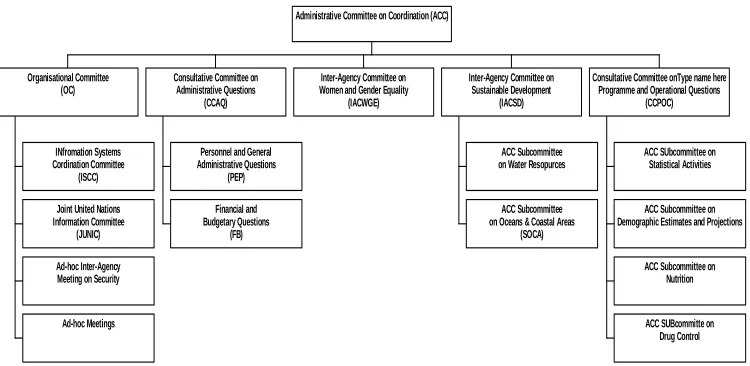
5.2. Administrative Committee on Coordination 57
Development 60
5.4. Subcommittee on Ocean and Coastal Areas 62
5.5. United Nations Informal Consultative Process
on the Oceans and the Law of the Sea 64
5.6. SOCA and UNICPOLOS: An assessment 68
CHAPTER 6 RECOMMENDATIONs AND CONCLUSION
6.1. Recommendation 71
6.2. Conclusion 73
LIST OF TABLES
Table 1: Offshore oil and gas production as % of world total production 2
Table 2: Total world fish production and marine fish production 3
Table 3: Growth of world sea borne trade 3 Table 4: Ecological Value of the world 4
Table 5: Ocean use framework 12
Table 6: The global marine interaction model 13
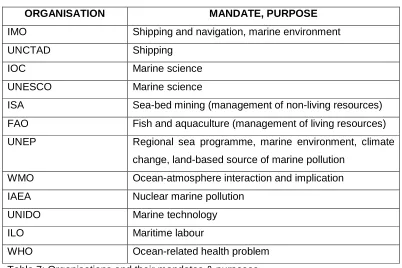
Table 7: Organisations (mandate and purposes) 50
LIST OF FIGURES
Figure 1: Physical dimension of the ocean (vertical profile) 10
Figure 2: Jurisdictional zones of the ocean under the UNCLOS 14
LIST OF ABBREVIATIONS
ACC Administrative Committee on Coordination
CBD Convention on Biological Diversity
CCAO Consultative Committee on Administrative Questions
CCPOC Consultative Committee on Programme and Operational
Questions
CEO Chief Executive Officer
CGG Commission on Global Governance
CSD Commission on Sustainable Development
CSD7 Seventh Session of Commission on Sustainable Development
DESA Department of Economic and Social Affairs
DOALOS Division for Ocean Affairs and Law of the Sea
DSD Division of Sustainable Development
ECA Economic Commission for Africa
ECE Economic Commission for Europe
ECLAC Economic Commission for Latin America and the Caribbean
ECOSOC Economic and Social Council
ESCAP Economic and Social Commission for Asia and Pacific
ESCWA Economic and Social Commission for Western Asia
FAO Food and Agricultural Organisation
FB Financial and Budgetary Questions
GA General Assembly
GDP Gross Domestic Product
GEF Global Environmental Facility
GESAMP Joint Group of Experts on the Scientific Aspects of Marine
Environmental Protection
HQ Headquarter
IACSD Interagency Committee on Sustainable Development
IACWGE Inter-Agency Committee on Women & Gender Equality
ICAO International Civil Aviation Organisation
IFAD International Fund for Agricultural Development
IGES International Group
IGO Intergovernmental organisation
IHO International Hydrographic Organisation
IIAS International Institute on Administrative Science
ILO International Labour Organisation
IMCO Intergovernmental Maritime Consultative Organisation
IMF International Monetary Fund
IMO International Maritime Organisation
IOC International Oceanographic Organisation
IOI International Ocean Institute
ISA International Seabed Authority
ISCC Information Systems Coordination Committee
ITU International Telecommunication Union
IUCN International Union for the Conservation of Nature and Natural
Resources
IWCO Independent World Commission on the Oceans
JUNIC Joint United Nations Information Committee
LC Legal Committee
MEPC Marine Environment Protection Committee
MSC Maritime Safety Committee
NGO Non Governmental Organisation
OC Organisational Committee
OECD Organisation of Economic cooperation and Development
OLA Office of Legal Affairs
PEP Personnel and General Administrative Questions
SD Sustainable Development
SOCA Subcommittee on the Ocean and Coastal Areas
SOF Ship & Ocean Foundation
SS Strong Sustainability
TC Technical cooperation Committee
UNCCD United Nations Convention to Combat Desertification
UNCED United Nations Conference on Environment and Development
UNCLOS United Nations Conference on the Law of The Sea
UNCTAD United Nations Conference on Trade and Development
UNDP United Nations Development Programme
UNEP United Nations Environment Programme
UNESCO United Nations Education, Scientific and Cultural Organisation
UNFCCC United Nations Framework Convention on Climate Change
UNFPA United Nations Population Fund
UNGA United Nations General Assembly
UNHCR United Nations High Commissioners for Refugee
UNHCS (Habitat) United Nations Centre For Human Settlements
UNICEF United Nations Children’s Fund
UNICPOLOS United Nations Informal Consultative Process on the Ocean
and the Law of the Sea
UNIDO United Nations Industrial Development Organisation
UNU United Nations University
UPU Universal Postal Union
WCED World Commission on Environment and Development
WFP World Food Programme
WHO World Health Organisation
WIPO World Intellectual Property Organisation
WMO World Meteorological Organisation
WS Weak Sustainability
WTO World Trade Organisation
CHAPTER ONE INTRODUCTION
“If it were not for the sea, the Earth would just be one more small, dead planet, another desert island adrift in the limitless black ocean of space. Life began in its waters, and no animal could clamber out of them onto dry land before algae in the primaeval oceans released oxygen to provide a welcoming atmosphere. And without the water from the sea that falls as rain, the continents would become barren again”.
- GESAMP
A Sea of Troubles
Few people have any idea how much we all depend on the oceans. The
oceans cover 71% of the earth’s surface and this fact alone suggests that oceans
play an important and significant role in the earth’s climate and ecology (Constanza,
1999). Anything that happens to and in the ocean will have a direct impact on the
world as a whole. Even more important is the world oceans area as a source of food
because capture fisheries and aquaculture provide protein to the people. As
land-based food supplies hit their limits, the ocean will play an even greater role and
fisheries will become even more vital to food security.
We tend to think that the oceans resources (living and non-living) are
inexhaustible, but studies showed that oceans resources are exhaustible and in
some cases, are non-renewable. As terrestrial resources become scarcer, demands
on the oceans will intensify. Therefore, our worldview about managing the ocean
needs to be adjusted.
It is estimated that the oceans contributed significantly to the economic well
being of the world in terms of energy resources, fisheries, transportation, recreation
and habitat. The coastal area provides an ideal space for urbanisation. It is
estimated that 37% of the world population lived between 100 kilometres of a
coastline and approximately 44% within 150 kilometres (Joint Group of Experts on
the Scientific Aspects of Marine Environmental Protection (GESAMP), 2001). If
will become a hotter place to live, and as a consequence, the sea level will rise. As a
result, coastal populations will be affected. Therefore, safeguarding the ocean is in
one way or another is vital for human survival. In short, the oceans play an important
role in economic and social dimension of the world’s population.
In term of economic activities, although there is no agreed value of the
ocean, attempts have been made to estimate the value of the ocean. The coastal
environment, including estuaries, coastal wetlands, sea grass and algae, coral reefs,
and continental shelves have a disproportionately high value (Constanza, 1999).
Some figures can be derived from the activities that taken place in the oceans. The
oil and gas industry for example, is an important industry as the world currently
relies heavily on these resources for its energy. Offshore production of oil and gas
accounted for 30% of world total production (IWCO, 1998).
PRODUCTION 1993 1994 1995
Oil Production
- World
- Offshore
- Share Offshore (%)
3182.5 880.9 27.7 3224.3 932.7 28.9 3265.4 965.3 29.6 Gas Production
- World
- Offshore
- Share Offshore (%)
1860.8 364.3 19.6 1881.3 381.1 20.3 1915.1 397.9 20.8
Oil and Gas Production
- World
- Offshore
- Share Offshore (%)
5043.3 1245.2 24.7 5105.6 1313.8 25.7 5181.0 1363.2 26.3
Table 1: Offshore oil and gas production as % of world total production 1993 – 1995
(in million tonnes of oil equivalent)
In term of fishing, marine capture fishing accounts for more than 60% of the
world fish supply.
1995 1996 1997
Total world fish catch
production
116,042,893 119,943,948 122,139,449
Total world marine fish
production
71,901,428 73,531,689 72,483,737
Table 2: Total world fish production and marine fish production
Source: Food and Agriculture Organisation (FAO), 2000.
In terms of trade, maritime shipping is involved in the transportation of over
80% of the world’s merchandise trade.
GROWTH OF WORLD SEABORNE TRADE
(Goods – in million metric tonnes)
Year Trade Per head of world population
(metric tonnes)
1955 800 0.286
1975 3064 0.747
1995 4700 0.832
2000 5690 0.940
Table 3: World Sea borne Trade
Besides these figures, there are also attempts to estimate the total value of
ocean related goods and services in monetary term and one study showed that the
total sum of marine industries (oil and gas, tourism, sea borne trade, naval defence,
shipbuilding, fishing, non-fuel minerals, submarine telecommunications), amount to
US$1 trillion and this amount represent 4% of total world’s Gross Domestic Product
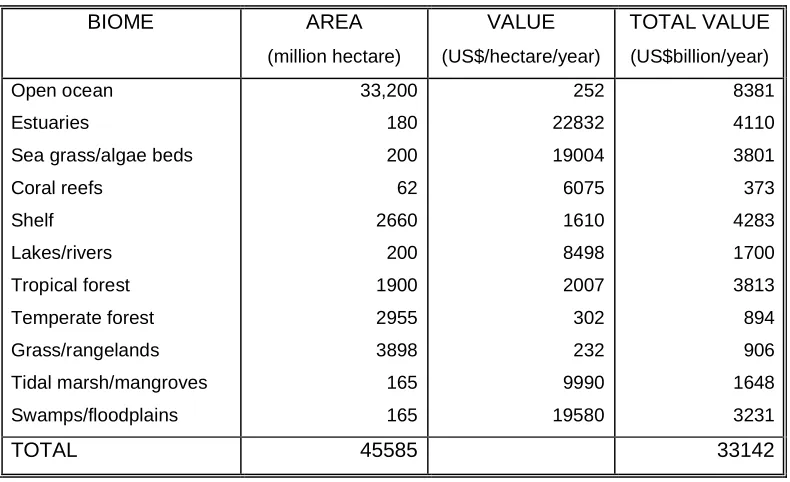
(GDP) (IWCO, 1998). Moreover, there are attempts by economists particularly
ecological-based economists that tried to estimate the value of world’s ecological
services. BIOME AREA (million hectare) VALUE (US$/hectare/year) TOTAL VALUE (US$billion/year) Open ocean Estuaries
Sea grass/algae beds Coral reefs Shelf Lakes/rivers Tropical forest Temperate forest Grass/rangelands Tidal marsh/mangroves Swamps/floodplains 33,200 180 200 62 2660 200 1900 2955 3898 165 165 252 22832 19004 6075 1610 8498 2007 302 232 9990 19580 8381 4110 3801 373 4283 1700 3813 894 906 1648 3231
TOTAL 45585 33142
Table 4: Ecological value of the world
Source: Constanza, 1997 and 1998.
Realising the importance of the ocean in terms of its economic, social and
ecosystem value including the survival of humankind itself, attempts have been to
better understand and manage the oceans and its resources. However, whilst efforts
have been proliferated to understand the oceans, the directions in which these
efforts are directed and evolving are not integrated. Therefore, we are often
confronted with two extremes, one that are too pessimistic, and the other is to
The International Conference on Human Environment held at Stockholm in
1972, brought about a major change in the vision of the environment. It sought to lay
greater emphasis on a long-term management of natural resources and control of
pollution. However, the institutional mechanisms in post-Stockholm lacked
coherence and were unable to integrate environmental consideration in
development process.
In 1982, after years of tense negotiations, United Nations Convention on the
Law of the Sea (UNCLOS) is open for signatory. UNCLOS deals with all matters
relating to the sea and is very comprehensive. UNCLOS is an attempt to establish
universality in the effort to achieve a just and equitable international economic order
in ocean by forwarding two important concepts, that are, the concept of the
Common Heritage of mankind and, that the problems of the ocean are interrelated
and need to be considered as a whole. UNCLOS also confirmed the task of existing
organisations by referring to the notion of “competent international organisation”.
Besides that, UNCLOS in one way or another, also expanding the works by these
organisations.
The United Nations Convention on Environment and Development (UNCED)
held at Rio in 1992 was inspired by the principle of sustainable development, has
imposed a critical review and evaluation of the state of ocean resources and the
marine environment, as well as the need to urgently respond to some new form of
degradation; and to consequences of human activity; such as that resulting in the
greenhouse effect and related sea level rise.
UNCLOS and UNCED are, thus, closely interlinked components and part of the
process of a new governance of the ocean. Therefore, it is timely that an appropriate
mechanism be created in order to provide these organisations an avenue to
consider the interrelated problems of the ocean as a whole and to identify issues,
programmes and strategies that are needed and mobilising fund. However, despite
all these efforts at UNCLOS and UNCED the governance of the ocean remain
fragmented and overlapping in responsibilities still prevailing.
Therefore, one of the weaknesses in the governance of the oceans is that,
there are too many institutions involved in it. It is very clear that the institutional
aspect of ocean governance lacks the “integrative vision”. However, the large
the legitimate interests that each may have. As problems in the ocean need holistic
and comprehensive approach as envisaged by UNCLOS and UNCED, it is
necessary to revitalise these organisations. Moreover, the absence of a Focal Point
entrusted with the governance of the ocean as a key mandate is certainly a major
setback.
1.2. RESEARCH OBJECTIVES AND METHODOLOGY
The main purpose of this dissertation is to identify international organisations
involved in the governance of the ocean and to examine whether there is a need to
have an international Focal Point for the governance of the ocean. This is because
the complexity and diversity of issues involved in ocean governance mean it is not
feasible to have only one agency involved. However, at the same time, this
complexity, and diversity requires the promotion of a centrifugal force – a Focal
Point to pull the diversity together for the integrated and sustainable development of
the oceans.
The objectives of this dissertation are as follows:
(a) to outline down the importance of the oceans in term of economic,
social and ecosystem;
(b) to define certain key governance principles such as sustainability,
precautionary, inter and intragenerational equity and to lay the
principles of integrated management and to establish arguments on
why this approach is useful to be used and adapted for the
governance of the ocean;
(c) to identify international intergovernmental organisations and
non-governmental organisations that are currently involved in ocean
governance;
(d) to outline proposals and recommendations that have been put
forward in order to strengthen the institutional aspect of ocean
governance; and finally,
(e) to make a proposal regarding s system that will enhance the
The primary methodology adapted by this dissertation has been that of
literature review particularly in the field of General Systems and Governance theory.
The intellectual discourse of scholars on this approach was adopted in order to be in
line with the mainstream of thinking prevailing worldwide within this subject.
Exchange of views and discussions with scholars that involved in this field was
conducted through personal electronic mail (e-mail). Literature review, exchange of
views and discussions served as the backbone of this research and from there
recommendations, solutions and conclusions are derived.
This research is presented in six chapters. The first chapter has introduced
and established the importance of the ocean to the economic, social and ecosystem
of the world. This chapter has also described briefly the research objectives and
methodology.
In chapter two, attempt has been made to define some basic concepts used
in this dissertation and advances the theoretical framework for this research, which
is based on the General System Theory.
Chapter three identifies international organisations that are involved in the
governance of the ocean at a global level. The purpose of this chapter is to describe
and analyse the role and mandate of these organisations. This chapter is primarily
descriptive in nature.
Chapter four investigates and traces the development of Administrative
Committee on Coordination (ACC), Subcommittee on Ocean and Coastal Areas
(SOCA) and United Nations Informal Consultative Process on the Ocean and the
Law of the Sea (UNICPOLOS). The aims of this chapter is to establish the fact that
institutional aspect of ocean governance has been identified in a weak situation and
efforts have been attempted to resolve this problem.
Chapter five outlines and discusses proposals that have been advanced by
scholars in term of improving institutional aspect of ocean governance. Three
selected proposals are outlined and discussed in this chapter.
Chapter six provides a recommendation to address the problems outlined in
CHAPTER TWO
A THEORETICAL FRAMEWORK
“Hope, creativity, and imagination will be required to meet the challenges that we face with our oceans. But they are after all the traits that first enabled and inspired explorers to take to the sea. They are the traits that allowed us to look at our inextricable ties to our environment and to invent new ways to protect our natural wonders. In the 21st century, these traits must lead us to preserve our living oceans as a sacred legacy for all time”.
- President William Jefferson Clinton
2.0. INTRODUCTION
This chapter will provide a description of the various concepts that will be
used in this research. First of all, the concept and definition of ocean, governance,
ocean management, ocean governance, and focal point will be outlined. After that,
the theory that provides the framework for this research will be discussed.
2.1. CONCEPTS AND DEFINITIONS
2.1.1. OCEAN
According to the Oxford Advanced Learner’s Dictionary, ocean means “the
mass of salt water that covers most of the earth’s surface” (Crowther, 1995, p. 800).
The same Dictionary defines sea as “the salt water that covers most of the earth’s
surface and surrounds its continents and islands (Crowther, 1995, p. 1057). As can
be seen, the word ocean and sea literally are synonymous. In this research, the
word ocean will be used and it is meant to represent the salt-water mass of the earth
as a whole.
In literature on management, the term “ocean” also carries other meaning
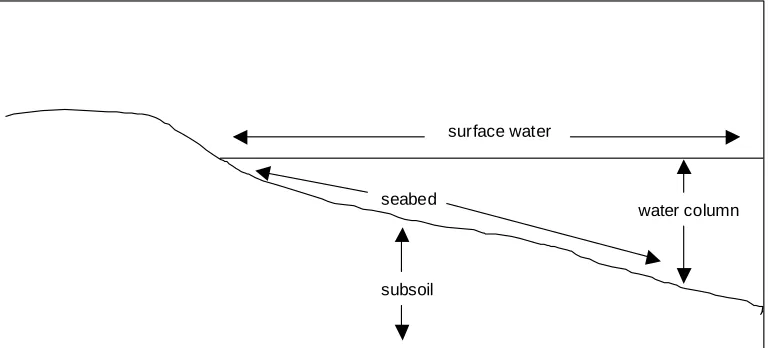
associates with its physical, management and jurisdiction components (Armstrong &
ocean, which in turn can be separated into four components. These components are
the surface water, the water column, the seabed and the subsoil.
surface water
water column
subsoil seabed
Figure 1: Physical dimension of the ocean (vertical profile)
Management component of the ocean can be divided into three
sub-components. These sub-components are the natural ocean system, ocean uses and
government programmes, agencies and policies (Armstrong & Rayner, 1981). The
natural ocean system contains ocean space (as described in the physical
component) and ocean resources such as living and non-living resources, dynamic
systems such as tides and thermal pattern (Armstrong & Rayner, 1981). Ocean
uses refer to the use of the ocean for various purposes such as navigation, fisheries,
recreational and many more. It also refers to the users, of which the number is
growing from single to multiple users consistent with the growth in uses.
Government programmes, agencies and policies refer to the government efforts to
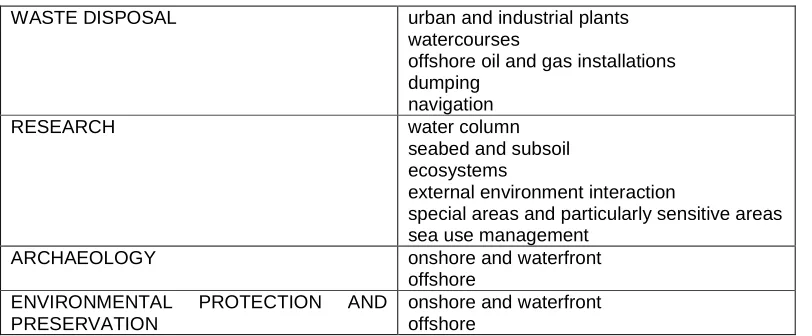
guide, direct and manage the ocean (Armstrong & Rayner, 1981). The categories
CATEGORIES SUB-CATEGORIES
SEAPORTS waterfront commercial structures offshore commercial structures
dockyards
passenger facilities naval facilities fishing facilities recreational facilities SHIPPING, CARRIERS bulk vessels
general cargo vessels unitised cargo vessels
heavy and large cargo vessels passenger vessels
multipurpose vessels SHIPPING, ROUTES routes
passages separation lanes SHIPPING, NAVIGATION AIDS buoy systems
lighthouses hyperbolic systems satellite systems inertial systems SEA PIPELINES slurry pipelines
liquid bulk pipelines gas pipelines water pipelines
water disposal pipelines
CABLES electric power cables telephone cables
AIR TRANSPORTATION airports others BIOLOGICAL RESOURCES fishing
gathering farming
extra food products
HYDROCARBONS exploration exploitation
storage
METALLIFEROUS RESOURCES sand and gravel water columns minerals seabed deposits RENEWABLE ENERGY SOURCES wind
water properties water dynamics subsoil
DEFENCE exercise areas
nuclear test areas minefields
explosive weapon areas
RECREATION onshore and waterfront offshore
WASTE DISPOSAL urban and industrial plants watercourses
offshore oil and gas installations dumping
navigation
RESEARCH water column
seabed and subsoil ecosystems
external environment interaction
special areas and particularly sensitive areas sea use management
ARCHAEOLOGY onshore and waterfront offshore
ENVIRONMENTAL PROTECTION AND PRESERVATION
onshore and waterfront offshore
Table 5: Ocean use framework (source: Vallega (1992) p.95-96)
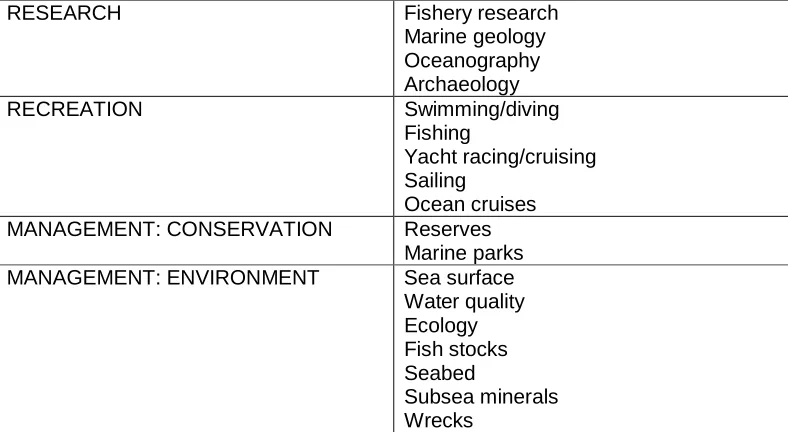
SEA USES
CATEGORIES INDIVIDUAL USES
NAVIGATION AND COMMUNICATION Navigations aids Harbour/port Shipping
Separation lanes Cables
MINERAL AND ENERGY RESOURCES Sand and gravel dredging Maintenance dredging Separation drilling Production platform Coastal oil installations Oil transportation Pipelines
Ocean mining Tidal energy BIOLOGICAL RESOURCES Demersal fishing
Pelagic fiching Seaweed gathering Aquaculture
WASTE DISPOSAL AND POLLUTION Solid waste Nuclear waste Incineration Industrial effluent Sewage
Oil pollution STRATEGY AND DEFENCE Nuclear test zone
Firing/bombing ranges Torpedo ranges
RESEARCH Fishery research Marine geology
Oceanography Archaeology
RECREATION Swimming/diving Fishing
Yacht racing/cruising Sailing
Ocean cruises MANAGEMENT: CONSERVATION Reserves
Marine parks MANAGEMENT: ENVIRONMENT Sea surface
Water quality Ecology Fish stocks Seabed
Subsea minerals Wrecks
Table 6: The global marine interaction model (source: Vallega (1992), page 91).
In term of jurisdictional dimensions of international management, the ocean
can be divided according to the division that have been agreed upon internationally,
notably in the United Nations Law of The Sea Convention 1982 (UNCLOS 1982).
According to the UNCLOS, the ocean is divided into four separate jurisdictional
zones. These zones are Territorial Sea, Contiguous Zone, Exclusive Economic
Zone and the Continental Shelf. For each of these zones, state enjoys different
rights and obligations to govern, and as a result, different governance approaches
Territorial Sea (0-12 nm)
Contiguous Zone (12-24 nm)
Exclusive Economic Zone (up to 200 nm)
High Seas
Figure 2: Jurisdictional zones of the ocean under the UNCLOS 1982
Continental Shelf
Based on these components, therefore, we can say that the term “ocean”
encompasses many meaning. For the purpose of this research, the term ocean,
besides representing the salt-water mass of the earth as a whole, is also means the
physical components of the oceans, the uses framework and the jurisdictional zones
of the ocean. Based on these conceptions, the ocean can be seen evolving in three
directions. In term of physical components, the exploitation of human toward the
ocean has been moving seaward. In term of uses framework, it has evolved from
single use to multiple uses and from the jurisdictional component of view, the
exploitation has been moving from near distance to up until 200 nautical miles and
beyond under the regime of the Continental Shelf and the High Seas.
2.1.2. GOVERNANCE
Before we move and deal with the concept of ocean governance, it is
important to first discuss the concept of governance. One of the problems regarding
the term “governance” is that there are no precise definitions. Oxford Advanced
Learner’s Dictionary stated that governance is “the activity or manner of governing”
(Crowther, 1995, p.515). The World Bank, one of the early users of the term defines
economic and social resources of a country, notably with a view to development”
(World Bank, 1992, p.2). Later in 1994, a World Bank publication further defines
governance by emphasising the aspect of good governance and mentioned:
“good governance is epitomised by predictable, open and
enlightened policy-making, a bureaucracy imbued with a
professional ethos acting in furtherance of the public good,
the rule of law, transparent processes, and a strong civil
society participating in public affairs, whereas poor
governance is characterised by arbitrary policy-making,
unaccountable bureaucracies, unenforced or unjust legal
systems, the abuse of executive power, a civil society
unengaged in public life, and widespread corruption” (World
Bank, 1994, p.1-2).
As suggested by the World Bank definitions, the concept of governance is
concerned with the exercise of power, and can be said to focus on the effectiveness
of the executive branch of national governments, as governance requires greater
responsiveness and accountability from the State. Therefore, from the World Bank
point of views, the focus is on the key element, that is, the governments.
The view that governance is a significant issue resulted in the formation of a
Commission on Global Governance (CGG) in 1992 by an independent group of 28
public figures. The CGG was established with the primary task to strengthen global
co-operation to meet the challenge of securing peace, achieving sustainable
development, and universalising democracy (CGG, 1992). The Commission defines
governance as “the sum of the many ways individual and institutions, public and
private, manage their common affairs. It is a continuing process through which
conflicting or diverse interests may be accommodated and cooperative action may
be taken. It includes formal institutions and regimes empowered to enforce
compliance, as well as informal arrangements that people and institutions either
Other institutions are also interested in governance. For example, the Institute for
Global Environmental Strategies (IGES) takes the view that governance is the
science of decision-making. It argues that, “the concept of governance refers to the
complex set of values, norms, processes, and institutions by which society manages
its development and resolves conflict, formally and informally. It involves the states
but also the civil society at the local, national, regional and global level” (IGES,
2001, p.1).
Lawrence Juda, one of the leading scholars in the field of ocean management
defines governance as “the formal or informal arrangements, institutions, and mores
which determine how resources or an environment are utilised; how problems and
opportunities are evaluated and analysed; what behaviour is deemed acceptable or
forbidden, and what rules and sanctions are applied to affect the pattern of resource
and environment use” (Lawrence Juda, 1999, p. 90-91).
John Fobes, former Deputy Director-General of UNESCO, takes the view that the
concept of governance “emphasises that order in society is created and maintained
by a spectrum of institutions, only one of which is known as government. By
examining that spectrum at all levels of society, we can obtain a broader sense of
“governability” as it is exercised in policy-making, in providing services and the
application of law. Order is certainly part of governance. But I believe that one
should also consider governance, at least at the international level, as a global
learning exercise. By so doing, politicians, practitioners, activists and academies
may expand their thinking beyond the traditional concept of government, of
international organisations and of the exercise of sovereignty” (Fobes, 1985, p.1).
The Governance Working Group of The International Institute of Administrative
Sciences (IIAS), defines governance as a:
“process whereby elements in society wield power and
authority, and influence and enact policies and decisions
concerning public life, and economic and social
development. These involve the relationship of individual
state, the generation and management of resources for
current and future generations, and the relationship between
states. As such governance is a broader notion than
“government”. Governance involves the nature of interaction
between such formally defined institutions, and those of civil
society. Existing cultural values and social norms, traditions
on structures are important influences on this interaction
process” (The Governance Working Group of IIAS, 1996,
p.5).
It is also clear from the above definitions, one of the common factors in definitions of
governance is that; (i) it is a process by which diverse interests are accommodated
and, (ii) governance is not equivalent to government as it also incorporates other
mechanisms and institutions such as civil society and non-governmental
organisations.
In this regard, James Rosenau provides an excellent view on the difference between
governance and government. According to him,
“both refer to purposive behaviour, to goal-oriented activities,
to systems of rules; but government suggests activities that
are backed by formal authority, by police powers to insure
the implementation of duly constituted policies, whereas
governance refers to activities backed by shared goals that
may or may not derive from legal and formally prescribed
responsibilities and that do not necessarily rely on police
powers to overcome defiance and attain compliance.
Governance, in other words, is a more encompassing
phenomenon than government. It embraces governmental
institutions, but it also subsumes informal, non-governmental
mechanisms whereby those persons and organisations
within purview move ahead, satisfy their needs, and fulfil
Similarly, regime theorist, Oran Young argues that “governance is a social function
whose performance is crucial to the viability of all human societies; it centres on the
management of complex interdependencies among actors (whether individual,
corporations, interests groups, or public agencies) who are engaged in interactive
decision making and, therefore, taking actions that affect each other’s welfare.
Governments, by contrast, are organisations-complex material entities possessing
offices, personnel, equipment, budgets, and legal personality and often professing
political ideologies that we commonly take for granted as vehicles for the provision
of governance because we are so accustomed to their efforts to perform this role in
domestic societies” (Young, 1996, p.2).
As a result, there are at least two essential actors in governance that are
government and civil society. The first actor is well known. However, the term civil
society needs some investigation. Generally speaking, civil society means other
than government and includes non-governmental organisations (NGOs),
communities and private multinationals. Daniel Wolfish and Gordon Smith (2000)
identifies six types of actors in governance processes. These are state actor
(government); global city regions such as New York Area; intergovernmental
organisations (IGOs) such as International Maritime Organisation (IMO), United
Nations Environment Programme (UNEP) and so on; non-state actors such as
NGOs, firm and private corporations; quasi-state institutions such as central banks,
and finally transnational communities such as transnational ethnic minorities and
criminal organisations (Wolfish & Smith, 2000).
From the brief discussion about the concept of governance as above, it can be said
that governance encompasses and transcends the collective meaning of related
concepts like state, government and the aspect of good government. Many of the
elements and principles of good government such as transparency, accountability,
efficiency, equitable, rule of law and responsive have become an integral part of the
meaning of governance. Therefore, we can say that governance is a complex, but
As a result of all these definitions, we can identify several principles associated with
governance. These principles are:
a. governance involves multiple and diverse actors, that is to say, the
government and the civil society. As a result, it can be said that
governance is participatory;
b. governance requires sustainability;
c. governance involves equity;
d. governance requires precautionary approach; and
e. governance is proactive or anticipatory rather than reactive.
Clearly from above quotes, it is clear that governance operates at a higher
organisational level than management and is essentially an upward extension of the
concepts, formats, language and mentality of management (Carver, 1999). Carver
further argued that “governance is attainable if we can embraced a new premise:
rather than an upward extension of management, governance is a downward
extension of ownership” (Carver, 1999, p.1).
The 21st century is the century of cooperation. This is because new and
emerging concepts such as globalisation, free market, and so on, demanded that
every nations cooperate with each others. At the same time, the collapse of
communism has enabled democracy to spread all over the world. As a result,
concepts of good governance which are dominated by democratic ideas is
proliferating The proliferation of good governance norms is backed up by arguments
from international support agencies such as International Monetary Fund (IMF), the
World Bank and so on. Consequently, states are more willing to cooperate with each
other for mutual benefits. Besides that, the 20th century has changed our perception
toward science as more and more scientific information available.
2.1.3. OCEAN GOVERNANCE: AN INTRODUCTION
The previous section has set out ideas about the concept of governance in general.
This section will consider this concept in the context of ocean use and management.
In particular, it is useful to see what scholars say about ocean governance and
Elisabeth Mann Borgese, the leading scholar in the field of ocean governance,
defines ocean governance as “the way in which ocean affairs are governed, not only
by governments, but also by local communities, industries and other stakeholders. It
includes national and international law, public and private law as well as custom,
tradition and culture and the institutions and processes created by them” (Borgese,
2001, p. 10).
According to Freidheim, (global) ocean governance means “the development of a
set of ocean rules and practices that are equitable, efficient in the allocation of
ocean uses and resources (Including the notion of sustainability), provide the means
of resolving conflicts over access to and the enjoyment of the benefit of oceans, and
specifically attempt to alleviate collective-actions problems in a world of
interdependent actors” (Freidheim, 1999, p.748).
Therefore, as discussed above, ocean governance involves related concepts similar
to governance such as participation, sustainability, equity, precaution and it is
proactive. Before we move it is useful to visit these concepts briefly. Participatory
means that in governance, multiple actors are actively involved in decision-making
including government and civil society.
Sustainable development or sustainability emerged from attempts to balance
economic development and environmental protection. The phrase “sustainable
development” originated from a report produced by the International Union for the
Conservation of Nature and Natural Resources (IUCN) in 1980 and became the
central concept in the World Commission on Environment and Development
(WCED), also known as Brundtland Commission report in 1987 (Jamieson, 1998).
The Brundtland Commission refers to sustainable development as the ability to
“meet the needs of the present without compromising the ability of future
generations to meet their own needs” (WCED, 1987, p. 8). WCED further states that
“sustainable development is not a fixed state of harmony, but rather a process of
change in which the exploitation of resources, the direction of investments, the
orientation of technology development, and institutional change are made consistent
the Brundtland Commission, recently wrote that “the great achievement of the
sustainable development concept is that it broke with the old conservationist
approach to natural resources and its tendency to place Earth’s other species above
people” (1992, p.143). The concept of sustainable development can be linked to the
economic and ethical dimension of the concept of the Common Heritage of Mankind
(Borgese, 2001). From this explanation, we can say that sustainability encompasses
other concepts, notably equity.
However, different people have deployed the idea of sustainable
development by the Brundtland Commission differently. Kothari states that there are
two notions of sustainable development and he argues that,
“to shift to sustainable development is primarily an ethical
shift. It is not, a technological fix, nor a matter of new
financial investment. It is a shift in values such that nature is
valued in itself and for its life support functions, not merely
for how it can be converted into resources and commodities
to feed the engine of economic growth. Respect for nature’s
diversity, and the responsibility to conserve the diversity,
define sustainable development as an ethical ideal out of an
ethics of respect for nature’s diversity flows a respect for the
diversity of cultures and livelihoods, the basis not only of
sustainability, but also of justice and equity. The ecological
crisis is in large part a matter of treating nature’s diversity as
dispensable, a process that has gone hand in hand with the
view that a large portion of the human species is dispensable
as well. To reverse the ecological decline we require an
ethical shift that treats all life as indispensable (Kothari,
1994, p. 232).
Whether Kothari’s view is agreeable or not, “it is possible that the present
disorder regarding the human relationship to nature will not be successfully
addressed until we have developed a richer set of positive visions regarding the
Sustainable development, over the last decade has generated the idea of
sustainability (Jamieson, 1998). Jamieson (1998) argues that sustainability centred
on the idea that “sustainable development should be directed towards building
societal capabilities rather than towards development as an end in itself” (p.184).
Jamieson further states that sustainability is related to the “human survivality and
the avoidance of ecological disaster” (1998, p.184). However, scholars’ views on
this idea are complex and diverse. At least two conceptions of sustainability have
been developed and these are Strong Sustainability (SS) and Weak Sustainability
(WS) (Jamieson, 1998). SS asserts that it is natural capital that should be sustained
while WS is centred on the well being of humankind (Jamieson, 1998).
Ocean governance called for sustainable development of the oceans. If
sustainability is our aim, therefore, we must have the ability to limit exploitation of
the ocean (Freidheim, 2000). In the sense, this means that we need to eliminate
open access to the resources of the ocean. As a result, common resources in the
area outside national jurisdiction, notably in the High Sea need to be given
ownership as even the most abundant resources have their limits, and the
unrestricted use of the common lead to the degradation as illustrates by Hardin in
“The Tragedy of the Commons”.
The concept of precaution reflects the attempt to move toward a more
proactive mode of management. Therefore, we can say that the precautionary
concept and anticipatory are identical, that is to say, they are aimed at considering
the implications of any action in advance and to assess the possible effect of that
action. (Juda, 1999). The precautionary concept was incorporated into the Rio
Declaration and Principle 15 of Rio Declaration stipulates “in order to protect the
environment, the precautionary approach shall be widely applied by states
according to their capability. Where there are threats of serious or irreversible
damage, lack of full scientific certainty shall not be used as a reason for postponing
cost-effective measures to prevent environment degradation” (Rio Declaration,
1992).
Beside, humans are part of the whole nature. Therefore, the way we treats
the First Conference of the Parties to the Framework Convention on Climate
Change states:
“Who cares about coral reefs? I often heard in the corridors
of the UN building in Geneva and New York, when the red
wine seeps into the head, reality sets in, and diplomacy is in
full play. I care. I listen to the cries of millions of polyps that
make up the corals. Why, because there is more at stake for
all of us than just the deaths of polyps and corals. What is
causing the polyps to die lies at the core of the way we
humans live, especially in OECD countries. Dead corals are
the victims of the injustices we continue to ignore, of greed,
of selfishness and of the abdication of moral and ethical
responsibility. It is an act of genocide against the corals and
so against species who depend on them, including,
ultimately, humans. The coral polyp’s own world mirrors the
human experience - the cries for freedom from foreign debt,
poverty, starvation, the cries to change lifestyles, not the
climate, the cries to stop burning fossil fuels. To ignore the
death of coral reefs is, I believe, to ignore the cries of many
of the world’s people of today, at the peril of our future
generations and our planet” (Lefale (1995), in Rayner, 1999,
p. 264).
As a result, we can say that “the conservation of nature is self-conservation
and the domination and degradation of nature is self-enslavement and debasement”
(Borgese, 1986, p.127).
2.1.3.1. THE CONCEPT AND PHILOSOPHY OF OCEAN GOVERNANCE
Currently, ocean governance is characterised by a set of sectoral institutions
at each level (international, regional, national and local). In such as way,
responsibilities for management remain fragmented among different entities with
are becoming more and more diverse and not confined to single organisation
mandates, and as a result overlap in responsibilities occurred. Besides that, there
are issues that cannot be tackled effectively by any organisation because of existing
gaps in responsibilities and jurisdiction.
The aim of the new ocean governance should be to create a climate of
cooperation rather than confrontation among the parties involved. Significant global
gains can be achieved through collaboration, and all parties will be better off in the
long run. Therefore, the development of the new system for ocean governance not
only necessary, but need to be defined in ways that foster the participation and
involvement of all parties (IWCO, 1998).
As mentioned in the introduction, a new concept of ocean governance is
already emerging, but it till lacks the commitment and vision for integration; a
commitment and vision that is required in order to make the system not only
consistent at every level, but also within every level and with the nature itself
(Borgese, 2001).
The most important aspect of the philosophy of ocean governance is the
seminal concepts put forward by Ambassador Arvid Pardo of Malta. The seminal
concepts are common heritage of mankind and that all aspects of ocean space are
interrelated and must be considered as a whole (Tommy Koh, 1983).
According to Borgese, the concept of Common Heritage of Mankind has five
implications and
“the first implications is nonappropriability - that is, the
common heritage can be used but not owned. It is an area
where there is no property. Second, it is a system of
management in which all users share. Third, it constitutes an
active sharing of not only financial benefits but also the
benefits derived from shared management and transfer of
technologies. The second and third points change the
structural relationship between rich and poor nations and
traditional concepts of development aid. Fourth, the concept
of common heritage implies reservation of ocean space for
peaceful purposes. Fifth, it implies reservation for future
Therefore, the concept of Common Heritage of Mankind means that nobody can
appropriate the ocean, and it belongs to everybody and as a result, becomes a
global common and put responsibility on humankind to manage it collectively, not
only for the benefit of present generations, but for the future generations as well.
Therefore, governance of the ocean must be done by entity that representing the
world community as a whole. Besides that, Common Heritage of Mankind also calls
for the peaceful use of the ocean. As a result, ocean governance emerged as a
concept that is multidisciplinary; economic in the sense that it encourages the
development of the ocean; environment in the sense that it calls for conservation;
ethical in the sense that it urges that benefit from development should be shared
equitably; peaceful in the sense that it calls for the peaceful use of the ocean
(Borgese, 2001).
The concept of the Common Heritage of Mankind, although it does not
achieve the full results as envisaged by Pardo in the negotiations during UNCLOS
due to political compromises; nevertheless, achieve recognition and has made its
presence felt by all during the negotiations.
However the second component of Pardo’s seminal ideas, that the problems
of the ocean are interrelated and need to be considered as a whole is far from being
achieved. As mentioned by Borgese, environmental and economic dimensions are
inseparable from the peace and security dimension. (Borgese, 1998). Besides that,
from the institutional point of view, the concept of the Common Heritage of Mankind
put a challenge on the issue of integration in order to considered the interrelated
problems of the oceans as a whole (Payoyo, 1994). Therefore, unified approach is
needed in the new system of the ocean governance.
2.1.4. FOCAL POINT
Focal Point is a term used in this research to describe an institutional mechanism
and programmes that affect the ocean and its resources that have been carried out
and implemented by various agencies.
In order to be effective, such a mechanism “must be authoritative; able to affect the
activities of all agencies and level of government; must be seen as legitimate and
appropriate part of the process; and be capable of making “informed” decisions”
(Cicin-Sain & Knecht 1998, p.62).
Focal point does not necessarily require the creation of new organisation. It can be
in a form of interagency committee or simply a “meeting” which devotes times for the
discussion about harmonising activities in its agenda. However, it is vital that a focal
point be formally created in order to achieve greater effectiveness and efficiency.
Clearly, a focal point in its “ideal” form, although might form or establish a new
“point”, undoubtedly will strengthen the existing mechanisms by pulling together all
these points in order to proceed in an integrated way.
Freidheim states that, we need intergovernmental organisations that “have an action
mandate; have authority to make their writ effective; devoted to achieving
sustainable use; based upon shared norms; have effective internal decision
machinery; have the appropriate expertise; have resources adequate to their tasks;
have machinery to resolve disputes; and that allow broad but orderly participation”
(Freidheim, 2000, p.193-194).
In order to understand on what can be regarded as a Focal Point, it is useful to
consider the concept of an institution. The concept of an institution is a difficult one
as some writers see institutions as “social rules and norms”, therefore, as cultural
traits shown by social groups; while others see institution as a specific organisation
designated to fulfil a given set of functions (Hall, et.al., 2001). This distinction has
been referred to as ‘rule-oriented’ and ‘role-oriented’ institutions (Brinkerhoff &
Goldsmith, 1992). The “rule-oriented” institution can be defined as the rules of the
games in a society, while “role-oriented” institution can be defined as organisation
that have attained special status or legitimacy (North, 1990).
In this regard, it is useful to follow the position taken by Hall (et.al.) that “the term
institution (al) is used to mean the combined environment of rule of the games and
change, therefore, is “refer to the evolution and dynamic interplay between “rules
and norms” and organisation, usually associated with the need to perform a new
task or to perform an existing one differently” (Hall, et.al., 2001, p. 785).
The Focal Point in this research will also employ a clearinghouse mechanism. The
term “clearinghouse” was originally used in the financial establishment where
members banks exchanged cheques and bills among themselves. Today, its
meaning has been extended to include an agency that brings together seekers and
providers of goods, services or information, thus matching demand and supply. The
Global Programme of Action on Protection of the Marine Environment from
Land-Based Activities (GPA) describes the clearinghouse mechanism as a referral system
for use by decision-makers (Kimball, 1995). The purpose of having a clearinghouse
mechanism as an aspect of the Focal Point is to provide all the actors with access
and assistance in reaching for information and scientific as well as technical
expertise for addressing ocean problems.
2.2. OCEAN GOVERNANCE: AN INTEGRATED MANAGEMENT APPROACH.
Ideas about the management of the ocean have been largely influenced by
structuralism (Vallega, 1992). Basically, structuralism takes the view that the best
future for the world at large lies with improved institutional structures (Johnston,
1993). However as scientific thought was in a transition phase from structuralism to
general systems theory in the 1960s and 1970s, ocean management has also been
influenced by this transition (Vallega, 1992). General systems theory on the other
hand, views that the best future for the world at large lies with the thorough
understanding of every aspect involved, that is to say, with wholeness in a holistic
manner (Mandel, 1995). This shift is reflected in the various stages such as
pre-UNCLOS stage, pre-UNCLOS stage and post-UNCED stage. Therefore, we can say
that in the 1980s and 1990s, ideas are largely influenced by the general systems
theory approaches.
As noted above, governance involves multiple actors with diverse interests and
background. A common methodology needs to be developed in order to integrate
that structuralism is no longer appropriate to continue to provide a conceptual
framework as a structuralist approach has not provided an avenue to deeply
consider the relationship between ocean uses and its morphogenesis (Vallega,
1992). This is because the main goal of structuralism is the understanding of the
structures such as the description of their components and their reciprocal
relationships. In contrast, general systems theory encourages multidisciplinary
approach and also taking into account the complexity of relationships in ocean uses
and changes that have taken place in environment and the need to be cautious
(Vallega, 1992). In this regard, general systems theory seems compatible with the
concept of ocean governance, in that it enables scientists, policy-makers, and other
actors to create a common platform for implementing multidisciplinary views.
Besides that, general systems theory enables a multidisciplinary approach to link the
complex interaction between the natural worlds with the socio-economic uses of the
ocean.
Furthermore, general system theory as it encourages multidisciplinary approach, will
be able to facilitate interaction between various science, communities, knowledge
and policy. As a result, coordination and, to some degree, certainty can be
achieved. Besides that, general systems theory enables systemic analysis, which
leads toward a prospective approach, be implemented. This is because, general
systems theory is concerned with morphogenesis, therefore, the future is not tied up
with the past, that is to say, no determined by the chains of cause and effect
relationships.
This research focuses on the institutional aspects of international (global) ocean
governance. Integrated management provides an avenue to consider the
appropriate mechanisms that need to be created in order to better safeguard the
ocean for the benefit of present and indefinite, future generations. This is because,
in almost every case, there are two major challenges that must be overcome by
governance institutional arrangements in order to be effective. These are the
challenge of acting under uncertainty and the challenge of coordination (Rayner,
1999).
Integrated management enables the uncertainty to be managed in the way that it
enables diverse actors from diverse background (policy-makers, scientists, etc) to
interface. This is because some questions although posed by scientific approach
cannot be answered by science alone. As stated by Rayner “while science puzzles
over issues such as the contribution of overfishing or pollution to declines in fish
stocks, or life cycles of marine birds and mammals, it cannot resolve the essential
human problems of sustainability, such as how these stock should be allocated and
what institutional arrangement best ensure that ecologically sustainable allocations
are implemented efficiently and fairly” (Rayner, 1999, p.262).
The integrated management approach discourages compartmentalisation. As a
result, organisation will not be rigidly divided up into fiefdoms and therefore, turf
battles will not prevail. Consequentially, organisations need to look at the whole
picture and this will encourages cooperation while competition among organisations
will be discourages.
CHAPTER THREE
EXISTING INSTITUTIONS IN OCEAN GOVERNANCE
3.1. INTRODUCTION
When we speak about the institutional aspects of ocean governance, largely
the discussion will centre on the United Nations system (international
intergovernmental organisations (IGOs)), institutions and legal regime associated
with the 1982 United Nations Law of the Sea Convention (UNCLOS) and institutions
that were established following the United Nations Conference on Environment and
Development 1992 (UNCED). In this chapter, a brief discussion about the IGOs,
UNCLOS’s institutions and UNCED’s organisations will be presented. After that, the
discussion and description about NGOs will be presented. The purpose of this
chapter is to identify organisations/agencies that are specifically involved in ocean
governance at global level. As a result of this purpose, organisations that exist and
work at a national, sub regional and regional level will not be discussed, although
clearly many international organisations also have a presence regionally.
The discussion will concentrate on their mandates, purposes and functions
and their relationships with other organisations. The purpose of discussing the
NGOs is to consider their role and influence in ocean governance, that is to say, the
increased involvement of civil society.
There are a great number of international intergovernmental arrangements
that in one way of another affect ocean governance. However, for the purpose of
this research, only organisations that are permanently involved in ocean governance
are discussed. These organisations are the Intergovernmental Oceanographic
Commission (IOC) of the United Nations Education, Scientific and Cultural
Organisation (UNESCO); the International Maritime Organisation (IMO); the Food
and Agricultural Organisation (FAO); the United Nations Conference on Trade and
Development (UNCTAD), the United Nations Environment Programme (UNEP); the
International Labour Organisation (ILO); the Global Environmental Facility (GEF)
organisations which might be discussed in passing such as the United Nations
Industrial Development Organisation (UNIDO), the International Atomic Energy
Agency (IAEA), the World Health Organisation (WHO), the International
Telecommunication Union (ITU), the International Hydrographic Organisation (IHO)
the World Meteorological Organisation (WMO) and so on.
3.2. INTERNATIONAL OCEANOGRAPHIC COMMISSION OF UNESCO
IOC has been described as the most important intergovernmental body promoting
the understanding of ocean processes (Ehlers, 2000). According to Article 1 (1) of
the IOC Statutes, IOC is a body with functional autonomy within UNESCO. The
purpose of IOC as outlined in Article 2 (1) of the Statutes is “to promote international
cooperation and to coordinate programmes in research, services and
capacity-building, in order to learn more about the nature and resources of the ocean and
coastal areas and to apply that knowledge for the improvement of management,
sustainable development, the protection of the marine environment, and the
decision-making processes of its Member States” (IOC Statutes, 1999, p.1). Thus,
we can say that IOC is concerned with the scientific aspects of the oceans and
specifically deals with three main areas, that is to say, scientific research, ocean
observations and capacity building (Ehlers, 2000).
The functions of IOC are listed in Article 3 of the Statutes and include, inter
alia, to recommend, promote, plan and coordinate international programmes in
research, observation and the disseminations and use of the results. It is also
empowered to recommend, promote and coordinate the development of relevant
standards, reference materials, guidelines and nomenclature (Article 3 (1), IOC
Statutes).
IOC also has been tasked to make recommendations and to coordinate
programmes in education, training and assistance in marine science, ocean and
coastal observations and the transfer of related technology. Besides that, IOC also
makes recommendations and provides technical guidance to relevant intersectoral
activities of UNESCO and may undertake mutually agreed duties within the mandate
of the Commission (Article 3 (1) (e), IOC Statutes). In addition, IOC shall as