VOLUME 37, ARTICLE 61, PAGES 1933
,
1948
PUBLISHED 14 DECEMBER 2017
http://www.demographic-research.org/Volumes/Vol37/61/ DOI: 10.4054/DemRes.2017.37.61
Descriptive Finding
The decline in consanguineous marriage among
Muslims in Israel: The role of education
Jona Schellekens
Guy Kenan
Ahmad Hleihel
© 2017 Jona Schellekens, Guy Kenan & Ahmad Hleihel.
This open-access work is published under the terms of the Creative Commons Attribution 3.0 Germany (CC BY 3.0 DE), which permits use, reproduction, and distribution in any medium, provided the original author(s) and source are given credit.
1 Introduction 1934
2 Data 1934
3 Variables 1935
4 Methods 1937
5 Results 1937
5.1 Consanguineous marriage 1939
5.2 Nonconsanguineous marriage 1941
6 Conclusion 1944
The decline in consanguineous marriage among Muslims in Israel:
The role of education
Jona Schellekens1
Guy Kenan2
Ahmad Hleihel2
Abstract
BACKGROUND
There are two explanations for the inverse relationship between consanguinity and women’s education. The female empowerment hypothesis posits that better-educated women will demand more freedom in choosing a marriage partner, whereas the role incompatibility hypothesis posits that school enrollment may prevent women from fulfilling spousal obligations.
OBJECTIVE
This article presents estimates of the relative contributions of school enrolment and educational attainment to the decline in consanguineous marriage.
METHODS
Our data comes from three rounds of the Palestinians in Israel Socio-Economic Survey. Using multinomial logistic regression analysis, we estimated discrete-time event history models to assess the effects of education on the probability of a consanguineous marriage. To test the two hypotheses we constructed two distinct education vectors for each woman from information on the number of years of schooling. The first charts yearly enrolment in education, whereas the second vector reflects actual attainment in each year.
RESULTS
Between 1975‒1979 and 2005‒2010, consanguineous marriage declined by almost 60%. The rise in the age of leaving school explains about a third of the decline. Educational attainment did not contribute to the decline.
CONTRIBUTION
To the best of our knowledge, this is the first study to present estimates of the relative contributions of school enrolment and educational attainment to the decline in consanguineous marriage.
1. Introduction
In the Middle East and North Africa, consanguineous marriage continues to be strongly favored (Romeo and Bittles 2014). Several studies have reported evidence of a decline in the proportion of women in a consanguineous marriage (e.g., Al-Arrayed and Hamamy 2012; Assaf and Khawaja 2009; Hamamy et al. 2005; Koc 2008; Sirdah 2014). Few of these studies, however, have tested any hypotheses about the determinants of the decline. This article focuses on the contribution of female education.
Female education may affect consanguineous marriage in at least two ways. According to the female empowerment hypothesis, better-educated women will demand more freedom in choosing a marriage partner (Givens and Hirschman 1994). However, education may not only empower women: there may also be an incompatibility of roles that prevents them from fulfilling spousal obligations while going to school (Esteve et al. 2012). Since consanguineous marriages tend to be contracted at a relatively early age (Goldberg 1967), the role incompatibility hypothesis predicts that an increase in enrolment will affect consanguineous marriage more than nonconsanguineous marriage. Quite a few studies have estimated the separate effects of school enrolment and educational attainment on marriage in general (e.g., Blossfeld and Jaenichen 1992; Santow and Bracher 1994; Oppenheimer, Kalmijn, and Lim 1997; Raz-Yurovich 2010). However, there are no comparable studies for the effects on consanguineous marriage.
Using three rounds of the Galilee Society’s Palestinians in Israel Socio-Economic Survey, we analyzed trends in the annual conditional probability of a consanguineous marriage given that a woman is still single and estimated the relative contributions of school enrolment and educational attainment to the decline in consanguineous marriage among Muslim women.
2. Data
marriage has been accumulating (Jaber, Halpern, and Shohat 2000; Vardi-Saliternik, Friedlander, and Cohen 2002; Kenan and Burck 2002; Sharkia et al. 2008; Na’amnih et al. 2015). Using a representative sample of more than 3,000 couples that married between 1948 and 2007, Sharkia et al. (2016) estimate that the percentage in a consanguineous marriage started to decline after 1980.
Our data comes from three rounds of the Palestinians in Israel Socio-Economic Survey, completed in 2004, 2007, and 2010. Each wave consisted of a random multistage sample of more than 3,000 households. There are no repeated observations from the same respondents. The overall response rate for the first round has not been published. In the second round the response rate was 81.9% and in the third round 87.3%. The age range of the people in the survey is 0‒98 years. However, the survey only asked married women below age 54 about consanguinity (El-Sheikh Muhammad 2005; Bashir, Sheikh Muhammad, and Rohana 2008; Sheikh Muhammad and Khatib 2011). We used retrospective data on the marital histories of women.
In the survey a consanguineous marriage is defined as a marriage within the same clan (e.g., El-Sheikh Muhammad 2005: 36). Consanguineous marriage is also common among Christians, although its prevalence is lower than among Muslims (Bittles and Hamamy 2010: 89) because some churches discourage consanguineous marriages by requiring special dispensation (Khury 1970). Therefore, Christians have been omitted from the analysis. Druze women have also been omitted, because they are a small group.
We used event history models to assess the effects of the covariates on the probability of marrying (see section on methods). In 1968 compulsory education was extended to grade 9. Therefore, we built a person-year file that followed each woman from age 15 to the year of her first marriage, to the year of the survey, or to age 54, whichever came first. The analysis was based on 8,287 women, contributing 59,105 women-years.
3. Variables
In the surveys, age at first marriage is defined as the age at which the woman started living together with her first husband. We used the questions about age at first marriage and consanguinity to construct the dependent variable. In each year the dependent variable indicates whether a woman was still single, whether she married a relative, or whether she married an unrelated man. Since marriage is not a linear function of age we modeled it as a polynomial function of age.
years of schooling. The first – educational status – charts yearly enrolment in education. The second vector ‒ educational attainment – reflects actual attainment in each year (e.g., Santow and Bracher 1994; Hoem and Kreyenfeld 2006; Raymo 2003; Zabel 2009). We assumed that all respondents started first grade at age six and that they followed a model educational trajectory without interruptions. We coded the respondents as being enrolled in the years before they attained the educational level reported in the interview. After the year in which they attained the level reported, we coded them as having left or finished school. We converted educational attainment in each year into three dummy variables indicating 0‒8 years, 9‒12 years (senior high school), and 13+ years (post-secondary) of education, with 0‒8 years as the reference category. There is no apparent correlation between enrolment and attainment. While education may affect marriage, there may also be a reverse effect of marriage on education, because women who marry tend to drop out of school (Al-Qudsi 2003: 574; Lloyd and Mensch 2008). To limit bias resulting from reverse causality we modeled marriage in yeart as a function of educational attainment and status in yeart-1.
After the 1948 Palestinian exodus, also known as the Nakba, only a minority of the Muslims who had lived in the part of Mandatory Palestine that became Israel remained in the country. Among those who remained in Israel, some were compelled to move to other communities and became internally displaced (Al-Haj 1986: 654). Among displaced individuals and their descendants, affiliation with the community of origin partly replaced kinship affiliation (Al-Haj 1995: 315). Therefore, we controlled for the woman belonging to an internally displaced family.
Unfortunately, we were unable to include other important risk factors for marriage and consanguinity such as family income or social class of the parents, because the survey only provides this kind of information for women who were still single at the time of the survey.
4. Methods
Most previous studies of consanguineous marriage model the probability of a consanguineous marriage conditional on the woman’s being already married. Thus, they are unable to separate the effect of school enrolment from that of educational attainment. Moreover, excluding single women biases the results for younger birth cohorts, because kin marriages tend to occur at a younger age. Therefore, following Baykara-Krumme (2016), we analyzed the conditional probability of a consanguineous marriage given that a woman is still single. Unlike Baykara-Krumme (2016), however, whose focus is on the effect of migration, we separated the effects of educational enrolment and attainment on the odds of marrying.
We used discrete-time event history models to assess the effects of education on the probability of marrying. In a discrete-time event history analysis we require that our data be in woman-year format, with one record for each year that each woman is at risk (including years in which an event occurs). Discrete-time event history models were estimated using logistic regression models of women-year data. This approach allows considerable flexibility in handling time-varying covariates such as age, educational attainment, and school enrolment (Allison 2010a: 236‒240). Most importantly, there is no loss of information due to nonmarriage at the time of the survey. Women who were single at the time of the survey were included as censored observations.
Each year each single woman was at risk of two kinds of event: a consanguineous or a nonconsanguineous marriage. Thus, there were two competing risks. If event times are discrete, maximum likelihood estimation requires that models for competing risks be estimated simultaneously rather than separately (Allison 2010b). Hence, we estimated a discrete-time multinomial logistic regression model of the log odds of a consanguineous or a nonconsanguineous marriage (e.g., Berrington and Diamond 2000).
5. Results
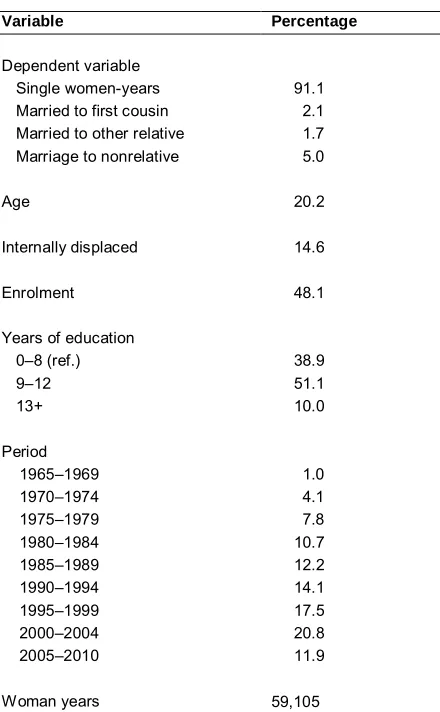
Table 1: Descriptive statistics for categorical variables
Variable Percentage
Dependent variable
Single women-years 91.1 Married to first cousin 2.1 Married to other relative 1.7 Marriage to nonrelative 5.0
Age 20.2
Internally displaced 14.6
Enrolment 48.1
Years of education
0‒8 (ref.) 38.9
9‒12 51.1
13+ 10.0
Period
1965‒1969 1.0
1970‒1974 4.1
1975‒1979 7.8
1980‒1984 10.7
1985‒1989 12.2
1990‒1994 14.1
1995‒1999 17.5
2000‒2004 20.8
2005‒2010 11.9
Woman years 59,105
Source: Palestinians in Israel Socio-Economic Survey 2004, 2007, 2010.
of 1.00 stands for the reference category, a coefficient greater than 1.00 represents a positive effect, and a coefficient less than 1.00 represents a negative effect on the odds.
5.1 Consanguineous marriage
The first model in Table 2 shows that in terms of odds ratios, consanguineous marriage has declined by 57% since 1975‒1979. The difference between the omitted period (1975‒1979) and the last period (2005‒2010) is very significant (p-value < 0.001). As predicted, internal displacement affects consanguineous marriage. It lowers the odds by almost 18% (p-value = 0.003).
Table 2: Discrete-time hazard models of a consanguineous marriage
Model 1 Model 2 Model 3
Variable eb Sig. eb Sig. eb Sig.
Age 6.471 .000 5.135 .000 5.384 .000
Age squared 0.959 .000 0.962 .000 0.961 .000
Period
1965‒1969 0.871 .611 0.665 .135 0.661 .129 1970‒1974 1.179 .156 1.089 .465 1.079 .514
1975‒1979 1.000 ‒ 1.000 ‒ 1.000 ‒
1980‒1984 0.830 .036 0.886 .175 0.894 .208 1985‒1989 0.825 .026 0.929 .395 0.945 .515 1990‒1994 0.777 .003 0.906 .256 0.931 .411 1995‒1999 0.606 .000 0.772 .003 0.796 .010 2000‒2004 0.555 .000 0.774 .003 0.801 .012 2005‒2010 0.431 .000 0.614 .000 0.637 .000
Internally displaced 0.824 .003 0.827 .004 0.826 .000
Enrolment int-1 0.391 .000 0.412 .000
Attainment int-1
0‒8 1.000
-9‒12 0.889 .029
13+ 0.913 .350
To test the role incompatibility hypothesis, the second model adds enrolment. Enrolment has a negative effect, lowering the odds by more than 60% (p-value < 0.001). To test the female empowerment hypothesis, the third model adds educational attainment. The odds of a consanguineous marriage among women with 9‒12 years of education is 11% less than among women with less than nine years of education (p -value = 0.029). However, there is no significant difference between women with post-secondary education and those with only a few years of schooling.
To estimate the contribution of enrolment to the decline in consanguineous marriage we compare the coefficients of the period dummy variables in the second model, which includes enrolment, with those in the first model, which does not include enrolment. If enrolment explains part of the decline, then it should attenuate the effect of the period dummy variables. Figure 1 shows that enrolment indeed attenuates the effect of the period dummy variables. If women were not enrolled in education after age fifteen, consanguineous marriages would have declined by 39% between 1975‒1979 and 2005‒2010 in terms of odds ratios (dashed line), instead of the 57% observed in the first model (solid line). Thus, almost a third of the decline in consanguineous marriage was the result of an increase in the age at leaving school. The curves of the second and the third model are close to each other for the whole observation period, indicating that educational attainment adds very little to the explanation of the decline. If women were not enrolled in education after age fifteen and did not have more than eight years of education, consanguineous marriage would have declined by 36% (dotted line) instead of the 39% observed in the second model (dashed line).
Figure 1: Period trends in consanguineous marriage in terms of odds ratios in three discrete-time hazard models: 1975‒2010
Source: Figure based on multinomial exponentiated logistic regression coefficients (eb) of period dummy variables in three models in
Table 2, controlling for age and internal displacement, using data from Palestinians in Israel Socio-Economic Survey 2004, 2007, 2010.
Note: The distance between the curves of the first and second models provides an estimate of the contribution of school enrolment to the decline, whereas the distance between the curves of the second and third models provides an estimate of the contribution of educational attainment to the decline.
5.2 Nonconsanguineous marriage
For comparison, we also discuss the decline in nonconsanguineous marriages. The first model in Table 3 shows that in terms of odds ratios, nonconsanguineous marriages declined by 36% between 1975‒1979 and 2005‒2010 (p-value < 0.001). Internal displacement lowers the odds by more than 15% (p-value < 0.005). We did not find an explanation for the latter finding in the literature. However, refugees in the West Bank and Gaza strip also have lower odds of marrying (Khawaja and Randall 2006: 40).
0.4 0.5 0.6 0.7 0.8 0.9 1 1.1
1975-1979 1980-1984 1985-1989 1990-1994 1995-1999 2000-2004 2005-2010
O
d
d
s
ra
ti
o
Socioeconomic status is unlikely to account for the effect of internal displacement, because educational attainment does not attenuate its effect.
Table 3: Discrete-time hazard models of a nonconsanguineous marriage
Model 1 Model 2 Model 3
Variable eb Sig. eb
Sig. eb
Sig.
Age 3.171 .000 2.880 .000 2.432 .000
Age squared 0.977 .000 0.979 .000 0.982 .000 Period
1965‒1969 1.398 .145 1.237 .356 1.251 .331 1970‒1974 1.599 .000 1.540 .000 1.576 .000
1975‒1979 1.000 ‒ 1.000 ‒ 1.000 ‒
1980‒1984 1.041 .639 1.074 .404 1.057 .519 1985‒1989 0.899 .211 0.950 .550 0.914 .292 1990‒1994 0.821 .020 0.880 .131 0.815 .017 1995‒1999 0.790 .004 0.873 .103 0.788 .005 2000‒2004 0.647 .000 0.738 .000 0.649 .000 2005‒2010 0.640 .000 0.735 .001 0.633 .000 Internally displaced 0.849 .004 0.851 .004 0.853 .005
Enrolment int-1 0.677 .000 0.513 .000
Attainment int-1
0‒8 1.000
-9‒12 1.593 .000
13+ 1.966 .000
Source: Palestinians in Israel Socio-Economic Survey 2004, 2007, 2010.
To test the role incompatibility hypothesis, the second model adds enrolment. Enrolment has a negative effect on the odds of a nonconsanguineous marriage, lowering the odds by about a third (p-value < 0.001).
The third model adds educational attainment. Controlling for enrolment, better-educated women have higher odds than less-better-educated women. The odds of women with post-secondary education is almost double that of women with 0‒8 years of education (p-value < 0.001). Thus, better-educated women do not have lower odds of marrying. Perhaps higher education provides greater access to more attractive marriage markets, as suggested by Oppenheimer and Lew (1995: 118).
of the period dummy variables. Figure 2 shows that enrolment indeed attenuates the effect of the period dummy variables. If women were not enrolled in education after age fifteen, nonconsanguineous marriage would have declined by slightly more than 25% (dashed line), instead of the 36% observed in the first model (solid line). However, the curves of the first and the third model are close to each other for the whole observation period, indicating that the increase in educational attainment almost completely cancels out the effect of enrolment. Thus, if women were not enrolled after age fifteen and did not have more than eight years of education, nonconsanguineous marriage would have declined more or less as it actually did (dotted line).
Figure 2: Period trends in nonconsanguineous marriage in terms of odds ratios in three discrete-time hazard models: 1975‒2010
Source: Figure based on multinomial exponentiated logistic regression coefficients (eb) of period dummy variables in three models in
Table 2, controlling for age and internal displacement, using data from Palestinians in Israel Socio-Economic Survey 2004, 2007, 2010.
Note: The distance between the curves of the first and second models provides an estimate of the contribution of school enrolment to the decline, whereas the distance between the curves of the second and third models provides an estimate of the contribution of educational attainment to the decline.
0.6 0.7 0.8 0.9 1 1.1
1975-1979 1980-1984 1985-1989 1990-1994 1995-1999 2000-2004 2005-2010
O
d
d
s
ra
ti
o
6. Conclusion
Previous research has shown that the decline in consanguinity is correlated with better female education. This correlation is usually interpreted as evidence for the empowerment hypothesis. However, education may not only empower women: there may also be an incompatibility of roles that prevents them from fulfilling spousal obligations while going to school. To the best of our knowledge, this article is the first to present the results of a test of both hypotheses regarding the decline in consanguineous marriage.
Two major findings emerged: the female empowerment hypothesis is not consistent with the data, while the role incompatibility hypothesis is. After 1980 consanguineous marriage declined by almost 60%. The rise in the age at leaving school explains about a third of the decline. School enrolment contributed more to the early stages of the decline. If the age at leaving school had not increased there would not have been a decline in consanguineous marriage between 1980‒1984 and 1990‒1994. School enrolment explains much less of the decline that occurred after 1990‒1994. Unfortunately, we do not have an explanation for the later stages of the decline. We compared our results with those for nonconsanguineous marriage. School enrolment also affects nonconsanguineous marriage. However, the negative effect of school enrollment and the positive effect of educational attainment cancel each other out.
References
Al-Arrayed, S. and Hamamy, H. (2012). The changing profile of consanguinity rates in Bahrain, 1990‒2009. Journal of Biosocial Science 44(3): 313‒319.
doi:10.1017/S0021932011000666.
Al-Haj, M. (1986). Adjustment patterns of the Arab internal refugees in Israel.
International Migration 24(3): 651‒674. doi:10.1111/j.1468-2435.1986.tb00 868.x.
Al-Haj, M. (1995). Kinship and modernization in developing societies: The emergence of instrumentalized kinship. Journal of Comparative Family Studies 26: 311‒ 328.
Allison, P.D. (2010a).Survival analysis using the SAS® system: A practical guide. 2nd ed. Cary: SAS Institute Inc.
Allison, P.D. (2010b). Survival analysis. In: Hancock, G.R. and Mueller, R.O. (eds.).
The reviewer’s guide to quantitative methods in the social sciences. New York: Routledge: 413‒425.
Al-Qudsi, S.S. (2003). Family background, school enrollments and wastage: Evidence from Arab countries. Economics of Education Review 22(6): 567‒580.
doi:10.1016/S0272-7757(03)00028-1.
Assaf, S. and Khawaja, M. (2009). Consanguinity tends and correlates in the Palestinian Territories. Journal of Biosocial Science 41(1): 107‒124. doi:10.1017/S0 021932008002940.
Bashir, N., Sheikh Muhammad, A., and Rohana, A. (2008).The Palestinians in Israel Socio-Economic Survey 2007: Main findings. Shefa-Amr: The Galilee Society, Rikaz Databank and Al-Ahali.
Baykara-Krumme, H. (2016). Consanguineous marriage in Turkish families in Turkey and in Western Europe. International Migration Review 50(3): 568‒598.
doi:10.1111/imre.12176.
Berrington, A. and Diamond, I. (2000). Marriage or cohabitation: A competing risks analysis of first-partnership formation among the 1958 British birth cohort.
Bittles A.H. and Hamamy, H.A. (2010). Consanguinity and endogamy in Arab countries. In: Teebi, A. (ed.). Genetic disorders among Arab populations. Heidelberg: Springer: 1‒130.doi:10.1007/978-3-642-05080-0_4.
Blossfeld, H.-P. and Jaenichen, U. (1992). Educational expansion and changes in women’s entry into marriage and motherhood in the Federal Republic of Germany. Journal of Marriage and the Family 54(2): 302‒315. doi:10.2307/ 353062.
El-Sheikh Muhammad, A. (2005).Palestinians in Israel Socio-economic Survey: Main findings 2004. Shefa-Amr: The Galilee Society and Rikaz Databank.
Esteve, A., Spijker, J., Riffe, T., and García, J. (2012). Spousal and parental roles among female student populations in 55 low- and middle-income countries.
Vienna Yearbook of Population Research 10: 77‒94. doi:10.1553/population yearbook2012s77.
Givens, B. and Hirschman, C. (1994). Modernization and consanguineous marriage in Iran.Journal of Marriage and the Family 56(4): 820‒834.doi:10.2307/353595.
Goldberg, H. (1967). FBD marriage and demography among Tripolitanian Jews in Israel. Southwestern Journal of Anthropology 23(2): 176‒191. doi:10.1086/ soutjanth.23.2.3629216.
Hamamy, H., Jamhawi, L., Al-Darawsheh, J., and Ajlouni, K. (2005). Consanguineous marriages in Jordan: Why is the rate changing with time? Clinical Genetics
67(6): 511‒516.doi:10.1111/j.1399-0004.2005.00426.x.
Hoem, J.M. and Kreyenfeld, M. (2006). Anticipatory analysis and its alternatives in life-course research. Part 1: The role of education in the study of first childbearing. Demographic Research 15(16): 461‒484. doi:10.4054/DemRes. 2006.15.16.
Jaber, L., Halpern, G., and Shohat, T. (2000). Trends in the frequencies of consanguineous marriages in the Israeli Arab community. Clinical Genetics
58(2): 106‒110.doi:10.1034/j.1399-0004.2000.580203.x.
Kenan, G. and Burck, L. (2002). Trends in patrilineal parallel first cousin marriages among Israeli Arabs: 1949‒1995. Annals of Human Biology 29(4): 398‒413.
doi:10.1080/03014460210151480.
Khury, F.I. (1970). Parallel cousin marriage reconsidered: A Middle Eastern practice that nullifies the effects of marriage on the intensity of family relationships.
Man, New Series 5(4): 597‒618.doi:10.2307/2799105.
Koc, I. (2008). Prevalence and sociodemographic correlates of consanguineous marriages in Turkey.Journal of Biosocial Science40(1): 137‒148.doi:10.1017/ S002193200700226X.
Lewando-Hundt, G., Shoham-Vardi, I., Beckerlega, S., Belmaker, I., Kassem, F., and Abu Jaafar, A. (2001). Knowledge, action and resistance: The selective use of pre-natal screening among Bedouin women of the Negev, Israel. Social Science and Medicine 52(4): 561‒569.doi:10.1016/S0277-9536(00)00160-X.
Lloyd, C.B. and Mensch, B.S. (2008). Marriage and childbirth as factors in dropping out from school: An analysis of DHS data from Sub-Saharan Africa.Population Studies 62(1): 1‒13.doi:10.1080/00324720701810840.
Na’amnih, W., Romano-Zelekha, O., Kabaha, A., Pollack Rubin, L., Bilenko, N., Jabber, L., Honovich, M., and Shohat, T. (2015). Continuous decrease of consanguineous marriages among Arabs in Israel. American Journal of Human Biology 27: 94‒98.doi:10.1002/ajhb.22610.
Oppenheimer, V.K. and Lew, V. (1995). American marriage formation in the 1980s: How important was women’s economic independence? In: Mason, K.O. and Jensen, A.-M. (eds.). Gender and family change in industrialized countries. Oxford: Clarendon Press: 105‒138.
Oppenheimer, V.K., Kalmijn, M., and Lim, N. (1997). Men’s career development and marriage timing during a period of rising inequality. Demography 34(3): 311‒ 330.doi:10.2307/3038286.
Raymo, J.M. (2003). Educational attainment and the transition to first marriage among Japanese women.Demography 40(1): 83‒103.doi:10.1353/dem.2003.0008.
Raz-Yurovich, L. (2010). Men’s and women’s economic activity and first marriage: Jews in Israel, 1987‒1995. Demographic Research 22(29): 933‒964.
doi:10.4054/DemRes.2010.22.29.
Romeo, G. and Bittles, A.H. (2014). Consanguinity in the contemporary world.Human Heredity 77(1‒4): 6‒9.doi:10.1159/000363352.
Sharkia, R., Zaid, M., Athamna, A., Cohen, D., Azem, A., and Zalan, A. (2008). The changing pattern of consanguinity in a selected region of the Israeli Arab community. American Journal of Human Biology 20(1): 72‒77. doi:10.1002/ ajhb.20678.
Sharkia, R., Mahajnah, M., Athamny, E., Khatib, M., Sheikh-Muhammad, A., and Zalan, A. (2016). Changes in marriage patterns among the Arab community in Israel over a 60-year period. Journal of Biosocial Science 48(2): 283‒287.
doi:10.1017/S0021932015000103.
Sheikh Muhammad, A. and Khatib, M. (2011).The Palestinians in Israel Third Socio-Economic Survey 2010: Main Findings. Shefa-Amr: The Galilee Society and Rikaz Databank.
Sirdah, M.M. (2014). Consanguinity profile in the Gaza Strip of Palestine: Large-scale community-based study.European Journal of Medical Genetics 57(2‒3): 90‒94.
doi:10.1016/j.ejmg.2014.01.003.
Vardi-Saliternik, R., Friedlander, Y., and Cohen, T. (2002). Consanguinity in a population sample of Israeli Muslim Arabs, Christian Arabs and Druze. Annals of Human Biology 29(4): 422‒431.doi:10.1080/03014460110100928.