R E S E A R C H A R T I C L E
Open Access
Does high-density lipoprotein influence the
development of saphenous vein graft disease
after coronary bypass surgery?: exploratory
analysis from the CASCADE trial
Katie Jerzewski
1,4, Marc Ruel
2, Pierre Voisine
3, Michel R Le May
2and Alexander Kulik
1,4*Abstract
Background:Low levels of high-density lipoprotein (HDL) purportedly increase the risk after coronary bypass surgery. This may relate to the development of saphenous vein graft (SVG) disease early postoperatively, but this premise has never been evaluated in the context of a prospective trial.
Methods:The CASCADE Trial was a multi-center study of 113 patients evaluating the use of postoperative clopidogrel. Patients received standard lipid management after surgery (96% statins). At 12 months, angiography and intravascular ultrasound was performed to assess SVG occlusion and intimal hyperplasia, respectively. In this exploratory analysis, we evaluated the influence of HDL levels on the development of SVG disease at 12 months, using the established cut-off of <40 mg/dL suggesting increased risk.
Results:While HDL levels increased over the time-period of the trial (P < 0.0001), 51.1% of patients had HDL levels <40 mg/dL 12 months after surgery. Slightly more SVG occlusions occurred amongst patients with HDL levels <40 mg/dL (6.8%), compared to patients with HDL levels >40 mg/dL (4.0%, P = 0.5). With multivariate adjustment, HDL level <40 mg/dL was associated with a trend towards more SVG occlusions (odds ratio: 3.2; P = 0.12). Lower HDL level was also associated with more intimal hyperplasia on ultrasound at 12 months (P = 0.10). Patients who had HDL levels >60 mg/dL had the least amount of intimal hyperplasia, significantly less than the remainder of the cohort (P = 0.01).
Conclusions:Within this population, lower HDL levels were associated with trends towards more graft occlusions and more vein intimal hyperplasia. Modulation of postoperative HDL levels may represent a valuable future strategy for the reduction of SVG disease.
Keywords:Coronary artery bypass graft surgery, Vein graft disease, HDL, Graft patency, Cholesterol
Background
The saphenous vein remains the most commonly uti-lized bypass conduit during coronary artery bypass graft surgery (CABG) due to its ready availability and ease of use. The long-term durability of this conduit, however, is limited by the development of saphenous vein graft (SVG) disease during the months and years after surgery
[1]. The process of SVG disease, in the form of intimal hyperplasia and atherosclerosis, is strongly influenced by hyperlipidemia [1,2]. Much focus has therefore been di-rected towards the reduction of low density lipoprotein (LDL) cholesterol levels as a means of improving graft patency [2,3], with current guidelines recommending statin treatment for all patients after CABG to achieve LDL levels <100 mg/dL [4]. Nevertheless, many patients remain at high risk for adverse events even when their LDL levels have been aggressively reduced by statins [5,6].
* Correspondence:[email protected] 1
Lynn Heart and Vascular Institute, Boca Raton Regional Hospital, 801 Meadows Road, Suite 104, Boca Raton, Florida 33486, USA 4
Charles E. Schmidt College of Medicine, Florida Atlantic University, Boca Raton, Florida, USA
Full list of author information is available at the end of the article
As such, increasing attention in the cardiology com-munity has recently been directed to the evaluation of therapies to raise high density lipoprotein (HDL) levels to further improve cardiovascular outcomes [5,7-9]. Low HDL levels are commonly seen in patients with coronary artery disease (CAD) and have been well-described as an independent risk factor for adverse outcomes in se-veral studies [5,6,10,11]. Less is known regarding the re-levance of HDL after CABG [12,13]. Data from the pre-statin era suggest that HDL can influence the devel-opment of SVG disease in the years that follow surgery [14]. While the mechanism is unclear, higher levels of HDL particles may slow the process of SVG disease by preventing atherogenesis, reducing vascular inflamma-tion and improving endothelial funcinflamma-tion [1,6]. To our knowledge, no study to date has evaluated whether HDL levels have an impact on the early development of SVG disease within the first year after surgery. Using angio-graphic and intravascular ultrasound (IVUS) data col-lected as part of the recent Clopidogrel after Surgery for Coronary Artery Disease (CASCADE) clinical trial [15,16], the purpose of this post-hoc study was to ex-plore the influence of HDL on the development of SVG disease early after CABG within a contemporary cohort of patients aggressively treated with preventa-tive therapies.
Methods
CASCADE trial design
The CASCADE Trial was a dual-center randomized placebo-controlled trial that evaluated the addition of clopidogrel to aspirin on the development of SVG dis-ease following CABG. Details of the study design and eligibility criteria have previously been published [15]. In brief, 113 patients who underwent CABG using at least two SVGs were enrolled in the trial. The Human Re-search Ethics Boards of the University of Ottawa Heart Institute and Hôpital Laval approved the study protocol, and each patient provided written informed consent be-fore enrollment. During the operation, the size of each target vessel was noted, and the quality of each target vessel was rated subjectively by the surgeon (good, fair, or poor). Saphenous vein was harvested using open techniques in the CASCADE trial, and endoscopic methods were not employed. Following surgery, pa-tients were randomized to receive either daily aspirin 162 mg plus clopidogrel 75 mg or aspirin 162 mg plus placebo, starting on the day of surgery, for the duration of 12 months.
Twelve months after CABG, patients underwent an-giography of the bypass grafts and the native coronary arteries. During the same session, intimal hyperplasia of one randomly selected SVG was assessed by IVUS [15]. A 40 MHz IVUS catheter (Atlantis SR Pro, Boston
Scientific Corporation, Natick, Massachusetts, USA) was used to analyze the most proximal 40 mm of the se-lected graft. The lumen and external elastic lamina area were measured for 1 mm cross sections, and the area of intimal hyperplasia was determined. Mean intimal area per patient was calculated for the 40 mm-ana-lyzed segment.
Twelve-month angiography was completed in 92 of the 113 enrolled patients (81.4%). Intravascular ultra-sound was performed in 90 of the 92 patients (97.8%) who underwent follow-up angiography. Intravascular ultrasound could not be performed in 2 patients due to technical factors (1 patient) or the presence of 2 oc-cluded SVGs (1 patient). As detailed elsewhere, the addition of clopidogrel to aspirin did not significantly reduce the process of SVG intimal hyperplasia or re-sult in improved vein graft patency 12 months after CABG [16].
Patient follow-up
While enrolled in the CASCADE Trial, patients were followed with clinic visits at 1, 6 and 12 months after surgery and telephone home assessments at 3 and 9 months. All patients were treated in accordance with current guidelines [4]. This included smoking cessation counseling, aggressive diabetes management, and the administration of aspirin, beta-blockers, angiotensin converting enzyme inhibitors, and statin medications. Patients were subjected to the standard of care with re-spect to lipid therapy after surgery. In the absence of an absolute contraindication, surgeons and cardiologists were advised to administer statin therapy postoperatively to each patient enrolled in the CASCADE Trial as recommended in the current guidelines [4]. The statin type and dose was left to the discretion of the prescrib-ing physician and was not dictated by the trial protocol. Lipid levels, including HDL, were assessed prior to sur-gery, and after surgery at 1, 6, and 12 months. Modula-tion of HDL levels with medical therapy (i.e. niacin) was not endorsed as part of trial enrollment, given the ab-sence of evidence [7] or guideline statements [4] sup-porting this practice. Office or telephone assessments were performed every 3 months to ensure medication compliance, including statin therapy. For the purpose of the present study, “consistent statin use” was defined as the preoperative and continued postoperative use of statin therapy throughout the 12-month period of the CASCADE Trial, reported by 62.8% of patients (71/113). Twelve-month clinical follow-up was complete for all patients.
Statistical analysis
occlusions and vein intimal hyperplasia. Standard de-scriptive statistical analyses were used, including re-peated measure analysis of variance to examine HDL levels over time. To evaluate the impact of HDL levels following CABG, graft occlusions and SVG intimal hy-perplasia were compared between patients who had HDL levels <40 mg/dL, 40–60 and >60 mg/dL, as mea-sured 12 months after surgery. Continuous data are presented as a mean ± standard deviation and were compared between groups using unpaired two-sided Student’s t tests. Categorical data are presented as pro-portions and were compared between groups using a Fisher’s exact test. Multivariate logistic regression ana-lysis was used to identify independent predictors of vein graft occlusion, and linear regression analysis was per-formed to evaluate predictors of SVG intimal hyper-plasia. The following factors were considered in the multivariate models: preoperative HDL level, HDL level 12 months after surgery, preoperative LDL level, LDL level 12 months after surgery, consistent statin use, age, female gender, body mass index, diabetes, smoking, off-pump surgery, and surgical center. Stepwise forward selection and backward elimination techniques were employed with P = 0.20 for entry and removal criteria. Odds ratios (OR) are reported for the logistic ana-lysis, and regression coefficients are reported for the linear analysis ± standard error. All reported P values are two-sided. P values <0.05 were considered signifi-cant, and P values between 0.05 and 0.20 were con-sidered trends towards statistical significance. Data were analyzed in Intercooled Stata 11.0 (Stata; College Station, Texas, USA).
Results Patient cohort
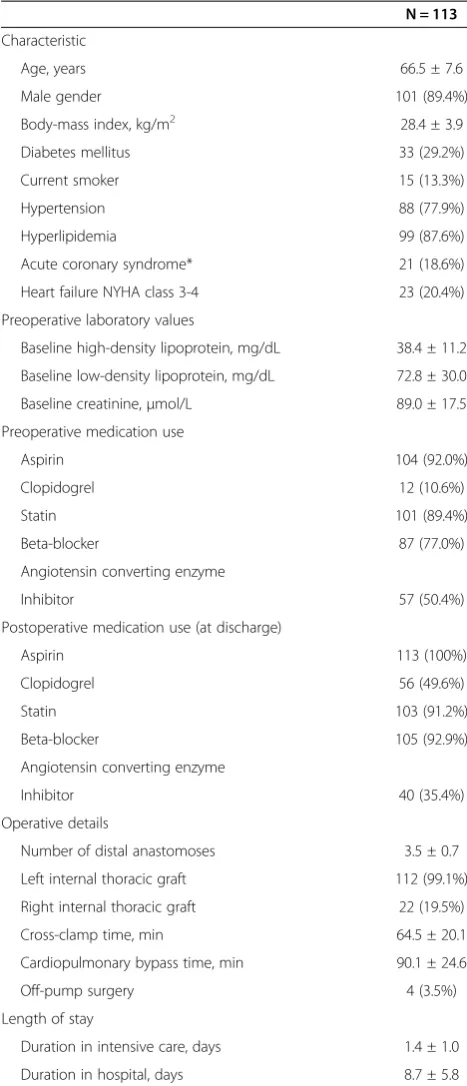
The CASCADE Trial cohort consisted of 113 patients who underwent CABG between 2006 and 2009. The mean age of the cohort was 66.5 ± 7.6 years, and 101 pa-tients (89.4%) were male (Table 1). Most papa-tients had been diagnosed with hypertension (77.9%) or hyperlipid-emia (87.6%) prior to surgery. Ten surgeons at 2 surgical centers performed a mean of 3.5 ± 0.7 grafts (range 2–6 grafts; total 396 grafts), with the majority of patients undergoing on-pump surgery. All patients but 1 received a left internal thoracic artery graft. The mean hospital length of stay after surgery was 8.7 ± 5.8 days. Most pa-tients were treated with statin therapy before surgery (89.4%), and nearly all patients received statin therapy after CABG (96% at 12 months).
HDL levels
Before surgery, 54.1% of patients had HDL levels <40 mg/dL, 45.0% of patients had HDL levels 40–60 mg/dL, and 0.9% of patients had optimal HDL levels >60 mg/dL.
Compared to preoperative values, HDL levels signifi-cantly increased (P < 0.0001 by repeated measure ana-lysis of variance) over the time period of the study (Figure 1). Whereas preoperative HDL levels were 38.4 ± 11.2 mg/dL, at 12 months after surgery, HDL Table 1 Patient characteristics
N = 113
Characteristic
Age, years 66.5 ± 7.6
Male gender 101 (89.4%)
Body-mass index, kg/m2 28.4 ± 3.9
Diabetes mellitus 33 (29.2%)
Current smoker 15 (13.3%)
Hypertension 88 (77.9%)
Hyperlipidemia 99 (87.6%)
Acute coronary syndrome* 21 (18.6%)
Heart failure NYHA class 3-4 23 (20.4%)
Preoperative laboratory values
Baseline high-density lipoprotein, mg/dL 38.4 ± 11.2
Baseline low-density lipoprotein, mg/dL 72.8 ± 30.0
Baseline creatinine,μmol/L 89.0 ± 17.5
Preoperative medication use
Aspirin 104 (92.0%)
Clopidogrel 12 (10.6%)
Statin 101 (89.4%)
Beta-blocker 87 (77.0%)
Angiotensin converting enzyme
Inhibitor 57 (50.4%)
Postoperative medication use (at discharge)
Aspirin 113 (100%)
Clopidogrel 56 (49.6%)
Statin 103 (91.2%)
Beta-blocker 105 (92.9%)
Angiotensin converting enzyme
Inhibitor 40 (35.4%)
Operative details
Number of distal anastomoses 3.5 ± 0.7
Left internal thoracic graft 112 (99.1%)
Right internal thoracic graft 22 (19.5%)
Cross-clamp time, min 64.5 ± 20.1
Cardiopulmonary bypass time, min 90.1 ± 24.6
Off-pump surgery 4 (3.5%)
Length of stay
Duration in intensive care, days 1.4 ± 1.0
Duration in hospital, days 8.7 ± 5.8
NYHANew York Heart Association.
levels were 40.3 ± 11.1 mg/dL (preoperative versus 12 months postoperative, P = 0.03). Twelve months after surgery, 51.1% of patients had HDL levels <40 mg/dL, 42.2% of patients had HDL levels 40–60 mg/dL, whereas only 6.7% of patients had optimal HDL levels >60 mg/dL. Patients who had HDL levels <40 mg/dL at 12 months had significantly lower LDL levels before surgery com-pared to patients who had HDL levels >40 mg/dL (preoperative LDL: 66.2 ± 22.8 mg/dL versus 84.4 ± 38.3 mg/dL, HDL level <40 mg/dL versus HDL level >40 mg/dL, P = 0.008).
HDL and graft occlusion
The twelve-month graft occlusion rate in the CASCADE Trial was 15 of 322 examined grafts (4.7%). The twelve-month internal thoracic artery graft occlusion rate was 1.8% (2/112), and the 12-month SVG occlusion rate was 6.2% (13/209).
For patients who had HDL levels >40 mg/dL 12 months after surgery, the overall graft occlusion rate was 3.3% (5/152), and the SVG occlusion rate was 4.0% (4/99). In contrast, for patients with HDL levels <40 mg/dL, the overall graft occlusion rate was slightly higher at 5.1% (8/158, P = 0.57), and the SVG occlusion rate was higher at 6.8% (7/103, P = 0.54). However, statistical significance was not reached (Figure 2). Increases in HDL levels to >60 mg/dL (6 patients) or decreases to <30 mg/dL (13 patients) did not significantly impact the SVG graft occlu-sion rate [P = not significant (NS)]. Preoperative HDL level was not associated with a change in the graft occlusion rate (P = NS).
Multivariate logistic regression analysis was used to identify factors independently associated with SVG oc-clusions 12 months following CABG. In the multi-variable model, 12-month HDL level <40 mg/dL was associated with a trend towards more SVG occlusions
(OR: 3.2; P = 0.12). LDL level >100 mg/dL was associated with more occlusions in the model (OR: 14.7; P = 0.02), whereas good target vessel quality was associated with less occlusions (OR: 0.3; P = 0.06). Preoperative HDL level <40 mg/dL or increases in postoperative HDL to >60 mg/dL were not significant factors in the multivari-ate model (P = NS).
HDL and intimal hyperplasia
The mean 12-month SVG intimal area in the CASCADE Trial was 4.31 ± 2.06 mm2, with considerable variation in intimal hyperplasia amongst the enrolled patients (95% confidence interval: 1.89, 7.97 mm2). Lower HDL level was associated with a trend towards more intimal hyper-plasia on IVUS 12 months after surgery (0.92 ± 0.73 mm2, P = 0.2). For patients who had HDL levels <40 mg/dL 12 months after surgery, intimal area was 4.42 ± 2.14 mm2, compared to 4.12 ± 1.73 mm2 for patients who had HDL levels >40 mg/dL (P = 0.5). Increasing HDL level from <40 mg/dL to 40–60 mg/dL (4.75 ± 2.12 mm2), did not significantly reduce intimal area at 1 year (P = NS), and decreases to <30 mg/dL also did not impact intimal area (4.68 ± 1.78 mm2, P = 0.4). However, patients who had HDL levels >60 mg/dL 12 months after surgery had the least amount of intimal hyperplasia on IVUS (Figure 3). Compared to patients who had HDL levels <60 mg/dL (4.41 ± 1.93 mm2), patients with HDL levels >60 mg/dL had significantly lower intimal area (2.38 ± 0.77 mm2, P = 0.01).
In multivariate linear regression analysis, lower HDL level was associated with a trend towards more intimal hyperplasia 12 months after surgery (1.23 ± 0.74 mm2, P = 0.10). In the model, older age was independently as-sociated with more intimal hyperplasia (0.06 ± 0.03 mm2
Figure 1High-density lipoprotein level during trial enrollment. High-density level significantly increased during the time period of the trial (P < 0.0001).
per each additional year, P = 0.05), whereas diabetes was associated with a reduction in SVG intimal hyperplasia (−1.02 ± 0.45 mm2
, P = 0.03). Consistent statin use throughout the trial and LDL level did not significantly predict intimal area in the multivariate analysis (P = NS).
Discussion
Strong evidence is available to support the use of statins to reduce LDL levels and improve the outcomes of pa-tients recovering from CABG [2-4]. Less is known, how-ever, regarding the influence of HDL on the outcomes of patients after CABG. Previous research has suggested that a relationship exists between lower HDL levels and higher risk of atherosclerosis progression and adverse events following surgery [12-14]. Nevertheless, these studies were conducted in an earlier era, before the rou-tine use of postoperative statins and antiplatelet agents. With a growing interest in the study of HDL therapies in the cardiology community [5,7-9], we sought to evalu-ate the relevance of HDL levels on the process of SVG disease within a cohort of contemporary CABG patients who were treated aggressively with secondary preventa-tive therapies.
In this exploratory analysis of the CASCADE trial, we assessed graft occlusion rates and vein intimal hyperpla-sia 12 months after CABG, comparing the degree of SVG disease between patients with low HDL levels to those with higher and more ideal levels. Using an established cut-off of increased risk (<40 mg/dL) [10,11], we noted slightly more SVG occlusions amongst patients with HDL levels <40 mg/dL (6.8%) compared to those with HDL levels >40 mg/dL (4.0%), although statistical significance was not seen (P = 0.54). After adjustment in
multivariate analysis, HDL level <40 mg/dL was associ-ated with a trend towards more SVG occlusions (OR: 3.2; P = 0.12). Lower HDL level was also associated with a trend towards more intimal hyperplasia on IVUS. Interestingly, patients with ideal levels of HDL >60 mg/dL had the least amount of intimal hyperplasia, significantly less compared to the rest of the cohort (P = 0.01).
Lower levels of HDL are well-known to be associated with worse clinical outcomes amongst CAD patients [5,6,10,11]. Some of the earliest data on the subject became available from the Framingham Heart Study, whereby low HDL was found to be a more potent CAD risk factor than high LDL [10]. Recent studies from the current era have shown that HDL levels are inversely re-lated to cardiovascular events, even amongst patients receiving statin therapy and those with LDL levels ag-gressively treated to <70 mg/dL [5,11]. In addition, mod-erate increases in HDL appear to be associated with regression of coronary atherosclerosis [17].
Given the risk for adverse events that remains despite statin treatment [5,6], several research groups have fo-cused their attention on the evaluation of therapies to increase HDL and thereby improve clinical outcomes in patents already treated with preventative medications [7-9,18]. A number of pharmacological interventions have been shown to improve HDL levels in clinical trials, including niacin [7,8], gemfibrozil [14], bezafibrate [19], fenofibrate [20], and torcetrapib [18]. While some stud-ies have demonstrated modest biological effects, such as the reduction of either carotid artery intimal thickness [8] or angiographic CAD progression [14,19,20], the ma-jority of the studies in the field have produced negative clinical results [7,18]. Casting doubt on the HDL theory, no therapy to date has been shown to increase HDL levels and improve outcomes in a clinical trial enrolling CAD patients already treated with statins [7,18].
In contrast to the attention that HDL has captured in the cardiology community, few studies have evaluated the influence of HDL levels on the outcomes of patients following cardiac surgery. Previous work from the Cleve-land Clinic has demonstrated associations between lower HDL and both worse long-term survival and higher risk of adverse events after CABG [12,13]. In the only pro-spective randomized study in the field, the Lopid Co-ronary Angiography Trial (LOCAT) enrolled 395 men with HDL levels <42.5 mg/dL who had undergone CABG on average 2 years earlier. From an era prior to the routine use of statins after CABG, patients were randomized to receive either slow-release gemfibrozil 1200 mg per day or matching placebo. Coronary angiog-raphy was performed at baseline and after a mean of 32 months of therapy. Gemfibrozil therapy led to sig-nificant increases in HDL levels (P < 0.001) and slowed the progression of native CAD (P = 0.009). Moreover,
gemfibrozil significantly reduced the risk of developing new lesions in bypass grafts on follow-up angiography (2% versus 14%, gemfibrozil versus placebo, P < 0.001) [14]. Despite the notable results of LOCAT, gemfibrozil never became incorporated into the routine care of CABG patients. This is likely a reflection of the impres-sive data published that same year promoting the use of statins after CABG [2], as well as the high risk of side ef-fects associated with gemfibrozil when combined with statin therapy [21].
Similar to LOCAT, our exploratory study provides support, albeit modest, to the concept that low HDL levels negatively influence the outcomes of patients fol-lowing CABG. Whereas the current study focused on the process of SVG disease within the first postoperative year, LOCAT patients were enrolled years after surgery, when many had already developed SVG disease at the time of the baseline angiography. We were limited by a smaller sample size and shorter follow-up period in our study, but we found that a relationship existed between HDL levels and SVG disease using both conventional angiography as well as using more sophisticated graft imaging with IVUS. We believe our data highlights the relevance of HDL as a factor influencing the develop-ment of SVG disease, even in the current era when nearly all patients receive antiplatelet and statin therap-ies after surgery.
Multiple mechanisms may explain the link between HDL and the development of SVG disease. HDL parti-cles reduce LDL oxidation and reverse cholesterol trans-port, promoting cholesterol efflux from macrophages and preventing foam cell development in a vessel wall [6,8]. Moreover, higher levels of HDL are profoundly anti-atherogenic and may favorably impact graft patency by preventing a procoagulant milieu [1,6]. Independent from their involvement in cholesterol metabolism, HDL also improves endothelial function and promotes endo-thelial repair [6]. By reducing vascular inflammation and thrombosis [6], it is possible that higher levels of HDL particles may slow the process of SVG disease, ultim-ately decreasing the risk of adverse outcome following surgery. Regardless of the exact mechanism of action, the biological signal demonstrated in this analysis high-lights the need for further research in this area. The modulation of HDL with medical therapy may represent a valuable future strategy for the prevention of SVG dis-ease after CABG.
The current study is the first to date to evaluate the im-pact of HDL levels on graft occlusion rates and vein intimal hyperplasia early after CABG. Nevertheless, the re-sults presented must be interpreted within the context of several limitations. The CASCADE Trial was designed to assess the impact of antiplatelet therapy on the process of SVG disease 12 months after surgery [15]. Patients were
not randomized to different postoperative lipid modifica-tion strategies, as these decisions were left to the discre-tion of physicians who were following established clinical guidelines [4]. Moreover, we acknowledge that the find-ings of this post-hoc analysis must be viewed as explora-tory in nature. Given the modest results, we believe our findings are hypothesis-generating and require confirm-ation from future studies, perhaps with longer follow-up periods and larger sample sizes. Post-hoc power calcula-tions revealed that we would have required more than 350 vein grafts in each group to have demonstrated a signifi-cant difference in the patency rate between patients who did or did not have HDL levels <40 mg/dL 12 months after surgery, assuming a statistical power of 50%.
Conclusion
Within the CASCADE trial population, our exploratory analysis demonstrated that lower HDL levels were associ-ated with trends towards more graft occlusions and more vein intimal hyperplasia 12 months following CABG. Pa-tients with ideal HDL levels >60 mg/dL had significantly lower amounts of intimal hyperplasia in our cohort. Des-pite the limitations of a small sample size, we noted a modest signal suggesting a potential effect of low HDL levels on the development of SVG disease early after sur-gery. We believe that modulation of postoperative HDL levels with medical therapy may represent a valuable fu-ture strategy for the reduction of SVG disease, and further research and clinical trials appear warranted.
Abbreviations
CABG:Coronary artery bypass graft surgery; CAD: Coronary artery disease; CASCADE: Clopidogrel after surgery for coronary artery disease; HDL: High density lipoprotein; IVUS: Intravascular ultrasound; LDL: Low density lipoprotein; LOCAT: Lopid coronary angiography trial; NS: Not significant; OR: Odds ratio; SVG: Saphenous vein graft disease.
Competing interests
The authors declare that they have no competing interests.
Authors’contributions
Each author listed contributed to the development of this manuscript. Specifically, KJ helped with data analysis and drafted the paper. MR, PV, and MRLM provided patients for the subject matter of this report, established study funding, and presented critical revisions of the manuscript. AK developed the study concept, performed the statistical analysis, and drafted the manuscript. All authors read and approved the final manuscript.
Acknowledgements
The CASCADE trial was funded by research grants from the Physicians’ Services Incorporated Foundation, from Boston Scientific Inc., and from the Bristol-Myers Squibb Sanofi Canada Partnership. The study authors alone designed this trial sub-study, analyzed the data, wrote the manuscript, and decided to submit the paper for publication. The authors attest to the accuracy of the data analysis.
Author details
1Lynn Heart and Vascular Institute, Boca Raton Regional Hospital, 801
Received: 5 April 2013 Accepted: 8 July 2013 Published: 10 July 2013
References
1. Motwani JG, Topol EJ:Aortocoronary saphenous vein graft disease: pathogenesis, predisposition, and prevention.Circ1998,97:916–931. 2. The effect of aggressive lowering of low-density lipoprotein cholesterol
levels and low-dose anticoagulation on obstructive changes in saphenous-vein coronary-artery bypass grafts. The post coronary artery bypass graft trial investigators.N Engl J Med1997,336:153–162. 3. Kulik A, Voisine P, Mathieu P, Masters RG, Mesana TG, Le May MR, Ruel M:
Statin therapy and saphenous vein graft disease after coronary bypass surgery: analysis from the CASCADE randomized trial.Ann Thorac Surg
2011,92:1284–1290. discussion 1290–1281.
4. Hillis LD, Smith PK, Anderson JL, Bittl JA, Bridges CR, Byrne JG, Cigarroa JE, Disesa VJ, Hiratzka LF, Hutter AM Jr,et al:ACCF/AHA guideline for coronary artery bypass graft surgery: a report of the American College of Cardiology Foundation/American Heart Association Task Force on practice guidelines.Circ2011,2011(124):e652–e735.
5. Barter P, Gotto AM, LaRosa JC, Maroni J, Szarek M, Grundy SM, Kastelein JJ, Bittner V, Fruchart JC:HDL cholesterol, very low levels of LDL cholesterol, and cardiovascular events.N Engl J Med2007,357:1301–1310.
6. Barter P:HDL-C: role as a risk modifier.Atheroscler Suppl2011,12:267–270. 7. Boden WE, Probstfield JL, Anderson T, Chaitman BR, Desvignes-Nickens P,
Koprowicz K, McBride R, Teo K, Weintraub W:Niacin in patients with low HDL cholesterol levels receiving intensive statin therapy.N Engl J Med
2011,365:2255–2267.
8. Taylor AJ, Villines TC, Stanek EJ, Devine PJ, Griffen L, Miller M, Weissman NJ, Turco M:Extended-release niacin or ezetimibe and carotid intima-media thickness.N Engl J Med2009,361:2113–2122.
9. Birjmohun RS, Hutten BA, Kastelein JJ, Stroes ES:Efficacy and safety of high-density lipoprotein cholesterol-increasing compounds: a meta-analysis of randomized controlled trials.J Am Coll Cardiol2005,
45:185–197.
10. Gordon T, Castelli WP, Hjortland MC, Kannel WB, Dawber TR:Predicting coronary heart disease in middle-aged and older persons. The Framington study.JAMA1977,238:497–499.
11. Seo SM, Choo EH, Koh YS, Park MW, Shin DI, Choi YS, Park HJ, Kim DB, Her SH, Lee JM,et al:High-density lipoprotein cholesterol as a predictor of clinical outcomes in patients achieving low-density lipoprotein cholesterol targets with statins after percutaneous coronary intervention.
Heart2011,97:1943–1950.
12. Foody JM, Ferdinand FD, Pearce GL, Lytle BW, Cosgrove DM, Sprecher DL:
HDL cholesterol level predicts survival in men after coronary artery bypass graft surgery: 20-year experience from The Cleveland Clinic Foundation.Circ2000,102:III90–III94.
13. Sabik JF 3rd, Blackstone EH, Gillinov AM, Smedira NG, Lytle BW:Occurrence and risk factors for reintervention after coronary artery bypass grafting.
Circ2006,114:I454–I460.
14. Frick MH, Syvanne M, Nieminen MS, Kauma H, Majahalme S, Virtanen V, Kesaniemi YA, Pasternack A, Taskinen MR, Lopid Coronary Angiography Trial (LOCAT) Study Group:Prevention of the angiographic progression of coronary and vein-graft atherosclerosis by gemfibrozil after coronary bypass surgery in men with low levels of HDL cholesterol.Circ1997,
96:2137–2143.
15. Kulik A, Le May M, Wells GA, Mesana TG, Ruel M:The clopidogrel after surgery for coronary artery disease (CASCADE) randomized controlled trial: clopidogrel and aspirin versus aspirin alone after coronary bypass surgery [NCT00228423].Curr Control Trials Cardiovasc Med2005,6:15. 16. Kulik A, Le May MR, Voisine P, Tardif JC, Delarochelliere R, Naidoo S, Wells
GA, Mesana TG, Ruel M:Aspirin plus clopidogrel versus aspirin alone after coronary artery bypass grafting: the clopidogrel after surgery for coronary artery disease (CASCADE) trial.Circ2010,122:2680–2687. 17. Nicholls SJ, Tuzcu EM, Sipahi I, Grasso AW, Schoenhagen P, Hu T, Wolski K,
Crowe T, Desai MY, Hazen SL,et al:Statins, high-density lipoprotein cholesterol, and regression of coronary atherosclerosis.JAMA2007,
297:499–508.
18. Barter PJ, Caulfield M, Eriksson M, Grundy SM, Kastelein JJ, Komajda M, Lopez-Sendon J, Mosca L, Tardif JC, Waters DD,et al:Effects of torcetrapib in patients at high risk for coronary events.N Engl J Med2007,
357:2109–2122.
19. Ericsson CG, Hamsten A, Nilsson J, Grip L, Svane B, de Faire U:Angiographic assessment of effects of bezafibrate on progression of coronary artery disease in young male postinfarction patients.Lancet1996,347:849–853. 20. Effect of fenofibrate on progression of coronary-artery disease in type 2 diabetes: the diabetes atherosclerosis intervention study, a randomised study.Lancet2001,357:905–910.
21. Bottorff MB:Statin safety and drug interactions: clinical implications.
Am J Cardiol2006,97:27C–31C. doi:10.1186/1749-8090-8-172
Cite this article as:Jerzewskiet al.:Does high-density lipoprotein influence the development of saphenous vein graft disease after coronary bypass surgery?: exploratory analysis from the CASCADE trial. Journal of Cardiothoracic Surgery20138:172.
Submit your next manuscript to BioMed Central and take full advantage of:
• Convenient online submission
• Thorough peer review
• No space constraints or color figure charges
• Immediate publication on acceptance
• Inclusion in PubMed, CAS, Scopus and Google Scholar
• Research which is freely available for redistribution