O R I G I N A L P A P E R
Personality and the response to predation risk: effects
of information quantity and quality
Grant E. Brown•Chris K. Elvidge• Indar Ramnarine• Douglas P. Chivers• Maud C. O. Ferrari
Received: 9 September 2013 / Revised: 5 February 2014 / Accepted: 17 February 2014 / Published online: 22 February 2014 ÓSpringer-Verlag Berlin Heidelberg 2014
Abstract Within aquatic ecosystems, chemosensory cues provide valuable public information regarding the form and degree of risk, allowing prey to make informed behavioural decisions. Such cues, however, may vary in both relative concentration detected (i.e. ‘quantity’) and reliability of the information available (i.e. ‘quality’), leading to varying response patterns. Moreover, prey species are also known to exhibit consistent behavioural tactics towards managing risk (i.e. personality), possibly shaping their use of public information. Here, we present two experiments examining the potential interacting effects of personality and the quantity (Experiment 1) or quality (Experiment 2) of public information on the short-term predator avoidance responses of wild-caught Trinidadian guppies under semi-natural conditions. Our first experiment demonstrated that per-sonality shaped responses to a high concentration of alarm cues (high risk), with shyer guppies exhibiting stronger antipredator responses than bolder guppies. When exposed to either low risk or stream water controls, personality had
no effect on the intensity of response. Our second experi-ment demonstrated that personality again shaped the response to high concentrations of alarm cues (a known risk) but not to a novel chemosensory cue (tilapia odour). When exposed to the unknown novel cue, guppies exhib-ited a relatively high intensity antipredator response, regardless of personality. Combined, our results suggest that individual risk-taking tactics shape the use of public information in a context-dependent fashion.
Keywords Personality Threat-sensitive trade-offs Trinidadian guppiesPublic informationPredator–prey Behavioural decisions
Introduction
Prey are often faced with the need to balance the con-flicting pressures of early detection and avoidance of pre-dation threats and the need to forage, defend territories and/ or reproduce (Lima and Dill 1990; Brown 2003). As a result, prey are forced to make behavioural decisions, leading to threat-sensitive trade-offs (Brown et al. 2006; Helfman and Winkelman 1997) in order to reduce the potential fitness costs associated with these conflicting pressures. The ability to make flexible behavioural deci-sions is contingent upon the availability of reliable public information regarding local predation threats (McNamara and Dall 2010; Schmidt et al. 2010). Within aquatic eco-systems, chemosensory cues are widely used by vertebrate and invertebrate prey to assess local threats and to adjust response intensities according to perceived threat levels (Brown2003; Ferrari et al.2010).
Chemosensory cues are likely to vary both in the quantity (the relative concentration of cues detected) and G. E. Brown (&)C. K. Elvidge
Department of Biology, Concordia University,
7141 Sherbrooke St. West, Montreal, QC H4B 1R6, Canada e-mail: [email protected]
I. Ramnarine
Department of Life Sciences, University of the West Indies, St. Augustine, Trinidad and Tobago
D. P. Chivers
Department of Biology, University of Saskatchewan, 112 Science Place, Saskatoon, SK S7N 1E2, Canada
M. C. O. Ferrari
Western College of Veterinary Medicine, University of Saskatchewan, 52 Campus Drive, Saskatoon, SK S7N 5B4, Canada
quality (the reliability of the cue detected) of information conveyed to receivers. Initially, the quantity of cues detected can mediate threat-sensitive behavioural trade-offs, resulting in concentration-dependent predator avoid-ance responses to damage-released chemical alarm cues from conspecific donors (Dupuch et al.2004; Brown et al.
2006, 2009), non-damage-released disturbance cues (Va-vrek and Brown2009) and learned predator odours (Ferrari et al. 2005). In addition, the quality of information may vary depending on the type of chemosensory cues avail-able. Due to their nature of release following mechanical damage to the skin of fishes (Chivers and Smith 1998; Chivers et al.2012), chemical alarm cues are highly reli-able indicators of risk (Chivers et al. 2012). Likewise, acquired recognition of predator odours may also provide prey with additional reliable indicators of ambient risk (Ferrari et al.2005; Ferrari and Chivers2006). Conversely, under conditions of high and variable predation threat, prey may exhibit increased predator avoidance upon detecting novel chemical cues independent of prior experience (i.e. neophobic predator avoidance; Brown et al. 2013). For example, Trinidadian guppies (Poecilia reticulata) from high-predation populations exhibit increased predator avoidance towards novel cues under both laboratory and field conditions, while guppies from low-risk populations were indifferent to the same novel cues (Brown et al.
2013). Thus, while damage-released conspecific alarm cues and acquired predator cues are familiar ‘known’ sources of information sources, the reliability of information associ-ated with neophobic responses (‘unknown’ cues) is likely lower to receivers (Brown et al.2013,2014).
A growing body of research demonstrates that individ-ual prey may show consistent risk-averse versus risk-prone tactics (Re´ale et al.2007; Sih et al.2004) while balancing trade-offs between predator avoidance and other fitness-related activities (Budaev and Brown2011). Such consis-tent response patterns generally represent different tactics towards the optimization of behavioural trade-offs medi-ated by the perceived level of threat (Smith and Blumstein
2008; Budaev and Brown 2011; Mathot et al. 2012). Despite a wealth of studies examining animal personality within and between populations (Sih et al. 2004; Re´ale et al.2007; Mathot et al.2012), surprisingly little is known about the potential interactions between personality and threat-sensitive behavioural trade-offs. Recent studies have shown linkages between environmental uncertainty and individual personality (Chapman et al.2010a; Mathot et al.
2012). For example, Trinidadian guppies held under con-ditions of temporally unpredictable foraging opportunities are consistently bolder than those experienced with pre-dictable foraging opportunities (Chapman et al. 2010a). Similarly, the expression of bold (but not shy) phenotypes of rainbow trout (Oncorhynchus mykiss) is influenced by
food availability and the intensity of perceived predation threats (Thomson et al.2012). Thus, we might predict that the threat-sensitive behavioural trade-offs of prey individ-uals should be shaped by individual personality, and that the effects of personality will depend upon both the ‘quantity’ and ‘quality’ of public risk assessment infor-mation on risk detected by individual receivers.
Here, we evaluate the potential effects of an individual latency to escape task (as a proxy for personality) on the use of public information, using wild-caught Trinidadian guppies tested under semi-natural conditions. In the first experiment, we explore the role of personality on the predator avoidance response of individual female guppies exposed to high or low concentrations of conspecific alarm cues or a stream water control. In the second experiment, we explore the role of personality on the response of guppies to a known risk (high concentration of conspecific alarm cue), an unknown risk (a novel chemosensory cue) or a stream water control.
Methods
Study populations and stimulus collection
Observations were conducted along an approximately 500-m stretch of the Lower Aripo River, Northern Range Mountains, Trinidad and Tobago. The Lower Aripo site is characterized as a ‘high-predation’ site (Croft et al.2006; Botham et al.2008) containing several predators that prey on both juvenile and adult guppies, including the pike cichlid (Crenicichla alta), blue acara (Aequidens pulcher) and brown coscorub (Cichlasoma taenia). In addition, there are several predators that prey on smaller, juvenile guppies, including Hart’s rivulus (Rivulus hartii) and the two-spot sardine (Astyanax bimaculatus).
Experiment 2. Guppy alarm cue was frozen in 20 mL ali-quots at-20°C until needed.
For Experiment 2, we collected tilapia (Oreochromis niloticus) odour as a novel potential predator cue. Tilapia do not occur in the Lower Aripo River, hence can be considered a ‘novel’ predator. Twenty-five adult tilapia (approximately 30 cm standard length) were held in a 600-L tank (filled with approximately 300 L of dechlori-nated tap water). The tank was aerated but not filtered. Prior to stimulus collection, tilapia were fed commercial pellet food, twice daily. We collected 500 mL of tank water, filtered it through polyester floss and froze the resulting ‘tilapia odour’ in 20 mL aliquots at-20°C until needed.
Experiment 1: Risk-taking tactics and the response to the levels of perceived risk
Test arenas consisted of clear Plexiglas boxes (60 cm930 cm 930 cm) bound at the corners with plastic zip-ties in order to allow the exchange of water between the enclosure and the stream. We positioned an isolation chamber (15 cm910 cm930 cm) constructed of opaque dark-grey Plexiglas near the upstream wall of the test arena. The isolation chamber was equipped with a dark Plexiglas cover (6 cm96 cm) and a hinged opening along the bottom edge. We positioned the test arenas in shaded pools, at least 1 m from the shore. Water depth in the enclosures ranged between 15 and 20 cm. Prior to behav-ioural observations, we collected non-gravid (assessed visually) female guppies from the pool using the seine net described above and placed them into a covered 16-L bucket filled with stream water. Guppies appeared to swim and forage normally in the holding bucket. Capturing guppies prior to testing ensured that we would not be observing individual guppies repeatedly. Females were chosen as the focal animals as they are generally more responsive to predation threats, especially under natural conditions (Magurran2005; Brown et al. 2009).
Immediately prior to a trial, we placed individual female guppies (mean±SD standard length=22.80±
2.90 mm) into the isolation chambers, closed the cover and allowed a 5-min acclimation period. Prior to each obser-vation, we provided ample food (freeze-dried tubifex worms, approximately 0.1 g) such that there was abundant food remaining following the trial. Tubifex worms were chosen as a forage items as they are easily visible and facilitated accurate counting of foraging attempts. Fol-lowing the acclimation period, we raised the hinged door remotely and began the observation. We initially recorded the latency (seconds) for an individual to leave the isolation
chamber and used this measure as a proxy for personality type, with latency inversely proportional to boldness (Brown et al. 2005). We recorded a guppy as having left the start box when more than half of its body was outside of the chamber. Latency to emerge has been demonstrated to be a highly reliable and repeatable proxy for personality in tropical poeciliids (Brown et al. 2005,2007; Harris et al.
2010). Moreover, recent studies with Trinidadian guppies demonstrate that risk-taking tactics are repeatable (Harris et al. 2010; Smith and Blumstein 2010). As such, our measure of ‘escape latency’ is a robust measure of indi-vidual risk-taking tactics.
Pre-stimulus observations began at this point and lasted 5 min, during which we recorded time moving and the frequency of foraging attempts. Immediately following the pre-stimulus observation period, we introduced a high relative concentration of guppy alarm cue (10 mL of stock solution), a low concentration of guppy alarm cue (2.5 mL alarm cue ?7.5 mL stream water) or a 10 mL stream water control. During the 5-min post-stimulus injection observation period, we recorded time moving and foraging as above. We also recorded the latency to resume foraging (time until the first foraging attempt was observed) fol-lowing stimulus exposure. Folfol-lowing each observation, the focal guppy was released and the observation arena was rinsed with stream water and repositioned. We conducted a total of 30 observations per stimulus and observations were made blind to treatment.
Experiment 2: Risk-taking tactics and the response to ‘known’ versus ‘unknown’ cues
Trials were conducted as described above except that fol-lowing the pre-stimulus observations, we introduced 10 mL of guppy alarm cue (same as high concentration in Experiment 1), tilapia odour (a novel chemosensory cue) or a stream water control. Previously, we have shown that guppies from the Lower Aripo exhibit predator avoidance responses towards tilapia odour under laboratory and field conditions (Brown et al.2013). We conducted 30 replicates per stimulus. Mean standard length (±SD) of guppies at the time of testing was 22.17±4.61 mm.
Statistical analysis
likely highly autocorrelated, we tested for the effect of stimulus type and personality (latency to escape) on the predator avoidance response using a multivariate GLM. Square-root-transformed latency to escape was included in the analysis as a covariate. All analyses were conducted using SPSS version 21.0.
Results
Experiment 1: Risk-taking tactics and the response to the levels of perceived risk
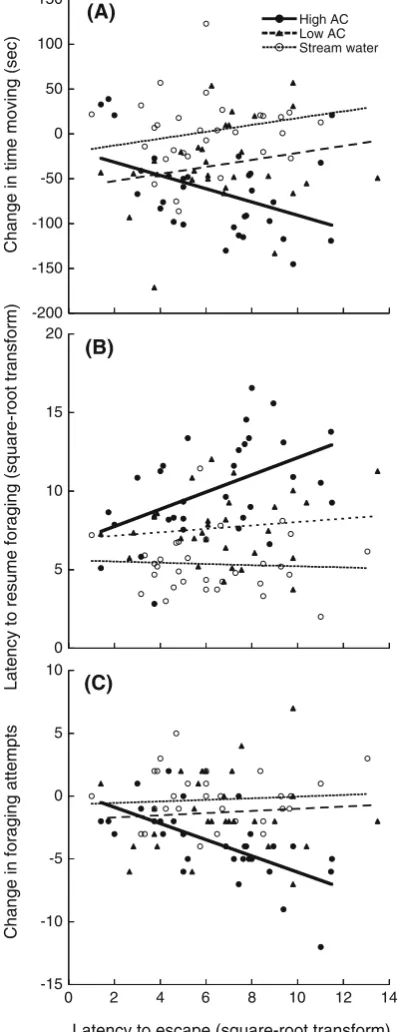
Latency to escape was not correlated with either baseline (pre-stimulus) foraging (F(1,90)=0.63, P=0.43) or time spent moving (F(1,90)=2.77, P=0.10); hence, we are justified in using the difference scores as dependent vari-ables. Our overall analysis (multivariate GLM) revealed a significant interaction between escape latency and cue type (F(3,86)=8.80, P\0.001). To further investigate this interaction, we compared the response of guppies exposed to stream water and low concentrations of alarm cue and found a significant effect of cue type (F(3,56)=28.68,P\0.001) but no cue by escape latency interaction (F(3,56)=1.16,
P=0.33). When exposed to stream water or a low con-centration of conspecific alarm cue, we found no effect of personality on the response patterns of guppies (Fig.1). However, there was a significant effect of personality on the response towards high concentrations of guppy alarm cue. Bolder guppies (i.e. shorter escape times) exhibited weaker responses than did shyer guppies (i.e. longer escape times). Experiment 2: Risk-taking tactics and the response to ‘known’ versus ‘unknown’ cues
As in Experiment 1, latency to escape was not related to baseline foraging (F(1,88)=0.11,P=0.75) or movement (F(1,88)=0.49, P=0.49). Our overall multivariate GLM revealed a significant cue9escape latency interaction (F(3,84)=40.67, P\0.001). As above, we compared the response of guppies exposed to tilapia odour versus stream water and found a significant effect of cue (F(3,55)=31.16,
P\0.001) but not a cue9escape latency interaction (F(3,55)=0.38, P=0.77). The responses of guppies towards the conspecific alarm cue treatment appear to be shaped by individual risk-taking tactics. As in Experiment 1, bolder guppies exhibited only weak response to the high concentration of alarm cues, while shyer guppies showed strong avoidance behaviour (reduced time moving, increased latency to resume foraging and reduced number of foraging attempts; Fig.2). There was no effect of indi-vidual risk-taking tactics on the response of guppies towards the novel predator odour (tilapia); all guppies
tested showed a strong avoidance response independent of latency to escape.
Discussion
Combined, these results clearly demonstrate that the expression of individual risk-taking tactics (personality) is shaped by both the ‘quantity’ (Experiment 1) and ‘quality’ (Experiment 2) of publicly available information used to assess risk levels. Our first experiment suggests that indi-vidual personality shapes the response of guppies to high, but not low-intensity acute threats. When exposed to the high-risk alarm cue (but not the low risk or control) treatment, shyer guppies exhibited much stronger anti-predator responses than did bolder guppies. Previous reports have shown that guppies exposed to high ambient predation risks exhibit strong graded threat-sensitive trade-offs (Botham et al.2008; Brown et al.2009). Our results suggest that these threat-sensitive response patterns are subject to individual personality. Moreover, the results of our first experiment support the hypothesis that behavioural flexibility may be limited by individual personality (Dingemanse et al.2010; Mathot et al.2012). For example, shyer chaffinches (Fringilla coelebs) and juvenile brown trout (Salmo trutta) are better able to respond to variable foraging opportunities under high-risk conditions than do bolder conspecifics (Quinn and Cresswell 2005; Adria-enssens and Johnsson 2011a,b). While shyer guppies tes-ted here exhibites-ted a graded (proportional) threat-sensitive response pattern to increased concentrations of conspecific alarm cue, bolder guppies had similar response intensities to both low- and high-risk alarm cues. Such differences in the degree of behavioural flexibility may arise if shy prey individuals are more susceptible to short-term changes in environmental factors (i.e. predation threats or foraging opportunities). Bolder prey may have a lower sensitivity to environmental fluctuations (i.e. the costs of not responding to short-term changes in some factor are relatively low); thus, they may be less likely to alter their behaviours in response to short-term variance in environmental factors (Luttbeg and Sih2010; Mathot et al.2012). While we did not test directly for individual repeatability and behavioural plasticity in the current study, our findings are consistent with the earlier hypothesized links between personality and behavioural plasticity (Dingemanse et al. 2010; Mathot et al.2012).
The sensory complementation hypothesis (Ferrari et al.
of local risk. For example, prey responding to chemosen-sory cues may initiate an increased predator avoidance response (e.g., reduced foraging), but in the absence of
complementary visual information (i.e. they do not see a predator), they may judge the situation sufficiently safe to return to baseline activity levels. Given that bolder prey are -200
-150 -100 -50 0 50 100 150
Change in time moving (sec)
(A)
0 5 10 15 20
Latency to resume foraging (square-root transform)
(B)
-15 -10 -5 0 5 10
0 2 4 6 8 10 12 14
Change in foraging attempts
Latency to escape (square-root transform)
(C)
High AC Low AC Stream water
Fig. 1 Change in time moving (seconds) (a), latency to resume foraging (seconds, square-root transform) (b) and change in foraging attempts (c) for guppies exposed to high concentrations of alarm cue (solid circles,heavy bold line), low concentration of alarm cue (solid triangles,long dashed line) or stream water control (open circles,short dashed line) plotted as a function of latency to escape a start chamber (seconds, square-root-transformed).N=30 per stimulus type
High AC Tilapia odour Stream water -200
-150 -100 -50 0 50 100
Change in time moving (sec)
(A)
0 5 10 15 20
Latency to resume foraging (square-root transform)
(B)
-15 -10 -5 0 5 10
0 5 10 15 20
Change in foraging attempts
Latency to escape (square-root transform)
(C)
more likely to inspect potential predators (Harris et al.
2010; Jones and Godin 2010; Pellegrini et al.2010), it is possible that personality impacts the complementary use of multiple sensory modalities during predation threat assessment. Here, bolder guppies may judge the lack of secondary information (e.g. visual cues) as indicating a lower level of risk, resulting in weaker responses compared to shyer guppies. Such relatively risk-prone strategies may allow bolder individuals to better meet their immediate energy needs compared to shyer ones (Brown et al.2005). Recent studies by Bell and Sih (2007) and Adriaenssens and Johnsson (2013) suggest that exposure to increased predation risk may rapidly select for behavioural syn-dromes in which bolder individuals may also be more aggressive towards both competitors and predators. Such positive correlations between boldness and aggression may further allow bolder (risk-prone) prey to maintain sufficient energy intake and reduce mortality risk under high levels of predation threats.
Our second experiment further extends these findings, demonstrating that the reliability of information associated with publically available cues also shapes the effects of individual risk-taking tactics. As in Experiment 1, guppies exposed to a known cue (high concentration of conspecific alarm cue) exhibited a strong interaction with individual risk-taking. However, guppies exposed to an unknown novel cue exhibited strong responses regardless of indi-vidual personality. We have recently demonstrated that guppies from high-predation risk sites exhibit avoidance of novel chemosensory cues in both laboratory and field trials (Brown et al. 2013). Such a neophobic response can be induced by exposure to elevated levels of risk and may function as a phenotypically plastic response to high and/or variable predation threats (Brown et al.2013). Recent data suggest that while the response to conspecific alarm cues by juvenile convict cichlids is proportional to the concen-tration detected (Brown et al.2006), the response to novel chemosensory cues is independent of concentration (i.e. elicits a response if detected). Rather, the strength of convict cichlid neophobic responses matches the level of background predation risk (Brown et al.2014). Thus, while guppies exposed to the known high-risk cue are able to adjust the intensity of response according to individual risk-taking tactics, those exposed to the unknown cue may overestimate the acute threat and exhibit a high intensity regardless of personality. Intuitively, this makes sense as the cost of lost foraging opportunities would likely be much less than the risk of mortality for prey failing to respond to a novel cue (i.e. Csanyi1985).
Within the context of foraging decisions, Mathot et al. (2012) argue that variable and unpredictable foraging oppor-tunities lead to ecological uncertainty and that as uncertainty increases, the costs associated with an inappropriate decision
also increase. Bolder individuals would potentially suffer higher relative costs under uncertain conditions than would shyer individuals. Our current results are consistent with this prediction, as novel cues appear to be less reliable indicators of local risk (i.e. uncertain indicators of risk) compared to con-served conspecific alarm cues. While bold guppies may be able to compensate for high levels of a known risk (Experi-ment 1), the costs of failing to respond to a novel cue may be too high. As a result, bolder guppies show a similar response to the novel cue as seen for shyer guppies (Experiment 2).
Recent studies have highlighted the context-dependent nature of personality within prey populations (Adriaenssens and Johnsson2011b; David et al.2012; Quinn et al.2012). The latency to forage of captive zebra finches (Taeniopygia guttata) is dependent upon the additive effects of personality and body condition, with bolder finches and/or finches in poorer body condition exhibiting shorter latencies than shyer and/or better condition ones (David et al.2011). Likewise, under conditions of unpredictable foraging opportunities, for example, guppies engage in riskier foraging tactics and are more likely to explore novel foraging opportunities than those exposed to predictable foraging conditions (Chapman et al.2010b). While we did not measure repeatability of risk-taking tactics, our results further demonstrate that there is considerable intrapopulation variability in individual risk-taking tactics. Moreover, our findings suggest that the expression of these tactics is dependent on the nature of public information detected (i.e. is context-dependent) and provide further support for the context-dependent nature of personality within prey populations.
Acknowledgments We wish to thank Drs. Jean-Guy Godin and James Grant for their helpful discussions, and Heather Auld, Pierre Chuard and Jemma Katwaroo-Andersen for their assistance in the field. Financial support was provided by the Natural Science and Engineering Research Council of Canada (NSERC) and Concordia University to G.E.B., NSERC and the University of Saskatchewan to D.P.C. and M.C.O.F. C.K.E. was supported by FRQNT. This work was conducted in accordance with Concordia University Animal Research Ethics Protocol 2011 and AREC-BROW-2012 and The Ministry of Food Production, Fisheries Division, Republic of Trinidad and Tobago.
References
Adriaenssens B, Johnsson JI (2011a) Shy trout grow faster: exploring links between personality and fitness-related traits in the wild. Behav Ecol 22:135–143
Adriaenssens B, Johnsson JI (2011b) Learning and context-specific exploration behaviour in hatchery and wild brown trout. Appl Anim Behav Sci 132:90–99
Adriaenssens B, Johnsson JI (2013) Natural selection, plasticity and the emergence of a behavioural syndrome in the wild. Ecol Lett 16:47–55
Botham MS, Hayward RK, Morrell LJ, Croft DP, Ward JR, Ramnarine I, Krause J (2008) Risk-sensitive antipredator behavior in the Trinidadian guppy,Poecilia reticulata. Ecology 89:3174–3185 Brown GE (2003) Learning about danger: chemical alarm cues and
local risk assessment in prey fishes. Fish Fish 4:227–234 Brown C, Jones F, Braithwaite VA (2005) In situ examination of
boldness–shyness traits in the tropical poeciliid,Brachyraphis episcopi. Anim Behav 70:1003–1009
Brown GE, Bongiorno T, Dicapua DM, Ivan LI, Roh E (2006) Effects of group size on the threat-sensitive response to varying concentrations of chemical alarm cues by juvenile convict cichlids. Can J Zool 84:1–8
Brown C, Jones F, Braithwaite VA (2007) Correlation between boldness and body mass in natural populations of the poeciliid Brachyhaphis episcopi. J Fish Biol 71:1590–1601
Brown GE, Macnaughton CJ, Elvidge CK, Ramnarine I, Godin J-GJ (2009) Provenance and threat-sensitive predator avoidance patterns in wild-caught Trinidadian guppies. Behav Ecol Socio-biol 63:699–706
Brown GE, Ferrari MCO, Elvidge CK, Ramnarine I, Chivers DP (2013) Phenotypically plastic neophobia: a response to variable predation risk. Proc R Soc Lond B 280:20122712
Brown GE, Chivers DP, Elvidge CK, Jackson CD, Ferrari MCO (2014) Background level of risk determines the intensity of predator neophobia in juvenile convict cichlids. Behav Ecol Sociobiol 68:127–133
Budaev S, Brown C (2011) Personality traits and behaviour. In: Brown C, Laland K, Krause J (eds) Fish cognition and behavior, 2nd edn. Blackwell, West Sussex, pp 135–165
Chapman BB, Morrell LJ, Krause J (2010a) Unpredictability in food supply during early life influences boldness in fish. Behav Ecol 21:501–506
Chapman BB, Morrell LJ, Tosh CR, Krause J (2010b) Behavioural consequences of sensory plasticity in guppies. Proc R Soc B 277:1395–1401
Chivers DP, Smith RJF (1998) Chemical alarm signalling in aquatic predator-prey systems: a review and prospectus. E´ coscience 5:338–352
Chivers DP, Brown GE, Ferrari MCO (2012) The evolution of alarm substances and disturbance cues in aquatic animals. In: Bro¨n-mark C, Hansson L-A (eds) Chemical ecology in aquatic systems. Oxford University Press, Oxford, pp 127–139 Croft DP, Morrell LJ, Wade AS, Piyapong C, Ioannou CC, Dyer JRG,
Chapman BB, Wong Y, Krause J (2006) Predation risk as a driving force for sexual segregation: a cross-population com-parison. Am Nat 167:867–878
Csanyi V (1985) Ethological analysis of predator avoidance by the paradise fish (Macropodus opercularisL.) I. Recognition and learning of predators. Behaviour 92:227–240
David M, Ce´zilly F, Giraldeau L-A (2011) Personality affects zebra finch feeding success in a producer–scrounger game. Anim Behav 82:61–67
David M, Auclair Y, Giraldeau L-A, Ce´zilly F (2012) Personality and body condition have additive effects on motivation to feed in zebra finchesTaeniopygia guttata. Ibis 154:372–378
Dingemanse NJ, Kazem AJN, Re´ale D, Wright J (2010) Behavioural reaction norms: animal personality meets individual plasticity. Trends Ecol Evol 25:81–89
Dupuch A, Magnan P, Dill LM (2004) Sensitivity of northern redbelly dace, Phoxinus eos, to chemical alarm cues. Can J Zool 82:407–415 Elvidge CK, Macnaughton CJ, Brown GE (2013) Sensory
comple-mentation and antipredator behavioural compensation in acid-impacted juvenile Atlantic salmon. Oecologia 172:69–78 Ferrari MCO, Chivers DP (2006) Learning threat-sensitive predator
avoidance: how do fathead minnows incorporate conflicting information? Anim Behav 71:19–26
Ferrari MCO, Trowell JJ, Brown GE, Chivers DP (2005) The role of learning in the development of threat-sensitive predator avoid-ance by fathead minnows. Anim Behav 70:777–784
Ferrari MCO, Vavrek MA, Elvidge CK, Fridman B, Chivers DP, Brown GE (2008) Sensory complementation and the acquisition of predator recognition by salmonid fishes. Behav Ecol Sociobiol 63:113–121
Ferrari MCO, Wisenden BD, Chivers DP (2010) Chemical ecology of predator-prey interactions in aquatic ecosystems: a review and prospectus. Can J Zool 88:698–724
Harris S, Ramnarine IW, Smith HG, Pettersson LB (2010) Picking personalities apart: estimating the influence of predation, sex and body size on boldness in the guppyPoecilia reticulata. Oikos 119:1711–1718
Helfman G, Winkelman D (1997) Threat sensitivity in bicolor damsel-fish: effects of sociality and body size. Ethology 103:369–383 Jones KA, Godin J-GJ (2010) Are fast explorers slow reactors?
Linking personality type and anti-predator behaviour. Proc R Soc B 277:625–632
Kim J-W, Brown GE, Dolinsek IJ, Brodeur NN, Leduc AOHC, Grant JWA (2009) Combined effects of chemical and visual informa-tion in eliciting antipredator behaviour in juvenile Atlantic salmon Salmo salar. J Fish Biol 74:1280–1290
Lima SL, Dill LM (1990) Behavioral decisions made under the risk of predation: a review and prospectus. Can J Zool 68:619–640 Luttbeg B, Sih A (2010) Risk, resources and state-dependent adaptive
behavioural syndromes. Proc R Soc Lond B 365:3977–3990 Magurran AE (2005) Evolutionary ecology: the Trinidadian guppy.
Oxford series in ecology and evolution. Oxford University Press, Oxford
Mathot KJ, Wright J, Kempenaers B, Dingemanse NJ (2012) Adaptive strategies for managing uncertainty may explain personality-related differences in behavioural plasticity. Oikos 121:1009–1020
McNamara JM, Dall SRX (2010) Information is a fitness enhancing resource. Oikos 119:231–236
Pellegrini AFA, Wisenden BD, Sorensen PW (2010) Bold minnows consistently approach danger in the field and lab in response to either chemical or visual indicators of predation risk. Behav Ecol Sociobiol 64:381–387
Quinn JL, Cresswell W (2005) Personality, anti-predation behaviour and behavioural plasticity in the chaffinch Fringilla coelebs. Behaviour 9:1377–1402
Quinn JL, Cole EF, Bates J, Payne RW, Cresswell W (2012) Personality predicts individual responsiveness to the risks of starvation and predation. Proc R Soc B 279:1919–1926 Re´ale D, Reader SM, Sol D, McDougall PT, Dingemanse NJ (2007)
Integrating animal temperament within ecology and evolution. Biol Rev 82:291–318
Schmidt KA, Dall SRX, van Gils JA (2010) The ecology of information: an overview on the ecological significance of making informed decisions. Oikos 119:304–316
Sih A, Bell AM, Johnson JC, Ziemba RE (2004) Behavioral syndromes: an integrative overview. Q Rev Biol 79:241–277 Smith BR, Blumstein DT (2008) Fitness consequences of personality:
a meta-analysis. Behav Ecol 19:448–455
Smith BR, Blumstein DT (2010) Behavioral types as predictors of survival in Trinidadian guppies (Poecilia reticulata). Behav Ecol 21:919–926
Thomson JS, Watts PC, Pottinger TG, Sneddon LU (2012) Hormones and behavior. Horm Behav 61:750–757