University of New Orleans University of New Orleans
ScholarWorks@UNO
ScholarWorks@UNO
University of New Orleans Theses and
Dissertations Dissertations and Theses
5-22-2006
Performance Appraisal of Estimation Algorithms and Application
Performance Appraisal of Estimation Algorithms and Application
of Estimation Algorithms to Target Tracking
of Estimation Algorithms to Target Tracking
Zhanlue Zhao
University of New Orleans
Follow this and additional works at: https://scholarworks.uno.edu/td
Recommended Citation Recommended Citation
Zhao, Zhanlue, "Performance Appraisal of Estimation Algorithms and Application of Estimation Algorithms to Target Tracking" (2006). University of New Orleans Theses and Dissertations. 394.
https://scholarworks.uno.edu/td/394
This Dissertation is protected by copyright and/or related rights. It has been brought to you by ScholarWorks@UNO with permission from the rights-holder(s). You are free to use this Dissertation in any way that is permitted by the copyright and related rights legislation that applies to your use. For other uses you need to obtain permission from the rights-holder(s) directly, unless additional rights are indicated by a Creative Commons license in the record and/ or on the work itself.
PERFORMANCE APPRAISAL OF ESTIMATION ALGORITHMS AND APPLICATION OF ESTIMATION ALGORITHMS TO TARGET TRACKING
A Dissertation
Submitted to the Graduate Faculty of the University of New Orleans
in partial fulfillment of the requirements for the degree of
Doctor of Philosophy in
Engineering and Applied Science
by
Zhanlue Zhao
B.S. Xi’an Jiaotong University, China, 1997 M.S. Xi’an Jiaotong University, China, 2000
c
Acknowledgements
I would like to express my deepest gratitude to my major advisor, Dr. X. Rong Li, for
his invaluable inspiration, continuous support, and constructive suggestions, which made it
possible for me to complete the Ph.D. degree. The positive and open research atmosphere
created by Dr. Li is the best nutrition for me to gain considerable knowledge and insights
into problems and techniques in estimation and decision theory, statistical signal processing
and information fusion. The research attitude and enthusiasm exemplified by Dr. Li will
give me everlasting inspiration and encouragement to my future work and research.
I am also indebted to Dr. Huimin Chen. His help, inspiration and encouragement made
my research much more interesting and enjoyable. The collaborations with Dr. Chen often
start with heated discussions and end with insightful ideas. Special thanks go to Dr. Vesselin
Jilkov for the long-term collaboration and his continuous support. I would also thank Dr.
Vesselin Jilkov, Dr. Huimin Chen, Dr. Tumulesh K.S. Solanky, Dr. Zhide Fang and Dr.
Stephen C. Lipp for serving on my thesis committee, and for their constructive and valuable
comments on the dissertation. I am also very grateful to all my friends and members in the
Information and Systems Laboratory, especially Jifeng Ru, Ming Yang, Zhansheng Duan,
Keshu Zhang, Peng Zhang, Anwer Bash, Ryan Pitre, Trang Nguyen and Victor Alvarado.
With their support and friendship, I had the great pleasure of carrying out research in such
a pleasant working environment. And I have to thank many friends who love me and whom
like to thank all the members and staff of the Department of Electrical Engineering at the
University of New Orleans for their support.
Last but not least, I want to thank my parents for their love and encouragement. Their
Contents
Abstract ix
1 Introduction 1
1.1 Appraisal of Estimation Performance . . . 1
1.2 Application of Estimation Algorithm to Target Tracking . . . 4
1.3 Contributions of the Dissertation . . . 5
I
Performance Appraisal of Estimation Algorithms
7
2 On Estimation Performance Measures 8 2.1 Parameter Estimation . . . 82.2 Criteria vs. Measures . . . 10
2.3 Formulation of Performance Measures . . . 11
3 Local Performance Measures 15 3.1 Absolute Error Measures0 . . . . 16
3.1.1 RMS Error and Average Euclidean Error . . . 16
3.1.2 Harmonic Average Error . . . 20
3.1.3 Geometric Average Error . . . 20
3.2 Relative Error Measures0 . . . . 22
3.2.1 Estimation error relative to estimatee . . . 22
3.2.2 Estimation Error Relative to Measurement Error . . . 24
3.3 Frequency Counts of Concentration0 . . . . 26
3.3.1 Success Region and Success Rate . . . 26
3.3.2 Feasible Region and Failure Rate . . . 28
3.3.3 Concentration Region and Probability . . . 29
3.4 Measures for Pairwise Comparison . . . 29
3.4.1 Pitman Closeness Measure . . . 30
3.4.2 Loss Measure and Gain Measure . . . 31
3.5 Illustrative Examples . . . 32
4 Global Performance Measures 42
4.1 Estimation Performance Spectrum . . . 43
4.1.1 Bayesian Point Estimation . . . 43
4.1.2 A Physical Interpretation . . . 44
4.1.3 Optimal Estimator Locations andp-power Error Costs . . . 46
4.1.4 Estimation Performance Spectrum . . . 49
4.2 Desired Error PDF and Performance Measures . . . 51
4.2.1 The Desired Error PDF . . . 51
4.2.2 Relative Concentration and Dispersion Measures . . . 53
4.3 Illustrative Examples . . . 56
4.4 Conclusions . . . 60
5 Model Distortion Measure and Multiple Model Algorithm 62 5.1 Probabilistic Model of Parameter Inference . . . 64
5.2 Model Distortion Measure . . . 65
5.2.1 Defining the Measure . . . 65
5.2.2 Comments . . . 66
5.3 Multiple Model Algorithm . . . 68
5.3.1 Model Set Design . . . 70
5.3.2 Model Probability Behavior . . . 70
5.4 Illustrative Examples . . . 74
5.5 Conclusions . . . 81
II
Application of Best Linear Unbiased Filtering Method to
Target Tracking
83
6 Best Linear Unbiased Filtering Method4 84 6.1 Introduction . . . 846.2 Recursive BLUE Filter . . . 85
7 Application to Target Tracking with Nonlinear Measurements4 88 7.1 Introduction . . . 88
7.2 Measurement Conversion Approach . . . 89
7.3 Tracking in Polar Coordinates . . . 91
7.4 Tracking in Spherical Coordinates . . . 94
7.5 Approximation of Measurement Residual Covariance S . . . 97
7.6 Simulation and Comparison . . . 100
7.7 Conclusions . . . 107
7.8 Appendix . . . 107
Abstract
This dissertation consists of two parts. The first part deals with the performance appraisal of
estimation algorithms. The second part focuses on the application of estimation algorithms
to target tracking.
Performance appraisal is crucial for understanding, developing and comparing various
estimation algorithms. In particular, with the evolvement of estimation theory and the
increase of problem complexity, performance appraisal is getting more and more challenging
for engineers to make comprehensive conclusions. However, the existing theoretical results
are inadequate for practical reference. The first part of this dissertation is dedicated to
performance measures which includelocal performance measures,global performance
measures and model distortion measure.
The second part focuses on application of the recursive best linear unbiased estimation
(BLUE) or lineae minimum mean square error (LMMSE) estimation to nonlinear
measure-ment problem in target tracking. Kalman filter has been the dominant basis for dynamic
state filtering for several decades. Beyond Kalman filter, a more fundamental basis for the
recursive best linear unbiased filtering has been thoroughly investigated in a series of papers
by Dr. X. Rong Li. Based on the so-called quasi-recursive best linear unbiased filtering
re-laxed such that a general linear filtering technique for nonlinear systems can be achieved.
An approximate optimal BLUE filter is implemented for nonlinear measurements in target
tracking which outperforms the existing method significantly in terms of accuracy, credibility
Chapter 1
Introduction
This dissertation consists of two parts. The first part deals with the performance appraisal
of estimation algorithms. The goal is to explore and initiate systematic, comprehensive and
scientifically defensible performance appraisal approaches. The second part is an application
of estimation algorithms to target tracking. The goal is to promote the application of the
recursive best linear unbiased estimation or linear minimum mean square error(LMMSE)
estimation technique. We will apply the recursive best linear unbiased filtering method to
handle nonlinear measurements in target tracking.
1.1
Appraisal of Estimation Performance
The ability to meaningfully assess the performance of an estimation algorithm is crucial for
development and comparison of practical systems. With evolution and proliferation of
esti-mation methods, such as least squares, the method of moments, maximum likelihood method,
Bayes and empirical Bayes procedures, uniformly minimum variance unbiased estimation,
risk-reduction approaches, robust technique and resampling technique, various algorithms
have been developed. In addition, as estimation problems and the related systems of
in-terest are getting more and more complex, huge difficulties are encountered for reconciling
various measures of performance, effectiveness and robustness.
research focal point sponsored by several agencies of the U.S. Department of Defense. Also,
as pointed out in [58], the emergence of fusion strategies such as adaptive fusion and
fu-sion management requires that Measures of Performance (MoPs), Effectiveness (MoEs), and
Robustness (MoRs) to be examined with greater seriousness. Huge difficulties are
encoun-tered. Further, the optimization of an algorithm with respect to one particular criterion will
frequently result in performance deterioration as measured by another criterion. Because
of this, one might be led to define “global” metrics which measure the overall effectiveness
of an algorithm. One could, for example, try to measure composite algorithm competence
using some ad hoc weighted average of local metrics. In practice, however, such
compos-ite metrics are very difficult to interpret. U.S. Navy investigators on the (Joint Operational
Tactical System) JOTS program concluded after extensive research on practical performance
evaluation techniques that [59]:
“Examination of the host of MoEs as presented earlier does not always provide clear cut
objective distinction of good versus poor performance. During the course of the evaluation,
attempts were made to establish a single MoE as a composite [i.e. weighted sum] of correlator
performance .... several problems were encountered with this MoE, however.... Clearly
a better method of combining MoEs is required .... Such an approach should codify the
philosophy of differing severity of the various types of errors, and nonlinearly increasing cost
associated with those errors as they increase and confusion compounds.”
Therefore, a systematic, comprehensive and scientifically defensible performance
ap-praisal is clearly needed. Towards this goal, we identify important performance aspects
and explore feasible performance appraisal measures. The first part of the dissertation will
be dedicated to theoretical investigations of this topic.
The analysis and comparison of estimation performance have two main aspects.
One is to investigate the properties of estimators and to measure the information
consistency, credibility and so on [21, 3, 57, 53, 13]. These investigations will provide a profile
of estimation performance which is mainly determined by the formulation of the problem.
For example, the performance bound depends on the likelihood function or the posterior
distribution. The unbiasedness could be either a requirement of problem formulation or a
desired property. These topics have been thoroughly addressed in the subject of statistics.
The other focuses on performance requirements for application purposes or meaningful
interpretation of estimation results. It emphasizes the methods to measure the goodness
of an estimation result relative to the application requirements. In contrast to the former,
existing work dealing with the latter is quite limited, although substantial work has been
done on performance metrics for evaluation of target tracking and data fusion algorithms
[15, 58, 16, 36, 35].
We will focus on the following four topics which are organized as follows.
In Chapter 2, the characteristics of parameter inference are presented. The inherent
gap between estimation problem formulation and application requirements is clarified. A
brief discussion on estimation criteria versus estimation measures is presented. A general
formulation of performance measures is introduced.
In Chapter 3, a group of local performance measures is introduced or proposed. The
pros and cons of most popularly used measures are investigated. New performance measures
are introduced, such as relative error measures, frequency count-type measures and pairwise
comparison measures.
Chapter 4 focuses on global performance measures. In this chapter, the interaction
be-tween estimation criteria and estimator is examined. The performance spectrum is proposed
to reveal such interrelationship. The desired estimation error probability density function
(PDF) is introduced to provide a more comprehensive characterization of the estimation
per-formance requirements. The perper-formance measures relative to the desired PDF is proposed.
filtering, model approximation is quite common in engineering research and development. It
heavily affects estimation performance. And it is of great interest to have a model distortion
measure to indicate the divergence or difference between the original model and the
approx-imated one. The significance of a model distortion measure is illustrated by its application
to two important problems—model set design and model probability behavior—associated
with the multiple model (MM) algorithm.
The related work on local and global performance measures has been published in [38,
34, 33, 35, 36, 37, 64]. The main results on model distortion measure have been appeared in
[65, 63].
1.2
Application of Estimation Algorithm to Target
Tracking
The second part of the dissertation focuses on the application of the recursive best linear
unbiased estimation (BLUE) to target tracking with nonlinear measurements. The Kalman
filter has been popularly used for state estimation for several decades. Beyond the Kalman
filter, a more fundamental basis is the recursive best linear unbiased filtering which has been
thoroughly investigated in a series of papers by Dr. X. Rong Li [69, 45, 29, 46, 32, 30, 31, 24].
Based on the so-called quasi-recursive best unbiased linear filtering technique, the Kalman
filter’s Linear-Gaussian assumptions can be relaxed such that a general linear filtering
scheme for nonlinear systems could be obtained.
In target tracking, target dynamics is usually modelled in the Cartesian coordinates,
while the measurements are directly available in the original sensor coordinates which are
highly nonlinear with respect to the target state. For a long while, this problem has been
handled by various algorithms based on the Kalman filter but with serious flaws [2, 20, 47,
48, 49, 50, 55, 56]. An approximate BLUE filter is implemented to target tracking with
accuracy, credibility and robustness without increase in computation. This part is mainly
based on our published papers [67, 66, 68].
In Chapter 6, we present the BLUE filtering technique. Its significance and contribution
are addressed.
In Chapter 7, we apply the BLUE filtering technique to target tracking with nonlinear
measurements. The fundamental flaws of existing measurement conversion methods are
in-vestigated. An approximate implementation of the BLUE filter is presented. The simulation
studies are illustrated. We conclude that the BLUE filter is more fundamental than the
Kalman filter. It outperforms the existing methods significantly.
Chapter 8 concludes the dissertation and provides directions to future work.
1.3
Contributions of the Dissertation
The contributions of this dissertation are summarized as below.
First, a thorough examination of the pros and cons of the most often used local
per-formance measures is conducted. The theoretical and practical justifications and
interpre-tations of these measures are clarified. In particular, the misinterpretation of the most
popularly used root mean square error is elucidated. This part is mainly based on the
papers [38, 34, 33, 35, 36].
Second, we initiate a systematic study for comprehensive and global estimation
per-formance appraisal. A new interpretation of the optimality of the Bayesian estimator is
presented which has a similarity to the lever principle. The interrelationship between the
estimator and estimation criterion is revealed which can help to produce new optimal
esti-mators with predictable estimation performance. Accordingly, an estimation performance
spectrum is proposed for estimation performance comparison. Also, the desired estimation
error probability density function is proposed such that various application concerns and
esti-mation error distribution relative to the desired one can be measured as well by the proposed
concentration and dispersion measures.
Third, a model distortion measure for statistical inference is proposed to indicate the
model difference between the original model and the approximated one. The distortion
mea-sure turns out to be the Kullback-Leibler divergence. This meamea-sure is highly related to the
behavior of the multiple model algorithm. It can be applied to the model set design problem
for multiple model estimation. Based on the behavior of model probability of the
multi-ple model estimation, the model probability update structure is extended to the multimulti-ple
hypotheses comparison such that an online structure is proposed to carry out the multiple
estimators’ performance comparison and fusion. The illustrative example is demonstrated
as well.
Fourth, we apply the recursive linear minimum mean square error estimation to target
tracking with measurements in polar and spherical coordinates. An approximate LMMSE
fil-ter is achieved which outperforms the existing methods significantly in fil-terms of the accuracy,
Part I
Chapter 2
On Estimation Performance Measures
2.1
Parameter Estimation
Estimation theory is concerned with inferring the value of a quantity of interest from
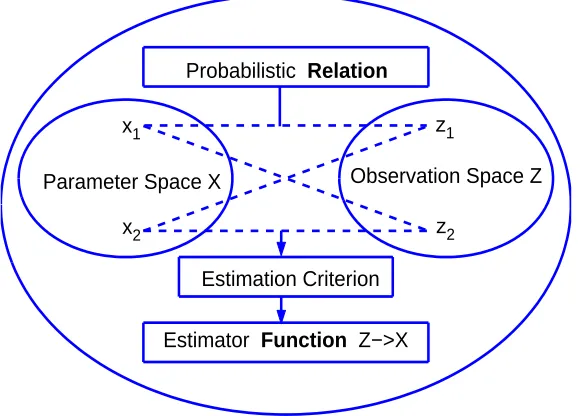
indi-rect, inaccurate and uncertain observations. It consists of four components: parameter space,
observation space, probabilistic relation between the parameter space and the observation
space, estimation criteria [57]. The probabilistic relation between parameter space and
ob-servation space determines the formulation of the problem. The parameter is estimated from
observations based on the probabilistic relation, most often, through optimization procedure
with an objective function defined by estimation criterion.
We demonstrate the inference structure by the following diagram.
The complete information on the uncertainty of parameter or state is carried by the
posterior probability density function or likelihood function. For Bayesian estimation, the
prior information of parameter is updated by using observation through Bayesian formula
to obtain the posterior PDF. The estimator is a special point within the domain of the
parameter or state which replaces its posterior PDF with estimation errors. This special
point is determined through optimization procedure. In other words, from a posterior PDF
to an estimator through optimization procedure, we obtain one possible value at the cost of
losing the complete information and producing estimation errors. For classical estimation,
Parameter Space X x1
x2
Observation Space Z z1
z2 Probabilistic Relation
Estimation Criterion
Estimator Function Z−>X
Fig. 2.1: Estimation Diagram
function. Usually, the maximum likelihood principle is employed to determine the estimator.
Again, the likelihood function is replaced by a point with associated estimation errors.
For estimation, besides the estimator itself it is also necessary to measure or specify
estimation error in a meaningful and comprehensive manner.
The estimation criterion serves to locate the optimal estimator. It needs to meet two
objectives. First, it should measure the practical requirements adequately. Second, it should
lend itself most easily to manipulation and computation from a technical and mathematical
viewpoint. Most often, an estimation criterion is a compromise of these two objectives and
mainly determined by the second one. It is even more instructive to retrospect the history
of the minimum mean square error (MMSE) as an estimation criterion proposed by Gauss
as follows [17]:
... The integral R∞
−∞x
2φ(x)dx, i.e., the average value of x2, seems very suitable for
defining and measuring, in a general way, the uncertainty of a system of observations.
agree. The question which concerns us here has something vague about it from its very
nature, and can not be made really precise except by some principle which is arbitrary to a
certain degree.
It is clear to begin with that the loss should not be proportional to the error committed, for
under this hypothesis, since a positive error would be considered as a loss, a negative error
would be considered as a gain; the magnitude of loss ought, on the contrary, to be evaluated
by a function of the error whose value is always positive. Among the infinite number of
functions satisfying this condition, it seems natural to choose the simplest, which is, without
doubt, the square of the error, and is the way proposed above.
Clearly, according to the arguments given by Gauss, the selection of estimation criterion
is arbitrary to a certain degree and can not reflect most of the application concerns. In
order to evaluate the estimation errors or performance for application purposes, we need use
performance measures. We discuss estimation criterion, estimation performance measures
and performance analysis in details next.
2.2
Criteria vs. Measures
Performance optimization, performance evaluation, and performance analysis are closely
related but different. Simply put, performance optimization is based on a theoretical criterion
(objective function); performance evaluation is usually done in terms of some performance
measures; and performance analysis aims at developing a performance model.
Practical measures for performance evaluation of estimation algorithms are closely
re-lated with theoretical criteria for performance optimization. They both should reflect the
performance and fit well with the intended applications. However, they are not to be
con-fused with each other. A performance measure is a ruler/metric that quantifies or sizes up
the performance of the algorithm, while a criterion defines the optimality of the solution
performance measures that serve as the objective functions for the estimation algorithms to
optimize. As a result, a criterion should be tractable in that it lends itself to easy
mathemat-ical manipulations, rather than merely a meaningful performance measure. In other words,
a criterion formulates the estimation problem as a tractable optimization problem and serves
as the basis for algorithm development. While mathematical tractability is a highly
desir-able property for an optimality criterion—an intractdesir-able criterion is hardly useful—it is not
an important consideration for a performance measure. Compared to estimation criterion,
estimation performance measure only concerns the fitness of an estimator to application
requirements. It can be very complex and comprehensive.
There is also a significant difference between performanceanalysis and performance
eval-uation. Performance analysis focuses on relationships between the performance and its key
factors and hence relies heavily on analytic tools. This is not the case for performance
evalu-ation, which simply evaluates or appraises the performance. Our focal point is performance
evaluation, not performance analysis. Tractability of a performance measure is an important
consideration in performance analysis, but not in performance evaluation, since a highly
com-plex performance measure would most likely render performance analysis intractable, but it
can only make performance evaluation costlier.
2.3
Formulation of Performance Measures
The followingnotational conventionwill be maintained throughout this dissertation. We
refer to any quantity to be estimated as an estimatee. It can be a time-invariant (or slowly
varying) parameter, a (deterministic or random) process or signal, in particular, the state
of a (deterministic or random) system. We will use the term estimator to mean both a
parameter estimator and a filter. The measures are presented in a form suitable for parameter
estimators directly, but are applicable to filters at any given time in a straightforward way.
˜
x, respectively. They are always assumed to be n-dimensional unless otherwise is stated
explicitly. Subscript i stands for quantities pertaining to the ith run of a Monte-Carlo
simulation. It is always assumed that ˜xi and ˜xj are independent for i 6= j. All default
vectors are column vectors. The Euclidean norm of a vector a is denoted as
kak= (a′a)1/2 where a′ stands for the transpose of the column vector a.
An estimator is a function of observations which provides a technical guess of a parameter
or state. Since it is data-dependent, its performance is random and should be evaluated in
a statistical sense. In other words, we need to know which estimator is more accurate or
closer to the true value on average than the other. In order to meaningfully quantify such
closeness for comparison purpose, the performance appraisal has to answer the following two
questions:
1. How to quantify the distance between an estimatee and its estimator given each piece
of data?
2. How to measure the performance difference statistically in terms of either marginal
distribution or joint distribution when comparing multiple estimators?
Next, a general formulation of performance measure which incorporates the above two
questions is presented.
First, we give the general performance measure for a single estimator. Define the
perfor-mance measure of a classical estimator as below,
M =Ez[m(x,ˆx)] =
Z
m(x,ˆx)f(z;x)dz
=< m(x,ˆx), f(z;x)>
where parameter x is constant, f(z;x) is the likelihood function of x, m(x,ˆx) is the
measure function of the difference between estimatee x and estimator xˆ, and usually is a
Similarly, a performance measure of a Bayesian estimator can be defined as
M =Ex,z[m(x,xˆ)]
=
Z Z
m(x,ˆx)f(x,z)dxdz
=
Z
ˆ
M1(z)f(z)dz
=
Z
ˆ
M2(x)f(x)dx
where ˆM1 =
R R
m(x,ˆx)f(x|z)dxf(z)dz and ˆM1 =
R R
m(x,ˆx)f(z|x)dzf(x)dx, f(x,z) is
the joint PDF of x and z, again, m(x,ˆx) is the deviation quantification function. Clearly,
the Bayesian estimator’s performance measure M is determined by m(x,ˆx) and f(x,z).
ˆ
M1(z) is the performance measure based on the posterior PDF f(x|z), while z is given;
ˆ
M2(x) is the performance measure based on the likelihood function f(z|x) conditioned on
x.
Second, when comparing multiple estimators, the difference between estimators relative
to the true estimatee can be measured directly. In other words, how often or how much
one estimator is better than the other relative to the true parameter x will be counted.
In this case, the joint distribution information of estimators and estimatee is taken into
consideration [17]. Here, we only stress pairwise comparisons.
The performance measure can be defined for direct pairwise comparison of two classical
estimators relative to the parameter itself as
M(ˆxi:ˆxj;x) =E[m(ˆxi :xˆj;x)]
=
Z
m(ˆxi :xˆj;x)f(z;x)dz
and for direct pairwise comparison of two Bayesian estimators as
M(ˆxi :ˆxj;x) = Ex,z[m(xˆi :ˆxj;x)]
=
Z Z
where m(ˆxi : ˆxj;x) is the difference between ˆxi and ˆxj relative to the true estimatee x,
i, j ∈ {1,2} and i 6=j. For example, for pairwise comparison, a meaningful measure could
be Pitman Closeness
m(xˆi :ˆxj;x) =
1 if ˆxi x
≻xˆj 0.5 if ˆxi =x ˆxj 0 if ˆxi ≺x xˆj
where ˆxi ≻x xˆj and xˆi ≺x ˆxj denotes that xˆi prefers to ˆxj and xˆj prefers to xˆi relative to
x, respectively. If M(ˆxi : ˆxj;x) is larger than 0.5, we say xˆi is better than ˆxj. A detailed
discussion will be given in next chapter.
Usually, the analytical form of performance measures can not be obtained and computer
simulations are resorted to. The use of computer simulations for assessing estimation
per-formance, although quite valuable for gaining insight and motivating conjectures, is hardly
conclusive. Nevertheless, when the performance of some particular scenarios is of interest,
simulation studies can provide a more direct comparison. Therefore, on the one hand,
com-puter simulations are scenario-dependent; on the other, they also give a direct evaluation
under a specific scenario.
When Monte Carlo simulation is employed, all the performance measures simply become
M =E[m(∗)] = 1
N
N
X
i=1
ml(∗)
wheremi(∗) is the measure of the difference betweenx and its estimatorˆxor the difference
between ˆxi and ˆxj relative to the true estimatee x, i, j ∈ {1,2}and i6=j on the lth run of
N Monte Carlo runs.
Local performance measures, global performance measures and model distortion measure
all follow this general formulation. They differ from each other in the specific definitions of
Chapter 3
Local Performance Measures
This chapter deals with performance measures that are local in the sense that they rely
on relatively local characteristics (e.g., moments) of the distribution of the estimation
er-ror. Interpretation of existing performance measures will be examined and new performance
measures will be proposed. They are classified into the following four categories: absolute
error measures (without a reference), relative error measures (with a reference), frequency
counts (of some events), and pairwise comparison measures. The first three categories are
devised to measure the performance of a single estimator. The last category is for
compar-ison purpose where the joint distribution of the two estimators relative to the parameter is
involved.
This Chapter is organized as follows. In Sec. 3.1, we first discuss several measures of
absolute error of estimation, including the root-mean-square error (RMSE) and what we
called average Euclidean error (AEE). Their pros and cons are presented. It is advocated
that the widely-used RMSE should be replaced by AEE in many applications. Also, two
new measures of absolute error—geometric average error and harmonic average error—are
introduced. Secs. 3.2 and 3.3 are dedicated entirely to new measures. In Sec. 3.2 we
present several measures ofrelative error in that they are normalized estimation errors with
respect to three references, respectively: magnitude of the estimatee, error of prior mean, and
concentration probability—of an estimation algorithm, which measure how concentrated the
estimates are around the estimatee. They stem from frequency counts of estimates within
some neighborhood of the estimatee, especially within what we called success region and
feasible region. They are complementary to the error measures and are useful for some
applications. Measures for pairwise comparison—Pitman closeness measure, loss measure
and gain measure—are provided in Sec. 3.4. They compare two estimators relative to
the estimatee case by case directly. The performance difference of these two estimators is
concluded by counting on the difference in each case. Illustrative examples are presented in
Sec. 3.5. Sec. 3.6 is concluding remarks.
3.1
Absolute Error Measures
03.1.1
RMS Error and Average Euclidean Error
RMSE. By far the most popular measure ofestimation error is theroot-mean-square(RMS)
error, or RMSEfor short, defined by
RMSE(ˆx) =
1
M
XM
i=1kx˜ik 2
1/2
(3.1)
where kx˜ik= (˜xi′x˜i)1/2.
The main nice feature of RMSE is that it is the finite-sample approximation of the
standard error pE[˜x′x˜], which is closely related with standard deviation. For scalarunbiased estimators, it is actually the most natural finite-sample approximation of standard deviation
of estimation error. Since standard deviation is an important parameter for probabilistic
analysis, RMSE is useful for probabilistic analysis in the scalar case. For example, if ˜x
is scalar, zero-mean, and Gaussian distributed with variance σ2, then P{|x˜| < RMSE} ≈
P{|x˜|< σ}= 0.683.
0 c
[2006] IEEE. Reprinted, with permission, from X. R. Li, Z. L. Zhao, “Evaluation of Estimation
AEE. An emphasis of this chapter is a proposal to replace in many situations the use of
RMSE with the following average Euclidean error (AEE):
AEE(ˆx) = 1
M
XM
i=1kx˜ik (3.2)
The term “Euclidean error” stems from the concept of Euclidean distance or Euclidean norm.
AEE (in the scalar case) is sometimes called mean absolute error (MAE), but this is not
recommended because the term “absolute error” is ambiguous for a vector. Also, it may
have a misleading implication that it is an absolute error, as opposed to a relative error.
Denote by e = kx˜k the Euclidean norm of the estimation error, which is a random
variable, and let ¯e and σ2
e be the mean and variance of e. Then
E[AEE(ˆx)] = ¯e, var[AEE(ˆx)] =σe2/M (3.3) whereσ2
e = var(e) =E(e2)−e¯2 = tr(Σ) +µ′µ−e¯2, and µand Σ are the mean and covariance of estimation error ˜x.
The mean Euclidean error ¯eis clearly a good indicator for the estimation error and, albeit
unknown, it can be estimated. Since AEE and ¯e are respectively the sample average and
the true mean of kx˜k, AEE is the most natural approximation/estimator of ¯e.
RMSE vs. AEE. RMSE and AEE focus on large errors in that their values are
domi-nated by the large error terms. For example, if all 100 terms are around 1 except that one
term is 400, then AEE would be about 5, but RMSE would be approximately 400, that is,
determined by one term while all the other 99 terms are essentially ignored! We say that such
measures are pessimisticsince they pay so much attention to howbad the performance is.
Clearly, RMSE is much more pessimistic than AEE. This example also reveals that RMSE
could be very unreasonable since it is highly distorted—it penalizes too severely on large
errors (i.e., bad behavior) and virtually ignores small errors (i.e., good behavior). This is
highly undesirable or even unacceptable for many applications, particularly as a performance
the case involving a few huge errors due to, say, filtering divergence: What is the RMSE of
a filter if it diverges on one or few of many runs?
Geometrically speaking, AEE(ˆx) is the arithmetic average of the Euclidean distance
between x and ˆx, while RMSE(ˆx) = √1 M(
PM
i=1kx˜ik2)1/2 is one
√
Mth of the Euclidean
distance between the (M n)-dimensional vectors [x′
1, x′2, . . . , x′M]′ and [ˆx′1,xˆ′2, . . . ,xˆ′M]′, which hardly has a physical interpretation, where xi and ˆxi are the estimatee and estimator on
run i. As such, AEE is truly the average distance between the estimate and the estimatee
in our physical (i.e., Euclidean) space. By contrast, RMSE does not have a simple physical
interpretation—it is not actually an average distance in our Euclidean space, although it is
often so interpreted incorrectly. Clearly, an erroneous interpretation invites confusion and
mistakes.
Consider the case of a scalar measurement z with mean ¯z. Mean deviation E[|z−z¯|] is
no doubt the most natural abstraction of the practical concept of measurement error since
measurement errors in most situations are actually average absolute errors. This should be
clear from the calibration process of a measurement instrument. On the other hand, RMSE
reflects the standard error (or standard deviation pE[(z−z¯)2] in the unbiased case). Due
to the popularity of standard deviation, measurement errors are more often expressed in
terms of RMSE or standard deviation than mean deviation. This is mainly because an
analysis based on the former is more tractable mathematically than on the latter. A
problem in practice is that many practitioners do not understand or are not even aware of
the difference—the former is also interpreted as the average error in magnitude.
The popularity of RMSE arises mostly from the fact that it is in general the best
finite-sample approximation of the standard error, which is the most popular optimality criterion
in terms of error. The widespread use of standard error (in fact, MSE) as a theoretical
criterion is well justified by its mathematical tractability. Such a justification is invalid
tractability is no longer a concern here. Instead, a clear and correct interpretation of the
metrics is essential.
It follows from the Kolmogorov strong law of large numbers, RMSE2 and AEE tend
(almost surely) to mean-square error E(e2) and mean Euclidean error e¯, respectively, as
M → ∞. They are consistent estimators of E(e2) and ¯e, respectively.
In the scalar Gaussian case, the mean deviation ¯e=E[|x˜|] and the standard deviationσ
are related by E[|x˜|] =σp2/π ≈ 0.8σ. Given an AEE in such a case, it can be converted
to RMSE and thus a probabilistic analysis can still be carried out since such an analysis
almost always assumes a Gaussian error. Note that for the vector case, it is usually not
straightforward to carry out a probabilistic analysis based on RMSE without additional
assumptions, even in the Gaussian case.
It is well known [23] that the conditional mean and median (i.e., the mean and median of
the posterior distribution) minimizes, respectively, MSE and mean Euclidean error and hence
RMSE and AEE. Consequently, the use of RMSE implicitly favors the conditional mean (i.e.,
MMSE) based estimators rather than any other estimator. This is usually a weakness for
performance evaluation, but could be a strength for some other purposes, especially for
verifying that an MMSE-based algorithm is properly designed and/or implemented. By
contrast, AEE favors estimators that minimize mean Euclidean error, which is, however,
rarely used as an optimality criterion due to the difficulty involved.
On the basis of the above arguments, we recommend that RMSE be replaced by AEE
when one is mainly concerned with the magnitude of the estimation errors, since the latter
has a more direct and natural interpretation. When a probabilistic analysis is needed, the
3.1.2
Harmonic Average Error
As explained before, RMSE and AEE are dominated by their large individual terms and
hence focus on bad behavior. In this sense they are pessimistic measures. However, we may
want to pay more attention to good behavior in some situations, that is, to use optimistic
measures.1 For this purpose, we propose the following harmonic average error (HAE):
HAE(ˆx) =
1
M
XM
i=1kx˜ik
−1
−1
= M
1/kx˜1k+· · ·+ 1/kx˜Mk
(3.4)
based on the well-known harmonic average. Clearly, HAE is dominated by the small error
terms and hence is an optimistic measure. It focuses on how good (rather than how bad,
as with a pessimistic measure) the performance of an estimator is.
Harmonic average has the following minmax property. Consider the problem of
ap-proximating (estimating) the true error e = kx˜k that is bound to be within the
in-terval [a, b]. Denote by ˆe an approximate of e. Then the harmonic average H(a, b)
of a and b yields the minimum of the greatest possible relative error |e − eˆ|/e, that
is, H(a, b) = arg mina≤ˆe≤bmaxa≤e≤b(|e − eˆ|/e), while the arithmetic average A(a, b) of
a and b yields the minimum of the greatest possible absolute error, that is, A(a, b) =
arg mina≤ˆe≤bmaxa≤e≤b|e−ˆe| [9].
3.1.3
Geometric Average Error
Neither RMSE and AEE nor HAE is good as abalanced measure for performance evaluation
and, in particular, as a metric for “average” error in magnitude. As far as the average error
in magnitude is concerned, for many problems it is reasonable to expect that any large error
(bad behavior) should be possibly balanced by a sufficiently small error (good behavior) and
vice versa. From this standpoint, the use of the arithmetic average as an average error in
1
magnitude is flawed. For example, assume AEE is equal to a. Then, an error that is larger
than 2a cannot be balanced by any sufficiently small error. The situation is reversed for
HAE.
In view of the above, we propose the following geometric average error (GAE):
GAE(ˆx) = QM
i=1kx˜ik
1/M
based on the well-known geometric average, which is better
computed recursively
GAEM(ˆx) = GAEM−1(ˆx) [kx˜Mk/GAEM−1(ˆx)]1/M
or through its logarithm for numerical reasons
log[GAE(ˆx)] = 1
M
XM
i=1logkx˜ik (3.5)
GAEM(ˆx) is defined as zero if one or more kx˜ik is zero. Clearly, it does not suffer from the
flaw mentioned above—any large error can be balanced by a sufficiently small error and vice
versa.
Denote by e = kx˜k the random variable that is the Euclidean norm of the estimation
error. It follows from H¨older’s inequality that [18]
¯
e=E[AEE(ˆx)] =E[GAE1(ˆx)]≥E[GAEM(ˆx)]≥E[GAEL(ˆx)]≥GM(e), L > M >1 with all inequalities strict if ¯e < ∞ and GM(e) > 0, where GM(e) = exp[E(lnkx˜k)] is the
geometric mean of the Euclidean norm kx˜k of the random error ˜x in theory. As shown in
[10], ife=kx˜khas zero probability outside the interval [a, b] thenσ2
e/b ≤¯e−GM(e)≤σe2/a, where σ2
e = var(e). Also, by the Kolmogorov strong law of large numbers, GAE(ˆx) tends
(almost surely) to GM(e) as M → ∞. In other words, GAE(ˆx) has an expected value
that converges monotonically to GM(e) from above as the number M of Monte-Carlo runs
increases, and thus it is a consistent, albeit biased, estimator of the geometric mean. In
addition, the application of the central limit theorem to logkx˜1k, . . . ,logkx˜Mk implies that log[GAE(ˆx)] is asymptotically Gaussian (normal) with N(E(logkx˜k),var(logkx˜k)/M) as
3.2
Relative Error Measures
0A relative error is one that is relative to some reference. There are many choices for the
reference. Relative error often reveals better the inherent error characteristics of an estimator
than the absolute error. For example, it is usually reasonable to expect that relative error
of an estimator is less variant than the absolute error as the magnitude of the estimatee
varies. Given two estimators and their performance for two different problems, respectively,
it would be misleading to use any absolute error measure for their performance comparison,
but relative error measures can be used. For such reasons, we recommend evaluating the
performance of estimators in terms of a relative error in most cases, although the literature
is full of performance evaluation in terms of absolute error.
Clearly, estimation error ˜xdepends on the magnitude of the estimateexand the accuracy
of the data (measurements)z (as well as the prior distribution ofxfor a Bayesian estimator)
as the input to the estimator ˆx(z). As a result, probably the most natural relative error is
˜
x/kxk or kx˜k/kxk. Another good choice of the reference is the measurement error; that is,
we express the estimation error ˜xin terms of the measurement error. We deal with measures
for such relative errors in this section.
3.2.1
Estimation error relative to estimatee
All the measures discussed in the previous section were given in terms of the absolute error
˜
x. This is often not desirable. For instance, an absolute error of ˜x = 1 is only 1% for an
estimatee of x= 100 but 50% for an estimatee of x= 2.
The relative error ˜x/kxk versions of the measures discussed in the previous section are
simply given by their corresponding formulas with ˜xi replaced by ˜xi/kxik. The absolute
For example, theRMS relative error (RMSRE) and average relative error (ARE) are
RMSRE(ˆx) =
1 M M X i=1
kx˜ik2/kxik2
1/2
(3.6)
ARE(ˆx) = 1
M
M
X
i=1
kx˜ik/kxik (3.7)
wherexiis the estimatee on runi(i.e., theith realization of the estimateex). Such measures
are very simple but limited. Relative measures presented below are more appealing.
Improvement of posterior over prior. We now introduce a metric of relative error
for Bayesian (and recursive) estimation. We call itBayesian estimation error quotient
(BEEQ). It quantifies the improvement, in terms of error, of a Bayesian estimator ˆx over
the prior mean ¯x or of the updated estimate ˆx of a recursive estimator over the predicted
estimate ¯x. We define it as
r∗(ˆx) = AEE(ˆx) AEE(¯x) =
PM
i=1kxi−xˆik
PM
i=1kxi−x¯k
(3.8)
where xi and ˆxi are the ith realizations of x and ˆx, respectively, and ¯x is the prior
mean (or prediction) of x. We do not recommend the use of RMSE here, such as
r∗(ˆx) = RMSE∗(ˆx)
RMSE∗(¯x) =
PM
i=1kxi−xˆik2/
PM
i=1kxi−x¯k2
1/2
, because of the shortcomings of
the RMSE (e.g., undue dominance of large terms and lack of a natural interpretation) and
the fact that merits of RMSE are largely irrelevant here.
One may be tempted to define BEEQ as M1 PM
i=1ri, that is, the arithmetic average of individual error quotientsri =kxi−xˆik/kxi−x¯k. This definition is not appropriate. As for
any arithmetic average of a positive quantity, particularly a ratio, the average will be
dom-inated by its large terms (i.e., by the cases in which errors are amplified). In other words,
good (small) terms should be counted but would be essentially ignored in this definition.
What is much worse and in fact fatal is that, as a result of this drawback, this measure is
significantly greater than 1 even for many optimal estimators, which is misleading and
the geometric average is much more appropriate here and thus BEEQ is better defined as
r(ˆx) = QM
i=1ri
1/M
, which is better computed through its logarithm for numerical reasons:
log[r(ˆx)] = 1
M
M
X
i=1
logri, ri = k
xi−xˆik
kxi−x¯k
(3.9)
Error amplification and error reduction are thus balanced.
BEEQ quantifies the contribution of the data to Bayesian (and recursive) estimation.
As the error kx−x¯k increases, an approximately constant BEEQ indicates that data has
an insignificant contribution to estimation, because the measurement error is in effect much
larger than kx−x¯k; the degree of drop in BEEQ reflects that of increase in the contribution
of the data; BEEQ will not increase unless an increase inkx−x¯k will lead to an even larger
increase in the measurement error.
It follows from the properties of arithmetic and geometric averages (see, e.g., [9])
that BEEQ is always bounded by the smallest and largest individual error quotients:
rmin ≤ r(ˆx) ≤ rmax, rmin ≤ r∗(ˆx) ≤ rmax, where rmin = min{r1, . . . , rM} and rmax =
max{r1, . . . , rM}.
3.2.2
Estimation Error Relative to Measurement Error
Clearly, the estimation accuracy depends on the accuracy of the data (measurements) as the
input to the estimator. In fact, a primary benefit of estimation is that estimates are more
accurate than measurements (after they are converted to the same space). As a measure of
this accuracy improvement, we introduce a metric, namedestimate-measurement error
ratio (EMER).
Assume that a (vector-valued) measurementzis related to the estimateexbyz =g(x, v),
where v is the measurement error. Let h(x) =E[g(x, v)|x] =E[z|x]. For the additive
zero-mean noise case with z =a(x) +v, we have h(x) = a(x). Then, EMER is defined by
ρ∗(ˆx) = AEE
∗(h(ˆx)) AEE∗(z) =
PM
i=1kh(xi)−h(ˆxi)k
PM
i=1kh(xi)−zik
where AEE∗ represents AEE in the measurement space:
AEE∗(h(ˆx)) = 1
M
M
X
i=1
kh(xi)−h(ˆxi)k
AEE∗(z) = 1
M
M
X
i=1
kh(xi)−zik
That is, EMER is defined as—after convertingxand ˆxto the measurement space—the ratio
of the average distance between x and ˆx over the average distance between x and z. Note
that the use of AEE∗ is preferable to that of RMSE∗ since RMSE is too much dominated by the large error terms, although measurement errors are often given in terms of standard
deviation.
Similar to BEEQ, the geometric average of individual estimate-measurement error ratios
is more appealing and thus EMER ρ(ˆx) is better defined by:
log[ρ(ˆx)] = 1
M
M
X
i=1
logρi, ρi = k
h(xi)−h(ˆxi)k
kh(xi)−zik
(3.11)
Also similar to BEEQ, EMER is always bounded by the smallest and largest individual
error ratios: ρmin ≤ ρ(ˆx) ≤ ρmax, ρmin ≤ ρ∗(ˆx) ≤ ρmax, where ρmin = min{ρ1, . . . , ρM} and
ρmax= max{ρ1, . . . , ρM}.
Clearly, we expect that EMER <1 for a good estimator and the smaller the EMER the
better the estimator.
The ultimate goal of estimation is usually to approximate the estimatee as closely as
possible. The closeness is usually better measured in the estimatee space directly, rather
than in the measurement space, as the above EMER does. In some situations, such as
positioning or localization applications, the mappingh(·) defined above is invertible; that is,
the mapping h−1(·) from the measurement space to the estimatee space is known. Then, a
better definition of EMER is
log[ρx(ˆx)] = 1
M
M
X
i=1
logρxi, ρxi = kxi−xˆik
kxi−h−1(zi)k
or alternatively
ρ∗x(ˆx) = AEE(ˆx) AEE(h−1(z)) =
PM
i=1kxi−xˆik
PM
i=1kxi−h−1(zi)k
(3.13)
where AEE(h−1(z)) = AEE(ˆx)| ˆ
x=h−1(z). It quantifies the amount of improvement an estima-tor has on the estimate provided by the measurement directly.
3.3
Frequency Counts of Concentration
0Simply put, each metric discussed so far provides a ruler to measure how large the estimation
error is: those of Sec. 3.2 are normalized with respect to a variety of references, while those of
Sec. 3.1 are not normalized. In contrast with these error measures, the performance measures
introduced in this section stem from counting the occurrence of some events.
3.3.1
Success Region and Success Rate
Recall that the least-squares (LS) estimation and MMSE estimation differ from the maximum
likelihood (ML) estimation and MAP estimation in their underlying ideas. The former seeks
an estimator that has the smallest error, while the latter uses the “most frequently occurred”
value of the estimatee as the estimator. As such, ML and MAP estimators may have larger
average errors but a higher probability of staying close to the true estimatee. This has
important implications. This fundamental difference should be kept in mind while deciding
on which estimation method to employ for a particular application.
Take the problem of estimation for interception/weapon control as an example. Here what
is important is that the estimates should be within a close neighborhood of the estimatee
(the kill zone of the weapon) such that the target can be destroyed, rather than the average
distance between them. Consider two estimators. The first delivers most estimates within
the kill zone but has some really bad misses. The second misses the kill zone quite often but
has few really bad misses and thus has a smaller average error (squared). Clearly, it is the
clearly demonstrates another important point: Use of RMSE alone for a comparison between
MMSE (or LS) and MAP (or ML) estimators could be quite unfair, which is unfortunately
quite common in practice. In fact, it should be clear that the use of RMSE to evaluate
estimators for such applications as weapon control and interception is not so appropriate.
With such applications in mind, we introduce a concept of a success of an estimate and a
corresponding region named success region. An estimator has asuccess given a particular
set of data if its estimate falls inside the success region Rs. Clearly, a good example of a
success region is the kill zone of a weapon, say, a missile—a region in which a target will be
destroyed by the missile. If an estimate is in the success region, a missile detonated at the
location of the estimate will destroy the target, hence a success.
The actual success region is clearly application dependent. We introduce the following
general definition of a success region for the cases when the actual success region is not
known for the application at hand. The success region Rs of an estimator ˆx is a function
of the estimateex and data z defined by
Rs={xˆi :ρi(ˆxi)≤δs} (3.14)
where ρi =kh(xi)−h(ˆxi)k/kh(xi)−zik is the individual estimate-measurement error ratio
(or better use ρx
i = kxi −xˆik/kxi −h−1(zi)k if h(·) is invertible) for some small δs (say,
δs= 0.1). Loosely speaking, for a givenx a success region is a ball kx˜k ≤δskh(x)−zk of a
radius δskh(x)−zk centered at x, meaning that an estimate with an error at mostδs times
the measurement error is treated as a success (e.g., a hit). For a randomx, the center of the
ball is also random.
This definition of success region certainly has drawbacks. For instance, it depends on
data z, while for some applications, e.g., the above interception problem, the success region
should not depend on the data. However, to expect a high success rate of any estimator
based on a set of poor data is unrealistic. This definition is recommended only when the
The success rate of an estimator is defined as the frequency (percentage) that its
estimates ˆxi are inside the corresponding success region. It is a finite-sample approximation
of the success probability P{xˆ∈Rs}.
3.3.2
Feasible Region and Failure Rate
Similarly, it is also beneficial to introduce the concept of failure for an estimator. We say an
estimator has afailureif its estimate falls outside a region called feasible region. Afeasible
region Rf is one (in the estimatee space) that an estimate falling outside it would result in
a serious consequence—the estimator would usually not be able to recover by itself (due to,
e.g., divergence). For example, in radar tracking, the so-called radar gate is a region (in the
measurement space) in which a target can be tracked in the track mode (rather than the
search mode) of the radar. It can be treated as the feasible region because the target will
be lost if its state estimate falls outside it.
Clearly, the actual feasible region is also application dependent. We introduce the
following general definition of a feasible region for the cases when the actual feasible region
is not known for the application at hand. The feasible region Rf of an estimator ˆx is a
function of the estimatee x and data z defined by
Rf ={xˆi :ρi(ˆxi)≤δf} (3.15)
for some largeδf (say,δf = 10). Loosely speaking, a feasible region is a ballkx˜k ≤δfkh(x)−
zkof a radiusδfkh(x)−zkcentered atx, meaning that an estimate with an equivalent error
in the measurement space greater thanδf times the measurement error is treated as a failure.
Note that the complement (outside) of the feasible region is deemed the failure region.
The failure rate of an estimator is defined as the frequency (percentage) that its
esti-mates ˆxi are outside the corresponding feasible region. It is a finite-sample approximation
3.3.3
Concentration Region and Probability
The success (or failure) rate is with respect to a specified success (or feasible) region. It
is sometimes more convenient to examine how large the “success” region of an estimator is
given a required success rate. Consider the region
Rδ ={xˆi :ρi(ˆxi)≤δ} (3.16)
If δ > 0 is such that, say, 80% of the estimates fall inside Rδ, then we can refer to Rδ as
the (normalized2) 80% concentration region of the estimator and δ as the 80% radius.
As such, an estimator with a smaller radius δ for a given required success rate (say, 80%)
delivers estimates closer to the estimatee. Given an arbitrary region Rδ, P{xˆ ∈ Rδ} is
the concentration probability of the estimator onRδ. Its finite-sample approximation is
the concentration percentile. Note that although somewhat similar to the concept of a
confidence interval, the concentration region relies on the (individual) estimate-measurement
error ratio.
3.4
Measures for Pairwise Comparison
When two estimators are employed simultaneously for competition, e.g., in a game, their
preference will depend on the pairwise comparison in all cases. In other words, their
perfor-mance difference involves the joint information of these two estimators relative to the truth.
If using measures involves only the marginal information of each estimate, the conclusions
could be misleading. For example when two absolute estimation error sequence are given as
˜
x1 = [1 2 3] andx˜2 = [2 3 1], no matter which of the performance measures in Secs. 3.1, 3.2 and 3.3 is used, the difference can not be discriminated. The need for performance measures
for pairwise comparison arises in such situations.
2
3.4.1
Pitman Closeness Measure
The Pitman closeness measure (PCM) is based on the probabilities of the relative
closeness of competing estimators to the parameter [17]. We explain it next. Letm(ˆx1 :xˆ2;x) denote the measure of the difference between ˆx1 and ˆx2 relative to the parameter x, and
m(ˆx1 :ˆx2;x) =
1 if ˆx1 ≻xˆ2 0.5 if ˆx1 =ˆx2
0 if ˆx1 ≺xˆ2
,
whereˆx1 ≻xˆ2means thatˆx1is preferred toˆx2relative tox, for example,||xˆ1−x||<||xˆ2−x||. The Pitman closeness measure of ˆx1 superior to ˆx2 relative to x, is defined as follows
PCM(xˆ1 :ˆx2;x) = E[m(ˆx1 :xˆ2;x)]
= P r(ˆx1 ≻xˆ2) + 0.5∗P r(ˆx1 =ˆx2)
where E[∗] stands for the expectation of ∗ and P r(∗) is the probability of ∗. Clearly
PCM(ˆx1 :ˆx2;x) = 1−PCM(ˆx1 :ˆx2;x)
When PCM(ˆx1 :ˆx2;x) >0.5 or equivalently PCM(ˆx1 : xˆ2;x) >PCM(ˆx1 : ˆx2;x), we say ˆxi is better thanxˆj. Pitman closeness measure is the relative frequency in which the estimator
ˆ
x1 will be superior to its competitor ˆx2.
PCM is generally applicable and robust against the choice of error measure function.
More specifically, the Pitman closeness always exists; it does not change when different
mea-sures, say theLp norms, of the estimation error are used. It uses the joint information of two
competing estimators, and more information can be extracted. Some peculiar phenomena
about the Pitman closeness have been observed by Rao [17]. He successfully argued for
the Pitman closeness as an intrinsic measure of acceptability and presented many diverse
univariate examples in which shrinking the MSE of an unbiased estimator to an MMSE
esti-mator did not yield a better estiesti-mator in the sense of Pitman closeness [17]. Therefore, the
not be revealed by MSE. Also, it can discriminate two estimators that are indistinguishable
by measures based on individual information.
However, because PCM is based on the joint information of pairwise estimators, this
invokes some deficiencies [17, 51, 53]. For example, they may take into account a subset of
the sample space that occurs only with probability slightly greater than 0.5; the “winner”
can then be arbitrarily bad when the observation does not belong to this subset. In other
words, they ignore many cases that are still relevant. Due to this peculiarity, they are not
transitive. In other words, ifxˆ1 is better thanˆx2andˆx2is better thanˆx3, according to PCM,
we can not concludeˆx1 is better thanˆx3. Consequently, when more than two estimators are
compared, it might be that none is dominant in the sense of PCM, even though under some
special conditions, the transitiveness does hold. The details can be found in [17, 51].
3.4.2
Loss Measure and Gain Measure
Based on the total probability theorem, a more specified measure with different costs under
conditions of “winning”, “losing” and “even”, respectively, can be defined as below
M(ˆx1 :ˆx2;x) = Pr(ˆx1 ≺xˆ2)E(m(ˆx1 :ˆx2;x)|ˆx1 ≺xˆ2)
+ Pr(ˆx1 ≻xˆ2)E(m(ˆx1 :ˆx2;x)|ˆx1 ≻xˆ2) + Pr(ˆx1 =ˆx2)E(m(ˆx1 :xˆ2;x)|xˆ1 =ˆx2),
where m(xˆ1 : xˆ2;x) is the difference measure between xˆi and ˆxj relative to x, i, j ∈
{1,2}and i6=j, E(m(ˆx1 :xˆ2;x)|ˆx1 ≺ˆx2) is the expectation of m(ˆx1 :xˆ2;x) conditioned on
ˆ
x1 ≺ˆx2. Then , given
m(ˆx1 :ˆx2;x) =
l(x,xˆ1,ˆx2) if ˆx1 ≺ˆx2
we have the loss measure (LM) under condition that ˆx1 is inferior to ˆx2 relative to x as
below:
LM(ˆx1 :ˆx2;x) = Pr(ˆx1 ≺ˆx2)E(l(x,ˆx1,ˆx2)|ˆx1 ≺ˆx2),
where l(x,xˆ1,ˆx2) is the penalty for ˆx1 to be inferior to ˆx2. The smaller LM(ˆx1 : xˆ2;x) is,
the better the estimator ˆx1 is.
Similarly, thegain measure (GM) thatˆx1 is superior toxˆ2 relative to xcan be defined as
GM(xˆ1 :ˆx2;x) = Pr(ˆx1 ≻ˆx2)E(g(x,ˆx1,xˆ2)|ˆx1 ≻xˆ2),
where g(x,xˆ1,ˆx2) is the reward for ˆx1 to be superior to ˆx2. The largerG(ˆx1 :xˆ2;x) is, the
better the estimator xˆ1 is. Obviously, when g(x,xˆ1,ˆx2) ≡ 1, this measure reduces to the
PCM.
The estimators compete against each other case by case directly. The joint information of
the estimators and estimatee is involved, more aspects of the difference between estimators
is revealed.
The loss measure and gain measure can greatly alleviate the peculiarity of the PCM that
“the winner can then be arbitrarily bad when the observation does not belong to this subset”.
Because they still depends on the joint information of estimators, generally speaking, they
are still not transitive.
3.5
Illustrative Examples
Example 1. In this example, we focus on demonstrating that error measures and frequency
counts are complementary.
Given a single linear noisy measurement z of an estimateex:
The maximum likelihood (ML) estimator is ˆxML = z. Assume that x is an exponentially
distributed random variable with prior pdf f(x) = λe−λx1(x), where 1(x) is the unit step function. It can be shown [23] that two classes of MAP and MMSE estimators, respectively,
with different values of λ, are given by
ˆ
xMAP(λ) = max(z−λ,0) ˆ
xMMSE(λ) = (√2π[1−Φ(λ−z)])−1e−(z−λ)2/2+z−λ
where Φ(·) is the standard Gaussian cumulative distribution function.
A simulation with 100,000 Monte Carlo runs was conducted in which x was generated
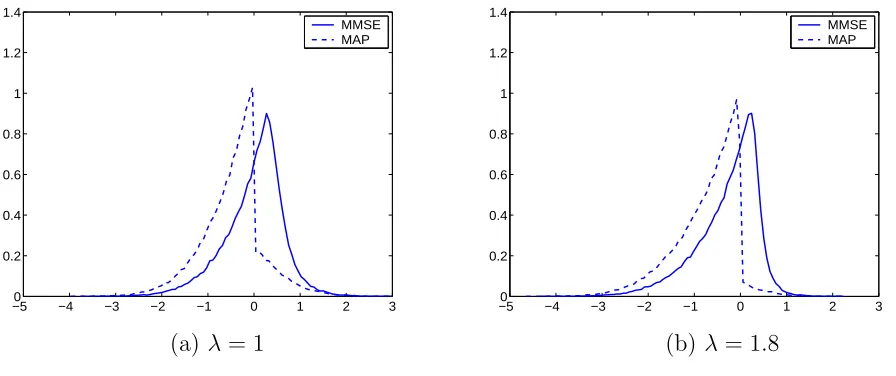
as a random variable with the true density f(x) = e−x1(x) (i.e., λ = 1). In the following plots, the x-axis is the λ values assumed in the MAP and MMSE estimators, while the true
λ is always equal to 1.
−50 −4 −3 −2 −1 0 1 2 3 0.2
0.4 0.6 0.8 1 1.2 1.4
MMSE MAP
−50 −4 −3 −2 −1 0 1 2 3 0.2
0.4 0.6 0.8 1 1.2 1.4
MMSE MAP
(a) λ= 1 (b) λ= 1.8
Fig. 3.1: Empirical probability densities of estimation errors of MAP and MMSE estimators.
Fig. 3.1 shows the empirical error pdfs of the MAP and MMSE estimators, each for the
two cases of λ = 1 and 1.8, respectively. Note that the estimation errors of the MAP
estimators are
˜
xMAP=x−xˆMAP=x−max(x+v−λ,0) =
λ−v z > λ