in the population sciences published by the Max Planck Institute for Demographic Research Konrad-Zuse Str. 1, D-18057 Rostock · GERMANY www.demographic-research.org
DEMOGRAPHIC RESEARCH
VOLUME 20, ARTICLE 11, PAGES 209-252
PUBLISHED 06 MARCH 2009
http://www.demographic-research.org/Volumes/Vol20/11/ DOI: 10.4054/DemRes.2009.20.11
Research Article
Unusually small sex differentials in mortality
of Israeli Jews: What does the structure
of causes of death tell us?
L. Daniel Staetsky
Andrew Hinde
© 2009 Staetsky & Hinde.
This open-access work is published under the terms of the Creative Commons Attribution NonCommercial License 2.0 Germany, which permits use, reproduction & distribution in any medium for non-commercial purposes, provided the original author(s) and source are given credit.
1 Introduction 210
2 Data and method 214
2.1 Data 214
2.2 Method 214
3 Causes of death of Israeli Jews (total population) in comparative
perspective
217
3.1 Israeli Jewish males versus males in Western countries 217
3.2 Israeli Jewish females versus females in Western countries 221
3.3 Sex differentials in mortality: Israeli Jews versus Western countries 225
4 Causes of death of Israeli-born Jews in comparative perspective 230
5 Discussion 235
6 Acknowledgements 241
Unusually small sex differentials in mortality of Israeli Jews:
What does the structure of causes of death tell us?
L. Daniel Staetsky 1 Andrew Hinde 2
Abstract
Since the establishment of Israel sex differentials in life expectancy at birth exhibited by Israeli Jews have been very low in comparison to other developed countries as a result of relatively high male and relatively low female life expectancy. To advance understanding of this phenomenon this paper explores cause-specific contributions to the difference in life expectancy between Israeli Jews and Western countries, for each sex, and to sex differentials in mortality in both populations. We quantify the major types of behaviourally induced mortality to show that it is especially low among Israeli Jewish males. We also investigate mortality in certain subgroups of Israeli Jews to gain a better understanding of female mortality in this population.
1 Southampton Statistical Sciences Research Institute. University of Southampton, UK, SO17 1BJ.
Phone: 44-(0)-23-8059-2569. E-mail: [email protected].
2 Southampton Statistical Sciences Research Institute. University of Southampton, UK, SO17 1BJ.
1. Introduction
In the Western world the difference between female and male life expectancies at birth grew from an average of 2.4 years in the 1900s to 4.8 years in the 1950s, and 6.2 years in the 1990s (United Nations 2004). The difference peaked approximately in the early 1980s at 6.6 years and was followed by a decrease (Trovato and Lalu 1996, 1998, Pampel 2002, 2005, Trovato and Heyen 2006). Among Israeli Jews the difference between female and male life expectancy at birth has been very low in comparison to Western countries: it was about 2.9 years in the 1950s, 3.5 years in the 1970s, and 3.8 years in the 1990s, i.e. it increased slightly and very slowly over time (Central Bureau of Statistics, Israel, Statistical Abstract of Israel, 2005). Previous research (see, for example, Staetsky and Hinde 2008) has shown that this phenomenon is due to a stable pattern of low male and somewhat elevated female mortality at old ages, mainly 60 and 65 years and over. In the second half of the 1990s life expectancy at birth of Israeli Jewish males was 76.3 years, as opposed to an average of 74.3 years among males of Western countries. For females the figures were 80.3 years and 80.6 years, respectively (Central Bureau of Statistics, Israel, Statistical Abstract of Israel, 2005, United Nations 2004). Although somewhat different in magnitude, both the survival advantage of Israeli Jewish males and the disadvantage of Israeli Jewish females could be traced back to the early 1950s.
mortality (Waldron 1993, Pampel 2001, 2002, 2003, 2005, Waldron, McCloskey, and Earle 2005). It is important to remember that in modern times, as in the past, a wide range of factors unrelated to sex-specific behavioural patterns operated to reduce or enhance sex differentials in mortality. Those factors were labelled by Waldron, McCloskey, and Earle (2005) as ‘other societal trends’ and their disproportionate impact on one sex is due to their interaction with sex-specific behaviour3.
Cause-specific sex differentials in mortality across the developed world have been extensively documented in the demographic literature. Of the major groups of causes of death, the largest mortality sex differentials were registered in relation to cardiovascular diseases (CVD), cancer, and external causes (Lopez 1983, Nathanson 1984, United Nations 1988, Waldron 1993, Zhang, Sasaki, and Kesteloot 1995, Nikiforov and Mamaev 1998, Waldron, McCloskey, and Earle 2005, Trovato and Heyen 2006). CVD, cancer, and external causes are also the main contributors to the change in mortality sex differentials, i.e. the increase across many developed countries prior to the 1970s-1980s and decrease sometime thereafter (Levi et al. 1992, Waldron 1993, Zhang, Sasaki, and Kesteloot 1995, Trovato and Lalu 1998, Pampel 2001, Waldron, McCloskey, and Earle 2005, Trovato and Heyen 2006).
During the second half of the 20th century mortality of developed countries and of Israeli Jews was dominated by chronic conditions. Depending on the period, CVD and cancer were together responsible for 45%-65% of total mortality. Infectious diseases accounted for 7% in the 1950s and for 2% in the 1990s, and the contribution of external causes was in a range of 5%-9%. Between the 1950s and the 1990s a massive decline in mortality (a gain of 9-10 years in terms of life expectancy at birth) among Israeli Jews, as in Western countries, was dominated by chronic diseases, with CVD playing an especially prominent role (Thom et al. 1985, Uemura and Pisa 1988, Thom and Epstein 1994). Cancer, infectious diseases, as well as other medical conditions, and external causes all contributed to the decline among females; among males cancer mortality rose or remained stable during this period in Israel and elsewhere in the developed world (Thom and Epstein 1994).
To our knowledge, the existing literature does not offer a comprehensive account of cause-specific mortality among Israeli Jews, with the focus on mortality sex differentials. However, previous research provides important indications in relation to the directions to be pursued. At different times research has indicated the presence of elevated mortality from cardiovascular diseases among Israeli females (Kark 1976, Ore
3 One example of such a trend is an advancement made by medical science in treatment of accidental falls.
among Israeli Jews and among Russian Jews was much smaller than in both the Russian population and the populations of selected Western countries.
Relatively small sex differentials are a recurrent finding in the literature on Jewish Diaspora mortality within the context of the developed world, specifically in the United States of America, Canada, England and Wales, and Russia (Needleman 1988, Rosenwaike 1990, 1994, Shatenstein and Kark 1995,Goldstein 1996,Shkolnikov et al. 2004, Haberman and Schmool 2005). It is important to note, however, that in contrast to Israel where the phenomenon of elevated old-age female mortality relative to the average of Western countries persisted into the 1990s, since approximately the 1970s both male and female old-age mortality among Jewish populations outside Israel was lower than in their host populations. Therefore, while small sex differentials remained the core characteristic of the Jewish mortality in Israel and in other Jewish communities for the large part of the 20th century, it was maintained by variable combinations of sex-specific mortality schedules. Importantly, elevated female mortality proved to be a transient feature (Staetsky and Hinde 2008).
This paper addresses the following questions:
1. For each sex, is the difference between the mortality of Israeli Jews and Western countries attributable to specific causes or groups of causes?
2. For sex differentials in mortality, is the difference between Israeli Jews and Western countries attributable to specific causes?
2. Data and method
2.1 Data
The mortality and population data for all comparator countries at all points in time come from the World Health Organization Statistical Information System (World Health Organization 2006b) which provides information on cause-specific deaths by sex and age, as well as population estimates in a corresponding format. Mortality data for Israeli Jews in the 1950s and 1970s come from the same source while for the 1990s they come from special data files prepared by the Central Bureau of Statistics, Israel. Population estimates of Israeli Jews in the 1950s and 1970s are taken from the annual publications of the Central Bureau of Statistics (Central Bureau of Statistics, Israel, Statistical Abstract of Israel, various years) and, in the 1990s, from a special data file prepared by the Central Bureau of Statistics, Israel.
2.2 Method
The principal technique used to address the research questions posed in this paper is the decomposition of the difference between two groups in life expectancy at birth into age- and cause-contributions. A number of approaches can be used for the cause decomposition of a mortality differential between groups, as expressed by the differential between life expectancy figures (Retherford 1975, Pollard 1982, 1988, Arriaga 1984, Pressat 1985, United Nations 1988, Das Gupta 1993, Trovato and Lalu 1998, Andreev, Shkolnikov, and Begun 2002, Vaupel and Canudas-Romo 2002, Trovato 2005, Trovato and Heyen 2006, Beltran-Sanchez and Preston 2007, Horiuchi, Wilmoth, and Pletcher 2008). Recent research into the properties of selected approaches has not revealed great differences between the results of their application (Andreev, Shkolnikov, and Begun 2002, Vaupel and Canudas-Romo 2002, Ponnapalli 2005, Beltran-Sanchez and Preston 2007). To our knowledge, a study of Jewish mortality in Moscow conducted by Shkolinikov et al. (2004) was the first to implement the decomposition of the difference in life expectancy into age- and cause-contributions within the context of Jewish mortality research. In this analysis we employ the United Nations method of decomposition (United Nations 1988, p. 105). The approach is chosen due to its precision, conceptual clarity and computational simplicity.
differentials are calculated and presented. Using the United Nations’ method of decomposition we calculate age- and cause-contributions to the difference between life expectancy at birth of (1) Israeli Jewish males and males of comparator countries; (2) Israeli Jewish females and females of comparator countries, and (3) females and males among Israeli Jews and in comparator countries.
The processes of widening and narrowing of sex differentials during the 20th century varied from place to place. However, since the focus of this paper is on mortality sex differentials in the Jewish population of Israel, this population will be compared to average measures of the populations of developed countries. This would also help to avoid a potentially overwhelming number of country-specific comparisons. Effectively, we create a single comparator for Israeli Jews using age, sex and cause-specific death rates of 18 Western countries for three points in time (1951-53, 1973-75, and 1995-97). The comparator population is therefore an unweighted average of the death rates of these countries. The 18 comparator countries are Australia, Austria, Belgium, Canada, England and Wales, Finland, France, Italy, Greece, Denmark, the Netherlands, New Zealand, Norway, Portugal, Spain, Sweden, Switzerland, and the United States of America4. As sex differentials in mortality of developed countries have been dynamic over the second half of the 20th century, we choose to focus on the early 1950s, mid-1970s, and mid-1990s. The distinctiveness of the 1950s, 1970s, and 1990s in relation to sex differentials in mortality has been suggested by the previous research (United Nations 1988, Waldron 1993, Zhang, Sasaki, and Kesteloot 1995, Trovato and Lalu 1996, 1998, Waldron, McCloskey, and Earle 2005, Trovato and Heyen 2006). As a result, it is possible to compare Israeli Jews to developed countries at the time of increase of sex differentials in mortality (1950s), their peak (1970s), and at the time of decrease in many Western countries (1990s).
With a few exceptions, we resort to broad groupings of the causes of death in order to minimise complications arising from the application of different practices of causes- of-death classification in different countries and periods of time (Janssen and Kunst 2004). Also, averaging across countries is a technique that may overcome cross national differences in coding of causes and diagnostic practices. Any temporal and cross country comparisons of detailed codes of causes of death should be exercised with caution, though, in general, male-female comparisons within one country are safer than
4
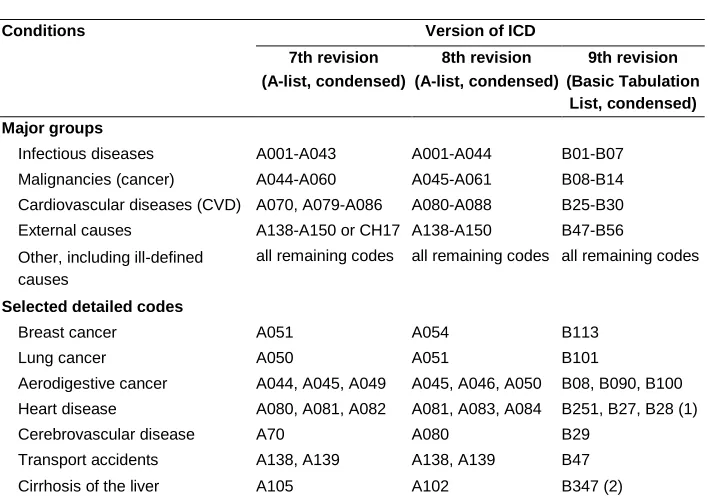
inter country comparisons within the same sex. Construction of the groupings of causes of death was performed as specified in Table 1:
Table 1: International classification of diseases (ICD) codes of causes of death taking part in the decomposition exercise
Conditions Version of ICD
7th revision 8th revision 9th revision
(A-list, condensed) (A-list, condensed) (Basic Tabulation
List, condensed)
Major groups
Infectious diseases A001-A043 A001-A044 B01-B07
Malignancies (cancer) A044-A060 A045-A061 B08-B14
Cardiovascular diseases (CVD) A070, A079-A086 A080-A088 B25-B30
External causes A138-A150 or CH17 A138-A150 B47-B56
Other, including ill-defined causes
all remaining codes all remaining codes all remaining codes
Selected detailed codes
Breast cancer A051 A054 B113
Lung cancer A050 A051 B101
Aerodigestive cancer A044, A045, A049 A045, A046, A050 B08, B090, B100
Heart disease A080, A081, A082 A081, A083, A084 B251, B27, B28 (1)
Cerebrovascular disease A70 A080 B29
Transport accidents A138, A139 A138, A139 B47
Cirrhosis of the liver A105 A102 B347 (2)
Note: (1) For Israeli Jews in the 1990s causes of death under the code B025 were incorporated in the category of heart disease, due to the nature of groupings supplied by the Central Bureau of Statistics, Israel. This category included only a small number of cases (10 cases across all age groups for Israeli Jewish males in 1995, for example).
(2)For Israeli Jews in the 1990s all chronic liver diseases under the detailed ICD-9 codes 570-573 are used, due to the nature of the groupings supplied by the Central Bureau of Statistics, Israel.
In Israel the 7th revision of the ICD was implemented during 1951-1968; the subsequent transitions to the 8th and 9th revisions of ICD took place in 1969 and 1979, respectively. Similar timing of the transitions was observed in other countries.
3. Causes of death of Israeli Jews (total population) in comparative
perspective
3.1 Israeli Jewish males versus males in Western countries
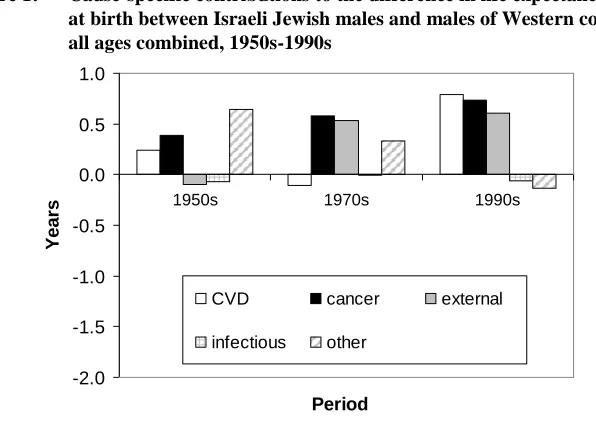
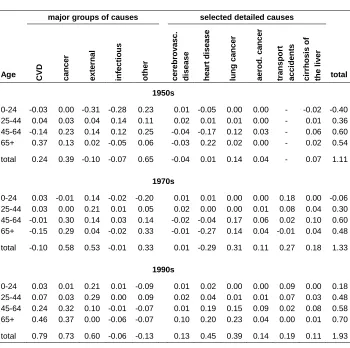
Cause-specific contributions to the difference in life expectancy at birth between Israeli Jewish males and males of Western countries (hereafter described as ‘other males’) are shown in Figure 1 and Table 2. Probably the most important observation here is that the relative survival advantage of Israeli Jewish males is formed by many causes of death at all points in time, and that it grows stronger over time due to the influence of both natural and external causes. In addition, one can see that all ages 25 years and over contribute significantly to the Israeli Jewish male survival advantage.
Figure 1: Cause-specific contributions to the difference in life expectancy at birth between Israeli Jewish males and males of Western countries, all ages combined, 1950s-1990s
-2.0 -1.5 -1.0 -0.5 0.0 0.5 1.0
1950s 1970s 1990s
Period
Y
e
a
rs
CVD cancer external
infectious other
Note: CVD-cardiovascular diseases.
Table 2: Cause- and age-specific contributions to the difference in life expectancy at birth between Israeli Jewish males and males of Western countries, 1950s-1990s
major groups of causes selected detailed causes
Age CVD cance
r e x te rna l inf e c ti ous ot her c e re brova s c . di s e a s e hea rt di s e a s e lung c a nce r a e rod. c a nce r tra nsport a c c ident s c irrhos is of the l iv e r total 1950s
0-24 -0.03 0.00 -0.31 -0.28 0.23 0.01 -0.05 0.00 0.00 - -0.02 -0.40 25-44 0.04 0.03 0.04 0.14 0.11 0.02 0.01 0.01 0.00 - 0.01 0.36 45-64 -0.14 0.23 0.14 0.12 0.25 -0.04 -0.17 0.12 0.03 - 0.06 0.60 65+ 0.37 0.13 0.02 -0.05 0.06 -0.03 0.22 0.02 0.00 - 0.02 0.54
total 0.24 0.39 -0.10 -0.07 0.65 -0.04 0.01 0.14 0.04 - 0.07 1.11
1970s
0-24 0.03 -0.01 0.14 -0.02 -0.20 0.01 0.01 0.00 0.00 0.18 0.00 -0.06 25-44 0.03 0.00 0.21 0.01 0.05 0.02 0.00 0.00 0.01 0.08 0.04 0.30 45-64 -0.01 0.30 0.14 0.03 0.14 -0.02 -0.04 0.17 0.06 0.02 0.10 0.60 65+ -0.15 0.29 0.04 -0.02 0.33 -0.01 -0.27 0.14 0.04 -0.01 0.04 0.48
total -0.10 0.58 0.53 -0.01 0.33 0.01 -0.29 0.31 0.11 0.27 0.18 1.33
1990s
0-24 0.03 0.01 0.21 0.01 -0.09 0.01 0.02 0.00 0.00 0.09 0.00 0.18 25-44 0.07 0.03 0.29 0.00 0.09 0.02 0.04 0.01 0.01 0.07 0.03 0.48 45-64 0.24 0.32 0.10 -0.01 -0.07 0.01 0.19 0.15 0.09 0.02 0.08 0.58 65+ 0.46 0.37 0.00 -0.06 -0.07 0.10 0.20 0.23 0.04 0.00 0.01 0.70
total 0.79 0.73 0.60 -0.06 -0.13 0.13 0.45 0.39 0.14 0.19 0.11 1.93
Note: CVD-cardiovascular diseases.
Source: Central Bureau of Statistics, Israel (Statistical Abstract of Israel, various years); special data files prepared by the Central Bureau of Statistics, Israel; World Health Organization (2006b).
years) is due to survival advantage from smoking-related types of cancer, i.e. cancer of lung and aerodigestive cancer. Survival advantage from all cancers and smoking-related cancers is present both at typical ages of premature mortality (45-64 years) and older ages (Table 2).
The situation in relation to CVD and ‘other’ natural causes (diseases other than cancer, CVD and infectious diseases) is less clear cut. In the 1990s and the 1950s CVD appears as one of the strong forces shaping survival advantage of Israeli Jewish males: its contribution is around 0.8 years and 0.24 years, respectively. That is, however, not the case in the 1970s when Israeli Jewish males are at some survival disadvantage relative to their counterparts in developed countries. The difference between Israeli Jewish males and other males in relation to CVD is mainly due to heart disease. The mortality of Israeli Jewish males from cerebrovascular diseases does not appear to be very different from what is observed elsewhere among males. Natural causes other than cancer, CVD, and infectious diseases represented a strong factor in the survival advantage of Israeli Jewish males in the 1950s (about 0.7 years) and 1970s (about 0.3 years) but not in the 1990s.
Apart from smoking-related cancers Israeli Jewish males also demonstrate survival advantage relative to other males for other major behaviourally induced types of mortality: external causes (broadly related to risk taking behaviour) and cirrhosis of the liver (an indication of the scope of alcohol misuse). In absolute terms, external causes are third in significance after CVD and cancer. In the 1970s and 1990s they are responsible for 0.5-0.6 years of survival advantage of Israeli Jewish males relative to other males. The pattern is especially strong for ages 25-44 years and 45-64 years, i.e. again, ages of premature mortality. In the 1950s the survival advantage of Israeli Jewish males from external causes was observed for all ages but 0-24 years. Survival disadvantage from external causes at these ages could be partly related to the existence of combat mortality among Israeli Jews. However, this is only an informed guess. Due to the nature of the coding of causes of deaths for these years (all external causes are brought together under a single code), this is not something that can be further explored. Detailed examination of age- and cause-contributions (not shown here) reveals that a large part of the survival disadvantage of Israeli Jewish males at ages 0-24 years comes from ages 15-19 and 20-24 years, i.e. ages where the toll of combat mortality is the highest5. Israeli Jewish males show an invariable advantage in mortality from cirrhosis of the liver (approximately 0.1-0.2 years of the total difference in life expectancy).
5 Combat mortality is excluded from the official statistics for major events of military hostilities between
The only cause of death where Israeli Jewish males are at a constant disadvantage is infectious diseases, but the contribution of this cause to the total mortality is low, especially during the 1970s and 1990s.
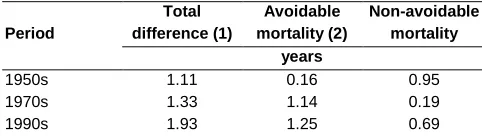
To further illustrate the role of the avoidable causes of death in the survival advantage displayed by Israeli Jewish males we obtain the joint contribution of lung cancer, aerodigestive cancer, cirrhosis of the liver, and external causes of death to the differential by summation. It is well known that nearly all of lung cancer deaths and a very large proportion of deaths from aerodigestive cancer are smoking-related and therefore could be prevented (Ravenholt 1990, Peto et al. 1992, 1994, Lopez, Collishaw, and Piha 1994). In a similar way, a very large proportion of deaths from cirrhosis of the liver and deaths from external causes could be averted in the absence of alcohol misuse and risk taking behaviour. A number of recent studies tried to quantify avoidable mortality based on the identification of avoidable (preventable and/or treatable) causes of death (Nolte and McKee 2003, Andreev et al. 2003, Nolte, Scholz, and McKee 2004, Nolte and McKee 2004). The methods used to achieve this are not completely uncontroversial (Nolte and McKee 2003, 2004), and we do not attempt to implement them because the nature of the groupings of causes of death available for Israeli Jews is not suitable for this purpose. Instead, we resort to the causes of death that are related to health damaging behaviour in the most unambiguous manner. Nearly all deaths from these causes can be averted through prevention.
Table 3 presents the joint contribution of lung cancer, aerodigestive cancer, cirrhosis of the liver, and external causes (defined here as avoidable mortality) to the difference in life expectancy between Israeli Jewish males and males of Western countries.
Table 3: Contributions of causes of death representing major types of avoidable mortality to the difference in life expectancy at birth between Israeli Jewish males and Western males, 1950s-1990s
Period
Total difference (1)
Avoidable mortality (2)
Non-avoidable mortality
years
1950s 1.11 0.16 0.95
1970s 1.33 1.14 0.19
1990s 1.93 1.25 0.69
Note: (1) Figures may not sum exactly due to rounding. (2) Avoidable mortality is defined here as mortality from lung cancer, aerodigestive cancer, cirrhosis of the liver, and external causes.
Even this imperfect quantification of avoidable mortality indicates quite clearly that a significant part of the survival advantage of Israeli Jewish males over males in other Western countries is due to the lower avoidable mortality of the former: 1.25 years out of 1.93 years (65%) of survival advantage shown by Israeli Jews in relation to their Western counterparts in the 1990s is due to the difference in mortality from smoking- related cancers, cirrhosis of the liver, and external causes. The contribution of these causes of death to the difference between the two groups is also large in the 1970s. It is smaller, both in an absolute and in a proportionate sense, in the 1950s, indicating that the gap between Israeli males and males in other Western countries in relation to major causes of avoidable mortality has widened over time.
Quantification of avoidable mortality by simple summation of its most typical causes is an imperfect tool. In reality, the impact of various health destructive behaviours on total mortality is larger since it also affects causes such as cardiovascular diseases and other types of cancer, for example. These effects are difficult to isolate. Consequently, what Table 3 shows is perhaps only the minimum possible contribution of avoidable mortality.
3.2 Israeli Jewish females versus females in Western countries
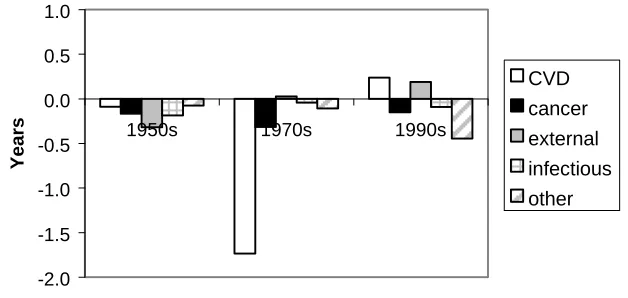
Figure 2 and Table 4 show the cause-specific contributions to the difference in life expectancy at birth between Israeli Jewish females and their counterparts in Western countries. It is quite clear that the relative survival disadvantage of Israeli Jewish females is also multicausal. It is also clear that, as opposed to male survival advantage, female disadvantage diminishes towards the 1990s, and it is most ‘stubborn’ for ages 65 years and over. In absolute terms, overall, it is also less strong than the male survival advantage, with the exception of the 1970s.
Disadvantage in relation to cancer mortality is one persistent feature of the survival disadvantage of Israeli Jewish females: cancer contributed, depending on period, 0.2-0.3 years to the total differential between life expectancy at birth of Israeli Jewish females and females in comparator countries (a range of 0.3-2.2 years). About one-third of it in the 1950s and 1970s and nearly all of it in the 1990s was due to breast cancer. The survival disadvantage of Israeli females from all cancers was especially persistent at ages 65 years and over. Interestingly, Israeli Jewish females displayed survival advantage over females in comparator countries in relation to smoking-related cancers in the 1990s, but not at earlier times (however, their survival disadvantage in relation to lung cancer in the 1950s and 1970s was relatively small).
Jewish females, responsible at different times for the range of 0.1-0.5 years in terms of life expectancy at birth. On the other hand, CVD did not display any clear pattern. Israeli Jewish females were at some disadvantage in the 1950s, and at a very strong disadvantage in the 1970s. Both cerebrovascular diseases and heart disease contributed to this pattern. In contrast, during the 1990s Israeli Jewish females displayed a clear survival advantage from CVD. This was largely due to their survival advantage from cerebrovascular diseases, as survival disadvantage from heart disease (sustained by ages 65 years and over) continued into the 1990s.
Figure 2: Cause-specific contributions to the difference in life expectancy at birth between Israeli Jewish females and females of Western countries, all ages combined, 1950s-1990s
Figure 2. Cause-specific contributions to the difference in life expectancy at birth between Israeli Jewish females and females of Western countries, all
ages combined, 1950s-1990s
-2.0 -1.5 -1.0 -0.5 0.0 0.5 1.0
1950s 1970s 1990s
Period
Y
ear
s
CVD cancer external infectious other
Note: CVD-cardiovascular diseases.
Table 4: Cause- and age-specific contributions to the difference in life expectancy at birth between Israeli Jewish females and females of Western countries, 1950s-1990s
major groups of causes selected detailed causes
Age CVD cance
r e x te rna l inf e c ti ous ot her c e re brova s c . di s e a s e hea rt di s e a s e lung c a nce r bre a s t c a nce r a e rod. c a nce r tra nsport a c c ident s c irrhos is of the l iv e r total 1950s
0-24 -0.05 0.00 -0.10 -0.23 -0.09 0.01 -0.06 0.00 0.00 0.00 - -0.01 -0.47 25-44 -0.03 -0.05 - 0.05 0.09 0.01 0.01 -0.06 -0.01 -0.04 0.00 - 0.00 -0.04 45-64 -0.12 0.00 -0.08 0.01 0.04 -0.08 -0.12 -0.01 -0.02 0.00 - 0.02 -0.16 65+ 0.11 -0.11 - 0.08 -0.05 -0.03 -0.25 0.11 -0.02 0.01 -0.01 - 0.01 -0.17
total -0.09 -0.17 -0.32 -0.19 -0.08 -0.31 -0.13 -0.04 -0.05 -0.01 - 0.03 -0.84
1970s
0-24 0.02 0.00 0.07 -0.01 -0.18 0.01 0.01 0.00 0.00 0.00 0.05 0.00 -0.10 25-44 0.02 -0.05 0.05 0.00 0.03 0.02 -0.01 0.00 -0.03 0.00 0.01 0.02 0.05 45-64 -0.39 -0.14 -0.01 0.00 -0.05 -0.11 -0.29 0.00 -0.06 0.00 -0.02 0.03 -0.59 65+ -1.39 -0.13 - 0.09 -0.04 0.10 -0.39 -1.04 -0.02 -0.02 -0.01 -0.02 0.01 -1.54
total -1.74 -0.32 0.02 -0.04 -0.11 -0.47 -1.33 -0.01 -0.11 -0.01 0.01 0.05 -2.18
1990s
0-24 0.02 0.01 0.08 0.01 0.03 0.00 0.01 0.00 0.00 0.00 0.04 0.00 0.14 25-44 0.04 -0.02 0.09 0.00 0.04 0.02 0.01 0.01 -0.01 0.00 0.02 0.02 0.15 45-64 0.07 0.02 0.05 -0.01 -0.04 0.03 0.02 0.06 -0.04 0.01 0.00 0.05 0.10 65+ 0.11 -0.17 -0.03 -0.09 -0.48 0.18 -0.16 0.04 -0.09 0.01 -0.01 -0.01 -0.65
total 0.24 -0.15 0.19 -0.09 -0.45 0.23 -0.11 0.11 -0.14 0.02 0.06 0.05 -0.26
Note: CVD-cardiovascular diseases.
In a way similar to males, Israeli Jewish females displayed a consistent survival advantage in relation to cirrhosis of the liver and a disadvantage in relation to infectious diseases. The situation in relation to external causes of death is somewhat puzzling. Israeli Jewish females exhibit survival advantage from these causes relative to their counterparts in the 1990s (0.2 years) and 1970s (0.02 years) but not in the 1950s, when a clear survival disadvantage (0.3 years) is observed. Moreover, even in the 1970s and 1990s older age groups among Israeli Jewish females retain a certain amount of survival disadvantage. Does this actually mean that elderly Israeli Jewish females tend to more risky behaviour than similarly aged females in other countries? This is not necessarily true as mortality from external causes at ages 45 years and over will also be influenced by the state of general health. Mortality from accidental falls in old age is related to increased frailty, which stems from various chronic conditions associated with old age (Waldron, McCloskey, and Earle 2005). Given that Israeli Jewish females demonstrate higher mortality from chronic conditions as well, higher mortality from accidental deaths might not appear as a surprise. It is impossible, with the available data, to offer any interpretation of the survival disadvantage of Israeli Jewish females from external causes at ages younger than 45 years and especially at ages 0-24 years in the 1950s. It is worth remembering that females are almost unaffected by combat mortality but are affected by the acts of political violence targeting the civilian population of Israel. Also, survival as a result of accidents is affected by the level of medical care and general socioeconomic situation. One must remember that the early 1950s were a period of significant strain on the Israeli medical system, and other aspects of the state material infrastructure due to mass migration (Hacohen 2003). More work is needed to disentangle this particular issue taking into consideration all possible aspects of socioeconomic conditions, the political situation, and the level of medical care.
Examination of the contribution of avoidable mortality (Table 5) to the difference between Israeli Jewish females and other Western females demonstrates that in the 1990s Israeli Jewish females showed lower mortality from typical avoidable causes, and in the 1970s the difference between Israeli Jewish females and Western females in mortality from avoidable causes was negligible. During the 1970s and 1990s the survival disadvantage of Israeli Jewish females seems to be exclusively due to nonavoidable mortality.
Table 5: Contributions of causes of death representing major types of avoidable mortality to the difference in life expectancy at birth between Israeli Jewish females and Western females, 1950s-1990s
Period
Total difference (1)
Avoidable mortality (2)
Nonavoidable mortality
years
1950s -0.84 -0.35 -0.50
1970s -2.18 0.06 -2.24
1990s -0.26 0.38 -0.64
Note: (1) Figures may not sum exactly due to rounding. (2) Avoidable mortality is defined here as mortality from lung cancer, aerodigestive cancer, cirrhosis of the liver, and external causes.
Source: Central Bureau of Statistics, Israel (Statistical Abstract of Israel, various years); special data files prepared by the Central Bureau of Statistics, Israel; World Health Organization (2006b).
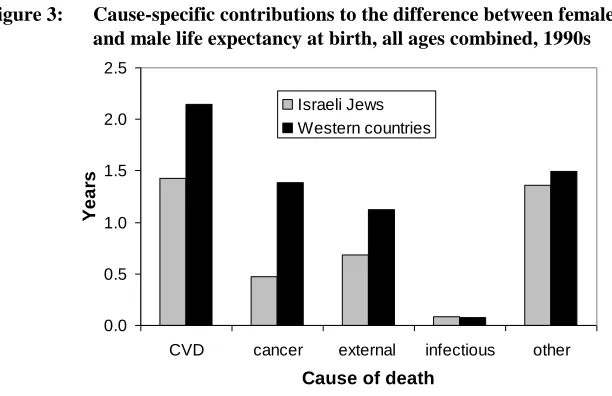
3.3 Sex differentials in mortality: Israeli Jews versus Western countries
Figure 3: Cause-specific contributions to the difference between female and male life expectancy at birth, all ages combined, 1990s
0.0 0.5 1.0 1.5 2.0 2.5
CVD cancer external infectious other
Cause of death
Ye
a
rs
Israeli Jews Western countries
Note: CVD-cardiovascular diseases.
Source: Special datafiles prepared by the Central Bureau of Statistics, Israel; World Health Organization (2006b).
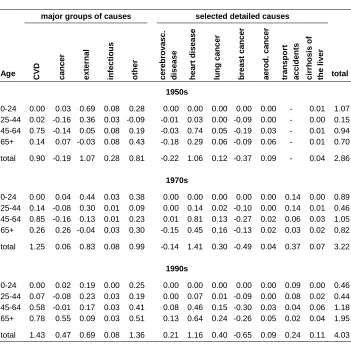
Table 6: Cause- and age-specific contributions to the difference in life expectancy at birth between females and males among Israeli Jews, 1950s-1990s
major groups of causes selected detailed causes
Age CVD cance
r e x te rna l inf e c ti ous ot her c e re brova s c . di s e a s e hea rt di s e a s e lung c a nce r bre a s t c a nce r a e rod. c a nce r tra nsport a c c ident s c irrhos is of the l iv e r total 1950s
0-24 0.00 0.03 0.69 0.08 0.28 0.00 0.00 0.00 0.00 0.00 - 0.01 1.07 25-44 0.02 -0.16 0.36 0.03 -0.09 -0.01 0.03 0.00 -0.09 0.00 - 0.00 0.15 45-64 0.75 -0.14 0.05 0.08 0.19 -0.03 0.74 0.05 -0.19 0.03 - 0.01 0.94 65+ 0.14 0.07 -0.03 0.08 0.43 -0.18 0.29 0.06 -0.09 0.06 - 0.01 0.70
total 0.90 -0.19 1.07 0.28 0.81 -0.22 1.06 0.12 -0.37 0.09 - 0.04 2.86
1970s
0-24 0.00 0.04 0.44 0.03 0.38 0.00 0.00 0.00 0.00 0.00 0.14 0.00 0.89 25-44 0.14 -0.08 0.30 0.01 0.09 0.00 0.14 0.02 -0.10 0.00 0.14 0.01 0.46 45-64 0.85 -0.16 0.13 0.01 0.23 0.01 0.81 0.13 -0.27 0.02 0.06 0.03 1.05 65+ 0.26 0.26 -0.04 0.03 0.30 -0.15 0.45 0.16 -0.13 0.02 0.03 0.02 0.82
total 1.25 0.06 0.83 0.08 0.99 -0.14 1.41 0.30 -0.49 0.04 0.37 0.07 3.22
1990s
0-24 0.00 0.02 0.19 0.00 0.25 0.00 0.00 0.00 0.00 0.00 0.09 0.00 0.46 25-44 0.07 -0.08 0.23 0.03 0.19 0.00 0.07 0.01 -0.09 0.00 0.08 0.02 0.44 45-64 0.58 -0.01 0.17 0.03 0.41 0.08 0.46 0.15 -0.30 0.03 0.04 0.06 1.18 65+ 0.78 0.55 0.09 0.03 0.51 0.13 0.64 0.24 -0.26 0.05 0.02 0.04 1.95
total 1.43 0.47 0.69 0.08 1.36 0.21 1.16 0.40 -0.65 0.09 0.24 0.11 4.03
Note: CVD-cardiovascular diseases.
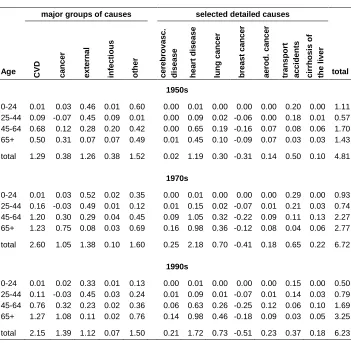
Table 7: Cause- and age-specific contributions to the difference in life
expectancy at birth between females and males in Western countries, 1950s-1990s
major groups of causes selected detailed causes
Age CVD cance
r e x te rna l inf e c ti ous ot her c e re brova s c . di s e a s e hea rt di s e a s e lung c a nce r bre a s t c a nce r a e rod. c a nce r tra nsport a c c ident s c irrhos is of the l iv e r total 1950s
0-24 0.01 0.03 0.46 0.01 0.60 0.00 0.01 0.00 0.00 0.00 0.20 0.00 1.11 25-44 0.09 -0.07 0.45 0.09 0.01 0.00 0.09 0.02 -0.06 0.00 0.18 0.01 0.57 45-64 0.68 0.12 0.28 0.20 0.42 0.00 0.65 0.19 -0.16 0.07 0.08 0.06 1.70 65+ 0.50 0.31 0.07 0.07 0.49 0.01 0.45 0.10 -0.09 0.07 0.03 0.03 1.43
total 1.29 0.38 1.26 0.38 1.52 0.02 1.19 0.30 -0.31 0.14 0.50 0.10 4.81
1970s
0-24 0.01 0.03 0.52 0.02 0.35 0.00 0.01 0.00 0.00 0.00 0.29 0.00 0.93 25-44 0.16 -0.03 0.49 0.01 0.12 0.01 0.15 0.02 -0.07 0.01 0.21 0.03 0.74 45-64 1.20 0.30 0.29 0.04 0.45 0.09 1.05 0.32 -0.22 0.09 0.11 0.13 2.27 65+ 1.23 0.75 0.08 0.03 0.69 0.16 0.98 0.36 -0.12 0.08 0.04 0.06 2.77
total 2.60 1.05 1.38 0.10 1.60 0.25 2.18 0.70 -0.41 0.18 0.65 0.22 6.72
1990s
0-24 0.01 0.02 0.33 0.01 0.13 0.00 0.01 0.00 0.00 0.00 0.15 0.00 0.50 25-44 0.11 -0.03 0.45 0.03 0.24 0.01 0.09 0.01 -0.07 0.01 0.14 0.03 0.79 45-64 0.76 0.32 0.23 0.02 0.36 0.06 0.63 0.26 -0.25 0.12 0.06 0.10 1.69 65+ 1.27 1.08 0.11 0.02 0.76 0.14 0.98 0.46 -0.18 0.09 0.03 0.05 3.25
total 2.15 1.39 1.12 0.07 1.50 0.21 1.72 0.73 -0.51 0.23 0.37 0.18 6.23
Note: CVD-cardiovascular diseases. Source: World Health Organization (2006b).
Table 8: Contributions of causes of death representing major types of avoidable mortality to sex differential in life expectancy at birth among Israeli Jews and in Western countries, 1950s-1990s
Period/ Population
Total sex differential (1)
Avoidable mortality (2)
Nonavoidable mortality
years
1950s
West 4.81 1.80 3.01
Israeli Jews 2.86 1.32 1.54
1970s
West 6.72 2.48 4.25
Israeli Jews 3.22 1.24 1.97
1990s
West 6.23 2.26 3.97
Israeli Jews 4.03 1.28 2.75
Note: (1) Figures may not sum exactly due to rounding. (2) Avoidable mortality is defined here as mortality from lung cancer, aerodigestive cancer, cirrhosis of the liver, and external causes.
Source: Central Bureau of Statistics, Israel (Statistical Abstract of Israel, various years); special datafiles prepared by the Central Bureau of Statistics, Israel; World Health Organization (2006b).
Avoidable mortality appears to contribute less significantly in absolute terms to the sex differentials among Israeli Jews relative to Western countries. If Western populations’ experience of sex differentials in mortality from major smoking-related cancers, cirrhosis of the liver, and external causes was similar to that observed among Israeli Jews, their total sex differential in life expectancy at birth could be reduced by one year or so in the 1970s and 1990s, and by half a year in the 1950s. The gap between Israeli Jews and other populations in relation to sex differentials would be smaller if only causes of non-avoidable mortality were allowed to operate in both populations. However, it is also apparent that the gap would not close completely as contributions of non-avoidable mortality are also smaller among Israeli Jews.
lung cancer mortality is low among Israeli Jewish males (Rakower 1957, Rennert et al. 1988, 1990, Lopez 1995). If we take the level of lung cancer mortality as an indicator of the overall impact of smoking, it is reasonable to expect that not only lung cancer, but many types of mortality in a society experiencing only a mild smoking epidemic would be low. This is precisely what is observed among Israeli Jewish males. Mortality in the Israeli Jewish male population is low also in relation to other typical behaviorally induced causes. This phenomenon has been noted in the Jewish population of Israel (Shuval 1992) but so far it has not been consistently employed for the explanation of the small sex differentials in mortality in this society.
As for the hypothesis linking the elevated mortality of Jewish females to their migrant origin, partial evidence supporting the hypothesis was presented by Staetsky and Hinde (2008) where a relatively low overall level of mortality was identified in a population of Israeli-born females in the 1990s. Unfortunately, it is impossible to perform a decomposition of cause-specific contributions to the differential in life expectancy at birth of various foreign-born groups and Western females. This is so simply due to the nature of migration processes to Israel. The first generation of migrants has aged significantly since its arrival to Israel, ‘losing’ its infants, children, and young adults. Thus, life table functions cannot be computed for Israeli Jewish foreign-born populations. Such a decomposition, however, is possible for the Israeli-born Jews, a population in which a full set of ages were present in the end of the 20th century. The results of this decomposition are presented and interpreted in the following section.
4. Causes of death of Israeli-born Jews in comparative perspective
In the mid-1990s, the Israeli-born Jewish population in Israel amounted to 2.8 million people, representing 61% of the total Jewish population of Israel (Central Bureau of Statistics, Israel, Statistical Abstract of Israel, 1997). In the 1990s the Israeli-born represented a majority at young ages, but were only a small minority at ages 65 years and over (Staetsky and Hinde 2008). Up until the 1990s the numbers of deaths in this population were too small to allow confident analysis of its causes-of-death profile.
Switzerland, but it is higher than in most populations of comparator countries and is close to that observed in Sweden and Italy. The differential between female and male life expectancy at birth among Israeli-born Jews was 3.3 years, still very low and, in fact, even lower than that of the total Israeli Jewish population (4 years). It is definitely much lower than that observed in Western countries (6.3 years).
Figure 4 and Table 9 present cause- and age-specific contributions to the difference in the life expectancy between Israeli-born Jewish males and females and their counterparts in Western countries in the 1990s.
Figure 4: Cause-specific contributions to the difference in life expectancy at birth between Israeli-born Jews living in Israel and the population of Western countries, by sex, all ages combined, 1990s
-2.0 -1.5 -1.0 -0.5 0.0 0.5 1.0 1.5 2.0
CVD cancer external infectious other
Cause of death
Ye
a
rs
Females Males
Note: CVD-cardiovascular diseases.
Table 9: Cause- and age-specific contributions to the difference in life expectancy at birth between Israeli-born Jews living in Israel and the population of Western countries, by sex, 1990s
major groups of causes selected detailed causes
Age CVD cance
r e x te rna l inf e c ti ous ot her c e re brova s c . di s e a s e hea rt di s e a s e lung c a nce r bre a s t c a nce r a e rod. c a nce r tra nsport a c c ident s c irrhos is of the l iv e r total
Israeli-born Jewish males living in Israel vs. Western males
0-24 0.03 0.01 0.22 0.02 -0.10 0.01 0.02 0.00 - 0.00 0.09 0.00 0.18 25-44 0.09 0.04 0.32 0.01 0.13 0.03 0.05 0.01 - 0.01 0.09 0.04 0.58 45-64 0.39 0.45 0.16 0.00 0.09 0.05 0.28 0.20 - 0.11 0.03 0.12 1.09 65+ 1.02 0.60 0.03 -0.01 0.25 0.26 0.55 0.35 - 0.05 0.00 0.05 1.90
total 1.53 1.10 0.73 0.02 0.37 0.35 0.90 0.56 - 0.17 0.20 0.21 3.75
Israeli-born Jewish females living in Israel vs. Western females
0-24 0.02 0.01 0.08 0.01 0.03 0.00 0.02 0.00 0.00 0.00 0.04 0.00 0.15 25-44 0.04 0.00 0.09 0.00 0.03 0.02 0.02 0.01 -0.01 0.00 0.02 0.02 0.17 45-64 0.18 0.12 0.06 -0.01 0.05 0.07 0.10 0.07 -0.03 0.02 0.00 0.05 0.40 65+ 0.42 0.07 0.01 -0.08 -0.25 0.31 -0.01 0.07 -0.08 0.03 0.02 0.01 0.18
total 0.66 0.20 0.25 -0.08 -0.15 0.40 0.12 0.14 -0.12 0.05 0.08 0.08 0.89
Note: CVD-cardiovascular diseases.
Source: Special data files prepared by the Central Bureau of Statistics, Israel; World Health Organization (2006b).
survival advantage of Israeli-born Jewish males is also observed for external causes and cirrhosis of the liver.
Israeli-born Jewish females, on the other hand, display a different positioning in relation to females in Western countries, when compared to the total population of Israeli Jewish females. Although less strong than in males, their positioning relative to females of Western countries is also clearly advantageous across many causes of death, including CVD (cerebrovascular and heart disease), total cancer, lung and aerodigestive cancer, external causes, and cirrhosis of the liver. It is also observed for most age groups. Note, for example, that in the 1990s mortality from CVD in age group 45 years and over contributed 0.6 years to the difference in life expectancy at birth between Israeli-born Jewish females and females in Western countries, and only 0.2 years to the difference between the total population of Israeli Jewish females and females of Western countries. Also, note that the contribution of all cancers is positive for born females, while it is negative for the total female population of Israeli Jews. Israeli-born females are at disadvantageous positioning in relation to ‘other’ natural causes (causes other than CVD, cancer, and infectious diseases) and breast cancer. A large proportion of the disadvantage for the earlier group of causes comes from the ‘oldest old’ (females aged 80 years and over), and it is observed for all ages for breast cancer.
Table 10 shows cause- and age-specific contribution to sex differentials in life expectancy among Israeli-born Jews and Western countries. Sex differentials in mortality among Israeli-born Jews are significantly smaller than in Western countries for all causes of death. The difference in the size of contributions to life expectancy at birth between the sexes is nearly twofold, for example, for CVD (especially heart disease, rather less for cerebrovascular disease), and external causes, and even greater than that for cancer overall, lung cancer, and cirrhosis of the liver. For most causes they are also smaller than in the total population of Israeli Jews (Table 6).
Table 11 shows contributions of avoidable mortality and the residual (nonavoidable mortality) to the difference in life expectancy between Israeli-born Jews living in Israel and Western countries, and to sex differentials in mortality in both settings.
Table 10: Cause- and age-specific contributions to the difference in life expectancy at birth between females and males among Israeli-born Jews living in Israel and in the population of Western countries, 1990s
major groups of causes selected detailed causes
Age CVD cance
r e x te rna l inf e c ti ous ot her c e re brova s c . di s e a s e hea rt di s e a s e lung c a nce r bre a s t c a nce r a e rod. c a nce r tra nsport a c c ident s c irrhos is of the l iv e r total
Israeli-born Jews living in Israel
0-24 0.00 0.02 0.19 0.00 0.27 0.00 0.00 0.00 0.00 0.00 0.10 0.00 0.48 25-44 0.06 -0.08 0.22 0.02 0.15 0.00 0.06 0.00 -0.09 0.00 0.07 0.01 0.37 45-64 0.55 -0.05 0.13 0.01 0.34 0.08 0.46 0.11 -0.30 0.03 0.02 0.02 0.98 65+ 0.48 0.64 0.11 -0.04 0.35 0.07 0.42 0.18 -0.30 0.08 0.06 0.01 1.54
total 1.09 0.53 0.65 -0.01 1.11 0.14 0.93 0.30 -0.69 0.11 0.25 0.04 3.37
Western countries
0-24 0.01 0.02 0.33 0.01 0.13 0.00 0.01 0.00 0.00 0.00 0.15 0.00 0.50 25-44 0.11 -0.03 0.45 0.03 0.24 0.01 0.09 0.01 -0.07 0.01 0.14 0.03 0.79 45-64 0.76 0.32 0.23 0.02 0.36 0.06 0.63 0.26 -0.25 0.12 0.06 0.10 1.69 65+ 1.27 1.08 0.11 0.02 0.76 0.14 0.98 0.46 -0.18 0.09 0.03 0.05 3.25
total 2.15 1.39 1.12 0.07 1.50 0.21 1.72 0.73 -0.51 0.23 0.37 0.18 6.23
Note: CVD-cardiovascular diseases.
Table 11: Contributions of causes of death representing major types of avoidable mortality to the difference in life expectancy at birth between Israeli-born Jews living in Israel and the population of Western countries, and to sex differentials in mortality in both contexts, 1990s
Sex/Population
Total difference (1)
Avoidable mortality (2)
Non-avoidable mortality
years
Israeli-born Jews vs. Western countries
Males 3.75 1.66 2.09
Females 0.89 0.53 0.36
Sex differentials in mortality
Israeli-born Jews 3.37 1.10 2.27
Western countries 6.23 2.26 3.97
Note: (1) Figures may not sum exactly due to rounding. (2) Avoidable mortality is defined here as mortality from lung cancer, aerodigestive cancer, cirrhosis of the liver, and external causes. Source: Special datafiles prepared by the Central Bureau of Statistics, Israel; World Health
Organization (2006b).
The finding of relatively low mortality across many causes of death in Israeli-born Jewish females is probably one of the most convincing pieces of evidence that can support the hypothesis making the link between the elevated mortality of the total population of Israeli Jewish females and the migrant origin of the majority of its adult population. It is also evident that whatever factors are responsible for low mortality from smoking-related cancer, cirrhosis of the liver, and external causes, and a wide range of other causes among the total population of Israeli Jewish males, these factors are likely to operate also, and more strongly, among Israeli-born Jewish males than among all Israeli Jewish males.
5. Discussion
the pattern exhibited by Israeli Jewish males. It is also most consistent in relation to cancer. CVD plays a prominent role in it during the 1970s but not in other periods. Breast cancer plays an important role in elevating female mortality from cancer as a whole in the 1990s, but it is much less prominent at earlier times. In relation to all major causes female disadvantage gradually disappears between the 1950s and 1990s, and is only significant in the 1990s for ages 65 years and over. At no period could the strong survival disadvantage of Israeli Jewish females be attributed to the effects of smoking or other types of behaviourally induced mortality. All causes of death make smaller contributions to the difference in life expectancy between the sexes among Israeli Jews than in comparator countries. The described patterns are observed across the majority of age groups but, from the point of view of the life expectancy at birth, it is especially important that they are observed for age groups 45-64 years and 65 years and over.
The irregular behaviour of CVD over the period of time under investigation is worth further consideration: this group of causes is a strong force in the Israeli Jewish female disadvantage in the 1970s and, though less strongly, also renders Israeli Jewish males a survival disadvantage in the same period. These features are not observed at any other point in time. Between the mid-1950s and the early 1970s the Israeli Jewish population underwent compositional change following the mass arrival of immigrants from the countries of the Middle East, North Africa, and Eastern Europe. Peritz et al. (1973) showed that these groups of new immigrants, both males and females, were characterized by especially high cardiovascular and total mortality relative to the earlier waves of immigration.
The Israeli Jewish population of adult ages is dominated by the foreign-born element: at ages 65 years and over, for example, the proportion of foreign-born has never fallen below 80%; for ages 45 years and over it has never fallen below 55% (Central Bureau of Statistics, Israel, Statistical Abstract of Israel, various years). When the mortality of the Israeli-born population in the 1990s is compared to the average of Western countries, both male and female mortality appear to be lower than that in Western countries across nearly all causes of death. Avoidable mortality contributes significantly to the lower mortality of both Israeli-born Jewish males and females. It is also part of the explanation of a very low sex differential in mortality characteristic of Israeli-born Jews. Two hypotheses proposed by Staetsky and Hinde (2008), making a link between health protective behaviour and the migrant status of Israeli Jews and their low male and high female mortality, respectively, gain further support in light of the findings reported in this paper.
Israeli Jewish mortality is usually examined within the context of developed countries (Thom et al. 1985, Uemura and Pisa 1988, Ore et al. 1991, Thom and Epstein 1994, Manor et al. 1999, 2000, 2004). There is a more or less explicit assumption that its levels should be largely comparable to those observed in the developed world. However, on the basis of what is known about the operation of different determinants of mortality levels and trends, this comparative framework appears somewhat restrictive. If we take into consideration the entire range of mortality determinants operating in the Israeli case, and try to imagine various possibilities for their interplay, forming an expectation about Israeli Jewish mortality becomes a non-straightforward task. The origin of the Israeli Jewish population, lack of positive selection at migration, and Israel’s initially relatively low level of development might inflate mortality; while the existence of relatively advanced medicine, a healthy diet, and the mild impact of smoking, alcohol misuse, and accidental deaths might suppress it. To what extent do these forces offset each other? This is a question that is difficult to answer and, to date, it has not been posed in the context of research on Israeli Jewish mortality. If one is to take an unbiased look at the mortality determinants in the Israeli case, possibilities of both high and low mortality appear to be reasonable and should be allowed.
might be low in relation to a certain set of comparators, while female mortality would not be necessarily as low in relation to the same set. A low impact of smoking, drinking, and risk taking would be more noticeable in relation to male mortality simply because these factors play a more prominent role in (and constitute a greater proportion of) male mortality. Female mortality better reflects the actual material conditions characteristic of the environment. Jewish females immigrated from societies with higher mortality and low socioeconomic conditions. Some of them spent a significant part of their lives (infancy, childhood and adolescence, and some part of adult life) in their societies of origin before immigrating to Israel. Therefore, Jewish females are, to a significant degree, products of their societies. The emerging body of evidence on early influences on adult mortality suggests that socioeconomic conditions experienced during gestation, infancy, and childhood may have a lasting impact on subsequent mortality from a wide range of causes, including cardiovascular diseases, cancer and diabetes (Elo and Preston 1992, Preston, Hill, and Drevenstedt 1998, Doblhammer 2004, Galobardes, Lynch, and Davey Smith et al. 2004, 2008, Gluckman and Hanson 2004, 2006, Hayward and Gorman 2004, Kuh and Ben-Shlomo 2004, Kuh and Davey Smith 2004, Lawlor, Ben-Shlomo, and Leon 2004, Godfrey 2006). Note, that although the female mortality of Jewish populations living in North America was higher than female mortality of their host populations before the 1970s, it became lower after the 1970s (Needleman 1988, Rosenwaike 1990, 1994, Shatenstein and Kark 1995, Goldstein 1996, Shkolnikov et al. 2004). This process paralleled the reduction in the proportion of foreign-born in these populations (Staetsky and Hinde 2008).
From this point of view, the ‘paradox’ of high Israeli Jewish female mortality, as described by Manor et al. (2000), is not really a paradox but something to be expected. This is not to say that the same factors pertaining to migrant origin do not affect Israeli Jewish male mortality. It is simply that their impact might be offset to a certain (unknown) extent by the effects of low behaviourally induced mortality. Note, for example, that although Israeli Jewish males have lower mortality from typical avoidable causes, there is no such consistent pattern for CVD, a cause relatively less affected by health destructive behaviour. Therefore, under present conditions (in general, the two sexes are unevenly affected by avoidable mortality, and in particular, the element of avoidable mortality is low among Israeli Jews), small sex differentials in mortality are essentially an arithmetical necessity.
socioeconomic and educational status of Jews (Fishberg 1911, Hersch 1948, Schmelz 1971, Glassner and Berg 1980, Condran and Kramarow 1991, Shuval 1992, Shatenstein and Kark 1995, Goldstein 1996, Almog 2000, Shkolnikov et al. 2004). Israeli Jewish society is heterogeneous in socioeconomic and educational terms, so it is sensible to discard the ‘socioeconomic’ argument in the present explanatory framework. Assessment of the possible impact of religiosity is a more complex matter. Earlier research within Israeli Jewish society suggested a link between religious observance and better health / lower mortality with ‘amelioration of stress’ as a major explanatory mechanism (Kark et al. 1996:345-346). It is important to remember, however, that Israeli Jewish society is also heterogeneous in terms of the degree of religious observance of its members.
The social structure of Israeli Jewish society, both in religious circles and in secular society, is characterised by a significant cohesiveness and centrality of family life. Both factors imply a significant amount of social control on individual behaviour and the presence of emotional resources to build upon at times of distress. Both Lopez (1983) and Nathanson (1984) indicated in very general terms, that modernity, in a broad sense, favoured females more than it did males. In the transition to modernity males adopted a range of behaviours that ultimately harmed them. Smoking is one example of such behaviour but not the only one. As Pampel (2005) showed, the gap in survival between females and males from causes unrelated to smoking has been continuously widening. It has also been suggested in the literature that an increasingly individualistic, achievement-orientated culture might adversely affect male health, especially their health from cardiovascular diseases (Oman and Thoresen 1999). Up until the end of the 20th century, the divorce rate and the proportion of never married in Israeli Jewish population remained low, and its fertility remained relatively high6. It is possible that a socially cohesive and family orientated culture would prove more beneficial for male health and survival than it would for females, making available to them emotional resources that would be unavailable otherwise and putting stronger social controls on their behaviour. This is simply so because the cultural elements would be important in prevention of health destructive behaviours, more characteristic of males than of females. This argument has been presented as relevant for the explanation of low male mortality among Jews in Canada (Shatenstein and Kark 1995)7. Shuval (1992:77-78) perceived religiosity, the strength of family ties and a sense of solidarity of Israeli
6
The proportion of never married among those aged 45-49 years in the end of the 1980s was 3%-4% in Israel, 5%-9% in the United Kingdom, 7%-9% in France, and 6%-10% in Germany (United Nations 1992). The total fertility rate of Israeli Jews was around 3.0 in the 1970s and 2.6 in the 1990s (Central Bureau of Statistics, Israel, Statistical Abstract of Israel, various years).
7 And also by the Israeli demographer and sociologist Prof. Jon Anson, Ben-Gurion University of the Negev,
Jewish society stemming from political and military conflict with its neighbours as responsible for what she labels as a relative ‘immunity to social problems’ of Israeli Jewish society. More research is needed on the relative importance of the factors listed, as well as on the question of what makes Israeli Jewish males benefit more than males of other more traditional societies with some similar features of social structure, say Spanish, Italian or Greek males. Perhaps more attention should be given to arguments linking health protective behaviour and the great stress on self control among Jews to their sense of vulnerability, acquired as a result of the long history of political and religious conflict with their non-Jewish environment (Glassner and Berg 1980).
The existence of genetic peculiarities in Jews was understood by certain scholars as relevant for explanation of patterns of Jewish mortality. Perhaps the strongest arguments were in relation to the high prevalence of genes predisposing to certain types of cancer among Jews (Feldman 2001, Shkolnikov et al. 2004, Lynch, Rubinstein, and Locker 2004). Genetic arguments exist also in relation to alcohol intolerance in Jews (Hasin et al. 2002). It is impossible, with the help of demographic tools only, to support or dismiss the possible role of genetic factors. If we take permanency of appearance of certain phenomena as an indication of genetic involvement in their creation, then the obvious candidate would be breast cancer in Israeli Jewish females. It is elevated at all points in time analysed in this study (1950s, 1970s, 1990s), and in the 1990s it is elevated for both foreign-born and Israeli-born Jewish females. There are indications, however, that mortality from breast cancer in Israeli Jews was lower than in developed countries through the 1980s. Also, the importance of breast cancer is very low in the 1950s and appears to rise towards the 1990s. It is simply too dynamic to be an exclusive expression of elevated genetic susceptibility. Also, other types of cancer in Israeli Jewish females are dynamic and they diminish in importance for the explanation of the survival gap between them and the female populations of developed countries. Genetic influences might be important in explaining the low level of alcoholism among Israeli Jews, but powerful cultural explanations exist for this phenomenon (Glassner and Berg 1980). The conclusion that is suggested by the finding of this paper, in our view, is that genetic factors are unlikely to be dominant forces of the observed patterns of female and male mortality at the population level.