in the population sciences published by the Max Planck Institute for Demographic Research Konrad-Zuse Str. 1, D-18057 Rostock · GERMANY www.demographic-research.org
DEMOGRAPHIC RESEARCH
VOLUME 19, ARTICLE 11, PAGES 261-292
PUBLISHED 01 JULY 2008
http://www.demographic-research.org/Volumes/Vol19/11/ DOI: 10.4054/DemRes.2008.19.11
Research Article
Albania:
Trends and patterns, proximate determinants
and policies of fertility change
Arjan Gjonca
Arnstein Aassve
Letizia Mencarini
This publication is part of Special Collection 7: Childbearing Trends and Policies in Europe (http://www.demographic-research.org/special/7/)
© 2008 Gjonca, Aassve & Mencarini.
1 Socio-economic development in communist Albania 1950-1990 262
2 Data description 264
3 Fertility trends and patterns 1950 – 2000 265
4 Emigration and fertility in Albania 271
5 The proximate determinants of fertility in Albania 277
5.1 Marriage 277
5.2 Induced abortion 278
5.3 Knowledge and use of contraception 280
5.4 Age and frequency of intercourse 280
6 Population and social welfare policies in Albania 280 6.1 Pro-natalist environment and traditionalism kept fertility high in
communist Albania between 1945 and 1990
281
6.1.1 Pro-natalist environment and policies 281
6.1.2 Cultural and traditional values 283
6.2 Social and economic policies reducing fertility in communist Albania between 1945 and 1990
284
6.3 Transition and the new setting for ‘family planning’ in Albania, 1990-2006
286
7 Concluding notes – family planning policy in Albania 289
Albania:
Trends and patterns, proximate determinants
and policies of fertility change
Arjan Gjonca 1
Arnstein Aassve 2
Letizia Mencarini 3
Abstract
For a very long time, Albania has had one of the highest levels of fertility in Europe: in 2002 the total fertility rate of 2.2 children per woman was the highest in Europe. Although this current level is high, the country has experienced a rapid fertility reduction during the last 50 years: a TFR decline from 7 to 2.2. This reduction has occurred in the absence of modern contraception and abortion, which indicates the significance of investments in the social agenda during the communist regime that produced policies with indirect effects on fertility. Most significant of these were policies focused on education, in particular on female education. Social and demographic settings for a further fertility reduction in Albania have been present since 1990. Contraception and abortion have been legalized and available since the early 1990s, but knowledge of their use is still not widespread in the country, largely due to the interplay between traditional and modern norms of Albanian society. This chapter points out that future fertility levels will be determined not only by new policies that might be introduced, but predominantly by the balance of this interplay.
1. Socio-economic development in communist Albania 1950-1990
It is difficult to understand any achievements or setbacks in the development of Albania without considering the impact of communist rule in the second half of the twentieth century. In the aftermath of the Second World War, the communist regime faced an unparalleled task: not only did it have to re-build a country destroyed by the war, it also had to create a modern country from the ruins of a semi-feudal society. The economy was in a shambles: farming was the main economic activity, involving about 85% of the population; heavy industry was limited and focused primarily on the extraction of a few minerals, despite the country’s wider wealth of mineral deposits. The country had no large industrial establishments; instead it had primitive forms of cottage industry supplementing agriculture or stock-raising activities (Mason et al. 1945). Industrial output had made an insignificant contribution to the country’s economy since the start of the Italian occupation in the late 1930s.
The post-war Albanian government followed a policy not unlike that of other socialist countries in order to accomplish its development strategy. Emphasis was placed on the development of an industrial base to bring about basic structural changes and a balanced development of agriculture. The country’s goal was set as the transformation of Albania from an agricultural society (85% of the population being rural in 1939) to a developed industrial-agricultural one. Although the Albanian government tried to keep a balance in its policy of development between agriculture and industry, the main focus of its development for 50 years was the industrialization of the country. The government based its policy on the Stalinist model of rapid industrialization, developing both light and heavy industry, and the principle of long-term economic planning was adopted. At the end of the second five-year plan in 1955, it was announced that a light industrial base was to be created, and that Albania had now become an agricultural-industrial country. The total output of the mineral industry increased dramatically.
poorest country in Europe with a gross national product (GNP) per capita of about US$380 (World Bank 1996).
There were two significant demographic consequences of the industrialization of the Albanian economy. The first was the change in the rural-urban ratio. The urban population grew from 15% in 1938 to 36% in 1989, and to almost 50% by 2001. The industrialization brought important changes in the working pattern for women, who made up 47% of the total labour force in 1989 (INSTAT 1992).
A new social system was needed for a patriarchal and agrarian society, in which more than 80% of the population lived in extreme poverty (Mason et al. 1945). The health of the population was extremely poor, with malaria and tuberculosis being widespread: twenty percent of the population was infected with malaria (Skendi 1956), while tuberculosis accounted for 17.8% of all deaths (Gjonça 2001). Other infectious diseases (such as smallpox, typhus fever, and syphilis) were prevalent across the country. Just after the Second World War, life expectancy at birth was no more than 50 years for both sexes. Infant mortality was at unprecedented levels for the region at 148 infant deaths per 1000 live births. This was higher than that of any of the neighboring Balkan countries, such as Greece, Yugoslavia, Romania, and Bulgaria. By the end of the 1990s the communist government could rightly claim a success story with respect to improvements in the health and survival of the population. Life expectancy at birth had improved to 70.7 years and the infant mortality rate was reduced to 45.4 deaths per 1000 live births (Gjonça 2001). By 2000 these figures had further improved, with life expectancy for both sexes reaching 74.4 years and infant mortality further reduced to just 22 deaths per 1000 live births.
The social system in Albania in the aftermath of World War II (WWII) was also in a dreadful state. Large regions of the country did not have access to basic standards of hygiene, medical needs, or education. There was no access to safe drinking water in most areas of the country and only a few cities had a central water provision. For the majority of households drinking water was obtained from private wells. There were only ten hospitals in the country and they could not even cope with the needs of the populations of the main cities. Most of the country’s population did not have access to a medical doctor in their own locality, and going to a hospital would involve traveling, sometimes for a whole week. The number of medical personnel was very low. There were about 1.1 doctors per 10,000 people, and the investment in health was only 1% of the state budget. The total investment in the social agenda was very low.
time, by the start of the 1970s, illiteracy was eliminated for people under 40 years of age; by 1989 the proportion of illiterates in the population was less than 8%; and by 2001 it was 5.6% (INSTAT 2004b).
The social organization was based on a patriarchal system that disadvantaged women in all aspects of their social life. The social structure was basically tribal in the north and semi-feudal in the centre and south of the country, with kinship and descent playing central roles. The basic unit of society was the extended family: a married couple with their married sons and their offspring, as well as any unmarried daughters. This extended family was the basic single residential unit and the basic economic entity. The size of these families was very large, and by the end of WWII some numbered as many as 60 to 70 members.
There was no social security system at the end of WWII: it was first introduced in 1947. While it initially covered only a fragment of the population, by 1967 the social insurance program covered most of the population.
2. Data description
The analyses in this paper are based on both aggregate level data and individual data. A large amount of information about fertility histories, marriages, and other socio-economic indicators in Albania exists at an aggregate level, and this paper has made use of these sources. The information was only made available in the mid-1990s. Until 2002 there were no individual data for the analysis of fertility in Albania. Most of the previous work (Falkingham and Gjonca 2001) was based on aggregate level data. For the first time, this paper makes use of individual data from the Albanian Living Standard Measurement Survey (ALSMS), which was implemented in 2002 and surveyed 3,544 households providing information on 16,634 individuals. It follows the standard format of the Living Standard Measurement Surveys (LSMS) and contains not only rich information on income and consumption expenditures, but also on education, employment, and, importantly for this analysis, full information on retrospective fertility histories for all women in the household. The 2002 ALSMS forms the basis for a longitudinal survey, with a sub-sample of households and individuals re-interviewed in 2003 and 2004.
with a discussion of the future of fertility in Albania, focusing on the interplay between the traditional and modern norms of society, and possible policies that might change the trend.
3. Fertility trends and patterns 1950 – 2000
It is difficult to build any fertility histories and trends for the period before World War II. Available data on crude birth rate(s) start from the early 1930s, at a time when the vital statistics registration system was set up in Albania. However the quality of such data is questionable for a variety of reasons. Most important of all is the existence of a birth registration tax in the period before WWII, which was a considerable burden for the budget of a typical Albanian household. Another factor was the high level of illiteracy in the country, which affected the registration of all events. In addition, one needs to take into account that the vital statistics registration system had just been introduced and was either incomplete or non-existent in some of the less developed areas of the country. Consequently, there was either a lack of data for complete regions or inaccurate reporting of the vital events for that period. It is for this reason that the analyses here focus on the period after 1950. However, here another important issue has to be taken into account: for the period 1950-1990 there is no data on individuals and it is only in 2002 that the first individual data to build fertility histories and analyze the fertility behaviour of Albanians was collected.
with changes in the MACB. In the case of Albania, this relationship is not so straightforward. The distinctive feature of fertility reduction in Albania is that when fertility decreased during the 1960-2000 period, it decreased for women of all ages (Figures 2a and 2b), thus the changes in the MACB were not dramatic.
The rise in period fertility during the 1950s and 1960s mirrors the experiences of many European countries at the end of the Second World War. As one of the countries with the highest per capita losses, it is not surprising that fertility increased in Albania immediately after the war. However, in no other European country did the post-war baby boom start from such a high underlying rate. An alternative interpretation of this trend is that it represents a pre-decline rise in fertility of the kind studied by Dyson and Murphy (1985), which they showed to be a widespread characteristic of fertility transition. The baby boom of the 1960s was accompanied by a decrease in the mean age of entrance into marriage (MAM). The mean age of marriage dropped from 21.8 years in 1950 to 21.2 years in 1960, remained at a similar level in 1965, and increased to 23 years in 1990. Since a first birth was universal, the trend in the MAM should follow the same trend in the mean age of first birth, which fell from 23.4 years in 1950 to 22.55 years in 1965. It subsequently increased to 24.51 years in 1990. It is also important to mention here that infant mortality started declining rapidly in the 1950s (Gjonça, Wilson, and Falkingham 1997) and that might have had an initial inverse effect in the early stages. By the mid 1970s the infant mortality rate (IMR) was almost half that of 1950 (143 per 1000).
When Albania opened up in the 1990s, immediately after the collapse of communism, it came as a surprise to learn that in the intervening period, fertility had fallen to around three children per woman, despite a pro-natalist Marxist regime and in the virtual absence of contraception and abortion.
policy, the existence of a pro-natalist environment, and the absence of the means of birth control kept the level of fertility relatively high through to the end of the 1980s.
Cohort fertility data show that the Cohort Fertility Rate (CFR) is not as high as the TFR, reinforcing the earlier view that the rise in fertility from 1950 to 1955 was in part an effect of timing, exacerbated by a boom in early marriages immediately after the war (Figure 1). Secondly, the downturn for both the TFR and CFR coincide, although the fall in cohort fertility is more gradual. Both measures, however, point to a fall in total family size from between 5 and 6 to just above 2 children per woman. It is important to mention here that just as in many other European countries, during the 1960s’ baby boom all cohorts contributed to the increase in the level of fertility (Figure 2b).
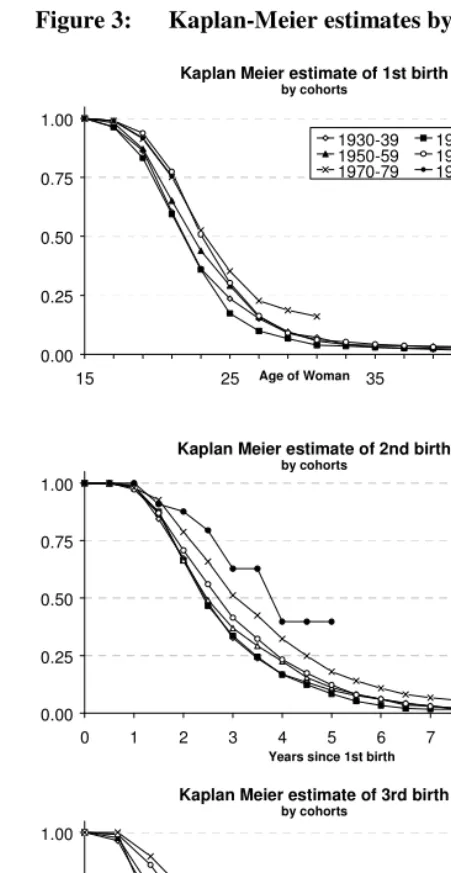
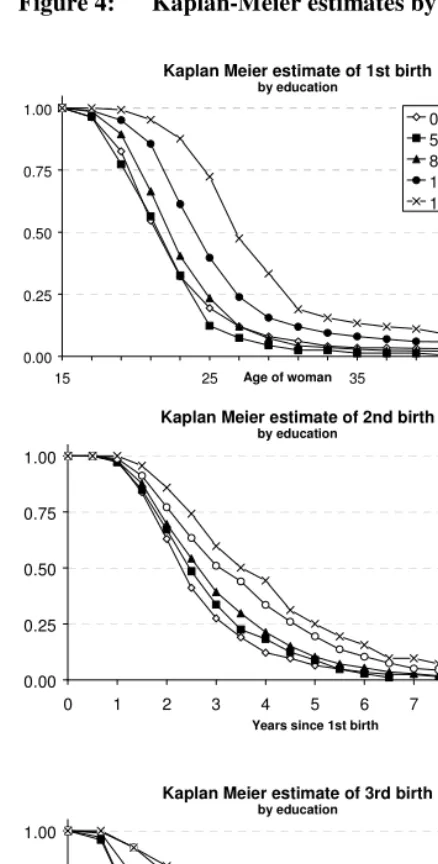
For the period before the late 1990s it was difficult to build any fertility histories due to the lack of individual data. Here, we use fertility histories based on data from the Albanian ALSMS in 2002. As well as describing the trends, semi-parametric statistical survival techniques are used to analyze the fertility differentials in Albania, based on demographic and socio-economic characteristics. Figures 3, 4, 5, and 6 show the results of the Kaplan Meier estimates by birth cohort, education, region, and rural/urban division against birth order. Since the purpose of this paper is to describe the fertility
Figure 1: Total period and cohort fertility rates, 1950-2000
2.0 3.0 4.0 5.0 6.0 7.0 8.0 9.0
1950 1955 1960 1965 1970 1975 1980 1985 1990 1995 2000
C h il d re n p e r w o m a n 25.0 26.0 27.0 28.0 29.0 30.0 31.0 32.0 M e a n a g e o f c h il d b e a ri n g ( in y e a rs ) TFR CFR MACB
Source: Authors’ calculations based on data from the Institute of Statistics (INSTAT, 1992, 2003b).
Figure 2a: Age-specific period fertility rates, 1950-2000 0 50 100 150 200 250 300 350
15 - 20 20-24 25-29 30-34 35-39 40-44 45 - 50
Mother's age group
C h ild re n p e r th o u s a n d w o m e n 1950 1960 1970 1980 1990 2000
Figure 2b: Age-specific cohort fertility rates
0 50 100 150 200 250 300 350
15- 20 20-24 25-29 30-34 35-39 40-44 45-50
Mother's age group
C h ild re n p e r th o u s a n d w o m e n 1930-34 1940-44 1950-54 1960-64 1965-69
changes and explain the differentials by different socio-economic characteristics, rather than analyze the quantum and tempo changes of Albanian fertility, this paper analyses some of the main variables, such as cohort, education, and rural/urban residence, against birth order in order to understand why and how fertility decreased in Albania. The fertility changes due to the other two variables (region and poverty level within the household) are presented for all births together as they did not reveal any differentials by birth order. Interpretation of the time dimension is somewhat difficult since some women were aged 15 when they gave first birth. The time to the second birth event is measured as that which has elapsed since the first birth, and for the third birth it is the time that has elapsed since the second birth. However, what we are interested in are the overall differentials more than differences by birth order.
Previously, we emphasized the role of education in the reduction of fertility in Albania (Falkingham and Gjonça 2001), but we were unable to quantify this effect. Figure 4 shows clearly the difference in fertility between women with different levels of education and by birth order, with the most educated being later entrants and having a lower level of childbearing for all birth orders. It is interesting to see the behaviour of the women with the two lower levels of education. When birth orders are compared, the effect of educational differences is apparent in all of them, but this effect is most evident in respect of the third birth. Note that even low levels of education make a difference when fertility is considered. This is particularly the case between the lower levels of education (0 to 4, 5 to 7 and 8 to 11 years) when the third birth is analyzed. While for the first birth the differences between these levels of education are not significant, for the third birth they are distinctive. The very small differences for the lower three levels of education where the first birth is concerned again prove that having a first birth in Albania remains universal even today. For the first birth, it is worth noting that women with 5 to 7 years of education have the highest likelihood of having more children, closely followed by women with 0 to 4 years of education. This can be explained by the fact that the groups with these levels of education are mainly the oldest cohorts (Gjonça 2001). For them, the traditional values are universal and widespread; the only difference resulting from the additional years in education would be in the time of childbearing, rather than in the number of children.
childbearing in the urban areas (see Figure 5). These differences are more evident for the third birth. The rural/urban differences seem to be not very significant when compared to the experiences of other developing countries. However, this could be specific to the Albanian case, where the country experienced the lowest income inequality in the whole of former Eastern Europe (Gjonça, Wilson, and Falkingham 1997, Gjonça 2001). The narrowing of the income gap between the rural and urban areas and, in particular, the improvement of female education in rural areas was seen as a priority by the former communist government. These two policies might have had an effect in minimizing the fertility differences between the urban and rural areas.
The Living Standard and Measurement Survey allows us to build a poverty variable based on both consumption and income levels of households. As for the poverty variable for the fertility differences by regions and rural/urban locations, this variable does not reveal a significant effect on the fertility level in Albania.
Very important in this analysis is the role of education (investment in the social agenda) relative to the other variables that show the level of development in the country, such as region and poverty variables. It is of particular importance when the policies affecting fertility change in Albania are considered later in this paper. It emphasizes the greater importance of the policies addressing the social agenda in the country, compared with those addressing economic development.
4. Emigration and fertility in Albania
Figure 3: Kaplan-Meier estimates by cohorts and birth order
Kaplan Meier estimate of 1st birth by cohorts
0.00 0.25 0.50 0.75 1.00
15 25 Age of Woman 35 45
1930-39 1940-49 1950-59 1960-69 1970-79 1980-86
Kaplan Meier estimate of 2nd birth by cohorts
0.00 0.25 0.50 0.75 1.00
0 1 2 3 4 5 6 7 8 9 10
Years since 1st birth
Kaplan Meier estimate of 3rd birth by cohorts
0.00 0.25 0.50 0.75 1.00
0 3 6 9 12 15
Years since 2nd birth
Figure 4: Kaplan-Meier estimates by education and birth order
Kaplan Meier estimate of 1st birth by education
0.00 0.25 0.50 0.75 1.00
15 25 Age of woman 35 45
0 - 4 yrs 5 - 7 yrs 8 - 11 yrs 12 - 15 yrs 16+ yrs
Kaplan Meier estimate of 2nd birth by education
0.00 0.25 0.50 0.75 1.00
0 1 2 3 4 5 6 7 8 9 10
Years since 1st birth
Kaplan Meier estimate of 3rd birth by education
0.00 0.25 0.50 0.75 1.00
0 3 6 9 12 15
Years since 2nd birth
Figure 5: Kaplan-Meier estimates for all births by rural/urban division
Kaplan Meier estimate of 1st birth by urban - rural
0.00 0.25 0.50 0.75 1.00
15 25 Age of woman 35 45
urban rural
Kaplan Meier estimate of 2nd birth by urban - rural
0.00 0.25 0.50 0.75 1.00
0 1 2 3 4 5 6 7 8 9 10
Years since 1st birth
Kaplan Meier estimate of 3rd birth by urban - rural
0.00 0.25 0.50 0.75 1.00
0 3 6 9 12 15
Years since 2nd birth
Figure 6: Kaplan-Meier estimates for all births by four major regions
Kaplan Meier estimate of 1st birth by region
0.00 0.25 0.50 0.75 1.00
15 25 Age of woman 35 45
Coastal Central Mountain Tirana
Kaplan Meier estimate of 2nd birth by region
0.00 0.25 0.50 0.75 1.00
0 1 2 3 4 5 6 7 8 9 10
Years since 1st birth
Kaplan Meier estimate of 3rd birth by region
0.00 0.25 0.50 0.75 1.00
0 3 6 9 12 15
Years since 2nd birth
feature will necessarily exclude an important part of those working abroad. As a result, it is difficult to use this data source to establish possible links with emigration and fertility outcomes.
However, aggregate data sources do give some clues to this issue. In the early years, migration was initially male dominated and thereby reduced the potential for childbearing due to the lack of matching partners. This might have affected the level of fertility initially, at least in the early years of the 1990s. Later, however, the gender difference became much more balanced, and it is believed that by the late 1990s this effect became negligible. Another issue to consider here is that migration is usually selective in terms of the individual education, place of residence, and work history. However, the census data showed that in Albania emigration has affected all areas of the country (INSTAT 2004c), people with different levels of education, and people from different social groups. In that respect the effect on fertility has not been unequal in different areas or within different groups of the population. Another relevant issue concerns remittances. As far as fertility decisions are affected by economic circumstances, one would expect remittances to have a positive effect on fertility. By and large, emigration is driven by difficult economic circumstances in the country of origin, and clearly remittances play an important role for household survival. From the 2002 ALSMS we know that one-third of household budgets came from remittances (World Bank 2003). This is a substantial amount and will affect all processes that are in any way income-related, and here, of course, childbearing is not an exception. However, as we have demonstrated, fertility has certainly decreased during this period and thus the effect of remittances on fertility is not a significant one. Therefore, it has to be concluded that factors other than income have driven the reduction of fertility since 1990. This is also supported by the results of our analyses, which show that poverty is not a significant factor in explaining variation in fertility in Albania during past years.
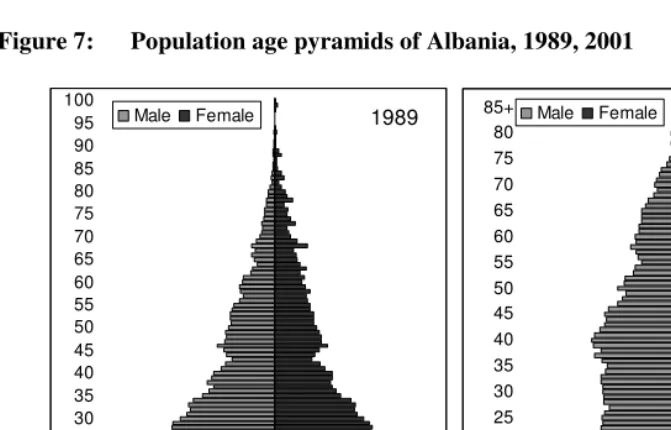
Figure 7: Population age pyramids of Albania, 1989, 2001
1989
0 5 10 15 20 25 30 35 40 45 50 55 60 65 70 75 80 85 90 95 100
Male Female 2001
0 5 10 15 20 25 30 35 40 45 50 55 60 65 70 75 80
85+ Male Female
Source: Authors’ calculations based on data from the Institute of Statistics (INSTAT, 1991, 2002).
5. The proximate determinants of fertility in Albania
While work has been done on the trends and patterns of fertility in Albania in the past 50 years, not much is known about the proximate determinants of fertility in Albania. This paper looks at the proximate determinants of fertility in Albania for the first time, using data from the Albanian Reproductive and Health Survey (ARHS) conducted in 2002 (INSTAT, 2003a).
5.1 Marriage
society remains traditional. This is interesting if one takes into account that despite dramatic improvements in education, and in female education in particular, the marriage pattern still has not changed in Albania. This is also supported by the fact that the mean age at marriage has changed very little. Thus, in 1950, the mean age at marriage for a female was 22.0 years, while in 2000 it was only 23.0 years. The same applied for men, with a mean age at marriage of 27.7 years in 1950 compared to 28.1 years in 2000. The picture is quite different when compared with neighboring countries, such as Greece, where in 2000, the mean age at marriage for females was 28.6 and for males 32.8, and Serbia and Montenegro, where the figures were 26.8 for females and 30.6 for males. As for the age at marriage, the marriage rate has not changed much. The crude marriage rate (marriages per thousand of population) in 1950 was 10.1 (INSTAT, 1992); in 2001 it was 8.4 (INSTAT, 2003b). It is understandable that with these high marriage rates, childbearing continues to be within marriage. Vital statistics show an insignificant number of children being born outside marriage. In 2003 the number of births out of wedlock was less than 0.5% of all births. Since marriage rates are so high one would expect cohabitations to be very low. Indeed, among the young population, those aged from 15 to 29, the proportion cohabitating was 0.2% (INSTAT 2005). Despite the strong traditional values, there are signs of increased cohabitation in Albania, in particular within the younger age groups. The introduction of new legislation (the Family Code) in 2003 is expected to affect the levels and trends of marriage and cohabitation.
5.2 Induced abortion
unwanted pregnancies themselves. Another may be the under-reporting of illegal abortions outside the medical system, and yet another may be the tendency to classify induced abortions as spontaneous or as miscarriages. Comparing the survey figures over time reveals a declining trend in the abortion ratio: the figure of 73 quoted above compares to the figures of 241 in 1999 and 172 in 2001 (INSTAT, 2003a). Prior to 1990 abortion was illegal so earlier records are not accurate. In 1991, abortion was legalized through a decree of the Council of Ministers approving the activities of family planning clinics in Albania. The law for the interruption of pregnancy which was later passed in parliament (1995) allows the termination of a pregnancy within the first 22 weeks for health and social reasons, and within 12 weeks for psychological reasons.
Figure 8: Proportions of Albanian female population married in 2001,
by place of residence
Female married population in 2001 (in %)
0.00 0.10 0.20 0.30 0.40 0.50 0.60 0.70 0.80 0.90 1.00
10 15 20 25 30 35 40 45 50
total rural urban
5.3 Knowledge and use of contraception
The analysis of fertility by age suggests an increase in childlessness among the young generation (or a postponement of childbirth to later years). It is only reasonable to assume that this has been a consequence of the introduction of modern methods of contraception. However, different sources of information give conflicting evidence on the issue. The ARHS data show that nine out of ten Albanian women know of at least one modern method of contraception, and about 87% know of at least one traditional method of contraception. While 81% of women know about condoms, only two-thirds have heard of oral contraception and less than 35% have heard of any other modern contraceptive methods. The situation is very similar for men. There is a strong belief that traditional methods are better than the modern ones, in particular, the importance of withdrawal versus the use of a condom. While the prevalence of any contraception is high among the married population (about 75% of women and 77% of men), the adoption of modern methods is very low at 8% for women, and 3% for men. Modern contraceptive use was found to be high only in women with higher education and living in the capital, Tirana (INSTAT, 2003a).
5.4 Age and frequency of intercourse
The age of first sexual intercourse in Albania remains relatively high compared to other European countries. The ARHS data indicate that the proportion of women who experienced sexual intercourse before the age of 18 was 10% for women aged between 40 and 44 and 16% for women aged between 20 and 24. The average age for first sexual intercourse for women was 21.1 years, only a few months younger than the average age of first marriage, at 21.9 years. Usually the first birth follows at an age of 23.4. For men the age of first sexual intercourse is similarly late (21.5 years). The median age at first marriage for men is 26.5 years.
6. Population and social welfare policies in Albania
“The essence of the socialist law of population is the full employment and rational utilization of all sources of labour, the ceaseless growth of the population, the ceaseless raising of the material and cultural well-being of the people.”
It is important to start this discussion by explaining the difference between the explicit and implicit population policies implemented in Albania. In an environment where fertility was already high due to strong traditional and cultural norms, the government did not need to have any explicit population policy in order to increase the level of fertility. However, other population policies, such as the reduction of infant and maternal mortality policies, had an indirect effect on fertility reduction in Albania. The communist government also invested considerably in improving the social agenda of the country through policies that would have a significant effect on the level and pattern of fertility in Albania, not just in the period 1950 to 1990, but also to the present day. The discussion that follows will be focused on two main streams of factors and policies, the ones that tended to keep fertility high during the past 50 years and the ones that reduced the fertility from 6 to 2.2 children per woman.
6.1 Pro-natalist environment and traditionalism kept fertility high in communist Albania between 1945 and 1990
In contrast to most other communist states of Eastern and Central Europe, which produced considerable pro-natalist propaganda, population issues were given little attention in Albania. The literature on the country tells us that there was no debate on population policy in Albania during the communist rule, either in policy discussion or in research work (Macura 1974). In fact, the only population-related policy was the reduction of infant and maternal mortality, and all demographic developments were seen in connection with this policy.
There were two sets of factors that kept fertility high in Albania. First were the pro-natalist environment and policies. Second, there were the traditional and cultural norms which were very strong in the patriarchal Albanian society in the aftermath of WWII.
6.1.1 Pro-natalist environment and policies
Contraceptives were not widely available and unlike in many European communist states, abortion was prohibited by law. It was only permitted on very narrow medical grounds, making Albania’s abortion law by far the most consistently restrictive in Eastern Europe (David 1970). Also there were no incentives to provide any form of education or information on the use of contraception; in a patriarchal society, the lack of knowledge about contraception would in effect restrict its use even if it were available. Contraception was never prohibited, but neither was it promoted. The main means of birth control was coitus interruptus; this has remained so to the present day, despite the availability of contraception and abortion (INSTA 2003a, INSTAT 2005).
Other areas of state policy also acted to sustain the high fertility level, either through strong financial incentives for mothers, or through the reduction of the ‘cost’ of childbearing. In order to encourage women to join the labour force, extensive provision of pre-school care was introduced. Infants and children under the age of three could be placed in daycare or even overnight accommodation for fees payable by the parents and their employers. All children aged between three and six were entitled to a free place in a state-funded kindergarten. This had a double benefit for the state: women were freed from childcare responsibilities and were thus able to work; and children could be inducted into the socialist education system at an early age. It also created a significant externality favoring large families.
Other policies reduced the ‘cost’ of children, both directly and indirectly. The price of children’s clothes was kept deliberately low. Canteens were provided both at the workplace and in local residential areas to lighten women’s loads, as were launderettes and labour-saving devices to assist women to combine their roles of workers and mothers (Hall 1994). Albania also adopted the Soviet practice of presenting medals to women who were particularly fecund, and this continued right up to the end of the 1980s. On the first birthday of the eighth surviving child a woman was awarded the accolade of ‘Heroic Mother’, while third, second and first class awards of ‘Mother’s Glory’ were bestowed on women with between four and seven children.
could react more quickly to the introduction of new policies. Second, the way employment was regulated in the rural areas meant that the financial benefits of the pregnancy leave were not significant in the agricultural cooperatives. Nonetheless, the increase in the pregnancy leave did have an immediate beneficial effect on infant mortality: in the following year, 1982, the infant mortality rate dropped by 18%, with mortality at two to five months being most affected (Skenderi and Vejsiu 1983).
These measures, applied in a traditional society like Albania where children were already seen as beneficial, only served to reinforce the psychological base for a large number of children (Falkingham and Gjonça 2001).
6.1.2 Cultural and traditional values
was even included in the constitution. The constitution of the People’s Socialist Republic (PSR) of Albania (Article 41) stated:
‘The woman enjoys equal rights with a man in work, pay, holidays, social security, education, in all social-political activities as well as in the family’ (Kuvendi Popullor 1976).
The move towards equal rights, despite being sanctioned by law, was a slow process. On the one hand, improvements in rights and equality in educational institutions and the workplace took place, but on the other hand, the traditional norms were enforced and survived in families and households in many parts of the country, in particular the countryside and the highlands. In these parts of the country women faced the double burden of having to work full time and at the same time cope with all the household responsibilities, despite the authority of the ‘master of the family’ being considerably reduced. Although the legislation had been introduced, its implementation was difficult. For example, when the divorce legislation was changed in 1970, giving both men and women equal rights to divorce, the person suing for it had to present the case publicly in court, thus making it not just difficult, but also creating a lack of privacy and showing ‘interference’ from the state. The situation has changed significantly today, but equal rights at home are still an issue that deserves to be addressed in current Albanian society.
6.2 Social and economic policies reducing fertility in communist Albania between 1945 and 1990
Although there were few explicit family planning policies, there were other social and economic policies that had a much more significant and implicit effect on fertility in Albania, in particular the ones that improved the social agenda in the country. There were two main achievements of the communist policies that affected the level of fertility in the country. First, the improvement in female education, and second the improvements in the employment rates for females.
proclaiming the eradication of illiteracy. This success was accepted even by the harshest critics of Albanian communism (Logoreci 1977). More importantly, the 1946 constitution of the country guaranteed free education for all, which opened the doors to all strata of society, most importantly the rural population. The promotion of education remained high on the communist agenda even in the last years of its existence. Thus, by 1985 the government was spending about 29% of its budget on education (Misja, Vejsiu, and Bërxholli 1987). This is unprecedented for any former communist government in Eastern Europe. In terms of enrolment, Albania had a broad-based system, with more than 90% of pupils completing compulsory primary education, and 70% of them continuing into secondary education. From these, more than 40% went on to university (Gjonça 2001).
Attention was paid to female education, in particular in the less developed areas of the country. It is well known that improvement in female education has a significant effect directly and indirectly on the level of fertility and other demographic processes (Caldwell 1986, Caldwell and Caldwell 1991). Table 1 shows the percentages of female students at all levels of education. It is clear that dramatic improvements were made during the period under consideration, and at the end of communist rule female education was on a par with male education. There is an important point to focus on here with regards to fertility changes: in 1967 Albania banned religion, with the government arguing that it was the major source of female oppression. Unquestionably, female educational opportunities improved, and the figures show that. The increase in the number of female students in secondary (not compulsory) and higher education in 1970 and 1980 is exceptional. This also affected the employment rates for females, and by 1970 we see most of the improvement. These measures are the ones most likely to account for the sharp decline in fertility in the following years from 1970 until 1980 (Figure 1). It has to be emphasized that these results were part of a whole package of measures giving women equal rights with men. All these measures together made the decline in fertility in the 1970s sharper than in previous periods.
It was not only female education that the communist regime invested in. Since the government was interested in full female employment, it also invested in the pre-school education system, creating a system of day-care nursing and kindergartens across the whole country. By 1970 women made up 45.3% of the labour force, an increase of more than one-quarter compared to 1960 (35.9%). Although the authority of the ‘master of the family’ was greatly reduced, the old patriarchal system survived, especially in the highlands.
“The State gives special protection to the interests of mother and child”.
In order to improve maternal and child health, medical care and prescriptions for pregnant mothers and for infants were free. There is a wide range of literature showing that the reduction of infant mortality to historically low levels generally leads to a reduction in the level of fertility (van de Walle 1986, Palloni and Rafalimanana. 1999). In the case of Albania, Gjonça, Aassve, and Mencarini (2006) found that the survival of a child had a strong effect on fertility reduction in the country. The 1950s and the 1960s saw most of the improvement in under-five mortality, reducing it to less than half of the 1950 value. This in itself could explain a significant part of the reduction of fertility in the late 1960s and early 1970s.
Table 1: Percentages of female students at different levels of education
1938 1950 1960 1970 1980 1990 2000
Primary education 32.4 45.4 42.3 46.9 47.2 47.9 48.6 Secondary education 22.0 28.8 29.8 40.9 44.7 45.0 49.2 Higher Education n/a n/a 16.6 32.5 49.6 50.1 61.4
Source: INSTAT 2000).
6.3 Transition and the new setting for ‘family planning’ in Albania, 1990-2006
The period after the collapse of communism was characterized by the introduction of many new laws and policies to regulate the transition to a more market-oriented and modern society. In this context, population policies were no exception. One of the first changes in legislation that the Albanian government introduced in 1991 was the legalization of abortion, which brought about a dramatic increase in their number, from almost zero to about 172 per thousand live births in 2002 (INSTAT, 2003a). Contraception became widely available, but the level of information and education for its use were, and still remain, very low. Another important policy was the increase of maternity leave from six months to nine months. All these changes took place in the early 1990s and should have had some effects on the level of fertility.
implied by recently introduced family planning policies are reflected in the use of birth control. While the practice of abortion has increased rapidly, the use of contraception is still very low, due to a lack of knowledge. Sex education has just been introduced in the secondary system, but it comprises a one-off lecture and is presented only in the secondary school systems in the main cities. It is precisely because of this that Albania is not experiencing a decline in fertility as sharp as that experienced in Southern Europe.
It is worth noting that education continues to remain high on the agenda of Albanians even after the collapse of communism and the introduction of the market economy. The 1990s experienced a few changes with regards to enrolment. The gross enrolment rate for primary education has decreased from 102% in 1990 to about 99.8% in 2002. While secondary enrolment has decreased from about 80% in 1990 to 44% in 2002, university enrolment has gone up by 5%. The drop in enrolment for secondary schooling is very significant. This may be due to the increased poverty and inequality in the country which has forced a large number of secondary students to enter the labour market. Illiteracy rates do not show much difference between the overall rates for males and females: the LSMS data show an illiteracy rate for males of 2.8% and for females of 6.2%; the census data show an even smaller and insignificant difference (1.2% and 1.9%). For a traditional society such as the Albanian one, this overall parity represents the achievement of social equality between genders, particularly as any remaining differences can be attributed to illiteracy in the older generations, where female illiteracy for over 60 years is about 34.8% and that of males only 12.4%.
When educational attainment is examined, it is clear that overall male/female differences are very small. Thus, for primary education the number of female graduates is higher at 52% of all graduates. For secondary education female graduates represent 47% of all graduates. The only level of educational attainment where there is a clear male advantage is the university level, where female graduates comprise just 41% of all graduates. However, this pattern will change in the years to come as the number of new students registering at university in the last 10 years has increased for females and decreased for males. By 2000 more than 60% of students registered in universities were female (INSTAT, 2000).
country and in particular in the urban areas, where the rate reaches a peak of 45.5% (excluding Tirana).
Female participation in the labour market has decreased from 47.4% in 1989 to 40.7% in 2001, and 45.1% of women not working outside the home are categorized as housewives. This represents about 22.7% of the total active female population, which means that the proportion of housewives has increased. Once unemployed or made redundant, a woman finds it hard to return to the labour market, particularly in the private sector, and in most cases she decides to remain at home.
Table 2: Unemployment rates by sex and place of residence for
the 1989 and 2001 censuses
1989 Census 2001 Census
Men
Tirana urban 10.4 19.7 Other urban 10.7 22.8 Rural 5.5 16.4 Country 7.4 18.8 Women
Tirana urban 14.5 34.3 Other urban 16.3 45.5 Rural 10.1 14.5 Country 12.4 28.4 Total
Tirana urban 12.4 26.1 Other urban 13.4 33.0 Rural 7.7 15.7 Country 9.8 22.7
Source: INSTAT 2004a.
7. Concluding notes – family planning policy in Albania
At about 2.2 children per woman, the level of fertility in Albania continues to be high compared to other European countries. If the trend continues and follows the experiences of other South-Eastern European countries, the next five years will see the level of fertility in Albania falling below the replacement level. Despite its present high level by European standards, Albanian fertility dropped dramatically in a short period of 50 years from 7 to 2.2 children per woman.
At the start of this paper we discussed the interplay between implicit and explicit policies in Albania during the communist period through to the present day. There was no explicit population policy in Albania during the period of communist rule until 1990: ideologically the government linked population growth to economic growth, and since there was already a high-fertility environment, there was no need for any population policy to help increase the level of fertility, as happened in some Eastern European countries. On the one hand, the government implemented a number of health policies that were aimed at reducing infant and maternal mortality, which indirectly affected the changes in fertility in the country. The reduction of infant mortality from 148 to 22 per thousand in a period of 50 years had a strong effect in reducing the level of fertility (Gjonça, Aassve, and Mencarini 2006). On the other hand the government implemented a considerable number of policies affecting social changes in the country, such as educational reform and, in particular, female education reform, which had a large effect in reducing fertility. Equal employment and full employment policies were again policies that affected the level of fertility in the country and these were followed by complementary policies to help mothers, such as a system of government sponsored nurseries and kindergartens. All of these policies created a more emancipated environment for women in which to make their own decision with regard to family formation, and all these policies had an indirect effect in reducing fertility.
The other dimension of the discussion in this paper was the interplay between
other age groups in the country (World Bank 2003). The interplay between traditional and modern values is also seen in the use of methods of birth control, where traditional forms of birth control (withdrawal is the dominant one) are still the norm. The use of modern methods of contraception is slowly but surely increasing, and changes are expected to take place here faster than changes in the marriage pattern. This is due to the availability of contraception and the dissemination of information among the younger population in recent years.
This discussion of the factors that affected fertility reduction in Albania was structured around the factors that sought to keep fertility high in Albania and those that decreased fertility over the past 50 years. It is clear from the analyses in this paper that the investments of the communist regime in the social agenda, in particular, policies and measures that improved women’s education and position within society and family, were by far the most important determinants in bringing the fertility rate down.
References
8 Nentori Publishing House. 1982. Portrait of Albania. Tirana: 8 Nentori. Publishing House. Aassve, A., Gjonca, A., Mencarini, L. November 2006. The Highest Fertility in Europe - for how
long? The analysis of fertility change in Albania based on Individual Data'. Working Paper of Institute for Social and Economic Research, paper 2006-56 (PDF) http://www.iser.essex.ac.uk/pubs/workpaps/pdf/2006-56.pdf. Colchester: University of Essex.
Ash, W. 1974. Pickaxe and rifle. Wimbledon: Howard Barker.
Bërxholli A., and P. Qiriazi. 1986. Albania: A Geographic Outline. Tirana: 8 Nentori Publishing House.
Caldwell, J. 1986. Routes to low mortality in poor countries, Population and Development Review 12(2): 171–220.
Caldwell, J., and P. Caldwell. 1991. The roles of women, families and communities in preventing illness and providing health services in developing countries, in J. N. Gribble, S. H. Preston (Eds.), The epidemiological transition: Policy, planning and implications for developing countries. Washington, DC: National Academic Press, pp: 252–271.
Coale, A. J. 1973. Demographic transition, in International Union for the Scientific Study of Population. International Population Conference, Liege, 1973. Vol 1. Liege, Belgium, IUSSP, 1973, pp: 53–72.
David, H. P. 1970. Family Planning and Abortion in the Socialist Countries of Central and Eastern Europe. New York: Population Council.
Dyson, T., and M. Murphy. 1985. The onset of fertility transition, Population and Development Review 11: 399–440.
Editorial Board of ‘New Albania’ (EBNA). 1984. Albania.Tirana: 8 Nentori Publishing House. Falkingham, J., and A. Gjonça. 2001. Fertility transition in Albania, 1950–1990, Population
Studies 55(3): 309–319.
Gjonça, A. 2001. Communism, Health and Lifestyle: The Paradox of Mortality Transition in Albania, 1950–1990. Westport, USA: Greenwood Press.
Gjonça, A., C. Wilson, and J. Falkingham. 1997. Paradoxes of health transition in Europe’s poorest country, Albania 1950–1990, Population and Development Review 23: 585–609. Golemi, B., and V. Misja. 1987. Zhvillimi i arsimit te larte ne Shqiperi. (Development of higher
education in Albania). Tirana: Mihal Duri Publishing House. Hall, D. 1994. Albania and the Albanians. London: Pinter.
Henshaw, K. S., S. Singh, and T. Hass. 1999. The incidence of abortion worldwide, Family Planning Perspective 25, Sup: 1–9.
INSTAT (Albania, Institute for Statistics). 1991. Population and Housing Census, 1989 – Principal Results. Tirana: INSTAT Albania.
INSTAT (Albania, Institute for Statistics). 1992. Statistical Yearbook of Albania 1991. Tirana: INSTAT Albania.
INSTAT (Albania, Institute for Statistics). (2000). The Yearbook of Educational Statistics.
Tirana: INSTAT Albania.
INSTAT (Albania, Institute for Statistics). 2003a. Albania. Reproductive Health Survey. Atlanta: US Department of Health and Human Services.
INSTAT (Albania, Institute for Statistics). 2003b. Statistical Yearbook of Albania 1993–2001.
Tirana: INSTAT Albania.
INSTAT (Albania, Institute for Statistics). 2004a. People and Work in Albania. 2001 Population and Housing Census. Tirana: INSTAT Albania.
INSTAT (Albania, Institute for Statistics). 2004b. Living Conditions and Inequality in Albania. 2001 Population and Housing Census. Tirana: INSTAT Albania.
INSTAT (Albania, Institute for Statistics). 2004c. Migration. 2001 Population and Housing Census. Tirana: INSTAT Albania.
INSTAT (Albania, Institute for Statistics). 2005. Becoming an adult – challenges and potentials of youth in Albania. Tirana: INSTAT Albania.
International Crisis Group (ICC). 1999. War in the Balkans: Consequences of the Kosovo conflict and future options for Kosovo and the region. Europe Report No 61, April 1999.
Keefe, E. K., S. J. Elpern, W. Giloane, J. J. M. Moore, S. Peters, and E. T. White. 1971. Area handbook for Albania. Washington DC: US Government Printing Office.
Kuvendi Popullor. 1976. The Constitution of the Socialist Republic of Albania. Article 14: 28– 41.
Logoreci, A. 1977. The Albanians: Europe’s forgotten survivors. London: Victor Gollancz; Boulder, CO: Westview Press.
Macura, M. 1974. Population policies in the Socialist countries of Europe, Population Studies 28: 369–379.
Mason, K., J. Myres, H. S. L. Winterbotham, F. Longland, C. F. Davidson, W. B. Turrill, N. White, and S. E. Mann. 1945. Albania. London: Naval Intelligence Division.
Misja, V., and Y. Vesju. 1985. Demographic Developments in the People’s Socialist Republic of Albania. Tirana: 8 Nentori Publishing House.
Misja, V., Y. Vejsiu, and A. Bërxholli. 1987. Popullsia e Shqipërisë. (Albanian population). Tirana: Mihal Duri.
Palloni, A., and H. Rafalimanana. 1999. The effects of infant mortality on fertility revisited: new evidence from Latin America, Demography 36(1): 41–58.
Skendi, S. 1956) Albania. London: Stevens and Sons.
Skenderi, K., and and Y. Vejsiu. 1983. The development of demographic processes and the socio-economic problems which emerge, in Institute of Marxist-Leninist Studies (Ed.), The national conference on problems of the development of the economy in the 7th five-year plan. Tirana: 8 Nentori Publishing House, pp: 155–164.
Spiegel P., and P. Salama. 1999. Kosovar Albanian Health Survey Report. Geneva, WHO. van de Walle, F. 1986. Infant mortality and the European Demographic Transition, in A. J. Coale
and S. C. Watkins (Eds.), The Decline of Fertility in Europe. Princeton, NJ: Princeton University Press, pp: 201–233.
World Bank. 1996. World Development Report 1996. Oxford and New York: Oxford University Press.