APPLICATION OF COMPUTERIZED MANAGEMENT
INFORMATION SYSTEM(CMIS) FOR A PAINT
MANUFACTURING INDUSTRY
Dr. Ramachandra C G1, Dr. Srinivas T R2, Rishi JP3, Virupaxappa B4
1Department of Mechanical Engineering Srinivas Institute of Technology, Mangaluru, India
2Department of Industrial and Production Engineering
Sri Jayachamarajendra College of Engineering, Mysuru, India 3
Department of Mechanical Engineering Vidyavardhak College of Engineerng, Mysuru, India
4Department of Mechanical Engineering
Dr M.V. Shetty Institute of Technology, Moodbidri, India.
ABSTRACT
In today’s business environment professional managers must learn how to use information technology to create competitive firms, manage global corporations and useful products & services to customers. Information systems today have become so vital to the management, organizational operations and products of large organizations. The work of an organization and its employees depends increasingly on what its information systems are capable of doing. Increasing market share, becoming a producer of high quality and low cost products, developing new products and increasing employee productivity depend more and more on the kinds and quality of information systems in the organization. Information systems are more than computers. All information systems can be described as “Organizational and Management Solutions to Challenges posed by the Environment”. In this paper, after studying the existing manual system in the Paint manufacturing industry and assumption is made to develop an information system under the concept of system approach. The department like marketing, production, stores and purchase are inter-linked for the better functioning of the organization. This will serve the management level of the organization providing managers with reports and in some cases with online access to the organizations current performance and historical records. This work is intended to serve the managers interested in weekly, monthly and yearly results.
Keywords: Application; Computerized; Management Information System; Manufacturing Industry:
INTRODUCTION
2
knowledge, learning and decision making of individual employees which in turn depicts the importance of computer based information system (CBIS). Formal systems rely on accepted and fixed definitions of data and procedures for collecting, storing, processing, disseminating and using these data. The formal systems are structured and they operate in conformity with predefined rules that are relatively fixed and not easily changed. Formal information systems can be either manual or computer based [02].
Yuemin Zhou, Bingfang Wu, Jihua Meng [03] developed a soil and water conservation-oriented small watershed management information system based on geographic information system and remote sensing technology. The main functions of the system include data management, data query, information analysis and decision support. The procedures developed will contribute to the decision support for the soil and water conservation planning. The system adopted the Client/Server mode and the database was built on the support of Oracle and ESRI ArcSDE technology. Based on the above, a small watershed-oriented management information system really was realized. Adriana Harizanova [04] attempted for analysis of the theory in the sphere of the Management Information System (MIS). The information needs of the various managerial levels are pointed out and the stages in the development of MIS are defined. The growing importance of the application of MIS in tailoring industry is shown. Bo Yan, Yiyun Chen, Guangwen Huang [05] introduces the main content and operation flow of the tax management information system as well as main functions of its subsystems. Then we describe the general structure and technical implementation strategy of the application system. The tax management information system can improve the taxation service, reduce the taxation cost, and provide reliable reference for macro-economic decisions.
MANAGEMENT INFORMATION SYSTEM
Management Information System (MIS) executives have the greatest challenges and opportunities in modern organizations [06]. The cost of operating organizations is going up at an alarming rate. Labor, management, physical plants, raw materials, energy and transportation cost are all more. The only exception to these phenomena is computer technology. Computer technology continues to offer increased performance that are often incomprehensible and for exceed implementation in organizations.
A.
Chracteristics of Management Inforamtion SystemThe important characteristics of Management Information System [07] are as follows
Management Oriented.
Management Directed.
Integrated.
Common Data Flows.
Heavy Planning Element.
Subsystem Concept.
Flexibility and Ease of Use.
Database.
Information as a Resource.
B.
Integration of Informaiton SystemIntegration of information systems is one of the essential concepts associated with management information system [08]. Systems can relate to one another in several ways that underline the need for their integration. Information flow between systems is useful when data in the file of one system is needed by another system but when it would be impossible for the second system to generate that data or when this approach would be more costly, slower or less accurate than using data from the first systems file. Thus integration is the interlocking of systems so that data from one system can be routinely passed to or retrieved by one or more other systems.
C.
Information FlowsTo work effectively in an organization [09] requires an understanding of how the organization functions. An important way to achieve this understanding is by analyzing the organizations information flows, which require an examination of its structure and activities and of the style of its managers. The hierarchy of an organization affects its information systems, the hierarchical structure is the fundamental framework around which the information system is organized. With few exceptions, the information system is organized to pass information upward along the lines of hierarchy. Information also flows downward along hierarchical lines in the form of policies and action guidelines. These types of information are less likely to be generated by the computer system and are usually less voluminous than the upward information flows. Information flows are not restricted to paths up and down the hierarch. Information also flows laterally with n an organization.
D.
Capabilites of a Computerized Management Information SystemA particular management information system [10] may have several technical capabilities designed into it. Collectively these capabilities entirely disprove the often-heard assertion that “A computer is only a high capacity adding machine or calculator it cannot do anything different, it can only do it faster”. Computer information systems can have a number of capabilities far beyond those of non-computer systems. These capabilities have revolutionized the nature of information systems and are revolutionizing the management process which uses the information that these system provide.
E.
Database Management System4
EXISTING MANUALLY MAINTAINED INFORMATION SYSTEM IN A
COMPANY
The paint manufacturing industry at present is maintaining a centralized information flow and it has every freedom regarding the flow of information either from the top level of managers to the lower level managers or vice versa i.e., the company is practicing both Bottom Up and Top Down design of the information flow. Regarding the external factors such as purchase and supply, the customers and vendors have to come through the managing director. The information regarding the purchase of finished goods by the customers and the supply of raw materials to the company by the vendors will be sent to the respective departments through the managing director only. The heads of various departments will then take care of the further proceedings. There is a good communication and understanding between the same hierarchical level and all should be in writing only. There is a general delay in typing and manual work and lot of time is wasted. Information regarding the orders, sales figures and inventory status, production for a particular period of for the day is not available on the spot. More man hours will be involved in generating the above reports. Besides, it is very difficult to follow up the activities immediately with the existing system.
A.
Information Flows, Data Collection and Analysis of DataThe information regarding the customers, their potentiality in placing the orders for different items and packing, the due date of supply, the mode through which the orders to be supplied is collected from the marketing department. Besides this, the sales data for the past three years is also collected. The orders place by various customers are analyzed and depending upon the demand an information is passed onto the production department requesting for the production of the same. The production department will analyze the requisition received from the marketing department and depending upon the various factors such as due date of supply, existing status of the raw materials, back orders and the assured supply of raw materials from the vendors which govern the start of the production, the department prioritizes the items to be manufactured. The production department will then look into the status of the raw materials and if is necessitates any purchase of raw materials, an information is passed onto the purchase department for the purchase of the same. The transactions made by the production department as well as marketing and stores are updated in the inventory of the stores for both finished goods and raw materials. The process continues for ever for making any decision.
SCOPE OF THE PRESENT WORK
hierarchical authority or responsibility structure. This work studies the existing system in the industry and proposes a computer based management information system. Record keeping is also made easier because input data’s can be automatically edited and equipment records can be standardized. It also highlights how business can use information systems to gain a competitive advantage. This system will not only limited to inter-relationship among various activities of the company, but also is aimed at better understanding and co-operation among employees of the organizational hierarchy. Besides, it explores the relationships with customers and suppliers. The scope of this research work includes the following departments such as Production Department, Marketing Department, Stores Department, and Purchase Department etc.
.
APPLICATION OF COMPUTERIZED MANAGEMENT INFORMATION
SYSTEM
This package is designed and developed using Asp Dot.Net as front end and My SQL as back end. The system provides real time information about the departments like Marketing, Production, Stores and Purchase are inter-linked for the better functioning of the organization. This work is intended to serve the managers interested in weekly, monthly and yearly results. A universal user friendly system gives all the information required by the employees at any of the nodes on the network. The details of the different input formats, menus, output formats, options provided are explained in brief in this designed software package.
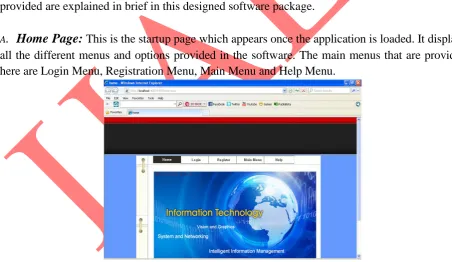
A. Home Page: This is the startup page which appears once the application is loaded. It displays all the different menus and options provided in the software. The main menus that are provided here are Login Menu, Registration Menu, Main Menu and Help Menu.
Figure 1. Home Page Window.
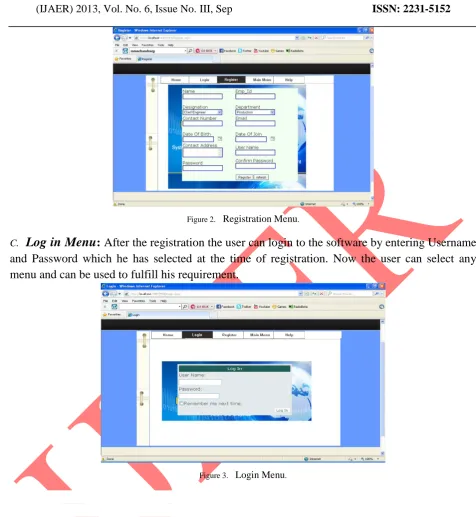
B. Register Menu: Before login to the software, the user has to register by entering the details
6
Figure 2. Registration Menu.
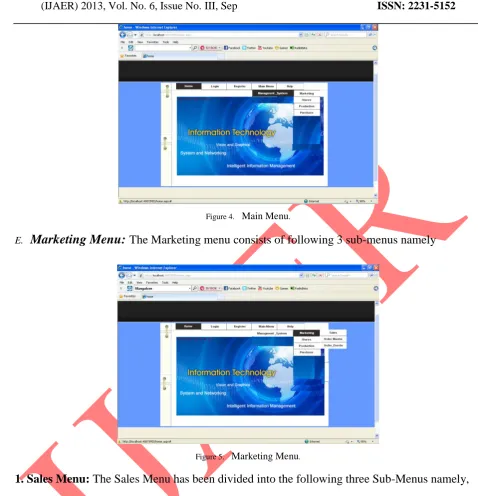
C. Log in Menu: After the registration the user can login to the software by entering Username and Password which he has selected at the time of registration. Now the user can select any menu and can be used to fulfill his requirement.
Figure 3. Login Menu.
Figure 4. Main Menu.
E.
Marketing Menu: The Marketing menu consists of following 3 sub-menus namely
Figure 5. Marketing Menu.
1. Sales Menu: The Sales Menu has been divided into the following three Sub-Menus namely,
a) Daily Sales: The daily sales contains the following information
Sales Type: This denotes whether the sale type is cash or credit. For cash sale a discount is fixed, whereas for credit sale it is zero.
Bill Number: The bill number will be auto generated.
8
To: Here the user selects from a choice of regular customers and counter sales. When regular
customer is selected, the list of name and address appears from the regular customer database. If it is a counter sale the user has to enter these himself.
Item Code: The user will select the item code from the drop down list and the corresponding name of the item will be displayed.
Packing: After selecting the appropriate item, the user has to strike the enter key to select the standard carton packing of the company. The packing input format consists of a table of three columns. The first column corresponds to different packing, the second one corresponds to unit price of that particular packing and the last column corresponds to the quantity.
b) Daily Sales Summary: This is about the abstract of the daily sales. When the user presses this menu, a report will be automatically displayed on the screen. A print out can also be taken using the print option of the report.
c) Sales History: When this is operated, a format will be opened indicating the three choices of viewing the different charts. There are 3 charts and the user can view each at a time by selecting the required option key as mentioned below.
Daily Sales: When the user presses this key, a chart shoeing the details of the daily sales summary will appear.
Sales Period Wise: Whenever the user wants the details of the sales between a period range, the user can select this option by pressing it.
Sales History: This will give the total sales turnover for the specified number of years.
2. Orders Master: The orders Master menu has been divided into the following 3 sub menus namely,
a) Orders: This input format is designed for the purpose of recording and storing the details about the orders placed by the different customers. The stored data after processing can be utilized for generating the reports such as the total quantity of a particular item placed by different customers.
b) Back Orders: Depending on the orders executed, the quantity of the back orders will be automatically displayed in the orders execution input format.
c) Requisition: This is about the report generated from the orders master. As soon as this is pressed, a message box will appear, asking the user to enter the range of dates for which report of the demand for different items and the total quantity for each item is required.
master. When the user selects the particular customer, order number, item name and order placed will be automatically displayed in the table. The user has to enter the quantity of the item delivered to get automatically the back order.
F.
Stores Menu: The stores menu consists of a sub-menu Inventory, this is the input format for storing the details of inventory of both the raw materials as well as the finished goods.
Figure 6. Stores Menu.
G.
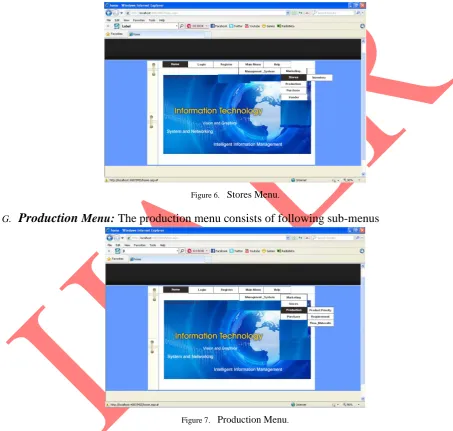
Production Menu:The production menu consists of following sub-menus
Figure 7. Production Menu.
1. Product Priority: Whenever a requisition is received from the marketing department, the production department will take care of prioritizing the items for production later. The item name, packing and quantity will be automatically displayed from the requisition report and only priorities are to be entered in the grid.
10
3. Flow of Material: This form is designed for the purpose of knowing inflow and outflow of the different raw materials from the stores. All the records are updated automatically in the Item Master as soon as the transactions are made from this input format.
H.
Purchase Menu:The purchase menu consists of following sub-menus
1. Purchase Order Suppliers: The user selects the vendor code from the drop down list. The vendor name and address will be automatically displayed. The order number is automatically generated.
2. Goods Received Note: The order number is automatically selected, the user selects the vendor code from the drop down list.
Figure 8. Purchase Menu.
.
RESULTS AND DISCUSSIONS
This is a comprehensive package for any small to medium scale industries. However, the depending upon the need of a client the package can be enhanced or altered. This package can also be implemented on a network connecting all the department and make the system a completely an integrated one. The company with the diversified production lines has now become the pioneers in manufacture and supply of decorative coatings and industrial paints to the various governments, state owned public undertakings, boards, corporations and private industries through established dealers and sales depots. This involves lot of paper works in its day to day activities. Manually maintained information systems are found too tedious either to produce reports or to make decision at the right time. Hence it is recommended that computerized information systems are utmost essential so that the efficiency of the company can further be enhanced to a greater extent.
across and varying market share in different places involve lot of paper works, which can be eliminated gradually by adapting computerized Management Information System and hence, the improved performance of the company. If the company decides to change its present system to the newly developed computerized information systems, all the unnecessary waste of time spent in manual work can be completely eliminated. Besides, information regarding the inventory, sales figures, production and purchase for a period or on the day will be available on the spot. Planning of men, material and machine can be properly planned so as to economically manufacture the products.
It is the human tendency that they never switch over to another “New System” as they are in the false conclusion that they are far better than the computers and do well manually what is required by the top managers without taking into consideration the speed and accuracy of the computer systems. Sometimes they hesitate to work with the computers, as it is completely a new one to them. But, in reality, if they practice doing with the computer systems, gradually they can become used to it. Once the MIS is implemented, the system has been run on a test and it can be implemented in a phased manner. First, it is used side by side with existing manual system to get familiarization and to get the staff used to it. Later once the user familiarize with the system, the new system alone can be maintained.
CONCLUSIONS
The proposed computerized maintenance management information system has been designed by keeping in mind the user requirements as the primary concern, moreover the system has been designed in such a way that further modification to the system can be made with ease. This information and communications system is designed to assist management in controlling department like marketing, production, stores and purchase which are inter-linked for the better functioning of the organization. This will serve the management level of the organization providing managers with reports and in some cases with online access to the organizations current performance and historical records. This work is intended to serve the managers interested in weekly, monthly and yearly results. The advantage and effectiveness of a computerized management information system depends to a large extent on the awareness of the user. It is necessary to review the system periodically and identify the improvements required. An effective Management Information System supplies accurate, relevant and timely information to the manager of an organization.
REFERENCES
[1] Kapur, Jagadish C “Management Information Systems: A conceptual Frame Work”,
Part-I and Part-Part-IPart-I, Part-Indian Management, 1982.
[2] Davis, Gordan.B, “Management Information Systems”, Mc.Graw Hill (International
Editions) Book Company Singapore, 1985.
12
[4] Adriana Harizanova, “The Management Information System in Tailoring Industry”,
Academic Journal, vol.09, 2003.
[5] Bo Yan, Yiyun Chen, Guangwen Huang, “Design of Tax Management Information
System”, IEEE-2009.
[6] O’Brien, James A. “Management Information System: A Managerial End User
Perspective”, Galgotia Publications (P) Ltd., Delhi 1991.
[7] Goyal D.P, “MIS Concept and Application”, Ist Edition Deep and Publications, 1994.
[8] A Muralidharan “Mangement Information Systems”, A.I.C.T.E Continuing Education
Program, Jan 1996.
[9] McLeod R, Schell G, “Management information systems”, Prentice Hall PTR, Paramus,
USA, 2003.
[10] Kenneth C.Laudon, Jane P. Laudon, “Management Information System”, America: