www.ijaer.in Copyright © IJAER 2019, All rights reserved Page 867
THE EFFECT OF CONCENTRATE CONSUMPTION ON CALF
WEANING TIME AND PERFORMANCE
1Serap Goncu (Prof), 1Sibel Bozkurt (MSc), 1*Muhammed Ikbal Yesil (PhD)
1Department of Animal Science Cukurova University, Adana, Turkey
*Corresponding Author
ABSTRACT
In this study, the effect of average daily concentrate consumption on calf weaning time and performance was studied for better calf raising performances. Forty male calves were allocated to four treatments. The first and second groups consisted of weaned groups on days 35 and 70 which only considers the duration, regardless of the consumption of the concentrate. In the second and third experimental groups, 700 grams of feed consumption was taken for 2 or 3 consecutive days. The daily feed consumption of calves was monitored and weaning was performed when 700 grams of concentrated feed consumption were consecutively used for 2 or 3 consecutive days. All calves consumed daily 4 L whole milk in two meals during the liquid feeding period. They also had free access to alfalfa straw and calf grower after first week. The calves were tested at similar birth weight on the 35th and 70th days and the differences between the groups were not statistically significant. However, weaning times of the groups showed significant (P<0.01) differences varying between 25 days and 70 days. Two calves were excluded from the trial due to health problems in the weaned group considering the 2-day concentrate feed consumption. This study showed that taking advantage of concentrated feed consumption in weaning of calves can be advantageous without decreasing performance.
Keywords: Average concentrate, Feed intake, Holstein calf, Performance, Weaning
1. INTRODUCTION
www.ijaer.in Copyright © IJAER 2019, All rights reserved Page 868 sufficient size and function in calves supports calf development by reducing morbidity and mortality. The most fundamental physiological change in young ruminants is weaning. The from birth to weaning period is critical time for cattle life time production. During this period mortality rates and feed costs can minimize using proper feeding and management while maintaining good performance. Ideal calf loss rate must be less than 5%. This goal can be obtain just reducing stress, controlling disease, good feeding and management. Studies have shown that weaning can be performed early and this will be beneficial in terms of calf development and farm economics and it will provide important advantage in calf rumen development.
The performance of the calves during the liquid feeding period affects the lifelong yield characteristics directly or indirectly (Soberon et al. 2012). Liquid nutrients delay rumen development in calves because they reduce consumption of solid feeds and insufficient production of volatile fatty acids (VFAs) and adversely affect feed consumption and performance after weaning (Khan et al. 2007a; Berends et al. 2012; Lukas et al. 2007).
In weaning, the ability to meet the nutrient requirements and the development of rumen should be considered rather than the age of the calf (Drackley, 2008; Lorenz et al. 2011). Water, milk and concentrated feed consumption are used as weaning criteria in the world. Because sufficient feed intake of calves is a prerequisite for the rumen function and increase in feed utilization. Nutrition in order to reach a sufficient size and function of calves’ rumen supports calves’ development by reducing the morbidity and mortality of (Khan et al., 2007b). The most fundamental physiological change in young ruminants is weaning (Baldwin et al. 2004).
Fluid feeding period in calves generally varies. It is stated that calves should drink at least 100 liters of milk during the growth period, and more than that are related to milk sales price and feeding program of the enterprise. In dairy cattle holdings, studies are gaining weight on early weaning aimed at both increasing the amount of salable milk and developing programs that will ensure healthy growth (Lengemann and Allen, 1959; Jones and Heinrichs, 2007).The care provided during the first years of life affects the health, development and lifelong productivity in the later life. From 140 liters up to 360 liters of milk drinking programs are used during the
weaning period (Sekerden and Ozkutuk, 1997).
However, in all studies, the main measure of weaning of calves is rumen development, and calves that can benefit from rough and concentrate feeds can be weaned (Keles, 2010). A relationship between concentrate feed consumption and rumen development of calves has been established (Savage and McCay, 1942). Feeding only with fluid (Brownlee, 1956) greatly reduces the rate of ruminal tissue and papillary growth (McCandlish, 1923; Tamate et al. 1928)
www.ijaer.in Copyright © IJAER 2019, All rights reserved Page 869 calves who can switch to solid feeds early increase therefore can be considered as an indicator of weaning (Quigley et al., 1991). However, with the development of rumen microorganisms after microbial digestion begins glucose in blood begins to decrease, the amount of VFA begins to increase (Church, 1979; Kocabatmaz et al., 1989).Morrill (1984) and Morrill et al. (1984)
reported an early weaning program at 2 to 4 weeks of age instead of 5 to 11 weeks with tasty calf starter feeds. In addition, it has been reported that the bacterial population in the rumen of calves which are eligible for switching to consume solid feeds at the age of 3 weeks has started to increase (Perston, 1956; Quayle, 1958; Anderson et al., 1987; Goncu et al. 2014).
Anderson et al. (1987), in an early weaning program, calves in one group continued to be fed with liquid until they consumed 227 g / d starting feed, and weaned at the age of 4 weeks while calves in the other group were fed by milk and starting feed and weaned at 6 weeks of age. The researcher also found that the daily concentrate feed consumption of early weaned calves at the age of 2-4 weeks was 180 grams while 60 grams in the control group; 1478 grams of concentrated feed consumed between 5-8 weeks, while the other group consumed 1044 grams. This difference continues after weaning 2623 grams of consumption versus 2270 grams of feed consumption is expressed. The researcher explained that faster rumen development was observed in early weaned calves by using data related to rumen metabolism.
Hopkins (1997) reported that the calves weaned at the age of 28 days and 56 days were of similar structure and that the similarity persisted when they reached the age of 90 days. It also stimulates the development of rumen with earlier and more concentrated consumption in addition to providing economy with less milk consumption of calves that have been weaned early. Dogan (2014) in a study on the effects of early weaning age on growth performance of black-white calves by 5 and 8 weeks age of weaning programs of calves in 3 different hosting systems as individual, group and individual+group reported that early weaning of calves doesn’t cause harm at lifelong performance but it is important to be housed in the individual + group compartment instead of the individual compartment in terms of animal welfare. Erez and Goncu, (2012)
showed that the effect of early weaning on the performance of Holstein Friesian calves did not have a negative effect on the performance of the calves. The differences between the feed utilization values of the experimental groups between 35-70 days and 0-70 days are reported as statistically significant. However, in the comparison of 120th day performance values, it is found in the results that these differences disappear.
www.ijaer.in Copyright © IJAER 2019, All rights reserved Page 870
(Heinrichs and Jones 2003; Lorenz et al., 2011; Soberon et al. 2012). However, the results of the research on the amount of dry feed accepted for weaning calves vary.
Concentrated feeds have priority over roughage because they increase the intake of dry matter and the size, physical structure, the amount of starch they contain and the chemical processes applied affect the production of VFAs produced in rumen (Lesmeister and Heinrichs, 2004; Montoro et al. 2013).
Leaver and Yarrow (1972) reports consume 3 days of consecutive concentrated feed intake of 400 g / day; have a similar performance when compared to feed intake of 650 and 900 g / day for 3 consecutive days and provides an advantage by allowing weaning 6-8 days earlier. Quigley et al. (1991) reported that if a calf consumed 600-700 g of concentrate for three consecutive days could be weaned. Appleman and Owen (1973) reported that dry feed intake (DFI) for weaning calves ranged from 454 to 908 g / day. However, overfeeding with grain baits of calves and concentrate feeds containing carbohydrates which are easily fermentable cause a decrease in rumen pH and motility and lead to overgrowth and keratinization in rumen papillae (Montoro et al. 2013).
Weaning causes stress in the calf depending on the intensity, duration and method of weaning, weaning age, housing or feeding conditions. Calves that have been weaned too early or weaned without consuming enough concentrate and roughage, tend to be more susceptible to developmental retardation and disease because they do not get enough food or rumen
development is incomplete (Leaver and Yarrow 1972; Heinrichs and Jones 2003; Lesmeister
and Heinrichs, 2004; Lorenz and et al., 2011; Soberon et al., 2012; Montoro et al., 2013).It has also been reported that calves that have been weaned before the development of rumen have lost weight after weaning (Flatt et al. 1958). Neamt et al. (2019) sudden weaning is reported to cause loss of body weight of 6.2% in the first 10 days after weaning, compared to 3.6% seen in graded weaning. Although some of the weight loss immediately after weaning involves the emptying of the gastrointestinal tract, which indicates loss of body tissue, it is far from explaining the total body weight lost in 3 days (Sweney et al. 2010; Heinrichs and Jones 2003; Kehoe et al. 2006; Budzynska and Weary 2007).
In this study, it is aimed to investigate the effect of weaning application on calf performance according to average feed consumption of 3 or 2 days.
2. MATERIALS AND METHODS
www.ijaer.in Copyright © IJAER 2019, All rights reserved Page 871 weaned groups on days 35 and 70 which only considers the duration in terms of weaning, regardless of the consumption of the concentrate. In the third and fourth experimental groups, 700 grams of feed consumption was taken for 2 or 3 consecutive days, which considers the concentrate feed intake, regardless of the duration. The daily feed consumption of calves was monitored and weaning was performed when 700 grams of concentrated feed consumption were consecutively used for 2 or 3 consecutive days. The mother of the calves was taken to the calving pen 1 week before birth and kept under calving pen until 3 days after birth. During this period, calves were controlled fed with colostrum in a controlled way by their mothers' colostrum with a bottle and to receive 6% of their live weight in 1 hour after birth and 10% of their live weight in 24 hours. During the first three days, calves were kept in individual calf pen opposite the calving pen. After the third day, the calves were taken into the individual calf hutches (106 width × 118 length × 140 cm height) with individual paddock (136 width × 120 length × 90 cm height) and kept until end of experiment (70 day). Calf hutches had soil floors with a straw bedded which is commonly used in intensive dairy farm for calf comfort. During the weaning period calves were fed with bucket twice a day for 4 L / day whole milk. From the second week onwards, calves were freely given alfalfa straw and calf growth feed in separate mangers. After the calves consumed the liquid feed, their buckets were kept filled with water throughout the experiment and they were allowed to receive daily clean fresh, water freely. Live weights, roughage and concentrate consumption of calves were determined in weekly periods. Health checks of the calves were carried out by the farm veterinary on a daily basis. The dry matter, crude protein, ash, ether extract and crude fiber contents of feeds were determined according to the standard AOAC procedures (1998). NDF and ADF were analysed using the methods of Van Soest et al. (1991) with ANKOM fibre analyser.
The chemical compositions of the calf starter and alfalfa hay used in the experiment are given in Table 1.
Table 1: Chemical composition of calf starter and alfalfa hay
Nutrient Content Calf starter Alfalfa Hay
Dry matter, % 87.9 89.9
Crude protein % 16.4 15.3
Crude cellulose, % 9.2 26.4
Crude oil, % 3.4 3.2
www.ijaer.in Copyright © IJAER 2019, All rights reserved Page 872 The data of the calves were analysed by using one-way analysis of variance in SPSS statistical package program in randomized plot design. The Chi Square statistic were analysed by using SPSS statistical package program for testing relationships between health problems of the groups.
3. RESULTS AND DISCUSSION
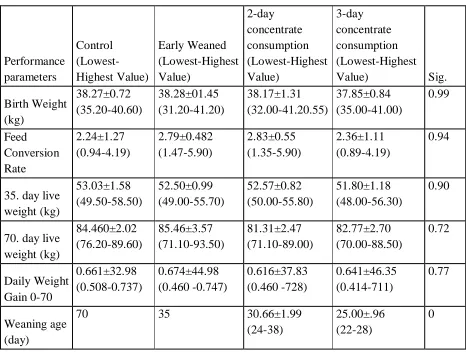
Live weight, feed consumption, daily live weight and feed consumption averages (kg), standard errors and variance analysis results of groups were given in Table 2. The calves were tested at similar birth weight on the 35th and 70th days and the differences between the groups were not statistically significant. However, weaning times of the groups showed significant (P<0.01) differences varying between 25 days and 70 days. Two calves were excluded from the trial due to health problems in the weaned group considering the 2-day concentrate feed consumption.
Table 2: The performances parameter of the experimental groups (x̄±Sx̄; min-max values) and variance analyses results
Performance parameters Control (Lowest-Highest Value) Early Weaned (Lowest-Highest Value) 2-day concentrate consumption (Lowest-Highest Value) 3-day concentrate consumption (Lowest-Highest
Value) Sig.
Birth Weight (kg) 38.27±0.72 (35.20-40.60) 38.28±01.45 (31.20-41.20) 38.17±1.31 (32.00-41.20.55) 37.85±0.84 (35.00-41.00) 0.99 Feed Conversion Rate 2.24±1.27 (0.94-4.19) 2.79±0.482 (1.47-5.90) 2.83±0.55 (1.35-5.90) 2.36±1.11 (0.89-4.19) 0.94
35. day live weight (kg) 53.03±1.58 (49.50-58.50) 52.50±0.99 (49.00-55.70) 52.57±0.82 (50.00-55.80) 51.80±1.18 (48.00-56.30) 0.90
70. day live weight (kg) 84.460±2.02 (76.20-89.60) 85.46±3.57 (71.10-93.50) 81.31±2.47 (71.10-89.00) 82.77±2.70 (70.00-88.50) 0.72 Daily Weight Gain 0-70 0.661±32.98 (0.508-0.737) 0.674±44.98 (0.460 -0.747) 0.616±37.83 (0.460 -728) 0.641±46.35 (0.414-711) 0.77 Weaning age (day)
70 35 30.66±1.99
(24-38)
25.00±.96 (22-28)
www.ijaer.in Copyright © IJAER 2019, All rights reserved Page 873 Health
problem
1 1 2 0 0.24*
*Chi square value.
Analysis of variance results of live weight, feed consumption, daily live weight and feed consumption rates which are showing the growth performance of weaned calves at 35 and 70 days corresponds with results of insignificant similarly by Anderson et al. (1987) and Quigley et al. (1991) results. In addition, the results of current study also similar with results about 20, 30, 40 and 50 days of age weaning differences between the groups are insignificant expressed by
Yun and Chung (1985). The results obtained in this study are in agreement with Ugur (1999)
that the difference between live weights and body measurements of weaned calves at the age of 21 and 30 days is not statistically significant. Winter (1985) expresses that the breed and weaning age of weaned Ayrshire and Holstein male calves at the age of three, five and seven weeks don’t have any effect on weaning age, weaning weight, daily weight increases up to 14 weeks, feed utilization rate of weaning age and dry matter intake. The average of excess feed intake of early weaned calves obtained in this study similar the statement by Hopkins (1997)
which indicates early weaning calves consume more calf starting feed although the difference between live weights and height at withers of early and late weaned calves is statistically insignificant. Hernandez et al. (1999) indicates weaning age and weaning performance after weaning is not adversely affected by the increase in calf growth depends on increase in feed intake. Luchini et al. (1991) reported that the amount of solid feed taken after weaning was more dependent on the physiological adaptation of calves than the feeding management before weaning.
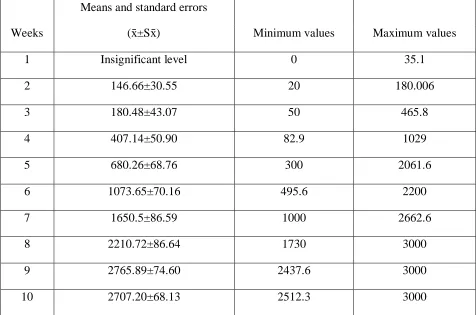
www.ijaer.in Copyright © IJAER 2019, All rights reserved Page 874 Daily feed consumption average changes of calves in the experiment are given in Table 3. It is understood that the consumption of concentrate feed of calves is 700 grams which is accepted as sufficient amount of feed intake in terms of weaning for 3 consecutive days starts from 29. day but a problem in ensuring continuity.
Table 3: Weekly average, lowest and highest feed consumption values of experimental calves
Weeks
Means and standard errors
(x̄ ±Sx̄) Minimum values Maximum values
1 Insignificant level 0 35.1
2 146.66±30.55 20 180.006
3 180.48±43.07 50 465.8
4 407.14±50.90 82.9 1029
5 680.26±68.76 300 2061.6
6 1073.65±70.16 495.6 2200
7 1650.5±86.59 1000 2662.6
8 2210.72±86.64 1730 3000
9 2765.89±74.60 2437.6 3000
10 2707.20±68.13 2512.3 3000
www.ijaer.in Copyright © IJAER 2019, All rights reserved Page 875 concentrate for three consecutive days could be weaned. Appleman and Owen (1973) reported that dry feed intake (DFI) for weaning calves ranged from 454 to 908 g / day. The amount of feed consumed is 1 k / day for 3-4 consecutive days for large breeds, while 750 grams for small breeds (Heinrichs and Jones 2003; Lorenz et al., 2011; Soberon et al. 2012). Morrill (1984) and Morrill et al. (1984) reported a weaning program at 2 to 4 weeks of age with delicious calf starter feeds. Anderson et al. (1987), found that the daily concentrate feed consumption of early weaned calves at the age of 2-4 weeks was 180 grams while 60 grams in the control group; 1478 grams of concentrated feed consumed between 5-8 weeks, while the other group consumed 1044 grams. The researcher explained that faster rumen development was observed in early weaned calves by using data related to rumen metabolism. It has been reported that the population of bacteria in the rumen of calves that have switched to solid feeds early in the age of 3 weeks has started to develop (Perston, 1956; Quayle, 1958; Anderson et al., 1987).
4. CONCLUSION
The weaning is one of the most significant factors in terms of lifelong performance of the cattle cause of meaning more salable milk, more effective and healthy rumen activities and the higher performance in the later life of calves thus providing some advantages for more business’ profitability. The physiological situation of the calf and rumen development should be considered as the main criteria in terms of weaning. Shortening weaning period of calves increases the saleable milk amount of farm and encourages the concentrate consumption of calves. As a result of the study shows that the individual feed consumption can reach the required amount for milk reduction at the age of 3th weeks. It was understood that there were calves that consumed more than the concentrate feed weaned in the 4th and 5th weeks. These data show that feed consumption capacity of calves contains significant variation. The calf concentrate consumption monitoring individually for weaning decision can be advantageous without decreasing performance.
REFERENCES
1. Soberon, F., E. Raffrenato, R. Everett, and M. Van Amburgh. 2012. Preweaning milk replacer intake and effects on long-term productivity of dairy calves. J. Dairy Sci. 95: 783-793.
2. Khan MA., Lee HJ., Lee WS., Kim HS., Kim SB., Ki KS., Ha JK., Lee HG., Choi YJ.,
2007a. Pre- and post-weaning performance of Holstein female calves fed milk through step-down and conventional methods. Journal of Diary Science, 90, 876-885.
www.ijaer.in Copyright © IJAER 2019, All rights reserved Page 876
4. Lukas F., Koppova I., Kudrna V., Kopecny J., 2007. Postnatal development of bacterial
population in the gastrointestinal track of calves. Folia Microbiol, 52, 99-107
5. Drackley, J. K. 2008. Calf nutrition from birth to breeding. Veterinary Clinic Food Animal 24:55-86.
6. Lorenz I, Earley B, Gilmore J, Hogan I, Kennedy E, More SJ., 2011. Calf health from birth to weaning. III. Housing and management of calf pneumonia. Ir Vet J. 64(1):1-9. doi:10.1186/2046-0481-64-14
7. Khan MA., Lee HJ., Lee WS., Kim HS., Kim SB., Ki KS., Park SJ., Ha JK., Choi YJ.,
2007b. Starch source evaluation in calf starter: I. Feed consumption, body weight gain, structural growth, and blood metabolites in Holstein calves. J Dairy Sci, 90, 5259–5268. 8. Lengemann, F.W., Allen, N.N., 1959. Development of rumen function in the dairy calf.
II. Effect of diet upon characteristics of the rumen flora and fauna of young calves. Journal of Dairy Science 42(7): 1171-1181.
9. Jones C., Heinrichs J., 2007. Early weaning strategies. The Pennsylvania State University, Collage of Agricultural Sciences, Cooperative Extension. DAS: 07-117.
10. Keles, A.E., 2010. Sutten Kesim Oncesinde Kaba Ve Kesif Yem Verilme Seklinin Sutten
Kesim Sonrası Buzagı Buyume Performansına Etkileri (Yuksek Lisans Tezi). Cukurova Universitesi Fen Bilimleri Enstitusu, Adana, 2010.
11. Savage, E. S., and C. M. McCay. 1942. The nutrition of calves. A review. J. Dairy Sci. 25:595
12. Brownlee, A. 1956. The development of the rumen papillae in cattle fed on different diets. Br. Vet. J. 112:369.
13. McCandlish, A. C. 1923. Studies on growth and nutrition of dairy calves. V. Milk as the sole ration for calves. J. Dairy Sci. 6:54.
14. Tamate, H., A. D. McGilliard, N. L. Jacobson, and R. Getty. 1962. Effect of various dietaries on the anatomical development of the stomach in the calf. J. Dairy Sci. 45:408. 15. McGilliard, A. D., N. L. Jacobson, and J. D. Sutton. 1965. Physiological development of
the ruminant stomach. Pages 39-50 in Physiology of digestion in the ruminant. R. W. Daugherty, R. S. Allen, W. Burroughs, N. L. Jacobson, and A. D. McGilliard, ed. Butterworths, WashingtOn, DC
16. Quigley, J.D., Smith, Z.P., Heitmann, R.N. (1991). Changes in plasma volatile fatty acids in response to weaning and feed intake in young calves. J. Dairy Sci. 74, 258–263
17. Church. D. C. (1979) Digestive Physiology and Nutrition of Ruminants, Vol. 1 Digestive Physiology, 2nd Ed .Corvallis, 97330, Oregon.
www.ijaer.in Copyright © IJAER 2019, All rights reserved Page 877 19. Morrill, J. L. 1984. Research in dairy calf nutrition. Pages 46-50 in Proc. of the 1984
Cornell Nutr. Conf., Cornell Univ., Ithaca, NY.
20. Morrill, J. L, A. D. Dayton, A. J. Zmoleck, and M. A. Vitcenda. 1984. Early weaning program for dairy calves examined. Feedstuffs 56:30.
21. Perston, T. R. (1956). Dry feeding of calves. Agriculture. 1956, 62:462.
22. Quayle, P. D. (1958). A study of the effects of dietary aureamycin and methods of weaning in early weaned calves. J. Agric. Sci. 1958, 50:535.
23. Anderson, K. L., T. G. Nagaraja, J. L. Morrill, T. B. Avery, S. J. Galitzer, and J. E. Boyer (1987). Ruminal microbial development in conventionally or early-weaned calves. J. Anita. Sci. 64:1215.
24. Goncu, S., Boga M., Kılıc U., Gorgulu M., Doran F. (2014). The effect of feeding regime without roughage during the pre-weaning period on pre- and postweaning performance of dairy calves", Bulgarian Journal Of Agricultural Science, vol.20 , pp.675-679, 2014 25. Hopkins, B.A., 1997. Effect of the method of calf starter delivery and effect of weaning
age on Starter intake and growth of Holstein calves fed milk once daily. J. Dairy Sci., 80: 2200-2203.
26. Dogan, Z, 2014. Siyah-Alaca Buzagılarda Farklı Sutten Kesme Yasının Buyume
Performansı Uzerine Etkileri. Adnan Menderes Universitesi Fen Bilimleri Enstitusu Zootekni AnabilimDalı 2014- YL- 009
27. Erez, İ., Goncu S. (2012). Siyah Alaca Buzagılarda Erken Sutten Kesmenin Performans
Uzerine Etkileri. Fen ve Muhendislik Bilimleri Dergisi, cilt.28, ss. 66-78, 2012.
28. Heinrichs AJ., Jones CM., 2003. Feeding the newborn dairy calf. Pennstate University, Collage of Agricultural Sciences, Research and Cooperative Extension, CAT UD013, The Pennsylvania State University, 112 Agricultural Administration Building, University Park, PA 16802.
29. Lesmeister KE., Heinrichs AJ., 2004. Effects of corn processing on growth
characteristics, rumen development, and rumen parameters in neonatal dairy calves. J Dairy Sci, 87, 3439-2450.
30. Montoro C., Miller-Cushon EK., De Vries TJ., Bach A., 2013. Effect of physical form of forage on performance, feeding behavior and digestibility of Holstein calves. J Dairy Sci, 96, 1117-1124
31. Leaver, J. D., and N. H. Yarrow. 1972. Rearing of dairy cattle. 2. Weaning calves according to their concentrate intake. Anim. Prod. 14:161
www.ijaer.in Copyright © IJAER 2019, All rights reserved Page 878 33. Flatt, W.P., Warner, R.G. Loosli. J.K. 1958. Influence of Purified Materials on the Development of the Ruminant Stomach, Journal of Dairy Science, Volume 41, Issue 11, Pages 1593-1600, Nov..
34. Neamț R.I., IlieD.1 ,Enculescu M.3 , Săplăcan S.1 and Cziszter T.L. 2019. The Weaning Stress Effect on Calf Behaviour and Performances. Research Journal of Biotechnology Vol. 14 (3) March (2019).
35. Sweeney BC, Rushen J, Weary DM, de Passillé AM. Duration of weaning, starter intake,
and weight gain of dairy calves fed large amounts of milk. J Dairy Sci. 2010;93(1):148-152. doi:10.3168/jds.2009-2427
36. Kehoe, S. I., C. D. Dechow, and A. J. Heinrichs. Effects of weaning age and milk feeding frequency on dairy calf growth, health and rumen parameters. Livestock Sci. In Press, Corrected Proof Available Online 1/22/07. doi:10.1016/j.livsci.2006.11.007.
37. Budzynska, M., and D. Weary. 2008. Weaning distress in dairy calves: Effects of alternative weaning procedures. Appl. Anim. Behaviour Sci. 112: 33-39.
38. AOAC (1998). Official Methods of Analysis. Association of Official Analytical Chemists, Arlington, VA
39. Van Soest P J, Robertson J B &Lewis B A, (1991). Methods for dietary fiber, neutral detergent fiber, and nonstarch polysaccharides in relation to animal nutrition. Journal of Dairy Science 74: 3583-3597
40. Yun, S.G., C.Y. Chung, 1985. The Effect of Weaning Time on the Growth and Feed Efficiency in Dairy Calves. Korean J. Dairy Sci., 7 (2): 49-55.
41. Ugur, F. 1999. Effects of different weaning age on the growth traits of Holstein Friesian calves. Tarım Bilimleri Dergisi. 5(3):48-52.
42. Winter, K. A. 1985. Comparative performance and digestibility in dairy calves weaned at three, five, and seven weeks of age. Can. J. Anim. Sci. 65:445.
43. Hernández M., Gabaldón L and Combellas J., 1999. Influence of restricted suckling period on milk yield of cows and live eight change of calves. Livestock Research for Rural Development 11(2) (http://www.cipav.org.co/lrrd/lrrd12/2/hern112.htm)
44. Luchini, N. D., S. F. Lane and D. K. Combs. 1991. Evaluation of starter diet crude protein level and feeding regimen for calves weaned at 26 d of age. J. Dairy Sci. 74:3949-3955.
45. Baldwin RL., Mcleod KR., Klotz JL., Heitmann RN., 2004. Rumen development,
intestinal growth and hepatic metabolism in the pre- and post-weaning ruminant. Journal of Dairy Science,87, 55-65