The Open Journal of Occupational Therapy
The Open Journal of Occupational Therapy
Volume 5
Issue 4 Fall 2017 Article 7
October 2017
Master’s of Occupational Therapy Student Perceptions of Creative
Master’s of Occupational Therapy Student Perceptions of Creative
Thinking Across the Academic Program
Thinking Across the Academic Program
Angela K. Boisselle
Texas Scottish Rite Hospital for Children - USA, [email protected]
Mary F. Baxter
Texas Woman's University - USA, [email protected]
Follow this and additional works at: https://scholarworks.wmich.edu/ojot
Part of the Curriculum and Instruction Commons, and the Occupational Therapy Commons
Recommended Citation Recommended Citation
Boisselle, A. K., & Baxter, M. F. (2017). Master’s of Occupational Therapy Student Perceptions of Creative Thinking Across the Academic Program. The Open Journal of Occupational Therapy, 5(4). https://doi.org/ 10.15453/2168-6408.1314
This document has been accepted for inclusion in The Open Journal of Occupational Therapy by the editors. Free, open access is provided by ScholarWorks at WMU. For more information, please contact
Master’s of Occupational Therapy Student Perceptions of Creative Thinking Master’s of Occupational Therapy Student Perceptions of Creative Thinking Across the Academic Program
Across the Academic Program
Abstract Abstract
This study was part of a larger study to describe how master’s of occupational therapy (MOT) students define and perceive their own creative thinking across the academic program. This study involved a cross-sectional quantitative study based on the self-reflective creative thinking surveys completed by the MOT students at Texas Woman’s University (N = 136). Principal component analysis (PCA) was used to reduce a large number of variables by finding which variables are redundant and measuring the same construct. The PCA resulted in three new components accounting for 68% of the variance. Three ANOVAs were conducted to explore possible differences in the students’ perceptions about creative thinking during phases of the program. This study did not reveal any significant differences among the students across the program regarding their perceptions of creative thinking. However, analysis showed rich information about the students’ perceptions of creativity. Three new components were created in response to the PCA. Overall, the students demonstrate high levels of agreement that the MOT students value creative thinking, believe it can be learned, and believe that it is important for occupational therapy practice. This study can serve as a basis for a larger study to develop assessment and/or MOT curriculum design.
Keywords Keywords
creativity, higher education, problem solving
Cover Page Footnote Cover Page Footnote
We would like to thank the MOT student participants, Dr. Cynthia Evetts, Dr. Diane Gregory, Dr. Keston Lindsay, Dr. Catherine Candler, Tammy Hood, Dr. Gayle Roux, and Dr. Dimitrios Zikos, for their direct assistance to make this study possible.
Credentials Display
Angela K. Boisselle, PhD, OTR, ATP Mary F. Baxter, OT, PhD, FAOTA
Copyright transfer agreements are not obtained by The Open Journal of Occupational Therapy (OJOT). Reprint permission for this Topics in Education should be obtained from the
corresponding author(s). Click here to view our open access statement regarding user rights and distribution of this Topics in Education.
DOI: 10.15453/2168-6408.1314
Background
In occupational therapy, creative thinkingis a construct identified as an active and deliberate development of new ideas and problem solving that is also reliant on the context (Barris, 1978; Schmid, 2004). Occupational therapists use creative
thinking daily to solve occupational challenges for clients with a wide variety of diagnoses. For example, an occupational therapist may encounter a postsurgical client, a client with feeding difficulties, and yet another client with social skills issues all in one day of practice. These situations require that the clinician demonstrate the flexibility to adapt to the unique problems of each client. In addition, occupational therapists are faced with increasing productivity demands, documentation requirements, and rapidly changing rules for reimbursement. Skills, beyond that of foundational clinical skills, are needed to solve problems related to the dynamic health care industry. As a result, occupational therapy requires the continuous expansion of practice in new and creative ways to remain significant (Pattison, 2008).
The overarching phenomenon of creativity is broad, complex, and often difficult to define (Runco, 2004). Aspects of creativity have influenced occupational therapy since the early 1900s. Meyer (1922/1977) and Slagle (1939) referred to creativity not only in terms of handiworks, but also in terms of the artistry of occupational therapy practice. Implied by the authors is the manner in which clinicians artfully make decisions. In the 1960s, occupational therapy experienced a deviation away from the use of handiworks in practice toward the more reductionist
ways of the medical model (Shannon, 1977). Although methods for service delivery changed, prominent occupational therapy scholars reminded clinicians that creativity is essential to occupational therapy practice. Reilly (1962) emphasized that “creativity is the end to which our knowledge ought to be designed” (p. 90). Smith (1974) argued that the artistry of practice takes precedence over science. The professional artistry referenced by the authors involves the therapist seamlessly adapting to new, unfamiliar, and challenging situations
(Schon, 1990). Artistry also involves the skill of
knowing what to do without necessarily being able
to articulate the specific knowledge, rules, or facts
of solving a problem. Contemporary occupational therapy scholars reinforce this idea by articulating that risk-taking, curiosity, adaptability, and flexibility are foundational to the practice of occupational therapy (Law, 2007; Murray, 2010; Royeen, 2003).
Based on the seemingly important need to think creatively as an occupational therapist, it is a reasonable idea that these abilities should be cultivated in occupational therapy students. Two articles specified the relationship between
occupational therapy students and creative thinking. Fox and Fox (1968) initially explored the creative thinking of occupational therapy students taking theory classes with the use of teacher-made tests designed to gauge the construct. The researchers discovered that students progressively developed in the areas of fluency, flexibility, and originality from mid-term to the end of the semester. Barris (1978) advised that competency-based curriculum should involve creative thinking to educate students to use
independent, original ideas to adapt to change and create novel methods to meet the needs of clients when they develop into practitioners. Current occupational therapy research identifies the need for occupational therapy students to develop adaptive competencies for creative thinking; however, they have not been specifically explored (Collins, Harrison, Mason, & Lowden, 2011; Murray, 2010; Schmid, 2004). On completion of a master’s-level occupational therapy program, students are
expected to demonstrate flexibility with changes in the practice setting, problem-solve and create alternative solutions in a variety of situations, adapt evidence-based guidelines to unique situations, and exhibit expertise in new and emerging technologies (American Occupational Therapy Association [AOTA], 2009). Despite the apparent need for flexibility, problem solving, and adaptiveness in occupational therapy practice, the overarching construct of creative thinking is essentially
unexplored in the occupational therapy literature. Scant research is also available on the manner in which creative thinking is fostered in occupational therapy students. In general,
prominent higher education experts have described creative thinking as an essential component to learning. The recently revised Bloom’s Taxonomy emphasizes creative thinking as an important component of learning. Bloom’s Taxonomy is a method to classify student-learning expectations as a result of instruction. In the revised version, “create” is considered the highest level of the cognitive process, which involves the assembly of thoughts to develop new ideas or original outcomes (Krathwohl, 2002). The Dreyfus model of clinical
problem-solving skills acquisition is also helpful to understand when creative thinking skills emerge in students. The Dreyfus model explains how an adult learner progresses through five levels of skill acquisition: novice, advanced beginner, competent, proficient, and expert. Creative thinking traits, such as intuition and problem solving in new and
imaginative ways, are present when students perform at the competent and expert level of
learning (Peña, 2010). Evidence suggests that some level of expertise is needed for fluency in creative thinking to occur. Based on these assumptions, it is reasonable to expect that students can learn to develop their abilities to think creatively. Further exploration into what creative thinking looks like in students in a master’s of occupational therapy (MOT) program and insight into how it can be fostered could be beneficial.
This study was the first of two studies to serve as foundational research on how creative thinking is experienced by MOT students
throughout the program. A second constructionism qualitative study, which is beyond the scope of this article, was conducted through a focus group with MOT faculty to reflect on the preliminary results of the student surveys and faculty perception of student creative thinking.
The participants included students in the first (MOT I) and fourth semesters (MOT IV) of a five-semester didactic program, and those in the first clinical rotation of the Fieldwork Level II (FW II) were concurrently provided with a self-reflective survey regarding creative thinking in the context of the student experience. The overarching research question for this study was “Is there a difference in
2 https://scholarworks.wmich.edu/ojot/vol5/iss4/7
students’ perspectives of creative thinking based on academic level in the occupational therapy program (MOT I, MOT IV, and FW II)?” In addition, this study sought to understand:
1. In what ways do MOT students define creative thinking?
2. What contexts (physical, social, or other) influence the creative thinking of
students?
3. How often do MOT students have opportunities to engage in activities for creative ideation (fluency, originality, adaptive ideas, and flexibility)? 4. What do MOT students identify as
specific intrinsic and extrinsic influences, if any, which may impact their creative thinking?
Method Research Design
Prior to the initiation of the study, approval was obtained from the university’s Institutional Review Board (IRB). The participants included 136 MOT students who attend a large university with three campuses in Texas. Data collection occurred over an initial period of 1 month with the web-based survey link that was distributed by the secretaries from the School of Occupational Therapy at each campus. Another data collection period was conducted with further recruitment via the use of the MOT program’s social media. Submission of the on-line survey was taken as informed consent for the study. Data were obtained concurrently from a purposeful and convenient sample of the MOT students in the MOT I, MOT IV, and FW II.
Instrument. The framework of the survey was adapted from the Student Creativity and Critical Thinking Survey of the Five Colleges of Ohio, which is designed to gain students’
perceptions of the manner in which creative thinking is fostered on campus (Grace & Murnan, 2009). Questions related to creative ideation were also included based on the Runco Ideation Behavior Scales (RIBS; Runco, Plunker, & Lim, 2001). Prompts were altered specifically to explore the students’ own ideas of creative thinking and the external influence of the MOT program. In addition, the participants were asked about the relationship of creative thinking to the profession of occupational therapy. The survey also included prompts that specifically related to constructs from the Creative Thinking Model, including creative ideation and motivational factors (Runco & Chand, 1995).
A pilot survey was reviewed and appraised by six occupational therapy clinicians and educators to establish content and face validity. The finalized survey consisted of four sections with 51 prompts: (a) demographic information, (b) problem finding, (c) intrinsic/extrinsic and contextual influences, and (d) creative ideas (fluency, originality, adaptive ideas, and flexibility). Each question was presented as a Likert ordinal scale. The survey was designed without a neutral category to avoid regression toward the mean.
Data analysis. Data from the student surveys were analyzed using SPSS, version 22, and several different methods. The initial 51 prompts from the survey were categorized into nine a priori constructs related to the Creative Thinking Model
(Runco & Chand, 1995). The constructs included two motivation constructs (intrinsic and extrinsic), three context constructs (social, physical, and virtual), and four creative ideation constructs
(fluency, flexibility, originality, and adaptive ideas). The mean scores from each construct were
calculated to create nine new constructs and represented the dependent variables (DV) for analysis.
In the initial analysis, the physical context variables did not correlate with the social and virtual contexts; therefore, an exploratory principal component analysis (PCA) was conducted to find undiscovered variables. Unlike a factor analysis, which identifies common variance and observed variables, a PCA is used to analyze complex and seemingly unrelated constructs, such as those found with the phenomenon of creative thinking where the relationship among variables cannot be easily explained (Field, 2013; Shlen, 2003). Techniques in using a PCA involve the detection relationships among the variables to reduce multiple variables to one or more groups that are commonly referred to as factors or components(Field, 2013).
Combinations of variables may also be
unexpectedly correlated and can be used to define hidden and more influential variables, which account for the variance of the original variables.
Analysis of variance (ANOVA) was conducted to compare the academic levels of the MOT students (Portney & Watkins, 2009). In order to answer the follow-up questions, frequencies of each of the original 51 prompts on the survey were analyzed. The academic levels of the participants served as the independent variable. The survey
prompts represented the dependent variables. Pearson’s chi square test was used to compare the observed versus expected frequencies from each variable as related to each academic level (Field, 2013).
Results Descriptive Statistics
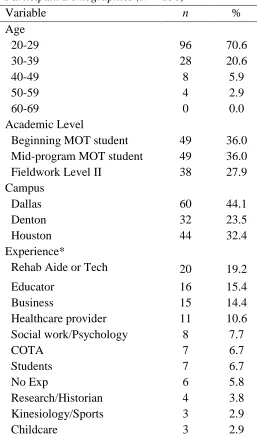
A total of 136 participants (39% return rate) out of 349 MOT students completed the survey. The majority of the participants were aged 20 to 30 years. Descriptive statistics are provided in Table 1.
Table 1
Participant Demographics (N = 136)
Variable n %
Age
20-29 96 70.6
30-39 28 20.6
40-49 8 5.9
50-59 4 2.9
60-69 0 0.0
Academic Level
Beginning MOT student 49 36.0 Mid-program MOT student 49 36.0 Fieldwork Level II 38 27.9 Campus
Dallas 60 44.1
Denton 32 23.5
Houston 44 32.4
Experience*
Rehab Aide or Tech 20 19.2
Educator 16 15.4
Business 15 14.4
Healthcare provider 11 10.6 Social work/Psychology 8 7.7
COTA 7 6.7
Students 7 6.7
No Exp 6 5.8
Research/Historian 4 3.8 Kinesiology/Sports 3 2.9
Childcare 3 2.9
4 https://scholarworks.wmich.edu/ojot/vol5/iss4/7
Retail 3 2.9
Fine Arts 1 1.0
Note. *Response rate N = 104 as answers were not forced.
Reducing Data
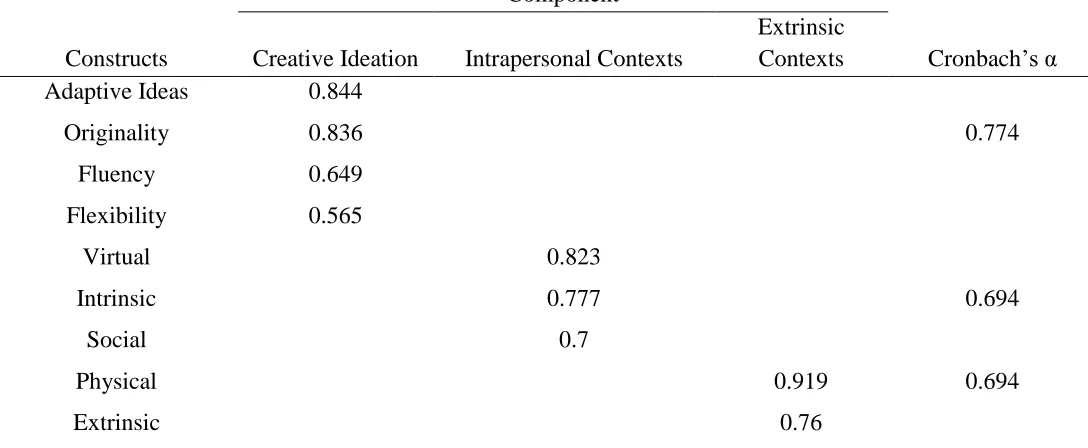
Analysis using a PCA was conducted on the nine constructs using a Varimax rotation with five iterations. Kaiser-Meyer-Olkin Measure of Sampling Adequacy (KMO) was conducted and produced a score of .783, which exceeded the requirements for adequacy at the criterion of > 0.7. Three components—creative ideation, intrapersonal contexts, and extrinsic contexts—explained 68% of the overall variance (see Tables 2 and 3). The constructs for creative ideation loaded together as expected and were consistent with the creative ideation constructs of the survey. The analysis for the remainder of the grouped contexts and
motivation variables loaded in an unexpected manner because it was not predicted that extrinsic
motivation would correlate with physical context, or that intrinsic motivation would correlate with social and virtual contexts.
After the components were extracted, each of the nine components with p > 0.5 was then calculated by a rotated correlation matrix (see Table 4). Variables that have a large number grouped on an axis mathematically signify a common,
unexpected dimension. Only the loads above 0.5 were considered. Cronbach’s alpha (α), an internal consistency analysis for the components, was also calculated. This is conducted to verify that each of the three components is reliable. Internal
consistency was achieved at 0.7 (Field, 2013; Portney & Watkins, 2009). Overall, the creative ideation variables demonstrated strong correlation (α = .77) and variables from both the intrapersonal and extrinsic components showed moderate correlation (α = .69).
Table 2
Eigenvalues, Percentages of Variance, and Cumulative Percentages for Components of the Nine Variables of Creative Thinking
Component Eigenvalue % of Variance Cumulative %
1. Creative Ideation 3.85 42.73 42.73
2. Intrapersonal Contexts 1.19 13.17 55.9
3. Extrinsic Context 1.08 11.94 67.85
Note. Extraction method: Principal Component Analysis. Only eigenvalue above 1 are shown.
Table 3
Definitions of New Components Based on Results of the Principal Component Analysis
Component Definitions
Creative Ideation Fluency, flexibility, originality, and adaptive ideas constructs loaded as predicted Intrapersonal Contexts Intrinsic motivation factors unexpectedly loaded with virtual and social contexts Extrinsic Context Extrinsic factors highly loaded with physical context
Table 4
Rotated Component Matrixa
Constructs
Component
Cronbach’s α Creative Ideation Intrapersonal Contexts
Extrinsic Contexts Adaptive Ideas 0.844
Originality 0.836 0.774
Fluency 0.649 Flexibility 0.565
Virtual 0.823
Intrinsic 0.777 0.694
Social 0.7
Physical 0.919 0.694
Extrinsic 0.76
Note. Extraction method: Principal Component Analysis. Only the highest factors are depicted. Rotation Method: Varimax with Kaiser Normalization. a. Rotation converged in 5 iterations.
Differences Among Groups
The second step of the data analysis was to explore the differences among the MOT I, MOT IV, and FW II students’ perceptions of creative thinking using the three combined components from the PCA. Because these components were not
correlated, three distinct ANOVAs were conducted to analyze each component separately. The first ANOVA compared the creative ideation component to the MOT I, MOT IV, and FW II participant responses. The independent variables used were the levels of study and the dependent variable used was creative ideation. The results of the creative
ideation ANOVA were (F (2, 104) = .604; p = .55) and not significant. The results of the second ANOVA compared the intrapersonal context
component between the three academic levels (F (2, 104) = 2.8, p = .06). The final ANOVA showed
relationship of extrinsic/physical component on the academic levels was (F (2, 104) = 2.8; p = .06), which was not significant. Overall, there was no significant effect of the creative ideation,
intrapersonal context, and extrinsic/physical components on the outcome variables of the MOT academic levels.
Frequencies
Follow-up questions were asked of each student cohort to gain a deeper understanding of how the participants defined creative thinking. Descriptive statistics were used to evaluate the follow-up questions and how the components of the PCA influence creative thinking.
Creative thinking terms. Knowledge of how students define creative thinking provides an overview of their basic understanding of the
concept. The participants across all of the academic
6 https://scholarworks.wmich.edu/ojot/vol5/iss4/7
levels most frequently identified the following terms to describe creative thinking: imaginative (87%, N = 111), innovative (82%, N = 104), artistic (76%, N = 96), inventive (75%, N = 95), and
expressive (72%, N = 91).
Creative thinking contexts. The
participants were asked survey questions that relate to the physical, social, and virtual contexts in which they participate in creative thinking. In the social context, the participants agreed that engaging in extra-curricular activities (75%, N = 114), engaging with students outside of class (68%, N = 114), and engaging with students and faculty in class
influence creative thinking (57%, N = 115). The participants less frequently agreed that interacting with faculty outside of class influenced their
creative thoughts (37%, N = 110). The participants strongly agreed that the physical environment at home or elsewhere influence creative thinking (95%, N = 116). The participant agreement was divided when asked if the university provides physical space to think creatively (50%, N = 116). The participants reported that they
frequently/almost always feel creative when they browse the internet (67%, N = 113) but less
frequently when they communicate with peers over the internet (44%, N = 114). In addition, 80% (N = 116) of the participants agreed that use of
multimedia influences creative thinking.
Creative ideation. The participants were asked how often they engaged in creative ideation activities over the past few months. The responses were sorted into four categories: fluency,
originality, adaptive ideas, and flexibility. The participants reported that they frequently engage in fluency-related activities, such as brainstorming strategies to develop new ideas (71%, N = 108) and to change existing ideas (58%, N = 108), and sharing ideas with other professionals (57%, N = 105). Participant agreement was neutral regarding their involvement in fluency-related activities to learn new things (52%, N = 106) and solve problems by working on other things (53%, N = 105). The participants reported that they almost always put together new ideas or concepts for assignments (81%, N = 105) and want to read more about things learned in class or fieldwork (80%, N = 108). The participants less frequently developed new ideas (42%, N = 106) or created new methods for occupational therapy (25%, N = 104). While 84% (N = 108) reported that they are willing to try new things, the participants were less likely to take an assignment in a slightly different direction (38%, N = 107). Eighty-one percent (N = 104) of the participants indicated that they often apply ideas about occupation to solve everyday problems, although the MOT I students showed a lower percentage than expected when compared to the other two academic levels (χ2
(2, N = 104) = 11.75,
p < .05). The participants reported that they also frequently think about new ways that occupational therapy contributes to other professions (62%, N = 104). A majority of the participantsstated that they frequently or almost always participate in
flexibility-related activities. In addition, the participants almost always integrate ideas from
other sources when they work on a paper (85%, N = 107). Eighty percent enjoy challenges to create new ways of doing things related to occupational
therapy. The participants also report that when they complete assignments, they frequently use a story, metaphor, or visual aids (66%, N = 105) and incorporate diverse viewpoints (64%, N = 104). The MOT I students showed a higher percentage than expected when compared to the other two academic levels for incorporating viewpoints in an assignment (χ2
(2, N = 104) = 11.76, p < .05).
Intrinsic motivational factors. The
participants were asked to rate five value statements to gain their perspective on creativity and creative thinking. A majority of the participants across cohorts strongly agreed that they consider
themselves creative (83%, N = 127), that creativity is important for occupational therapy (96%, N = 116), and that they value opportunities for creative thinking (96%, N = 127). They also strongly agreed that it is important to assess creative thinking (87%, N = 116) and that creative thinking can be learned (78%, N = 127).
The participants agreed that they feel
creative more often during leisure activities, such as engaging in a hobby (91%, N = 115), engaging in an extra-curricular or co-curricular activity, completing class projects (75%, N = 114), and browsing the internet (67%, N = 113). Learning activities that included writing (37%, N = 115), reading for class (19%, N = 113), and listening to speakers (35%, N = 114) were less influential for creative thinking according to the participants. The
FW II students showed a lower percentage than expected when compared to the other two academic levels for listening to speakers on campus (χ2 (2, N = 114) = 6.07, p < .05) and completing projects (χ2 (2, N = 113) = 7.65, p < .05).
Extrinsic motivational factors. The participants were asked to indicate their agreement with questions related to factors external to
themselves that influence creative thinking, such as levels of engagement with faculty, the MOT
program, and the university.
Faculty engagement. Sixty-two percent (N = 116) of the participants agreed that the faculty of the MOT students create conditions on campus where creative thinking is more likely to thrive, and the participants agreed that faculty modeled creative thinking and behavior (74%, N = 116).
MOT program. The participants strongly agreed that creative thinking is valued in the MOT program (78%, N = 116), the program values efforts (76%, N = 116), and the program is conducive (73%, N = 116) to thinking creatively. The FW II students showed a lower percentage than expected when compared to the other two academic levels for listening to speakers on campus (χ2 (2, N = 109) = 7.12, p < .05). Less than half of the participants (47%, N = 116) agreed that the MOT program provides time for creative thinking.
University. Half of the participants (50%, N = 116) agreed that the university provides physical space for creative thinking. Over half of the participants agreed that general courses encourage creative thinking (53%, N = 116) and opportunities
8 https://scholarworks.wmich.edu/ojot/vol5/iss4/7
to learn without right or wrong answers (53%, N = 115). Less than half (39%, N = 115) of the
participants agreed that there is a creative vibe on campus.
Discussion
The participants identified that they value creative thinking, believe it can be learned, and deem creative thought as important for the practice of occupational therapy. Context appears to influence creative thinking, as does relationships with peers and faculty. Creative thinking seems to be fostered on an academic program level more so than by the university. And, leisure activities appear to have more influence on the participants’ creative thinking than academic-related activities.
This study sought to answer whether there was a statistical difference among perceptions of creative thinking for MOT I, MOT IV, and FW II students at a university. Based on the literature review for this study, it was hypothesized that the MOT students’ creative thinking would increase as they progressed through the program. This
hypothesis was based mainly on the (a) Dreyfus Model that adult learners transition from a novice to an expert and (b) Bloom’s Taxonomy that the ability to create is the highest cognitive process gained through education (Krathwohl, 2002; Peña, 2010). Contrary to research, the study revealed that the MOT students’ perceptions about creative thinking remain constant throughout the program. One potential explanation is that the FW II students may return to foundational level learning once they enter the clinical environment.
Quantitatively, significance differences were not found among the MOT I, MOT IV, and FW II students’ perceptions of creative thinking. There was, however, rich information obtained through analysis of the data. Three new components were created as a result of the PCA. The most significant component, creative ideation, was the only
component that remained consistent with the original set of variables that were grouped in constructs. In addition, the constructs of the creative ideation component demonstrated strong reliability and were consistent with those traits identified as important for creative thinking (Law, 2007; Murray, 2010; Royeen, 2003; Runco, 2014; Runco & Chand, 1995).
The MOT students across the program agreed that creative thinking terms included imaginative, innovative, inventive, expressive, and artistic. Intrinsic factors were more influential than extrinsic factors. In addition, the MOT students perceived that social and virtual contexts promoted more creative thought than physical context. It was shown that intrinsic factors and those with social components are more influential than extrinsic factors. The students across the academic levels agreed that class projects and brainstorming to develop new ideas are among learning activities that foster their creative thinking. They also appreciated the use of multimedia during courses. And the students reported that they frequently incorporate knowledge from other courses and reading to enhance creative thinking.
Limitations and Future Research
The phenomenon of creativity is vast and encompasses many disciplines. The study was limited to the discipline of occupational therapy as it relates to the educational process of occupational therapy students. This study was also limited to small samples of MOT students at one university. It would be beneficial to replicate the study with an increased sample size and additional universities. The study was a cross-sectional design, which was a snap shot at one point in time of three cohorts. The cohorts had a span of three semesters, which may not have been enough of a range to detect
differences in creative thinking. In addition, it would be beneficial to study how creative thinking transforms to the clinical setting once occupational therapy students progress into clinicians.
Implications for Occupational Therapy Education
This study reveals that creative thinking can be useful to examine in occupational therapy education:
Provides a conceptual foundation to
discover methods to best facilitate creative thinking as it relates to the learning
environment, such as course design and curriculum.
Students agreed that student-centered,
multimodal activities and time for reflection, brainstorming, and peer mentorship are more influential for student creative thinking.
Social and virtual contexts are more connected with intrinsic motivation as opposed to physical contexts.
Conclusion
This study was a foundational investigation into how MOT students perceive their own creative thinking. A longitudinal study following
occupational therapy students throughout the education program would also be advantageous to define changes in creative thinking in relationship to transitioning from a novice to expert. It may also be valuable to compare older students with younger students to examine if there is a relationship
between life experience and creative thinking. The creative thinking survey in combination with three new components from the PCA study provided foundational work for an assessment tool for OT student creative thinking. The results reveal that there is much work to be explored in the area of creative thinking in relationship to occupational therapy education. It is hoped that this study can be used to supplement the occupational therapy body of knowledge on creative thinking and contribute to the operationalization of how students think
creatively.
References
American Occupational Therapy Association. (2009). Blueprint for entry-level education. American Journal of Occupational Therapy, 64(1), 186-203.
http://dx.doi.org/10.5014/ajot.64.1.186
Barris, R. (1978). Competency-based education and creative thinking. American Journal of Occupational Therapy, 32(6), 363-368.
Collins, M., Harrison, D., Mason, R., & Lowden, A. (2011). Innovation and creativity: Exploring human occupation and professional development in student
10 https://scholarworks.wmich.edu/ojot/vol5/iss4/7
education. British Journal of Occupational Therapy, 74(6), 304-308.
http://dx.doi.org/10.4276/030802211X130743839580 20
Field, A. (2013). Discovering statistics using IBM SPSS statistics. Los Angeles: Sage Publications. Fox, J. V., & Fox, F. H. (1968). Exploratory studies on the
measurement of creative thinking about occupational therapy. The American Journal of Occupational Therapy, 22(3), 180-185.
Grace, N., & Murnen, S. (2009). Creative and critical thinking: Assessing the foundations of a liberal arts education. 3-year comprehensive report. Ohio: The College of Wooster. Retrieved from
http://imaginativecurriculumnetwork.pbworks.com/f/ CREATIVE+AND+CRITICAL+THINKING+LIBE RAL+ARTS+EDUCATION.pdf
Krathwohl, D. R. (2002). A revision of Bloom’s Taxonomy: An overview. Theory into Practice, 41(4), 212-218.
http://dx.doi.org/10.1207/s15430421tip4104_2
Law, M. C. (2007). Occupational therapy: A journey driven by curiosity. American Journal of Occupational
Therapy, 61(5),599-602.
http://dx.doi.org/10.5014/ajot.61.5.599
Meyer, A. (1977). The philosophy of occupation therapy.
American Journal ofOccupational Therapy, 31(10), 639-642. (Original work published 1922).
Murray, C. (2010). Fostering student creativity. OT Practice, 15(17), 9-12.
Pattison, M. (2008). Creating our own destiny. British Journal of Occupational Therapy, 71(10), 405.
http://dx.doi.org/10.1177/030802260807101001
Peña, A. (2010). The Dreyfus model of clinical problem-solving skills acquisition: A critical perspective. Medical Education Online, 15(1), 1-11. Retrieved from
https://doi.org/10.3402/meo.v15i0.4846
Portney, L. G., & Watkins, M. P. (2009). Foundations of clinical research: Applications to
practice (3rd ed.). Upper Saddle River, NJ: Pearson Education.
Reilly, M. (1962). Occupational therapy can be one of the great ideas of 20th century medicine. Eleanor Clarke Slagle Lecture. American Journal of Occupational Therapy, 16, 1-9.
https://www.ncbi.nlm.nih.gov/pubmed/14491211
Royeen, C. B. (2003). Chaotic occupational therapy:
Collective wisdom for a complex profession. Eleanor Clarke Slagle Lecture. American Journal of
Occupational Therapy, 57(6),609-624.
http://dx.doi.org/10.5014/ajot.57.6.609
Runco, M. A. (2004). Creativity. Annual Review of Psychology, 55, 657-687.
http://dx.doi.org/10.1146/annurev.psych.55.090902.1 41502
Runco, M. A. (2014). Conclusion: What creativity is and what it is not. In M. A. Runco (Ed.), Creativity: Theories and themes: Research, development, and practice (2nd ed.). London: Elsevier, Inc.
http://dx.doi.org/10.1016/b978-0-12-410512-6.00013-8
Runco, M. A., & Chand, I. (1995). Cognition and creativity. Educational Psychology Review, 7(3), 243-267.
http://dx.doi.org/10.1007/BF02213373
Runco, M. A., Plucker, J. A., & Lim, W. (2001). Development and psychometric integrity of a measure of ideational behavior. Creativity Research Journal, 13(3), 393-400.
http://dx.doi.org/10.1207/S15326934CRJ1334_16
Schmid, T. (2004). Meanings of creativity within occupational therapy practice. Australian Occupational Therapy Journal, 51(2), 80-88.
http://dx.doi.org/10.1111/j.1440-1630.2004.00434.x
Schon, D. (1990). Educating the reflective practitioner: Toward a new design for teaching andlearning in the professions. San Francisco, CA: Jossey-Bass, Inc. Shannon, P. (1977). The derailment of occupational therapy.
American Journal of Occupational Therapy, 31(4), 229-234.
Shlen, J. (2003). A tutorial on principal component analysis: Derivation, discussion and singular value
decomposition. Retrieved from:
https://www.cs.princeton.edu/picasso/mats/PCA-Tutorial-Intuition_jp.pdf
Slagle, E. C. (1939). The training of a therapist for work of mental patients. Professional and Technical Education in Relation to Mental Health, 408-415. Smith, M. B. (1974). Competence & adaptation: A perspective
on therapeutic needs and means. American Journal of Occupational Therapy, 28(1), 11-15.