O R I G I N A L R E S E A R C H
Open Access
Statistical and radiobiological analysis of
the so-called thyroid stunning
Stephan Walrand
*, Michel Hesse and François Jamar
Abstract
Background:The origin of the reduction in thyroid uptake after a low activity iodine scan, so-called stunning effect, is still controversial. Two explanations prevail: an individual cell stunning that reduces its capability to store iodine without altering its viability, and/or a significant cell-killing fraction that reduces the number of cells in the tissue still taking up iodine. Our aim is to analyze whether this last assumption could explain the observed reduction.
Methods:The survival fraction after administration of a small radioiodine activity was computed by two
independent methods: the application of the statistical theory underlying tissue control probability on recent clinical studies of thyroid remnant131I ablation and the use of the radiosensitivities reported in human thyroid cell assays for different radioiodine isotopes.
Results:Both methods provided survival fractions in line with the uptake reduction observed after a low131I activity scan. The second method also predicts a similar behavior after a low123I or124I activity scan.
Conclusions:This study shows that the cell-killing fraction is sufficient to explain the uptake reduction effect for131I and123I after a low activity scan and that even if some still living cells express a stunning effect just after irradiation (as shown in vitro), they will mostly die with time. As theβ/αvalue is very low, this therapy fractionation should not impact the patient outcome in agreement with recent studies. However, in case of huge uptake heterogeneity, pre-therapy scan could specifically kills high-uptake cells and by the way could reduce the cross irradiation to the low-uptake cells during the therapy, resulting in a reduction of the ablation success rate.
Keywords:Thyroid stunning, Radiobiological model, TCP, Survival fraction, Radio-iodine
Background
The so-called thyroid stunning effect refers to the ob-served fact that the 131I uptake at therapy is lower than the one predicted from a131I pre-therapeutic scan, even when using a low activity such as 74 MBq [1–7]. In addition to a reduction of the iodine uptake at 24 h, a reduction of the effective half-life was also reported [7]. The explanation for this uptake reduction is still contro-versial [8–14]. In vitro studies suggest that irradiation may perturb cell metabolism before cell viability [15], specifically by a downregulation of the sodium/iodide symporter (NIS) expression at the transcription level [16, 17], resulting in a reduction of the capacity to trans-port iodine. Others suggest that this reduction could purely result from killed cells that are thus no longer
present for (or able of ) keeping accumulated iodine [9]. The first hypothesis really corresponds to a cell stun-ning, while the latter one corresponds to a therapy fractionation.
A lower, but still actual uptake reduction was also ob-served by Hilditch et al. [6] after administering 200 MBq of123I. To explain this fact, the authors also suggested a self-stunning effect occurring during the 131I therapy itself. The rationale is that in average 123I delivers 80 times less Gy per GBq than 131I due to its shorter half-life and its lower electron emission energy [18]. However, Lundh et al. [19] showed in thyroid cells assays that the relative biological effectiveness (RBE) of123I was about 5-fold higher than that of131I, and thus an uptake reduction induced by a low 123I activity cannot a priori be rejected.
The aim of this study is to determine whether the cell-killing fraction can quantitatively explain the * Correspondence:[email protected]
Nuclear medicine, Molecular Imaging, Radiotherapy and Oncology Unit (MIRO), IECR, Université Catholique de Louvain, Av. Hippocrate 10, 1200 Brussels, Belgium
uptake reductions of thyroid remnants reported after a low activity pre-therapeutic scan using either radio-iodines (131I, 123I) [6, 7]. The survival fraction, or equivalently the cell-killing fraction, was computed by two independent approaches: analyzing data reported in recent thyroid ablation studies [20–24] with the statistical theory underlying the tissue control probabil-ity (TCP) [25], and using the radiosensitivities mea-sured in human thyroid cell assays performed on both normal and malignant lines [26] and the mean absorbed doses reported in clinical studies [7]. In addition, the second computation is also presented in Additional file 1 for a heterogeneous absorbed dose distribution as observed on124I PET scans [27].
Methods
Pure statistical analysis
Simply assuming Poisson statistics, Brahme and Agren [25] deduced for TCP (initially named eradication prob-ability), a relation that is known widely accepted [28, 29]:
TCPð Þ ¼A e−Nc SfðD Að ÞÞ ð1Þ
where A is the administered activity, D(A) is the absorbed dose in the tissue, Sf is the cell surviving frac-tion, and Nc is the number of cells alive before irradiation.
As beta-particles present a low linear energy transfer (LET) and as the effective half-life of 131I in thyroid is sufficiently large to result in low dose rate, the survival fraction Sf can be approximated by:
SfðD Að ÞÞ ¼ e−αD Að Þ ð2Þ
whereαis the cell radiosensitivity.
Therapeutics 131I activities still correspond to chemical traces (less than 0.5 μg), thus for each patient, the absorbed dose is proportional to the administered activity, and Sf can be rewritten as:
SfðD Að ÞÞ ¼ e−α^A ð3Þ
In addition to the cells radiosensitivity α, the param-eter α^ also takes into account the uptake and the S factor of the thyroid remnant.
Recent studies [20–24] using a single administration of 1.11 GBq of131I report thyroid remnant control prob-abilities ranging from 70 to 95 %, i.e.,
TCP 1ð :11 GBqÞ∈½0:70; 0:95 ð4Þ
Thyroid cells radiosensitivity
Gaussen et al. [26] measured thyroid normal and tumor cells radiosensitivities for low LET from60Co irradiation of 15 cell cultures (5 normal, 6 papillary carcinoma,
1 follicular carcinoma, 3 macrofollicular adenoma, com-ing from 11 patients). These assays analyzed accordcom-ing to the linear-quadratic model showed thatαranged from 0.37 Gy−1 (most radioresistant tumor cells) up to 0.97 Gy−1(most radiosensitive normal cells), with a very lowβ/α value. As beta particles also present a low LET, these αvalues measured for60Co can be used for131I as recommended by ICRP [30]. Furthermore, the quadratic term can be neglected, validating the use of Eq. (2). Lundh et al. [19] showed in thyroid cells assays that the relative biological effectiveness (RBE) of 123I versus 131I was about 5-fold, resulting in α value for 123I ranging from 1.9 to 4.9 Gy−1. This can be explained by the larger LET of 123I Auger electrons as compared to that of higher energy 131I beta particles. In addition, a higher LET also induces an even lowerβ/αvalue [31].
Cell survival fraction in thyroid remnants
As thyroid remnants are an unknown mix of normal and tumor cells, the cell survival fraction was estimated within the measured range ofαvalues.
Lassman et al. [7] measured the uptake in the thyroid remnants of six patients in two consecutive scans after administration of 74 MBq of 131I (delay 4–6 weeks). They found that the absorbed dose at the first scan ranged from 4 to 38 Gy, corresponding to 0.15 and 1.70 % of the administered activity per gram of tissue, together with a biological half-life larger than 40 days. Rescaled to the standard thyroid mass (20 g), this gives an uptake ranging from 3 to 34 %. This is in line with iodide biokinetics reported from ICRP model giving an uptake of 33 % for a normal thyroid and a biological half-life of 80 days [32].
Hilditch et al. [6] reported the therapeutic to diagnostic uptake ratio of thyroid remnants in 26 and 16 patients using 120 MBq of131I and 200 MBq of123I for the diag-nostic scan, respectively. As the thyroid remnant uptakes were not reported, we estimated the cell survival fraction by taking also into account the variability of uptake in thy-roid remnants derived in the previous paragraph from [7].
As the biological half-life (>40 days) is much larger than the 124I and 123I physical half lives, i.e., 4.18 and 0.55 days, these latter values were used as the effective half-lives in the absorbed dose computation.
Results
Pure statistical analysis
Straight inversion of Eq. 1 gives
Sfð Þ ¼A −ln TCPð ð ÞAÞ
Nc ð5Þ
Sf 1ð :11 GBqÞ∈5:110−10;3:610−8 ð6Þ
Note that, due to the random nature of energy depos-ition in cells by the beta particles, a value Nc × Sf signifi-cantly lower than one is needed to get more than 70 % of chance to kill all the cells.
Combining Eqs. 3 and 6, we can write
Sf 74 MBqð Þ ¼e−α74 MBq¼ e−α1:11GBq74=1110
¼ ðSf 1ð :11 GBqÞÞ1=15∈½24%;32% ð7Þ
As a result of the 15th root, the survival fraction for 74 MBq only slightly varies in the range of TCP values reported after administration of 1.11 GBq of131I.
The same computation for 120 MBq of131I gives
Sf 120 MBqð Þ∈½10%;16% ð8Þ
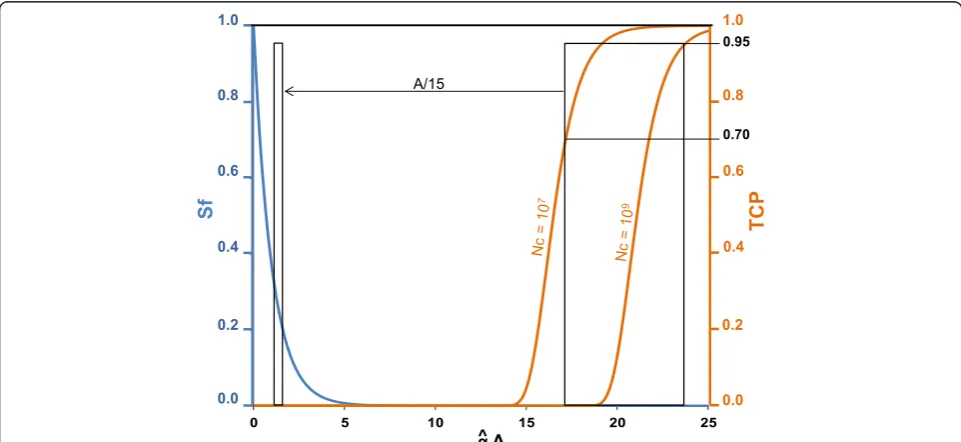
Figure 1 shows the predicted survival fraction Sf and the TCP for 107and 109cells as functions of the dimen-sionless variable ^αA. Note that this figure depends only on the number of cells ,Nc, in the tissue to be controlled and not on the cell type. This last feature only modifies the value of ^α, or in the other words, the corresponding activityAneeded to control the tissue.
Radiobiological analysis
Table 1 shows the mean absorbed dose and the cell survival fraction computed assuming uniform absorbed dose for the pre-therapeutic activities administered in Sgouros et al. [27], Lassmann et al. [7], and Hilditch et
al. [6]. The mean absorbed dose D was computed using Olinda [18]. Lowest and highest mean absorbed dose values correspond to the minimal and maximal thyroid remnants uptake observed in [7], i.e., 0.15 and 1.7 %/g, respectively. Lowest and highest (italicized in Table 1) cell survival fractions were derived from the combin-ation of the maximal and minimal (italicized in Table 1) absorbed dose andαvalues, respectively.
Discussion
Two independent formalisms show that the cell-killing fraction is sufficient to explain the observed iodine uptake reduction after a first pre-therapy scan, i.e., (1) a statistical analysis based on Poisson statistics and on the remnant control probability reported in recent clinical studies, and (2) a radiobiological analysis using normal and cancer thyroid cells radiosensitivity assays data jointly with the uptake non-uniformity observed in124I PET.
Note that such explanation of the uptake reduction by cells killing is not incompatible with studies reporting a decrease of the uptake reduction when the delay be-tween the two scans increases [34, 35]. Indeed, after ir-radiation, a fraction of the surviving cells will proliferate with time and by the way the iodine uptake will also re-increase with time.
The pure statistical analysis shows that, contrary to a commonly accepted opinion, small activities of131I such as 74 or 120 MBq, i.e., one order of magnitude smaller than those used for therapy, already kill in average about
Fig. 1Predicted survival fraction (Eq. 3) and TCP (Eq. 1) for 107and 109cells as functions of the dimensionless variable^αA. Note that an activity
75 or 87 % of the remnant cells, respectively. This is suf-ficient to explain the mean uptake reduction, i.e., 56 % for 74 MBq and 67 % for 120 MBq, observed by Lass-man et al. [7] and by Hilditch et al. [6], respectively.
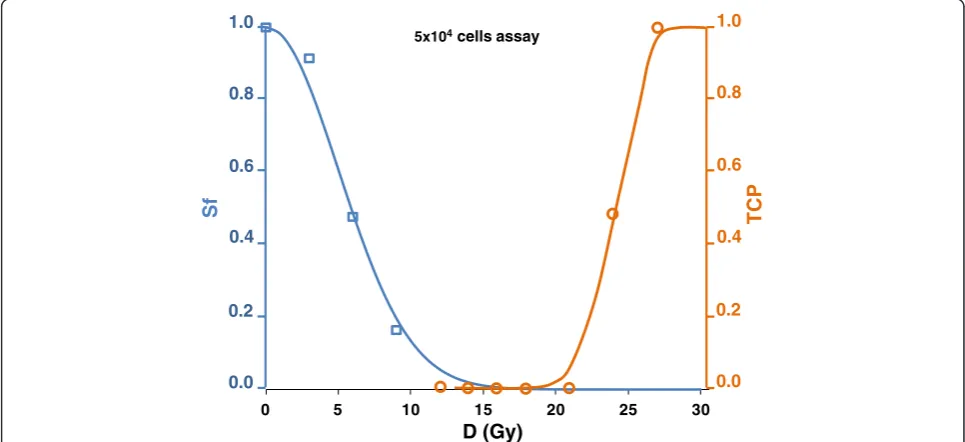
Equation 1 involves that a probability of 70 % of ablating a 1 g of tissue requires a survival fraction lower than 10−9. This corresponds to absorbed doses far above those that already kill a significant fraction of cells as shown in Fig. 1. The pattern of Fig. 1, i.e., a large valley between the Sf and the TCP curves, was also experimentally observed in direct measurements of the survival fraction and of the TCP by Kappler et al. [36] in megacolony assays after uniform irradiation (Fig. 2). This general pattern is not related to the cell type, but is related to the random energy deposition of rays jointly with the high number of cells in tissues that involves large absorbed dose in order to kill almost all the cells.
The radiobiological computation using Eq. 2 and the radiosensitivities measured in thyroid cell assays con-firmed the result of the statistical analysis, i.e., that the therapy to diagnostic uptake ratios can be explained by
the cell-killing fraction (Table 1). The computed uptake reductions are even too large.
Lassman et al. reported mean absorbed doses ranging from 4 to 38 Gy (Table 3 in [7]) for a first 74 MBq 131I scan. Rescaled to a 1.11 GBq131I therapy without pre-therapy scan, the mean absorbed dose typically ranges from 60 to 600 Gy. Assuming uniform absorbed dose, such huge values should provide a TCP equal to 100 %, higher than the 70–95 % range reported in the literature [20–24]. Taking into account the heterogeneous uptake, as measured in124I PET [27] and using a more sophisticated radiobiological model, the computed survival fraction increased and provided uptake reduction in line with the observations (see Additional file 1).
It is a real deficiency that in all the papers reporting the stunning effect in vivo [1–6], except that of Lassmann et al. [7], neither the absorbed doses nor the thyroid remnant uptakes were assessed. Regarding the huge variation in remnant uptakes due to the lesion type, but also due to the hypo- or eu-thyroid status of the patient, doses estimation is required to avoid blurring of the observations that could lead to misunderstanding of the physical effects.
0 5 10 15 20 25 30
Sf TCP
D (Gy)
0.0 0.2 0.4 0.6 0.8 1.0
0.0 0.2 0.4 0.6 0.8 1.0 5x10⁴cells assay
Fig. 2Cell survival fraction Sf and TCP measured by Kappler et al. after uniform irradiation of sarcoma megacolony assays (5 × 10⁴cells)
(curves Lu-siRNA in Figs. 5 and 6 of [31]: cells were radio-sensitized by RNA transfection). The much larger number of cells in actual lesions (>107→Sf < 10−8for TCP = 0.9) still dramatically widens the width of the valley in between the two curves as shown in Fig. 1
Table 1Summary of reported and computed data
Uptake min–max Cells tum.–nor. Uptake ratio Dose dist. uniform
A(MBq) D(Gy) α(Gy−1) αD SfEq.2
A(MBq) D(Gy) α(Gy−1)
αD SfEq.2
124I [26] 74
2.1–23.7 0.37–0.97 0.78–23.0 0–0.46
131I [7] 74
4.0–38.0 0.37–0.97 1.48–36.9 0.08–1.00 0–0.23
131I [6] 120
6.5–61.6 0.37–0.97 2.41–59.8 0.05–0.83 0–0.09
123I [6] 200
The present study shows that the cell-killing fraction is sufficient to explain the observed reductions in uptake, and that even if some living cells express a stunning effect just after irradiation (as shown in vitro [15–17]), they will mostly die with time. In other words, the pre-therapy scan appears to be itself a first therapy cycle. As theβ/αvalue is very low (0.02 ± 0.03 Gy−1[27]), no significant reduction of the therapeutic efficiency should result from this absorbed dose fractionation. This is in line with several re-cent studies reporting that the uptake reduction does not impact the131I therapy outcome [4, 37–40].
However, one has to keep in mind that in lesions ex-pressing huge uptake heterogeneity, the low pre-therapy activity could kill cells with high uptakes without killing by cross firing surrounding cells with low uptakes. After-wards, these cells with high uptake will no longer take131I up during the main therapy session (because most are killed), reducing by this way the cross irradiation that the cells with low uptake could have received. This cell type selection occurring during the pre-therapy scan could explain lower rates of ablation success reported in some studies [41, 42].
Conclusions
The pure statistical analysis supports that the so-called thyroid stunning effect can be explained by the cell-killing fraction. This result is confirmed by the quantitative biological analysis based on normal and tumor cells radio-sensitivities measured on human thyroid cell assays.
The study also shows that the two radioiodine isotopes (131I,123I) induce an uptake reduction after a low activity scan and that it could be the case for124I too. As theβ/ α value is very low, this effective fractionation of the therapy should not impact the patient outcome, in agreement with recent studies. However in case of huge uptake heterogeneity, pre-therapy scan could specifically kills high-uptake cells and by the way could reduce the cross irradiation to the low uptake cells during the ther-apy, resulting in a reduction of the ablation success rate.
Additional file
Additional file 1:Prediction of the uptake reduction after a first low activity131I or123I scan observed by Hilditch et al. [6] and Lassmann et al. [7] using the thyroid cells radiosensitivity [26] jointly with the non-uniform uptake in tissue observed in124I PET [27]. (DOCX 102 kb) Competing interests
The authors declare that they have no competing interests.
Authors' contributions
SW found the statistical and radiobiological analysis. SW and MH performed the mathematical and numerical computations. FJ handled the biological, physiological and medical aspects of the study. All authors participated to the paper writing. All authors read and approved the final manuscript.
Acknowledgements
We thank Dr. G Demonceau and Dr. N Leners for valuable discussions that motivated this study, we are much thankful to Prof. A Nahum who brought to our attention the important issue of thyroid absorbed dose heterogeneity. This study was not funded.
The authors have no conflict of interest to disclose.
This article does not contain any studies with human participants performed by any of the authors.
No animal was involved in this study.
Received: 19 August 2015 Accepted: 10 November 2015
References
1. Jeevanram RK, Shah DH, Sharma SM, Ganatra RD. Influence of initial large dose on subsequent uptake of therapeutic radioiodine in thyroid cancer patients. Int J Rad Appl Instrum B. 1986;13:277–9.
2. McDougall IR. 74 MBq radioiodine 131I does not prevent uptake of therapeutic doses of 131I (i.e. it does not cause stunning) in differentiated thyroid cancer. Nucl Med Commun. 1997;18:505–12.
3. Bajén MT, Mañé S, Muñoz A, Garcia JR. Effect of diagnostic dose of 185 MBq 131I on postsurgical thyroid remnants. J Nucl Med. 2000;41:2038–42. 4. Dam HQ, Kim SM, Lin HC, Intenzo CM. 131I therapeutic efficacy is not influenced
by stunning after diagnostic whole-body scanning. Radiology. 2004;232:527–33. 5. Kalinyak JE, McDougall IR. Whole-body scanning with radionuclides of iodine,
and the controversy of“thyroid stunning”. Nucl Med Commun. 2004;25:883–9. 6. Hilditch TE, Dempsey MF, Bolster AA, McMenemin RM, Reed NS.
Self-stunning in thyroid ablation: evidence from comparative studies of diagnostic 131I and 123I. Eur J Nucl Med Mol Imaging. 2002;29:783–8. 7. Lassmann M, Luster M, Hänscheid H, Reiners C. Impact of 131I diagnostic
activities on the biokinetics of thyroid remnants. J Nucl Med. 2004;45:619–25. 8. Woolfenden JM. Thyroid stunning revisited. J Nucl Med. 2006;47:1403–5. 9. Sisson JC, Avram AM, Lawson SA, Gauger PG, Doherty GM. The so-called
stunning of thyroid tissues. J Nucl Med. 2006;47:1406–12.
10. Gerard SK, Park HM. Stunning effect. J Nucl Med. 2007;48:328–9. author reply: 329-330.
11. Hilditch TE, Bolster AA, Dempsey MF, Reed NS. The so-called stunning of thyroid tissue. J Nucl Med. 2007;48:675–6. author reply: 676.
12. Filesi M, Colandrea M, Montesano T, D'Apollo R, Ronga G. Thyroid stunning in clinical practice: is it a real problem? Minerva Endocrinol. 2008;34:29–36. 13. Kalinyak JE, McDougall IR. Whole-body scanning with radionuclides of
iodine, and the controversy of“thyroid stunning.”. Nucl Med Commun. 2004;25:883–9.
14. McDougall IR, Iagaru A. Thyroid stunning: fact or fiction? Semin Nucl Med. 2011;41:105–12.
15. Postgard P, Himmelman J, Lindencrona U, Bhogal N, Wiberg D, Berg G, et al. Stunning of iodide transport by 131I irradiation in cultured thyroid epithelial cells. J Nucl Med. 2002;43:828–34.
16. Lundh C, Nordén M, Nilsson M, Forssell-Aronsson E. Reduced iodide transport (stunning) and DNA synthesis in thyrocytes exposed to low absorbed doses from 131I in vitro. J Nucl Med. 2007;48:481–6.
17. Nordén MM, Larsson F, Tedelind S, Carlsson T, Lundh C, Forssell-Aronsson E, et al. Down-regulation of the sodium/iodide symporter explains 131I-induced thyroid stunning. Cancer Res. 2007;67:7512–7.
18. http://www.doseinfo-radar.com/OLINDA.html. Accessed 13 November 2015.
19. Lundh C, Lindencrona U, Postgård P, Carlsson T, Nilsson M, Forssell-Aronsson E. Radiation-induced thyroid stunning: differential effects of (123)I, (131)I, (99m)Tc, and (211)At on iodide transport and NIS mRNA expression in cultured thyroid cells. J Nucl Med. 2009;50:1161–7.
20. Cheng W, Ma C, Fu H, Li J, Chen S, Wu S, et al. Low- or high-dose radioiodine remnant ablation for differentiated thyroid carcinoma: a meta-analysis. J Clin Endocrinol Metab. 2013;98:1353–60.
21. Castagna MG, Cevenini G, Theodoropoulou A, Maino F, Memmo S, Claudia C, et al. Post-surgical thyroid ablation with low or high radioiodine activities results in similar outcomes in intermediate risk differentiated thyroid cancer patients. Eur J Endocrinol. 2013;169:23–9.
23. Du P, Jiao X, Zhou Y, Li Y, Kang S, Zhang D, et al. Low versus high radioiodine activity to ablate the thyroid after thyroidectomy for cancer: a meta-analysis of randomized controlled trials. Endocrine. 2015;48:96–105. 24. Abdulrezzak U, Tutus A, Isik I, Kurt Y, Kula M. The quantitative comparison
of low dose and standard dose radio iodine therapy effectiveness in patients with low risk differentiated thyroid cancer. Q J Nucl Med Mol Imaging. 2015 Jan 20. [Epub ahead of print]
25. Brahme A, Agren AK. Optimal dose distribution for eradication of heterogeneous tumors. Acta Oncol. 1987;26:377–85.
26. Gaussen A, Legal JD, Beron-Gaillard N, Laplanche A, Travagli JP, Caillou B, et al. Radiosensitivity of human normal and tumoral thyroid cells using fluorescence in situ hybridization and clonogenic survival assay. Int J Radiat Oncol Biol Phys. 1999;44:683–91.
27. Sgouros G, Kolbert KS, Sheikh A, Pentlow KS, Mun EF, Barth A, et al. Patient-specific dosimetry for 131I thyroid cancer therapy using 124I PET and 3-dimensional-internal dosimetry (3D-ID) software. J Nucl Med. 2004;45:1366–72.
28. Nahum AE. Converting dose distributions into tumour control probability. IAEA 1996 http://www.iaea.org/inis/collection/NCLCollectionStore/_Public/ 28/018/28018201.pdf#page=26 Accessed 13 November 2015.
29. McParland BJ. Nuclear medicine radiation dosimetry: advanced theoretical principles. New York: Springer; 2010. p. 449.
30. The 2007 recommendations of the international commission on radiological protection. ICRP publication 103. Ann ICRP. 2007; 37:1-332
31. Barendsen GW, Walter HM. Effects of different ionizing radiations on human cells in tissue culture. IV modification of radiation damage. Rad Res. 1964;21:314–29. 32. Johansson L, Leide-Svegborn S, Mattsson S, Nosslin B. Biokinetics of iodide
in man: refinement of current ICRP dosimetry models. Cancer Biother Radiopharm. 2003;18:445–50.
33. Gibson WG, Peng TC, Croker BP. Age-associated C-cell hyperplasia in the human thyroid. Am J Pathol. 1982;106:388–93.
34. Medvedec M. Seeking a radiobiological explanation for thyroid stunning. Eur J Nucl Med. 2001;28:393–5.
35. Modoni S, Martino G, Valle G, Perrone E, Frusciante V. How is thyroid remnant ablation affected by former 131-1 diagnostic doses and/or elapsed time? Eur J Nucl Med Mol Imaging. 2000;27:1152.
36. Kappler M, Rot S, Taubert H, Greither T, Bartel F, Dellas K et al. The effects of knockdown of wild-type survivin, survivin-2B or survivin-delta3 on the radiosensitization in a soft tissue sarcoma cells in vitro under different oxygen conditions. Cancer Gene Ther. 2007;14:994–1001.
37. Amin A, Amin M, Badwey A. Stunning phenomenon after a radioactive iodine-131I diagnostic whole-body scan: is it really a point of clinical consideration? Nucl Med Commun. 2013;34:771–6.
38. El-Saban K, Al-Sakhri H, Al-Zahrani A. Effect of stunning of diagnostic 131-iodine doses on ablative doses for differentiated thyroid cancer patient’s outcome. J Sol Tum. 2013;3:11–9.
39. Yap BK, Murby B. No adverse affect in clinical outcome using low preablation diagnostic (131)i activity in differentiated thyroid cancer: refuting thyroid-stunning effect. J Clin Endocrinol Metab. 2014;99:2433–40. 40. Etchebehere EC, Santos AO, Matos PS, Assumpção LV, Lima MC, Lima MC, et al. Is thyroid stunning clinically relevant? A retrospective analysis of 208 patients. Arq Bras Endocrinol Metabol. 2014;58:292–300.
41. Hu YH, Wang PW, Wang ST, Lee CH, Chen HY, Chou FF, et al. Influence of 131I diagnostic dose on subsequent ablation in patients with differentiated thyroid carcinoma: discrepancy between the presence of visually apparent stunning and the impairment of successful ablation. Nucl Med Commun. 2004;25:793–7.
42. Verburg FA, Verkooijen RB, Stokkel MP, van Isselt JW. The success of 131I ablation in thyroid cancer patients is significantly reduced after a diagnostic activity of 40 MBq 131I. Nuklearmedizin. 2009;48:138–42.
Submit your manuscript to a
journal and benefi t from:
7Convenient online submission 7Rigorous peer review
7Immediate publication on acceptance 7Open access: articles freely available online 7High visibility within the fi eld
7Retaining the copyright to your article