www.adv-radio-sci.net/9/67/2011/ doi:10.5194/ars-9-67-2011
© Author(s) 2011. CC Attribution 3.0 License.
Advances in
Radio Science
Suppression of grating lobes for MMW sparse array setups
S. Bertl, A. Kirschner, and J. Detlefsen
Fachgebiet Hochfrequente Felder und Schaltungen, Technische Universitt M¨unchen, Arcisstr. 21, 80333 M¨unchen, Germany
Abstract. For arrays the placement of the single elements determines the angular resolution and the unambiguity in-terval. The width of the total array determines the resolu-tion capabilities. The wider the elements are placed from each other, the more space in Fourier domain is covered by the measurement and the resolution in time domain will im-prove. On the other hand the density of the elements has an effect on the angular interval in which objects can be de-tected unambiguously. For objects within the unambiguous interval grating lobes will appear outside this area while ob-jects outside result in grating lobes in the interval of interest. In this paper the properties of arrays regarding resolution and unambiguity interval will be discussed and methods for the suppression of ambiguous grating lobes are suggested. One approach to suppress the influence of the grating lobes lies in the evaluation of different frequency bands.
1 Introduction
To realise a sensor with range and azimuth resolution capa-bilities, a single antenna with high gain that is moved me-chanically can be used. To avoid mechanical movements ar-rays can be considered instead. Their performance depends on the number of elements and their placement. However the hardware effort is considerable higher such that the amount of elements is usually limited. A concept that reduces the ef-fort to a certain part exploits the concept of virtual apertures. This means every combination of transmitter and receiver forms a virtual element of an array that contains overall more elements than the single arrays for transmit and receive. The properties of these arrays and possible applications in MMW-domain are discussed.
Correspondence to: S. Bertl
2 Properties of arrays 2.1 Concept of virtual arrays
Virtual arrays can be formed from an arbitrary transmitting array with N antenna elements and a receiving array with
Melements. The position of the single antenna elements is known and denoted with xT n for the n-th transmitting an-tenna andxRmfor them-th receiving antenna.
For being able to separate the transmitted signals of the different Tx-antennas at the receivers it is required that the transmitted waveformssi are orthogonal such that
Z
sn(t )·sm∗(t )dt=
1 n=m
0 n6=m. (1)
In the receiving antennas the orthogonal waveforms are extracted byNmatched filters. The total number of extracted signals is thenN·M. The received signal of a point scatterer with a reflection coefficientρcan be written as
sm,n(t )=ρ·exp(j k0u·(xT n+xRm)) (2) =ρ·exp
j2k0u· x
T n+xRm 2
. (3)
The vectoruis the unit vector pointing from the center of the array towards the scattering centre. In this description it is assumed that the distance between the point scatterer and the two arrays is much larger than the dimensions of the array. Equation (3) shows that the response is the same as for an array withM·Nelements where each element is transmitting and receiving just its own signal located in the middle of a pair of transmit and receive antenna at
xT n+xRm
2 withm=1...,M, n=1,...,N. (4)
68 S. Bertl et al.: Suppression of grating lobes for MMW sparse array setups
(a)
2
Bertl, Kirschner, Detlefsen: Suppression of Grating Lobes for MMW Sparse Array Setups
r
ρ
b b b b bRx
b
Tx
b b b b b
b
Object
D
D
vϕ
1(a) Array geometry
k
Tk
R2
·
k
v∆
k
y(b)
k
-space representation
Fig. 1: Virtual array formed of one Tx and
n
Rx antennas
proaches can be considered for the orthogonalisation. In
general the principles known from communication can be
applied for the radar case too. The approach that does not
require a high hardware effort is to separate the signals in
time by transmitting the signals at a given sequence. The
separation of the signals at the receiver is then done by
ap-plying rectangular windows to the specific time slots of the
corresponding signals of the different transmitters.
When the used bandwidth
B
is sufficient
B
can also be
split into
N
parts and each transmitter uses only a fraction
B/
N. The drawback of this solution is that the resolution of
the system will be reduced and the hardware effort will be
higher too, since the filtering of the signals at the receivers
has to be done. In addition a separate down-conversion for
each band has to be realised at the receiver.
Also a modulation of the phase of each transmitted signal
is possible. In this case the separation can be done by
cor-relation of the received signals with the signal of a specific
transmitter in order to separate the corresponding pair.
2.3
Description of arrays in
k
-space
It can be shown, that a virtual array that is formed by a
trans-mit and a receive array has the same resolution properties as
the monostatic array with Tx and Rx placed in the centre of a
pair of Tx and Rx antenna of the respective arrays. In the
fol-lowing an example with one transmit antenna and
n
receive
antennas, shown in Fig. 1, is considered. The
considera-tions can be applied to configuraconsidera-tions with arbitrary amount
of antennas in both arrays. A point scatterer placed at the
perpendicular bisector of the Rx array at a distance
r
is
con-sidered.
For a fully monostatic array with Tx and Rx antennas at
the same position the width of the occupied
k
-space becomes
∆
k
y=
D
2
r
· |
k
Rx+
k
Tx|
(5)
=
D
r
|
k
|
.
(6)
The azimuth or
y
-resolution can then be determined
approx-imately by
∆
y
=
2
π
∆
k
tot=
2
π
2∆
k
y(7)
=
2
πr
2
D
|
k
|
=
λ
2
D
·
r.
(8)
For the situation in case of the virtual array set up by a
single transmit element and an object placed on the
perpen-dicular bisector only the positions of the transmit array
ele-ments lead to an occupation of the
k
-space in
y
-direction. For
the different elements the projection of the resulting
k
-vector
2
·
k
v=
k
T+
k
R, shown in Fig. 1, on the
k
yaxis is
k
y1= sin
ϕ
1· |
k
|
=
D
2
r
· |
k
|
(9)
k
yn= sin
ϕ
n· |
k
|
=
D
2
r
· |
k
|
.
(10)
Taking the two outer elements into account since they result
in the largest extension in
k
y-direction, the size of the
occu-pied
k
-space is
∆
k
y=
k
y1+
k
yN=
D
r
· |
k
|
.
(11)
and the resulting azimuth resolution results in
∆
y
=
r
·
λ
D
.
(12)
Comparing this with the monostatic case, from in (8)
∆
y
=
r
·
λ
D
=
r
·
λ
2
D
v(13)
it turns out that the resolution of the virtual array is the same
as for a monostatic array with half the array size:
D
= 2
·
D
v.
2.4
Realisation of virtual arrays
For the realisation of a virtual array different possibilities can
be considered. In general an equal spacing of the virtual
el-ements is desired. Possible goals could be minimum total
space of the overall setup or a specific distribution of the
vir-tual elements with respect to the positions of the real array
elements. Setups for those two mentioned realisations are
shown Fig. 2. For all realisation a virtual array with
M
·
N
virtual elements is generated by
M
+
N
antennas. The
ge-ometric dimensions can be different for the same virtual
ex-tension.
3
Methods for grating lobe suppression
3.1
Choice of the antenna pattern
A first approach to reduce the influence of objects that are
outside the unambiguity interval on this interval, is to adapt
(b)
2
Bertl, Kirschner, Detlefsen: Suppression of Grating Lobes for MMW Sparse Array Setups
r
ρ
b b b b bRx
b
Tx
b b b b b
b
Object
D
D
vϕ
1(a) Array geometry
k
Tk
R2
·
k
v∆
k
y(b)
k
-space representation
Fig. 1: Virtual array formed of one Tx and
n
Rx antennas
proaches can be considered for the orthogonalisation. In
general the principles known from communication can be
applied for the radar case too. The approach that does not
require a high hardware effort is to separate the signals in
time by transmitting the signals at a given sequence. The
separation of the signals at the receiver is then done by
ap-plying rectangular windows to the specific time slots of the
corresponding signals of the different transmitters.
When the used bandwidth
B
is sufficient
B
can also be
split into
N
parts and each transmitter uses only a fraction
B
/
N
. The drawback of this solution is that the resolution of
the system will be reduced and the hardware effort will be
higher too, since the filtering of the signals at the receivers
has to be done. In addition a separate down-conversion for
each band has to be realised at the receiver.
Also a modulation of the phase of each transmitted signal
is possible. In this case the separation can be done by
cor-relation of the received signals with the signal of a specific
transmitter in order to separate the corresponding pair.
2.3
Description of arrays in
k-space
It can be shown, that a virtual array that is formed by a
trans-mit and a receive array has the same resolution properties as
the monostatic array with Tx and Rx placed in the centre of a
pair of Tx and Rx antenna of the respective arrays. In the
fol-lowing an example with one transmit antenna and
n
receive
antennas, shown in Fig. 1, is considered. The
considera-tions can be applied to configuraconsidera-tions with arbitrary amount
of antennas in both arrays. A point scatterer placed at the
perpendicular bisector of the Rx array at a distance
r
is
con-sidered.
For a fully monostatic array with Tx and Rx antennas at
the same position the width of the occupied
k
-space becomes
∆
k
y
=
D
2
r
· |
k
Rx
+
k
Tx
|
(5)
D
The azimuth or
y
-resolution can then be determined
approx-imately by
∆
y
=
2
π
∆
k
tot
=
2
π
2∆
k
y
(7)
=
2
πr
2
D
|
k
|
=
λ
2
D
·
r.
(8)
For the situation in case of the virtual array set up by a
single transmit element and an object placed on the
perpen-dicular bisector only the positions of the transmit array
ele-ments lead to an occupation of the
k
-space in
y
-direction. For
the different elements the projection of the resulting
k
-vector
2
·
k
v
=
k
T
+
k
R
, shown in Fig. 1, on the
k
y
axis is
k
y
1
= sin
ϕ
1
· |
k
|
=
D
2
r
· |
k
|
(9)
k
yn
= sin
ϕ
n
· |
k
|
=
D
2
r
· |
k
|
.
(10)
Taking the two outer elements into account since they result
in the largest extension in
k
y
-direction, the size of the
occu-pied
k
-space is
∆
k
y
=
k
y
1
+
k
yN
=
D
r
· |
k
|
.
(11)
and the resulting azimuth resolution results in
∆
y
=
r
·
λ
D
.
(12)
Comparing this with the monostatic case, from in (8)
∆
y
=
r
·
λ
D
=
r
·
λ
2
D
v
(13)
it turns out that the resolution of the virtual array is the same
as for a monostatic array with half the array size:
D
= 2
·
D
v
.
2.4
Realisation of virtual arrays
For the realisation of a virtual array different possibilities can
be considered. In general an equal spacing of the virtual
el-ements is desired. Possible goals could be minimum total
space of the overall setup or a specific distribution of the
vir-tual elements with respect to the positions of the real array
elements. Setups for those two mentioned realisations are
shown Fig. 2. For all realisation a virtual array with
M
·
N
virtual elements is generated by
M
+
N
antennas. The
ge-ometric dimensions can be different for the same virtual
ex-tension.
3
Methods for grating lobe suppression
3.1
Choice of the antenna pattern
A first approach to reduce the influence of objects that are
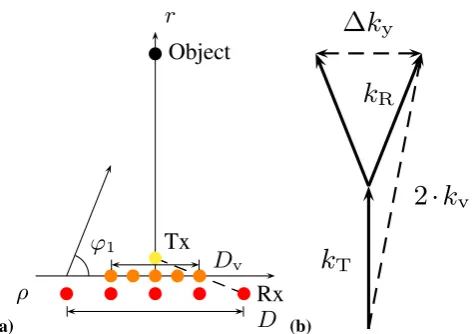
Fig. 1. Virtual array formed of one Tx andnRx antennas. (a) Arraygeometry. (b) k-space representation.
2.2 Realisation of orthogonal signals
The separation of the transmitted signals at the receivers is essential for the realisation of virtual arrays. Different ap-proaches can be considered for the orthogonalisation. In general the principles known from communication can be applied for the radar case too. The approach that does not require a high hardware effort is to separate the signals in time by transmitting the signals at a given sequence. The separation of the signals at the receiver is then done by ap-plying rectangular windows to the specific time slots of the corresponding signals of the different transmitters.
When the used bandwidthB is sufficientB can also be split intoN parts and each transmitter uses only a fraction
B/N. The drawback of this solution is that the resolution of the system will be reduced and the hardware effort will be higher too, since the filtering of the signals at the receivers has to be done. In addition a separate down-conversion for each band has to be realised at the receiver.
Also a modulation of the phase of each transmitted signal is possible. In this case the separation can be done by cor-relation of the received signals with the signal of a specific transmitter in order to separate the corresponding pair. 2.3 Description of arrays ink-space
It can be shown, that a virtual array that is formed by a trans-mit and a receive array has the same resolution properties as the monostatic array with Tx and Rx placed in the centre of a pair of Tx and Rx antenna of the respective arrays. In the fol-lowing an example with one transmit antenna andnreceive antennas, shown in Fig. 1, is considered. The considerations can be applied to configurations with arbitrary amount of an-tennas in both arrays. A point scatterer placed at the perpen-dicular bisector of the Rx array at a distanceris considered.
For a fully monostatic array with Tx and Rx antennas at the same position the width of the occupiedk-space becomes
1ky=
D
2r· |kRx+kTx| (5)
=D
r |k|. (6)
The azimuth ory-resolution can then be determined approx-imately by
1y= 2π
1ktot = 2π
21ky
(7)
= 2π r 2D|k|=
λ
2D·r. (8)
For the situation in case of the virtual array set up by a sin-gle transmit element and an object placed on the perpen-dicular bisector only the positions of the transmit array el-ements lead to an occupation of thek-space iny-direction. For the different elements the projection of the resultingk -vector 2·kv=kT+kR, shown in Fig. 1, on thekyaxis is
ky1=sinϕ1· |k| =
D
2r· |k| (9)
kyn=sinϕn· |k| =
D
2r· |k|. (10)
Taking the two outer elements into account since they result in the largest extension inky-direction, the size of the occu-piedk-space is
1ky=ky1+kyN=
D
r · |k|. (11)
and the resulting azimuth resolution results in
1y=r· λ
D. (12)
Comparing this with the monostatic case, from in (8)
1y=r· λ
D=r· λ
2Dv
(13) it turns out that the resolution of the virtual array is the same as for a monostatic array with half the array size:D=2·Dv. 2.4 Realisation of virtual arrays
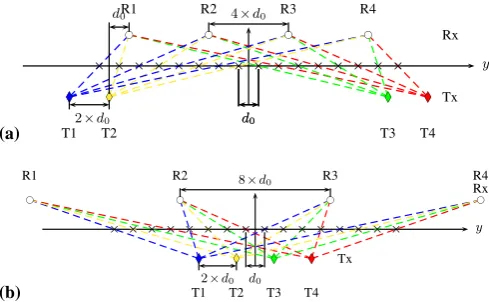
For the realisation of a virtual array different possibilities can be considered. In general an equal spacing of the virtual el-ements is desired. Possible goals could be minimum total space of the overall setup or a specific distribution of the vir-tual elements with respect to the positions of the real array elements. Setups for those two mentioned realisations are shown Fig. 2. For all realisation a virtual array withM·N
virtual elements is generated byM+N antennas. The geo-metric dimensions can be different for the same virtual ex-tension.
S. Bertl et al.: Suppression of grating lobes for MMW sparse array setups 69
(a)
Bertl, Kirschner, Detlefsen: Suppression of Grating Lobes for MMW Sparse Array Setups
3
the antenna pattern such that the main lobe of the single
an-tenna elements mainly covers the unambiguity interval.
Ob-jects outside will then be received already with lower
ampli-tudes. This approach will not be discussed in detail here.
3.2
Azimuth ambiguity and resolution
As shown in the previous section the azimuth resolution
ca-pabilities depend on the maximum dimensions of the array,
see equation (13). The more space the elements occupy, the
higher the resolution. On the other hand the number of
vir-tual array elements determines the number of azimuth sample
points and therefore together with the resolution the interval
where scatterers can be localised uniquely. Let
d0
be the
dis-tance between the virtual array elements. The unambiguity
interval then becomes
ϕunamb
=
±
sin
−1c0
4
fcd0
.
(14)
When the distance between the virtual elements is e. g.
d0
=
0
.
8
·
λ, then the unambiguity interval becomes
ϕunamb
=
±
18
.
2
◦. At an angular offset of
∆
ϕgrating
= 2
·
arcsin
c0
4
f
c0d0(15)
grating lobes will appear.
3.3
Evaluation of sub bands
As shown in equation (15) the position of the grating lobes
is varying with a change of the centre frequency of the used
frequency band. In contrast to this the results of different sub
y
× × × × × × × × × × × × × × × ×
b
c bc
b
c
b
c
l
d ld
l d l d d0 d0
4×d0
2×d0
d0
Tx Rx
T1 T2 T3 T4
R1 R2 R3 R4
(a) Placement of Rx- und Tx-antennas according to Weiß (2009), “Setup 1”
y
× × × × × × × × × × × × × × × ×
b
c bc
b
c
b
c
l
d ld
l
d
l
d
d0
8×d0
2×d0
Tx
Rx
T1 T2 T3 T4
R1 R2 R3 R4
(b) Alternative placement of Rx- und Tx-antennas to separate left and right part of the virtual array with a maximum number of vir-tual elements, “Setup 2”
Fig. 2: Different options for setting up a virtual array
bands overlap at the correct angular position of the object.
When the spacing between the virtual elements is expressed
in terms of the wavelength
λ
c,0that corresponds with
f
c,0and
d0
=
αλ
c,0, then the distance between main and gratinglobe in another frequency band with a centre frequency of
f
c,ibecomes
∆
ϕgrating
,i= 2
·
arcsin
f
c04
f
ciα
.
(16)
When the azimuth resolution cell of the array is smaller than
the separation of the grating lobes, they will be placed in
different resolution cells. The grating lobes can then be
dis-tinguished from the main lobe by comparing the responses
obtained for two different frequency bands.
In Fig. 3 the distance between grating lobes and main
lobe is shown as a function of the centre frequency at the
frequency range of interest
f
= 72
...
78GHz
. When e.g. a
distance between the virtual elements
d0
= 0
.
8
λ
is used, the
resolution capabilities in azimuth are around
∆
ϕ
= 2
◦. The
distance of the grating lobes for
d0
= 0
.
8
λ
would be
∆
ϕ
= 2
◦when the centre frequencies are separated by 4 GHz, such
that the grating lobes could be resolved at different positions,
when the two sub-bands are evaluated.
34 35 36 37 38 39
70 71 72 73 74 75 76 77 78
fci(GHz)
∆ϕ(◦)
∆ϕ= 2◦
Fig. 3: Distance between object’s position and grating lobe as
a function of centre frequency
f
ci(object at the perpendicular
bisector of the array)
4
Measurements
4.1
Evaluation of one band
For first measurements an existing MMW-sensor operating at
a slightly higher frequency range
f
= 90
.
5
...
100
.
5GHz
with
1 Tx and Rx channel is used. In order to simulate the data of
an array, the sensor is mounted on a linear positioner and the
measurement samples are taken at different positions. The
measurements are taken in steps of
∆
y
= 3mm
, which
corre-sponds to a spacing of
d0
= 0
.
92
×
λ
cof the equivalent array.
The measurements were done along a corridor of a length
of approx. 20 m. A picture of the measured scene is shown
in Fig. 4. The major objects that appear are: a trihedral, a
copper roll on a mount, a fire extinguisher, showcases and a
radiator. The reconstruction result is shown in Fig. 5. The
(b)
the antenna pattern such that the main lobe of the single an-tenna elements mainly covers the unambiguity interval. Ob-jects outside will then be received already with lower ampli-tudes. This approach will not be discussed in detail here.
3.2 Azimuth ambiguity and resolution
As shown in the previous section the azimuth resolution ca-pabilities depend on the maximum dimensions of the array, see equation (13). The more space the elements occupy, the higher the resolution. On the other hand the number of vir-tual array elements determines the number of azimuth sample points and therefore together with the resolution the interval where scatterers can be localised uniquely. Letd0be the dis-tance between the virtual array elements. The unambiguity interval then becomes
ϕunamb=±sin−1
c0
4fcd0
. (14)
When the distance between the virtual elements is e. g.d0=
0.8·λ, then the unambiguity interval becomes ϕunamb=
±18.2◦. At an angular offset of
∆ϕgrating= 2·arcsin
c0
4fc0d0
(15)
grating lobes will appear.
3.3 Evaluation of sub bands
As shown in equation (15) the position of the grating lobes is varying with a change of the centre frequency of the used frequency band. In contrast to this the results of different sub
y × × × × × × × × × × × × × × × ×
b
c bc
b
c
b
c
l
d ld
l d l d d0 d0
4×d0
2×d0
d0
Tx Rx
T1 T2 T3 T4
R1 R2 R3 R4
(a) Placement of Rx- und Tx-antennas according to Weiß (2009), “Setup 1”
y × × × × × × × × × × × × × × × ×
b
c bc
b
c
b
c
l
d ld
l
d
l
d
d0
8×d0
2×d0
Tx
Rx
T1 T2 T3 T4
R1 R2 R3 R4
(b) Alternative placement of Rx- und Tx-antennas to separate left and right part of the virtual array with a maximum number of vir-tual elements, “Setup 2”
Fig. 2: Different options for setting up a virtual array
bands overlap at the correct angular position of the object. When the spacing between the virtual elements is expressed in terms of the wavelengthλc,0 that corresponds with fc,0 andd0=αλc,0, then the distance between main and grating lobe in another frequency band with a centre frequency of
fc,ibecomes
∆ϕgrating,i= 2·arcsin
fc0
4fciα
. (16)
When the azimuth resolution cell of the array is smaller than the separation of the grating lobes, they will be placed in different resolution cells. The grating lobes can then be dis-tinguished from the main lobe by comparing the responses obtained for two different frequency bands.
In Fig. 3 the distance between grating lobes and main lobe is shown as a function of the centre frequency at the frequency range of interest f= 72...78GHz. When e.g. a distance between the virtual elementsd0= 0.8λis used, the resolution capabilities in azimuth are around∆ϕ= 2◦. The
distance of the grating lobes ford0= 0.8λwould be∆ϕ= 2◦ when the centre frequencies are separated by 4 GHz, such that the grating lobes could be resolved at different positions, when the two sub-bands are evaluated.
34 35 36 37 38 39
70 71 72 73 74 75 76 77 78
fci(GHz) ∆ϕ(◦)
∆ϕ= 2◦
Fig. 3: Distance between object’s position and grating lobe as a function of centre frequencyfci(object at the perpendicular bisector of the array)
4 Measurements
4.1 Evaluation of one band
For first measurements an existing MMW-sensor operating at a slightly higher frequency rangef= 90.5...100.5GHzwith 1 Tx and Rx channel is used. In order to simulate the data of an array, the sensor is mounted on a linear positioner and the measurement samples are taken at different positions. The measurements are taken in steps of∆y= 3mm, which corre-sponds to a spacing ofd0= 0.92×λcof the equivalent array. The measurements were done along a corridor of a length of approx. 20 m. A picture of the measured scene is shown in Fig. 4. The major objects that appear are: a trihedral, a copper roll on a mount, a fire extinguisher, showcases and a radiator. The reconstruction result is shown in Fig. 5. The
Fig. 2. Different options for setting up a virtual array. (a)
Place-ment of Rx- und Tx-antennas according to Wei (2009), Setup 1. (b) Alternative placement of Rx- und Tx-antennas to separate left and right part of the virtual array with a maximum number of virtual elements, Setup 2.
3 Methods for grating lobe suppression 3.1 Choice of the antenna pattern
A first approach to reduce the influence of objects that are outside the unambiguity interval on this interval, is to adapt the antenna pattern such that the main lobe of the single an-tenna elements mainly covers the unambiguity interval. Ob-jects outside will then be received already with lower ampli-tudes. This approach will not be discussed in detail here. 3.2 Azimuth ambiguity and resolution
As shown in the previous section the azimuth resolution ca-pabilities depend on the maximum dimensions of the array, see Eq. (13). The more space the elements occupy, the higher the resolution. On the other hand the number of virtual array elements determines the number of azimuth sample points and therefore together with the resolution the interval where scatterers can be localised uniquely. Letd0be the distance between the virtual array elements. The unambiguity interval then becomes
ϕunamb= ±sin−1
c
0 4fcd0
. (14)
When the distance between the virtual elements is e. g.
d0=0.8·λ, then the unambiguity interval becomesϕunamb= ±18.2◦. At an angular offset of
1ϕgrating=2·arcsin
c
0 4fc0d0
(15) grating lobes will appear.
Bertl, Kirschner, Detlefsen: Suppression of Grating Lobes for MMW Sparse Array Setups
3
the antenna pattern such that the main lobe of the single
an-tenna elements mainly covers the unambiguity interval.
Ob-jects outside will then be received already with lower
ampli-tudes. This approach will not be discussed in detail here.
3.2
Azimuth ambiguity and resolution
As shown in the previous section the azimuth resolution
ca-pabilities depend on the maximum dimensions of the array,
see equation (13). The more space the elements occupy, the
higher the resolution. On the other hand the number of
vir-tual array elements determines the number of azimuth sample
points and therefore together with the resolution the interval
where scatterers can be localised uniquely. Let
d
0be the
dis-tance between the virtual array elements. The unambiguity
interval then becomes
ϕ
unamb=
±
sin
−1c
04
f
cd
0.
(14)
When the distance between the virtual elements is e. g.
d
0=
0
.
8
·
λ
, then the unambiguity interval becomes
ϕ
unamb=
±
18
.
2
◦. At an angular offset of
∆
ϕ
grating= 2
·
arcsin
c
04
f
c0d
0(15)
grating lobes will appear.
3.3
Evaluation of sub bands
As shown in equation (15) the position of the grating lobes
is varying with a change of the centre frequency of the used
frequency band. In contrast to this the results of different sub
y × × × × × × × × × × × × × × × × bc bc bc bc l
d ld
l d l d d0 d0 4×d0
2×d0
d0
Tx Rx
T1 T2 T3 T4
R1 R2 R3 R4
(a) Placement of Rx- und Tx-antennas according to Weiß (2009),
“Setup 1”
y × × × × × × × × × × × × × × × × bc bc bc bc ld ld
l
d
l
d
d0 8×d0
2×d0
Tx
Rx
T1 T2 T3 T4
R1 R2 R3 R4
(b) Alternative placement of Rx- und Tx-antennas to separate left
and right part of the virtual array with a maximum number of
vir-tual elements, “Setup 2”
Fig. 2: Different options for setting up a virtual array
bands overlap at the correct angular position of the object.
When the spacing between the virtual elements is expressed
in terms of the wavelength
λ
c,0that corresponds with
f
c,0and
d
0=
αλ
c,0, then the distance between main and grating
lobe in another frequency band with a centre frequency of
f
c,ibecomes
∆
ϕ
grating,i= 2
·
arcsin
f
c04
f
ciα
.
(16)
When the azimuth resolution cell of the array is smaller than
the separation of the grating lobes, they will be placed in
different resolution cells. The grating lobes can then be
dis-tinguished from the main lobe by comparing the responses
obtained for two different frequency bands.
In Fig. 3 the distance between grating lobes and main
lobe is shown as a function of the centre frequency at the
frequency range of interest
f
= 72
...
78GHz
. When e.g. a
distance between the virtual elements
d
0= 0
.
8
λ
is used, the
resolution capabilities in azimuth are around
∆
ϕ
= 2
◦. The
distance of the grating lobes for
d
0= 0
.
8
λ
would be
∆
ϕ
= 2
◦when the centre frequencies are separated by 4 GHz, such
that the grating lobes could be resolved at different positions,
when the two sub-bands are evaluated.
34
35
36
37
38
39
70 71 72 73 74 75 76 77 78
f
ci(GHz)
∆
ϕ
(
◦)
∆
ϕ
= 2
◦Fig. 3: Distance between object’s position and grating lobe as
a function of centre frequency
f
ci(object at the perpendicular
bisector of the array)
4
Measurements
4.1
Evaluation of one band
For first measurements an existing MMW-sensor operating at
a slightly higher frequency range
f
= 90
.
5
...
100
.
5GHz
with
1 Tx and Rx channel is used. In order to simulate the data of
an array, the sensor is mounted on a linear positioner and the
measurement samples are taken at different positions. The
measurements are taken in steps of
∆
y
= 3mm
, which
corre-sponds to a spacing of
d
0= 0
.
92
×λ
cof the equivalent array.
The measurements were done along a corridor of a length
of approx. 20 m. A picture of the measured scene is shown
in Fig. 4. The major objects that appear are: a trihedral, a
copper roll on a mount, a fire extinguisher, showcases and a
radiator. The reconstruction result is shown in Fig. 5. The
Fig. 3. Distance between object’s position and grating lobe as a
function of centre frequencyfci(object at the perpendicular
bisec-tor of the array).
3.3 Evaluation of sub bands
As shown in Eq. (15) the position of the grating lobes is vary-ing with a change of the centre frequency of the used fre-quency band. In contrast to this the results of different sub bands overlap at the correct angular position of the object. When the spacing between the virtual elements is expressed in terms of the wavelengthλc,0 that corresponds with fc,0 andd0=αλc,0, then the distance between main and grating lobe in another frequency band with a centre frequency of
fc,ibecomes
1ϕgrating,i=2·arcsin
f
c0 4fciα
. (16)
When the azimuth resolution cell of the array is smaller than the separation of the grating lobes, they will be placed in different resolution cells. The grating lobes can then be dis-tinguished from the main lobe by comparing the responses obtained for two different frequency bands.
In Fig. 3 the distance between grating lobes and main lobe is shown as a function of the centre frequency at the fre-quency range of interestf=72...78GHz. When e.g. a dis-tance between the virtual elementsd0=0.8λis used, the res-olution capabilities in azimuth are around1ϕ=2◦. The dis-tance of the grating lobes ford0=0.8λwould be 1ϕ=2◦ when the centre frequencies are separated by 4 GHz, such that the grating lobes could be resolved at different positions, when the two sub-bands are evaluated.
4 Measurements
4.1 Evaluation of one band
For first measurements an existing MMW-sensor operating at a slightly higher frequency rangef=90.5...100.5GHz with 1 Tx and Rx channel is used. In order to simulate the data of an array, the sensor is mounted on a linear positioner and the
70 S. Bertl et al.: Suppression of grating lobes for MMW sparse array setups
4
Bertl, Kirschner, Detlefsen: Suppression of Grating Lobes for MMW Sparse Array Setups
results are represented in a logarithmic scale with 50 dB
dy-namic range. The used frequency range for the measurement
is
f
= 90
.
5
...
93
.
5GHz
.
Fig. 4: Measurement scene in a corridor with several objects
4.2
Processing of sub bands
For the evaluation of sub bands two parts of the
sen-sor’s available bandwidth are used.
The lower band
is
f
1= 90
.
5
...
92
.
8GHz
and the upper one covers
f
2=
98
.
2
...
100
.
5GHz
. When the two sub bands are evaluated it
shows that the result of them don’t overlap exactly in range.
In addition the grating lobes are not at the exact position in
azimuth according to the used frequencies. A possible
rea-son could be inaccuracies in the data acquisition (trigger), but
also a mismatch in tuning voltage of the VCO and expected
frequency, which leads to inaccurate output frequencies. As
a consequence the evaluation of the measured data has to be
adapted. The two images can not be compared point by point
at the exact position of a peak. Instead of this a mask is
generated, where main-lobes are identified. This is done by
determining the object responses produced by grating lobes
and main lobes in the two sub-bands. The main lobe is at
r (m)
y (m)
0 5 10 15 20 25
−8
−6
−4
−2
0
2
4
6
8
showcases
radiator
Fig. 5: Reconstruction result of the scene according to
the photo shown in Fig. 4, logarithmic scale with 50 dB
dynamic range, green line:
unambiguous interval,
f
=
r (m)
y (m)
0 5 10 15 20 25
−6
−4
−2
0
2
4
6
(a) Unprocessed measurement result
r (m)
y (m)
0 5 10 15 20 25
−6
−4
−2
0
2
4
6
(b) Result after evaluation of the sub bands
Fig. 6: Comparison of original processed array data and
re-sults after applying a mask with the position of the main
lobes
the same position in the two pictures, grating lobes are at
dif-ferent positions. The mask contains only these points where
main lobes have been identified, for other coordinates it is
set to zero. A result of this processing scheme is shown in
Fig. 6. It shows that outside the unambiguous region grating
lobes have been removed for the most part.
5
Conclusions
The concept of virtual arrays has been presented. It is
use-ful to implement arrays with several virtual elements while
keeping the hardware effort at a lower level compared to the
realisation of an array with Tx and Rx at each position of the
array. To demonstrate the expected imaging properties an
existing MMW-sensor has been used to setup an array with
16 elements. In order to reduce the presence of azimuth
am-biguities, two different sub bands have been evaluated. A
suppression of grating lobes is possible with this processing
step. For the considered bandwidth of 72. . . 78 GHz in the
realisation of the system, two sub-bands with 2 GHz
band-width and a separation of the centre frequencies
f
ciof 4 GHz
is considered. Evaluation of sub-bands allows to distinguish
Fig. 4. Measurement scene in a corridor with several objects.4
Bertl, Kirschner, Detlefsen: Suppression of Grating Lobes for MMW Sparse Array Setups
results are represented in a logarithmic scale with 50 dB
dy-namic range. The used frequency range for the measurement
is
f
= 90
.
5
...
93
.
5GHz
.
Fig. 4: Measurement scene in a corridor with several objects
4.2
Processing of sub bands
For the evaluation of sub bands two parts of the
sen-sor’s available bandwidth are used.
The lower band
is
f
1= 90
.
5
...
92
.
8GHz
and the upper one covers
f
2=
98
.
2
...
100
.
5GHz
. When the two sub bands are evaluated it
shows that the result of them don’t overlap exactly in range.
In addition the grating lobes are not at the exact position in
azimuth according to the used frequencies. A possible
rea-son could be inaccuracies in the data acquisition (trigger), but
also a mismatch in tuning voltage of the VCO and expected
frequency, which leads to inaccurate output frequencies. As
a consequence the evaluation of the measured data has to be
adapted. The two images can not be compared point by point
at the exact position of a peak. Instead of this a mask is
generated, where main-lobes are identified. This is done by
determining the object responses produced by grating lobes
and main lobes in the two sub-bands. The main lobe is at
r (m)
y (m)
0 5 10 15 20 25
−8
−6
−4
−2
0
2
4
6
8
showcases
radiator
Fig. 5: Reconstruction result of the scene according to
the photo shown in Fig. 4, logarithmic scale with 50 dB
dynamic range, green line:
unambiguous interval,
f
=
90
.
5
...
93
.
5GHz
r (m)
y (m)
0 5 10 15 20 25
−6
−4
−2
0
2
4
6
(a) Unprocessed measurement result
r (m)
y (m)
0 5 10 15 20 25
−6
−4
−2
0
2
4
6
(b) Result after evaluation of the sub bands
Fig. 6: Comparison of original processed array data and
re-sults after applying a mask with the position of the main
lobes
the same position in the two pictures, grating lobes are at
dif-ferent positions. The mask contains only these points where
main lobes have been identified, for other coordinates it is
set to zero. A result of this processing scheme is shown in
Fig. 6. It shows that outside the unambiguous region grating
lobes have been removed for the most part.
5
Conclusions
The concept of virtual arrays has been presented. It is
use-ful to implement arrays with several virtual elements while
keeping the hardware effort at a lower level compared to the
realisation of an array with Tx and Rx at each position of the
array. To demonstrate the expected imaging properties an
existing MMW-sensor has been used to setup an array with
16 elements. In order to reduce the presence of azimuth
am-biguities, two different sub bands have been evaluated. A
suppression of grating lobes is possible with this processing
step. For the considered bandwidth of 72. . . 78 GHz in the
realisation of the system, two sub-bands with 2 GHz
band-width and a separation of the centre frequencies
f
ciof 4 GHz
is considered. Evaluation of sub-bands allows to distinguish
between main and grating lobes. Using this approach arrays
Fig. 5. Reconstruction result of the scene according to the photo
shown in Fig. 4, logarithmic scale with 50 dB dynamic range, green line: unambiguous interval,f=90.5...93.5GHz.
measurement samples are taken at different positions. The measurements are taken in steps of1y=3mm, which corre-sponds to a spacing ofd0=0.92×λcof the equivalent array. The measurements were done along a corridor of a length of approx. 20 m. A picture of the measured scene is shown in Fig. 4. The major objects that appear are: a trihedral, a copper roll on a mount, a fire extinguisher, showcases and a radiator. The reconstruction result is shown in Fig. 5. The results are represented in a logarithmic scale with 50 dB dy-namic range. The used frequency range for the measurement isf=90.5...93.5GHz.
4.2 Processing of sub bands
For the evaluation of sub bands two parts of the sen-sor’s available bandwidth are used. The lower band is f1=90.5...92.8GHz and the upper one covers f2=
(a)
4
Bertl, Kirschner, Detlefsen: Suppression of Grating Lobes for MMW Sparse Array Setups
results are represented in a logarithmic scale with 50 dB
dy-namic range. The used frequency range for the measurement
is
f
= 90
.
5
...
93
.
5GHz
.
Fig. 4: Measurement scene in a corridor with several objects
4.2
Processing of sub bands
For the evaluation of sub bands two parts of the
sen-sor’s available bandwidth are used.
The lower band
is
f
1= 90
.
5
...
92
.
8GHz
and the upper one covers
f
2=
98
.
2
...
100
.
5GHz
. When the two sub bands are evaluated it
shows that the result of them don’t overlap exactly in range.
In addition the grating lobes are not at the exact position in
azimuth according to the used frequencies. A possible
rea-son could be inaccuracies in the data acquisition (trigger), but
also a mismatch in tuning voltage of the VCO and expected
frequency, which leads to inaccurate output frequencies. As
a consequence the evaluation of the measured data has to be
adapted. The two images can not be compared point by point
at the exact position of a peak. Instead of this a mask is
generated, where main-lobes are identified. This is done by
determining the object responses produced by grating lobes
and main lobes in the two sub-bands. The main lobe is at
r (m)
y (m)
0 5 10 15 20 25
−8
−6
−4
−2
0
2
4
6
8
showcases
radiator
Fig. 5: Reconstruction result of the scene according to
the photo shown in Fig. 4, logarithmic scale with 50 dB
dynamic range, green line:
unambiguous interval,
f
=
90
.
5
...
93
.
5GHz
r (m)
y (m)
0 5 10 15 20 25
−6
−4
−2
0
2
4
6
(a) Unprocessed measurement result
r (m)
y (m)
0 5 10 15 20 25
−6
−4
−2
0
2
4
6
(b) Result after evaluation of the sub bands
Fig. 6: Comparison of original processed array data and
re-sults after applying a mask with the position of the main
lobes
the same position in the two pictures, grating lobes are at
dif-ferent positions. The mask contains only these points where
main lobes have been identified, for other coordinates it is
set to zero. A result of this processing scheme is shown in
Fig. 6. It shows that outside the unambiguous region grating
lobes have been removed for the most part.
5
Conclusions
The concept of virtual arrays has been presented. It is
use-ful to implement arrays with several virtual elements while
keeping the hardware effort at a lower level compared to the
realisation of an array with Tx and Rx at each position of the
array. To demonstrate the expected imaging properties an
existing MMW-sensor has been used to setup an array with
16 elements. In order to reduce the presence of azimuth
am-biguities, two different sub bands have been evaluated. A
suppression of grating lobes is possible with this processing
step. For the considered bandwidth of 72. . . 78 GHz in the
realisation of the system, two sub-bands with 2 GHz
band-width and a separation of the centre frequencies
f
ciof 4 GHz
is considered. Evaluation of sub-bands allows to distinguish
between main and grating lobes. Using this approach arrays
(b)
4
Bertl, Kirschner, Detlefsen: Suppression of Grating Lobes for MMW Sparse Array Setups
results are represented in a logarithmic scale with 50 dB
dy-namic range. The used frequency range for the measurement
is
f
= 90
.
5
...
93
.
5GHz
.
Fig. 4: Measurement scene in a corridor with several objects
4.2
Processing of sub bands
For the evaluation of sub bands two parts of the
sen-sor’s available bandwidth are used.
The lower band
is
f
1= 90
.
5
...
92
.
8GHz
and the upper one covers
f
2=
98
.
2
...
100
.
5GHz
. When the two sub bands are evaluated it
shows that the result of them don’t overlap exactly in range.
In addition the grating lobes are not at the exact position in
azimuth according to the used frequencies. A possible
rea-son could be inaccuracies in the data acquisition (trigger), but
also a mismatch in tuning voltage of the VCO and expected
frequency, which leads to inaccurate output frequencies. As
a consequence the evaluation of the measured data has to be
adapted. The two images can not be compared point by point
at the exact position of a peak. Instead of this a mask is
generated, where main-lobes are identified. This is done by
determining the object responses produced by grating lobes
and main lobes in the two sub-bands. The main lobe is at
r (m)
y (m)
0 5 10 15 20 25
−8
−6
−4
−2
0
2
4
6
8
showcases
radiator
Fig. 5: Reconstruction result of the scene according to
the photo shown in Fig. 4, logarithmic scale with 50 dB
dynamic range, green line:
unambiguous interval,
f
=
90
.
5
...
93
.
5GHz
r (m)
y (m)
0 5 10 15 20 25
−6
−4
−2
0
2
4
6
(a) Unprocessed measurement result
r (m)
y (m)
0 5 10 15 20 25
−6
−4
−2
0
2
4
6
(b) Result after evaluation of the sub bands
Fig. 6: Comparison of original processed array data and
re-sults after applying a mask with the position of the main
lobes
the same position in the two pictures, grating lobes are at
dif-ferent positions. The mask contains only these points where
main lobes have been identified, for other coordinates it is
set to zero. A result of this processing scheme is shown in
Fig. 6. It shows that outside the unambiguous region grating
lobes have been removed for the most part.
5
Conclusions
The concept of virtual arrays has been presented. It is
use-ful to implement arrays with several virtual elements while
keeping the hardware effort at a lower level compared to the
realisation of an array with Tx and Rx at each position of the
array. To demonstrate the expected imaging properties an
existing MMW-sensor has been used to setup an array with
16 elements. In order to reduce the presence of azimuth
am-biguities, two different sub bands have been evaluated. A
suppression of grating lobes is possible with this processing
step. For the considered bandwidth of 72. . . 78 GHz in the
realisation of the system, two sub-bands with 2 GHz
band-width and a separation of the centre frequencies
f
ciof 4 GHz
is considered. Evaluation of sub-bands allows to distinguish
between main and grating lobes. Using this approach arrays
Fig. 6. Comparison of original processed array data and results
after applying a mask with the position of the main lobes. (a) Un-processed measurement result. (b) Result after evaluation of the sub bands.
98.2...100.5GHz. When the two sub bands are evaluated it shows that the result of them don’t overlap exactly in range. In addition the grating lobes are not at the exact position in azimuth according to the used frequencies. A possible rea-son could be inaccuracies in the data acquisition (trigger), but also a mismatch in tuning voltage of the VCO and expected frequency, which leads to inaccurate output frequencies. As a consequence the evaluation of the measured data has to be adapted. The two images can not be compared point by point at the exact position of a peak. Instead of this a mask is generated, where main-lobes are identified. This is done by determining the object responses produced by grating lobes and main lobes in the two sub-bands. The main lobe is at the same position in the two pictures, grating lobes are at dif-ferent positions. The mask contains only these points where main lobes have been identified, for other coordinates it is set to zero. A result of this processing scheme is shown in Fig. 6. It shows that outside the unambiguous region grating lobes have been removed for the most part.
5 Conclusions
The concept of virtual arrays has been presented. It is use-ful to implement arrays with several virtual elements while keeping the hardware effort at a lower level compared to the realisation of an array with Tx and Rx at each position of the array. To demonstrate the expected imaging properties an ex-isting MMW-sensor has been used to setup an array with 16 elements. In order to reduce the presence of azimuth ambi-guities, two different sub bands have been evaluated. A sup-pression of grating lobes is possible with this processing step. For the considered bandwidth of 72. . . 78 GHz in the realisa-tion of the system, two sub-bands with 2 GHz bandwidth and a separation of the centre frequenciesfciof 4 GHz is consid-ered. Evaluation of sub-bands allows to distinguish between main and grating lobes. Using this approach arrays can be tailored to the desired field of view and a good azimuth reso-lution.
References
Wei, M. Digital Antennas, in: Multistatic Surveillance and Recon-naissance: Sensor, Signals and Data Fusion, pages 5-1–5-29, RTO-EN-SET-133, 2009. Available from http://www.rto.nato. int.abstract.aps
Li, J., Stoica, P. MIMO radar signal processing, John Wiley & Sons Inc., Hoboken, New Kersey, 2009.
Ender, Joachim H. G. MIMO-SAR, in: Proceedings of IRS-07, In-ternational Radar Symposium 2007, Kln, Germany, September 2005–2007.