The Thirty-Third AAAI Conference on Artificial Intelligence (AAAI-19)
Triple Classification Using Regions and Fine-Grained Entity Typing
Tiansi Dong
B-IT, University of Bonn, Germany [email protected]
Zhigang Wang
Aisino Corporation, China [email protected]Juanzi Li
DCST, Tsinghua University, China [email protected]
Christian Bauckhage,
1,2Armin B. Cremers
1 1B-IT, University of Bonn, Germany2Fraunhofer IAIS, Germany {bauckhag, abc}@bit.uni-bonn.de
Abstract
A Triple in knowledge-graph takes a form that consists of
head, relation, tail. Triple Classification is used to deter-mine the truth value of an unknown Triple. This is a hard task for 1-to-N relations using the vector-based embedding approach. We propose a new region-based embedding ap-proach using fine-grained type chains. A novel geometric pro-cess is presented to extend the vectors of pre-trained enti-ties into n-balls (n-dimensional balls) under the condition thathead balls shall contain theirtailballs. Our algorithm achieves zero energy cost, therefore, serves as a case study of perfectly imposing tree structures into vector space. An un-known Triple (h, r, x) will be predicted as true, whenx’s n-ball is located in the r-subspace of h’s n-ball, follow-ing the same construction of knowntailsofh. The experi-ments are based on large datasets derived from the bench-mark datasets WN11, FB13, and WN18. Our results show that the performance of the new method is related to the length of the type chain and the quality of pre-trained entity-embeddings, and that performances of long chains with well-trained entity-embeddings outperform other methods in the literature. Source codes and datasets are located at https: //github.com/GnodIsNait/mushroom.
Introduction
Knowledge-graphs represent truth knowledge in the Triple (head, relation, tail), shortened as(h, r, t). In Semantic Web Community, such a Triple is named as(subject, predicate, object). Knowledge-graphs such as Word-Net, Yago, and Freebase (Miller 1995; Suchanek, Kasneci, and Weikum 2007; Bollacker et al. 2008) are very useful for AI ap-plications, e.g. question-answering, query expansion, infor-mation retrieval, document classification (Manning, Ragha-van, and Sch¨utze 2008; Socher et al. 2013; Bordes et al. 2013; Wang et al. 2014a; Wang and Li 2016). How-ever, knowledge-graphs normally suffer from incomplete-ness. One research topic in AI is to predict the missing part of a knowledge-graph. The basic task is Triple Classifica-tion, which is to determine the truth value, or the degree of truth value, of an unknown Triple.
In the literature of representational learning, a Triple
(h, r, t)is encoded as a quasi triangular relationh+r≈t,
Copyright c⃝2019, Association for the Advancement of Artificial Intelligence (www.aaai.org). All rights reserved.
which can be understood as a translation from hto tby addingr. Using this method, (Bordes et al. 2013) achieved the state-of-the-art performance, but it suffers from the 1-to-N, N-to-1 and N-to-N relations. Hyperplane projection methods allow an entity to have several embeddings for different relations. However, these methods do not signif-icantly improve the performance of predicting unknown tails of Triples in 1-to-N relations (Wang et al. 2014b; Lin et al. 2015).
It is not difficult to understand that there is no perfect vec-tor representation for 1-to-N relation: Letisabe the perfect vector representation for theisarelation,(zurich, isa, city)
and(new york, isa, city)be two Triples. Ideally, we shall havezurich+isa=cityandnew york+isa=city. However, this leads to a wrong assertion that zurichand
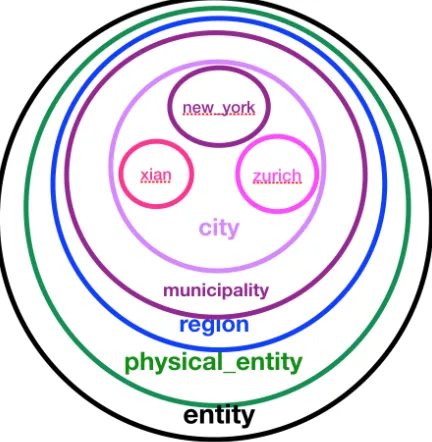
new york are the same city. We propose to extend entity-embeddings from vectors into regions, so that the isa re-lation can be implicitly represented by the inclusion rela-tion between regions: zurich region and new york region are located inside the cityregion, thecityregion is inside the municipality region, . . . . We can have a further fine-grained typing chain ofcity:city,municipality,region, phys-ical entity, entity, as illustrated in Figure 1. Such chains can be interpreted as an incremental conceptual clustering (Fisher 1987), and proven to be useful. They carry more type information than a single type (Ren et al. 2016), provide more specific semantic information (Xu et al. 2016). They have benefitted many real applications, e.g., knowledge-base completion (Dong et al. 2014), entity linking (Ling, Singh, and Weld 2015; Durrett and Klein 2015), relation extrac-tion (Liu et al. 2014), and quesextrac-tion-answering (Yahya et al. 2014).
sub-space into thecityregion. Thebeijingball is located inside theisa subspace, whileinner cityball is inside thepart of subspace. The two subspaces are disconnected from each other, as illustrated in Figure 2. This method can be un-derstood as a recursive usage of supporting vector machines (SVM) withn-balls as kernels, i.e. (Shawe-Taylor and Cris-tianini 2004).
We use vectors trained by TEKE model (Wang and Li 2016) as pre-trained entity-embeddings, and extend them into balls inn-dimensional spheres, namelyn-balls. Given tailst1, t2, . . . , tnof headhwith relationr, and fine grained typing chain of h0(= h), h1, h2, . . . , hk, we design a new geometrical process to constructn-balls oftis and hjs, so that any two n-balls of ti are disconnected, ti’s n-ball is inside ther-subspace of h0’sn-ball, andn-ball ofhi−1 is
contained by theisasubspace ofhi’sn-ball. The relations of containment shall be strictly realised. To determine whether a new entityxis a tail of headh0 with relation r, we
ap-ply the same geometric process tox. If then-ball of xis contained by ther-subspace ofn-ball ofh,(h, r, x)will be predicted as positive.
Figure 1:n-ball embedding
The contributions of this article are as follow: (1) a novel graph-embedding method is proposed to use n-ball for entity-embedding, and implicitly represent 1-to-N rela-tions as inclusion relarela-tions amongn-balls. Instead of a sin-gle type, we use fine-grained entity typing in Triple Classifi-cation; (2) a geometric transformation is proposed to strictly encode all selected Triple relations inton-ball embeddings, which cannot be achieved by the back-propagation method (Rumelhart, Hinton, and Williams 1988).
The rest of the article is structured as follows: Section 2 reviews related works; Section 3 presents our method; Sec-tion 4 shows experiment results; SecSec-tion 5 summarizes the current work, lists on-going works, and the impact.
Figure 2:n-ball embedding with subspaces
Related Works
Triple Classification using representational learning is re-lated to researches in the fields of graph embedding and rea-soning with loss-function.
Graph Embedding
Representational learning has been widely applied for knowledge-graph representation and reasoning. TransE (Bordes et al. 2013) trained vector representations of
(h, r, t), in which the vector triangle equation t ≈ h+r
stand. TransH (Wang et al. 2014b) relaxed this approxima-tion relaapproxima-tion on projecapproxima-tion hyperplanes, i.e.t⊥≈dr+r⊥. In
TransR (Lin et al. 2015) and TransD (Ji et al. 2015), the vec-tor triangle approximation is further updated toMrh+r≈ Mrt, that is, the approximation holds, after the head vec-tor and the tail vecvec-tor are transformed by a relation-related matrix Mr. In TransD (Ji et al. 2015) transformation ma-trixMris determined by both entities and relations. These models can be understood as the extension of TransE using the kernel approach (Shawe-Taylor and Cristianini 2004). CTransR (Lin et al. 2015) and TransG (Xiao et al. 2015b) extend TransR by clusteringhandtbefore applying matrix transformation. The vector triangular approximation holds for representative vectors within its cluster in the kernel space, i.e.Mrh′+r ≈Mrt′, whereh′andt′ are the rep-resentative vectors ofhandtin their clusters, respectively. TransA (Xiao et al. 2015a) introduced a weight matrixWr: fr(h, t) = (|h+r−t|⊤)Wr(|h+r−t|).
Xie et al. 2016). For example, by combining a CBOW and TransE to learn Triple embeddings, or by adopt-ing deep convolution neural model to maximize the prediction of entity descriptions, experiment results are significantly improved, e.g., (Wang and Li 2016; Han, Liu, and Sun 2016).
To improve the performance of the reasoning with 1-to-N relations, researchers have proposed region-based graph embedding methods. The KG2E (He et al. 2015) model embeds entities using Gaussian distributions, namely high-dimensional regions of probability. (Xiao, Huang, and Zhu 2016) uses manifolds: a Triple (h, r, t) is interpreted as a manifold M(h,r,t) = D2
r, that is, given hand r, tailt shall be located in the manifold. (Nickel and Kiela 2017) uses Poincar´e balls to represent entities and relations, as an unsupervised approach to embed tree structures.
Loss-Function Using Margin and Negative Samples
The dominant method for representation training is to min-imize a loss-function (LeCun et al. 2006), which tries to guarantee that the triangular relation of true Triples is bet-ter than that of negative samples within a margin (Gutmann and Hyv¨arinen 2012). Formally, letδbe the margin,S be the set of true Triples, andS′be the set of negative samples,
the loss-function is written as follows:
L= ∑
(h,r,t)∈S
∑
(h,r,t′)∈S′
max(0, f(h, r, t) +δ−f(h, r, t′))
wheref(x, y, z),∥x+y−z∥is a degree measurement of the triangular relation among vectorsx,y,z. Stochastic Gra-dient Descent (SGD) process is applied to reduce the value ofLuntill a local minimum is reached.
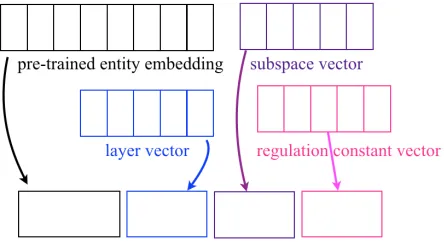
Figure 3: Four components of the central point
Triple Classification Using
n
-Ball Embeddings
Loss-function plus SGD does not guarantee the global min-imum. Negative sampling shall not exhaust all false Triples. We distinguish from ‘samplings’ the ‘type’, which can be intuitively understood as a bounded region that separates all negative samples from true Triples. To simplify the process, we restrict these regions ton-balls, and develop geometric construction approach to achieve the global minimum.We start with some terminologies. Then-ball embedding of entityeis written asB(Oe, rde), whereOeis the vector
Figure 4: A type chain for three concrete cities
of the central point of then-ball of entitye, andrdeis the radius of thisn-ball.Oecan be further specified by(de, le), wheredeis the unit vector representing the direction ofOe, andleis the length ofOe. We definen-ball as an open space as follows:B(Oe, rde) ,{p|∥Oe−p∥ < rde}, in which ∥x−y∥ , √
(x−y)⊤(x−y).
B(Oe, rde)is the set of vectorpwhose Euclidean distance toOe is less thanrde. That is,n-balls are open spaces. The complement region of ann-ball is not introduced (Dong 2008).
The Structure of the Central Point
The structure of the central point consists of four pieces of vector information as illustrated in Figure 3.
• the vector embedding ofeacquired from corpus;
• the lengthpof the type chain ofeis encoded by a layer vector, whose firstpelements are ‘1’, followed by ‘0’. For example, the layer vector of entity.n.01 is [0,0,0,0,0], the layer vector of location.n.01 is [1,0,0,0,0], the layer vector of xian.n.01 is [1,1,1,1,0], see Figure 4. Siblings have the same layer vector;
• different relations toe’s parent are encoded by different vectors, which are calledsubspace vectors.
• regulation constant vector, whose function is to avoid an
n-ball containing the origin point of the space.
Inspired by (Zeng et al. 2014) and (Han, Liu, and Sun 2016), we concatenate the pre-trained entity-embedding vector, the subspace vector, the layer vector, and the regu-lation constant vector as the central point of ann-ball.
Construct
n
-Balls and Subspaces
Given a Triple (h, r, t), we construct the r-subspace within B(Oh, rdh), which is also an n-ball, written as B(Ohr, rdhr). For each tailtsatisfying(h, r, t),B(Ot, rdt) is part of ther-subspaceB(Ohr, rdhr). We define two predi-cates forbeing disconnected(DC) andbeing inside(P) re-lations as follows:
• B(Oe1, rde1)disconnects fromB(Oe2, rde2), written as
Figure 5: B(Oe2, rde2) is inside B(Oe1, rde1),
B(Oe1, rde1)disconnects fromB(Oe3, rde3)
to or greater than the sum ofrde1andrde2.
DC(e1, e2),∥Oe1−Oe2∥ ≥rde1+rde2 (1)
• B(Oe1, rde1) is inside B(Oe2, rde2), written as
P(e1, e2), if rde2 equals to or is greater than the sum ofrde1 and the distance betweenOe1 andOe2, as illustrated in Figure 5.
P(e1, e2), rde2 ≥ ∥Oe1−Oe2∥+rde1 (2)
We need to strictly encode all known Triple relations into inclusion relations amongn-balls. This is a big chal-lenge, as the widely adopted back-propagation training pro-cess quickly reaches a non-zero local minimum and termi-nates1 (Rumelhart, Hinton, and Williams 1988). The prob-lem is that when locations and sizes of twon-balls are up-dated locally, already improved locations and sizes will very easily deteriorate. We, therefore, use the classic depth-first recursion process, and employ three transformations to con-struct and trainn-ball embeddings as follows.
• Homothethic transformation, which keeps the direction of the central point, and enlarges lengths of the central vector
land the radiusrdwith the same ratek(k >0).
• Shifting transformation, which keeps the length of the ra-diusrdof ann-ball, and add a new vectorpto its central point.
• Rotation transformation, which keeps the length of the ra-diusrd, and rotates angleαwith thei-th and thej-th ele-ments ofO.
1
This happens even for small datasets. A toy dataset was created to show that the target configuration could not be achieved by back-propagation process. The source code is available at https://github. com/GnodIsNait/bp94nball
Algorithm 1:constructn-ball embeddings
input :known tails: (h,r,t1). . . (h,r,tM),ti∈tails; type chain:tChains=[h,h1, . . . ,hN]; pre-trained entity-embeddings:EV
output:r-subspace ofn-ball of headh:ballHr; geometric transformation history:tranHis
tranHis= []
// initialise n-balls of [t1, ...,tM] foreachele∈[t1, . . . ,tM]do
bTails[ele]=init nball(ele,EV)
end
// make n-balls of [t1, ...,tM] mutually be disconnected using three geometric transformations
bTails,tranHis=disconnect(bTails,tranHis)
ballHr=init nball(h,EV)
// for each member in bTails, create
n-ball of r-space of h to contain,
using geometric transformations
foreachele∈bTailsdo
bHr[ele],tranHis
=contain(ballHr,r,ele,tranHis)
end
whiletChainsnot emptydo
ele=pop(tChains,0)
ifele==hthen
// create the minimal cover of
bHr as the isa-subspace inside h’s n-ball
ballHr=mini cover ball(bHr)
bTs[ele0]=ballHr
else
bTs[ele]=init nball(ele,EV)
bTs[ele],tranHis
=contain(bTs[ele], isa,bTs[ele0],tranHis)
ele0=ele
end
returnballHr,tranHis
end
Homothethic transformation keeps the pre-trained word-embeddings, while shifting and rotation transformations change trained word-embeddings. To keep the pre-trained vectors, we apply the three transformations with dif-ferent priorities: homothethic transformation with the high-est priority, followed by shifting transformation, then ro-tation transformation. To prevent already trained relations from deteriorating, we introduce the principle of family ac-tion:if one transformation is applied for ann-ball, the same transformation shall be applied for all its child balls. We use depth-first recursive procedure to constructh’sn-ball and its
r-subspaces, as illustrated in Algorithm 1. Subspaces ofh
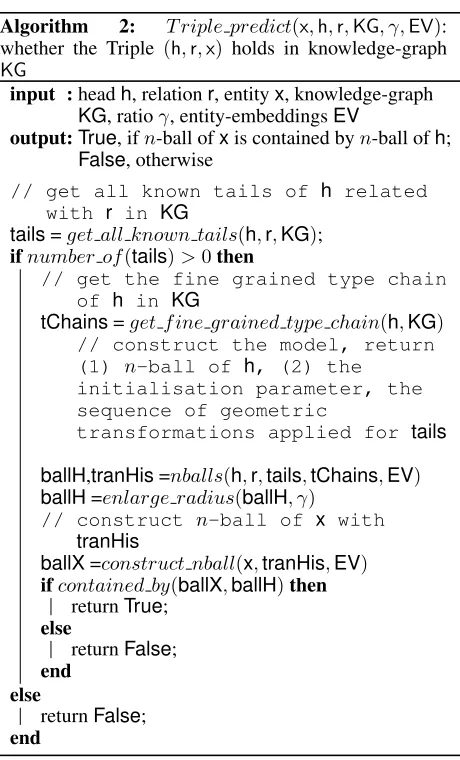
Algorithm 2: T riple predict(x,h,r,KG, γ,EV): whether the Triple (h,r,x) holds in knowledge-graph KG
input :headh, relationr, entityx, knowledge-graph
KG, ratioγ, entity-embeddingsEV
output:True, ifn-ball ofxis contained byn-ball ofh;
False, otherwise
// get all known tails of h related with r in KG
tails=get all known tails(h,r,KG); ifnumber of(tails)>0then
// get the fine grained type chain of h in KG
tChains=get f ine grained type chain(h,KG) // construct the model, return
(1) n-ball of h, (2) the
initialisation parameter, the sequence of geometric
transformations applied for tails
ballH,tranHis=nballs(h,r,tails,tChains,EV)
ballH=enlarge radius(ballH, γ)
// construct n-ball of x with
tranHis
ballX=construct nball(x,tranHis,EV)
ifcontained by(ballX,ballH)then returnTrue;
else
returnFalse; end
else
returnFalse; end
Experiments and Evaluation
The Aim of the Experiments
The aim of the experiments is to evaluate the proposed method for classifying Triples of 1-to-N relations. Given a new Triple (h, r, x), we will construct a Triple-predicting model M(h, r) from the knowledge-graph, and predict whether(h, r, x)is true by inspecting whether then-ball of
xis inside ther-subspace ofh’sn-ball.
Datasets
Knowledge-graphs for Triple Classification are normally generated from WordNet (Miller 1995), and Freebase (Bol-lacker et al. 2008). WordNet is a large English lexical database, whose entities are calledsynsetrepresenting a dis-tinct word sense. Freebase is a large knowledge graph about world facts. Following the evaluation strategies, e.g. (Bor-des et al. 2013; Socher et al. 2013; Wang and Li 2016; Ji et al. 2015), we use WN11, WN18, FB13 to generate datasets for classifying Triples of 1-to-N relations. We have manually analyzed all the relations in the three datasets, and rename them in term of the containment relation ofn-balls as follows.
id WN18/WN11/FB13 relation n-ball relation 0 A B member of domain topic contain0(A, B)
A domain topic B
1 A B member meronym tr contain1(A, B)
2 A B member of domain region contain2(A, B)
A domain region B
3 A B hypernym tr contain3(B, A)
A type of B
4 A B member holonym tr contain1(B, A)
5 A B instance hypernym contain5(B, A)
A subordinate instance of B
6 A B member of domain usage contain6(A, B)
7 A B synset domain topic of contain0(B, A)
A synset domain topic B
8 A B hyponym tr contain3(A, B)
9 A B instance hyponym contain5(A, B)
A has instance B
10 A B synset domain usage of contain6(B, A)
11 A B has part tr contain11(A, B)
12 A B part of tr contain11(B, A)
13 A B synset domain region of contain2(B, A)
14 A gender B contain14(B, A)
15 A nationality B contain15(B, A)
16 A profession B contain16(B, A)
17 A place of death B contain17(B, A)
18 A place of birth B contain18(B, A)
19 A location B contain19(B, A)
20 A institution B contain20(B, A)
21 A cause of death B contain21(B, A)
22 A religion B contain22(B, A)
23 A parents B contain23(B, A)
24 A children B contain24(A, B)
25 A ethnicity B contain25(B, A)
Table 1: mapping WN18/WN11/FB13 relations ton-ball re-lations
Dataset #R #E #train Triple #test Triple FB13-nball 13 75,043 306,747 45,897 WN11-nball 5 38,696 94,472 14,587 WN18-nball 7 40,943 60,490 13,148
Table 2: Datasets extracted from WN11, FB13, WN18
• Each 1-to-N relation is assigned by an identification num-ber from 0 to 25. Ifris theith non-symmetric relation, Triple(h, r, t)is named ascontaini(h, t)inn-ball repre-sentation, the prefixtr is added tocontaini, ifris tran-sitive;
• ifr−1is the inverse ofr, Triple(t, r−1, h)will be
trans-formed to(h, r, t).
the valid dataset into the training dataset. After transforma-tion and reductransforma-tion, WN11-nball dataset has 5 relations, to-taling 94,472 training Triples (91,888 from WN11 training Triples, 2,584 from WN11 valid Triples), and 20,495 testing Triples; applying the same data-processing, WN18 dataset only remains 135 testing Triples. We increased the number of testing Triples to 6,574 with true values, and the same number of Triples with false values, following the same set-ting used for WN11 (Socher et al. 2013). FB13 dataset has 75,043 entities, 306,747 training Triples, and 45,897 testing Triples.
To predict truth-value of(h, r, x), our model must have at least one tailtof(h, r, t)in the training set. We remove all Triples in the testing set, which does not have sample tails in the training set. Final dataset sizes are listed in Table 2.
Experimental Results for Triple Classification
Implementation. For each testing Triple(h, r, t), we con-struct a Triple-predicting modelM(h, r)withh’s hypernym path and tails ofhin the training set, and record the trans-formation sequence. Given a knowledge-graphKG, we used entity-embeddings trained in two different ways: (1) only KG, i.e. TransE (Bordes et al. 2013), and (2)KG with text corpus, i.e. TEKE (Wang and Li 2016).
Evaluation Protocol. In transformation-based approach, a threshold δr is defined to evaluate a score functionf: if a transformation scoref of a Triple is belowδr, this Triple will be predicted as true. We apply this method for then-ball setting as follows: To judge whetherxis the tail ofhwith re-lationr:(h, r, x), we initialize then-ball ofx,B(Ox, rdx), the same way as initializing other n-balls, and transform
B(Ox, rdx)following the same sequence of transformations as then-ball construction process of any true tailtofhwith relationr,(h, r, t). If the finalB(Ox, rdx)is located in the r-subspace of then-ball ofh,B(Ohr, rdhr),(h, r, x)will be predicted as true, otherwise false. We update the final radius
rdhr with a ratioγto maximize performances of predicting results, as described in Algorithm 2.
Experiments with FB13-nball Triples in FB13 dataset do not have hypernym relations. As a result, the length of the fine-grained typing chain is zero. This degrades the model into a trivial case: Tripe (h, r, x)holds, if and only ifxis inside ther-subspace ofh’sn-ball. We draw the minimum
r-subspace containing all known true tails. Using TEKE E vectors, the accuracy reaches a maximum of78%, which is almost the same as77.4%reported in (Wang and Li 2016). Though our datasets are not exactly the same as the bench-mark datasets, this result is consistent with existing results in the literature. FB13-nball datasets and pre-trained entity-embeddings are free for downloads2.
Experiments with WN11-nball Triples in WN11 dataset have hypernym relations. Heights of type chains vary from 1 to 12. Precisions, recalls, and accuracies are illustrated
2
https://figshare.com/articles/FB13nball zip/7294295
Figure 6: Precision of Triple prediction using WN11-nball dataset. Whenγincreases, the precision will drop
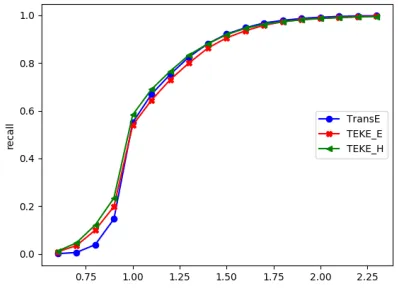
Figure 7: Recall of Triple prediction using WN11-nball dataset. Whenγincreases, the recall will increase
in Figure 6, Figure 7, and Figure 8. We expand the range of γ from 0.6 to2.3, to see whether smaller γ can con-tribute to precision. Experiment results support that smaller
γgreatly improves precisions, and severely weakens recalls. The maximum value of73%in accuracy is reached by us-ing TEKE E vectors whenγ = 1.4, a bit less than75.9%
reported by (Wang and Li 2016).
Figure 8: Accuracy of Triple classification using
WN11-nball with differentγvalues
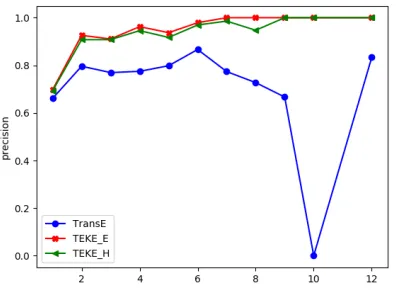
Figure 9: Precision vs. length of type chains in WN11-nball Dataset, whenγ= 1
We analyze the relation between accuracies and lengths of type chains. Figure 10 shows the maximum accuracy with regard to Triples whose lengths of type chains are higher thanN. For example, if we choose γ = 1.5, the accuracy using TEKE E embeddings will reach 81.8% for Triples whose type chains are longer than 8. When type chains are longer than 4, the accuracy of our model using TEKE E em-beddings will significantly outperform the results reported in (Wang and Li 2016).
The performance by using TransE is lower than and not as stable as that by using TEKE E or TEKE H entity-embeddings. The reason is that TEKE E and TEKE H entity-embeddings are jointly trained by knowledge-graph and corpus information, while TransE does not consider corpus information. WN11-nball datasets and pre-trained entity-embeddings are free for public access3.
Experiments with WN18-nball Triples in WN18-nball dataset have richer hypernym relations than Triples in
3
https://figshare.com/articles/WN11nball/7294307
Figure 10: Accuracy vs. different lengths of type chains in WN11-nball Dataset; when lengths increases, the accuracy has a tendency to increase; numbers in the plots represent theγvalue with which the accuracy reaches maximum
Figure 11: Using the Triple prediction model on the un-ballanced WN18-nball testing dataset, the accuracy reaches
98% using TEKE E pre-trained entity-embeddings, when
γ= 1
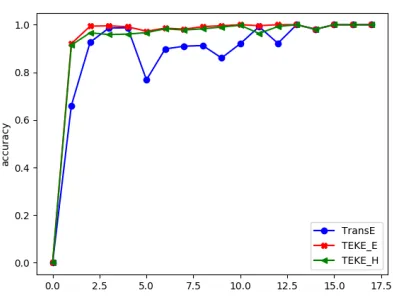
WN11-nball. For example, the lengths of type chains are longer than those of WN11-nball: 57.1% type chains in WN18-nball are longer than 5; the maximum length is 18. However, it turns out that only 72 tails of truetesting Triples have pre-trained entity-embeddings, while 6574 tails of falsetesting Triples have. With this unballanced testing dataset, our predicting model produces surprisingly good ac-curacy. Accuracy reaches 98% using TEKE E pre-trained entity-embeddings, whenγ= 1, as illustrated in Figure 11. Lengths of type chains contribute to accuracy, see Figure 12. TransE embedding also delivered great results, though the performance remains less stable than that of TEKE E and TEKE H embeddings. WN18-nball datasets and pre-trained entity-embeddings are free for downloads4.
4
Figure 12: Using the Triple prediction model on the unbal-lanced WN18-nball testing dataset, the accuracy increases along with the length of type-chains, whenγ= 1
Conclusions, Limitations, and Impact
Triple classification for 1-to-N relations is a tough problem. We propose a region-based embedding method using fine-grained entity typing. The contribution of our work is to perfectly encode 1-to-N symbolic relations into the embed-ding space, resulting inn-ball embeddings. Experiment re-sults are surprisingly good for well pre-trained entities hav-ing long type chains.In real applications, knowledge-graphs either do not have type chains, or have incomplete type chains, e.g. Freebase, DBPedia. Automatic extracting fine grained entity typing is an active topic in data-mining and knowledge discovery. Re-cent progresses are proposed to employ deep neural network architecture integrated with structural and attributive infor-mation from DBpedia (Jin et al. 2018). The presented work only uses a single tree structure extracted from knowledge-graph. We are extending current algorithms to address di-rected acyclic structures. This will lead to a new embedding method for knowledge-graphs.
Another limitation is the scalability problem of the algo-rithm: When we impose large tree-structures into embedding spaces with zero energy cost, current algorithm will be slow, mainly because of the principle of family action. For exam-ple, to impose tree-structured hypernym relations contain-ing 54,310 nodes into the Glove embeddcontain-ings (Penncontain-ington, Socher, and Manning 2014), our current algorithm will take around 6.5 hours.
In the terminology of deep-learning, we developed geo-metric construction methods to embed tree structures into vector spaces with the zero energy cost, which cannot be achieved by the back-propagation method. Think of these
n-balls as a kind of Venn diagrams (Venn 1880) in the embedding space, our method paves paths for integrating logical structured common-sense reasoning (Hayes 1985; Davis and Marcus 2015) with deep-learning, and serves as a simple computational example of how System 1 (simu-lated by deep-learning) can synergistically work with
Sys-tem 2 (simulated by logic and rule) (Kahneman 2011) – We need to add some parameters, e.g. the length of radius, layer vector, to extend vectors from deep-learning systems inton -balls, and perfectly encode logic and rules into topological relations among thesen-balls.
Acknowledgements
Thanks goes to Zhiyuan Liu for viewing the early drafts, to Dong Li for the proof-reading, and to three anonymous reviewers for their constructive comments. Partial financial supports from NSFC (China) under Grant No. 61472177 and No. 61661146007, and BMBF (Germany) under grant num-ber 01/S17064 are greatly appreciated.
References
Bishop, C. M. 2006. Pattern Recognition and Machine Learning. Secaucus, NJ, USA: Springer-Verlag.
Bollacker, K.; Evans, C.; Paritosh, P.; Sturge, T.; and Taylor, J. 2008. Freebase: A collaboratively created graph database for structuring human knowledge. InSIGMOD ’08, 1247– 1250. New York, NY, USA: ACM.
Bordes, A.; Usunier, N.; Garcia-Duran, A.; Weston, J.; and Yakhnenko, O. 2013. Translating embeddings for mod-eling multi-relational data. In Burges, C. J. C.; Bottou, L.; Welling, M.; Ghahramani, Z.; and Weinberger, K. Q., eds., Advances in Neural Information Processing Systems 26. Curran Associates. 2787–2795.
Davis, E., and Marcus, G. 2015. Commonsense reason-ing and commonsense knowledge in artificial intelligence. Commun. ACM58(9):92–103.
Dong, X.; Gabrilovich, E.; Heitz, G.; Horn, W.; Lao, N.; Murphy, K.; Strohmann, T.; Sun, S.; and Zhang, W. 2014. Knowledge vault: A web-scale approach to probabilis-tic knowledge fusion. In Proceedings of the 20th ACM SIGKDD International Conference on Knowledge Discov-ery and Data Mining, KDD’14, 601–610. New York, NY, USA: ACM.
Dong, T. 2008. A Comment on RCC: from RCC to RCC++. Journal of Philosophical Logic37(4):319–352.
Durrett, G., and Klein, D. 2015. A joint model for entity analysis: Coreference, typing, and linking. InTACL, 477– 490.
Fisher, D. H. 1987. Knowledge acquisition via incremental conceptual clustering. Mach. Learn.2(2):139–172.
Goodfellow, I.; Bengio, Y.; and Courville, A. 2016. Deep Learning. The MIT Press.
Gutmann, M. U., and Hyv¨arinen, A. 2012. Noise-contrastive estimation of unnormalized statistical models, with appli-cations to natural image statistics. J. Mach. Learn. Res. 13(1):307–361.
Han, X.; Liu, Z.; and Sun, M. 2016. Joint representation learning of text and knowledge for knowledge graph com-pletion. CoRRabs/1611.04125.
He, S.; Liu, K.; Ji, G.; and Zhao, J. 2015. Learning to repre-sent knowledge graphs with gaussian embedding. InCIKM ’15, 623–632. New York, USA: ACM.
Ji, G.; He, S.; Xu, L.; Liu, K.; and Zhao, J. 2015. Knowl-edge graph embedding via dynamic mapping matrix. In ACL’2015, 687–696. Beijing: ACL.
Jin, H.; Hou, L.; Li, J.; and Dong, T. 2018. Attributed and predictive entity embedding for fine-grained entity typing in knowledge bases. InCOLING, 282–292. ACL.
Kahneman, D. 2011. Thinking, fast and slow. Allen Lane, Penguin Books. Nobel laureate in Economics in 2002.
LeCun, Y.; Chopra, S.; Hadsell, R.; Ranzato, M.; and Huang, F. J. 2006. A tutorial on energy-based learning. InPredicting Structured Data. MIT Press.
Lin, Y.; Liu, Z.; Sun, M.; Liu, Y.; and Zhu, X. 2015. Learn-ing entity and relation embeddLearn-ings for knowledge graph completion. InAAAI’15, 2181–2187. AAAI Press.
Ling, X.; Singh, S.; and Weld, D. S. 2015. Design challenges for entity linking. InTACL, 315–328.
Liu, Y.; Liu, K.; Xu, L.; and Zhao, J. 2014. Exploring fine-grained entity type constraints for distantly supervised rela-tion extracrela-tion. InCOLING, 2107–2116.
Manning, C. D.; Raghavan, P.; and Sch¨utze, H. 2008. In-troduction to Information Retrieval. New York, NY, USA: Cambridge University Press.
Miller, G. A. 1995. Wordnet: A lexical database for english. Commun. ACM38(11):39–41.
Nickel, M., and Kiela, D. 2017. Poincar´e embed-dings for learning hierarchical representations. CoRR abs/1705.08039.
Pennington, J.; Socher, R.; and Manning, C. D. 2014. Glove: Global vectors for word representation. In EMNLP’14, 1532–1543.
Ren, X.; He, W.; Qu, M.; Huang, L.; Ji, H.; and Han, J. 2016. Afet: Automatic fine-grained entity typing by hierarchical partial-label embedding. InEMNLP, 1369–1378.
Rumelhart, D. E.; Hinton, G. E.; and Williams, R. J. 1988. Learning representations by back-propagating errors. In Anderson, J. A., and Rosenfeld, E., eds., Neurocomput-ing: Foundations of Research. Cambridge, MA, USA: MIT Press. 696–699.
Shawe-Taylor, J., and Cristianini, N. 2004.Kernel Methods for Pattern Analysis. Cambridge University Press.
Socher, R.; Chen, D.; Manning, C. D.; and Ng, A. 2013. Reasoning with neural tensor networks for knowledge base completion. In Burges, C. J. C.; Bottou, L.; Welling, M.; Ghahramani, Z.; and Weinberger, K. Q., eds.,Advances in Neural Information Processing Systems 26. Curran Asso-ciates, Inc. 926–934.
Suchanek, F. M.; Kasneci, G.; and Weikum, G. 2007. Yago: A core of semantic knowledge. InWWW ’07, 697–706. New York, NY, USA: ACM.
Venn, J. 1880. On the diagrammatic and mechanical repre-sentation of propositions and reasonings. The London,
Ed-inburgh and Dublin Philosophical Magazine and Journal of Science10(58):1–18.
Wang, Z., and Li, J. 2016. Text-enhanced representation learning for knowledge graph. InIJCAI, 1293–1299. Wang, Z.; Zhang, J.; Feng, J.; and Chen, Z. 2014a. Knowl-edge graph and text jointly embedding. InEMNLP, 1591– 1601.
Wang, Z.; Zhang, J.; Feng, J.; and Chen, Z. 2014b. Knowl-edge graph embedding by translating on hyperplanes. In AAAI, 1112–1119. AAAI Press.
Xiao, H.; Huang, M.; Hao, Y.; and Zhu, X. 2015a. Transa: An adaptive approach for knowledge graph embedding. CoRRabs/1509.05490.
Xiao, H.; Huang, M.; Hao, Y.; and Zhu, X. 2015b. TransG : A generative mixture model for knowledge graph embed-ding. CoRRabs/1509.05488.
Xiao, H.; Huang, M.; and Zhu, X. 2016. From one point to a manifold: Knowledge graph embedding for precise link prediction. InIJCAI, 1315–1321.
Xie, R.; Liu, Z.; Jia, J.; Luan, H.; and Sun, M. 2016. Repre-sentation learning of knowledge graphs with entity descrip-tions. InAAAI, 2659–2665.
Xu, B.; Zhang, Y.; Liang, J.; Xiao, Y.; Hwang, S.-W.; and Wang, W. 2016. Cross-lingual type inference. InDASFAA, 447–462.
Yahya, M.; Berberich, K.; Elbassuoni, S.; and Weikum, G. 2014. Robust question answering over the web of linked data. InCIKM, 1107–1116.
Zeng, D.; Liu, K.; Lai, S.; Zhou, G.; and Zhao, J. 2014. Re-lation classification via convolutional deep neural network. InCOLING, 2335–2344.
Zhang, D.; Yuan, B.; Wang, D.; and Liu, R. 2015. Joint semantic relevance learning with text data and graph knowl-edge. InACL-IJCNLP, 32–40.