R E S E A R C H
Open Access
(Identity-based) dual receiver encryption
from lattice-based programmable hash
functions with high min-entropy
Yanyan Liu
1,2*, Daode Zhang
1,2, Yi Deng
1,2and Bao Li
1,2Abstract
Dual receiver encryption (DRE) is an important cryptographic primitive introduced by Diament et al. at CCS’04, which allows two independent receivers to decrypt a same ciphertext to obtain the same plaintext. This primitive is quite useful in designing combined public key cryptosystems and denial of service attack-resilient protocols. In this paper, we obtain some results as follows.
• Using weak lattice-based programmable hash functions (wLPHF) with high min-entropy (Crypto’16), we give a generic IND-CCA secure DRE construction in the standard model. Furthermore, we get a concrete DRE scheme by instantiating a concrete wLPHF with high min-entropy.
• For DRE notion in the identity-based setting, identity-based DRE (IB-DRE), basing on lattice-based programmable hash functions (LPHF) with high min-entropy, we give a framework of IND-ID-CPA secure IB-DRE construction in the standard model. When instantiating with concrete LPHFs with high min-entropy, we obtain five concrete IB-DRE schemes.
Keywords: Dual receiver encryption, Identity-based dual receiver encryption, Lattice-based programmable hash functions with high min-entropy
Introduction
Dual receiver encryption, which was proposed by Diament, Lee, Keromytis and Yung (Diament et al.2004), is a special kind of public-key encryption which allows two independent users to decrypt a ciphertext to obtain the same plaintext by using their own secret keys. More pre-cisely, in a DRE scheme, the encryption algorithm takes as input a message Mand two receivers’ independently generated public keyspk1andpk2and produces a cipher-textc. Once the receivers receive the ciphertextc, either of them can decryptcand obtain the message Musing their respective secret key. This primitive is quite use-ful in designing combined public key cryptosystems and denial of service attack-resilient protocols. Ten years later, S. Chow, Franklin and Zhang (Chow et al.2014) refined
*Correspondence:[email protected]
1State Key Laboratory of Information Security, Institute of Information Engineering, Chinese Academy of Sciences, Beijing 100093, China
2School of Cyber Security, University of Chinese Academy of Sciences, Beijing 100049, China
the notion of DRE and appended some appealing features for DRE. Zhang et al. (2016a) extended the DRE in public-key setting to the identity-based setting: identity-based dual receiver encryption (IB-DRE), so as to handle the difficulty of certificate management.
Many constructions from pairings and lattices have been emerged since the notions of DRE and IB-DRE was proposed.
Constructions from pairings.In Diament et al. (2004), presented the first DRE scheme by transforming the three-party one-round Diffie-Hellman key exchange scheme by Joux (2000), and also proved that it is indistinguishable secure against chosen ciphertext attacks. However, their scheme relied on the existence of random oracle heuris-tic, where a DRE that proven to be secure in the random oracle model (ROM) may turn into insecure one when the RO is instantiated by an actual hash function in practice. Hence, (Youn and Smith: An efficent construction of dual-receiver encryption, unpublished) began with attempting to give a provably secure DRE scheme in the standard
model by combining an adaptively CCA secure encryption scheme and a non-interactive zero-knowledge protocol, while suffered low efficiency due to the prohibitively huge proof size. Later on, Chow, Franklin, and Zhang (Chow et al. 2014) proposed a CCA secure DRE scheme via combining a selective-tag weakly CCA-secure tag-based DRE (based on the tag-based encryption scheme in Kiltz (2006)) and a strong one-time signature scheme, as well as other DRE instantiations for non-malleable and other properties 1. Recently, Zhang et al. (2016a) constructed two provably secure IB-DRE schemes against adaptively chosen plaintext or ciphertext and chosen identity attacks based on an identity-based encryption scheme in (Waters 2005).
Constructions from lattices.As studied in (Chow et al. 2014; Zhang et al. 2016a), the DRE or IB-DRE can be viewed as a special instance of broadcast tion (BE, for short) or identity-based broadcast encryp-tion (IBBE, for short) primitive which supports multiple recipients in an encryption system. So a construction of BE or IBBE implies a construction of DRE or IB-DRE. Georgescu (2013) constructed a tag-based anonymous hint system (Libert et al. 2012) under the ring learning with errors (RLWE) assumption. Combining an IND-CCA secure public key encryption (PKE) scheme and a strongly unforgeable one-time signature (OTS), we can get an IND-CCA secure BE scheme which is a conclusion in Libert et al. (2012). Wang et al. (2015) presented a con-struction of BE which is indistinguishable against adap-tively chosen plaintext attacks (IND-CPA), based on the LWE problem. As for IBBE constructions, Wang and Bi (2010) proposed an adaptively secure IBBE scheme in the ROM, under the LWE assumption.
Our Contributions. In this paper, we pay
atten-tion to using lattice-based programmable hash func-tion to construct the DRE and IB-DRE on lattices. Our schemes are constructed in the standard model and satisfy chosen-ciphertext or chosen-plaintext secu-rity based on the hardness of the Learning With Errors (LWE) problem. Specifically, our works are stated as follows.
• We give a generic DRE construction from weak lattice-based programmable hash functions (wLPHF) with high min-entropy which defined in Zhang et al. (2016b). The construction is indistinguishable against chosen-ciphertext attacks (IND-CCA) in the
standard model. When instantiating with a wLPHF with high min-entropy, we get a concrete DRE scheme. We also compare our DRE scheme with the existing lattice-based DRE schemes. Please see more details in Table1.
• We also give a framework of IB-DRE from
lattice-based programmable hash functions (LPHF)
with high min-entropy. The construction is secure against chosen-plaintext and adaptively
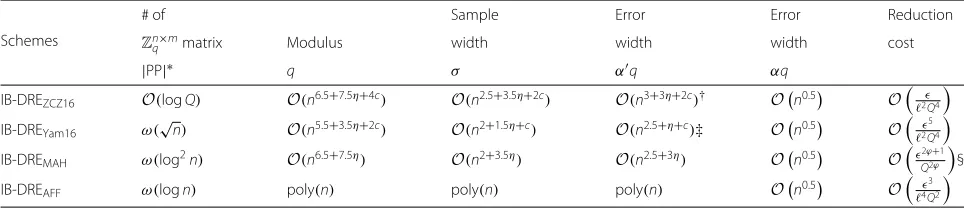
chosen-identity attacks (IND-ID-CPA). When instantiating with five concrete LPHFs with high min-entropy, we obtain five concrete IB-DRE schemes. The differences between our IB-DRE schemes and the existing lattice-based IB-DRE schemes are described in Table2.
Remark 1.This work is relevant to Zhang et al. (2018b) in which we constructed DREABBand IB-DREABBdirectly from the identity-based encryption scheme in Agrawal et al. (2010), and it is a concrete case of our generic construction. As our growing understanding, we find that DREABB (or, IB-DREABB) can be explained by using wLPHFs or LPHFs with high min-entropy. So, in this paper, we present a generic DRE (IB-DRE) construction from wLPHFs (LPHFs) with high min-entropy.
Preliminaries
Notations. Let λ be the security parameter, poly(λ) denotes the functionf(λ) = O(λc)for some constantc andnegl(λ)represents a negligible function. For positive integern∈N, [n] represents the set{1,· · ·,n}.Zqdenotes the ring of integer moduloqfor integerq ≥ 2. Matrices are written as bold capital letters such asA,B, and column vectors are written as bold lowercase letters such asx,y. The transpose of the matrixAstands forAand [A|B] represents the matrix by concatenatingAandB.(a)iand (A)isignifyi-th element ofaand thei-th column ofA.In andInvnstand for then×nidentity matrix and the set consists of invertible matrices inZnq×n, respectively.
Dual Receiver Encryption
Definition 1 (Dual receiver encryption (DRE) (Chow et al.2014))A dual receiver encryption schemeDRE = (CGenDRE,GenDRE,EncDRE,DecDRE) is defined as follows:
• CGenDRE(1λ)→crs. The randomized common
reference string (CRS) generation algorithm on input a security parameterλ, output a CRScrs.
• GenDRE(crs)→(pk,sk). The randomized key
generation algorithm on inputcrs, output a pair of public key and secret key(pk,sk). Run theGenDRE
twice independently to generate the key pairs (pk1,sk1)and(pk2,sk2)for two independent users. Without loss of generality, assumepk1andpk2are ordered based on lexicographic order.
• EncDRE(crs,pk1,pk2,M)→c. The randomized
encryption algorithm takescrs, two public keyspk1
andpk2(such thatpk1<dpk2) and a message M as
input, outputs a ciphertext c.
• DecDRE(crs,pk1,pk2,skj,c)→M. The deterministic decryption algorithm on input two public keyspk1
Table 1Comparison of DRE Schemes from Lattices
# of # of # of Other
Schemes Zn×m
q matrix Zmq×mmatrix Zmq vector Assumption Security primitives
|pk|∗ |sk|∗ |c|∗
Geo13†(Georgescu2013) − − − RLWE IND-CCA PKE, OTS
WWW’15 (Wang et al.2015) 1 1 1 LWE IND-CPA
Ours:DREABB 1 1 4 LWE IND-CCA OTS
∗,|pk|,|sk|and|c|show the size of public key, secret key and ciphertext, respectively.
†, Because of the usage of an IND-CCA secure PKE scheme from lattices, we do not know how to show the detail of|pk|,|sk|and|c|about Geo’13 scheme
Correctness. For all crs ← CGenDRE
1λ, all (pk1,sk1) ← GenDRE(crs) and all (pk2,sk2) ← GenDRE(crs), andc←EncDRE(crs,pk1,pk2,M), the follow-ing holds:
PrDecDRE(crs,pk1,pk2,sk1,c)=M
=DecDRE(crs,pk1,pk2,sk2,c)
≤1−negl(λ).
Security. DRE is said to be IND-CCA secure if for any probabilistic polynomial time (PPT) adversaryA, its advantage denoted as
AdvindDRE−cca,A1λ=Pr
ExpindDRE−cca,A1λ=1 − 1 2
is negligible in λ, where ExpindDRE−cca,A(1λ) is defined in Table3.
Identity-Based Dual Receiver Encryption
Definition 2 (Identity-based dual receiver encryp-tion (IB-DRE) (Zhang et al. 2016a))An identity-based dual receiver encryption scheme IB-DRE = (SetupID, KeyGenID,EncID,DecID) is defined as follows:
• SetupID
1λ→(PP,Msk). The setup algorithm on inputs a security parameter1λ, outputs a pair of public parameters and master secret key (PP, Msk). • KeyGenID(PP,Msk,id1st,id2nd∈ID)→
skid1st,skid2nd. The key generation algorithm on inputs
the public parameters PP, master secret key Msk, and two identitiesid1st,id2nd, outputsskid1st andskid2ndas the secret keys for the first receiverid1stand the second receiverid2nd, respectively.
• EncID(PP,id1st,id2nd,M)→c. The encryption algorithm on inputs the public parameters PP, two identitiesid1standid2nd, and a message M, outputs a ciphertext c.
• DecID(PP,c,skidj)→M. The decryption algorithm on inputs the public parameters PP, a ciphertext c, and one secret keyskidj,j∈ {1st, 2nd}, outputs a message M or⊥.
Correctness. For all (PP,Msk) ←$ SetupID
1λ, all identities idj ∈ ID, all messages M, all skidj ← KeyGenID(PP,Msk,idj), allc ←EncID(PP,id1st,id2nd,M), it holds that
PrDecID(PP,skid1st,c)=M=DecID(PP,skid2nd,c)
≤1−negl(λ).
Security.An IB-DRE scheme is said to be IND-ID-CPA secure if for any PPT adversaryA, its advantage denoted as
AdvindIB−−idDRE−cpa,A1λ=Pr
ExpindIB−−idDRE−cpa,A(1λ)=1 −1 2
Table 2Comparison of IB-DRE Schemes from Lattices
# of # of # of Standard
Schemes Znq×mmatrix Zqm×mmatrix Zmq vector Assumption Security model
|PP|∗ |Msk|∗ |c|∗ ?
WB’10 (Wang and Bi2010) 1 1 3 LWE IND-ID-CPA ROM
Ours:
IB−DREABB O(n) 1 3 LWE IND-ID-CPA
IB−DREZCZ O(logQ) 1 3 LWE IND-ID-CPA
IB−DREYam ω(√n) 1 3 LWE IND-ID-CPA
IB−DREMAH ω(log2n) 1 3 LWE IND-ID-CPA
IB−DREAFF ω(logn) 1 3 LWE IND-ID-CPA
Table 3IND-CCA security for DRE
ExperimentExpindDRE−cca,A(1λ): crs←$ CGenDRE(1λ);
(pkj,skj) $
←GenDRE(crs)forj∈ {1, 2};
(M0,M1,s)←$ ADecDRE(skj,c)(crs,pk1,pk2);
b← {$ 0, 1},c←$ EncDRE(crs,pk1,pk2,Mb);
b←$ ADecDRE(skj,c)∧c=c(c,s); ifb=bthen return 1 else return 0.
is negligible in λ, whereExpIBind−−idDRE−cpa,A(1λ) is defined in Table4.
Lattice-Based Programmable Hash Function with High Min-Entropy
Let ,m,m,n,q,v be some polynomials in the security parameter λ. A hash function H : X → Zn×m
q con-tains two algorithms (H.Gen,H.Eval), where the PPT key generation algorithm H.Gen(1λ) takes the security parameterλas input and outputs a keyK, namely,K ← H.Gen1λ, and the efficiently deterministic evaluation algorithmH.Eval(K,X)takes X ∈ X = {0, 1} as input and outputs a hash value Z ∈ Znq×m, namely, Z =
H.Eval(K,X).
Definition 3(Lattice-based programmable hash func-tions (LPHF) (Zhang et al.2016b))A hash function H :
X → Zn×m
q is a(1,v,β,γ,δ)-LPHF if there exist a PPT trapdoor key generation algorithmH.TrapGenand a PPT deterministic trapdoor evaluation algorithm H.TrapEval such that the following properties hold:
Syntax:Given a uniformly random matrixA ∈ Znq×m and a (public) trapdoor matrix B ∈ Znq×m, the PPT algorithm H.TrapGen outputs a key K along with a trapdoor td. i.e., (K,td) ← H.TrapGen1λ,A,B. Moreover, given td, K and X ∈ X, the determinis-tic algorithm H.TrapEval returns RX ∈ Zmq×m and SX ∈Znq×n, i.e.,(RX,SX)=H.TrapEval(td,K,X), such that s1(RX)≤βandSX ∈Invn∪ {0}with overwhelm-ing probability over the trapdoor td generated together with K, where s1(·)is defined in AppendixA, andInvn denotes the set of invertible matrices in Zn×n
q .
Table 4IND-ID-CPA security for IB-DRE
ExperimentExpIBind−−idDRE−cpa ,A(1λ): (PP,Msk)←$ SetupID(1λ)
(id1st,id2nd,M0,M1,s)←$ AKeyGenID(PP,Msk,id1st,id2nd)(PP);
b← {$ 0, 1},c←$ EncID(PP,id1st,id2nd,Mb);
b←$ AKeyGenID(PP,Msk,id1st,id2nd)∧idj=idj,j=1st,2nd(c,s); ifb=bthen return 1 else return 0.
Correctness: For all(K,td) ← H.TrapGen1λ,A,B, all X ∈ X and(RX,SX) = H.TrapEval(td,K,X), it holds thatH.Eval(K,X)=ARX+SXB.
Statistically close trapdoor keys: For all K,td ← H.TrapGen(1λ,A,B), and all K ← H.Gen1λ, the statistical distance between A,K and (A,K) is at mostγ.
Well-distributed hidden matrices: For all K,td ← H.TrapGen1λ,A,B, any inputs X∗,X1,· · ·,Xvwhere X∗=Xjfor any j∈[v], it holds that
Pr[SX∗=0∧SX1,· · ·,SXv ∈Invn]≥δ,
where (RX∗,SX∗) ← H.TrapEval(td,K,X∗) and
RXj,SXj
←H.TrapEval(td,K,Xj)for j∈[v], and the probability is over the trapdoor td generated together with K.
A weak LPHF (wLPHF) is a relaxed version
of LPHF with only a little difference that the H.TrapGen additionally takes X∗ as input. i.e., (K,td)←H.TrapGen(1λ,A,G,X∗).
Definition 4 (Lattice-based programmable hash func-tions with high min-entropy (Zhang et al.2016b))Assume the hash functionH:X →Znq×mis a(1,v,β,γ,δ)-LPHF whereγ = negl(λ)and noticeableδ > 0. The key space of His K, andH.TrapGen and H.TrapEval are the cor-responding trapdoor generation and trapdoor evaluation algorithms.His called as a LPHF with high min-entropy if for uniformly random matrixA∈ Znq×mand a (public) trapdoor matrixB∈Znq×m, the following condition holds:
• For any(K,td)←H.TrapGen(1λ,A,B), anyX∈X
and(RX,SX)=H.TrapEval(td,K,X), the distributions
(A,K,v,u)and A,K,v,(RX)v
are statistically close, whereu←$ Zmq,v←$ Zmq.
In a similar way, wLPHF with high min-entropy can be defined.
Definition 5(Weak lattice-based programmable hash functions with high min-entropy) Assume the hash func-tion H : X → Znq×m is a (1,v,β,γ,δ)-wLPHF where γ = negl(λ) and noticeableδ > 0. The corresponding trapdoor generation and trapdoor evaluation algorithms areH.TrapGenandH.TrapEval.His called as a wLPHF with high min-entropy if for uniformly random matrixA∈ Zn×m
q and a (public) trapdoor matrixB∈Znq×m:
the distributions
(A,K,v,u)and
A,K,v,(RX∗)v
are statistically close, whereu←$ Zmq,v←$ Zmq.
Dual Receiver Encryption Construction
In this section, we will give the generic construction of DRE using the weak lattice-based programmable hash function with high min-entropy, and give the parameter selection and the security proof of the scheme.
In order to obtain the IND-CCA security, we require two primitives: a strong one-time signature schemeOT S = (GenOTS,SigOTS,VrfOTS)which defined in Definition6in Appendix B and a (1,v,β,γ,δ)-wLPHFH : {0, 1}λ →
Zn×m
q with high min-entropy, whereγ is negligible and δ >0 is noticeable. Let integersn,m,q,v,βbe polynomi-als in the security parameterλ, and setm = m. Assume the message spaceM∈ {0, 1}nand the size of verification key isλbits , our DRE schemeDREis as follows.
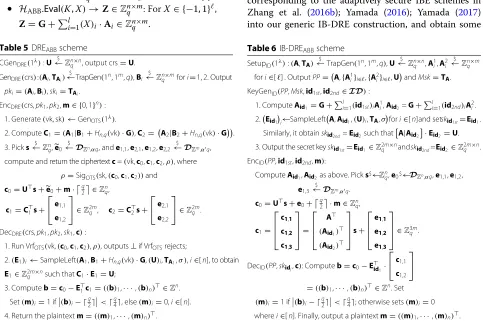
• CGenDRE(1λ): On input a security parameterλ,
algorithmCGenDREsets the parametersn,m,qas
specified in Correctness and Parameter Selection as below. Then choose a uniformly random matrix U∈Znq×n. Finally, output a CRScrs=(n,m,q,U). • GenDRE(crs): Generate a pair of matrices
(Ai,TAi)∈Zqn×m×Zmq×mby using
TrapGen(1n, 1m,q), and computeKi←$ H.Gen(1λ) twice independently fori∈ {1, 2}. Finally, output
pki=(Ai,Ki)andski=TAi.
• EncDRE(crs,pk1,pk2,m∈ {0, 1}n): Generate a pair (vk,sk)←$ GenOTS(1λ)and compute
C1=[A1|H.Eval(K1,vk)]∈Znq×2m,
C2=[A2|H.Eval(K2,vk)]∈Znq×2m. Then, pick
s←$ Znq,e0←$ DZn,αq, and
e1,1,e2,1,e1,2,e2,2←$ DZm,αq. Finally, compute and return the ciphertextc=(vk,c0,c1,c2,ρ), where ρ=SigOTS(sk,(c0,c1,c2))and
c0 =Us+e0+m· q
2
∈Zn q,
c1=C1s+
e1,1 e1,2
∈Z2m
q , c2=C2s+
e2,1 e2,2
∈Z2m q .
• DecDRE(crs,pk1,pk2,sk1,c): To decrypt a ciphertext c=(vk,c0,c1,c2,ρ)with a private keysk1=TA1,
the algorithmDecDREdoes as follows:
– RunVrfOTS(vk),(c0,c1,c2),ρ), outputs⊥if VrfOTSrejects;
– Fori∈[n], run(E1)i←
SampleLeft(A1,H.Eval(K1,vk),(U)i,TA1,σ).
Then obtainE1∈Z2qm×nsuch that C1·E1=U;
– Computeb=c0−E1c1and treat each
element ofb=((b)1,· · ·,(b)n)as an integer
inZ, and set(m)i=1if(b)i− q2<q4, else(m)i=0, wherei∈[n];
– Finally, it returns the plaintext m=((m)1,· · ·,(m)n).
Correctness and Parameter Selection
To make sure the correctness and the security proof works, we need to satisfy the following:
• Fori∈[n], the corresponding error terms are less thanq/4with overwhelming probability (i.e. αq√m+2ασmq<q/4)
|(e0)i−(E1)i ·
e1,1 e1,2
| ≤ |(e0)i| + |(E1)i ·
e1,1 e1,2
|
≤αq√m+σ√2m·αq√2m<q/4.
• TrapGenalgorithm can works (i.e.m≥6nlogq). • SampleLeftalgorithms can operate (i.e.,σ ≥
TAi ·ω
logm
=Onlogq
·ωlogm
. • SampleRightalgorithms can operate(i.e.
σ ≥ TG ·s1
Rvk·ωlogmand
σ ≥ TG ·s1
Rvk·ωlogm, where
s1Rvk≤βands1Rvk≤β).
• ReRandalgorithm can works (i.e.,α/2α >s1(Vi)for
i=1, 2, where
s1(V1)=s1
[Im|Rvk∗]≤1+s1Rvk∗≤1+β
ands1(V2)≤1+βrespectively, andαq>
maxωlogm,ωlog 2m= ωlog 2m.
• The worst case to average case reduction works (i.e. αq>2√2n).
To satisfy the above requirements, we set the parameters as follows:
λ=n,=n,m=O(nlogq), σ=√5·β·ωlogm, αq=3√n,αq=6(1+β)·√n,
q=12√mn+48√5β+β2·m√n·ωlogm.
Security Proof
Proof (of Theorem 1). Assume A is a PPT adversary againstDRE in a chosen-ciphertext attack. The cipher-text c = (vk,(c0,c1,c2),ρ) is valid if VrfOTS(vk,(c0,c1, c2),ρ) = 1. The challenge ciphertext is c∗ = (vk∗,(c∗0,c1∗,c∗2), ρ∗) during the experiment, and Forge is the event that A submits a valid ciphertext c = (vk∗,(c0,c1,c2),ρ) to the decryption oracle during the query phase (assume thatvk∗is chosen at the outer of the experiment). Note that
Advind−ccaDRE,A(1λ)=Pr[Expind−ccaDRE,A(1λ)=1]−1 2
≤Pr[Expind−ccaDRE,A(1λ)=1∧Forge]−1 2Pr[Forge]
+Pr[Expind−ccaDRE,A(1λ)=1∧Forge]+12Pr[Forge]−12 ≤12Pr[Forge]+Pr[Expind−ccaDRE,A1λ
=1∧Forge]+12Pr[Forge]−12.
By the security of OT S defined in Definition 6 in AppendixB, Pr[Forge] is negligible. So in order to com-plete the proof of Theorem1, we only need to prove the following lemma.
Lemma 1 Pr[ExpindDRE−cca,A1λ=1∧Forge]+1
2Pr[Forge]− 1 2
is negligible, assuming the DLWEq,n,n+2m,α assumption holds.
Proof (of Lemma 1). We will prove the lemma by a sequences of games. We show that if there is a PPT adver-saryAcan breaks ourDREscheme with a non-negligible advantage(i.e. the success probability is12+), then there exists a reduction can break theDLWEq,n,n+2m,α
assump-tion with an advantage δ2. For simplicity, we set the trapdoor matrixB = G ∈ Znq×m throughout the proof. Assume that the adversary A makes Q1 and Q2 times queries forDec(sk1,·)andDec(sk2,·), respectively, andv= Q1+Q2. In the following, defineXias the event that the challenger outputs 1 inGameifori∈ {1, 2, 3, 4, 5, 6, 7}.
Game1 This game is the same as the original
exper-iment ExpindDRE−cca,A(1λ) as described in Table 3 except that when the adversary A submits a valid ciphertext (vk∗,(c
0,c1,c2),ρ)to the decryption oracle, namely, the Forgeevent happens,Caborts and outputs a random bit. It is easy to see that
Pr[X1]− 1 2
=Pr[ExpindDRE−cca,A(1λ)
=1∧Forge]+1
2Pr[Forge]− 1 2
(1)
Game2 This game is identical to the Game1 except
thatCchanges the generation of the public keys and the
challenge ciphertext, and the way that the decrypt oracle answered.
Setup phase: For i = 1, 2, generate a pair of matrices (Ai,TAi) ← TrapGen(1n, 1m,q), and generate the key of
the wLPHF as(Ki,tdi)←H.TrapGen(1λ,Ai,G,vk∗). Decryption queries: WhenAsubmits a valid ciphertext (vk = vk∗,(c0,c1,c2),ρ), the challenger generatesE1 or E2as follows:
(E1)j←SampleLeft
A1,A1Rvk+Svk G,(U)j,TA1,σ
(E2)j←SampleLeft
A2,A2Rvk+SvkG,(U)j,TA2,σ
forj∈[n], whereH.TrapEval(td1,K1,vk)=Rvk,Svkand H.TrapEvaltd2,K2,vk=Rvk,Svk.
Challenge phase: GenerateRvk∗,Svk∗andRvk∗,Svk∗ using H.TrapEval algorithm as in Decryption queries
phase, and set C1 =
A1|A1Rvk∗+Svk∗G, C2 =
A2|A2Rvk∗+Svk∗G
. By the well-distribution hidden matrices property of wLPHF,
Pr[Svk∗ =0∧Qi=11Svki ∈Invn]≥δ,
Pr[Svk∗ =0∧Qi=21Svki ∈Invn]≥δ.
Thus, with noticeable probability δ2, (c∗0,c∗1,c∗2) in the challenge ciphertext are as follows:
c∗0=Us+e0+mb· q
2
,
c∗1=
(A1) (R
vk∗)(A1)
s+
e1,1 e1,2
,
c∗2=
(A2) (Rvk∗)(A2)
s+
e2,1 e2,2
.
Game3 This game is identical to the Game2 except
thatCchooses the matricesA1andA2uniformly random fromZnq×minstead of generated byTrapGen, and gener-ate the matricesE1andE2usingSampleRightinstead of SampleLeft. i.e., forj∈[n],
(E1)j←SampleRight
A1,G,Rvk,Svk,(U)j,TG,σ
, (E2)j←SampleRight
A2,G,Rvk,Svk,(U)j,TG,σ
, where H.TrapEvaltd1,K1,vk
= Rvk,Svk and H.TrapEval(td2,K2,vk)=
Rvk,Svk
.
Game4This game is identical to theGame3except that
we change the way that the challenge ciphertext is gener-ated. Picks←$ Znq,e0←$ DZn,αq, ande1,1,e2,1←$ DZm,αq,
and setw=Us+e0,b1=A1s+e1,1,b2=A2s+e2,1. Then compute
c∗0=Us+e0+mb· q
2
,
c∗1=ReRand
Im (R
vk∗)
,b1,αq, α
2α
,
c∗2=ReRand
Im (Rvk∗)
,b2,αq, α
2α
Game5This game is identical to theGame4except that
the challenge ciphertext generated as follows. The
chal-lengerC first picksw ←$ Znq,b1 ←$ Zmq,b2 ←$ Zmq, and e1,1,e2,1←$ DZm,αq, and setsb1=b1+e1,1,b2=b2+e2,1.
Then it computes
c∗0=w+mb· q
2
,
c∗1=ReRand
Im (Rvk∗)
,b1,αq, α
2α
,
c∗2=ReRand
Im (R
vk∗)
,b2,αq, α
2α
.
Game6In this game, the challenge ciphertext generated
as follows:C picksw ←$ Znq,b1 ←$ Zmq,b2 ←$ Zmq, and
e1,1,e2,1,e1,2,e2,2←$ DZm,αq. Then it computes c∗0=w+mb·
q 2
,
c∗1=
b1 (R
vk∗)b1
+
e1,1 e1,2
,
c∗2=
b2 (Rvk∗)b2
+
e2,1 e2,2
.
Game7In this game,(c∗0,c∗1,c∗2)in the challenge
cipher-textc∗=(vk∗,(c∗0,c∗1,c∗2),ρ∗)is chosen fromZn
q×Z2qm× Z2m
q uniform randomly. At this time,ρ∗is a signature on a random message. In this cases, the adversaryAhas no more advantage than random guess. Thus, Pr[X7]= 12.
Analysis of Games.
Lemma 2|Pr[X2]−12| =δ2|Pr[X1]−12| +negl(λ).
Proof This lemma can be proved by the the statistically close trapdoor keys and well-distributed hidden matrices properties of the wLPHF.
Lemma 3 Game3andGame2are statistically
indistin-guishable, namely,|Pr[X3]−Pr[X2]| ≤negl(λ).
Proof By the first, second and third items in Lemma16, the matrix A that generated by TrapGen is statisti-cally close to uniform in Znq×m, and the vectors gen-erated by SampleLeft and SampleRight are statistically close. Those changes only make negligible difference,
|Pr[X3]−Pr[X2]| ≤negl(λ).
Lemma 4 Game4andGame3are statistically
indistin-guishable, namely,|Pr[X4]−Pr[X3]| ≤negl(λ).
Proof This lemma can be proved by using the property ofReRandin Lemma17.
Lemma 5Assume that the DLWEn,q,n+2m,α assump-tion holds, then Game5 and Game4 are
computa-tionally indistinguishable, namely, |Pr[X5]−Pr[X4]| ≤ DLWEn,q,n+2m,α.
Proof Suppose there exists an adversaryAcan distin-guishGame4andGame5with non-negligible advantage,
then we can construct an reductionBwho can break the DLWEassumption as follows.
The simulator B is given the LWE instance:
U,A1,A2,w=w+e0,b1=b1+e1,1,b2=b2+e2,1
∈ Zn×n
q ×Znq×m×Znq×m×Znq×Zmq×Zmq wheree0 $
←DZn,αq,
e1,1,e2,1 ←$ DZm,αq. The task of B is to distinguish
whetherw = Us,b1 = A1s,b2 = A2s fors ←$ Znq
orw ←$ Znq,b1,b2 ←$ Zmq. Note that this subtle change from the standard LWE problem is done only for the convenience of the proof. Then it works as follows:
Setup phase: The same as inGame4.
Decryption queries: During the game, decryption queries made byAare answered as inGame4.
Challenge phase: WhenAsends two messagesm0,m1, Bgenerates the challenge ciphertext as follows:
c∗0=w+mb· q
2
,
c∗1=ReRand
Im (Rvk∗)
,b1,αq, α
2α
,
c∗2=ReRand
Im (R
vk∗)
,b2,αq, α
2α
.
Guess phase: After being allowed to make additional queries, A guesses if it interacts with the challenger in Game4orGame5.
It is easy to see that if (U,A,w,b) is a valid LWE
instance, then the view of A is the same as in
Game4; otherwise, the view ofAcorresponds to that in
Game4. By theDLWEn,q,n+2m,α assumption, it holds that
|Pr[X5]−Pr[X4]| ≤DLWEn,q,n+2m,α.
Lemma 6 Game6andGame5are statistically
indistin-guishable, namely,|Pr[X6]−Pr[X5]| ≤negl(λ).
Proof This lemma can be proved by property ofReRand in Lemma17.
Lemma 7 Game7andGame6are statistically
Proof This lemma can be obtained by the property of wLPHF with high min-entropy.
Complete the Proof of Theorem 1.By Lemmas 3-7
and the fact that Pr[X7]= 12, we can getPr[X2]−12 ≤ DLWEn,q,n+2m,α + negl(λ). Note that |Pr[X1]−12| +
1
2Pr[Forge]≥ and Pr[Forge]≤ negl(λ), and by Lemma2, we obtain thatDLWEn,q,n+2m,α≥δ2+negl(λ).
Identity-Based Dual Receiver Encryption Construction
In this section, we will give the generic construction of IB-DRE using lattice-based programmable hash functions, and give the parameter selection and the security proof of the scheme.
In our IB-DRE scheme, we require that the hash func-tionH:{0, 1}λ→Zn×m
q is a(1,v,β,γ,δ)-LPHF with high min-entropy which is defined in Definition4, whereγ is negligible andδ >0 is noticeable. Let integersn,m,q,v,β be polynomials in the security parameterλ. And in our concrete construction, setm = m. Assume the identity space isID= {0, 1}, and a message spaceM = {0, 1}n, our IB-DRE schemeIB-DREis as follows:
• SetupID(1λ): Given a security parameterλ, first set
the parametersn,m,qas specified in parameter selection in Parameter selection as below. Then, obtain a pair of matrices(A,TA)∈Zqn×m×Zmq×mby usingTrapGen(1n, 1m,q), generateK1,K2by running
H.Gen(1λ)twice independently, and choose a uniformly random matrixU∈Znq×n. Finally, output
PP=(n,m,q,A,K1,K2,U)andMsk=TA.
• KeyGenID(PP,Msk,id1st,id2nd∈ID):Given public parametersPP, a master key Msk, and identities id1st,id2nd, first compute
Aid1 =H.Eval(K1,id1st), Aid2 =H.Eval(K2,id2nd).
Then, fori∈[n],
(Eid1)i←SampleLeft(A,Aid1,(U)i,TA,σ). Set
skid1st =Eid1 ∈Z2qm×nsatisfying
A|Aid1
·Eid1 =U.
Similarly, obtainskid2nd =Eid2such that
A|Aid2
·Eid2 =U.
• EncID(PP,id1st,id2nd,m): ComputeAid1,Aid2as
above. Then, picks←$ Znq,e0←$ DZn,αq, ande1,1, e1,2,e1,3←$ DZm,αq. Finally, compute and return the ciphertextc=(c0,c1), where
c0=Us+e0+ q
2
·m∈Znq,
c1= ⎡ ⎣cc11,,12
c1,3
⎤
⎦=
⎡
⎣ A
(Aid1) (Aid2)
⎤ ⎦s+
⎡ ⎣ee11,,12
e1,3
⎤ ⎦∈Z3m
q .
• DecID(PP,skidj,c): To decrypt a ciphertext c=(c0,c1)with a private keyskid1st =Eid1, it
computesb=c0−Eid1·
c1,1 c1,2
and let
b=((b)1,· · ·,(b)n)∈Znq. Set(m)i=1if (b)i− q
2< q
4; otherwise set(m)i=0where i∈ {1,· · ·,n}. Finally, it returns a plaintext m=((m)1,· · ·,(m)n).
Correctness and Parameter Selection
Parameter selection.To make sure the correctness and the security proof works, we need to satisfy the following
• Fori∈[n], the corresponding error term should be less thanq/4with overwhelming probability
|(e0)i−(Eid1)i ·
e1,1 e1,2
| ≤ |(e0)i| + |(Eid1)i ·
e1,1 e1,2
|
≤αq√m+σ√2m·αq√2m≤q/4.
• theTrapGenalgorithm can works (i.e.m≥6nlogq) • SampleLeftalgorithms can operate (i.e.σ ≥
TA ·ω
logm
=Onlogq
·ωlogm
• SampleRightalgorithms can operate(i.e.σ ≥ TG·s1
R
idij
·ωlogm=√5·β·ωlogm,
wheres1
R
idij
≤β,i∈[Q],j=1, 2)
• ReRandalgorithm can works (i.e.α/2α >s1(V)
wheres1(V)=s1
Im|Rid∗ 1|R
id∗2
≤
1+s1
Rid∗ 1
+s1
Rid∗ 2
≤1+2β, andαq>
maxωlogm,ωlog 3m= ωlog 3m
• the worst case to average case reduction works (i.e. αq>2√2n)
To satisfy the above requirements, we set the parameters as follows:
λ=n,=n,m=O(nlogq), σ =√5·β·ωlogm
,
αq=3√n,αq=6(1+2β)·√n,q=12√mn
+48√5β+2β2·m√n·ωlogm
.
Security Proof
Theorem 2 Let n,q,m ∈ Z, andα,β ∈ Rbe polyno-mials in the security parameter λ. For large enough v = poly(n), letH=(H.Gen,H.Eval)be any(1,v,β,γ,δ)-PHF with high min-entropy from {0, 1}n toZnq×m, whereγ = negl(λ)andδ >0is noticeable. Then, if theDLWEq,n,n+m,α
secure IB-DRE scheme against chosen-plaintext and adap-tively chosen-identity attacks.
Proof (of Theorem2) We show that if there is a PPT adversaryAcan breaks ourIB-DREscheme with a non-negligible advantage (i.e. the success probability is 12+ ), then there exists a reduction that can break the LWE assumption with an advantageδ23.
LetQ = Q(λ) be the upper bound of the number of key queries and I∗ = id∗1st,id∗2nd,idi1st,idi2ndi∈[Q]
the set of challenge ID and ID’s for key queries. We will prove the theorem by a sequences of games where the first game is the real IND-ID-CPA game in Table4and in the last game the adversary has advantage zero. In each
game, the challengerCselects a uniform coinb ← {$ 0, 1} in the challenge phase, while finallyAreturns a guess bit bforbto the challenger. In the first game, the challenger setsbˆ = b, these values might be different in the latter games. We defineXi as the event thatbˆ = bin Gamei fori ∈ {0, 1, 2, 3, 4, 5, 6, 7}. As mentioned in the proof of Lemma 1, we fix the trapdoor matrix B = G ∈ Znq×m throughout the proof.
Game0This game is the real IND-ID-CPA game. By the
definition, it holds that
Pr[X0]−1 2
=Pr[bˆ =b]−1 2
=Pr[b=b]−1 2 =. Game1This game is identical toGame0except thatC
changes the setup and challenge phases.
Setup phase: Same as inGame0 except that generate
(Ki,tdi)←H.TrapGen(1λ,A,G)fori=1, 2.
Challenge phase: Generate Aid∗1 and Aid∗2
using H.TrapEval instead of H.Eval. Compute
(R
id∗1,Sid∗1) ← H.TrapEval(K1,td1,id∗1st), (Rid∗2,Sid∗2) ←
H.TrapEval(K2,td2,id2∗nd), and setAid∗i =AR
id∗i +Sid∗iG
fori = 1, 2. Then, choose a random coinb ∈ {0, 1}, pick
s←$ Znq,e0←$ DZn,αq,e1,1,e1,2,e1,3←$ DZm,αq. Compute the challenge ciphertextc∗=(c∗0,c∗1)where
c∗0=Us+e0+ q
2
·mb∈Znq,
c∗1= ⎡
⎣ A
(Aid∗1)
(Aid∗2)
⎤ ⎦s+
⎡ ⎣ee11,,12
e1,3
⎤ ⎦∈Z3m
q .
Game2This game is identical toGame1except that add
an abort event that is independent of the adversary’s view. Guess phase: Finally,Aoutputs his guessb ∈ {0, 1}of b.Cdefines the following function
τtd1,td2,K1,K2,I∗
= ⎧ ⎨ ⎩ 0,S
id∗1=0∧Sid∗2=0∧
Q i=1Sidi
1
∈Invn∧Qi=1S
idi2∈Invn, 1, otherwise,
where Rid∗
i,S
id∗i
, i = 1, 2, generated as in Game1,
and R
idi1,S
idi1
← H.TrapEvalK1,td1,idi1st
,
R
idi2,S
idi2
←H.TrapEval(K2,td2,idi2nd)fori∈[Q]. Abort check: Let(tdi,Ki),i= 1, 2 be produced at setup phase as inGame1. The challengerCcomputesτ(td1,td2, K1,K2,I∗). If τ(td1,td2,K1,K2,I∗) = 1, the challenger
aborts the game and setsbˆ ← {$ 0, 1}ignoring the output ofA.
Artificial abort: Given the identities set I∗, let
p = Pr
τtd1, td2, K1,K2,I∗
=0 over the
random choice of
td1,K1
and
td2,K2
. The
challenger samples O−2log−1λ−1logλ−1
times the probability p by independently running
tdi,K!i
← H.TrapGen1λ,Ai,G
and evaluating
τtd1,td2,K1,K2,I∗
to compute an estimatep, where λis the lower bound of the pfor any setI∗. Ifp > λ, then abort with probability pp−λ (and not abort with probability pλ), and setbˆ ← {$ 0, 1} ignoring the output ofA.
Finally, when receiving b from A, the challenger sets
ˆ
b=b.
Game3 This game is identical to Game2 except that
change the generation ofAand the way that answering the key query.
Setup phase: Choose a random matrix A ∈ Znq×m instead of running theTrapGenalgorithm.
Key query: For thei-th secret key query idi1st,idi2nd, i ∈[Q], generate R
idi1,S
idi1
and R
idi2,S
idi2
by using H.TrapEvalsuch thatAidi
1 = AR
idi1 +S
idi1GandAidi2 =
AR
idi2+S
idi2G. IfS
idi1 =0orS
idi2 =0, abort the game and
setbˆ ← {$ 0, 1}ignoring the output ofA. Otherwise, com-pute
Eidi
ι
j←SampleRight
A,G,R
idiι,S
idiι,TG,(U)j,σ
forι=1, 2 andj∈[n], set and sendskidi
1 =Eidi1 ∈Z 2m×n q andskidi
2 =Eidi2 ∈Z 2m×n
q , wherei∈[Q].
Challenge phase: When the adversary outputs id∗1st, id∗2nd and two messages m0, m1, for
Rid∗
i,S
id∗i
, i = 1, 2, generated as inGame2, the challenger first checks if
Sid∗
1 = 0∧S
id∗2 = 0. If not, abort the game and output a
random bitbˆ ← {$ 0, 1}. Thus,Aid∗i =ARid∗
i,i=1, 2. Pick s←$ Znq,e0←$ DZn,αq,e1,1,e1,2,e1,3←$ DZm,αq, compute and send the challenge ciphertextc∗=(c∗0,c∗1)where
c∗0=Us+e0+ q
2
c∗1= ⎡
⎣ A
(Aid∗1)
(Aid∗2)
⎤ ⎦s+
⎡ ⎣ee11,,12
e1,3
⎤ ⎦
=
⎡ ⎢ ⎣
As (Rid∗
1)
As
(Rid∗ 2)
As
⎤ ⎥
⎦+
⎡ ⎣ee11,,12
e1,3
⎤ ⎦∈Z3m
q .
At the guess phase, it also executes the artificial abort check.
Game4 This game is identical to Game3 except that
change the way that the challenge ciphertext generated. Pick s ←$ Znq, e0 ←$ DZn,αq, e1 ←$ DZm,αq, and set w=Us+e0,b1=As+e1. Compute
c∗0=w+ q
2
·mb,
c∗1=ReRand ⎛ ⎜ ⎝ ⎡ ⎢ ⎣
Im (Rid∗ 1)
(Rid∗ 2)
⎤ ⎥
⎦,b1,αq, α
2α ⎞ ⎟ ⎠.
Game5In this game, the challenge ciphertext is
gener-ated as follows. Pickw ←$ Znq,b ←$ Zmq,e1 $
← DZm,αq, b1=b+e1. Then compute
c∗0=w+q 2
·mb,
c∗1=ReRand ⎛ ⎜ ⎝ ⎡ ⎢ ⎣
Im (R
id∗1)
(R
id∗2)
⎤ ⎥
⎦,b1,αq, α
2α ⎞ ⎟ ⎠.
Game6In this game, the challenge ciphertext is
gener-ated as follows. Pickw←$ Znq,b←$ Zmq,e1,1,e1,2,e1,3 ←$ DZm,αq. Then compute
c∗0=w+ q
2
·mb, c∗1= ⎡ ⎢ ⎣
b (R
id∗1)b
(R
id∗2)b
⎤ ⎥
⎦+
⎡ ⎣ee11,,12
e1,3
⎤ ⎦
Game7 In this game, choose the challenge ciphertext
randomly uniform, namely,c= (c∗0,c∗1) ←$ Znq×Z3qm. In this game, the advantage of the adversary is zero. Namely, Pr[X7]= 12. By the definition of7, we have7=0.
Analysis of Games.
Lemma 8 IfHis a LPHF with high min-entropy, then
|Pr[X1]−Pr[X0]| ≤negl(λ).
Proof This lemma can be proved by the statistically close trapdoor keys property of LPHF in definition3.
For i ∈ {2, 3, 4, 5, 6, 7}, let pi be the probability that the challenger does not abort in the abort check stage in Gamei, and the probability in the artificial abort stage in
Gameiis defined aspi= Pr
τtd1,td2,K1,K2,I∗
=0 . Since the adversary might obtain some information oftd1 andtd2from the challenge ciphertext, the probabilitypi might not be equal topi. Formally, letibe the difference betweenpiandpi, i.e.i= |pi−pi|.
Lemma 9IfHis a(1,v,β,γ,δ)-LPHF, and Q≤v, then
|Pr[X2]−12| ≥ 12(δ2−2).
So as not to interrupt the proof of Theorem2, we skip the proof of Lemma9for time being.
Lemma 10 IfHis a(1,v,β,γ,δ)-LPHF, and Q≤v, then
|Pr[X3]−Pr[X2]| ≤negl(λ)and|3−2| ≤negl(λ).
Proof Note that abort check and the artificial abort in Game2and inGame3are identical. By the item 1, item 2
and item 3 of Lemma16, those changes that generating the matrixAusingTrapGenand secret keyskidi
j,i ∈[Q] ,j =
1, 2, usingSampleRightinstead ofSampleLeftmake only negligible difference. In conclusion,|Pr[X3]−Pr[X2]| ≤ negl(λ)and|3−2| ≤negl(λ).
Lemma 11 IfHis a(1,v,β,γ,δ)-LPHF, and Q≤v, then
|Pr[X4]−Pr[X3]| ≤negl(λ)and|4−3| ≤negl(λ).
Proof This lemma can be proved by the property of ReRandin Lemma17.
Lemma 12 Assume that theDLWEn,q,n+m,α assumption holds, then|Pr[X5]−Pr[X4]| ≤DLWEn,q,n+m,αand|5− 4| ≤DLWEn,q,n+m,α.
Proof we can construct an adversary Bto against the DLWEn,q,n+m,α problem using the ability of A, where A
is an adversary inGame4 orGame5. The simulatorBis
given the LWE instance:(A,u =b+e)∈Znq×(n+m)× Zn+m
q wheree
$
← DZn+m,αq. And the task ofBis to
dis-tinguish whetherb =(A)sfors←$ Znqorb←$ Znq+m. Note that this subtle change from the standard LWE prob-lem is done only for the convenience of the proof. Then works as follows:
Setup phase: Let the firstncolumns ofAbe the matrix U ∈ Znq×nand the lastmcolumns the matrixA∈ Znq×n. The rest is the same as inGame4.
Key query: During the game, key extraction queries made byAare answered as inGame4without knowing
TA.
Challenge phase: For
Rid∗
i,S
id∗i
, i = 1, 2, generated as inGame4, first check ifSid∗
1 = 0∧S
abort the game as inGame4. Otherwise,Aid∗1 = ARid∗ 1,
Aid∗2 = ARid∗2. Pick a random coinb
$
← {0, 1}. Let the firstncoefficients ofubew∈ Znq, and the lastm coeffi-cientsb1 ∈ Zmq. Then the challenge ciphertext generated as follows:
c∗0=w+ q
2
·mb, c∗1=ReRand ⎛ ⎜ ⎝ ⎡ ⎢ ⎣
Im (Rid∗
1)
(Rid∗
2)
⎤ ⎥
⎦,b1,αq, α
2α
⎞ ⎟ ⎠.
If b = (A)s for s ←$ Znq, then (A,u = b + e = (U,A)s+e) is a valid LWE sample, the view of the adversary Ais the same as inGame4. And if b ←$
Zn+m
q , then the view of the adversaryAis the same as in Game5. So the advantage of Bis|Pr[X5]−Pr[X4]|, by theDLWEassumption, it holds that|Pr[X5]−Pr[X4]| ≤ DLWEn,q,n+m,αand|5−4| ≤DLWEn,q,n+m,α.
Lemma 13|Pr[X6]−Pr[X5]| ≤ negl(λ) and |6 − 5| ≤negl(λ).
Proof This lemma can be proved just according to the property of ReRand in Lemma17.
Lemma 14IfH is LPHF with high min-entropy, then
|Pr[X7]−Pr[X6]| ≤negl(λ)and|7−6| ≤negl(λ).
Proof This lemma can be obtained by the property of LPHF with high min-entropy in definition4.
Complete the proof of Theorem2.By Lemmas9-14and
the fact that Pr[X7]= 12, it holds that
DLWEn,q,n+m,α≥ 1 2(δ
2−
2)−negl(λ).
And by Lemmas 10-14again, we can obtain that 2 ≤ DLWEn,q,n+m,α +negl(λ). Thus,DLWEn,q,n+m,α ≥ δ
2
3 −
negl(λ).
In order to complete the proof of Theorem2, we need to prove the Lemma 9 by using the Lemma 28 in the full vision of Agrawal et al. (2010), which is described as follows.
Lemma 15(Lemma 28 in Agrawal et al. (2010))Let I∗be a(Q+1)-ID tuple{id∗,{idj}j∈[Q]}denoted the challenge ID along with the queried ID’s, andη(I∗)the probability that an abort does not happen inGame2. Letηmax=maxη(I∗)
andηmin =minη(I∗). For i=1, 2, we set Xibe the event thatbˆ=b at the end ofGame1. Then
Pr[X2]− 1 2
≥ηminPr[X1]− 1 2
− 1
2(ηmax−ηmin).
Lemma9: IfHis a(1,v,β,,δ)-LPHF, andQ≤v, then
|Pr[X2]−12| ≥ 12(δ2−2).
Proof (of Lemma9) As the generations of(td1,K1)and (td2,K2)are independent, by the well-distributed hidden matrices property of theH, it holds that
p=Pr
S
id∗1=0∧Sid∗2=0∧
Q
i=1Sidi1∈Invn∧
Q
i=1Sidi2∈Invn
=Pr
Sid∗ 1=0∧
Q i=1Sidi
1∈
Invn]·Pr[Sid∗ 2=0∧
Q i=1Sidi
2∈
Invn
≥δ·δ=δ2=λ.
According to Lemma15, we only need to evaluateηmax, ηmin and ηmax − ηmin. By the definition of p2 and p2 in Game2, it holds that η(I∗) = p2pλ, where p is an estimate of p2. Since the challenger always sam-ples O−2log−1λ−1logλ−1 times p2 to com-pute p, according to the Chernoff bounds, we have Prp≥p2
1+8≤λ8and Prp≤p2
1−8≤λ8. Then,
ηmax≤1−λ
8
p2 λ
p2
1− 8,
ηmin≥1−λ
8
p2 λ
p2(1+ 8) ≥ 7λp2
9p2
ηmax−ηmin≤1−λ
8
λp2
4(1−642)p2
≤ 16λp2 63p2
Substitute them and the value ofλinto the inequality in Lemma15, we can get
Pr[X2]−1 2 ≥ 7λp2
9p2 ·− 1 2 ·
16λp2 63p2
≥λ(p2−2)
2p2 ≥
1
2(λ−2)= 1 2
δ2−
2
.
Instantiation of Generic DRE construction
As said in Zhang et al. (2016b), the selectively secure IBE in Agrawal et al. (2010) implies a weak LPHF with high min-entropy, thus we can use this weak LPHF to instantiate our IND-CCA secure DRE scheme.
The wLPHFHABB:Znq→Znq×min Agrawal et al. (2010) consists of two algorithms(HABB.Gen,HABB.Eval)which are defined as follows:
• HABB.Gen(1λ)→K:A0←$ K=Znq×m, and output K =A0.
• HABB.Eval(K,X)→Z∈Znq×m: ForX∈Zn
q, an FRD encoding functionHn,q:Znq→Znq×nwhich was introduced in Zhang et al. (2018b), output Z=A0+Hn,q(X)G.
The associating algorithms HABB.TrapGen and