Framework for an Improved
Translation Workflow
Dissertation
zur Erlangung des akademischen Grades eines Doktors der Philosophie
der Philosophischen Fakultäten der Universität des Saarlandes
vorgelegt von
Santanu Pal
aus
Sonamukhi, West Bengal, Indien
Erstberichterstatter: Prof. Dr. Josef van Genabith Zweitberichterstatter: Prof. Dr. Dietrich Klakow Tag der letzten Prüfungsleistung: 27.11.2017
A Hybrid Machine Translation Framework for an Improved Translation Workflow
by SantanuPal
Doctor of Philosophy
Computerlinguistik, Sprachwissenschaft und Sprachtechnologie Universität des Saarlandes
Over the past few decades, due to a continuing surge in the amount of content being translated and ever increasing pressure to deliver high quality and high throughput trans-lation, translation industries are focusing their interest on adopting advanced technologies such as machine translation (MT), and automatic post-editing (APE) in their translation workflows. Despite the progress of the technology, the roles of humans and machines essentially remain intact as MT/APE are moving from the peripheries of the translation field closer towards collaborative human-machine based MT/APE in modern transla-tion workflows. Professional translators increasingly become post-editors correcting raw MT/APE output instead of translating from scratch which in turn increases productivity in terms of translation speed. The last decade has seen substantial growth in research and development activities on improving MT; usually concentrating on selected aspects of workflows starting from training data pre-processing techniques to core MT processes to post-editing methods. To date, however, complete MT workflows are less investigated than the core MT processes. In the research presented in this thesis, we investigate av-enues towards achieving improved MT workflows. We study how different MT paradigms can be utilized and integrated to best effect. We also investigate how different upstream and downstream component technologies can be hybridized to achieve overall improved MT. Finally we include an investigation into human-machine collaborative MT by taking humans in the loop. In many of (but not all) the experiments presented in this thesis we focus on data scenarios provided by low resource language settings.
(Zusammenfassung)
Aufgrund des stetig ansteigenden Übersetzungsvolumens in den letzten Jahrzehnten und gleichzeitig wachsendem Druck hohe Qualität innerhalb von kürzester Zeit liefern zu müssen sind Übersetzungsdienstleister darauf angewiesen, moderne Technologien wie Maschinelle Übersetzung (MT) und automatisches Post-Editing (APE) in den Überset-zungsworkflow einzubinden. Trotz erheblicher Fortschritte dieser Technologien haben sich die Rollen von Mensch und Maschine kaum verändert. MT/APE ist jedoch nunmehr nicht mehr nur eine Randerscheinung, sondern wird im modernen Übersetzungsworkflow zunehmend in Zusammenarbeit von Mensch und Maschine eingesetzt. Fachübersetzer werden immer mehr zu Post-Editoren und korrigieren den MT/APE-Output, statt wie bisher Übersetzungen komplett neu anzufertigen. So kann die Produktivität bezüglich der Übersetzungsgeschwindigkeit gesteigert werden. Im letzten Jahrzehnt hat sich in den Bereichen Forschung und Entwicklung zur Verbesserung von MT sehr viel getan: Ein-bindung des vollständigen Übersetzungsworkflows von der Vorbereitung der Trainings-daten über den eigentlichen MT-Prozess bis hin zu Post-Editing-Methoden. Der voll-ständige Übersetzungsworkflow wird jedoch aus Datenperspektive weit weniger berück-sichtigt als der eigentliche MT-Prozess. In dieser Dissertation werden Wege hin zum idealen oder zumindest verbesserten MT-Workflow untersucht. In den Experimenten wird dabei besondere Aufmertsamfit auf die speziellen Belange von sprachen mit gerin-gen ressourcen gelegt. Es wird untersucht wie unterschiedliche MT-Paradigmen verwendet und optimal integriert werden können. Des Weiteren wird dargestellt wie unterschiedliche vor- und nachgelagerte Technologiekomponenten angepasst werden können, um insgesamt einen besseren MT-Output zu generieren. Abschließend wird gezeigt wie der Mensch in den MT-Workflow intergriert werden kann. Das Ziel dieser Arbeit ist es verschiedene Technologiekomponenten in den MT-Workflow zu integrieren um so einen verbesserten Gesamtworkflow zu schaffen. Hierfür werden hauptsächlich Hybridisierungsansätze ver-wendet. In dieser Arbeit werden außerdem Möglichkeiten untersucht, Menschen effek-tiv als Post-Editoren einzubinden. Die hierbei gewonnenen Übersetzungsprozessdaten
werden automatisch gesammelt und stehen für künftige Forschung zur Verfügung (z.B. zur Unterstützung von inkrementellen Updates einzelner Workflow- und Post-Editing-Komponenten). Das Hauptziel dieser Dissertation ist es, die echten Bedürfnisse und Probleme der Anwender von Übersetzungstechnologie - einschließlich von professionellen übersetzern - zu erfassen. Es soll ein kollaborativer Rahmen für hybride maschinelle Übersetzung geschaffen werden, der den Übersetzungsworkflow verbessert und den Post-Editing-Effort für den Übersetzer reduziert. Auf dieser Grundlage soll die Funktionalität von Übersetzungssystemen in Hinblick auf die Anforderungen der Anwender optimiert werden, statt die Anwender dazu zu zwingen, ihre Arbeitsweise an die Technologie anzu-passen. Des Weiteren untersucht diese Arbeit ob und wie bestehende Technologien wie neuronale MT (NMT), statistische MT (SMT), beispielbasierte MT (Example Based MT, EBMT) und Translation- Memory-Systeme (TM) die Anforderungen der Anwender un-terstützen können.
Hierfür wird der in der arbeit verfolgte Ansatz auf zwei Arten beschrieben. Normalerweise werden verschiedene Technologiekomponenten im Übersetzungsworkflow kombiniert; im ersten Teil dieser Arbeit liegt der Schwerpunkt auf den (i) Komponenten, im zweiten Teil auf den (ii) Workflows. Im ersten Teil dieser Arbeit liegt der Schwerpunkt insbesondere auf Design und Implementierung von leistungsstarken und benutzerfreundlichen Tech-nologiekomponenten (beschrieben in Kapitel 3, Kapitel 4 und Kapitel 5). In diesem Teil werden diverse Hybridisierungsansätze angewandt. Im zweiten Teil der Arbeit liegt der Schwerpunkt auf der Identifizierung optimierter Workflows durch die Kombination ver-schiedener Technologiekomponenten. Hier wird eine Plug&Play-Methodologie angewen-det, bei der der Optimierungsgrad in Bezug auf besseren Übersetzungsoutput gemessen wird. Des Weiteren wird in diesem Teil der Arbeit auch der Mensch in den Über-setzungsprozess zur Bewertung der Übersetzungsqualität sowie zur langfristigen schrit-tweisen Verbesserung der Technologiekomponenten durch Feedback eingebunden. Zusät-zlich werden gleichzeitig wertvolle Ressourcen für Übersetzungsprozessforschung geschaf-fen (vgl. Kapitel 6). In Kapitel 6 liegt der Fokus auf Technologien der die Sammlung von Ressourcen für den vorgeschlagenen Rahmen zur schrittweisen Verbesserung von MT/APE-Komponenten für der Workflow sowie für die Übersetzungsprozessforschung
unterstützen. Nachdem Ressourcen in beträchtlichem Umfang durch den kollabora-tiven Rahmen für hybride human-maschinelle Übersetzung geschaffen wurden, soll diese Forschungsarbeit künftig durch die Einbeziehung weiterer Komponenten fortgeführt wer-den. APE stellt jedoch auch eine beträchtliche Verbesserung unseres übersetzungsrahmen dar.
MT ist per Definition ein computergestützter Prozess, der Text einer menschlichen Sprache in eine andere umwandelt. Dies geschieht entweder voll- oder halbautomatisch (dies ist der Fall bei von Menschen unterstützen MT, bei der der Mensch in den Überset-zungsprozess eingebunden wird). In den letzten Jahren wurden verschiedene Ansätze zur MT untersucht, z.B. regelbasierte, beispielbasierte, wissensbasierte, statistische und neu-ronale Ansätze. Hinsichtlich weitreichender Entwicklungen und Anwendungen war SMT und insbesondere phrasenbasierte SMT (phrase-based SMT, PB-SMT) aus all diesen An-sätzen bis vor kurzem weitgehende dominierend1. Die Qualität von PB-SMT hängt sehr stark von vorgelagerten Prozessen wie Wordalignment und Bewertung von Phrasenpaaren ab. Beides kann durch die Verwendung großer satzalignierter Parallelkorpora erreicht wer-den. Jedoch kann die Verfügbarkeit von Daten eine Herausforderung sein. PB-SMT für Sprachpaare mit knappen Datenressourcen liefert schlechtere Übersetzungsqualität, da nicht genügend Trainingsdaten aus Parallelkorpora verfübar sind. Hieraus resultiert die erste Forschungsfrage (RQ).
RQ1: Wie kann MT für Sprachen mit geringen Ressourcen verbessert werden?
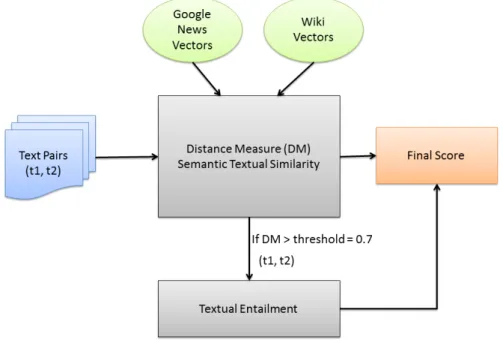
In Kapitel 3 wird eine mögliche Lösung für das Problem der Datenknappheit dargestellt. In diesem Kapitel wird eine Methodologie zur Extraktion paralleler Textfragmente aus vergleichbaren Korpora beschrieben, die als zusätzliche Trainingsdaten in der SMT für das Sprachenpaar Englisch-Bengali genutzt werden können. Für dieses Sprachenpaar stehen nur geringe Ressourcen zur Verfügung. Zur Extraktion von Paralleltexten aus vergleichbaren Korpora wird im Rahmen dieser Arbeit Textual Entailment Techniken (TE) angewendet. Der wichtigste Teil dieser Forschung, der in diesem Kapitel vorgestellt wird, wurde auch in (Pal et al., 2014b, 2015b) veröffentlicht.
1WMT 2016 war die erste große Shared Task, bei der NMT besser abschnitt als SMT-basierte Ansätze.
Um bereits bestehende zweisprachige Daten bestens zu nutzen, ist außerdem die Daten-vorverarbeitung entscheidend. Wie schon erwähnt, baut SMT sehr stark auf gute Qualität von Wort- und Phrasenalignment als Darstellung von Übersetzungswissen durch SMT-Systemen aus einem bilingualen Korpus. Eine der Kernkomponenten der SMT ist das statistische Wortalignment, oft basierend auf IBM-Modellen (Brown et al., 1993). Diese IBM-Modelle können jedoch schlecht mit komplexen Ausdrücken (z.B. Multi-Word Ex-pressions (MWE), Named Entities (NE)) umgehen, da diese Modelle viele-zu-viele Align-ments nicht ohne weiteres abdecken können. Des Weiteren ist unterschiedliche Wortstel-lung in verschiedenen Sprachen ein bekanntes Phänomen und stellt für MT (insbesondere SMT) eine besondere Herausforderung dar. Hieraus resultiert die zweite Forschungsfrage:
RQ2: Wie kann SMT bereits bestehende Trainingsdaten besser nutzen?
In Kapitel 4 wird das Problem der Alignierung von vielen-zu-vielen Ausdrücken behan-delt und beschrieben wie mit unterschiedlicher Wortstellung in weit entfernten Sprach-paaren effizient umgegangen werden kann. Es wird außerdem eine Hybridmethode zur Kombination verschiedener Wordalignments unterschiedlicher Wordaligners vorgestellt. Diese Methode wird anschließend in den Rahmen eines hybriden Multienginesystems zur Verbesserung der MT-Performance eingebunden.
In Kapitel 4 sollen Modellfehler reduziert werden (z.B. weist das Modell nicht den höch-sten Score dem behöch-sten Übersetzungskandidaten zu). Dies geschieht durch (i) die systema-tische Kombination verschiedener MT-Komponenten, (ii) die Kombination verschiedener Systeme und (iii) die Neubewertung des Outputs verschiedener MT-Systeme. Hieraus resultiert die dritte Forschungsfrage:
RQ3: Wie könnte eine verbesserte hybride MT-Implementierung aussehen?
In Kapitel 4 und (Pal et al., 2014c) wird ein hybrides SMT-System beschrieben, mit dem die Baseline-SMT-Performance verbessert wird. Dies erfolgt durch die Einbindung zusätzlicher Wissensquellen wie beispielsweise extrahierter zweisprachige Named Enti-ties, Translation Memories und Phasenpaare, die durch beispielbasierte Methoden und
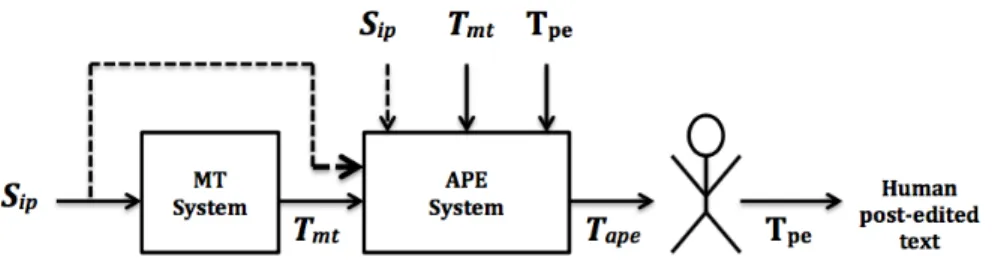
Standard-SMT-Ressourcen gewonnen wurden. Die Performance verschiedener hybrider Systeme und auch Ergebnisse einer Systemkombination basierend auf einem Confusion Network, bei dem die beste Performance jedes einzelnen Systems in der Multi-Engine Pipeline kombiniert wird, werden beschrieben. Wichtige Teile der in diesem Kapitel vorgestellten Forschungsarbeit wurden in (Pal et al., 2014c,a, 2015a, 2016a) publiziert. MT-Systeme haben das Fernziel vollautomatisch eine Übersetzung zu generieren, die ohne Nachbearbeitung veröffentlicht werden kann. Bestehende MT-Systeme erreichen dieses Qualitätsziel jedoch meist nicht, so dass der rohe MT-Output von Menschen post-editiert werden muss (vgl. Abbildung 1). Zur Verbesserung der Übersetzungsqualität ohne eine Veränderung des ursprünglichen MT-Systems selbst kann ein zusätzliches Plug-in-Modul zur Nachbearbeitung verwendet werden. Dies kann beispielsweise ein nachgelagertes monolinguales MT-System wie ein automatisches Post-Editing-System (APE) sein, dass auf Output des eigentlichen MT-Systems und den vom Menschen durchgeführten Kor-rekturen trainiert wurde (cf. Abbildung 2). So kann eine vernünftigere und machbare Lösung erreicht werden, ohne das gesamte eigentliche MT-System zu erneuern. Somit kann eine vierte Forschungsfrage gestellt und untersucht werden:
RQ4: Wie kann ein effektives automatisches Post-Editing-System erstellt werden, dass die Übersetzungsqualität des eigentlichen MT-Systems verbessert?
Figure 1: Post-editing on MT;Sip: source texts,Tmt: corresponding MT output texts andTpe: the human post-edited version ofTmt.
Der Vorteil von APE liegt in seiner Anpassungsfähigkeit an jegliche black-box MT-Engine; d.h. sind post-editierte Daten verfügbar, so ist kein inkrementelles oder volles Training des eigentlichen MT-Systems, das bei der Sammlung der Post-Editing-Daten verwen-det wurde, notwendig. APE setzt Verfügbarkeit der Quelltexte voraus (Sip), sowie den
Figure 2: Automatic Post-editing; here “99K” meansSipmay be or may not be included in the APE system betweenSip_Tmt–Tpe. Our APE system currently uses onlyTmt–Tpe. entsprechenden MT-Output der Texte (Tmt) und die vom Menschen post-editierte Version (Tpe) ofTmt. APE-Systeme können als MT-Systeme zwischenSip_TmtundTpemodelliert werden. Statistische APE-Systeme (SAPE) oder neuronale APE-Systeme (NNAPE) kön-nen auch ohneSipgebaut werden. Hierfür werden genügend “monolinguale” Paralleltexte der Zielsprache Tmt–Tpe verwendet. APE-Tasks konzentrieren sich gewöhnlich auf sys-tematische Fehler des MT-Systems – meist Lexik- oder Wortstellungsfehler sowie falsches Löschen oder Hinzufügen eines Wortes. Hieraus resultiert die fünfte Forschungsfrage.
RQ5: In wie weit ist ein APE-System in der Lage, den letztlichen Post-Editing-Effort zu verringern und die Produktivität zu steigern?
Zur Beantwortung von Forschungsfragen RQ4 und RQ5 wird in Kapitel 5 und (Pal et al., 2016c) ein APE-System auf Grundlage von neuronalen Netzen zur Verbesserung des ro-hen MT-Outputs vorgestellt. Das neuronale APE-Modell (NNAPE) basiert auf einem bidirektionalen rekurrenten neuronalen Netz (RNN) und besteht aus einem Encoder, der MT-Output in einen Vektor mit festgelegter Länge kodiert. Ein Decoder nutzt den Vektor zur Erstellung der post-editierten Übersetzung (PE).
In Kapitel 5 werden zudem zwei Stränge der MT-Forschung kombiniert: MT basiert auf APE (statistsch (Pal et al., 2016f) und neuronalen Netzen (Pal et al., 2016c)) sowie Multi-Engines (Systemkombinationen) (Pal et al., 2016b). APE-Systeme nutzen ein nachgelagertes MT-System, das auf Zielsprachenseite durch die Korrekturen des Human-Post-Editors lernt und verbessern so den Output des eigentlichen MT-Systems. Dies ist eigentlich eine sequentielle MT-Systemarchitektur. Gleichzeitig gibt es außerdem sehr
viel Literatur zuparallelenMT-Systemkombinationen, bei denen der gleiche Input in ver-schiedene Engines gegeben wird. Der beste Output wird dann ausgewählt oder es werden kleinere Teile verschiedener Outputs kombiniert um einen besseren Übersetzungsoutput zu erhalten. In einem Experiment werden sequentielle und parallele Systemkombinatio-nen integriert und somit eine signifikante Produktivitätssteigerung bezüglich Post-Editing durch professionelle Übersetzer erreicht. Wichtige Teile der in diesem Kapitel vorgestell-ten Forschungsarbeit wurden in (Pal et al., 2015c, 2016b,c,f) publiziert.
Die Übersetzungen von MT/APE-Systemen müssen oft noch durch menschliche Über-setzer korrigiert werden, so dass sie veröffentlicht werden können. Fallstudien (O’Brien et al., 2009; TAUS Report, 2010) zeigen, dass der Einsatz einer MT/APE-Engine für alle Seiten bezüglich Kosten- und Zeiteinsparnis von Nutzen sein kann: für Kunden, Über-setzer und Language Service Providers (LSP). Das Gesamtbild bleibt jedoch weiterhin gemischt: MT/APE ist einerseits oft günstig und einfach anwendbar; andererseits ist die Übersetzungsqualität oft nicht zufriedenstellend. Einige professionelle Übersetzer über-setzen lieber von Grund auf selbst. Somit stellt sich die folgende Forschungsfrage:
RQ6: Wie können bestehende MT-Workflows bei der Arbeit des Menschen mit CAT-Tools optimiert werden?
In Kapitel 6 wird ein neues webbasiertes Post-Editing Tool vorgestellt: CATaLog Online
wurde mit einigen neuen Features verbessert. Das Tool kann als reines CAT-Tool genauso verwendet werden wie für das Post-Editing von TM-Segmenten oder von MT-Output. Das Tool erfasst umfassende Informationen im Aktivitätslog, eine Funktion, die die meisten CAT-Tools nicht bieten. Das Tool ist für die Übersetzungsprozessforschung ausgelegt und bietet die folgenden Vorteile: (i) farblich markierte TM-Übersetzungsvorschläge (die markierte Quelle TM sowie das entsprechende Zielfragment werden auf der sel-ben Oberfläche angezeigt), (ii) eine Vielzahl an Editinglogs, (iii) Alignment von Quelle, TM/MT/APE-Output mit dem Ergebnis von humanem PE, (iv) eine verbesserte TM-ähnlichkeitsmessung und Suche (Pal et al., 2016e) und (v) die zusätzliche Übersetzung-soption APE. Wichtige Teile der in diesem Kapitel vorgestellten Forschungsarbeit wurden in (Nayek et al., 2015; Nayak et al., 2016; Pal et al., 2016e,d) publiziert.
I express my sincere gratitude to my advisor Prof. Josef van Genabith, for the con-tinuous support of my Ph.D study and related research, for his patience, motivation, and immense knowledge. I could not have imagined having a better advisor and mentor for my Ph.D study.
Most of the work reported in this thesis would be impossible without the collaboration and guidance of my co-advisor Dr. Sudip Kumar Naskar for his affectionate and valuable guidance; without his help, the present work could not have been successful. His valuable suggestions and thoughts were very fruitful for shaping my ideas in research. He provided much encouragement and moral support especially during the final year of my doctoral thesis.
Besides my advisors, I would like to thank the rest of my thesis committee: Prof. Ingo Reich, Prof. Dietrich Klakow, Prof. Erich Steiner, and Dr. Cristina España-Bonet, for their insightful comments and encouragement.
My sincere thanks also go to other researchers and colleagues including Prof. Elke Teich, Liling Tan, Marcos Zampieri, Mihaela Vela, Jon Dehdari, Raphael Rubino, Katrin Manzel, Jörg Knappen, Daniele Moretti, José Manuel Martínez, Ekaterina Lapshinova-Koltunski, Stefania Degaetano-Ortlieb, Marc Summkeller, Peggy Daut, Ulrike Konz, Anne Weber, Andrea Wurm and Stefan Fischer who provided me with opportunities to do collaborative research.
I thank my fellow EXPERT labmates, my friends in the following institutions: Jadavpur University (India), Dublin City University (Ireland) and other EXPERT’s partner univer-sities, and industry partners: Pangeanic (Spain) and Translated SRL (Italy). In particu-lar, I would like to thank the People Programme (Marie Curie Actions) of the European Union’s Framework Programme (FP7/2007-2013) under REA grant agreement no. 317471 for providing the financial support to undertake the research described in this thesis. I would also like to thank Heike Przybyl who helped me writing the German thesis sum-mary and Gareth Dwyer who proofread this thesis as a native speaker.
Last but not the least, the encouragement given by my grandmother Puspa Rani Dutta, my grandfather Late Nabani Kumar Dutta, my mother Alpana Pal, my father Amar Nath Pal, my maternal uncle Swarup Dutta, Arup Kumar Dutta and Ashish Karmakar who have always been a constant source of inspiration and whose encouragement is beyond linguistic expression for me.
Finally, my deepest gratitude goes to my wife Sandipta Pal for supporting me spiritually throughout writing this thesis and my life in general. Without her continuous support and immense patience, it would have been impossible for me to complete this work.
Abstract v
German Summary vii
Acknowledgements xv
Contents xvi
List of Figures xxiii
List of Tables xxv
Abbreviations xxvii
1 Introduction 1
1.1 Publications Resulting from the Research Presented in this Thesis . . . . 11
1.1.1 Chapter 3 . . . 11 1.1.2 Chapter 4 . . . 13 1.1.3 Chapter 5 . . . 15 1.1.4 Chapter 6 . . . 17 2 Literature Survey 19 2.1 Introduction . . . 19 2.2 Machine Translation . . . 19
2.2.1 Example Based Machine Translation . . . 22
2.2.2 Statistical Machine Translation . . . 23
2.2.3 Word Based SMT . . . 23
2.2.4 Phrase Based SMT . . . 23
2.2.5 Log-linear Model for SMT . . . 24
2.2.7 Language Model . . . 26
2.3 Hybrid MT . . . 26
2.4 Neural MT . . . 30
2.5 Automatic post-editing . . . 32
2.5.1 Statistical APE over RBMT . . . 32
2.5.2 Statistical APE over SMT . . . 32
2.5.3 Rule-Based APE over SMT . . . 33
2.6 Translation Workflow . . . 33
2.6.1 Translation Memory . . . 33
2.6.2 Beyond Basic TM Functionalities . . . 33
2.6.3 Needs or Problems Encountered by TM Users . . . 34
2.6.4 Different types of Interactive MT and Learning from Mistakes . . . 35
2.7 Conclusions . . . 36
3 Mining Parallel Resources from Comparable Corpora 39 3.1 Introduction . . . 40
3.2 Related Work . . . 43
3.3 The TESim System . . . 45
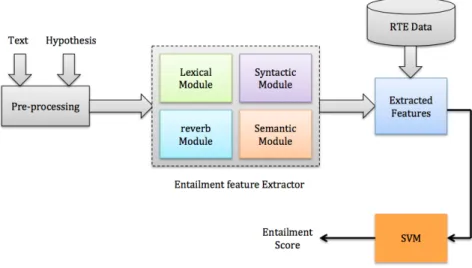
3.4 A Two-way TE System . . . 48
3.4.1 Lexical Module . . . 48
3.4.2 The Syntactic Module . . . 50
3.4.3 reVerb Module . . . 51
3.4.4 Semantic Module . . . 51
3.4.5 Support Vector Machines (SVM) . . . 52
3.5 Comparable Text Extraction from Comparable Corpora . . . 54
3.5.1 Comparable Corpora Collection . . . 54
3.5.2 Monolingual Clustering . . . 54
3.5.3 Cross-lingual Linked Clusters . . . 55
3.6 Alignment of Parallel Text Fragments . . . 55
3.6.1 Template-based Phrase Extraction . . . 56
3.7 Dataset . . . 57
3.8 System Setup . . . 58
3.9 Experiments and Results . . . 58
3.10 Conclusions and Future Work . . . 60
4 Hybrid Machine Translation 61 4.1 Introduction . . . 62
4.2 Related Research . . . 68
4.3 Preprocessing . . . 71
4.3.2 Multi-word Expression Alignment . . . 73
4.3.3 Preordering . . . 75
4.3.3.1 Tree Based Reordering . . . 77
4.3.3.2 Word Alignment-based Reordering . . . 77
4.3.4 Example Based Phrase Alignment . . . 79
4.4 Hybrid Word Alignment . . . 80
4.4.1 Word Alignment Using GIZA++ . . . 80
4.4.2 Berkeley Aligner . . . 80
4.4.3 SymGiza++ . . . 81
4.4.4 Hybridization . . . 81
4.5 Forest-to-String Based SMT . . . 82
4.6 Multi-Engine Hybrid System . . . 83
4.7 Experiments with English–Bengali Data . . . 84
4.7.1 Data . . . 84
4.7.2 Experiment with Forest-to-String Based SMT . . . 85
4.7.2.1 Results . . . 85
4.7.3 Experiment with Word Alignment based Pre-reordering . . . 87
4.8 Experiment with English/Indian Language (IL)– Hindi Data . . . 92
4.8.1 TM Implementation . . . 93
4.8.2 Hybrid System . . . 94
4.8.3 Baseline Settings . . . 95
4.8.4 Result and Analysis . . . 95
4.9 Experiments with English–German Data . . . 100
4.9.1 Data . . . 100
4.9.2 Hybrid System . . . 101
4.9.2.1 LM-NEA-EBMT-SMT hybrid system . . . 102
4.9.3 MIRA-MERT coupled tuning . . . 102
4.9.3.1 System Combination . . . 103
4.9.4 Baseline Settings . . . 103
4.9.5 Results and Analysis . . . 104
4.10 Conclusions and Future Work . . . 104
5 Automatic Post Editing 107 5.1 Introduction . . . 108
5.2 Related Work . . . 112
5.3 Hybrid Word Alignment . . . 114
5.3.1 Statistical Word Alignment . . . 114
5.3.2 Edit Distance-Based Word Alignment . . . 115
5.3.2.2 METEOR Alignment . . . 116
5.3.3 Producing Additional Alignments . . . 116
5.3.4 Alignment Hybridization . . . 117
5.4 Phrase-Based SAPE . . . 117
5.5 Hierarchical Phrase-based SAPE . . . 119
5.6 OSM based APE . . . 120
5.7 System Combination for APE . . . 122
5.8 Neural Network based APE . . . 122
5.9 Experiments with English–Italian Data . . . 125
5.9.1 Data . . . 125
5.9.2 Experimental Settings for NNAPE . . . 126
5.9.3 Evaluation of the NNAPE System . . . 126
5.9.3.1 Automatic Evaluation . . . 126
5.9.3.2 Human Evaluation . . . 127
5.9.3.3 Analysis . . . 128
5.9.4 Experimental Settings for System Combination based APE . . . . 129
5.9.5 Evaluation for System Combination based APE . . . 129
5.9.5.1 Automatic Evaluation . . . 130
5.9.5.2 Human Evaluation . . . 131
5.9.5.3 Time and Productivity Gain Analysis . . . 132
5.10 Experiment with English–German Data . . . 134
5.11 Conclusions and Future Work . . . 137
6 Interactive Translation Workflow 141 6.1 Introduction . . . 142
6.2 Related Work . . . 145
6.3 CATaLog Online: System Description . . . 146
6.3.1 Finding Similar Segments . . . 147
6.3.2 Color Coding . . . 151
6.3.3 Improving Search Efficiency . . . 154
6.3.3.1 Re-ranking . . . 155
6.3.4 Machine Translation . . . 155
6.3.5 Automatic Post-Editing . . . 156
6.3.6 Translation Process Research withCATaLog Online . . . 156
6.4 CATaLog_TS: Beyond Translation Memories . . . 158
6.4.1 Generating a Dictionary . . . 158
6.4.2 Finding Translations for Unmatched Parts . . . 159
6.4.3 Finding Positions to Insert Translations . . . 161
6.4.3.2 Finding Position Using Parse Tree . . . 162
6.4.4 Placing Translations of Unmatched Words in a TM Suggestion . . 168
6.5 CATaLog_TS_ReRank – Re-ranking of the TM Suggestion Translations . 169 6.6 Experiments with the Generated TM Suggestion . . . 171
6.7 User Studies with CATaLog Online . . . 173
6.8 Conclusions and Future Work . . . 177
7 Conclusions and Future Work 179 7.1 Research Contributions and Questions Answered . . . 179
7.2 Future Work . . . 184
A CATaLog Online: A Web-based CAT Tool for Distributed Translation with Data Capture for APE and Translation Process Research 189 A.1 Introduction . . . 190
A.2 CATaLog . . . 190
A.2.1 Similarity Measure . . . 191
A.2.2 Searching . . . 192
A.2.3 Color Coding . . . 192
A.3 CATaLog Online . . . 193
A.3.1 File Translation . . . 193
A.3.2 CAT Tool . . . 194
A.3.3 Project Management . . . 195
A.3.4 Job Management . . . 197
A.3.4.1 Editing Log . . . 198
A.4 APE and Translation Process Research using CATaLog Online . . . 199
A.5 Conclusions and Future Work . . . 200
1 Post-editing on MT;Sip: source texts,Tmt: corresponding MT output texts and Tpe: the human post-edited version ofTmt. . . xi 2 Automatic Post-editing; here “99K” means Sip may be or may not be
in-cluded in the APE system between Sip_Tmt–Tpe. Our APE system cur-rently uses onlyTmt–Tpe. . . xii
1.1 Post-editing on MT;Sip: source texts,Tmt: corresponding MT output texts and Tpe: the human post-edited version ofTmt. . . 7 1.2 Automatic Post-editing; here “99K” means Sip may be or may not be
in-cluded in the APE system between Sip_Tmt–Tpe. Our APE system cur-rently uses onlyTmt–Tpe. . . 8 1.3 Schematic design of the research and the research questions presented in
this thesis. . . 12 3.1 Schematic design of the research and the research questions presented in
this Chapter. . . 41 3.2 Word2vec models: The vocabulary for learning word vectors consists of
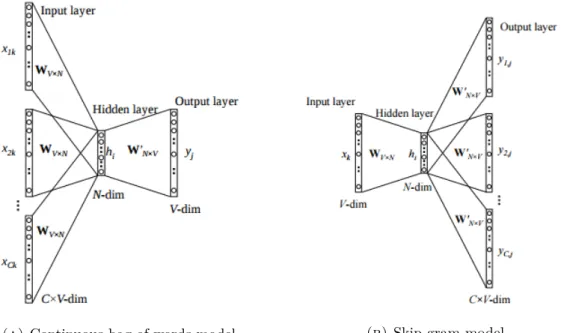
V-dim words and N is the dimension of the hidden layer. The input to hidden layer connections are represented by matrix W ∈ RV×N, where each row represents a vocabulary word. Similarly, hidden layer to output layer connections are described by matrix W′ ∈ RN×V. C is the number of words in the context. These figures are borrowed from the tutorials in Chris McCormick’ Blog (http://mccormickml.com/tutorials/) and these models are originally reported in Mikolov et al. (2010) . . . 46 3.3 System Architecture . . . 47 3.4 Two way TE architecture . . . 49 4.1 Schematic design of the research and the research questions presented in
this Chapter. . . 63 4.2 Word alignments with unordered and reordered source. . . 91 4.3 BLEU scores for all 5 language pairs on all three domains: Health, Tourism,
5.1 Schematic design of the research and the research questions presented in this Chapter. . . 109 5.2 Producing additional alignments (wi–w¯j,wi–w¯j+1) . . . 117
5.3 Generating thetthT Lpe wordyt for a givenT Lmt (x) by our NNAPE Sys-tem. We followed the same graphical architecture described in Bahdanau et al. (2015). . . 123 5.4 Polling outcome of NNAPE vs GT . . . 128 6.1 Schematic design of the research and the research questions presented in
this Chapter. . . 143 6.2 TER alignment between input sentence and TM matched segment. . . 148 6.3 Logs generated by CATaLog Online. . . 157 6.4 POS-based context dictionary . . . 160 6.5 Parse tree . . . 166 6.6 Correlation between the number of edits and edit time. . . 175 6.7 Box plot distributions of the different types of edits for the three translators
(T1,T2, and T3). . . 176 7.1 Generating the tth T Lpe wordyt for a givenT Lmt (x) andSLip (w). . . . 187
A.1 Landing page user interface ofCATaLog online . . . 194 A.2 File translation interface . . . 195 A.3 CAT interface . . . 196 A.4 Project Management interface for PMs . . . 197 A.5 Project Management interface for translators . . . 197 A.6 Job search interface ofCATaLog online. . . 198 A.7 Job interface ofCATaLog online . . . 198 A.8 Job interface of TM selection . . . 199 A.9 Job download interface . . . 199
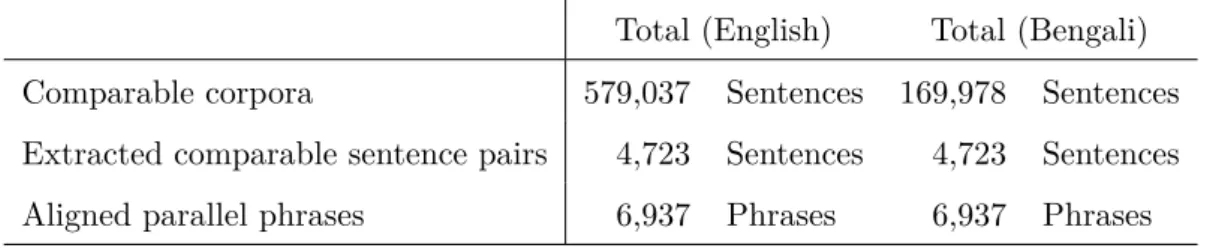
3.1 Examples of text pairs and entailment results . . . 48 3.2 RTE-data statistics used for training our SVM based TE system . . . 53 3.3 Statistics of the Comparable Corpus . . . 58 3.4 Evaluation results; all scores are statistically significant over baseline systems. 59 4.1 Phi-matrix . . . 74 4.2 Systematic evaluation results for English–Bengali. HPB:=HPBSMT, FB:=FSBSMT;
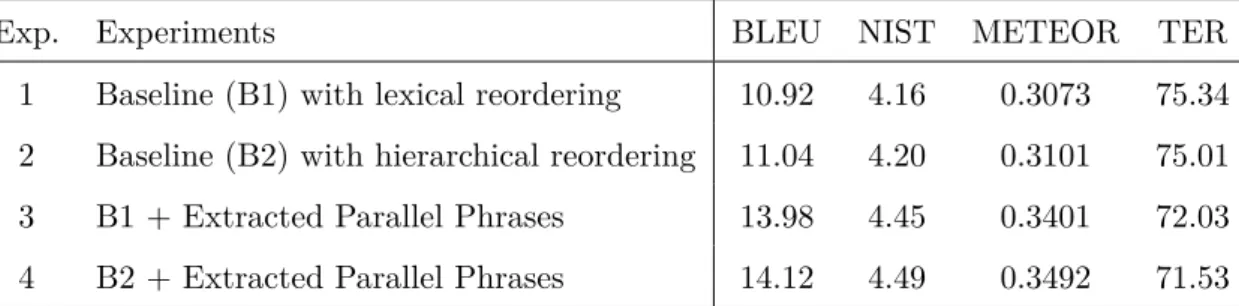
All FB outputs provide statistically significant improvements over HPB. . 86 4.3 Evaluation results obtained on the reordering experiments. . . 89 4.6 Evaluation scores of our system-combination submission in ICON-2014 on
5 language pairs in three domains; Overall average BLEU Score : 24.613 TER: 57.856 . . . 98 4.7 Systematic comparison between system-combination and Baseline system 99 4.8 Parallel training data statistics after cleaning . . . 101 4.9 Systematic comparison between system-combination (System 7), six best
performing individual systems and Baseline system . . . 103 5.1 Automatic evaluation. . . 127 5.2 Pairwise correlation between translators in the evaluation process. . . 128 5.3 Automatic evaluation using Sentence-BLEU over 1,000 test set sentences;
% Gain= AP E1000 & % Loss= 1000GT . . . 130 5.4 Automatic evaluation of the systems over 1,000 test set sentences. . . 131 5.5 Outcome of polling with four expert translators for 145 sentences. (EN:English,
DE:German, FR:French, ES:Spanish, CA:Catalan, IT:Italian). . . 132 5.6 Post editing statistics over GT and SC-APE. . . 133 5.7 Assessment of the post-editors based on their performance and quality. . . 134 5.8 Statistics of the WMT-2016 APE Shared Task Data Set. SEN: Sentences,
EN: English, DE: German. . . 135 5.9 Systematic Evaluation on the WMT-2016 APE Shared Task Development
Set . . . 136 5.10 Evaluation on the WMT-2016 APE Shared Task Test Set . . . 137
6.1 TM source–target alignment and TM source–input alignment . . . 164 6.2 Systematic comparison betweenCATaLog,CATaLog_TS,CATaLog_TS_ReRank
and Moses. . . 173 6.3 Selection of suggestions by translators in CATaLog Online. . . 174 6.4 Cohen’s κ measuring agreement for the selected suggestion, editing time
APE AutomaticPost-Editing
BLEU BiLingualEvaluation Understudy
CAT Computer AidedTranslation
CN ConfusionNetwork
CBMT Corpus Based Machine Translation
DNN DeepNeuralNetwork
EBMT Example BasedMachine Translation
FSBSMT Forest toStringBased StatisticalMachine Translation
HPE Human Post-Editing
HWA HybridWordAlignment
MT Machine Translation
METEOR Metric for Evaluation of Translation with Explicit ORdering
MERT Minimum Error Rate Training
MWE Multi-WordExpressions
NE Named Entities
NMT NeuralMachineTranslation
NN NeuralNetwork
NNAPE NeuralNetwork based AutomaticPost-Editing
OSM OperationSequenceModel
PB-SAPE Phrase BasedStatistical AutomaticPost-Editing
PB-SMT Phrase BasedStatistical MachineTranslation
PE Post-Editing
RNN RecurrentNeuralNetwork
RBMT RuleBased MachineTranslation
SL SourceLanguage
SAPE StatisticalAutomaticPost-Editing
SMT StatisticalMachineTranslation
SC-APE System Combination based AutomaticPost-Editing
TL Target Language
TE Textual Entailment
TM Translation Memory
TPR Translation Process Research
Introduction
The work presented in this thesis aims at improving and integrating different compo-nent technologies of Machine Translation (MT) in an ideal or at least improved workflow based on hybridization approaches. The thesis also investigates effective ways of involv-ing humans as post-editors and supportinvolv-ing this by automatically collectinvolv-ing translation process data for future research (e.g., to support incremental updates of individual work-flow and post-editing components). The main aim of the research presented in this thesis is to examine real-life needs and problems which confront translation technology users, including professional translators, and provide a collaborative hybrid machine translation framework towards an improved translation workflow, and reduce post-editing effort of the translators. Based on this, the translation system functionality should be optimized in terms of user requirements rather than forcing the users to change how they work with the technology. The research also investigates whether and how combinations of exist-ing technologies such as Neural MT (NMT), Statistical MT (SMT), Example Based MT (EBMT) and Translation Memory (TM) systems can be used and integrated to support the users’ requirements. Throughout, in this thesis has a special focus on the data settings provided by low resource languages.
In order to achieve our objective, we describe our approach in two complementary ways. Technology components are usually combined into translation workflows; part of our research will therefore concentrate on the (i) components, while the other part of our research will focus on (ii) workflows. Specifically, in the first part of our research, we focus on the design and implementation of component technologies (described in Chapter
3, Chapter 4 and Chapter 5) that are effective and user friendly. Here we make extensive use of hybridization approaches. In the second part of our research, we concentrate on identifying better workflows based on a combination of different components of the component technologies in the workflow using a plug and play methodology, where better is initially measured in terms of translation output quality. Furthermore, our work also involves humans in the translation process for the purpose of assessing translation quality and as a long term goal for providing activity-log based feedback to incrementally enhance the different components of the component technology on the one hand and simultaneously generating valuable resources for translation process research on the other hand (cf., Chapter 6).
By definition, MT is a computer based process which transforms text in one human lan-guage text into another in either a fully automatic or a semi-automatic (human assisted MT, i.e., involving a human in the translation process) manner. Many approaches to MT have been explored, for instance rule-based, example-based, knowledge-based, statistical and neural approaches to MT. Out of these, in terms of large-scale evaluations and use, SMT in particular phrase-based SMT (PB-SMT) has until recently been the most suc-cessful MT paradigm1. The quality of PB-SMT mainly relies on good quality upstream word alignment as well as good phrase pair estimation, both of which can be achieved by using large amounts of sentence aligned parallel corpora. However, data scarcity can be a challenge and PB-SMT for low resource language pairs usually produces inferior quality translations due to insufficient amounts of parallel training data. This leads us to our first research question (RQ).
RQ1: How can MT for low resource languages be improved?
Comparable corpora provide a possible solution to this data scarcity problem to some extent. Comparable documents are not strictly parallel. Comparable corpora consist of bilingual documents. However these documents are not sentence by sentence translations; but they are on the same topic and convey similar information and hence it is likely that there exists some sentential or sub-sentential level of parallelism. Recently, comparable corpora are being considered as a valuable resource for acquiring parallel data, which can play an important role in improving the quality of SMT (Smith et al., 2010). The parallel
1WMT 2016 has been the first large scale shared task in which NMT has outperformed SMT based
segments extracted from comparable corpora are typically added to an existing training corpus as additional training material which is expected to improve performance of SMT systems, specifically for low-resource language pairs (e.g. English–Bengali). However, large fully parallel fragments of text are rarely found in comparable document pairs. The bigger the size of the fragment, the less probable it is that its parallel version will be found in the target. Nevertheless, there is always a chance of obtaining parallel phrases, tokens or even sentences in comparable documents. The challenge is to discover those parallel fragments which can be useful in increasing SMT performance. In Chapter 3, we describe a methodology for extracting English–Bengali parallel text fragments from comparable corpora. To extract parallel text from comparable corpora, in our research we apply textual entailment (TE) and then utilize the additional training data in SMT. In Pal et al. (2015b) we show that the additional training data extracted from comparable corpora provides significant improvements of 3.06 absolute points and 32.97% relative over the baseline PB-SMT system as measured by BLEU (Papineni et al., 2002) for English– Bengali translations.
Furthermore, to obtain optimal benefits from the existing bilingual data, data preprocess-ing plays a crucial role. As mentioned earlier, SMT relies heavily on the quality of word alignment and phrase alignment which essentially represent the translation knowledge acquired by an SMT system from a bilingual corpus. One of the core components of SMT is statistical word alignment which is often based on IBM models (Brown et al., 1993). These IBM Models do not work well with complex expressions (e.g., multi-word expres-sions (MWEs), Named Entities (NEs)), due to their inability to handle many-to-many alignments. The IBM Models only allow one-to-many alignments from source language to target language (Koehn et al., 2003; Marcu, 2001)2. In another well-known statisti-cal word alignment approach, Hidden Markov Models (HMM: Vogel et al. (1996)), the alignment probabilities depend on the alignment position of the previous word. HMM alignment does not explicitly consider many-to-many alignments either. Furthermore, reordering is a well-known cross-lingual phenomena which poses a significant challenge in MT (especially in SMT). This leads us to the second research question:
RQ2: How can SMT better profit from the existing training data?
2Alignment in both directions (i.e., alignment symmetrization) are used to partially address this
In Chapter 4, we address this many-to-many alignment problem indirectly. Our objective focuses on how to best handle the NEs and MWEs in SMT. In our research, MWEs, NEs and compound verbs are automatically identified on both sides of the parallel cor-pus. Then, source and target language NEs are aligned using a statistical transliteration method. We rely on these automatically aligned NEs and treat them as translation ex-amples. We modify the parallel corpus by converting the MWEs into single tokens and adding the aligned NEs to the parallel corpus in a bid to improve the word alignment, and hence the phrase alignment, quality. This preprocessing results in improved MT quality in terms of automatic MT evaluation as we show in Pal et al. (2013b) for English– Bengali, Tan and Pal (2014) for English–Hindi, and Pal et al. (2015a) for English–German. Chapter 4 also presents how reordering between distant language pairs can be handled efficiently in phrase-based SMT. The problem of reordering between distant languages has been approached with prior reordering of the source text at chunk level to simulate the target language ordering (Pal et al., 2014a). In this chapter, we report experiments on prior reordering of the source chunks following the target word order suggested by word alignment. We reorder the test set using a monolingual MT trained on source and reordered source. Our approach of prior reordering of the source chunks is compared with pre-ordering of source words based on word alignments (Holmqvist et al., 2012) and the traditional approach of prior source reordering based on language-pair specific reordering rules. The effects of these reordering approaches is studied on an English–Bengali trans-lation task, a language pair with substantially different word order. Our experimental results show that in our data setting word alignment based reordering of the source chunks is more effective than the other reordering approaches and that it produces statistically significant improvements over the baseline system on BLEU (Pal et al., 2014a). Manual inspection confirms significant improvements in terms of word alignments.
Over the last 10-15 years, MT has made considerable progress, in large part due to re-search and development in statistical and hybrid (and recently neural) approaches to MT. In many cases, MT services provide a convenient support not only for professional translators but also for general users. Free online MT engines and commercial engines are available, such as Google Translator3, Systran4, Microsoft Bing translator5, etc. Fur-thermore, commercial as well as free version of translation support tools (well-known as
3https://translate.google.com/ 4http://www.systransoft.com/ 5https://www.bing.com/translator
Computer Aided Translation – CAT tools) are also available such as MateCat6, Cas-maCat7, Trados8 Translation tools and are widely used in the translation industry. The core component of the vast majority of CAT tools are translation memories (TM). TMs work under the assumption that previously translated segments can serve as good models for new translations, especially when translating technical or domain specific texts, where some amount of repetition exists. Translators input new texts to be translated into the CAT tool and these texts are divided into shorter segments. The TM engine then checks whether there are segments (and their translation) in the memory which are similar to those from the input text. Every time the software finds a similar segment in the memory, the tool shows it together with its translation to the translator as a suitable suggestion usually through a graphical interface. In this scenario, translators work as post-editors by adapting retrieved segments suggested by the CAT tool or in case no suitable segments are found translating new segments from scratch. This process is done iteratively and every post-edited segment or new translation increases the size of the translation memory making it more useful for future translations.
TM systems store source and target language translation pairs for effectively reusing the previous translations originally created by human translators. Conceptually, EBMT is closely related to TM. The difference between the two approaches is that EBMT extracts translations of fragments of an input sentence to be translated from the translation model and combines fragments to produce translations for a segment in question whereas TMs are not translation systems as such but rather act like search engines which provide closely matching translation pairs for a complete segment to effectively reduce the translation workload of translators.
Despite continued and significant progress, fully automatic MT is often not yet able to always provide desirable performance in terms of output quality. Each approach to MT has its own method of acquiring and using translation knowledge from the parallel bilingual translation examples, along with its own advantages and disadvantages. The knowledge representation processes in both EBMT and SMT use very different techniques in order to extract translation knowledge. SMT phrases are n–grams (i.e., contiguous sequence of words), rather than grammatical phrases (as in a grammatical theory such as noun
6https://www.matecat.com/ 7http://www.casmacat.eu/
phrases (NPs), prepositional phrases (PPs) or Verb phrases (VPs)) as in EBMT. Many researchers have investigated combinations of different MT approaches (Hybrid MT) to achieve better performance. The decoding task for SMT models is an NP-hard (Knight, 1999) problem with exponential complexity of the search space which implies that a decoder can only perform a non-exhaustive search (using heuristic search methods) to find the best possible translation for a given input. This may lead to a number of system errors such as – model error: the model fails to assign the highest score to the best translation candidate, search error: the search process fails to find the best translation hypothesis in the search space and induction error: when the optimal translation is absent in the search space owing to various pruning strategies (Fancellu and Webber, 2015). Our research aims to reduce the model error (i) by systemically combining various MT components, (ii) by combining different systems and (iii) by re-ranking different MT systems’ outputs. This leads to our third research question.
RQ3: What could improved hybrid implementations of MT be like?
Our Hybrid MT system described in Chapter 4 and in (Pal et al., 2014c) improves over the baseline SMT performance by incorporating additional knowledge sources such as the extracted bilingual named entities, translation memories, and phrase pairs induced from example-based methods together with the standard SMT resources. We report performance on different hybrid systems as well as results of a confusion network based system combination that combines the best performance of each individual system within a multi-engine pipeline. Our best system (Pal et al., 2014c) achieved an overall BLEU score of 24.61 averaged over all language pairs and all domains in the shared task on SMT in Indian languages which encompassed translating from five languages (Bengali, English, Marathi, Tamil and Telugu) into Hindi in three different domains (Health, Tourism and General).
We also performed a similar experiment on English–German (Pal et al., 2015a) using the WMT-20159 news-2015 test set, where our confusion-network-based system combi-nation model outperforms all our individual MT systems. Our hybrid system achieved an improvement of 5.9 absolute BLEU points i.e., a 35.3% relative improvement over the English–German baseline PB-SMT system.
In Chapter 4, we also present a similar hybrid technique which combines different word alignment methods and integrates them into a forest-to-string based SMT (FSBSMT) system (Pal et al., 2016a). We show that hybrid word alignment integrated into various experimental settings of FSBSMT provides considerable improvements over state-of-the-art Hierarchical Phrase based SMT (HPBSMT). The research also demonstrates that additional integration of Named Entities (NEs), their translations and Example Based Machine Translation (EBMT) phrases (all extracted from the bilingual parallel training data) into the system brings about further improvements over the hybrid FSBSMT system. Our best system achieves 78.5% relative (9.84 BLEU points absolute) improvement over the baseline HPBSMT on an English–Bengali data set.
The ultimate goal of MT systems is to provide fully automatic publishable quality trans-lations. However, existing MT systems often fail to deliver publishable quality transla-tion output requiring human post-editing of raw MT output. To achieve translatransla-tions of sufficient quality, translations often need to be corrected or post-edited by human trans-lators (cf. Figure 1.1). Nonetheless, translations produced by MT systems have improved substantially and consistently over the last two decades. Translations produced by MT systems are now widely used in the translation and localization industry. To enhance the quality of translation without changing the original MT system itself, an additional plug-in automatic post-processing module, e.g. a second stage monolingual MT system such as an automatic post-editing (APE) system trained on previous output of the first-stage MT system and its human corrections (PEs/HPEs), can be introduced (cf. Figure 1.2). This may lead to a more reasonable and feasible solution compared to rebuilding the entire existing first-stage MT system. This motivated us to pose and explore for our fourth research question.
RQ4: How can we build an effective automatic post-editing system which can improve the translation quality of the first-stage MT system?
Figure 1.1: Post-editing on MT; Sip: source texts, Tmt: corresponding MT output texts andTpe: the human post-edited version of Tmt.
Figure 1.2: Automatic Post-editing; here “99K” means Sip may be or may not be included in the APE system betweenSip_Tmt–Tpe. Our APE system currently uses only
Tmt–Tpe.
The term “Post-Editing” (PE) is defined as the corrections performed by humans over the translations produced by an MT system (Veale and Way, 1997). It is often under-stood as the process of improving a translation provided by an MT system with the minimum amount of manual effort (TAUS Report, 2010). While MT is often not perfect, post-editing MT output can yield productivity gains as it may require less effort than translating the same input manually from scratch. MT outputs are often post-edited by professional translators and the use of MT has become an important part of the trans-lation workflow. A number of studies confirm that post-editing MT output can improve translators’ performance in terms of productivity and it may positively impact on trans-lation quality and consistency (Guerberof, 2009; Plitt and Masselot, 2010; Zampieri and Vela, 2014). The wide use of MT in modern translation workflows in the localization industry, in turn, has resulted in substantial quantities of human PE data (MT output and its human correction) which can be used to develop APE systems. APE (Knight and Chander, 1994) has been proposed as an automatic method for improving raw MT output, before (as it may not be a perfect) performing final human post-editing on it (cf. Figure 1.2). The approach is based on automatic corrections of errors made by the MT system. The automatic corrections of errors are learned from the human-corrected output of a first stage MT system possibly resulting in a productivity increase in the translation process. The advantage of APE relies on its capability to adapt to any black-box MT engine; i.e., upon availability of post-edited data, no incremental training or full re-training of the first stage MT system is required to improve the overall translation quality of the first stage MT system that was involved in the post-editing data collection. APE assumes the availability of source texts (Sip), corresponding MT output texts (Tmt) and the human post-edited version (Tpe) of Tmt, and APE systems can be modelled as an MT system
between Sip_Tmt and Tpe. However, statistical APE (SAPE) or neural APE (NNAPE) systems can also be built without the availability of Sip using only sufficient amounts of target side “mono-lingual” parallel Tmt–Tpe text within the SMT framework. Usually APE tasks focus on systematic errors made by MT systems – the most frequent ones often being incorrect lexical choices, incorrect word ordering, and incorrect insertion or deletion of a word. This leads to our fifth research question.
RQ5: To what extent is an APE system able to reduce final post-editing effort in terms of increasing productivity?
To find answers to research questions RQ4 and RQ5, in Chapter 5 and (Pal et al., 2016c), we present a neural network based APE system to improve raw MT output quality. Our neural model of APE (NNAPE) is based on a bidirectional recurrent neural network (RNN) model and consists of an encoder that encodes an MT output into a fixed-length vector from which a decoder provides a post-edited (PE) translation. APE translations produced by NNAPE show statistically significant improvements of 3.96, 2.68 and 1.35 BLEU points absolute over the original English–Italian MT, phrase-based APE and hi-erarchical APE outputs, respectively. Furthermore, human evaluation shows that the NNAPE generated PE translations are much better than the original MT output. In Chapter 5, we also investigate an APE method to improve the translation quality pro-duced by an English–German SMT system (Pal et al., 2016f). We present an APE system based on the Operation Sequence Model (OSM) combined with a PB-SMT system. The system is trained on “monolingual” data consisting of MT output texts (T Lmt) produced by a black-box MT system and their corresponding human post-edited version (T Lpe). Our system achieves 64.10 BLEU (1.99 absolute points and 3.2% relative improvement in BLEU over raw MT output) and 24.14 TER (0.66 absolute points and 0.25% relative improvement in TER over raw MT output) on the official WMT 201610 APE test set. Furthermore, in Chapter 5, we combine two strands of MT research: APE and multi-engine (system combination) MT (Pal et al., 2016b). APE systems learn a target-language-side second stage MT system from the data produced by human corrected output of a first stage MT system, to effectively improve the output of the first stage MT in what is essentially a sequential MT system combination architecture. At the same time, there is a rich research literature on parallel MT system combination where the same input is
fed to multiple engines and the best output is selected or smaller sections of the various outputs are combined to obtain an improved translation output. In this chapter we show that parallel system combination in the APE stage of a sequential MT-APE combination yields substantial translation improvements both in terms of automatic evaluation metrics as well as in terms of productivity improvements measured in a post-editing experiment. In addition, we also show that system combination on the level of APE alignments yields further improvements. Overall our APE system yields statistically significant improve-ments of 5.9% relative BLEU over a strong baseline (English–Italian Google MT) and 21.76% significant productivity increase in a human post-editing experiment with profes-sional translators.
The translations provided by MT/APE systems often need to be corrected by human translators to make them publishable. In the localization and translation industry, CAT tools are widely used by professional translators in their regular work practice. CAT tools are computer software that facilitates translators’ work in terms of ease of use, faster project delivery and saving translators’ time and cost due to (partial) automation. However, translation tools are progressively changing due to technological advances. Au-tomatic translations or translation suggestions produced by these tools may not always be correct. Because of this and partly due to the fear of job loss due to progressive automa-tion, translation tools are not always well accepted by processional human translators in traditional translation workflows. This is a well-known problem for the translation industry (TAUS Report, 2010; TAUS/CNGL Report, 2010).
Case studies (O’Brien et al., 2009; TAUS Report, 2010) have shown that the deployment of an MT/APE engine can be beneficial to all sides, including clients, translators and language service providers (LSP) in terms of cost and time saving. However, the overall picture remains mixed: on the one hand, often MT/APE is cheap and easy to use, while on the other hand, in many cases, the quality of translation is not always satisfactory: sometimes professional translators prefer to translate from scratch. This leads us to investigate the following research question.
RQ6: How can human interaction with CAT tools be optimized in existing MT workflows?
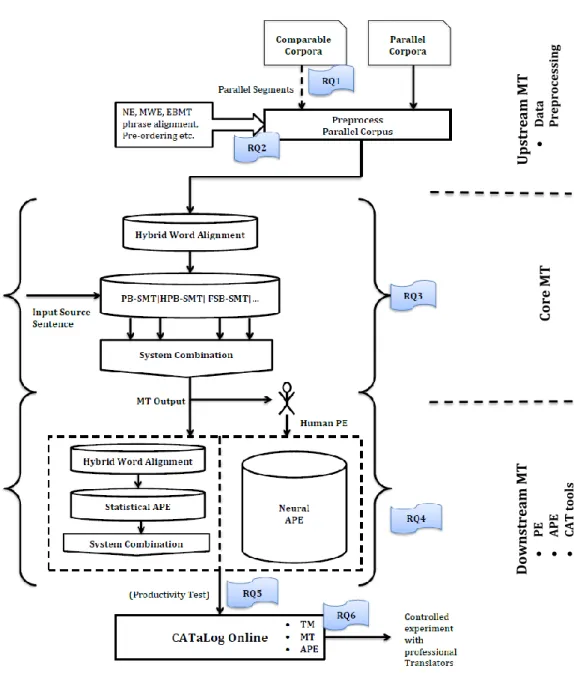
Schematically the research and the research questions presented in this thesis can be represented as in Figure 1.3.
For the purposes of this thesis, we divide workflows into three general sections: “upstream MT”, “core MT” and “downstream MT”. Upstream MT addresses data preprocessing and extraction, core MT addresses hybrid approaches to MT while downstream MT addresses PE, APE and CAT tools with the human in the loop. The research question addressed in this thesis address all 3 stages of this generic workflow (Figure 1.3).
1.1 Publications Resulting from the Research Presented in
this Thesis
1.1.1 Chapter 3
• Santanu Pal, Partha Pakray and Sudip Kumar Naskar. 2014. Automatic Build-ing and UsBuild-ing Parallel Resources for SMT from Comparable Corpora, In Hybrid Approaches to Translation (HyTra-2014) Workshop in 14th Conference of the Eu-ropean Chapter of the Association for Computational Linguistics (EACL 2014), Gothenburg, Sweden, pages 26–30, April 2014.
Contributions: We present an automatic approach to extracting parallel fragments from comparable corpora for enriching MT training data for low resource language pairs. First author paper. The technological contributions offered in this work is the application of textual entailment (TE) method in MT research. The TE system was developed by Dr. Partha Pakray, a co-author. I developed the core idea of using TE for extracting parallel fragment from comparable corpora.
• Santanu Pal, Partha Pakray, Alexander Gelbukh, Josef van Genabith. 2015. Min-ing Parallel Resources from Comparable Corpora to improve performance of Ma-chine Translation, Computational Linguistics and Intelligent Text Processing Lec-ture Notes in Computer Science Volume 9041, 2015, pages 534–544, April 14-20, 2015, Cairo, Egypt.
Contributions: This is an extension of the (Pal et al., 2014b) above; however, in this case we applied an advanced TE system. First author paper. In this paper, I used a novel TE method and distributional semantics for text similarity. I applied template-based phrase extraction and a TE based monolingual clustering technique to align parallel phrases from comparable sentence pairs. I developed the core idea of
Ups tr ea m MT D at a P reprocessin g Co re MT D ow ns tr ea m M T PE AP E CAT t ool s
Figure 1.3: Schematic design of the research and the research questions presented in this thesis.
using TE and distributional semantic text similarity for extracting parallel fragment from comparable corpora.
1.1.2 Chapter 4
• Santanu Pal, Sudip Kumar Naskar and Sivaji Bandyopadhyay. 2014. Word Alignment-Based Reordering of Source Chunks in PB-SMT. Published in the Proceedings of the Ninth International Conference on Language Resources and Evaluation (LREC), Reykjavik, Iceland, pages 3565–3571.
Contributions: First author paper. In this paper, I show how reordering between distant language pairs can be handled efficiently in PB-SMT. I addressed the prob-lem of reordering between distant languages with prior reordering of the source text at chunk level to simulate the target language ordering. Prior reordering of the source chunks was performed in this work by following the target word order sug-gested by word alignment. I developed the main idea and performed the central experiments of the work projected in the paper.
• Liling Tan and Santanu Pal. 2014. Manawi: using multi-word expressions and named entities to improve machine translation. In Proceedings of Ninth Workshop on Statistical Machine Translation. WMT 2014. Baltimore, USA, pages 201–206.
Contributions: This paper describes the English–Hindi MT system submitted to the 2014 WMT translation task. I contributed in alignment of multiwords and named entities and applied this prior alignment to the PB-SMT framework. I de-veloped the core idea of using pseudo-alignment of NEs and MWE as an additional training corpus in PB-SMT framework.
• Santanu Pal, Ankit Srivastava, Sandipan Dandapat, Josef van Genabith, Qun Liu and Andy Way. 2014. USAAR-DCU Hybrid Machine Translation System for ICON 2014. In Proceedings of the 11th International Conference on Natural Language Processing, ICON-2014, Goa, India.
Contributions: First author paper. This paper presents the USAAR-DCU MT system submitted to the NLP Tools Contest in ICON 2014. I developed the core
idea of using an effective preprocessing method and applying explicitly aligned bilin-gual terminology, i.e., named entities, to the PB-SMT pipeline and finally devel-oped a simple but effective hybridization technique for using multiple knowledge sources. All the experiments were carried out and research contributions were made by myself; all other co-authors guided me during my secondments in Dublin City University.
• Santanu Pal, Sudip Kumar Naskar, Josef van Genabith. 2015. UdS-Sant: English– German Hybrid Machine Translation System. In the Proceedings of the EMNLP 2015 Tenth Workshop on Statistical Machine Translation (WMT 2015), Lisbon, Portugal, pages 152–157.
Contributions: First author paper. In this paper, I develop an English–German Hybrid MT system submitted to the Translation Task organized in WMT 2015. I incorporated additional knowledge such as extracted bilingual named entities and bilingual phrase pairs induced from example-based methods into PB-SMT. I devel-oped the core idea and performed the central experiments of the work projected in the paper.
• Santanu Pal and Sudip Kumar Naskar. 2016. Hybrid Word Alignment. In “Hybrid Approaches to Machine Translation”. Springer International Publishing Switzer-land. M.R. Costa-jussà et al. (eds.), Hybrid Approaches to Machine Translation, Theory and Applications of Natural Language Processing.
Contributions: First author paper. In this paper, I present a hybrid word align-ment model for PB-SMT. This provides most informative alignalign-ment links which are offered by both unsupervised and semi-supervised word alignment models. I proposed an algorithm where two unsupervised word alignment models, namely GIZA++ and Berkeley aligner, and a rule based word alignment technique are com-bined together. The core part of the experiment and the research methodology have been designed by me. Jointly with my co-author we made substantial contri-butions to conception and design, and/or acquisition of data, and/or analysis and interpretation of data, and experimental outcomes.
• Santanu Pal, Sudip Kumar Naskar, Josef Van Genabith. 2016. Forest to String Based Statistical Machine Translation with Hybrid Word Alignments. Computa-tional Linguistics and Intelligent Text Processing Lecture Notes in Computer Sci-ence, 2016, CICLING-2016. Konya, Turkey.
Contributions: First author paper. In this paper, I show how hybrid word align-ment integrated into various experialign-mental settings of Forest to String based SMT can provide considerable improvement over state-of-the-art Hierarchical Phrase based SMT. The research also demonstrates that additional integration of NEs, their trans-lations and EBMT phrases into the Forest to String Based SMT system provides considerable performance improvements.
1.1.3 Chapter 5
• Santanu Pal, Mihaela Vela, Sudip Kumar Naskar, Josef van Genabith. 2015. USAAR-SAPE: An English–Spanish Statistical Automatic Post-Editing System. In the Pro-ceedings of the EMNLP 2015 Tenth Workshop on Statistical Machine Translation (WMT 2015), Lisbon, Portugal, pages 216–221.
Contributions: First author paper. I developed an APE system submitted to the APE Task organized in WMT 2015. I designed three basic components: corpus preprocessing, hybrid word alignment and a PBSMT system integrated with the hybrid word alignment. The hybrid word alignment consists of a combination of multiple word alignments into a single word alignment table. The PB-SMT based APE system was trained on Spanish MT output and the corresponding manually post-edited output. I developed the core idea and performed the central experiments of the work presented in the paper.
• Santanu Pal. 2015. Statistical Automatic Post Editing. In The Proceedings of the EXPERT Scientific and Technological workshop.
Contributions: Solo author paper. In this paper, I built a hierarchical phrase based APE system that can automatically handle and estimate word insertion error (by considering one-to-many alignment links between MT–PE aligned data), word deletion error (by considering many-to-one alignment links between MT–PE aligned data), lexical error (by estimating lexical weighting during model estimation) and
word ordering error (using a hierarchical model facilitates word ordering since it uses synchronous context free grammar (SCFG) based hierarchical phrases). • Santanu Pal, Marcos Zampieri, and Josef van Genabith. 2016. Usaar: An Operation
Sequential Model for Automatic Statistical Post-editing. In Proceedings of the First Conference on Machine Translation. WMT 2016. Association for Computational Linguistics, pages 759–763.
Contributions: First author paper. In this paper, I developed an English–German APE system which is based on Operation Sequence Model combined with PB-SMT system. The system is trained on monolingual settings between MT outputs pro-duced by a black-box MT system and their corresponding post-edited version. • Santanu Pal, Sudip Kumar Naskar, Mihaela Vela and Josef van Genabith. 2016.
A Neural Network based Approach to Automatic Post-Editing. In the Proceedings of the The 54th Annual Meeting of the Association for Computational Linguistics (ACL 2016), Berlin, Germany, pages 281–286.
Contributions: First author paper. My contribution in this work is designing the core components, introducing deep neural networks into automatic post-editing pipeline and setting up and carrying out experiments. I collaborated with the in-dustry partner (Translated SRL, Rome, Italy) of the EXPERT project and used their data and translators for the APE experiments. My co-author Dr. Mihaela Vela helped complete the human evaluation.
• Santanu Pal, Sudip Kumar Naskar and Josef van Genabith. Multi-Engine and Multi-Alignment Automatic Post-Editing and its Impact on Translation Productiv-ity. In the 26th International Conference on Computational Linguistics (COLING 2016), Osaka, Japan, pages 2559–2570.
Contributions: First author paper. I developed the core idea, designed the core components, introduced alignment combination and multi-engine system combina-tion into the automatic post-editing pipeline, conducted automatic evaluacombina-tion and human evaluation, applying the model in an industrial setup.
1.1.4 Chapter 6
• Tapas Nayek, Sudip Kumar Naskar, Santanu Pal, Marcos Zampieri, Mihaela Vela and Josef van Genabith. CATaLog: New Approaches to TM and Post Editing Inter-faces. In the Proceedings of the 1st Workshop on Natural Language Processing for Translation Memories (NLP4TM), collocated with RANLP 2015, Hissar, Bulgaria, pages 36–42.
Contributions: In this paper we proposed a novel retrieval technique and post-editing interface for TMs. One of the novel features of CATaLog is a color coding scheme that is based on the similarity between an input segment and the retrieved TM segments, which helps the translators to identify portions of the sentence which are most likely to require post-editing thus demanding minimal effort and increasing productivity. I developed the ideas on color-coding between input text and TM segments (both for source and target).
• Santanu Pal, Marcos Zampieri, Mihaela Vela, Tapas Nayak and Sudip Kumar Naskar, Josef van Genabith. 2016. CATaLog Online: Porting a Post-editing Tool to the Web. In the Proceedings of the 10th International Conference on Language Resources and Evaluation (LREC 2016), pages 599–604.
Contributions: First author paper. I developed a free-ware software (CATaLog online) that can be used through a web browser. CATaLog onlineis the web version of CATaLog with faster TM retrieval and provides a novel and user-friendly online CAT environment to post-editors and translators to reduce post-editing time and effort. It collects post-editing logs which are a fundamental source of information for translation process research. CATaLog online remotely monitors and records user activities generating a wide range of logs. It also provides on-demand MT output that automatically learns from post-editor feedback. The tool provides a complete set of log information currently not available in most commercial CAT tools. Other co-authors helped to reproduce some modules from theCATaLog desk-top version and also shared their expertise and knowledge about state-of-the-art CAT technology.