Towards an Effective QoS Prediction of Web Services using Context-Aware Dynamic
Bayesian Network Model
Saravanan CHANDRASEKARAN, Vijay Bhanu SRINIVASAN, Latha PARTHIBAN
Abstract: The functionally equivalent web services (WSs) with different quality of service (QoS) leads to WS discovery models to identify the optimal WS. Due to the unpredictable network connections and user environment, the predicted values of the QoS are likely to fluctuate. The proposed Context-Aware Bayesian Network (CABN) system overcomes these limitations by incorporating the contextual factors in user, server, and environmental perspective. In this paper, three components are introduced for personalized QoS prediction. First, the CABN incorporates the pre-clustering model and reduces the searching space for QoS prediction. Second, the CABN confronts with the multi-constraint problem while considering the multi-dimensional QoS parameters of similar QoS data in WS discovery. Third, the CABN sends the normalized QoS value of records in similar as well as neighbor clusters as inputs to the Dynamic Bayesian Network and improves the prediction accuracy. The experimental results prove that the proposed CABN achieves better WS-Discovery than the existing work within a reasonable time.
Keywords: contextual information; Dynamic Bayesian Network; QoS; QoS normalization; Web Service; WS-Discovery 1 INTRODUCTION
Web Services (WSs) support interoperable machine-to-machine interaction over a World Wide Web (WWW) [1]. Multiple service providers compete to release the functionally equivalent WSs. The quality of service (QoS) becomes a decisive factor in evaluating non-functional characteristics of these competing WSs and determining the most appropriate WS to the user. Most of the service providers expose the service functionality and quality via Semantic QoS ontology using Web Services Description Language (WSDL). The conventional QoS satisfactory WS discovery techniques [2-5] always assume that the QoS data provided by the semantic ontology are efficient and reliable. However, the QoS values propagating from the service providers may be unbelievable. The service providers may advertise better QoS than the factual level to attract several users to access their services to gain more benefits. Thus, analyzing past QoS information of WS invocation records is a feasible way to predict the performance of WS to the user preference.
There are two issues in predicting the performance of web service and selecting the most appropriate WS to the preferences of the user. Firstly, the WS-QoS prediction is an area of multiple criteria decision making, where the decision has to be taken in the existence of trade-offs between two or more conflicting QoS parameters. The constraint QoS problem needs to consider the multi-dimensional parameters and pack them into a single value. Secondly, the unpredictable internet environment and contextual factors of a user, as well as server widely vary the QoS values [6, 22]. Failing to consider the contextual reasons behind the user preference is likely to introduce inaccurate discovery, and even develop biases in dynamic QoS [7]. In the emerging need of accurate WS discovery, the personalized QoS prediction or the integration of contextual information is essential. However, most of the conventional WS-QoS prediction approaches exploit a set of static model parameters with the help of semantic QoS ontology and lack in predicting the accurate QoS values.
The main contributions of the proposed Context-Aware Bayesian Network (CABN) are as follows:
• The proposed Web service discovery model provides the QoS prediction with multi-constraint optimization and dynamic Bayesian model completely not relying on the knowledge provided by the service provider. • Using the process of QoS satisfactory WS discovery
with respect to the QoS parameters even in the presence of constraints on those parameters, the CABN attempts to improve the prediction accuracy. • By reducing the searching space of the past QoS data
for appropriate WS discovery using pre-clustering model, the CABN clusters the past usage experience of WS on the underlying multi-dimensional QoS factors such as response time, reliability, and so on.
• To reduce the fluctuation in predicting QoS compared to the actual QoS value, the CABN takes temporal and spatial information of both user and server as important aspects of data filtering.
• To provide a better trade-off between the searching space and prediction quality, the proposed CABN utilizes the past WS usage experiences of users with similar and neighboring clusters as evidence in the Dynamic Bayesian model.
1.1 Paper Organization
The organization of the rest of the paper is as follows: Section 2 includes the earlier works related to the WS discovery and prediction of QoS. Section 3 describes the proposed methodology. Section 4 shows the experimental results of the proposed system, and Section 5 concludes the work.
2 RELATED WORKS
The number of web services available with the same functionality is the significant issue in selecting the appropriate web service for the user query. The conventional UDDI techniques for selection of web service supports only the keyword-based search. However, the keywords are inadequate to support the semantically related concepts which lead to the irrelevant result for the user query. The semantic description of web services plays a significant role in automatic web service discovery.
242 Technical Gazette 25, Suppl. 2(2018),241-248
Hence, the service description approaches such as Web Ontology Language for Services (OWL-S) [8], DARPA Agent Markup Language for Services (DAML-S), Web Service Description Language with Semantics (WSDL-S), and the Web Service Modeling Language (WSML) [23] are proposed to add semantics in order to simplify the process of selecting relevant web services. However, the approaches do not include concepts like QoS constraints, user expectation, and offers. It indicates that the semantic description of web services is not enough to identify the appropriate web service due to the availability of several web services with the similar functionality. It leads to incorporating QoS attributes with the semantic web service description. The QoS ontology and its vocabulary are modeled using the Web Services Modeling Ontology (WSMO) which annotates the WS descriptions with the QoS data. The quality attributes and its measurements are described in the QoS selection model which assists in selecting the particular service [9]. Moreover, the methods [24] and [10] also exploit the QoS attributes in WS discovery.
Some of the approaches perform the optimal WS discovery to accomplish the WS composition. A novel approach in QoS-based web service selection identifies the optimal set of services to achieve a user‘s goal into smaller sub-problems to solve each independent problem in isolation. The approach starts from the global level and solves the web service selection problem at the local level. It decomposes the global QoS constraints into a set of local constraints through finding the best decomposition of QoS constraints using aggregation functions [11]. The approaches [25, 26] also follow the same approach of [11] except the Mixed Integer Linear Programming (MILP) for finding the optimal WS composition. Also, the exploitation of the notion of skyline effectively reduces the number of candidate services to be considered in WS composition implemented in [26]. Another novel approach adopts the numeric temporal planning to generate QoS-aware web service compositions [12]. However, these approaches do not ensure the global QoS constraints as they select services at the local level. None of the above approaches consider the dynamic nature of the QoS attributes.
The web service QoS are inherently uncertain due to the dynamic Internet environment. Hence, the measurement algorithms exploit the fuzzy theory to eliminate the uncertainty [27, 28]. Some of the recent approaches consider the dynamic QoS attributes and exploit the model to predict those attribute values. To predict the dynamic QoS attributes, the system in [29] uses the Bayesian Network Model. It predicts the capability of web services in different user requirements QoS attributes based on the past invocation of WSs. The approach in [13] solves the web service selection problem and improves the accuracy of the result using an improved Particle Swarm Optimization Algorithm with Adaptive weight adjustment and non-uniform mutation strategies.
Similarly, with the aim of reducing the expensive and time-consuming web service discovery, a collaborative QoS approach is proposed based on the experience of web service usage in [14-18]. The first collaborative prediction method initially computes the Pearson Correlation Coefficient (PCC) measurement to calculate the pairwise similarity among all users on the user-service matrix of
QoS data. Consequently, the past QoS values obtained from the similar clusters are fused to achieve the predicted value [14]. Another QoS prediction approach exploits the same concept and considers the distribution characteristics of QoS data to calculate the similarity for improving the prediction accuracy [15]. To improve the QoS prediction accuracy, the web service recommendation approach based on the collaborative filtering considers the regional factor. Moreover, the approach of Personalized QoS-Aware Web Service Recommendation (PQWSs) provides a visualization method which assists the users to know more about web service performance [24].
In [17] the collaborative filtering approach is employed to collect past QoS data to predict the QoS values. In [18] the neighborhood integrated approach is applied to predict the personalized Web service QoS value. A collaborative filtering-based web service recommender assists the user to select the appropriate web services. It clusters the users and services using location and QoS values to provide the personalized web service recommendation. The Petri network model also involved in WS discovery and Learning Fuzzy Petri Network (LFPN) model analyzes the various contexts of the services and builds the service discovery model. Initially, the functionally similar services are extracted, and suitable WSs are selected. Consequently, the QoS of WS is predicted using the past QoS of data with the help of LFPN learning algorithm [19]. A location-aware Web service recommender system (LoRec) is an approach which predicts the QoS values of WSs according to the past QoS records to recommend the best services. Moreover, it considers the location of the user to improve the QoS prediction accuracy [6]. The novel approach implements a probabilistic model using the Hidden Markov Model (HMM) to predict the response time of WSs and then selects an optimal WS based on their response time [20]. Even though, the existing approaches predict the QoS of WSs by considering the context information they face to predict the accurate QoS information as they assume that the same geographical users obtain the similar QoS value of the same WS invocation. The proposed CABN overcomes this issue by considering the network location of the user as the context information instead of physical location as well as the time also.
3 BASIC IDEA OF THE PROPOSED METHODOLOGY The QoS prediction is a widely used technique in WS recommendation. The most dominant factor that affects the QoS prediction is the contextual information. Utilizing the wisdom of local neighbors, it is applied to predict the quality of functionally satisfactory WSs. This work exploits the contextual information in user, server, and environmental perspective to attain superior QoS prediction accuracy.
Most of the conventional work mainly focuses on leveraging users' past QoS records and multi-constraint QoS parameters to find out similar users. There is a large amount of past WS invocation records that need to be processed for each end user in identifying the similar neighbors. However, it is ineffective in the large-scale and highly dynamic Internet environment due to the service status and network conditions. The recent progress in the
area of Web service recommendation unveils that the pre-clustering model is necessary to reduce the searching space for QoS prediction [14]. Thus, the proposed work clusters the past QoS information underlying different contextual information. Then, the CABN model filters the similar QoS records based on user-specific spatial-temporal information from the clustered data. Since the WS-QoS is highly dependent on service status, such as the number of users and network conditions, it always varies with time and geographical location. Moreover, WS performance may change over time due to dynamic server status and network conditions. Thus, the proposed methodology adapts the Bayesian network to handle the dynamically changing user demands together provisioning with the consistent QoS and achieve effective resource utilization in a cloud environment. However, unreliable users may contribute to the QoS prediction, leading to inaccuracy of the QoS results. To cope with this issue, a highly credible approach, named as evidence-based dynamic Bayesian network model is applied to predict the WS-QoS values. 3.1 Hierarchical Model for Pre-Clustering the Similar QoS
Experience Records
The semantic QoS ontology provides service description to the WS in a machine-readable format. Distinguishing the functionally similar web services using semantic QoS ontology description is inadequate due to the uncertain Internet environment [4]. The tentative QoS values may not accurately provide the actual performance of a WS. Thus, the QoS prediction is essential to provide the quality satisfactory WSs. Past QoS data filtering is quite necessary to find useful records for appropriate QoS prediction, especially from huge data. Data filtering is a highly effective mechanism and easy to implement. However, it suffers from a fundamental problem such as the inability to scale up to improve the prediction accuracy. To address the scalability problem, the proposed CABN seeks the users for QoS prediction within highly similar and smaller clusters, rather than within the entire database. The CABN encompasses a new hierarchical clustering strategy to guide the filtering model to the specific search directions regarding the current user contextual factors. Thus, it reduces the QoS prediction time while maintaining the accuracy.
3.1.1 Context Aware Hierarchy Pre-Clustering Model The CABN intuitively applies the hierarchy pre-clustering model towards the reduction of similar neighbor searching area in predicting the WS-QoS with respect to some given contextual factors in user, server, and environmental perspective. The past QoS data contain invocation records evaluated by users for various WSs, and each record includes a set of static (security and prize) and dynamic non-functional properties (response time, throughput, and availability). Some of the factors influence the user-observed QoS performance of WSs such as user and server location, network, and the Internet connections between users and Web services. According to the QoS influencing contextual factors, this approach divides the data into many clusters to enable faster and more accurate prediction model. To determine the neighbors of the
current user, the CABN measures the functional dependency and clusters the data in a hierarchy to reduce the computational complexity as well as improve the prediction accuracy.
The functional dependency of each contextual factor with respect to other factors is a basis for providing priority to the contextual factors. A major contribution of the functional dependency measurement is to arrange the user, server and environmental factors to generate a set of decision rules for the prediction of the quality of WSs. Arranging contextual factors, according to the priority can separate the records into clusters that are likely to contain similar values. Functional dependency measurement is a major challenge in the clustering process. It denotes the degree of dependency of a contextual factor on other factors and plays an important role to partition the data set. The functional dependency F(X) of a contextual factor X is shown in Eq. (1), and conditional dependency F(X/Y) is defined as the entropy of X after observation of another contextual factor Y, given in Eq. (2).
( ) i ( )log ( )i i
F X =
∑
p x p x (1) ( ) i ( )i i( i i)log ( i i)F X Y =
∑
p y∑
x y p x y (2)where p(xi) defines the prior probability of the ith value of
X, p(Xi/Yj) refers to the post prior probability of X with the given values of yj, where j = 1, 2, .., N i.e. the number of distinct values of contextual factors. The information gain of a given contextual attribute X on the factor of Y
(IG(X/Y)) is the difference between the functional and conditional dependency values, as shown in Eq. (3).
( ) ( ) ( )
IG X Y =F X −F X Y (3) The information gain is biased for contextual factors with higher discrimination in the past QoS data and using the information gain metric it is easier to cluster the QoS records according to the priority of contextual factors. For example, consider 100 past QoS records and the user contextual factors such as location, the contextual server attribute such as geographic location, and moreover environmental factors such as the purpose of WS and network. Considering that the user has two different locations, but the server location is same in all the records, and they have two different network types with three kinds of WSs. While measuring the IG (server/(user)) using Eq. (3), it provides better information gain, compared to the IG (user/(environment) or IG (server/(environment) due to the highly discriminant contextual values. Thus, the QoS records are clustered in order of functional dependency of the user, server, and environmental factors. This process reduces the similar neighbor searching area when a current user demands QoS satisfactory WS.
3.2 User Time and Spatial-Aware Similar Neighbor Filtering Model
Facing significant amount of functionally similar WSs is expensive for service providers to identify the optimal one. Although clustering user experiences regarding the
244 Technical Gazette 25, Suppl. 2(2018),241-248
context information reduce the searching area, the relevant past QoS experience of users may change over time. Even though User, Server, and environment information are included in the cluster, the dynamic behavior of WS over a time distracts the accuracy of optimal WS discovery. With the user and server contextual factors, the proposed system considers the environmental factors such as network traffic condition regarding the time and spatial factors, as they play a major role in filtering the past QoS experience of most relevant users from a smaller cluster.
3.2.1 Time and Spatial Information Representation
The main aim of the temporal and spatial aware WS-QoS prediction is to provide functionally similar WS-QoS satisfactory web services for a current user. To improve the prediction accuracy, the current user who demands QoS satisfactory WS requires analyzing the performance of all the functionally satisfied WSs in the current time slot. The CABN provides an effective spatial-temporal QoS prediction. Web service QoS prediction is summarized in the steps. 1) Current user requests a WS in the current time 2) A set of satisfactory functional services is retrieved from the clustered past QoS data on the contextual factors 3) The temporal and spatial QoS prediction algorithm filters the set of retrieved QoS satisfactory services for the current time.
In the CABN the contextual information such as the location of the user and service, time of issuing the request, and Autonomous System Number (ASN) are taken into account. The location includes the network and the country in which the user and service are located. When a current user demands the WS, the user context information is generated as a triple like (Tu, IPu, ASNu, CountryIDu), where the Tu is the time when the user requests the service,
IPu denotes the IP address of the user, ASNu denotes the ID
of the ASN, and CountryIDu denotes the ID of the country that IPu belongs to. An AS is a group of IP networks under the control of one or more network operator(s) following a common and defined external routing policy to the Internet. Due to the same routing protocol, the users in the same AS achieve the similar QoS values when they invoke the same WS [8]. The unique ASN identifies users in each AS, but it does not mean that they are not always geographically close, and vice versa. Thus, it explains the reason for choosing both the AS as well as the geographic positions, such as latitude and longitude alone, to predict the WS-QoS. Acquiring similar neighbors from the clustered records is feasible with the triple mapping.
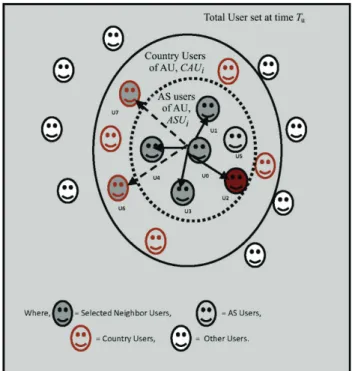
The Fig. 1 is an example, illustrating the procedure of selecting the similar neighbors for an active user, AU. Consider U0 is the active user who is currently requesting the service. The outer circle represents the users located in the same country of user U0, and the inner circle represents the users located in the range of similar ASN. The required past QoS experienced users (PUs = 6). With the proposed context-aware similarity estimation, the system first searches for similar neighbors in the inner circle. Moreover, the system applies the context-aware similarity estimation on the users in the country, who accesses the similar WS, and selects the user who obtains the highest similarity with the AU to return the neighbor users.
Figure 1 Context-aware similar neighbor selection 3.2.2 Similar Neighbor Records Facilitating QoS
Normalization
All the retrieved services used by the neighbor users can deliver the same functionality but potentially differ regarding QoS values. Thus, an overall utility measurement function can be performed on the records of neighbor users to predict the QoS of WSs. The selected n neighbor users (i) define the quality of service with k
number of dynamic factors, for example, response time, throughput, availability, and so on. It is ineffective to evaluate the experience of neighbor users with an equivalent function on distinct QoS factors. As different QoS factors may have different features, the most commonly used QoS functional forms are additive, multiplicative, and concave. Since the WS must satisfy a set of restrictions, the QoS measurement with multiple metrics must depend on the rule of metric aggregation. QoS aggregation defines the WS utility for the user by mapping multi-dimensional factors into one single real value from the user’s perspective.
Tab. 1 illustrates the considered QoS factors and its functions.
Table 1 Different QoS factors and aggregation functions
QoS Metric Type QoS Function Response time Additive (AF) Q=
∑
ni=1{ }
qm i( )Availability Multiplicative (MF) Q=
∏
in=1{ }
qm i( ) Throughput Concave (CF) Q=Minni=1{ }
qm i( )To estimate the overall quality of a WS used by the neighbor users, the proposed CABN exploits a utility function (UT) to map k types of quality vectors according to their categories into a single real value as shown in Tab. 1. It is defined as follows in Eqs. (4)-(6):
(
)
(
max( ))
T 1 max( ) min( ) ( ) k j j j j j j q Q U WS W q q = − = ∗ − ∑
(4){
}
max( )j kj 1 i q =Function= Max q (5){
}
min( )j kj 1 i q =Function = Min q (6)Note that some of the users require selecting a web service with overall best performance, whereas some other user may want to select a service which probably meets two or more QoS parameters. It is evident that the requirement of each user is different and makes the system complex. To solve this complex and inconsistent state of user needs, the CABN allows users to provide weight to the QoS factors dynamically. The value of Wj denotes the weight provided for the jth QoS factor by the end user. The CABN applies the QoS normalization on all the neighbor users of functionally similar WSs.
3.3 QoS Prediction Model using Dynamic Bayesian Networks
The mean value of the normalized QoS of WS is a familiar way to predict the WS-QoS. However, due to the dynamic and unpredictable nature of the WSs, it is not adequate to accurately measure the QoS of the WS. To combat this QoS uncertainty, the proposed system sends the normalized WS utility values as input to the Bayesian network (BN) for making an effective QoS prediction. A BN is a directed acyclic graph, and its main focus on uncertainty management has been successfully applied in a WS-QoS prediction. Consider, a user U requires a web service that satisfies the QoS requirements in terms of better availability. The probability of WS that provides better availability is represented as Hypothesis, H. According to the user requirement; the CABN rule provides higher Wj = MF (availability) than other factors in the WS utility measurement. To choose appropriate WS, most of the conventional systems measure the probability of Hypothesis with respect to user querying time. Even though a CABN probability measurement can combine data from QoS records to estimate the likelihood of a hypothesis probability, the prediction at the time might fluctuate the accuracy due to the uncertain network traffic. The probability for a hypothesis in CABN to choose a WS often depends not only on time but also takes into account the network traffic-specific neighbor clusters for the user querying time even when there are some discriminant contextual factors in them.
3.3.1 Time Efficient and Evidence-based Dynamic Bayesian Model
The processing evidence is a fundamental task in WS-QoS prediction and WS ranking. To reduce the impact of the dynamic Internet environment, this work also utilizes the experiences of users from neighbor clusters as evidence. They must have similar network type and Internet connections between users and WSs even their WS invocation time is different. The discriminant contextual
factors of the neighbor clusters with user context must not deviate the predicted QoS quite far from the original performance. Consider a set WS = {WSi} 1 ≤ i ≤ n of n services, Evidence ={EV} 1 ≤j ≤m collected from network traffic-specific neighbor clusters, located in an area close to the user, and let the utility factor UT (ws) = {wsi(t)} 1 ≤
i≤n; 0 ≤t ≤Tu. Note that time Tu is split into intervals and the records in network traffic-specific neighbor clusters must have similar ASU and network traffic to the user context even at various time intervals. The evidence-based dynamic Bayesian network model is flexible for representing probabilistic relationships between WSs and network traffic at the user querying time. Accordingly, the joint probability over all the time intervals can be factorized into the following chain rule as in Eq. (7),
(
)
{
u}
{
}
1 1 1 ,| , ( ) ( ) | n T m i j j t j p H Traffic t p H t p H Traffic = = = = =∏ ∏
∗∏
(7)After identifying the neighbor cluster records as evidence, the CABN estimates the p(H, t) for each WS and ranks the WS based on the user requirements. To predict the current performance of the WS, it provides more importance to the recent access of WS by updating the clustered database. The CABN selects an optimal WS using the dynamic Bayesian network for the user querying time. By using pre-clustering and dynamic Bayesian models, the proposed work effectively reduces the need for accessing the entire past QoS data for every active user request and selects the most appropriate QoS satisfactory WS. Also, the user requests are grouped according to the similar ASN of the user before predicting the QoS of WS. Thus, the proposed work effectively reduces the need for accessing past QoS data for every active user request, and it results in reduced execution time.
4 PERFORMANCE EVALUATION
This section experiments the proposed CABN system with the objective of measuring the prediction accuracy and delivering an appropriate QoS satisfactory WS. 4.1 Implementation Scenario
The following setup is employed to comparatively evaluate the performance of the proposed CABN system and PQWS [16]. All the processes are programmed in Java. The experiments are implemented with JDK 1.7, Netbeans 8.0.1, and MySQL 5.5.4. They are conducted on a PC with Pentium (R) Dual-Core Processor, 3.20 GHz CPU, 1.96 GB of RAM, running on an Ubuntu 12.04 operating system. The CABN utilizes the real world QoS dataset of Web services as the experimental data [21]. Apache Benchmark is used to generate the required load requests. 4.2 Result Analysis
To determine the performance of the CABN, the performance metrics such as Precision, Recall, F-Measure, and Response Time are evaluated.
246 Technical Gazette 25, Suppl. 2(2018),241-248 Precision (P):
Number of QoS Satisfactory WSs Precision =
Total number of Returned WSs
Recall (R):
Recall =
Number of QoS Satisfactory WSs =
Total number of WSs that should have been Returned
F-Measure: F-Measure 2 P R P R ∗ = ∗ +
Response Time: The amount of time that the proposed system has taken to respond to the user query.
Figure 2 PrecisionVs. Number of WSs
In Fig. 2, the precision of the CABN is illustrated by varying the number of WSs. With the help of accurate context information and sufficient past QoS data, the proposed CABN attains better precision in WS discovery. This scenario shows the impact of exploiting past experiences in WS discovery. The precision of CABN degrades when increasing the number of WSs and decreasing the past QoS data size. The results in Fig. 2 indicate that the precision is consistently lower for low past data. The fact is primarily due to the sparse data, which may distract the accuracy of precision. On the other hand, increased number of WSs has a high probability of increasing the degree of sparseness in past records about particular WS. When the service discovery is performed with the number of past records, the precision is better (97%) when the no. of WSs is 500, however, for medium past QoS data, CABN obtains 95% of precision. Considering the relevant users who improve within the context the accuracy of optimal WS discovery. The process of considering low QoS explodes inaccurate detection.
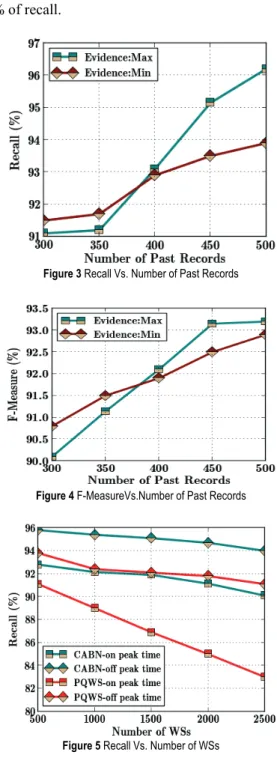
In Fig. 3 and 4, the performance of CABN in terms of Recall and F-Measure is plotted with varying number of past records in WS discovery. The usage of evidence in CABN reduces the distortion and increases the accuracy of WS discovery. It is observed that for 400 past records, the performance of CABN with maximum evidence exceeds
the CABN performance with the Usage of the minimum number of evidence. However, as the past data is low, the distortion in QoS prediction incurred by the irrelevant records increases significantly, thereby decreasing the recall of the CABN. The CABN with maximum evidence is suitable for a huge number of past records, whereas CABN with minimum evidence provides better results with a low number of past records. Moreover, the main reason of CABN to attain a better recall is to solve the multi-constraint problem during the consideration of different QoS parameters in WS discovery using QoS normalization. For instance, at 500 past records, the CABN with the consideration of the number of evidence attains 93.1% of recall.
Figure 3 Recall Vs. Number of Past Records
Figure 4 F-MeasureVs.Number of Past Records
Figure 5 Recall Vs. Number of WSs
Fig. 5 illustrates the performance of the CABN which is evaluated in terms of recall by comparing with the existing PQWS system. Similar to the CABN the existing system also evaluates the different service functional descriptions. However, it does not take into account the
fact of network condition and temporal factor. Even with the huge number of WSs, the CABN can attain better performance with the help of context QoS prediction using AS and dynamic Bayesian network. The consideration of temporal and traffic information based evidence supports to utilize the advantages of past QoS information in WS discovery fully. Hence, the CABN obtains 90% of Recall at peak time; however, the PQWS attains 83% with 2500 WSs.
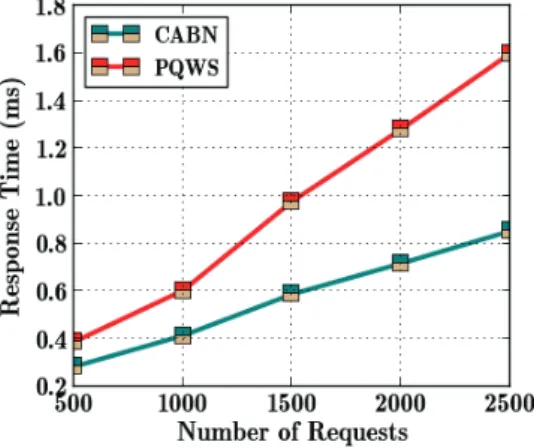
Figure 6 Response Time Vs. Number of Request
In Fig. 6, the comparative performance of the CABN and PQWS is illustrated. The Response Time increases linearly, when the number of WSs increases. The proposed CABN performs better because the CABN system groups the user request for the same WS according to the similar ASN and processes the past QoS data only once for the group, thus resulting in less response time. However, the PQWS has to process the past QoS data for every user request. Moreover, the consideration of AS in QoS prediction reduces the number of past QoS data involved in QoS prediction as it takes the same AS users. When a service discovery is performed with 500 requests, the system obtains 0.3ms for generating a response. When the number of requests is 2500, the system takes 0.81ms for execution, whereas the PQWS spends 1.6 ms.
5 CONCLUSION
The proposed CABN achieves an optimal WS discovery over a huge number of available WSs with the help of accurate contextual information and past QoS records. Hierarchical Pre-Clustering model, QoS Normalization, and dynamic Bayesian model are the steps involved in CABN. The pre-clustering model exploits the functional dependency measurement and successfully reduces the searching space for QoS prediction. The utilization of user-specific spatial-temporal information enables the CABN model to filter the past QoS data fast from the similar cluster. By solving the multi-constraint problem while considering the multi-dimensional QoS parameters of similar QoS data in WS discovery employing the QoS normalization technique, the CABN attains accurate QoS prediction. Moreover, the CABN exploits the Dynamic Bayesian Network and collects evidence from the temporally and spatially closed clusters. This process ensures the appropriate WS discovery. Finally, the experimental results prove that the proposed CABN achieves better WS-Discovery than the existing work
within a reasonable time. The experimental results show that the CABN increases the recall by 7% more than that of the existing system, PQWS.
6 REFERENCES
[1] Kreger, H. (2001). Web services conceptual architecture (WSCA 1.0). IBM Software Group 5.
[2] Jeckle, M. & Zengler, B. (2003). Active UDDI-an extensionto UDDIfor dynamic and fault-tolerant service invocation. Web, web-services, and database systems, Springer, 91-99. https://doi.org/10.1007/3-540-36560-5_7
[3] Slimani, T. (2013). Semantic description of web services, arXiv preprint arXiv:1310.7367.
[4] Kritikos, K. & Plexousakis, D. (2009). Requirements for QoS-based web service description and discovery. IEEE Transactions on Services Computing, 2(4), 320-337.
https://doi.org/10.1109/TSC.2009.26
[5] Reiff-Marganiec, S., Yu, H. Q., & Tilly, M. (2009). Service selection based on non-functional properties. Service-Oriented Computing - ICSOC Workshops, Springer, 128-138. https://doi.org/10.1007/978-3-540-93851-4_13
[6] Chen, X., Zheng, Z., Yu, Q., & Lyu, M. R. (2014). Web service recommendation via exploiting location and QoSinformation. IEEE Transactions on Parallel and Distributed Systems, 25(7), 1913-1924.
https://doi.org/10.1109/TPDS.2013.308
[7] Liu, J., Tang, M., Zheng, Z., Liu, X., & Lyu, S. (2015). Location-Aware and Personalized Collaborative Filtering for Web Service Recommendation. IEEE Transactions on Services Computing, 9(5), 686-699.
https://doi.org/10.1109/TSC.2015.2433251
[8] Martin, D., Paolucci, M., McIlraith, S., Burstein, M., McDermott, D., McGuinness, D., Parsia, B., Payne, T., Sabou, M., Solanki, M., Srinivasan, N., & Sycara, K. (2005). Bringing semantics to web services: The OWL-S approach.
Semantic Web Services and Web Process Composition, Springer, 26-42.
https://doi.org/10.1007/978-3-540-30581-1_4
[9] Wang, X., Vitvar, T., Kerrigan, M., & Toma, I. (2006). A QoS-aware selection model for semantic web service.
Service-Oriented Computing - ICSOC / Chicago, 390-401.
https://doi.org/10.1007/11948148_32
[10]Yu-Jie, M., Jian, C., Shen-Sheng, Z., & Jian-Hong, Z. (2006). Interactive Web Service Choice-Making Based on Extended QoS Model. Journal of Zhejiang University Science A, 7(4), 483-492.
https://doi.org/10.1631/jzus.2006.A0483
[11]Alrifai, M., Risse, T., Dolog, P., & Nejdl, W. (2008). A scalable approach for QoS-based web service selection.
Service-Oriented Computing - ICSOC, Workshops, Springer, 190-199.
[12]Zou, G., Lu, Q., Chen, Y., Huang, R., Xu, Y., & Xiang, Y. (2014). QoS-aware dynamic composition of Web services using numerical temporal planning. IEEE Transactions on Services Computing, 7(1), 18-31.
https://doi.org/10.1109/TSC.2012.27
[13]Wang, W., Sun, Q., Zhao, X., & Yang, F. (2010). An improved particle swarm optimization algorithm for QoS-aware web service selection in service oriented communication. International Journal of Computational Intelligence Systems, 3(1), 18-30.
https://doi.org/10.1080/18756891.2010.9727750
[14]Xu, Y., Yin, J., & Li, Y. (2016). A collaborative framework of web service recommendation with clustering-extended matrix factorization. International Journal of Web and Grid Services, 12(1), 1-25.
248 Technical Gazette 25, Suppl. 2(2018),241-248
[15]Sun, H., Zheng, Z., Chen, J. R., & Lyu, M. (2013). Personalized web service recommendation via normal recovery collaborative filtering. IEEE Transactions on Services Computing, 6(4), 573-579.
https://doi.org/10.1109/TSC.2012.31
[16]Xi, C., Zheng, Z., Liu, X., Huang, Z., & Sun, H. (2013). Personalized QoS-aware web service recommendation and visualization. IEEE Transactions on Services Computing, 6(1), 35-47. https://doi.org/10.1109/TSC.2011.35
[17]Zheng, Z., Ma, H. R., Lyu, M., & King, I. (2011). QoS-aware web service recommendation by collaborative filtering.
IEEE Transactions on Services Computing, 4(2), 140-152.
https://doi.org/10.1109/TSC.2010.52
[18]Zheng, Z., Ma, H., R. Lyu, M., & King, I. (2013). Collaborative web service QoSprediction via neighborhood integrated matrix factorization. IEEE Transactions on Services Computing, 6(3), 289-299.
https://doi.org/10.1109/TSC.2011.59
[19]Feng, L., Obayashi, M., Kuremoto, T., & Kobayashi, K. (2012). A learning Fuzzy Petri net model. IEEE Transactions on Electrical and Electronic Engineering, 7(3), 274-282. https://doi.org/10.1002/tee.21728
[20]Ahmed, W., Wu, Y., & Zheng, W. (2015). Response time based optimal web service selection. IEEE Transactions on Parallel and Distributed Systems, 26(2), 551-561.
https://doi.org/10.1109/TPDS.2013.310
[21]Zibin, Z., Zhang, Y. R., & Lyu, M. (2014). Investigating QoS of real-world web services. IEEE Transactions on Services Computing, 7(1), 32-39.
https://doi.org/10.1109/TSC.2012.34
[22]Shen, Y., Zhu, J., Wang, X., Cai, L., Yang, X., & Zhou, B. (2013). Geographic location-based network-aware QoS prediction for service composition. IEEE Proceedings of the 20th International Conference on Web Services (ICWS) / USA, 66-74. https://doi.org/10.1109/ICWS.2013.19
[23]Bruijn, J. D., Lausen, H., Polleres, A., & Fensel, D. (2006). The Web Service Modeling Language WSML: An Overview. Proceedings of the 3rd European Semantic Web
Conference, 590-604. https://doi.org/10.1007/11762256_43
[24]Liu Y., Ngu A. H., & Zeng L. Z. (2004). QoS Computation and Policing in Dynamic Web Service Selection. Proceeding 13th International Conference World Wide Web / USA, 66-73. https://doi.org/10.1145/1013367.1013379
[25]Alrifai, M. & Risse, T. (2009). Combining global optimization with local selection for efficient QoS-aware service composition. Proceedings of the 18th international
conference on World wide web, ACM / Spain, 881-890.
https://doi.org/10.1145/1526709.1526828
[26]Alrifai, M., Skoutas, D., & Risse, T. (2010). Selecting skyline services for QoS-based web service composition.
Proceedings of the 19th international conference on World
wide web, ACM / USA, 11-20.
https://doi.org/10.1145/1772690.1772693
[27]Wang, P., Chao, K., Lo, C., Huang, C., & Li, Y. (2006). A Fuzzy Model for Selection of QoS-Aware Web Services.
Proceedings of the 2006 International Conference on E-Business Engineering (ICEBE) / China, 585-593.
https://doi.org/10.1109/ICEBE.2006.3
[28]Wan, C. & Wang, H. (2007). Uncertainty-aware QoS Description and Selection Model for Web Services.
Proceedings of the 2007 International Conference on Services Computing (ICWS) / USA, 154-161.
https://doi.org/10.1109/SCC.2007.122
[29]Wu, G., Wei, J., Qiao, X., & Li, L. (2007). A bayesian network based QoS assessment model for web services.
Proceedings of IEEE International Conference on Services Computing / USA, 498-505.
https://doi.org/10.1109/SCC.2007.1
Contact information:
Saravanan CHANDRASEKARAN, Research scholar Department of Computer Science and Engineering, Annamalai University,
Sadagopan Nagar, Annamalai Nagar, Chidambaram, Tamil Nadu 608002, India [email protected]
Vijay Bhanu SRINIVASAN, Assistant Professor Department of Computer Science and Engineering, Annamalai University,
Tamil Nadu, India [email protected]
Latha PARTHIBAN, Assistant Professor Department of Computer Science, Pondicherry University
Pondicherry, India [email protected]