Manufacturing
strategy
processes
17
A framework for the design of
manufacturing strategy
processes
A contingency approach
John Mills, Ken Platts and Mike Gregory
University of Cambridge, UK
Introduction
What is a manufacturing strategy nowadays – is it world-class, lean production, JIT, cells or TQM? Is it none of them, some of them or all of them? How do these popular strategies align with Skinner’s notions of manufacturing objectives and strategic decision areas? How can strategies that promote single status, teamwork and empowerment be squared with the top-down, “planning” strategy processes that develop and apply them?
These questions should concern manufacturing strategy researchers. Manufacturing strategy researchers, with rare exceptions, have continued to make their own way, drawing little from the closely related fields of business strategy economics and organization behaviour[1]. In addition, again with rare exceptions, researchers have addressed neither the incorporation of popular strategies within their traditional frameworks nor the potentially necessary extension of those frameworks. There is thus a need to review manufacturing strategy and related research in order to identify useful knowledge that can be used to build on existing manufacturing frameworks.
Such a review needs a focus and the design of manufacturing strategy processes has been chosen as the focus for this article; the review has therefore been structured to draw out those factors that have been observed to influence the strategy process and, therefore, its design. In order to achieve this aim the traditional manufacturing strategy “process and content” framework[2,3] has been extended. The review then adds flesh to the framework and finally the framework’s ability to assist in the design of a manufacturing strategy process is tested. First, however, manufacturing strategy is set in the context of other strategies and manufacturing’s potential strategic roles are described.
Manufacturing strategy in context
In business the word “strategy” is commonly used at three levels[4]: (1) Corporate strategy – what set of businesses should we be in?
International Journal of Operations & Production Management, Vol. 15 No. 4, 1995, pp. 17-49. © MCB University Press, 0144-3577
This paper was produced during the research project – Manufacturing Strategy and Performance Measurement – sponsored by the ACME Directorate of SERC, Grant GR/H 21470.
IJOPM
15,4
18
(2) Business strategy – how should we compete in XYZ business?
(3) Functional strategy – how can this function contribute to the competitive advantage of the business?
Within this hierarchy, manufacturing strategy can appear in two places, first at the corporate level, taking a broad view over a set of related or separate businesses. Second, it can appear as one of the functional strategies at the business level and it is with this level that this article is predominantly concerned.
Manufacturing strategy has been defined as “the effective use of manufacturing strengths as a competitive weapon for the achievement of business and corporate goals”[5]. Manufacturing’s strengths are developed and sustained by a “pattern of decisions”[6] as originally proposed by Mintzberg[7-9]. These are taken in a set of decision areas (for example[10]) which encompass manufacturing strategy and are aimed at achieving manufacturing goals that align with business and corporate goals.
It has also been recognized that manufacturing can contribute to business strategy in more than one way. Hayes and Wheelwright[6] suggested four stages in the development of manufacturing’s strategic role:
(1) Internally neutral: the objective is to minimize the negative impact of the manufacturing function.
(2) Externally neutral: the objective is to maintain parity with competitors, usually by following industry practice.
(3) Internally supportive: manufacturing exists to support business strategy. Manufacturing investments are checked for consistency at the business level and the implications of business strategy changes for manufacturing are considered.
(4) Externally supportive: manufacturing capabilities shape business strategy in terms of the types of products developed and the ways in which markets are addressed. Manufacturing leads rather than follows and long range programmes are implemented to acquire capabilities in advance of needs.
The most common target in the literature has been stage three[11-13]. However, growing interest in the learning organization[14,15], “core competences”[16] and capabilities competition[17] may provoke more interest in stage four. Empirical studies on the strategic role of manufacturing have shown that up to 50 per cent of respondents believe their role is at stage three[18,19]; that there is confusion surrounding the terminology of the subject[18-20] and that within most firms manufacturing strategy was neither visible nor obvious[20]. Thus the subject still has some way to go to prove its worth in many manufacturing companies.
Manufacturing
strategy
processes
19
The manufacturing strategy process framework
This section proposes a framework for reviewing and analysing the factors relevant to the design of a manufacturing strategy process. The most common manufacturing strategy framework has consisted of “process”, or how strategy is made, and “content” – the constituents of a manufacturing strategy[2,21]. Matthews and Foo[22] extended this framework to “process, content, performance, consistency and implementation”. Other frameworks are available from the business strategy literature, for example Pettigrew’s framework[23] of “process, content and context”. Pettigrew’s use of “process and content” was similar to that used by Leong et al.[2] and Anderson et al.[21]. His view of “context” included both external factors such as sectoral, economic, social, political and competitive environments and internal factors covering the enterprise’s structural, cultural and political facets.
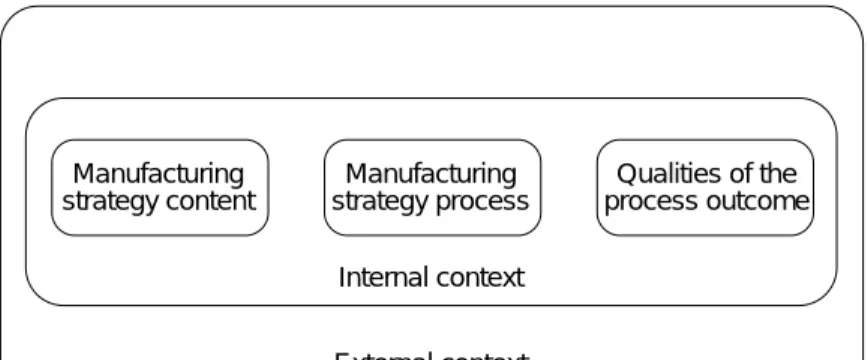
The proposed amalgam of these frameworks is shown in Figure 1. The central focus is the manufacturing strategy process, the design of which is contingent on the content model(s) chosen and the required qualities of the outcome of the process.
The latter element is taken from Matthews and Foo[22] whose “performance and consistency” are examples of criteria used to assess the process output. For a framework required to capture influences on the strategy process this extension to the traditional “process and content” framework includes important strategy process design criteria. The second extension is the internal and external context described by Pettigrew[23] which can enable many of the contingencies studied in the business strategy literature and rarely used in the manufacturing literature[1,2] to be included. Attention will be drawn to these effects as the detailed framework is built.
Manufacturing strategy content
This element of the framework describes the majority view found in the manufacturing strategy literature plus potential extensions and modifications to that view in the content areas of manufacturing’s objectives and decision
Figure 1. The outline manufacturing strategy process framework Manufacturing strategy content Manufacturing strategy process Qualities of the process outcome Internal context External context
IJOPM
15,4
20
areas. In this way the literature on competence, generic and “best practice” strategies has been incorporated.
Manufacturing objectives: the majority view
Skinner[10] defined manufacturing’s objectives as cost, quality, delivery and flexibility and indicated that there were trade-offs between them. These essentially external objectives have survived the attention of numerous researchers to this day. However, they have been refined to more detailed levels, for example flexibility can be further defined and measured in many ways[24-26] and the detailed dimensions of cost, quality, delivery and flexibility are discussed in Neely and Wilson[27]. Both Hill[28] and Platts and Gregory[29] have suggested that the basic four objectives can be tailored to the individual organization. For example, a specific performance objective for one company may be product flexibility – the speed with which new products are introduced or existing products are modified. Measures and targets in this area become part of such an organization’s manufacturing objectives.
The interaction between objectives in the form of trade-offs has, however, become a contentious issue. In 1969 Skinner believed it impossible for manufacturing to make a wide range of high quality and low cost products quickly. Wheelwright[30] questioned this assumption, having noted that many Japanese managers seek to improve quality and reduce costs simultaneously. With the growth in knowledge of Japanese manufacturing techniques through the 1980s, as detailed in Schonberger[31] and the empirical data collected by the Manufacturing Futures survey, more questions were asked. Nakane hypothesized that Japanese managers attack quality, time, cost and flexibility sequentially[32].
Nakane’s theory may explain how trade-offs can be overcome and this view is partly supported by Slack[25] who entered the time dimension into the debate. He argued that while no manufacturer can double its product range tomorrow without increasing cost this may well be possible over a longer period. This connects with the continuous improvement philosophy espoused by many, including Schonberger[33], who stated in 1990:
World class strategies require chucking the(trade-off) notion. The right strategy has no optimum, only continual improvement in all things (p. 21).
The debate has continued to run; however, as Slack[34] pointed out Schonberger has challenged the conservatism inherent in the trade-off assumption. Managing and marketing directors may now be less likely to be persuaded by manufacturing directors that they cannot have high quality and low cost at the same time.
Manufacturing objectives: potential additions
The manufacturing objectives described above can apply to any of the Hayes and Wheelwright four stages of manufacturing’s strategic role. The fourth
Manufacturing
strategy
processes
21
stage, externally supportive, may require additional types of objective sincethis stage is aimed at providing new capabilities which may shape business strategy in terms of the types of products developed and the ways in which markets are addressed. Such objectives might cover the acquisition of knowledge and application leadership of a particular technology or technology combination[16]. However the competence need not be technologically based and could be the integration of a set of managerial skills in a business process[17,35]. While the future implementation of new capabilities may be supported by the traditional externally oriented manufacturing objectives, the development of new capabilities is likely to require internally oriented objectives.
Manufacturing strategy decision areas: the majority view
Manufacturing objectives are achieved through a pattern of actions in a set of decision areas and Skinner’s[10] original list of decision areas is shown in Table I.
Though many writers in the field have developed their own set of manufacturing decision areas, agreement is generally high[3]. Table II compares Skinner’s listing and Wheelwright’s[36] framework for manu-facturing strategy with the decision areas chosen by several researchers[28, 29, 37-39].
The balance of research in these decision areas has moved from a concentration during the 1970s and early 1980s on the so-called structural or hard aspects of strategy, e.g. plant location, size and manufacturing process choice, towards the infrastructural or soft aspects e.g. organization, performance measurement, management style. The realization of the importance of these “soft” aspects of strategy was first documented by Skinner[40]:
In a nutshell, our methods of decision-making, communicating, scheduling and supervising make up the infrastructure of our plants; and these internal elements are proving more
Table I.
Manufacturing’s strategic decision areas
Decision area Explanation
Plant and equipment Plant size and location, degree of vertical integration and
choice of manufacturing process
Production planning and controls Planning, inventory and quality control
Labour and staffing Wage systems, incentive schemes, degree of
specialization, supervision style and size of manufacturing engineering staff
Product design/engineering Product variety, design stability, process technology,
development policy
Organization and management Management style, organization form, size of staff group
IJOPM
15,4
22
Decision ar ea s Platts[29] Sc hr oeder[37] Hill[28] Ha y es et al. [38]Fine and Hax[39]
Skinner[10] Structur al Cap acity Plant cap acity Cap acity Cap acity Cap acity
Plant and equipment
F acilities Plant location F acilities F acilities
Plant and equipment
Pr ocess and Pr ocess Pr ocess T ec hnolog y T ec hnolog y and
Plant and equipment
tec hnolog y tec hnolog y p rocesses Sp an of pr ocess Mak e o r b u y P rocess p ositioning V er tical inte g ration V er tical inte g ration
Plant and equipment
Infr astructur al Quality Quality assu rance Quality assu rance Quality Quality Pr oduction planning and contr ol manag ement and contr ol Contr ol p olicies Pr oduction and Manuf actu ring Pr oduction Manuf actu ring Pr oduction planning in v ento ry contr ol planning contr ol planning infr astr uctu re and contr ol just-in-time systems in v ento ry Ne w pr oducts Ne w pr oduct Ne w pr oduct Scop e ne w P roduct design intr oduction de v elopment pr oducts engine ering Human r esou rces Manag ement of W o rk str uctu ring W o rkfo rc e, Human r esou rces La bou r and staf fing p eople P ayment systems p erfo rmance Clerical pr ocedu re s m easu rement and re war d Suppliers Suppliers V endo r r elations Manuf actu ring Or g anizational Or g anization Or g anization and o rg anization str uctu re manag ement Manuf actu ring systems Engine ering function supp o rt Info rmation systems P erfo rmance me asu rement Table II. Manufacturing decision areas
Manufacturing
strategy
processes
23
resistant to change than the purely technological ingredients on which factory managers and engineers tend to focus[40].
In addition, most writers during the 1970s and early 1980s concentrated on individual areas of content, losing the holistic perspective Skinner had encouraged. Schmenner[41] investigated economies of scale; Hayes and Schmenner[42] looked at factory organization, product or process based. Hayes and Wheelwright[43,44] wrote on the important links between process and product life cycles and the literature on quality policy was particularly rich[45-48]. Hill[13] invented the important notions of winning and order-qualifying criteria and connected them with manufacturing process choice. There were, however, exceptions; Voss[49] recognized that the successful introduction of advanced manufacturing technology was not just an engineering task. After identifying the system’s operational and business objectives it was necessary to amend organizational controls to support the system’s performance objectives and specify the organizational integration required to enable the manufacturing control systems to support the new system’s objectives.
More recently interactions between decision areas have been studied, for example manufacturing processes and manufacturing control systems[50] and the impact of human resource policies on the implementation of manufacturing control systems[51]. Writers on vertical integration[52,53] have taken a multi-dimensional view covering the firm’s manufacturing technologies and processes (current and future), supplier evaluation, impact on new product introduction, capacity and facility decisions. Indeed the vertical integration decision area may be fundamental to other decision areas since it should identify what the firm has to manufacture itself and why[54].
Nevertheless, the gap identified in the literature by Voss[55] and Adam and Swamidass[1] concerning the interaction between different decision areas is still large and much remains to be done.
Manufacturing strategy decision areas: potential additions and alternatives There are, perhaps, three potential additions to the majority view on manufacturing strategy decision areas. The first is the integration of popular, best practice strategies like JIT and TQM with traditional decision areas – a gap noted by Adam and Swamidass[1]. The second is the generic approach to manufacturing strategy and the third is the inclusion of recent work on competence and capability. One potential alternative to the majority view is also discussed in this section – a business process framework for manufacturing strategy.
Best practice strategies. In a survey of UK SMEs[19] when respondents commented on the content of their strategies, it was uni-dimensional strategies that were most in evidence. MRP II, empowerment, JIT and total quality were the most regular descriptions of manufacturing strategy . Each of these strategy descriptions (and at least two multi-dimensional strategies, lean
IJOPM
15,4
24
manufacturing and world-class could be added) can be gathered under the heading “best practice” strategies[56]. Most of these strategies may be appropriate for most manufacturers at particular times and for a length of time and their accessibility via conferences, publications and consultancy may explain their popularity. However, there may be two disadvantages for the business in the application of such strategies.
First, the implementation of best practice strategies alone is unlikely to develop manufacturing’s ability to create and understand its own strategy and this may be especially so if external consultants deliver packaged solutions. As conditions change over time, manufacturing is likely to continue to be reliant on external help to adapt its manufacturing policies to new situations. Second, best practice strategies do not cover all the strategic areas within manufacturing and if this is not realized and an overall strategic context is absent best practice strategies may fail. Past best practice strategies, like MRPI or advanced manufacturing technology, often did not live up to expectations.
In essence, these strategies can be considered as bundles of actions in certain majority view decision areas, which tend to work well together. For example, the implementation of cells normally involves decisions and actions to invest in more equipment and to update manufacturing control systems, organization and certain cultural factors if full benefits are to be obtained. This strategy is not simply a re-layout of the manufacturing process. Therefore successful implementation partly relies on developing an integrated and consistent set of actions from the majority view decision areas that are appropriate to the best practice theme(s) chosen and the existing policies in manufacturing.
Best practice strategies may also be compared to ready-to-wear suits, modifications to improve the fit may be preferable to a potentially more time-consuming process to create a bespoke strategy. However, unlike strategies, no-one expects managers to know how to make their own suits and if a firm’s managers do not consciously develop their own strategy, perhaps by incorporating best practice strategies within a more comprehensive framework then they are likely to follow rather than lead. Such a following role may, however, be entirely natural if manufacturing’s strategic role is at Hayes and Wheelwright’s stage one or two.
Generic manufacturing strategies. There have been two streams of research on generic manufacturing strategies. The first is predominantly survey or case based, in which results are analysed by cluster techniques to identify sets of companies following similar or generic strategies. From such an analysis performance differences between the clusters may lead to new perspectives on manufacturing strategy, for example, whether manufacturing strategies are shaped by markets or other forces.
The main studies include:
● An examination of 100 case studies, carried out by Stobaugh and Telesio[12], identified three groups of international manufacturing strategy – cost based, technology based and market driven.
Manufacturing
strategy
processes
25
● Roth and Miller[57] examined the strategic management practices of 188 North American companies and identified three groups of generic manufacturing strategy – caretaker, innovator and marketeer.
● de Meyer[58] used results from the European Manufacturing Futures survey to identify three groups – high performance product groups, manufacturing innovators and marketing oriented.
There are differences between the groupings identified by these researchers. For example, the high performance product group[58] was different to the groupings identified in the USA by Stobaugh and Telesio[12] or Roth and Miller[57]. This group emphasized top performing products, the need to make fast production plan changes and achieve fast delivery.
The second stream of research emphasizes the development of frameworks that should assist in the strategic management of manufacturing. One framework, proposed by Kotha and Orne[59] uses three dimensions: process structure complexity, product line complexity and organization scope. The extremes of these dimensions are used to define a set of theoretical generic strategies that match Porter’s[60] model of generic business strategy. Empirical support has not been published for this framework.
Another framework[61] proposed four generic strategies which are based on blending the empirical studies described earlier with other studies and his own case-based research. He also aligned these four generic strategies: caretaker, reorganizer, marketeer and innovator with Hayes and Wheelwright’s[6] four stages of the development of manufacturing’s strategic role. Sweeney, however, notes that each of these roles could be used by manufacturing companies that were implementing any of the four generic manufacturing strategies proposed. Table III summarizes work on generic manufacturing strategies[6, 12, 57, 58, 61, 62].
Like those using the experience curve approach to product families[63], those adopting a generic strategy may create conditions which enable competitors to predict some of their actions. Another note of warning on the use of generic strategies has been sounded by Miller and Roth[64]:
Finally an important line of future research is to test the stability of this taxonomy globally, and over time. The “laws” of business that seem to define the strategic positioning and competitive behaviour in this and other taxonomies have all been based on observations of the business environment during a short 20 year span. If we suppose that intelligent competitors will use their knowledge of the “normal” rules of battle to better develop new principles of competitive warfare, then we may anticipate that new manufacturing strategic groups will be formed over time, and in different parts of the world (p. 27).
Competence and capability. Ideas on competence and capability emerged before the second world war in the writings of the “Austrian School” of economics[65]. This school believed that the source of a firm’s competitive advantage was in unobservable factors (viewed from outside the firm) rather than observable strategic factors. Teece et al.[66] described these factors as “upstream, idiosyncratic and difficult to imitate resources” and “sticky, hard to change
IJOPM
15,4
26
resource bundles”. It is such “capabilities” that provide superior product offerings on which competition is based[66].
In the business strategy literature the notion of “distinctive competence” was first described by Selznick[67]. It has appeared regularly since then, for example Peters[68] and Porter[60,69]. In this context a distinctive competence is an ability which sets a business apart from its competitors and provides tangible benefits for customers and thus competitive advantage to the business. One recent theme addresses the identification and leverage of competences for the business benefit; Prahalad and Hamel[16] defined “core competences” as:
…the collective learning in the organization especially how to co-ordinate diverse production skills and integrate multiple streams of technologies[16].
Their examples included Canon where core competences in precision mechanics, fine optics and microelectronics were said to be used to enter new markets. Stalk et al.[17] also pursued this theme but distinguished between capabilities and Prahalad and Hamel’s core competences. In their view capabilities are superior business processes like dealer handling, or product realization rather than technologically-related competences. Their examples are from the logistics processes of supermarket chains as well as manufacturers like Honda, who are said to have superior ways of handling dealers.
Table III.
Generic strategies by researcher name
Blended Edmondson
generic Stobaugh and Hayes and
strategies, and Roth and Wheelwright Sweeney Wheelwright
Sweeney[61] Telesio[12] Miller[57] de Meyer[58] [62] [61] [6]
Caretaker Cost-driven Caretaker The quick Quick fix Internally
strategy relief mode of neutral
response to manufacturing challenges (1st mode)
Marketer Market- Marketer Marketing Stretch Externally
driven orientated neutral
strategy group
Reorganizer High The use of Catch up Internally
performance organizational supportive
product tools mode of
group response
(2nd mode)
Innovator Technology- Innovator Manufacturing To develop a Break Externally
driven innovators competitive through supportive
strategy edge through
manufacturing (3rd mode) (Adapted from [61])
Manufacturing
strategy
processes
27
Teece et al.[66] came to the conclusion that the most critical competencedifferences are to do with the organizational capabilities of the firm. The confusion in terminology continues but the two strands of what a competence or capability is or is not can be seen in the manufacturing literature. Cleveland et al.[70] proposed that “production competence” is “a manufacturer’s overall ability to support and prosecute the firm’s business strategy”. Furthermore, they contended that “production competence” is a function of the production process and the firm’s business strategy. In other words, a technology view of competence reminiscent of Prahalad and Hamel[16] was taken. In a critique of Cleveland et al.[70], Vickery[35] proposed that production competence is to do with the efficiency and effectiveness of the manufacturing strategy formulation and implementation process whose aim is to support business strategy requirements with appropriate manufacturing performance. In other words a view of competence nearer to the Stalk et al.[17] view of capability as a superior business process.
The most interesting new theme in this area is the notion of how competences or capabilities are actually built over time[66]. Porter[69] stated that this area of research was one important, potential component of a dynamic theory of strategy. This is a developing area which may provide additional decision areas for manufacturing strategy which are appropriate for a firm pursuing a manufacturing-based competitive advantage. Hayes and Pisano[71] have begun to address this potentially important area and have clearly addressed manufacturing companies at stage four:
Manufacturing strategy is about creating operating capabilities a company needs in the future[71].
The business process framework. This framework of manufacturing strategy content was described by Rhodes[72] and is illustrated in Figure 2.
Instead of a list of decision areas which focus on manufacturing and which have few interaction guidelines a set of nine business processes is proposed. Rhodes argued that these processes covered all manufacturing industries and were understandable to all functions in the business. The notion of dealing with manufacturing strategy in the context of business processes may also have advantages for the process of formulating manufacturing strategy and this will be described later. This framework may be a genuine alternative view of manufacturing strategy decision areas despite the likelihood that all manufacturing decisions in each process are likely to find a home in the majority view framework. As yet, however, published material on this framework is rare and it is included as an area with potential for further research.
Manufacturing strategy formulation process
The structure of this section uses and develops Platts four aspects of process – point of entry, participation, procedure and project management’[73]. Platts argued that a process was not mere procedure – a set of steps. To be useful a
IJOPM
15,4
28
process should specify how an organization might be attracted to implement the process; who should participate in the process and how the project of implementing the process should be managed.
Point of entry
It is necessary for the strategy process to provide a method of entry into the company or business unit and provide a platform to develop the understanding and agreement of the managing group[74].
Platts[74] used “competitive profiling”[75] to provide a quick, easily completed task which would demonstrate to a company that there was a need to proceed with the full process. The intention was that a marketer would identify a product family and then sketch the profile to represent the market requirements in terms of cost, delivery, quality, etc. A manufacturer would be asked independently to sketch how manufacturing actually performed on this product family. Mismatches could be easily demonstrated by overlaying acetate films. It was hoped that such mismatches would be startling enough to encourage the whole process to be pursued.
Gunn[76] and Hayes and Wheelwright[6] made the point that one of the platforms needed to embark on the strategy process is knowledge. The process often requires training and management development to embed the principles and concepts necessary. On the same theme Sweeney[77] proposed a “tactical to strategic management development programme”. This programme raised the issues of management style and team membership roles and contained a
two-(a) (b) (c) (d) (e) (f) (g) (h) (i)
Customer order progress Supply chain
Production processes Product definition and development
Motivation and culture Finance and accounts Organization
Information and IT Process and plant development
Marketing Selling Purchasing Producing Assembling Designing Financing
(a) to (e) achieving (f) to (i) enabling Business processes Functions department Figure 2. Functional departments and business processes
Manufacturing
strategy
processes
29
day workshop on how to manage strategically. It continued by “workshadowing” managers to record how they spent their time and visits to other factories to see how others had overcome change management problems. At another level Voss[78] asserted that an important responsibility of a company board is to ensure that a process for developing manufacturing strategy exists. He also noted[79] that in the four cases observed the manufacturing strategy process was initiated by either the manufacturing or managing director. Leonard-Barton[80] pointed out that many opportunities to question current strategy assumptions were available at the earliest stages of new product introduction; thus the strategy process might be usefully initiated at such a time.
Participation
There are, perhaps, three dimensions of participation within the literature – width across the business involving contributions from other functions; depth of participation within the manufacturing function; and the participation of others from outside the business unit. Anderson et al.[21] showed empirically that the function most consistently involved in the process was marketing; their role was important in providing much of the data on customer and business strategy requirements. Marketing was central to Hill’s process[28] since it began by identifying order-winning and order-qualifying criteria. Slack[25] viewed the key links being between manufacturing, marketing and product development. In general other functions have been involved in the strategy process for two main reasons: first for specific activities, such as finance assessing the costs and financial benefits of manufacturing strategy options; second, for knowledge that can be brought to the strategic debate, such as personnel’s knowledge of the organization. Leong et al.[2], Platts and Gregory[29], Schroeder and Lahr[37] and Fine and Hax[39] all recommend the involvement of all functions. Others like Hill[28] and MacBeth[81] have at least the marketing function involved; Slack[25] involves marketing and product development.
Gunn[76] detailed a number of aspects to be considered when selecting a team to carry out the process. The best must be involved; a balance of skill and experience with “get up and go” should be planned for. The team also needed to contain “political heavyweights” and potential future executives. Hayes and Wheelwright[6] pointed out that implementors should be involved to help avoid implementation difficulties and noted how rarely this had occurred in their experience. Garvin[82] described a process whose objective was to increase the depth of participation in the strategy process in order to derive credible, implementable strategy using the best appropriate knowledge in the organization. Participants from outside the business unit are typically corporate specialists or external consultants in facilitation or project modes. There are potential advantages in using external participants – they generally arrive without the assumptions that members of the business unit carry and
IJOPM
15,4
30
typically understand and are experienced in the process. In each of four strategy process cases studied, Voss[79] found a facilitator present.
Procedure
Once point of entry and participation issues have been covered, the major stages in the strategy process are generally threefold. The first is typically an audit of current strategy against a set of manufacturing objectives; the second stage is the formulation of a set of action plans – the strategy – which is designed to close any gaps identified in the first stage. These two stages are not universally separated. The final stage is implementation of the action plans. The output of the audit or data gathering and analysis stage is a comparison of manufacturing performance and current action plans with the requirements of business strategy. This comparison may be across all areas of a decision content model as in Platts[74] and Fine and Hax[39] or it may be more narrowly based, for example Hill[13] focused initially on the match of business requirements with manufacturing processes.
The formulation stage is documented in much less detail than the audit stage. Slack[25] proposed that the decisions on how to close gaps are specific to the organization and its environment and that it is the responsibility of the organization’s personnel to generate an imaginative and practical set of action plans. Hill[28] provided a more structured approach, stating that the manufacturing process choice should be made before decisions in manufacturing infrastructure but gave, at that time, no details on how these infrastructural areas might be tackled. Other writers[37,39,83] offer limited input on this stage, with suggestions including tackling the highest priority issues first and iterating between strategies in each decision area. Research in an aerospace company[54] indicated that the vertical integration area should be dealt with early in the process since deciding what a firm will manufacture is fundamental to most other decision areas. However, Sweeney[77] proposed an order of attack that left vertical integration decisions late and devoted early effort to capacity, facilities and human resource management.
The business process framework[72] may have some advantages over the majority view decision areas in the formulation stage. The “achieving” business processes (see Figure 2) are dynamic and relate to the work people do and the overall tasks the organization must accomplish. For this reason the framework may be more understandable than the traditional content model, it also places manufacturing strategy in a wide context and can show that improvements in process performance require co-operative efforts from all functions. For the same reasons this perspective may also assist strategy implementation[72].
The implementation stage is usually based on the management of a number of projects, sometimes seen within an overall improvement plan[82]. Hayes et al.[38] observed that strategy implementation projects developed through three stages as manufacturing attempted to move through Hayes and Wheelwright’s[6] four strategic roles. The stages were operating projects,
Manufacturing
strategy
processes
31
manufacturing system changes and organization-wide changes and reflectedthe increasing influence of manufacturing’s strategic role.
Implementation is a key issue since strategy is what is implemented not what is speculated, written down or presented[6,7,84]. However, decisions not to do things can be valuable strategic (in)actions since they set boundaries on the enterprise’s manufacturing and/or business strategy.
Project and process management
Platts[74] identified two project management issues from interviews with practitioners on strategy formulation and audit processes. Adequate resourcing for managing, supporting and operating groups should be identified. In addition, a time scale should be agreed. Time scales evident in the literature are highly variable; for example Schroeder and Lahr[37] propose two full days to execute their process ; others[29,79] have found the process takes rather longer – typically four months. Gunn[76] claims six-to-18 months is a more likely time scale given that the group not only have to learn to work as a team, but have to learn new methods, concepts and even new technologies. Hayes and Wheelwright[6] view the manufacturing strategy formulation process as continually ongoing over time. Their view appears to be based on the adaptive view of strategy formation observed and described by several writers on business strategy.
There seems to be a continuum between what could be called the big bang approach of Schroeder and Lahr[37] and the continuous creation view of Hayes and Wheelwright[6]. If it is believed that manufacturing strategy is the pattern of actions implemented in manufacturing’s strategic decision areas then since actions may be required at any time then strategy making is an ongoing process. This has great significance for the strategy process and the tools it might use, they may have to be suitable for use at any time as part of the normal management process rather than as a separate strategic process carried out at particular times.
The need to incorporate time into the “manufacturing policy framework” was recognized by Voss[55]; however little work has been published on this issue. The need has also been recognized by Porter[69] who separated the theory of strategy into the causes of superior performance at a given period in time and the dynamic process by which competitive positions are created. The latter perspective is the one practitioners face and researchers have largely ignored; however, Van de Ven[85] has proposed longitudinal studies over long periods to better understand the ongoing strategy process.
Qualities of the process outcome
Published processes either explicitly state or implicitly assume that the purpose of the manufacturing strategy process is to develop a strategy which will enhance the firm’s competitive situation. Indeed Voss[79] observed that in two of four cases studied the manufacturing strategy process was begun because of competitive pressures. From this perspective the outcome of the process is a
IJOPM
15,4
32
strategy. However in Voss’s two other cases, internal perceptions of lack of focus and consistency led to the initiation of the process and in our research other motivations and purposes have emerged. For example, at an automotive parts manufacturer the first purpose of implementing the process was to check the appropriateness of current manufacturing strategy to business requirements and the second to help build a newly formed business team. In an aerospace company[54] the purpose of their manufacturing strategy process was:
to produce a widely understandable framework for analysing the effect of internal and external changes of requirements and environment on Manufacturing and generate consistent, appropriate responses. This objective should not be confused with the outcome of the process e.g. a strategy to reduce the cost of adding value by…[54].
Both examples indicate a requirement for the process to deliver organizational learning[15,38] as well as a strategy. Yet the most well-documented and tangible outcome remains a strategy or a strategy modification and two fundamental questions must be posed:
(1) How can a manufacturing strategy be assessed?
(2) What proof exists that having a manufacturing strategy and/or an explicit manufacturing strategy process improves the performance of the firm?
Manufacturing strategy assessment
Both Hayes and Wheelwright[6] and Slack[25] have proposed criteria for evaluating a manufacturing strategy and a description of an effective manufacturing strategy. Hayes and Wheelwright emphasized that manufacturing strategy should:
● support the firm’s competitive success factors;
● be consistent with business and other functional strategies;
● show internal consistency between manufacturing decision areas. Slack added the tests of consistency over time and credibility to Hayes and Wheelwright’s criteria.
The importance of consistency between manufacturing strategy and business strategy[10], marketing strategy[28], all functional strategies[21] and the consistency of the individual components of manufacturing strategy with one another[10,36] has been well supported.
There is one caveat from the business literature. Mintzberg[7] warned that a highly consistent strategy could be very difficult to change and this was particularly true if the strategy was also unique, placing the business in a particular market niche. He cited Volkswagen’s difficulties in breaking out of the “people’s car” Beetle mould. The eventual break was achieved after ten years during which profits reduced markedly. In manufacturing, the time scales of implementing some strategies can be long and therefore strategy consistency
Manufacturing
strategy
processes
33
over time is desirable; however, as Slack[25] pointed out, businesses do notgenerally benefit from an overly rigid strategy. Wrapp[86], with respect to organizational objectives and strategy, pointed out that policy strait-jackets are to be avoided and, although a manager should give the organization a sense of direction, a certain open-endedness should be retained for flexibility purposes. A paradox has emerged here, consistency versus future adaptability or precise strategy communication (to assist implementation) versus imprecision in order to retain flexibility. A manufacturing strategy development process must take account of the criteria and cannot ignore the paradox.
The value of a manufacturing strategy
In 1992 Tunälv[87] reported a study on 184 Swedish manufacturing businesses which gave empirical support to the hypothesis “companies with a formulated manufacturing strategy, aligned with the business strategy, will achieve higher business performance than companies without a strategy”. Swamidass and Newell[5] in an empirical study of 35 firms found a positive relationship between the performance of the firm (growth) and the higher the role of manufacturing managers in the firm’s strategic decision-making process. The proof of the value of having a formulated, manufacturing strategy is building, but the case is yet to be proven.
Internal context
It has been suggested by reviewers of the manufacturing strategy process literature[1,2] that further insight into the strategy process may be gained by using methods and ideas from other fields. The main field explored in this section is the business strategy literature and its links with the field of organization behaviour. Of particular interest are the ways in which the (business) strategy process is perceived and the cultural and political contexts within which a manufacturing strategy process resides.
Alternative strategy processes
The most common strategy process modes in the literature are entrepreneurial, planning, adaptive, ideological and grass roots. The particular titles used here are those used by Mintzberg alone and with various collaborators[7,9,84]. They are the result of considerable historical, empirical research on how business strategy is actually formed. This area has been studied by several other authors, each generally inventing new terms to describe similar modes[88-95]. Note also that the process modes described here rarely, if ever, exist alone in their pure form[7,9,84,96,97].
Entrepreneurial. This strategy process mode depends on the ability of one individual or a small group to impose their vision of the firm’s role in the world on the organization by direct orders[9]. It is also known as the command mode[97] where it is clear that the role of top management is to provide direction and the role of organization members is, like soldiers, to obey. Strategy making in this mode is deliberate, alternatives are analysed and an
IJOPM
15,4
34
appropriate course of strategic action is determined. This mode seems to occur most frequently in young and small organizations which are able to find safe niches in their environments[9]. Therefore this may be an important mode for SMEs though it can also occur in larger organizations, particularly in crisis conditions in which all actors are willing to follow one leader[9]. The notion of the entrepreneurial chief executive is an attractive one and many large companies have grown through such entrepreneurs (IBM-Watson, Sony-Morita, Apple-Jobs then Sculley).
No specific manufacturing strategy process research has been found to illustrate this process. However, manufacturing managers have found themselves constrained from above in particular areas of manufacturing strategy – particularly facilities, vertical integration, capacity and organization[98]. Hayes and Wheelwright’s[6] stages one and two could be associated with this mode operated at the business level.
Planning. The planning process mode has been the traditional view of strategy development described by, among others, Ansoff[99], Ackoff[100] and Andrews[101]. This rational view depended on an analysis of the environmental opportunities and threats, and the internal strengths and weaknesses of the organization. The process sought to identify action plans which would use the organization’s strengths to exploit opportunities while minimizing its vulnerability to threats.
The approach assumed implementation did not occur without systematic, comprehensive analysis and comparison of alternatives mainly judged by financial measures. Mintzberg[84] pointed out that this mode “assumes that formal analysis can provide an understanding of the environment sufficient to influence it”. Implementation then took place and consisted of a series of integrated decisions taken across all strategic areas. As Hart[97] described – the role of top management is to be “boss”, evaluating and controlling, while organization members act as “subordinates”, following the system.
This mode has been mostly associated with large companies operating in relatively stable environments and with the teaching methods and consulting style of the Harvard Business School or the “Design School” as Mintzberg[96] described it.
From the manufacturing strategy literature, Skinner[10] emphasized the interdependency of the decision areas within manufacturing strategy. He criticized senior managers for allowing so-called experts to develop strategy and stressed the need for a top-down overview. Indeed Skinner’s 1969 paper[10] included the first diagram showing the systematic, rational steps required to develop a manufacturing strategy. Since then the majority of manufacturing strategy design processes have taken an analytic, systematic approach recognizable as a planning process (see [29,39,81,83,87,102]). This may be because the first stage of a manufacturing strategy process, usually an audit, is the stage most documented and is an analytic stage, distinct from formulation and implementation.
Manufacturing
strategy
processes
35
IdeologicalWhen members of an organization share a vision and identify so strongly with it that they pursue it as an ideology, then they are bound to exhibit patterns in their behaviour, so that clear realised strategies can be identified. These may be called ideological strategies[9].
This process mode, also called “symbolic” by Hart[97], involves the creation by top management of a compelling, long-term vision and a clear corporate mission. The corporate vision gives meaning to the organization’s activities and provides a sense of identity for employees; it defines the basic philosophy and values of the firm[103]. The use of symbols, metaphors and emotion are central to this process mode. Hart[97] described the role of top management as that of a “coach”, motivating and inspiring organizational members to act like “players” and respond to the challenge.
In 1985 Mintzberg had not studied such an organization but he was confident that such a mode existed in certain charitable institutions and Israeli kibbutzim. More concretely it is in the nature of most religious organizations. Recently, however, Hamel and Prahalad[104] have discerned this mode in industrial organizations, for example:
● Komatsu’s vision of “Maru-C” – to encircle Caterpillar, its primary rival.
● Coca-Cola’s vision of putting a coke within “arm’s reach” of every consumer in the world.
Hamel and Prahalad[104] coined the phrase “strategic intent” for the long-term mission of an organization and have further developed this mode to encourage the setting of ambitious “stretch” targets to obtain spectacular growth[105]. This has been a fashionable mode which may not always have been well implemented. In a survey by Digital, reported in the Financial Times 10 May 1993, 80 per cent of UK firms had a mission statement, but only 39 per cent of these mission statements affected daily work behaviour. In practice, manufacturing plants within companies like Philips Electronics, Lucas Industries and Rolls-Royce Aerospace have declared manufacturing vision or mission statements but, as yet, little research material has emerged.
Adaptive. Lindblom[106] first described this process mode as “the science of ‘muddling through’”; later he described it as “disjointed incrementalism”. Mintzberg in 1973[84] described it as “adaptive”, in 1978 Quinn[107] described it as “logical incrementalism” and in 1987 Ansoff[92] labelled it “ad hoc reactive”. The approach assumed that the strategy development task was so complex in time, opportunity and human cognition that the whole could not be grasped. Thus interaction with the environment, through experimentation, was essential to learn and build frameworks that could aid decision making. Unlike the planning mode where a bold plan was executed, the incremental approach consciously worked in small, disjointed steps learning and adapting strategy over time.
Hart in 1992[97] titled this mode “transactive”, since it required continual dialogue with key stakeholders, employees, suppliers, customers, etc., and cross functionally within the organization. He described top management’s role as a “facilitator”, empowering and enabling the process of transacting between all
IJOPM
15,4
36
members of the organization whose role is to “learn and improve” and who were viewed as “participants”.
Both the Deming prize and the Malcolm Baldrige Award have been granted partly based on an organization’s demonstration of a strong organizational learning capability fostered by transactive relationships among suppliers, customers and employees. Examples of such transactive processes are full JIT implementations including the involvement of suppliers and customers and the use of quality function deployment where most functions of the organization and customers are involved in new product specification.
Grass roots. This process mode was the antithesis of the planning and entrepreneurial modes; here top management’s role was as a “sponsor” exercising little strategic control over the organization[97]. Strategy initiatives emerged from individuals who, acting as “entrepreneurs”, experimented and took risks. Mintzberg[108] referred to this mode as “grass roots” strategy making, other descriptions are “organic”[92], “generative”[97] and “bottom-up”[93].
At its most extreme this mode produced unconnected initiatives from independent entrepreneurs – an example of such an organization could be a university. Less extreme and captured in Mintzberg and Water’s[9] descriptor “umbrella strategy” – was a mode where top management set out broad guidelines within which new product strategies were permissible. Across the range of such strategy-making it was assumed that those closest to customers, product and process technologies would produce the best strategies. Hence the importance of identifying, developing and rewarding product champions and encouraging team based innovation, for example “Skunk works”[109]. In addition, this mode assumed that top management could recognize high potential projects from those that were not and then shepherd them through the organization, filtering out less promising ideas. The grass roots mode has been found in organizations that require great expertise and/or creativity[108] and business level examples of this mode in action have been the “post-it” development in 3M and Data General’s 32-bit mini computer development[110]. Within the manufacturing strategy literature Blenkinsop and Duberley[111] described a case in which the development of one aspect of manufacturing strategy could be argued to have arisen via the grass roots mode. However, Skinner[10] criticized this mode, calling for a more planned, holistic, integrated approach to manufacturing strategy. This mode may, however, be appropriate at the creative, second stage of the manufacturing strategy process – formulation.
Strategy process mode summary and issues
Table IV summarizes the modes discussed earlier. In the business strategy literature the main issue is not whether these modes exist – that is accepted. The issue is whether particular combinations or configurations of modes are superior to others in particular circumstances[97]. Mintzberg regarded the entrepreneurial, planning and adaptive modes combined and/or alternated by managers to suit differing conditions as a realistic description of
strategy-Manufacturing
strategy
processes
37
making[84]. Nonaka[93] described a strategy-making process that combined the ideological mode – top management creates a vision – with the grass roots mode – middle management invent concrete means of closing the gap between what exists and what top management hopes to create. Nonaka called this process “middle-up-down”. Kawai[94] with examples from Asahi Beer, Nissan and Matsushita identified the use of the same two modes as Nonaka but associated the ideological with faster moving industries and the grass roots with more mature industries. However, he asserted that both modes need to be activated as conditions, principally environmental uncertainty, dictated. Hoshin Kanri, a strategy-making process adopted by Bridgestone, Toyota, and Hewlett-Packard[112] seems to be a combination of the ideological and grass roots modes as above but with an imposed structure that could only be associated with the planning mode.
There has been much recent debate[96,113,114] on the validity of the planning mode in comparison with more adaptive approaches. However, if it is accepted that one process mode cannot be optimal for all situations and a contingency approach is feasible[115, p. 481] such debates could cease. Quinn[116], based on research in large multinational companies has taken a contingent view:
because of differences in organizational form, management style or the content of individual decisions no single (strategy) paradigm can hold for all strategy decisions[116].
Quinn also appeared to believe that a formal planning system institutionalized the adaptive, incremental reality of the strategy process and he reconciled the adaptive and planning modes by acknowledging a role for formal planning techniques since they:
● provide a discipline forcing managers to look ahead periodically;
● require rigorous communications about goals, strategic issues and resource allocations;
● stimulate longer term analyses than would otherwise be made;
● generate a basis for evaluating and integrating short-term plans;
● lengthen time horizons;
● create an information framework[107].
Table IV.
Strategy modes versus organizational roles
Entrepreneurial Planning Ideological Adaptive Grass roots
Role of top Commander Boss Coach Facilitator Sponsor
management
Provide direction Evaluate and Motivate and Empower and Endorse and
control inspire enable support
Role of Soldier Subordinate Player Participant Entrepreneur
organization
members To obey Follow the Respond to Learn and Experiment
system the challenge improve and take risks
IJOPM
15,4
38
In the manufacturing strategy literature the mode assumptions of writers is generally clear. Skinner[10,11,117] relied on a top down planning view. Hayes et al.[38] took a much more adaptive stance, based on the importance they saw in the learning process and their apparent reluctance to advance a step-by-step process. Gunn[76] proposed a long process of strategy-making which emphasized learning and therefore leaned towards the adaptive mode. There is again little empirical work on this aspect of manufacturing strategy with Maruchek et al.[98] being the exception. In a study of “leading edge” firms from various industries they found the manufacturing strategy process to be top down, reactive to corporate strategy and generally limited to choice of manufacturing technology, planning and control systems and human resources aspects. Thus though the modes of the manufacturing strategy process may be chosen by manufacturing, they will exist in a business which may use different strategy-making modes to develop its business strategy. The modes followed outside manufacturing might significantly influence manufacturing’s choice.
Cultural factors
Combining the views of Schwartz and Davis[118] and Johnson[119] culture can be defined as a set of shared beliefs, values and expectations about an organization and the ways of doing things in that organization. These beliefs evolve slowly and are very difficult to change dramatically. This reluctance to change is caused partly by the fact that those most powerful in the organization are likely to benefit most from the existing culture[119]. Both Schwartz and Davis and Johnson recommend a form of culture audit in order to choose strategy implementation paths which avoid conflict with a firm’s culture. One consultancy explicitly diagnoses organizational culture within their business strategy analysis process in order to recognize potential barriers to implementation[120]. Such paths, however, may not exist and techniques to surface managers’ strategic and cultural assumptions[121,122], provoke crisis or use outsiders as change agents[119] to implement “necessary” strategic change.
Selznick[67] believed a major role of the leader was to embody the purpose of the organization within the organization’s social structure and to define the standards and values of the organization. He was not prescriptive about the values themselves, but there are many writers who recommend a set of values that enable “The Learning Organization”[14,15,38,123].
Empirical data on the relevance of culture in the manufacturing strategy context is rare but an exception is Misterek et al.[124], who found that a significant contribution from manufacturing to the firm’s competitive position was associated with:
● “low power distance”[125] managers are regularly seen on the shop floor, engineers are located close to the shop floor and face to face communication is more common than written memoranda;
Manufacturing
strategy
processes
39
● “high collectivism”[125] supervisors encourage team work, team problem solving and group performance rewards are in evidence;
● “high congruity”, the existence of a credible plant wide philosophy and a high degree loyalty to the company from employees.
This implied that efforts to change culture in order to improve the position of the firm was a viable part of long-term strategy. Schonberger’s[126] “world-class” message contained cultural recommendations, especially on employee involvement and democratic leadership, which would tend to reduce power distance and on team work which would tend to increase collectivism.
Finally Hayes and Wheelwright’s[6] four stages in the development of manufacturing’s strategic role hints at a cultural dimension. If manufacturing were regarded as having a negative impact on the firm it is likely this would be evident in cultural factors – manufacturing might not be regarded as the place to be seen, transfer to manufacturing might be interpreted as a punishment and manufacturing’s responses might tend to the defensive.
External context
The most widely quoted structuring of external context is Porter’s[60] model of industry structure where five factors shaped business strategy: threat of entry to the market from other organizations; supplier power; buyer power; availability of substitute products and existing competitors. Later Porter[127] extended these factors to include the geographical location of the firm to explain successes in, for example, Silicon Valley and Japan. Hayes and Wheelwright[6] stated that manufacturing strategy should be consistent with the business environment since it was of little use to propose manufacturing strategies that could not be afforded or ignore regulatory imperatives. It has also been indicated that fast moving markets may require businesses to use a different balance of strategy modes than slower moving markets[94 and Hart[98] summarized four contingent factors (based on[128]) that predict likely strategy process modes which are shown in Table V.
The framework – summary
The framework has now been built and Figure 3 summarizes the main sub-elements that have been covered in the review.
The review set out to suggest ways of incorporating strategies like TQM within traditional manufacturing models and it was also hoped that potential extensions to traditional frameworks might be identified by reviewing related literature. We have shown that popular, best practice strategies can be linked to the traditional decision area framework and that capability and competence may provide potential extensions to manufacturing’s traditional objectives and decision areas. The alternative strategy modes introduced from business strategy have extended the usual planning only mode so common in the manufacturing strategy literature and may be of particular interest to firms pursuing human resource strategies that value empowerment and team work. The idea of strategy creation being an ongoing process has extended the traditional project or big bang approach to the manufacturing strategy process
IJOPM
15,4
40
mostly found in the literature and has highlighted the need for accessible tools to support ongoing strategy processes.
Discussion – using the framework
In this section interactions between sub-elements in the framework are described. The discussion revolves around the use of the framework to help
Table V.
Strategy mode versus Miller’s[128]
contingencies
Entrepreneurial Planning Ideological Adaptive Grass roots
Environment Simple; low level Stable; low Dynamic; Complex; Turbulent;
of complexity degree of high velocity many dynamic and
change or radical stakeholders complex
change
Firm size Small Medium-large Medium-large Large No relation
Stage of firm No relation Steady growth Rapid growth; Mature No relation
development re-orientation
Strategic No relation Solidify Proactive Continuous Innovation
orientation position change improvement (prospector)
(defender) (prospector/ (analyser)
analyser) (Adapted from [97] to use Mintzberg’s mode descriptors)
Figure 3. The manufacturing strategy process framework Manufacturing strategy content Objectives quality, time cost and flexibility
capability and competence Decision areas: facilities, capacity, vertical integration, manufacturing processes and control, organization, human resources,
quality policy, NPI and performance measurement
best practice strategies business processes capability and competence
Manufacturing strategy process Point of entry: education and gaining
commitment Participation: within the business, within manufacturing and externals
Process management: big-bang–continuous creation
Qualities of the process outcome Consistency: with business and
other functional strategies, between the decision areas, with the business
environment over time Comprehensive
Appropriate Procedure:
audit, formulation and implementation
Credible
Internal context Alternative strategy modes
Entrepreneurial, planning, adaptive, ideological, grass roots Culture, stage of firm development
External context
Supplier power, buyer power, availability of substitutes, threat of entry, existing competitors Regulation, political and economic context, geographic position
Manufacturing
strategy
processes
41
design a manufacturing strategy process to achieve a set of process outcomes.The fact that many interactions are at work can lead to a complex picture and two steps have been taken to simplify the framework while retaining its vital elements. First, the external context is omitted, as mentioned earlier the main impact of sectoral, national and market factors enters the manufacturing strategy process from business strategy and objectives – a key start point for all published processes. Second, a subset of potential interactions is shown; no attempt has been made to create a picture where every aspect of the framework can be seen to interact with every other, albeit in particular circumstances. This was too ambitious a picture to create given the number of interactions; however, after partially designing a manufacturing strategy process a set of further interactions are used to illustrate sub elements which have been previously ignored or assumed.
Table VI summarizes how the framework could be used to design the audit, formulation and implementation stages of a manufacturing strategy process to achieve a set of desired process outcomes and its elements are now discussed. Audit
The audit stage is the most documented stage in the manufacturing strategy process and generally concentrates on defining the manufacturing task and assessing the ability of current strategy to achieve that task. To achieve consistency with business and other functional strategies and credibility of manufacturing strategy the involvement of the CEO and senior representatives from all functions is essential. Credibility within manufacturing and widely within other functions would be assisted by creating an awareness of the process across the firm and especially within manufacturing at an early stage. The procedure should include education (a point of entry issue) on the strategy principles being used in the process (for example which strategy content framework is to be used) and the means of gathering and comparing audit data. Comprehensiveness of the manufacturing strategy is not a major issue in this stage but any deficiencies will be identified in the content model chosen by the end of the stage. Most published processes observe these points to a greater or lesser extent; however in no case yet seen has the audit stage included a systematic means of looking at past manufacturing strategy. Such a perspective would be necessary to enable manufacturing to construct a strategy that displayed consistency over time[25].
The planning mode is the most supportive since this is a structured, data-intensive stage aimed at identifying the strengths and weaknesses of current strategy.
Formulation
In this stage the aim is to generate an action plan which addresses issues that prevent the manufacturing task being achieved. Procedures which enable iterations with business and other functional strategies by the involvement of the CEO and functional managers will tend to assist the consistency and credibility of manufacturing strategy, even when this means business strategy
IJOPM
15,4
42
is adjusted to match manufacturing capabilities. Credibility within manufacturing will be considerably improved by wide involvement in the creation and evaluation of strategy alternatives and it is likely that the quality of strategy proposals and the ease of subsequent implementation will also be improved by such participation. The achievement of consistency over time implies that methods are required that can recognize the scale of change from the past that the implementation of potential strategic options requires and the potential longevity of these options. The achievement of consistency within manufacturing strategy requires methods of predicting interactions between options in different decision areas over time. Procedures that adequately address the latter two requirements have yet to enter the manufacturing strategy literature.
The supportive strategy process modes are entrepreneurial, adaptive and grass roots and Table V identifies the external context that favours these modes.
Table VI.
The design of a strategy process
Qualities of the
process outcome Audit Formulation Implementation
Consistency with Participation: Procedure: the Participation: regular
business and other involvement of CEO possibility of iterations feedback on progress
functional strategies and function heads with business and to CEO and function
and wide awareness functional strategies heads
within the business that
the process is active Participation: regular
feedback on progress to CEO and function heads
Credibility within Procedure: methods Participation: Participation: wide and
the business for deriving the appropriate deep dissemination of
manufacturing tasks involvement of other the strategy
from business strategy functions
Credibility within Participation: Participation: deep Procedure: means of
manufacturing awareness of the involvement in the achieving widespread
strategy process at an creation and checking understanding of the
early stage of strategic options strategy
Comprehensiveness Point of entry: wide Procedure: tests for
education of the comprehensiveness
strategy principles being used
Consistency over Procedure: methods of Procedure: methods for
time capturing past recognizing the scale and
strategies longevity of options
Consistency between Procedure: methods of
different parts of the predicting the effect of
manufacturing options in terms of
strategy interactions between