Electrical and Computer Engineering BU Open Access Articles
2019-10
Design space exploration of neural
network activation function circuits
This work was made openly accessible by BU Faculty. Please
share
how this access benefits you.
Your story matters.
Version
Accepted manuscript
Citation (published version): Tao Yang, Yadong Wei, Zhijun Tu, Haolun Zeng, Michel A Kinsy,
Nanning Zheng, Pengju Ren. 2019. "Design Space Exploration of
Neural Network Activation Function Circuits." IEEE Transactions on
Computer-Aided Design of Integrated Circuits and Systems, Volume
38, Issue 10, pp. 1974 - 1978.
https://doi.org/10.1109/tcad.2018.2871198
https://hdl.handle.net/2144/39100
× ∼ × × ∼ ×
Design Space Exploration of Neural Network Activation
Function Circuits
Tao Yang, Yadong Wei, Zhijun Tu, Haolun Zeng, Michel A. Kinsy,Member IEEE,
Nanning Zheng,fellow IEEEand Pengju Ren,Member IEEE
Abstract—The widespread application of artificial neural networks has prompted researchers to experiment with FPGA and customized ASIC designs to speed up their computation. These implementation efforts have generally focused on weight multiplication and signal summation operations, and less on activation functions used in these applications. Yet, efficient hardware implementations of nonlinear activation functions like Exponential Linear Units (ELU), Scaled Exponential Linear Units (SELU), and Hyperbolic Tangent (tanh), are central to designing effec-tive neural network accelerators, since these functions require lots of resources. In this paper, we explore efficient hardware implementations of activation functions using purely combinational circuits, with a focus on two widely used nonlinear activation functions, i.e.,SELUandtanh. Our experiments demonstrate that neural networks are generally insensitive to the precision of the activation function. The results also prove that the proposed combinational circuit based approach is very efficient in terms of speed and area, with negligible accuracy loss on the MNIST, CIFAR-10 and IMAGENETbenchmarks. Synopsys Design Compiler synthesis results show that circuit designs fortanhandSELUcan save between
3.13 7.69 and 4.45 8.45 area compared to the LUT/memory based implementations, and can operate at 5.14GHz and 4.52GHz using the 28nm SVT library, respectively. The implementation is available at: https://github.com/ThomasMrY/ActivationFunctionDemo.
Index Terms—Artificial Neural Networks; Activation Functions; Ex-ponential Linear Units (ELU), Scaled ExEx-ponential Linear Units (SELU), Hyperbolic Tangent (tanh).
I. INTRODUCTION
Artificial neural networks (ANN) are deployed in a wide range of applications, such as image recognition, speech recognition, and natural language processing. Speeding up neural network inference and reducing power consumption have become essential in order to enable ANN adoption in edge devices where power and low-latency are required. Current CPUs and GPUs are ill-suited for this class of devices, leading many researchers to pursue custom FPGA or ASIC accelerators.
ANNs consist of neurons, which sum incoming signals and apply an activation function, and connections, which amplify or inhibit passing signals. When the neuron’s activation function is nonlinear, the two-layer neural network becomes a universal function approx-imator [1]. Various nonlinear equations, such as sigmoid, logistic, tanh, Rectified linear unit (ReLU), Scaled Exponential Linear Unit (SELU), etc. [2] have been used to implement activation functions. Researchers in [3] show that nonlinear activation functions affect the learning and generalization capabilities of ANNs.
The rationale for focusing on the efficient implementation of exponential functions is twofold: (a) exponential functions are used in several activation functions, such asELU,SELU,tanh, andsigmoid, and (b) the ELU [4] and SELU [5] functions have been shown (i) to significantly decrease training time, (ii) to push mean activations closer to zero, (iii) to not require batch normalization, and (iv) to alleviate the vanishing gradient problem. For example, the SELU activation function provides lower and upper bounds on the gradient variance and removes the vanishing/exploding gradient problem. Therefore, we expect a wider adoption of these activation functions in the future and attempts to reduce their hardware area, latency, and power consumption.
However, straightforward implementation of the aforementioned nonlinear activation functions in hardware is very expensive because most of these equations require exponentiation and division [6]. Most of accelerators do not implement an ISA [7]–[9] but rather create modules individually, therefore preventing designers from amortizing the costs of physical activation functions. Thus, besides pushing for the efficient execution of the matrix multiplication operations, special attention should also be paid to the other components of the ANN acceleration hardware. This holds true for the activation function. Each neuron in the hidden and output layers needs an activation func-tion. Therefore, small implementation inefficiencies in the activation function can quickly add up. In fact, to achieve a significant speedup, hardware accelerators possess thousands or more processing elements (PEs). Hence, the number of hardware activation function components can be significant, and efforts to optimize activation function circuits could dramatically decrease ANN area and power requirements [10]. For example, if thetanhfunction is implemented using a 10-bit output and 1000 data points, the storage of the function values will require a 10Kb memory structure. Having hundreds of these modules in a design would require multiple megabits of storage. Indeed, in [11], the authors compare 8-bit neuronsReLUandtanh/sigmoidactivation functions. They show that replacing the ReLUwith tanh increases the neuron area by 20% and neuron energy by 36%.
In general, nonlinear functions like tanh cannot be effectively approximated using only combinational logic. However, deep neural networks can tolerate low precision operations, therefore lending themselves to such approximations. Using purely combinational logic has the benefits of providing low latency with small area overhead compared conventional ROM-based approaches. We illustrate this point using thetanhandSELUfunctions. Their implementations are generalized and open-sourced.
In this work, we explore the design space trade-offs of neural network activation function circuits. In particular, we focus on the efficient implementation of activation functions using purely combi-national logic for higher clocking speed and smaller area overhead. The rest of this paper is organized as follows: previous works are introduced in Section II, in Section III and IV we present a detailed implementation of theSELUandtanhfunctions, Section V summarizes the experimental results and Section VI concludes this paper.
II. RELATED WORK
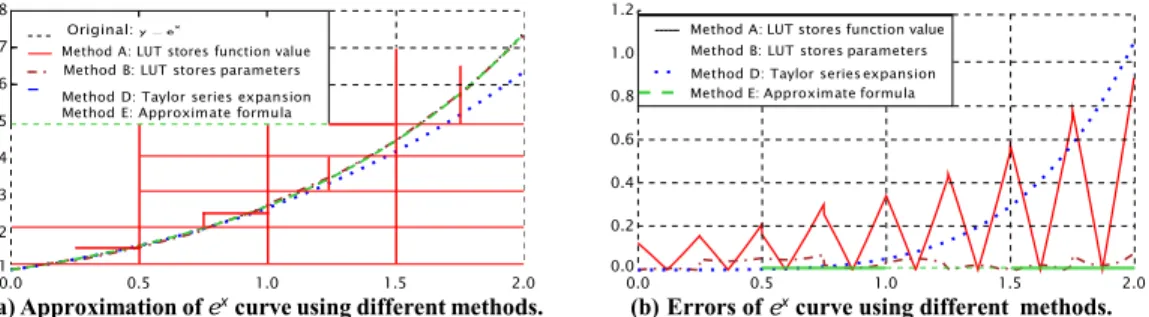
Various approaches have been proposed for implementing activa-tion funcactiva-tions in hardware. Generally, these methods fall into two categories: piecewise approximations and look-up table (LUT) based approaches [12]. In this work, we consider the six most commonly used approaches to make the review concise. On the whole, high-fidelity approximations tend to use more resources and have higher latencies, while low-fidelity implementations incur approximation losses but are faster and require fewer hardware resources. In Fig-ure 1, we plot the approximation of theexcurve with methods 1, 2, 4 and 5. Method 3 (CORDIC algorithm [13]) and method 6 (Optimized
+ ≥ ≈ 3 15 1 e−e n! 0 ∞ (n) − 8 7 6 5 4 3 2 1 0.0 0.5 1.0 1.5 2.0
(a) Approximation ofexcurve using different methods.
1.2 1.0 0.8 0.6 0.4 0.2 0.0 0.0 0.5 1.0 1.5 2.0
(b) Errors ofexcurve using different methods.
Fig. 1.Approximation ofexcurve using different methods.Method E has a low approximation error, causing the respective curves to be overlapped.
LUT-based method) are omitted as they require too much resource to be directly implemented in hardware.
A. Storing function values in LUTs
Look-up tables (LUT) are the most commonly used method to implement activation functions in hardware. The function values are divided into equal sub-ranges and each sub-range is approximated by a value stored in a LUT. For LUT implementations, raising precision requires increasing the sampling rate, adding more storage and increasing latency.
The method requires four cycles to approximate the sigmoid
function. The authors designed a structure to calculate the expression
2−1.5x, which takes two cycles. An add and a division operations are also performed and take one cycle each. For the tanh function ap-proximate an additional clock cycle is required. The implementation of this approximation formula uses fewer resources than the CORDIC approach, but its latency is still high.
F. Optimized LUT-based method
This approach is an optimized LUT-based method combined with a Taylor series expansion. The equation is expanded up to the
fifth-B. Storing parameters in LUTs
Instead of storing the function values directly, this method keeps order: tanh(x)≈x−x33 215x5 (6)
the function slope and the function intercept in the LUT. The function
value can then be calculated using the following formula, wherekis Whenx3−2x5≤0.02, one can use the approximationtanh(x)≈x. the slope andbis the function intercept. This approach is a general
form of storing function values in LUTs withk= 0(cf. II-A).
y=kx+b (1)
This method leads to a small improvement on the accuracy, but it also has to store more data and uses an adder and a multiplier to calculate the function values.
C. CORDIC algorithm
The third method is the CORDIC algorithm. It uses shift, addi-tion and subtracaddi-tion operaaddi-tions approximate the nonlinear activaaddi-tion function. The CORDIC algorithm requires less area than storing the parameters in LUTs, but more clock cycles and hardware modules are required to compute the activation function. While the algorithm achieves higher approximation accuracy, its increase in latency may not be suitable for deployment in low-latency edge devices.
D. Taylor series expansion
The Taylor series expansion can be used to approximate a nonlinear activation function to any precision. The expansion formula is of the
By solving the inequality, one getsx 0.39, andtanh(2.90) 1. Only the values in the[0.39,2.90]range need to be stored.
In all, LUT based methods need storage/memory and an extra pipeline stage for the memory access. All these methods, except the one that stores function values in LUTs, either require relatively complex calculations/logic or several clock cycles to minimize the approximation error. According to our experiments in Section V, ANNs are generally insensitive to activation function precision. This is a key insight that allows us to simplify the approximation method without sacrificing the system accuracy. In the following sections, we analyze the activation functions and present our proposed combinational circuit based implementation method.
III. ACTIVATIONFUNCTIONSEXPLORATION
In this section, we discuss the nonlinear activation functions realized using our proposed design approach. We define thesigmoid
andtanhfunction as:
x −x sigmoid(x) = , tanh(x) = (7) 1 +e−x ex+e−x form: f(x) =Σf (x0)(x−x )n (2) n=0
Compared tosigmoid function, thetanh function passes through zero and can be approximated as y = xaround zero. As a result, when the absolute value of the input is small enough, one can This method does require multipliers and several clock cycles to
perform the calculation.
E. Approximation formula
The method introduced in [14] uses the following formula to approximate the exponential function:
ex ≈Ex(x) ≈ 21.44x (3)
Based on this formulation, one can calculate thesigmoidfunction as:
perform the matrix operation directly, therefore, the training process is relatively easy. In principle,sigmoidandtanhhave similar expressive ability, but in practice,sigmoidis equivalent to an activation function with a bias. It still needs the real bias term to offset its influence, which can affect the optimization. Therefore, the tanh function is used more often. Furthermore, it converges faster than thesigmoid
function.
Thetanhfunction has been shown experimentally to outperform thesigmoidfunction. There two reasons for this: the output of the
1 1
Sigmoid(x)≈1 + 2−1.44x≈1 + 2−1.5x (4) tanhfunction is normalized around 0, producing both positive and negative outputs. Thesigmoidis not, introducing a systematic bias. whereas thetanhfunction can be calculated as:
tanh(x) = 1−2Sigmoid(−2x) (5) Second, when the output of the neuron restricted toactivation is more likely to be close to 0, so the neurons are generally[ 1,1], the
Original:y=ex
Method A: LUT stores function value Method B: LUT stores parameters Method D: Taylor series expansion
Method E: Approximate formula Method E: Approximate formula Method A: LUT stores function value Method B: LUT stores parameters Method D: Taylor series expansion
. 2k − XX3 2 XX 2 1 XX1 0 00 01 11 10 XX1 0 00 01 11 X2 10 m0 10 11 m0 9 0 m 1 m8 0 m14 13 1 m 12 0 m 6 1 m 5 1 m 1 m4 2 0 m 15 m1 7 1 m 3 1 m 1 1 m 0 m0 − XXXX X
less saturated withtanhthan withsigmoid, allowing gradients to better propagate and speeding up learning [15].
In [5], the authors introduced theSELUfunction and analytically proved that neuron activations converge towards zero mean and unit variance. This allows networks withSELUactivations to train deeper models, speed up learning, and use stronger regularizers without sacrificing accuracy. This is the main motivation behind focusing our work on the efficient implementation of exponential functions.
We define ELU and SELU as:
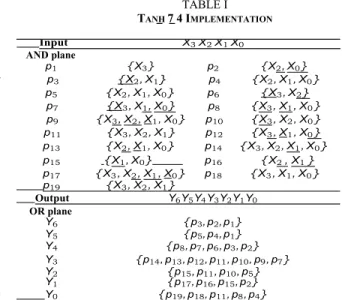
TABLE I TANH7 4 IMPLEMENTATION Input X3X2X1X0 AND plane p1 {X3} p2 {X2, X0} p3 {X2, X1} p4 {X2, X1, X0} p5 {X2, X1, X0} p6 {X3, X2} p7 {X3, X1, X0} p8 {X3, X1, X0} p9 {X3, X2, X1, X0} p10 {X3, X2, X0} p11 {X3, X2, X1} p12 {X3, X1, X0} p13 {X2, X1, X0} p14 {X3, X2, X1, X0} ELU(x) = x x >0 αex−α else (8) p15 {X1, X0} p16 {X2, X1} p17 {X3, X2, X1, X0} p18 {X3, X1, X0} p19 {X3, X2, X1} SELU(x) =λELU(x). (9) Hereλ= 1.0507andα= 1.6733.
IV. ACTIVATION FUNCTIONIMPLEMENTATION A. Implementation of the tanh function
In this section, we introduce our method for implementing the
tanhactivation function using exclusively combinational circuits. We consider only the intervals where the function changes significantly.
1) Properties of the tanh function: Tanhis an odd function, mean-ing that it is symmetric with respect to0. In order to approximate it, we only need to observe the positive half of the function. As it converges to1, we approximate its value in the range[0,2]for the targeted precision in this work.
We divide the activation function range into 2k segments evenly with the step1. The approximation error depends on the numberk,
which controls the sampling density. The larger the k is, the lower the approximation errors are, but more complex the implementation. During training, the exacttanhfunction is used to calculate the
Output Y6Y5Y4Y3Y2Y1Y0 OR plane Y6 {p3,p2,p1} Y5 {p5,p4,p1} Y4 {p8, p7, p6, p3, p2} Y3 {p14, p13, p12, p11, p10, p9, p7} Y2 {p15, p11, p10, p5} Y1 {p17, p16, p15,p2} Y0 {p19, p18, p11, p8, p4}
reduces the number of individual circuits. As an illustration, here is the expression of one bit of the output value:
Y1=X2X1+X2X0+X3X2X1X0+X1X0 (10) Xirefers to the i+1-th bit of the input value, and theY1refers to the
second bit of the output value.
4) Combinational logic for the tanh function: Finally, we can implement the logic expression using an RTL language to get the logical circuits. As for the negative part of the function, since thetanhis an odd function, we can deliver the sign bits to the output directly. If we useg(x)
to represent the ladder function between [ 2, 2], the approximated activation functiontanhcan be written as follows:
gradients, since the approximate function is non-differentiable. The approximated function is used for the forward pass.
2) Encoding the value of the activation function: After selecting a sampling rate, we choose the output value’s integer and fractional
tanh(x) = g(x)1 x2≥≥2x >−2
−1 −2≥x
(11)
parts bit-width. The integer part is either0 or1. For the illustrative case, in order to simplify the complexity of the combinational logic, we choose7-bits to encode the output value of the activation function:
1-bit for the integer part and6-bits for the fractional part.
3) Generating the Karnaugh map for the tanh function:Boolean functions can be expressed in their canonical form: by listing the input values on the left side of the truth table and the output values on the right side, we get a Karnaugh map. Figure 2 shows the Karnaugh map for one of thetanhactivation bits. By analyzing the map, one can derive the needed circuit for implementing the bit. We repeat this procedure for all the bits of thetanhactivation function.
5) Simulation and validation:Once we have the RTL module, we need to simulate it to check the logic expression and make sure it approximates the desired function. Next, we analyze the time delay of the combinational circuit and check whether the activation function lies on the critical path of the design. After functional and timing testing, if there exist any race conditions or hazards, we change the Karnaugh map to remove them.
After simplifying the logic expression, we obtain the final expressions of thetanhfunction as illustrated in Table I.
B. Implementation of the SELU activation function
We demonstrate in this section the implementation of theSELU
function using only combinational circuits.
1) Properties of the SELU activation function: From the formula 8, the positive part of the SELU function is linear, so we only need to approximate the negative part. Consideringe−3.875≈0.0208≈0, if the
input value is less than−3.875, the output value is−α,αbeing a static
3 2 1 0
predetermined parameter. We then divide the interval[ 3.875,0]intok
0 segments evenly.
2) Encoding the value of the activation function:We encode the input value with5bits. To maintain precision, we encode the output value into8-bits,1bit for the integer part and7-bits for the fractional part. In this way, it can be represented astanh 8 5.
Fig. 2. Karnaugh map of one of the output bits of thetanhactivation function (Y1) with a4-bits input and a7-bits output (tanh 7 4).
A direct implementation will have a circuit for every cell with the value 1, and a multiple-input OR gate choosing one of these circuit outputs. We can simplify the logic expression from the Karnaugh map by combining some of the adjacent 1’s in the table cells. This
3) Generating the Karnaugh map for the SELU function: We can construct the truth table and Karnaugh map in a similar fashion as described in Section IV.A.3). From the Karnaugh map, we draw the Karnaugh circle to get the simplest logical expression without race condition and hazards. In total, we arrive at31logical expressions. Here we show an illustration using one bit of the output value:
0 m0 XXX X X XXXX X X XXX XXXX XXXX 4 XXX XXX 4 XXX 19 3 2 1 0 4 2 1 0 { } { } − − Y3=X4X3X2+X4X3X1+X3X1X0 +X2X1X0+X3X2X1+X4X3X2X1 +X4X3X1X0+X4X3X1X0+X4X3X2X1 (12) TABLE II SELU 8 5 IMPLEMENTATION Input X4X3X2X1X0 AND plane
Xirefers to thei+1-th bit of the input value, andY1refers to the second
bit of the output value.
In Figure 3, each color block refers to a product, and the logic expression is the sum of all the products. The blocks that have the same color refer to the same product.
2 1 0 p1 {X3} p2 {X4} p3 {X4, X3} p4 {X2, X1, X0} p5 {X3, X2, X1} p6 {X4, X1, X0} p7 {X4, X3, X1} p8 {X4, X3, X2} p9 {X4, X2, X0} p10 {X4, X2, X1} p11 {X4, X3, X2} p12 {X4, X3, X1} p13 {X2, X1, X0} p14 {X3, X2, X1} 3 2 4 3 2 3 24 3 2 1 p15 {X3, X1, X0} p16 {X4, X3, X1} X X 00 01 11 10X X 00 01 11 10 p17 {X3, X2, X1} p18 {X3, X2, X1, X0} 10 1 0 00 00 4 3 1 0 p {X , X , X , X } p {X , X , X , X} 01 11 4 3 2 1 10 1 m m0 m m0 m 1 m8 0 m X1 3 2 01 7 6 11 14 10 10 4 3 1 1 1 m 0 m m0 m X0 0 m 1 m 0 m10 3 2 1 3 1 0 p21 {X4, X3, X2, X0} p22 {X4, X2, X1, X0} p23 {X4, X3, X1, X0} p24 {X4, X3, X2, X1} p25 {X4, X3, X2, X1} p26 {X4, X3, X1, X0} p27 {X4, X3, X1, X0} p28 {X4, X3, X2, X1} p29 {X4, X3, X2, X0} p30 {X4, X3, X1, X0} p31 {X4, X2, X1, X0} p32 {X4, X3, X2, X0} p33 {X3, X2, X1, X0} p34 {X4, X3, X2, X1}
Fig. 3. Karnaugh map of one of the output bits ofSELUactivation function (y3) with 5-bits input and 8-bits output(SELU 8 5).
4) Combinational logic of the SELU function: The approximation ofSELUusing purely combinational logic is shown in Table II. The table shows the final complete logic expressions. We define the SELU function using the formulation shown in equation 13. It is worth noting that we only define it on the (−3.875,0)interval, as the function is linear for
x≥0and constant forx≤ −3.875.
p35 {X4, X3, X1, X0} p36 {X4, X2, X1, X0} p37 {X4, X3, X2, X1} p38 {X4, X3, X2, X1} p39 {X4, X3, X2, X0} p40 {X4, X3, X1, X0} p41 {X4, X2, X1, X0} p42 {X4, X3, X2, X1} p43 {X3, X2, X1, X0} p44 {X3, X2, X1, X0} p45 {X3, X2, X1, X0} p46 {X4, X3, X2, X1} p47 {X4, X3, X1, X0} p48 {X4, X3, X2, X0} p49 {X3, X2, X1, X0} p50 {X3, X2, X1, X0} p51 {X4, X3, X2, X1, X0} p52 {X4, X3, X2, X1, X0} SeLU(x) =λ f(x)x x0≥≥x >0 −3.875 −α −3.875≥x (13) pp5355 X{4X4, X, X3, X3, X22, X, X11, X, X00} pp5654 X{X4, X4, X3, X3, X2, X2, X11, X, X00} Output Y7Y6Y5Y4Y3Y2Y1Y0 OR plane 5) Simulation and validation:The purpose of the simulation is the
same as in the case of the tanhactivation function. As more variables may lead to race conditions and hazards more easily, all the possible combinations should be simulated.
More accurate approximations can be achieved by increasing the number of bits for inputs and outputs. Increasing the number of bits in the input helps break the function into more linear segments. Whereas, a larger number of bits in the output representation boosts its precision. In all, using higher bit-widths improves the approximation accuracy but also leads to more complex circuits.
V. EXPERIMENT
Look-up table based designs are the most common implementation of activation functions. Therefore, in our comparative study, for the baseline designs, we implement thetanhandSELUfunctions using look-up tables. The function values storage based implementation is denoted as (ROM y) and the parameters storage based one is (ROM k b). Their construction uses LUTs and follows the procedures described in Section II. Their comparison with the proposed combinational circuit based approach is done in terms of approximation error, power, area, and network accuracy. The evaluation is conducted in a two-step, software-hardware approach. First, we evaluate the approximation method in software using PyTorch to verify the neural network accuracy. It is worth noting that the procedure may run multiple iterations to find out an appropriate bit-width. Second, for a selected bit-width, the full neural network is implemented in hardware. We then perform circuit-level analysis on the RTL code and deploy it on the FPGA board for further system-level validation.
A. Approximation Error
The average errors for the three different methods – the proposed combinational circuit based approach, ROM y and ROM k b – are shown in Table III. The errors for the tanh and SELU functions are bounded to the ranges 2< x <2and 3.875< x <0, respectively. The average error is calculated using the following formula:
Σ|P−A| Y7 {p4, p2, p1} Y6 {p19,p18, p5, p2} Y5 {p20, p8, p7, p6} Y4 {p53, p52, p51, p24, p23, p22, p21, p10, p9, p3} Y3 {p28, p27, p26, p25, p15, p14, p13, p12, p11} Y2 {p55, p54, p34, p32, p31, p30, p29, p18, p17, p16} Y1 {p45, p44, p43, p42, p41, p40, p39, p38, p37, p36, p35, p34, p27, p23, p22, p19} Y0 {p56, p50, p49, p48, p47, p47, p46, p44} TABLE III
COMPARISON OFAE(AVERAGE ERROR)AND AREA
Active Function Tanh 7 4 SELU 8 5
Index AE Area(µm2) AE Area(µm2)
Our method 4.19% 97.65 2.22% 137.59
ROM y1
ROM k b 04..19%52% 306751..4412 20..22%17% 1162612.24.93
P is the function value, A is the approximate value, and N represents the number of sample points. Since piecewise linear approximation is used in our proposed method, the average error is the same as in the function values storage approach (ROM y) and larger than when the parameters are stored (ROM k b). The parameters storage approach does use more resources for this slight accuracy improvement (cf. V-B). B. Resources Analysis
To get more accurate results, we synthesized the different designs using a 28nm SVT library. The absolute time delays for the tanh
and SELU functions are 0.1947ns and 0.221ns. This means that the combinational logic can operate at the maximum frequencies of 5.14GHz (tanh) and 4.52GHz (SELU). The area overheads of thetanhandSELU
implementations are shown in the Table III.
The proposed combinational circuit based method implementation of thetanhfunction saves 68.1% and 87.0% in area compared to function
14-bits inputs and 7-bits outputs (1-bit for the integer) LUT can be
implemented with16 ×6bits ROM, which is estimated to take half of the area of a32×6bits ROM. The ROM in Memory Compiler has at least 32
AverageError= |P|
N ×100% (14) entries. 5-bits inputs and 9-bits outputs (1-bit for the integer) LUT can beimplemented with32×8bits ROM.
m m m 0 m 1 m 1 m 0 2 m 3 1 9 0 m 1 m 1 m 15 1 1 m 11 1 m 11 1 9 8 1 0 0 13 12 5 4 14 15 13 12 6 0 m7 5 1 m4 1 1 m 1 m 0 m0 20
− − − −
− − −
− −
− − − −
Comparison of Power Consumption(mW)
250 200 150 100 50 0
Our method ROM_y ROM_k_b tanh SeLU
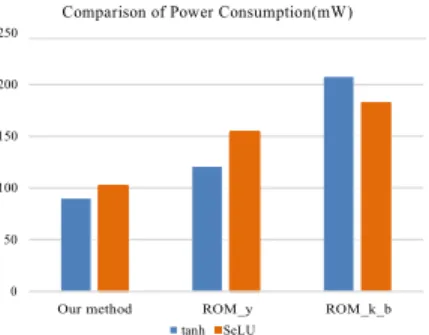
Fig. 4. Power consumption of the three methods. The energy consumption of the proposed method is lower compared to the alternative LUT-based approaches.
values storage approach (ROM y) and the parameters storage method (ROM k b), respectively. For the SELU function implementation, the area savings are 77.53% and 88.17% over ROM y and ROM k b, respectively. The three methods are deployed on the Xilinx VC7V2000T FPGA board. The power consumption results are reported in Figure 4.
One clock cycle is needed to get the function value from the LUT for both the ROM y and ROM k b approaches. For the ROM k b, two clock cycles are needed for the linear function computation. On the other hand, the proposed method is purely combinational.
C. Inference Accuracy
In this section, we focus on the network accuracy. We use Pytorch with bit-wise operations to approximate the activation functions. We train the neural networks using the original, full precision activation function implementations. Then in the validation phase we replace the activation functions with their approximation function circuits. We make no attempt to retrain the network after changing the activation function. Since such an attempt may remove accuracy losses incurred by quantizing theactivation functions.
TABLE IV
PERFORMANCE OFOURMETHOD ONANN COMPARED WITH
ORIGINALDESIGN
MNIST CIFAR-10 ImageNet(Top1/Top5)
Tanh(Original) 96.15% 87.17% 42.39%/67.61% Tanh 5 4 0.2% 5.07% 8.16%/ 8.94% Tanh 7 4 0.05% 1.96% 7.83%/ 8.42% Tanh 7 6 +0.04% 0.29% 7.23%/ 8.0% SeLU(Original) 97.67% 86.79% 39.260%/63.342% SeLU 5 4 +0.04% −4.15% −0.122%/+ 0.458% SeLU 7 4 +0.01% −4.47% −0.004%/+ 0.866% SeLU 8 5 +0.37% −0.69% +0.368%/+ 1.278%
We test the proposed method with LeNet on the MNIST dataset, VGG-16 on the CIFAR-10, and AlexNet on the IMAGENETdataset. The
experimental results show an accuracy loss of0.05%and an increase of
0.37%compared to the original network on MNIST usingtanh 7 4and
SELU 8 5, respectively. In case of the CIFAR-10 experiments, we get an accuracy loss of1.96%and 0.69%fortanh 7 4andSELU 8 5. For the experiments on the IMAGENET, the accuracy losses are7.83%
on top-1 and8.42%on top-5 under tanh 7 4, while there are gains of0.368% on top-1 and1.278%on top-5 for the SELU 8 5. The results of the comparative study of the exact implementation and the proposed approximation method are summarized in Table IV. When the quantization method is applied, the network inference accuracy increases. The overall effect of the quantization precision on the inference accuracy follows the pattern observed in other studies [16].
VI. CONCLUSION
In this work, we propose an efficient approximation scheme for activation functions using purely combinational logic, which takes only one clock cycle. We should its implementation and performance on two widely used activation functions, i.e.,tanhandSELU. We conduct
a comparative study of the proposed method with other widely used methods, i.e., storage based approaches. Based on the average approxi-mation errors, our method has the best performance to circuit complexity ratio. Activation quantization bears little effect on network accuracy. The hardware implementation of the proposed activation functions is realized using the 28nm SVT library to further validate the efficiency of the proposed approach in terms of area and timing delay. Area reductions of 68.1% and 87.0% for thetanhfunction, and 77.53% and 88.17% for theSELU function are recorded when compared with the two baseline LUT-based activation function implementations (ROM y and ROM k b).
VII. ACKNOWLEDGEMENTS
This work was supported in part by the National Science and Tech-nology Major Project of China No.2018ZX01028-101-001, National Key Research and Development Plan No.2016YFB0200202 and National Natural Science Foundation of China No.61773307.
REFERENCES
[1] G. Cybenko, “Approximation by superpositions of a sigmoidal function,”
Approximation Theory & Its Applications, vol. 9, no. 3, pp. 17–28, 1993. [2] C. W. Lin and J. S. Wang, “A digital circuit design of hyperbolic tangent sigmoid function for neural networks,” inIEEE International Symposium on Circuits and Systems, 2008, pp. 856–859.
[3] K. Basterretxea, J. M. Tarela, I. Del Campo, and G. Bosque, “An experimental study on nonlinear function computation for neural/fuzzy hardware design,”IEEE Transactions on Neural Networks, vol. 18, no. 1, pp. 266–83, 2007.
[4] D.-A. Clevert, T. Unterthiner, and S. Hochreiter, “Fast and accurate deep network learning by exponential linear units (elus),” 2015.
[5] G. Klambauer, T. Unterthiner, A. Mayr, and S. Hochreiter, “Self-Normalizing Neural Networks,” 2017.
[6] S. Vassiliadis, M. Zhang, and J. G. Delgado-Frias, “Elementary function generators for neural-network emulators,”IEEE Transactions on Neural Networks, vol. 11, no. 6, pp. 1438–1449, 2002.
[7] S. Han, J. Kang, H. Mao, Y.Hu, X. Li, Y.Li, D. Xie, H. Luo, S. Yao, Y. Wang, H. Yang, and W. B. J. Dally, “Ese: Efficient speech recognition engine with sparse lstm on fpga,” in Proceedings of the 2017 ACM/SIGDA International Symposium on Field-Programmable Gate Arrays. ACM, 2017, pp. 75–84.
[8] S. Yin, P.Ouyang, S. Tang, F. Tu, X. Li, S. Zheng, T. Lu, J. Gu, L. Liu, and S. Wei, “A high energy efficient reconfigurable hybrid neural network processor for deep learning applications,”IEEE Journal of Solid-State Circuits, vol. 53, no. 4, pp. 968–982, 2018.
[9] S. Yin, S. Tang, X. Lin, P. Ouyang, F. Tu, L. Liu, and S. Wei, “A high throughput acceleration for hybrid neural networks with efficient resource management on fpga,”IEEE Transactions on Computer-Aided Design of Integrated Circuits and Systems, vol. PP, no. 99, pp. 1–14, 2018.
[10] M. T. Tommiska, “Efficient digital implementation of the sigmoid function for reprogrammable logic,”IEE Proceedings - Computers and Digital Techniques, vol. 150, no. 6, pp. 403–411, 2003.
[11] J. Li, Z. Yuan, Z. Li, C. Ding, A. Ren, Q. Qiu, J. Draper, and Y. Wang, “Hardware-driven nonlinear activation for stochastic computing based deep convolutional neural networks,” 2017.
[12] M. Zhang, S. Vassiliadis, and J. G. Delgado-Frias, “Sigmoid generators for neural computing using piecewise approximations,”IEEE Transac-tions on Computers, vol. 45, no. 9, pp. 1045–1049, 1996.
[13] M. Qian, “Application of cordic algorithm to neural networks vlsi design,” inComputational Engineering in Systems Applications, IMACS Multiconference on, vol. 1. IEEE, 2006, pp. 504–508.
[14] S. Gomar, M. Mirhassani, and M. Ahmadi, “Precise digital implemen-tations of hyperbolic tanh and sigmoid function,” inSignals, Systems and Computers, 2016 50th Asilomar Conference on. IEEE, 2016, pp. 1586–1589.
[15] Y. A. LeCun, L. Bottou, G. B. Orr, and K. R. Muller, “Efficient back-prop,”Lecture Notes in Computer Science (including subseries Lecture Notes in Artificial Intelligence and Lecture Notes in Bioinformatics), vol. 7700 LECTU, pp. 9–48, 2012.
[16] I. Hubara, M. Courbariaux, D. Soudry, R. El-Yaniv, and Y. Bengio, “Quantized neural networks: Training neural networks with low preci-sion weights and activations,” 2016.