SURVEY QUESTION BANK: Topic Overview 6 (September 2011)
MEASURING
EDUCATIONAL
ATTAINMENT
Silke
Schneider
(GESIS
–
Leibniz
Institute
for
the
Social
Sciences)
Education is a complex topic for survey measurement, and the individual’s educational attainment is only a narrow snapshot of possible measures relating to an individual’s educational experience (Smith, 1995). It is, however, a pervasive concept in social science theories, and accordingly one of the most used variables in social science research using individual level data. Researchers are often interested in the effect of educational attainment on Y, or the effect of X on Y net of educational attainment. In both cases, a reliable and valid measure of educational attainment is required. Even if not of direct theoretical relevance for a specific piece of research, it is standard practice to control for individuals’ educational attainment given this variable correlates substantially with many other variables.
This topic overview sets out how educational attainment can be understood, how it is measured in three large‐scale UK surveys, and what analytical measures (including cross‐nationally comparable ones) can be derived from the available survey measures.1
1 For more in‐depth reports regarding educational attainment data in surveys in which educational attainment is more than a social background variable, see Dearden (2011) and Jenkins and Sabates (2007).
1. The concept of educational attainment
Educational attainment is defined as the highest level of education an individual has successfully completed. Another term typically used in the literature is (highest) ‘educational qualification’. Educational attainment distinguishes individuals on a vertical scale, i.e. educational attainment categories can largely (although often not entirely) be ordered hierarchically. Educational attainment refers to an important direct outcome of education (Jenkins and Sabates, 2007), as opposed to the input (e.g. cognitive ability; effort), process (e.g. educational pathway taken, full‐time or part‐time study) or indirect outcomes of education (e.g. income)..
There are other direct outcomes of education, most notably skills and competences and levels of performance in a specific exam or qualification. Whereas virtually all surveys employ at least one measure of educational attainment as defined above, measures of educational achievement or skills and competences require more complex data collection instruments. Particularly skill and competence measures are therefore limited to specialised surveys. Educational qualifications consequently often serve as a proxy for skills and competences.2
Educational qualifications constitute important social signals in the labour and marriage markets and are highly predictive of related outcomes. Through indirect effects (e.g. income), various other outcomes at later stages in life (e.g. health) also correlate highly with educational attainment. In addition, education is theorised to have an influence on individuals’ attitudes by facilitating the evaluation of complex social situations, widening the individual’s knowledge and horizon of experiences as well as by direct exposure to norms and values in educational institutions.
2. Measurement of educational attainment
The highest level of education successfully completed is either indicated by the highest educational qualification (vocational or academic) achieved, or by the number of years of education or schooling completed (in which case each year is regarded as a kind of level).
Educational qualifications are official documents that certify that an individual has reached a certain level of competence in one field of education
2 The field or subject of study of the highest qualification obtained (e.g. Jackson et al., 2008; Andersson and Olsson, 1999) is also often covered in surveys in order to collect information on
or in a group of fields of education, which is usually formally assessed through examinations. They indicate individuals’ ability to learn and perseverance (Jenkins and Sabates, 2007). ‘Years of education’ do not have the same meaning: they merely assume that the longer the individual stayed in education, the higher the level of attainment. Although correlated with qualifications achieved, this measure neither takes the element of validation of skills and competencies through examination, nor the official character of a qualification as a social signal into account. It is closer to an input than an output measure. It also does not allow for the demarcation of different types of education. Educational qualifications are consequently often regarded as a more informative and thus more valid indicator of educational attainment. Many surveys employ measures of both. However, analysts often avoid the highest educational qualification as a measure of attainment because it is more cumbersome to deal with, i.e. more difficult to code into an analytical variable with a reasonable number of categories, and it has to be analysed as a categorical or possibly ordinal rather than interval level variable. If predictor or control variable, dummy variables have to be used for the different categories of qualifications. ‘Years of education’ is in contrast often just used in statistical analyses ‘as‐is’. If theory does not give a clear priority to either of those measures, it is recommended to perform sensitivity analyses to test if the results of the study are insensitive to the choice of measure of educational attainment. The remainder of this topic overview focuses on educational attainment as measured by educational qualifications.
In most countries and surveys, the highest educational qualification is measured using one or a sequence of closed questions with fixed response categories typically listing educational qualifications shown to the respondent on a show card. Categories for ’don’t know’ and ‘other’ are usually available to the interviewer for respondents who do not know the answer3 and for
those who cannot identify which category to choose respectively. In the latter case, a follow‐up question asking for verbatim information on which other qualification was achieved is often provided. Ideally, these open responses are assigned to the existing categories during data processing.
Although an alternative, only very few countries or surveys measure educational attainment with an open question that is entirely post‐coded during data processing. As an intermediate strategy, the question is asked as an open question but the interviewer codes the response to a fixed set of categories during the interview. This latter approach is problematic because it may lead to interviewer effects that cannot be easily traced.
3 This happens mostly in the case of proxy information, i.e. when the respondent is asked to report the educational attainment of somebody else, e.g. his/her mother.
It is possible to collect either data on the highest educational qualification only or on all qualifications achieved. While the latter requires more time during the interview and more complex coding, the former requires an instrument with strictly hierarchically ordered response categories.
Most data sets also allow identification of individuals who are currently in full‐time education, i.e. who have probably not yet achieved their highest qualification. 4
For instrument development, the crucial step is to design a list of response categories with educational qualifications that
1. cover the full range of qualifications (including number and grades of a qualification in countries like the UK where modular educational programmes are common) expected to exist in the sample (i.e. including outdated ones),
2. order those in a hierarchy (as much as possible) so that it is clear to respondents with more than one qualification which is the highest, and 3. ensure individual entries are not too numerous or long so as to be
cumbersome for interviewers and respondents.
If this results in too much information for one questionnaire item, it can be split into several items, either by focusing items on sectors of education (e.g. school leaving qualifications, post‐school qualifications) or by drilling down from broad categories of qualifications to more specific ones. Examples for both strategies are covered in the next section.
3. Measurement of educational attainment in UK surveys
Many UK surveys employ both a measure of school‐leaving age, from which years of education can be derived, as well as on individuals’ highest educational qualification. In the latter case, vocational as well as academic qualifications are usually covered. Given academic qualifications are the ones that empirically make a difference, it is highly desirable that these can be identified.
With respect to educational qualifications, there are three issues that make the measurement more difficult in the UK than in many other countries: First of all, the educational systems of the UK’s constituent countries and the respective terminology differ. Given the amount of migration between
4 For some research questions, it makes sense to exclude these from the analyses, or to exclude respondents below a certain age (e.g. 25) to avoid comparing individuals who are still in initial education with those who have completed their initial education.
England, Wales, Scotland and Northern Ireland, all systems need to be covered in any UK questionnaire. Secondly, an increasing issue in survey measurement of educational attainment is the fact that many residents have achieved their highest qualification abroad.
Thirdly, and most importantly, educational qualifications, especially vocational ones, are numerous and rather weakly regulated in the UK. In addition, their names and content change quite often. This makes the vertical ordering and comparison of qualifications within the UK (e.g. across cohorts or regions) quite difficult (see Jenkins and Sabates, 2007). As a consequence, the Office for National Statistics (ONS) recommends to collect information on all qualifications obtained whenever possible. Although this has the additional advantage that individuals’ trajectories through the educational system can be followed, this may not be feasible for general social surveys. Equivalencies established in the National Qualifications Framework (QCA, 2006) help to some degree, but they have not been empirically validated. ONS Harmonised Concepts and Questions for Social Data Sources Primary and Secondary Standards
In their effort to provide standard measurement instruments and output variables, ONS (2005) suggest a simple classificatory scheme to be derived from a brief set of questions for measuring educational attainment in surveys that cannot collect as much detail as the LFS. These are the questions suggested:
Source: ONS (2005)
This results in a three‐category variable, distinguishing 1) qualification at degree level or above, 2) any other kind of qualification, and 3) no qualification.
This scheme does not represent well the amount of variation in educational attainment existing among individuals in the UK. Category 2 contains a
Do you have any educational qualifications for which you received a certificate? 1. Yes 2. No IF QUESTION 1=NO: WHICH QUALIFICATIONS Do you have any professional, vocational or other work‐related qualifications for which you received a certificate? 1. Yes 2. No IF QUESTION 1=YES OR QUESTION 2=YES: HIGHEST QUALIFICATION Was your highest qualification... 1. at degree level or above 2. or another kind of qualification?
highly varied set of qualifications, ranging from key skills or 1 GCSE below grade C to the Higher National Diploma (HND), and would represent more than 50% of the UK’s population. It thus lacks validity for multivariate analyses. The only use for it is to contrast individuals who hold a degree level qualification with those with other or no qualifications in cross‐tabulations, reporting little meaningful averages for the former two categories, which may be highly heterogeneous with respect to many outcomes.5
In order to achieve some more detail, ONS (2004) however also suggests a ‘provisional’ scheme in the secondary standards with six output categories, distinguishing
1) Higher Education & professional/vocational equivalents,6
2) A levels, vocational level 3 and equivalents
3) GCSE/O Level grade A*‐C, vocational level 2 and equivalents 4) Qualifications at level 1 and below
5) Other qualifications: level unknown (including foreign qualifications) 6) No qualifications
ONS recommends that in order to code this variable, information on all qualifications held should be collected so that only during data processing, it is decided which of the individuals’ qualifications is the highest. The outcome variable is however still fairly crude, not distinguishing vocational/professional and general/academic education, different numbers and levels of GCSEs and A‐Levels or levels of university degrees.7 Also it does
not attempt to measure the level of attainment of individuals with foreign qualifications.
The following sections illustrate the measurement of educational attainment in three surveys conducted in the UK: the Labour Force Survey (LFS), the British Social Attitudes Survey (BSA), and the UK Household Longitudinal Study (UKHLS), also known as Understanding Society (the successor of the British Household Panel Study).8
5 According to ONS, cognitive interviewing showed that the conditions for a more complex scheme – such as consistent ordering of qualifications by respondents – were not met. However, the procedures and report of the cognitive testing have not been published. 6 The most common equivalents for each of those categories are given on page 8 of ONS (2004). 7 I am however not aware of any studies validating this measure. The ONS harmonization website has also not been updated since 2008. 8 The Centre for Longitudinal Studies (CLS) has recently published a working paper (Dodgeon et al., 2011) on the measurement of educational attainment in the National Child Development Study (NCDS) and the 1970 British Cohort Study (BCS70). An earlier CLS working paper by Jenkins and Sabates (2007) covers the measurement of educational qualifications in the NCDS, Labour Force Survey and BHPS.
Quarterly Labour Force Survey (QLFS)
The UK Quarterly Labour Force Survey collects highly detailed information about all educational qualifications a respondent holds, including vocational and professional qualifications as well as fields of study. It employs a ‘drilling down’ strategy, i.e. asks the respondent to tick all categories of qualifications that apply, and then asks successively more detailed questions about those categories. For example, individuals that indicate to have a first degree are asked what class of degree they have achieved; individuals with a higher degree are asked to specify what kind of higher degree; and individuals with A‐Levels are asked if they have one or more than one A‐Level. Consequently, the LFS allows coding educational attainment in numerous and very flexible ways.9
The LFS also provides a number of derived variables on educational qualifications, which can then be recoded further according to researchers’ requirements. However, even the most detailed of those derived variables (HIQUAL8 with 50 categories)10 does not differentiate between two or more
A‐Levels vs. one A‐Level, although two A‐Levels are the requirement for university entry. This information would have to be derived from another variable. Another derived variable (HIQUAL8D) orders those detailed categories into five broader ones (plus ‘other’ and ‘don’t know’). The variable LEVQUAL8 finally orders the qualifications held into six categories relating to the National Qualifications Framework, which takes number of A‐Levels into account but omits other distinctions.
The LFS does not collect information on educational qualifications achieved abroad: they are coded as ‘other’. Although verbatim information is collected on ‘other’ qualifications, this is not post‐coded, e.g. to the closest UK equivalent or in the International Standard Classification of Education (ISCED) produced for the EU‐LFS. Given the amount of migration into the UK and the increase in student mobility out of the UK, this means that a substantial number of respondents have effectively ‘missing data’.
British Social Attitudes Survey (BSA)
In the context of attitudinal research, education is known to be highly correlated with a wide variety of attitudes. The amount of detail required for the measurement of education is however somewhat lower in attitudinal surveys than in the LFS. We do not need to know the specific qualification obtained, but the level of the qualification (in order to capture skill and competence differences between respondents) as well as orientation of the
9 The questionnaire items are too numerous to be replicated here. Please refer to the LFS user guide (ONS, 2009) for more details.
qualification and/or institutional context (in order to capture other aspects of socialisation through formal education). The BSA employs a relatively crude measurement of school qualifications, and a very detailed measurement of post‐school qualifications (see overviews below). For both items, all qualifications held are to be recorded.
School Qualifications
Source: BSA 2009 questionnaire
13 I am not aware of a validation study testing the construct validity of different analytical measures for the UK.
Have you passed any of the examinations on this card?
1 Yes 2 No
Please tell me which sections of the card they are in? CODE ALL THAT APPLY
1 Section 1: GCSE Grades D‐G/Short course GCSE/Vocational GCSE CSE Grades 2‐5 GCE O‐level Grades D‐E or 7‐9 Scottish (SCE) Ordinary Bands D‐E Scottish Standard Grades 4‐7 SCOTVEC/SQA National Certificate modules Scottish School leaving certificate 2 Section 2: GCSE Grades A*‐C CSE Grade 1 O‐level Grades A‐C or 1‐6 School Certificate/Matriculation Scottish SCE Ord. Bands A‐C or pass Scottish Standard Grades 1‐3 or Pass Scottish School Leaving Certificate Lower Grade Scottish Intermediate 3 Section 3: A‐level, S‐level, A2‐level, AS‐level International Baccalaureate Vocational A‐level (AVCE) Scottish Higher Scottish SCE/SLC/SUPE at Higher Grade Scot. Higher School Certificate Certificate Sixth Year Studies/ Advanced Higher Grades 4 Section 4: Overseas school leaving exam or certificate 8 (Don't know) 9 (Refusal)
Post‐school qualifications
Source: BSA 2009 questionnaire
This is a good instrument apart from the fact that school‐leaving qualifications that do not allow university entry (e.g. AS‐level) are coded together with those that do (e.g. International Baccalaureate). Given the amount of detail requested for post‐school qualifications, it is not obvious why the school‐leaving qualifications are not collected in some more detail. Also, as with the LFS, foreign school qualifications are not distinguished by level but end up all in one category. It is unclear from the instrument alone what happens with foreign university degrees or vocational qualifications, but they will possibly often appear in the ‘other’ category.
And have you passed any of the exams or got any of the qualifications on this
card?
1 Yes 2 No
Which ones? PROBE: Which others? PROBE FOR CORRECT LEVEL
1 Univ/CNAA first degree 2 Univ/CNAA diploma / Foundation Degree 3 Postgraduate degree 4 Teacher training qualification 5 Nursing qualification 6 Foundation/advanced (modern) apprenticeship 7 Other recognised trade apprenticeship 8 OCR/RSA ‐ (Vocational) Certificate 9 OCR/RSA ‐ (First) Diploma 10 OCR/RSA ‐ Advanced Diploma 11 OCR/RSA ‐ Higher Diploma 12 Other clerical, commercial qualification 13 City&Guilds ‐ Level 1/ Part I 14 City&Guilds ‐ Level 2/ Craft/ Intermediate/Ordinary/ Part II 15 City&Guilds ‐ Level 3/Advanced/ Final/ Part III 16 City&Guilds ‐ Level 4/Full Technological/ Part IV 17 Edexcel/BTEC First Certificate 18 Edexcel/BTEC First/General Diploma
19 Edexcel/BTEC/BEC/TEC (General/Ordinary) National Certificate or Diploma (ONC/OND)
20 Edexcel/BTEC/BEC/TEC Higher National Certificate (HNC) or Diploma (HND) 21 NVQ/SVQ Lev 1/GNVQ/GSVQ Foundation level 22 NVQ/SVQ Lev 2/GNVQ/GSVQ Intermediate level 23 NVQ/SVQ Lev 3/GNVQ/GSVQ Advanced level 24 NVQ/SVQ Lev 4 25 NVQ/SVQ Lev 5 97 Other recognised academic or vocational qualification (WRITE IN) 98 (Don't know) 99 (Refusal)
Understanding Society/UK Household Longitudinal Study (UKHLS)
Understanding Society uses a somewhat different measurement strategy from the BSA. It also employs two main questions, but does not differentiate between school and post‐school qualifications, but between general/academic/professional and vocational qualifications (see overviews below). Each item provides 15 (substantive) response categories. The response categories for item 1 are presented in an ordered fashion and the respondent is asked to indicate the highest rather than all qualifications held. For item 2, a ‘code all that apply’ approach is used.
General/academic/professional qualifications
Source: Understanding Society , wave 3, main questionnaire
Can you tell me the highest educational or school qualification you have
obtained?
PRIORITY FROM 1 = HIGHEST TO 15 = LOWEST
CODE ONE ONLY
1 University Higher Degree (e.g. MSc, PhD) 2 First degree level qualification including foundation degrees, graduate membership of a professional Institute, PGCE 3 Diploma in higher education 4 Teaching qualification (excluding PGCE) 5 Nursing or other medical qualification not yet mentioned 6 A Level 7 Welsh Baccalaureate 8 International Baccalaureate 9 AS Level 10 Higher Grade/Advanced Higher (Scotland) 11 Certificate of sixth year studies 12 GCSE/O Level 13 CSE 14 Standard/Ordinary (O) Grade / Lower (Scotland) 15 Other school (inc. school leaving exam certificate or matriculation) 96 None of the above
Vocational qualifications
Source: Understanding Society, wave 3, main questionnaire
In contrast to its predecessor, the British Household Panel Survey (BHPS), Understanding Society does not distinguish between different numbers of qualifications for GCSEs or A‐Levels, or detailed level of vocational qualifications. Only for National Vocational Qualifications (NVQs), a rough two‐category distinction is made. A third question between those two checks back if the highest general/academic qualification was obtained in the UK in case the response for question one was 1, 2, 3, 4, 5, 8 or 15. So at least for higher education qualifications as well as the IB, we know the level of a foreign qualification rather than just that fact that it is a foreign qualification.
4. Analytical measures of educational attainment
When coding data for analysis, there are a number of ways to construct educational attainment variables (Dodgeon et al. 2011): They can be coded by:
• highest academic level
• highest NVQ level (academic) • highest NVQ level (vocational) or
• highest NVQ level (both academic and vocational)
And which of the following vocational or other qualifications do you have, if
any?
CODE ALL THAT APPLY
1 Youth training certificate 2 Key Skills 3 Basic skills 4 Entry level qualifications (Wales) 5 Modern apprenticeship/trade apprenticeship 6 RSA/OCR/Clerical and commercial qualifications (e.g. typing/shorthand/book‐keeping/commerce) 7 City and Guilds Certificate 8 GNVQ/GSVQ 9 NVQ/SVQ ‐ Level 1 ‐ 2 10 NVQ/SVQ ‐ Level 3 ‐ 5 11 HNC/HND 12 ONC/OND 13 BTEC/BEC/TEC/EdExcel/LQL 14 SCOTVEC, SCOTEC or SCOTBEC 15 Other vocational, technical or professional qualification 96 None of the above
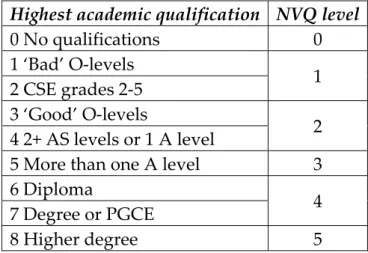
Which of those approaches to choose depends on the particular research question and the reasons why educational attainment is included in the statistical model. Dodgeon et al. (2011) suggest the categorisation shown in Table 1 for highest academic level and equivalence with National Vocational Qualification (NVQ) levels. Vocational qualifications can then be assigned to NVQ levels by reference to the National Qualifications Framework (NQF). Other proposals have been made, see Jenkins and Sabates (2007).
Table 1: Academic and vocational education categories suggested by
Dodgeon et al. (2011)
Highest academic qualification NVQ level
0 No qualifications 0 1 ‘Bad’ O‐levels
2 CSE grades 2‐5 1 3 ‘Good’ O‐levels
4 2+ AS levels or 1 A level 2 5 More than one A level 3 6 Diploma
7 Degree or PGCE 4 8 Higher degree 5
This level of detail with respect to academic qualifications can only be achieved if the original measurement instruments provide for it. For example, Understanding Society does not sufficiently differentiate different levels of vocational qualifications, number of A‐Levels or number and grades of GCSEs to make this scheme feasible. However, not even the BSA allows a strict differentiation of NVQ levels 2 and 3, given the number of A‐Levels is not covered. However a minimum of two A‐Levels is required for university entry, which is thus an important anchor point.
It often makes sense to distinguish vocational and academic qualifications within any one level, even though the distinction is sometimes difficult to draw (e.g., where does ‘teaching’ belong?). Academic and vocational qualifications tend to correlate differently with many dependent variables. For example, when investigating the economic returns to education, ‘parity of esteem’ between vocational and academic qualifications cannot just be taken for granted. It is advisable to aggregate a variable by collapsing categories only if sensitivity analyses (of the most saturated model calculated) suggest that this simplification does not affect the results, e.g. the effects of other
variables.13 Such sensitivity analyses are generally performed too rarely,
especially if educational attainment is ‘only’ a control variable.
4.1 Coding UK educational attainment data for cross‐national research
For cross‐nationally comparative research, it is often desirable to code country‐specific educational qualifications into categories capturing their closest equivalents in other countries. Two categorical coding schemes are in use for this purpose.
Comparative Analysis of Social Mobility in Industrial Nations (CASMIN) The CASMIN education scheme (Brauns et al., 2003) was developed in the 1970s by comparative social stratification researchers and has repeatedly been refined and updated since. It has been widely used in cross‐national studies of social stratification and mobility (e.g. Breen et al., 2009; Müller et al., 1993). It draws both vertical and horizontal distinctions, i.e. differentiation levels and types of education. Table 2 shows how UK qualifications are coded in the CASMIN scheme according to Brauns et al. (2003).
Table 2: CASMIN and its UK equivalents Description UK equivalents 1a Inadequately completed general elementary education no qualification 1b General elementary education
CSE below grade 1, GCSE grades D‐G, SCE standard grades 4‐7, GCS O‐Level grades D‐E
1c Basic vocational
qualification or general elementary education and basic vocational
qualification
Entry Level qualification, Basic Skills qualification, Key Skills qualification, YT/YTP certificate
City and Guilds other, RSA other,
SCOTVEC modules or equivalent, BTEC first or general certificate, GNVQ/GSVQ foundation level, NVQ/SVQ level 1 or equivalent
2a Intermediate vocational qualification or
intermediate general education plus basic vocational qualification
BTEC/SCOTVEC first or general diploma, City and Guilds craft, RSA diploma, GNVQ intermediate, NVQ/SVQ level 2 or equivalent, Traditional Apprenticeship, Modern apprenticeship, Foundation level
2b Intermediate general qualification
CSE grade 1, GCSE grade A‐C or
equivalent, SCE standard grades 1‐3, GCS O‐Level grades A‐C
2c
voc
Full vocational maturity certificate
Modern apprenticeship, Advanced level, City and Guilds advanced craft,
OND/ONC, BTEC/SCOTVEC national, RSA advanced diploma or certificate, GNVQ advanced, NVQ/SVQ level 3 2c
gen
Full general maturity certificate
AS level or equivalent, A level or equivalent, SCE higher or equivalent, Scottish 6th year certificate (CSYS), Access qualification
3a Lower tertiary certificate RSA higher diploma, HNC/HND, BTEC higher etc, NVQ/SVQ level 4, Nursing qualification, Teaching qualification for primary education, other higher education below degree level
3b Higher tertiary certificate University/CNAA Bachelor Degree, Higher degree, Doctorate, NVQ/SVQ level 5,
Teaching qualification for secondary and further education, Diploma in higher education, Graduate member of prof. institute, Foundation degree, PGCE
CASMIN provides a good level of differentiation (although often aggregated versions are used because the data don’t allow this level of detail) and validity across countries. However, it has not been implemented in many countries outside of Europe, and for many European countries bridging instructions are missing.
4.2 The International Standard Classification of Education (ISCED)
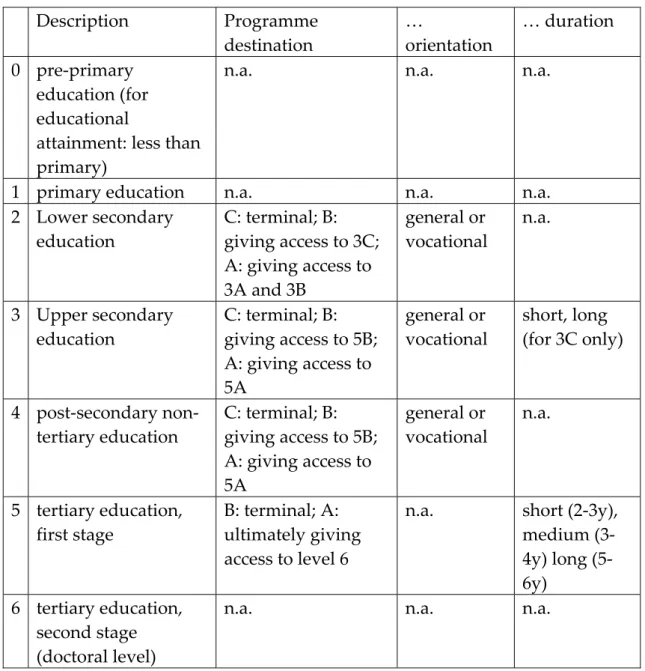
The International Standard Classification of Education 1997 (ISCED, UNESCO, 2006) is an international standard classification for education‐ related data maintained by the UNESCO Institute for Statistics. It establishes standard definitions and criteria for seven levels of education (0 to 6) and a number of sub‐dimensions within most of those levels (see Table 3).
Table 3: ISCED 97 levels and sub‐dimensions Description Programme destination … orientation … duration 0 pre‐primary education (for educational
attainment: less than primary)
n.a. n.a. n.a.
1 primary education n.a. n.a. n.a. 2 Lower secondary education C: terminal; B: giving access to 3C; A: giving access to 3A and 3B general or vocational n.a. 3 Upper secondary education C: terminal; B: giving access to 5B; A: giving access to 5A general or vocational short, long (for 3C only)
4 post‐secondary non‐ tertiary education C: terminal; B: giving access to 5B; A: giving access to 5A general or vocational n.a. 5 tertiary education, first stage B: terminal; A: ultimately giving access to level 6
n.a. short (2‐3y), medium (3‐ 4y) long (5‐ 6y) 6 tertiary education, second stage (doctoral level)
n.a. n.a. n.a.
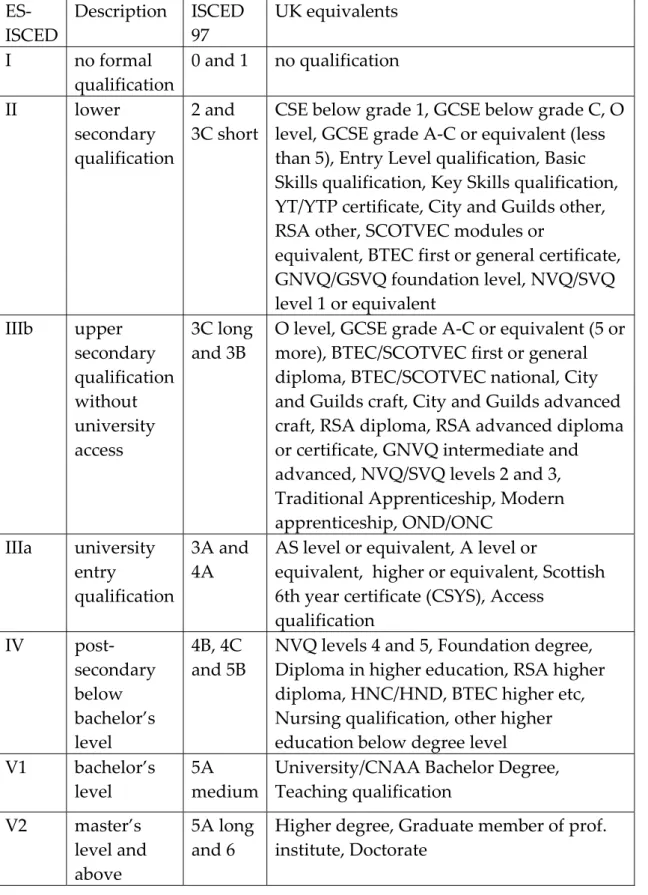
Given its subdimensions are rarely implemented in surveys, ISCED levels are often directly used as an analytical scheme. ISCED levels have however shown to have very limited construct validity in a large number of countries, substantially hampering comparability. An alternative ‘European Survey version of ISCED’ (ES‐ISCED) has been proposed to achieve a more meaningful and comparable analytical scheme that can be derived from a detailed ISCED coding (Schneider 2010). ES‐ISCED is implemented in the European Social Survey (ESS) from round 5 onwards. The bridging to UK qualifications shown is illustrated in Table 4.
Table 4: ISCED 97 and ES‐ISCED for the United Kingdom ES‐ ISCED Description ISCED 97 UK equivalents I no formal qualification 0 and 1 no qualification II lower secondary qualification 2 and 3C short
CSE below grade 1, GCSE below grade C, O level, GCSE grade A‐C or equivalent (less than 5), Entry Level qualification, Basic Skills qualification, Key Skills qualification, YT/YTP certificate, City and Guilds other, RSA other, SCOTVEC modules or
equivalent, BTEC first or general certificate, GNVQ/GSVQ foundation level, NVQ/SVQ level 1 or equivalent IIIb upper secondary qualification without university access 3C long and 3B
O level, GCSE grade A‐C or equivalent (5 or more), BTEC/SCOTVEC first or general diploma, BTEC/SCOTVEC national, City and Guilds craft, City and Guilds advanced craft, RSA diploma, RSA advanced diploma or certificate, GNVQ intermediate and advanced, NVQ/SVQ levels 2 and 3, Traditional Apprenticeship, Modern apprenticeship, OND/ONC IIIa university entry qualification 3A and 4A
AS level or equivalent, A level or
equivalent, higher or equivalent, Scottish 6th year certificate (CSYS), Access
qualification IV post‐ secondary below bachelor’s level 4B, 4C and 5B
NVQ levels 4 and 5, Foundation degree, Diploma in higher education, RSA higher diploma, HNC/HND, BTEC higher etc, Nursing qualification, other higher education below degree level V1 bachelor’s
level
5A medium
University/CNAA Bachelor Degree, Teaching qualification V2 master’s level and above 5A long and 6
Higher degree, Graduate member of prof. institute, Doctorate
The LFS user guide (vol. 5 on classifications) contains a table indicating which UK qualifications are classified in which ISCED 97 level. These assignments
can however be contested (e.g. Schneider 2008, Steedman 1996). Table 4 shows the official way of classifying UK qualifications to ISCED (from Eurostat, 2009) and the respective derived ES‐ISCED. From a comparability point of view, it would be better to classify all O‐level and GCSEs as ISCED level 2 and ES‐ISCED II since the first school‐leaving certificate, usually achieved around age 16, is classified this way in continental Europe. Also, nursing qualifications should only be classified as tertiary if A‐Levels have been completed previously in order to take their upgrading over time into account (for details, see Schneider et al., forthcoming).
ISCED has been revised over the last few years. The revised version, ISCED 2011, is expected to be adopted in November 2011. It will have nine levels (0 to 8) providing further differentiation for tertiary education in line with the European Qualification Framework (EQF) and the Bologna Process. Thus tertiary qualifications below the Bachelor level (new level 5), Bachelor level (new level 6) and Master level (new level 7) will be distinguished. Moreover, the sub‐dimensions within levels will be formalised so that a 3‐digit code is achieved. It will thus become a ‘proper’ classification from which analytical variables can then be derived using standard recoding routines. Further details on ISCED 2011 and its implementation in the European Social Survey round 5 are provided in Schneider (2011).
5. Conclusions
There is no standard way in the UK according to which educational attainment is measured, coded and analysed. This is to some degree due to the fact that for different purposes, educational attainment needs to be measured in different ways. Therefore, theoretical interest thus needs to guide researchers in which way exactly to code educational qualifications: are qualifications used as a proxy for skills and competences, or can we assume signalling effects, or both? Are we concerned with market or non‐market outcomes of education? May the relationship in question be influenced by the type of education achieved, i.e. academic or vocational? Analysts need to re‐ consider, for each study, why they want to measure educational attainment, and achieve a suitable measure through theoretical reasoning and sensitivity testing.
There are a number of issues that would be worthwhile working on in the future:
1. There is no systematic review evaluating available survey measurements and analytical educational attainment variables for the UK (but see Jenkins and Sabates, 2007). To my knowledge, no comprehensive studies have been
conducted comparing the speed and cost of data collection and the reliability, validity and comparability over time of data collected and coded in different ways.
2. Measurement of educational attainment through proxy information is common in household surveys such as the LFS. How valid is proxy information with respect to educational attainment? Is there any difference between school‐leaving certificates, vocational and university qualifications? 3. For capturing foreign qualifications, there are two options: either foreign qualifications are assigned to the closest national equivalent while indicating that the highest educational qualification was achieved abroad (so that when conducting studies referring to the national education system only, those cases can be excluded). Alternatively, foreign qualifications could be coded into the International Standard Classification of Education straight away. 4. Both for cross‐national research and the coding of foreign qualifications, it would be great if in the long run an integrated international data base of educational qualifications would be developed. A UK data base of educational qualifications would be a good start though.
5. Finally it needs to be highlighted that educational attainment and formal qualifications are only the tip of the iceberg in an individual’s educational and learning experience. Skills and competences, field of education, full‐time vs. part‐time study, the specific educational institution, performance in exams and non‐formal education are separate concepts in the area of learning and education that require separate measurements and that may moderate or mediate the effects of educational attainment.
Bibliography
Andersson, R. and Olsson, A.‐K. (1999). Fields of training: Manual. European Centre for the development of vocational training, Thessaloniki.
Brauns, H., Scherer, S., and Steinmann, S. (2003). The CASMIN educational classification in international comparative research. In Hoffmeyer‐Zlotnik, J. H. P. and Wolf, C., editors, Advances in cross‐national comparison: A European working book for demographic and socio‐economic variables, pages 221–244. Kluwer Academic/Plenum, New York; London.
Breen, R., Luijkx, R., Müller, W., and Pollak, R. (2009). Nonpersistent inequality in educational attainment: Evidence from eight European countries. American Journal of Sociology, 114(5): 1475–1521.
Dodgeon, B., Hancock, M., Johnson, J., and Parsons, S. (2011). Deriving highest qualification in NCDS and BCS70. CLS Cohort Studies Data Note 2011/1, Centre for Longitudinal Studies, London.
Eurostat (2009). UOE – UNESCO‐OECD‐Eurostat data collection on education: Mapping of national education programmes to ISCED‐97 for
school/academic year 2006/2007.
http://circa.europa.eu/Public/irc/dsis/edtcs/library?l=/public/unesco_collection /programmes_isced97/
Jackson, M., Luijkx, R., Pollak, R., Vallet, L.‐A., and van de Werfhorst, H. G. (2008). Educational fields of study and the intergenerational mobility process in comparative perspective. Inter‐ national Journal of Comparative Sociology, 49(4‐5): 369–388.
Jenkins, A. and Sabates, R. (2007). The classification of qualifications in social surveys. Technical Report 2007/2, Centre for Longitudinal Studies, London. http://eprints.ioe.ac.uk/5699/1/Jenkins2007Classification_2007_2.pdf
Müller, W. and Karle, W. (1993). Social selection in educational systems in Europe. European Sociological Review, 9(1): 1–23.
Office for National Statistics (2009). Quarterly Labour Force Survey User Guide. Colchester, Essex: UK Data Archive.
Office for National Statistics (2005). Harmonised Concepts and Questions for Social Data Sources: Primary Standards. Office for National Statistics, 3rd edition.
Office for National Statistics (2004). Harmonised Concepts and Questions for Social Data Sources: Secondary Standards. Office for National Statistics, 1st edition.
Qualifications and Curriculum Authority (2006). The National Qualifications Framework: Helping learners make informed decisions. URL: http://www.qcda.gov.uk/resources/6184.aspx
Schneider, S. L. (2011). The International Standard Classification of Education 2011 and its application in cross‐national surveys. Manuscript.
Schneider, S. L., de Heus, M., Luijkx, R., Kieffer, A., Barone, C., Saar, E., and Bartusek, A. (conditionally accepted). Harmonising measures of educational attainment for comparative research: A double comparison of measures across countries. Social Science Research.
Schneider, S. L. (2010). Nominal comparability is not enough: (In‐ )Equivalence of construct validity of cross‐national measures of educational attainment in the European Social Survey. Research in Social Stratification and Mobility, 28(3): 343–357.
Schneider, S. L. (2008). The application of the ISCED‐97 to the UK’s educational qualifications. In Schneider, S. L., editor, The International Standard Classification of Education (ISCED‐97). An evaluation of content and criterion validity for 15 European countries, pages 281–300. MZES, Mannheim.
Smith, T. W. (1995). Some aspects of measuring education. Social Science Research, 24(3): 215–242.
Steedman, H. (1996). Measuring the quality of educational outputs: A note. Discussion paper 302, Centre for Economic Performance, LSE.
UNESCO (2006 [1997]). International Standard Classification of Education: ISCED 1997 (re‐edition). UNESCO‐UIS, Montreal.