E
ffi
cient Indexing for Big Data in
Hadoop MapReduce and Main
Memory Databases
Stefan Richter
Thesis for obtaining the title of Doctor of Engineering
of the Faculties of Natural Sciences and Technology of Saarland University
Saarbr¨ucken, Germany 2015
Dean of the Faculty Prof. Dr. Frank-Olaf Schreyer Day of Colloquium 25.05.2016
Examination Board:
Chairman Prof. Dr. J¨org Hoffmann
Adviser and First Reviewer Prof. Dr. Jens Dittrich Second Reviewer Prof. Dr. Jan Reineke Third Reviewer Prof. Dr. Wolfgang Lehner Academic Assistant Dr. Alvaro Torralba
To my family
Acknowledgements
I want to express my sincere gratitude to everybody who supported me in my doctoral research at Saarland University and contributed to the success of this work. First, I want to thank my advisor Prof. Dr. Jens Dittrich for the opportunity and encouragement to pursue my Ph.D. under his supervision. His motivation, inspiration, experience, and continuous support on many levels have been invaluable for my research and this thesis. Besides my advisor, I also want to thank Prof. Dr. Jan Reineke for reviewing my thesis. My sincere thanks go to Jorge Quian´e and Victor Alvarez for their professional and moral support. They have been role models of postdoctoral researchers to me and I greatly enjoyed working with them. I thank all current and former fellow Ph.D. students at our chair: Stefan Schuh, Endre Palatinus, Felix Martin Schuhknecht, Alekh Jindal, and J¨org Schad. In the past years, many of you have become friends to me and I enjoyed our stimulating discussions and our teamwork. I would also like to thank our secretary Angelika Scholl-Danopoulos for keeping our backs free from administrative works.
Last but not the least, I would like to thank my family: my parents, grandparents, and my sister for their endless love and understanding. You have supported me in countless ways throughout writing this thesis and my life in general.
I acknowledge that parts of the research work presented in this thesis were supported by funding from the German Ministry of Education and Science (BMBF).
Abstract
In recent years, the database community has witnessed the advent and breakthrough of many new system designs like the famous Hadoop MapReduce or main memory databases like MonetDB, Hekaton, SAP Hana, and HyPer to solve the problems of “Big Data”. The system architectures in this generation of emerging systems often radically differ from traditional relational databases. For database research, this trend creates new challenges to design and optimize data structures for those novel architectures. Premier candidates for innovations are index structures, which are traditionally among the most crucial performance factors in databases. In this thesis, we focus on efficient indexing methods for Hadoop MapReduce and main memory databases. Our work consists of three independent parts that resulted from different research projects.
In the first part, we introduceHAIL, a novel approach for efficient static and adaptive indexing in Hadoop MapReduce. We believe that efficient indexing becomes increas-ingly important in the context of very large data sets. HAIL combines very low index build times that are often even invisible for users, with significant runtime improvements for selective MapReduce jobs. We provide extensive experiments, and show that HAIL can improve job runtimes by up to 68x over Hadoop.
In the second part of this thesis, we present an in-depth evaluation of the adaptive radix tree ART, a recent and very promising competitor in the domain of tree-indexes for main memory databases. ART was reported by its inventors to be significantly faster than previous tree indexes and even competitive to hash tables. However, the original evaluation of ART did not considerJudy Arrays, which is, to the best of our knowledge, the first data structure introducing adaptivity to radix trees. Furthermore, the hash ta-ble used in the comparison with ART was just a textbook implementation of chained hashing and not a more sophisticated state-of-the-art hash tables. We provide an ex-tended analysis and experimental evaluation of ART, including a detailed comparison to Judy Arrays, hashing via quadratic probing, and three variants of Cuckoo hashing. Our results give a more differentiated look on ART. In particular, we present striking conceptual similarities between ART and Judy Arrays and show that well-engineered hash tables can beat the lookup throughput of adaptive radix trees by up 6x.
In the third part, motivated by our previous results, we take a closer look at hash-ing methods in main memory databases. We identify seven key factors that influence hashing performance, evaluate their impact, and discuss the implications on hashing in modern databases. Our study indicates that choosing the right hashing method and con-figuration can make an order of magnitude difference in insert and lookup performance. We also provide a guideline for practitioners on when to use which hashing method.
Zusammenfassung
In den letzten Jahren hat die Datenbank-Community das Aufkommen und den Durch-bruch von vielen neuartigen Systementw¨urfen erlebt, deren ¨ubergeordnetes Ziel es ist, die Probleme im Bereich “Big Data” zu l¨osen. Wichtige Beispiele hierf¨ur sind das ber¨uhmte Hadoop MapReduce oder Hauptspeicher-Datenbanken wie MonetDB, He-katon, SAP Hana und Hyper. Die Architekturen in dieser Generation von Systemen un-terscheiden sich oft grundlegend von den Ans¨atzen traditioneller relationaler Datenban-ken. F¨ur die Datenbankforschung schafft diese Entwicklung neue Herausforderungen im Zusammenhang mit dem Entwurf passender Datenstrukturen und deren Optimierung in diesem neuen Kontext. Zu den herausragenden Kandidaten f¨ur Innovationen z¨ahlen hierbei Indexstrukturen, die traditionell zu den wichtigsten Leistungsfaktoren in Daten-banken geh¨oren. In dieser Arbeit konzentrieren wir uns auf effiziente Indizierungsme-thoden f¨ur Hadoop MapReduce und Hauptspeicher-Datenbanken. Unser Beitrag besteht dabei aus drei unabh¨angigen Teilen, die jeweils aus verschiedenen Forschungsprojekten in diesem Bereich entstanden sind.
Im ersten Teil pr¨asentieren wirHAILals neue Methode f¨ur effizientes statisches und adaptives Indizieren in Hadoop MapReduce, einem Framework f¨ur verteilte Datenver-arbeitung auf großen Rechnernetzwerken. Wir glauben, dass effiziente Indizierung im Hinblick auf die sehr großen Datenmengen in typischen Hadoop Systemen besonders wichtig ist. HAIL kombiniert eine sehr niedrige Indizierungszeit, die f¨ur die Nutzer zumeist sogar unsichtbar bleibt, mit erheblichen Laufzeitverbesserungen f¨ur selektive MapReduce Jobs. Wir pr¨asentieren umfangreiche Experimente hierzu und zeigen, dass HAIL Job-Laufzeiten gegen¨uber Hadoop um bis zu 68x verbessert.
Im zweiten Teil dieser Arbeit pr¨asentieren wir eine umfassende Analyse von ART, einem adaptiven Radix-Baum, der einen sehr vielversprechenden Wettbewerber auf dem Gebiet der Indexb¨aume f¨ur Hauptspeicher-Datenbanken darstellt. Die Erfinder von ART erkl¨aren in ihrer Arbeit, dass ART deutlich schneller als vorherige Indexb¨aume ist und sogar an die Leistung von Hash Tabellen heranreicht. Allerdings fehlt in dieser ur-spr¨unglichen Studie ein Vergleich von ART mit Judy Arrays, welches nach unserem Wissen der erste adaptive Radix-Baum ist. Des Weiteren basieren die gezeigten Ergeb-nisse im Zusammenhang mit Hash Tabellen lediglich auf einem Vergleich von ART mit einer einfachen Implementierung von Chained Hashing, anstelle von optimierten Hash Tabellen auf dem neusten Stand der Technik. Wir liefern eine erweiterte Studie zu ART,
einschließlich detaillierter Vergleiche mit Judy Arrays, mit Quadratic Probing sowie mit drei Varianten von Cuckoo Hashing. Unsere Ergebnisse erlauben eine differenziertere Bewertung von ART. Insbesondere erl¨autern wir auch die auff¨alligen konzeptionellen ¨Ahnlichkeiten zwischen ART und Judy Arrays. Weiterhin zeigen unsere experimentel-len Ergebnisse, dass der Durchsatz f¨ur Suchanfragen bei Hash Tabelexperimentel-len um bis zu einem Faktor von 6 h¨oher ist als bei adaptiven Radix-B¨aumen.
Im dritten Teil, zu dem uns unsere vorangehenden Ergebnisse motiviert haben, wer-fen wir einen genaueren Blick auf Hashing-Verfahren f¨ur Hauptspeicher-Datenbanken. Wir identifizieren sieben Schl¨usselfaktoren, welche die Leistung von Hash Tabellen be-einflussen. Dar¨uber hinaus diskutieren wir die Auswirkungen dieser Faktoren und die Konsequenzen f¨ur Hashing in modernen Datenbanken. Unsere Studie zeigt deutlich, dass die Wahl der richtigen Hash-Verfahren und deren korrekte Konfiguration einen Unterschied von einer Gr¨oßenordnung bei der Leistung f¨ur Einf¨uge- und Suchopera-tionen machen kann. Abschließend bieten wir auch einen praktischen Leitfaden an, der dabei hilft, das beste Hashing-Verfahren f¨ur eine konkrete Problemstellung zu finden.
Contents
1 Introduction 1
1.1 Motivation . . . 1
1.2 Overview . . . 2
2 Background, Contributions, and Publications 5 2.1 Chapter 3 : HAIL — Hadoop Adaptive Indexing Library . . . 5
2.1.1 Background . . . 5
2.1.2 Contributions . . . 6
2.1.3 Personal Contributions . . . 8
2.1.4 Publications . . . 8
2.2 Chapter 4 : A Comparison of Adaptive Radix Trees and Hash Tables . . 10
2.2.1 Background . . . 10
2.2.2 Contributions . . . 12
2.2.3 Publications . . . 13
2.3 Chapter 5 : A Seven-Dimensional Analysis of Hashing Methods and its Implications on Query Processing . . . 13
2.3.1 Background . . . 13
2.3.2 Contributions . . . 14
2.3.3 Publications . . . 15
3 Towards Zero-Overhead Static and Adaptive Indexing in Hadoop 17 3.1 Introduction . . . 17
3.1.1 Motivation . . . 18
3.1.2 Research Questions and Challenges . . . 21
3.1.3 Contributions . . . 22
3.2 Overview . . . 23
3.2.1 HDFS and Hadoop MapReduce . . . 24
3.2.2 HAIL . . . 24
3.2.3 HAIL Benefits . . . 25
3.3 HAIL Zero-Overhead Static Indexing . . . 26
3.3.1 Data Layout . . . 26 xiii
3.3.2 Static Indexing in the Upload Pipeline . . . 27
3.3.3 HDFS Namenode Extensions . . . 29
3.3.4 An Index Structure for Zero-Overhead Indexing . . . 30
3.4 HAIL Job Execution . . . 31
3.4.1 Bob’s Perspective . . . 31
3.4.2 System Perspective . . . 33
3.4.3 HailInputFormat and HailRecordReader . . . 34
3.4.4 Missing Static Indexes . . . 35
3.5 HAIL Zero-Overhead Adaptive Indexing . . . 35
3.5.1 HAIL Adaptive Indexing in the Execution Pipeline . . . 36
3.5.2 AdaptiveIndexer Architecture . . . 37
3.5.3 Pseudo Data Block Replicas . . . 39
3.5.4 HAIL RecordReader Internals . . . 40
3.6 Adaptive Indexing Strategies . . . 41
3.6.1 Lazy Adaptive Indexing . . . 42
3.6.2 Eager Adaptive Indexing . . . 42
3.6.3 Selectivity-based Adaptive Indexing . . . 45
3.7 HAIL Splitting and Scheduling . . . 46
3.8 Related Work . . . 47
3.9 Experiments on Static Indexing . . . 49
3.9.1 Hardware and Systems . . . 50
3.9.2 Datasets and Queries . . . 51
3.9.3 Data Loading with Static Indexing . . . 52
3.9.4 Job Execution using Static Indexes . . . 56
3.9.5 Impact of the HAIL Splitting Policy . . . 61
3.10 Experiments on Adaptive Indexing . . . 61
3.10.1 Hardware and Systems . . . 63
3.10.2 Datasets and Queries . . . 63
3.10.3 Adaptive Indexing Overhead for a Single Job . . . 64
3.10.4 Adaptive Indexing Performance for a Sequence of Jobs . . . 66
3.10.5 Eager Adaptive Indexing for a Sequence of Jobs . . . 67
3.11 Conclusion . . . 68
4 A Comparison of Adaptive Radix Trees and Hash Tables 71 4.1 Introduction . . . 71 4.1.1 Contributions . . . 72 4.2 Radix Trees . . . 73 4.2.1 Judy Array . . . 74 4.2.2 ART . . . 77 4.3 Hash Tables . . . 78 4.3.1 Quadratic probing . . . 78
CONTENTS xv
4.3.2 Cuckoo hashing . . . 79
4.3.3 Hash functions . . . 81
4.4 Main Experiments . . . 81
4.4.1 Experimental setup . . . 83
4.4.2 Specifics of our workloads . . . 83
4.4.3 Non-covering evaluation . . . 84
4.4.4 Mixed workloads . . . 91
4.4.5 Covering evaluation . . . 92
4.5 Conclusions . . . 98
5 A Seven-Dimensional Analysis of Hashing Methods and its Implications on Query Processing 101 5.1 Introduction . . . 101 5.1.1 Our Contributions . . . 102 5.2 Hashing Schemes . . . 103 5.2.1 Chained Hashing . . . 104 5.2.2 Linear Probing . . . 105 5.2.3 Quadratic Probing . . . 106
5.2.4 Robin Hood Hashing on LP . . . 106
5.2.5 Cuckoo Hashing . . . 108 5.3 Hash Functions . . . 109 5.3.1 Multiply-shift . . . 109 5.3.2 Multiply-add-shift . . . 109 5.3.3 Tabulation hashing . . . 110 5.3.4 Murmur hashing . . . 111 5.4 Methodology . . . 111 5.4.1 Setup . . . 111
5.4.2 Measurement and Analysis . . . 112
5.4.3 Data distributions . . . 112
5.4.4 Narrowing down our result set . . . 112
5.4.5 On load factors for chained hashing . . . 113
5.5 Write-once-read-many (WORM) . . . 114
5.5.1 Low load factors: 25%, 35%, 45% . . . 115
5.5.2 High load factors: 50%, 70%, 90% . . . 118
5.6 Read-write workload (RW) . . . 122
5.7 On table layout: AoS or SoA . . . 125
A Mosquito: Another One Bites the Data Upload STream 131
A.1 Abstract . . . 131
A.2 Introduction . . . 131
A.3 Mosquito Overview . . . 132
A.3.1 Aggressive Indexing . . . 133
A.3.2 Adaptive Indexing . . . 133
A.3.3 Aggressive Map Execution . . . 134
A.4 Demonstration and Use Cases . . . 135
A.4.1 Demo Setup . . . 135
A.4.2 Use Cases . . . 135
List of Figures 139
List of Tables 141
Chapter 1
Introduction
1.1
Motivation
In our modern society, the amount of data that is stored and processed grows rapidly year by year. This data is generated everywhere around us, for example on social media websites, by cell phones, financial transactions, logistics, images, videos, and by various other sensors. If we consider this huge increase in data sources in our daily life, it should not come at a surprise that by far the largest share of all digital data in the world was created in very recent years1. However, not only the sheer volume of data is increasing,
but also its variety, veracity, and the velocity in which data must be handled. These changes imposed huge challenges on database research and demonstrated the limits of traditional approaches to data management.
Apparently, these new problems could not simply be solved by adapting the om-nipresent disk-based relational database systems of the past, that have been in the focus of database research for decades. Instead, we have seen the advent of new system de-signs, which benefit from recent advancements in computer hardware, such as high performance multicore CPUs, huge main memory, or simply the increased hardware cost-efficiency. Maybe the most prominent example from this generation of emerg-ing systems is Hadoop MapReduce, a massively parallel distributed system for large-scale batch processing on unstructured data. The availability of cheap but powerful commodity hardware, low upfront investments, and relative easy-of-use made Hadoop MapReduce a disruptive technology that changed the world by making data processing at petabyte scale widely available. Another important branch of new system designs are main memory (also called in-memory) relational databases. Nowadays, the memory sizes for mainstream servers reaches the scale of terabytes and most users (excluding the largest technology companies) can already store their entire data in the main memory of
1According to SINTEF [16], already in 2013 90% of the digital data in the world was created within the last two years.
a single machine. Main memory databases benefit from this development by removing the bottleneck of disk or network I/O from their data processing pipelines. Thus, they provide orders of magnitude improvements in latency and throughput compared to their disk-based ancestors.
We strongly believe that in the context of these changes, we should discuss the con-sequences for optimal data structures and algorithms that should be employed in those new systems. One premier example in this area are database index structures, which are traditionally among the most crucial factors for the performance of data management systems. Indexes can accelerate data retrieval dramatically, because they allow us to quickly identify and locate records that qualify with respect to a filter condition. Thus, indexes can reduce the amount of data that has to be processed to answer a query by orders of magnitude. However, this benefit is only available if a suitable index for a filter condition is available, and the availability of indexes, in turn, is limited by the fact that indexes do not come for free. Each index consumes resources, such as memory or disc space, and the footprint for most indexes typically grows linearly with the size of the indexed data. Furthermore, indexes must first be created and even maintained in the presence of updates, which is costly. As a result, designing index structures and methods that offer good tradeoffs between search features (e.g. range predicates, prefix searches, multiple dimensions), index performance, and indexing costs is a complex and important research topic. In the context of disk-based relational database systems, in-dexing has been researched for decades and is still not considered a solved problem. For those observations, several questions arise: How much of those previous results carry over to the new systems? What modifications to index structures should we make, and where are new potentials for innovation?
This thesis is a contribution to the discussion about indexing in a new age of data processing. In particular, we focus on exploring indexing methods in Hadoop MapRe-duce and main memory databases.
1.2
Overview
This work consist of three independent parts that correspond to the different projects of my doctoral research.
First, we present HAIL (Hadoop Adaptive Indexing Library), a novel approach for efficient static and adaptive indexing in the distributed data processing framework Hadoop together with an in-depth evaluation (Chapter 3) and an associated system demonstration (Appendix A).
Then, we shift our focus away from distributed systems towards index structures for main memory databases. In particular, we focus on the adaptive radix treeARTful[76], a recent and promising competitor in the domain of main memory indexes, that was re-ported to be significantly faster than previous tree indexes and even competitive to hash
1.2. Overview 3 tables. In this work we provide an in-depth analysis and experimental comparison of ARTful and relevant prior work, i.e. Judy Array[12] and competitive hashing schemes, which were not considered in the original paper (Chapter 4).
Motivated by our results we finally take a closer look at hashing methods for main memory databases. We identify seven key factors that influence hashing performance, evaluate their impact, and discuss the implications for hashing as an essential building block for algorithms in modern database systems (Chapter 5).
As each chapter covers a full research project, we decided to keep all chapters self-contained. This means that there is no consolidation across chapters, for example on introductions and foundational parts. In the following Chapter 2 we provide the back-grounds, as well as details about contributions and previous publications for each of the aforementioned chapters. We also point out the connections of all parts in the context of this work as a whole.
Chapter 2
Background, Contributions, and
Publications
2.1
Chapter 3 : HAIL — Hadoop Adaptive Indexing
Library
2.1.1
Background
In Chapter 3 we introduce HAIL (Hadoop Adaptive Indexing Library), a novel ap-proach for static and adaptive indexing in Hadoop MapReduce [111]. Recently, Hadoop MapReduce has evolved into an important industry standard for massive parallel data processing and has become widely adopted for a variety of use-cases. However, when we started our work on the HAIL project in 2011, Hadoop MapReduce was still a rather young, emerging open source project inspired by Google’s famous MapReduce pa-per [26] that had yet to reach its adolescence. Nevertheless, Hadoop’s promise of ease-of-use and scalability on commodity hardware entailed a rapidly growing user base, including important companies like Facebook, IBM, eBay, Twitter, AOL, Adobe and Yahoo!. Hadoop was considered a key technology that could make large scale data pro-cessing widely available and affordable for the first time. With this technology at their fingertips, researchers as well as practitioners started to explore the potential of Hadoop as a foundation for various data intensive applications, such as graph algorithms [9] and RDF [57], machine learning [89, 80], data warehousing [108] and a distributed database [47, 1] — to name a few. However, Hadoop MapReduce was originally de-signed as a framework for parallel and distributed batch computations, scanning over large amounts of unstructured data that is stored on a cluster of commodity machines. It is obvious that this initial design of Hadoop is not well suited or “lacks” certain features for many of the aforementioned applications and, in turn, such applications often have to stretch or extend the boundaries of the system. This also contributes to the
ing observations that Hadoop, despite being very scalable, is rather resource-inefficient compared to more specialized systems.
In 2009, an experimental study by Pavlo et. al. [92] compared Hadoop MapRe-duce against two parallel DBMSs and found that Hadoop was slower by a large factor for most analytical queries. They concluded that MapReduce is “a major step back-wards” from parallel DBMSs. In a follow-up article [27], the authors of the initial MapReduce paper disagreed with this assessment, mentioning that those conclusions were “(...) based on implementation1 and evaluation shortcomings not fundamental to the MapReduce model”. Both works, however, agree that the lack of indexes and the commitment to “schema-later”, which results in parsing overhead at runtime and suboptimal data layout, significantly contributed to the low performance of Hadoop MapReduce. As a result, several papers tried to solve those problems and have shown that indexes [1, 35, 79, 64, 78] and storing data in binary format using optimized lay-outs [24, 66, 81, 55, 45] can improve the performance of several classes of MapReduce jobs dramatically. However, one major weakness of all previous approaches to index-ing and data layouts are high parsindex-ing and index creation costs. This shortcomindex-ing has inspired our work on HAIL, an approach for indexing in Hadoop that focuses on mini-mizing and hiding the parsing and index creation costs. HAIL creates different clustered indexes over terabytes of data with only minimal, often invisible overhead and can dra-matically improve runtimes of selective MapReduce jobs. This is a huge improvement over previous work where index creation costs are significant and can become almost prohibitive for large datasets. This way we also reduce the performance gap to parallel relational databases.
Research on indexing in Hadoop is still ongoing, and after the publication of HAIL there have been several related works in this area which we will briefly summarize in the following. While HAIL offers record-level indexes per HDFS block, the authors of E3 (Eagle Eyed Elephant) [42] propose split-oriented indexing, i.e. building one index for each file that allows for excluding complete blocks of the file from processing. Spa-tialHadoop [40] and ScalaGIST [83] extend Hadoop to support multi-dimensional and spatial indexing. However, none of these works focuses on minimizing index creation costs. In this respect, Instant Loading [87] is related to HAIL as it transfers two core ideas, invisible parsing and index creation at insert time to the main memory database HyPer [70]. AIR (Adaptive Index Replacement) [104] is an enhancement for automatic index selection and replacement in HAIL’s adaptive indexing pipeline.
2.1.2
Contributions
In the following, we present a detailed lists of contributions for HAIL:
1The term “implementation” here refers to Hadoop MapReduce, in contrast to, e.g., Google’s undis-closed implementation.
2.1. Chapter 3 : HAIL — Hadoop Adaptive Indexing Library 7 1. Zero-Overhead Indexing. We show how to effectively piggyback sorting and index creation on the existing HDFS upload pipeline. This way it is not needed to run a MapReduce job to create those indexes, nor to read the data a second time in any other way for the purpose of indexing. In fact, the HAIL upload pipeline is so effective when compared to HDFS that the additional overhead of sorting and index creation is hardly noticeable in the overall process. Therefore, we offer a win-win situation over Hadoop MapReduce and even over Hadoop++[35]. We give an overview of HAIL and its benefits in Section 3.2.
2. Per-Replica Indexing.We show how to exploit the default replication of Hadoop to support different sort orders and indexes for each block replica (Section 3.3). For a default replication factor of three, up to three different sort orders and clus-tered indexes are available for processing MapReduce jobs. Thus, the likelihood to find a suitable index increases and the runtime for a workload improves. Our approach benefits from the fact that Hadoop is only used for appends: there are no updates. Thus, once a block is full, it will never be changed again.
3. Job Execution. We show how to effectively change the Hadoop MapReduce pipeline to exploit existing indexes (Section 3.4). Our goal is to do this with-out changing the code of the MapReduce framework. Therefore, we introduce optional annotations for MapReduce jobs that allow users to enrich their queries by explicitly specifying their selections and projections. HAIL takes care of per-forming MapReduce jobs using normal data block replicas or pseudo data block replicas (or even both).
4. HAIL Scheduling. We propose a new task scheduling, called HAIL Schedul-ing, to fully exploit statically and adaptively indexed data blocks (Section 3.7). The goal of HAIL Scheduling is twofold: (i) to reduce the scheduling overhead when executing a MapReduce job, and (ii) to balance the indexing effort across computing nodes to limit the impact of adaptive indexing.
5. Zero-Overhead Adaptive Indexing. We show how to effectively piggyback adaptive index creation on the existing MapReduce job execution pipeline (Sec-tion 3.5). The idea is to combine adaptive indexing and zero-overhead indexing to solve the problem of missing indexes for evolving or unpredictable workloads. In other words, when HAIL executes a map reduce job with a filter condition on an unindexed attribute, HAIL creates that missing index for a certain fraction of the HDFS blocks in parallel.
6. Adaptive Indexing Strategies. We propose a set of adaptive indexing strategies that makes HAIL aware of the performance and the selectivity of MapReduce jobs (Section 3.6). We present:
(a) lazyadaptive indexing, a technique that allows HAIL to adapt to changes in the users’ workloads at a constant indexing overhead.
(b) eager adaptive indexing, a technique that allows HAIL to quickly adapt to changes in the users’ workloads with a robust performance.
(c) We then show how HAIL can decide which data blocks to index based on the selectivities of MapReduce jobs.
7. Exhaustive Validation. We present an extensive experimental comparison of HAIL with Hadoop and Hadoop++[35] (Section 3.9 and Section 3.10). We use seven different clusters including physical and virtual EC2 clusters of up to 100 nodes. A series of experiments shows the superiority of HAIL over both Hadoop and Hadoop++. Another series of scalability experiments with different datasets also demonstrates the superiority of using adaptive indexing in HAIL. In particu-lar, our experimental results demonstrate that HAIL: (i) creates clustered indexes at upload time almost for free; (ii) quickly adapts to query workloads with a neg-ligible indexing overhead; and (iii) only for the very first job does HAIL have a small overhead over Hadoop when creating indexes adaptively: all the following jobs are faster in HAIL.
2.1.3
Personal Contributions
Our work on HAIL initially started as my Master thesis and eventually became a larger team project that involved several members of our research group. As a member of this team developing HAIL I was involved in almost all aspects of the system from the start to the end of the project. I declare my personal contributions in Table 2.1.
2.1.4
Publications
• [96] Stefan Richter. HAIL: Hadoop Aggressive Indexing Library. Master’s thesis,
Saarland University, Germany, 2012
• [36] Jens Dittrich, Jorge-Arnulfo Quian´e-Ruiz, Stefan Richter, Stefan Schuh,
Alekh Jindal, and J¨org Schad. Only Aggressive Elephants are Fast Elephants. PVLDB, 5(11):1591–1602, 2012.
• [99] Stefan Richter, Jorge-Arnulfo Quian´e-Ruiz, Stefan Schuh, and Jens Dittrich.
Towards Zero-Overhead Adaptive Indexing in Hadoop. CoRR, abs/1212.3480, 2012.
• [100] Stefan Richter, Jorge-Arnulfo Quian´e-Ruiz, Stefan Schuh, and Jens
Dit-trich. Towards Zero-Overhead Static and Adaptive Indexing in Hadoop. VLDB Journal, 23(3):469–494, 2013.
2.1. Chapter 3 : HAIL — Hadoop Adaptive Indexing Library 9
• [37] Jens Dittrich, Stefan Richter, and Stefan Schuh. Efficient OR Hadoop: Why
Not Both? Datenbank-Spektrum, 13(1):17–22, 2013.
• [98] Stefan Richter, Jens Dittrich, Stefan Schuh, and Tobias Frey. Mosquito:
Another one bites the Data Upload STream. PVLDB, 6(12):1274–1277, 2013, demo paper, see Section A.
• Patent: Replicated data storage system and methods WO 2013139379 A1.
Contribution Involvement Details
Zero-Overhead Static Index-ing.
major I developed and implemented most of this contribution. SS and JQ were in-volved in discussions and supported me in coding and debugging.
Per-Replica Indexing. major see above.
Job Execution. major see above.
HAIL Scheduling no SS developed this together with JQ.
Zero-Overhead Adaptive In-dexing.
major I developed and implemented most of this contribution. SS and JQ were in-volved in discussions and supported me in coding and debugging.
Lazy Adaptive Indexing
Strategy.
full I developed this on my own as default strategy of the Adaptive Indexer. Eager Adaptive Indexing
Strategy.
minor I was involved in the discussion of this idea with SS, but the implementation was done by him.
Selectivity-based Adaptive Indexing Strategy.
major I developed this on my own and SS was involved in the discussion.
Exhaustive validation. minor I was involved in designing, writing,
and running jobs for the experiments and particularly in the evaluation and interpretation of results. Most work for writing and running the jobs was done by SS, JQ, and JS.
Table 2.1: Personal contributions to Chapter 3. Contributions by Stefan Schuh (SS),
Jorge-Arnulfo Quian´e-Ruiz (JQ), and J¨org Schad (JS) are mentioned in the “Details” column.
Initial results of the HAIL project were published as my Master Thesis [96]. An ex-tended version containing the HAIL Splitting strategy was published in PVLDB [36]. Afterwards, we introduced adaptive indexing in Hadoop and published the results in
a technical report [99]. A combined article including the description of the original HAIL system and the adaptive indexing of LIAH was then published in the VLDB Jour-nal [100]. Chapter 3 of this thesis is an extended version of that jourJour-nal article. I decided to include the full article, as it is very hard to understand my personal contributions for this thesis in isolation.
2.2
Chapter 4 : A Comparison of Adaptive Radix Trees
and Hash Tables
2.2.1
Background
MapReduce started the wide and general adoption of data analytics on unstructured data at large scale in both research and industry. With this use-case in mind, Hadoop was clearly designed for long running queries in batch fashion and to address the problem of ever growing dataset sizes. Hadoop offered a solution that could handle many problems related to this dimension of dataset size. With this focus on the dimension of dataset size, Hadoop does not really offer a solution for applications that are difficult in other dimensions like query latency or throughput, and it became quickly clear that Hadoop MapReduce was not a solution that fits all problems [92, 105]. For example, OLTP (On-line Transaction Processing) applications for businesses are typically not problematic in terms of pure dataset size as the amount of customers, products and orders per year ob-viously do not follow Moore’s law. However, real-time transactions and analytics over data in the size of up to a few terabytes can bring huge benefits and enable new ways in which companies run their businesses. With prices for main memory constantly de-creasing, it became possible to run database applications for most companies completely in main memory, and leave high I/O-costs that come along with traditional, disk-based approaches out of the equation. This combination of technical progress and customer demands triggered the development of a new generation of main memory databases, like MonetDB, H-Store/VoltDB [68], SAP HANA [43], Microsoft Hekaton [28], and HyPer [70]. A common design trait of this generation is heavy optimization for modern hardware features that mitigate the impact of the ever growing performance gap be-tween the storage medium main memory and CPU, thus aiming for getting as close to becoming CPU-bound as possible.
With the paradigm shift from disk-based to memory-based systems there is also a shift in the relevant optimizations and their impact. For example, arguably the most important optimization in disk-based system is to avoid disk I/O (and random I/O in particular) by keeping hot data in main memory wherever possible. Interestingly, the essence of this idea can be transferred to main memory systems as well and is again the foundation to one of the most important optimizations. In this analogy, main memory databases try to keep hot data in the cache hierarchy, as close to the CPU as possible
2.2. Chapter 4 : A Comparison of Adaptive Radix Trees and Hash Tables 11 and try to avoid accesses to the slower memory (again in particular random accesses) at all costs. While the basic idea of cache optimization already finds application in older disk based systems, it is now playing a more fundamental role in main memory where the latencies are orders of magnitude smaller. As a result, optimizations for main memory databases present new challenges to the way data should be stored and accessed in order to be processed efficiently. For example, such challenges occur when designing new tree index structures, which are crucial for the performance of database systems, on disk as well as in main memory. Tree-shaped index structures have already come a long way from binary search trees and their variants (e.g., AVL-tree, Red-Black-Tree, Splay-Tree). While binary search trees are interesting from a theoretical perspective, they have become less and less popular in practice over years. The main reason for this development is the ever-growing gap in performance between CPU and memory, which entailed increasing cache sizes and the addition of more and more layers to the memory hierarchy over time. As a result, the assumption of uniform memory access costs is invalid in practice for modern hardware architectures.
This observation triggered the development of index structures like the venerable B-tree and its variants, which were developed to improve cache and memory efficiency over binary search trees and are still widely used in many current database systems. However, B-trees were originally designed to accelerate disk-based systems, but they are no longer the way to go in main memory systems because, at least in their original form, their cache utilization is suboptimal. In addition to that, the algorithms on B-trees rely heavily on key comparisons, which are hard do predict for the hardware and there-fore introduce significant amounts of branch mispredictions. Branch mispredictions, in turn, entail pipeline stalls which are expensive on modern CPUs that often feature long execution pipelines.
Because of the aforementioned shortcomings, the last decade has seen a consider-able amount of research on tree-structured indexes for main memory systems [72, 102, 8, 15, 69, 85, 71, 76]. Among the most recent and most interesting data structures for main memory systems there is the recently-proposed adaptive radix tree ARTful [76] (ART for short). ART was integrated into the state-of-the-art main memory database HyPer [70] and, for example, reported to boost the performance of OLTP by a factor of two over previous approaches. Furthermore, the authors of ART presented experi-ments that indicate that ART was clearly a better choice over other recent tree-based data structures like FAST [71] and CSB+-trees [95]. However, ART was not the first
adaptive radix tree. To the best of our knowledge, the first was Judy Array (Judy for short), and a comparison between ART and Judy was not shown. This raised the ques-tion for us, whether a performance that is comparable to ART was already available for years through Judy, a data structure that is more than a decade old. Moreover, the same set of experiments indicated thatonly a hash table was competitive to ART. The hash table used by the authors of ART in their study was a chained hash table, but this kind of
hash tables can be suboptimal in terms of space and performance due to their potentially high use of pointers.
2.2.2
Contributions
In Chapter 4 weextendthe discussion of related work and the experimental comparison offered by the authors of ART in the original paper. This includes the following major contributions:
1. Conceptual comparison of ART and Judy Array.We provide an in-depth com-parison for both, concepts and implementation of ART and Judy Array, which is missing in the original paper [76] on ART. We show striking similarities between both structures, although the design of Judy Array is more than a decade older than ART. As Judy Array is a patented technology, this information is valuable to (re-)assess the novelty of ART and the possible risks of integrating ART into commercial databases.
2. Experimental comparison of ART and Judy Array.Similar to the conceptional comparison, the authors of ART also did not include Judy Array in their exper-imental comparison of ART with other index structures. We close this gap and provide a detailed comparison between ART and Judy Array w.r.t. performance and memory consumption.
3. Experimental comparison of ART and well-engineered hashing schemes. In the original paper, the authors found that the performance of ART is competitive to hash tables. However, they only compared against a textbook implementa-tion of chained hashing with Murmur [7] as hash funcimplementa-tion. This combinaimplementa-tion is arguably a suboptimal representative for hash tables in their benchmark. We in-vestigate how the picture changes when we use more elaborate, well-engineered hashing tables, such as Google’s sparse and dense hash tables [48] and our own implementations of Cuckoo hashing, as well as different hash functions. We sim-ulate two different types of workloads in our experiments, OLAP (bulk inserts and bulk lookup) and OLTP (a mix of inserts, deletes and lookups) and provide a micro-architectural analysis of our results using CPU performance counters. 4. Evaluation of range query performance. In the original work on ART, the
authors explain that efficient support for range queries is one big advantage of tree structured indexes over hash tables. However, they do not provide an experimental evaluation of the range query performance of ART. In fact, range query support was not implemented in the published ART code. We implemented this missing feature and compared the range query performance of ART, e.g. against Judy Array and a B+-tree.
2.3. Chapter 5 : A Seven-Dimensional Analysis of Hashing Methods and its
Implications on Query Processing 13
5. Evaluation for covering and non-covering indexing scenarios. In our experi-ment, we differentiate two relevant use-cases for our indexes. The first use-case is covering index, where both keys and values are completely stored inside the index structure. Here, the index is used as a stand-alone data structure. The sec-ond use-case isnon-coveringindex, where the index itself does not contain keys and values. Instead a non-covering index operates on top of a primary store that contains the keys and values, e.g. a database table.
2.2.3
Publications
[6] Victor Alvarez, Stefan Richter, Xiao Chen, and Jens Dittrich. A Comparison of Adaptive Radix Trees and Hash Tables. In31st IEEE ICDE, April 2015
2.3
Chapter 5 : A Seven-Dimensional Analysis of
Hash-ing Methods and its Implications on Query
Process-ing
2.3.1
Background
Our work in Chapter 5 addresses a problem that we encountered during our previous studies from Chapter 4. Many researchers and practitioners are tempted to consider hashing a solved problem and there is noticeably less work published on hash based indexing compared to, e.g. tree indexes in recent database research. In the database community, hashing is often considered as a simple way to achieve lookups in constant time, where it is safe to use an arbitrary method as a black box and expect good per-formance. Moreover, it seems like we expect that optimizations to hashing can only improve it by a negligible delta. For example, textbook chained hashing is still used as the default implementation in the code bases of many research prototypes, database im-plementations, and the standard libraries of popular programming languages. Chained hashing became popular already in the 50s as, perhaps, the very first iteration of hash-ing — robust and easy to implement. However, nowadays, plain chained hashhash-ing is often a suboptimal choice in practice w.r.t. performance and memory efficiency for many use-cases on modern hardware due to its use of pointers. We found it remark-able, that relatively little attention is given to a technique like hashing, that is ubiquitous in databases, e.g. as hash index structure and as the backbone of many algorithms like hash-joins, deduplication, and hash-based aggregation. Rather recently, there has been a considerable amount of interesting theoretical research on new hashing algorithms, e.g. on Cuckoo hashing [90], as well as interesting reconsiderations about the proper-ties of well-established methods like linear probing in combination with certain hash
functions [93]. Those lines of research with promising theoretical results made us cu-rious, whether or not the proposed techniques could also make an impact in practice on real hardware where constant factors are sometimes more important for performance than asymptotic behavior, and if there is application for those ideas in databases. In the end, we were interested how different hash table implementations would compare to each other in this context, what tradeoffs different approaches could provide, how much this choice would affect performance, and how the theoretical results will match practi-cal observations. On top of that, between the lines in recent work, we found evidence that hashing performance in databases is severely impacted by more factors than just the hash table. For example, a recent work on hash joins [75] reported that just using a different hash function with lower computational complexity already improved the end-to-end runtime of their hash join by 36%. This observation made us wonder, what dimensions impact the performance of hashing in databases and what the relationship and impact of those dimensions are in a modern system. In addition to hash table orga-nization and hash function, we identified that five further dimensions have an important influence on hashing performance. To put things in perspective, we carefully study this, in total, seven-dimensional parameter space and we also offer a glimpse about the ef-fect of different memory layouts and the use of SIMD instructions. Our main goal is to produce enough results that can guide practitioners, and potentially the query optimizer, towards choosing the most appropriate hash table for their use-case at hand.
In this study, we decided to focus on hash tables in a single-threaded context to isolate the impact of the aforementioned dimensions. We believe that a thorough evalu-ation of concurrency in hash tables is a research topic that deserves a complete study on its own. However, our observations still play an important role for hash maps in multi-threaded algorithms. For partitioning-based parallelism — which has recently been considered in the context of (partition-based hash) joins [10, 11, 75] — single-threaded performance is still a key parameter: each partition can be considered an isolated unit of work that is only accessed by exactly one thread at a time, and therefore concurrency control inside the hash tables is not needed. Furthermore, all hash tables we present in the paper can be extended for thread safety through well-known techniques such as striped locking or compare-and-swap. Here, the dimensions we discuss still impact the performance of the underlying hash table.
We focus on 64-bit integer keys and values, which is arguably the most important mapping in modern and future main memory databases for large datasets. In partic-ular, main memory databases typically make heavy use of dictionary compression to substitute complex or variable-length datatypes (e.g. strings) with integer values.
2.3.2
Contributions
2.3. Chapter 5 : A Seven-Dimensional Analysis of Hashing Methods and its
Implications on Query Processing 15
1. Overview on hashing schemes and hash functions. We give an overview on five of the most important hashing schemes (including linear probing, quadratic probing, Robin Hood hashing [21], Cuckoo hashing [90], and chained hashing) and four hash functions (Multiply-shift [30], Multiply-add-shift [29], Tabulation hashing [114, 110, 93], and Murmur hashing [7]) that we considered for our study. 2. Identification of five additional dimensions and evaluation of their impact on hashing performance. Given a hashing scheme and a hash function, we identify five additional dimensions that can significantly impact the performance of hash tables (key distribution, load factor, hash table size, read/write ratio, un/successful lookup ratio). Together with hashing schemes and hash functions, we consider in total a seven dimensional space w.r.t. the questionwhich hash table performs best in which situation and why?
3. Experiments for static workload. We present the essential results of our exper-iments that explore the seven dimensional parameter space with respect to static workload (think of OLAP). In this scenario, hash tables are loaded once with a fixed and previously known amount of data and after that lookups are performed. In particular, in this setting, hash tables never have to resize.
4. Experiments for dynamic workload. Similar to the static workload, we also in-vestigate dynamic workload (think of OLTP). Here, the hash tables are preloaded with a certain amount of data. Afterwards, a mixed workload of inserts, deletes, lookups, and updates is executed. In this setting we also observe how the hash tables handle resizing (rehash operation).
5. Experiments on hash table memory layout and vectorization. We also present experiments that explore the impact of different memory layouts (Array-of-Structs vs Struct-of-Arrays) by the example of a linear probing hash table. Furthermore, we also investigate the effects of vectorization (SIMD), e.g. comparing multiple keys in one instruction.
6. Lessons learned and decision diagram for practitioners.We report our lessons learned and condense the results of all experiments in a flow diagram that can guide practitioners towards the right hash table configuration for their use-case at hand.
2.3.3
Publications
[97] Stefan Richter, Victor Alvarez, and Jens Dittrich. A Seven-Dimensional Analysis of Hashing Methods and its Implications on Query Processing. PVLDB, 9(3):96–107, 2015
Chapter 3
Towards Zero-Overhead Static and
Adaptive Indexing in Hadoop
3.1
Introduction
MapReduce has become the de facto standard for large scale data processing in many enterprises. It is used for developing novel solutions on massive datasets such as web analytics, relational data analytics, machine learning, data mining, and real-time ana-lytics [52]. In particular, log processing emerges as an important type of data analysis commonly done with MapReduce [14, 82, 41].
In fact, Facebook and Twitter use Hadoop MapReduce (the most popular MapRe-duce open source implementation) to analyze the huge amounts of web logs generated every day by their users [107, 51, 79]. Over the last years, a lot of research works have focused on improving the performance of Hadoop MapReduce [24, 56, 63, 66]. When improving the performance of MapReduce, it is important to consider that it was initially developed for large aggregation tasks that scan through huge amounts of data. However, nowadays Hadoop is often also used for selective queries that aim to find only a few relevant records for further consideration1. For selective queries, Hadoop
still scans through the complete dataset. This resembles the search for a needle in a haystack.
For this reason, several researchers have particularly focused on supporting efficient index access in Hadoop [112, 35, 79, 64]. Some of these works have improved the performance of selective MapReduce jobs by orders of magnitude. However, all these indexing approaches have three main weaknesses. First, they require a high upfront cost for index creation. This translates to long waiting times for users until they can actually start to run queries. Second, they can only support one physical sort order (and hence one clustered index) per dataset. This becomes a serious problem if the
work-1A simple example of such a use-case would be a distributed grep.
load demands indexes for several attributes. Third, they require users to have a good knowledge of the workload in order to choose the indexes to create. This is not always possible, e.g., if the data is analyzed in an exploratory way, or queries are submitted by customers.
3.1.1
Motivation
Let us see through the eyes of a data analyst, say Bob, who wants to analyze a large web log. The web log contains different fields that may serve as filter conditions for Bob like visitDate, adRevenue, sourceIP, and so on. Assume Bob is interested in all sourceIPs with a visitDate from 2011. Thus, Bob writes a MapReduce program to filter out exactly those records and discard all others. Bob is using Hadoop, which will scan the entire input dataset from disk to filter out the qualifying records. This takes a while. After inspecting the result set, Bob detects a series of strange requests from sourceIP 134.96.223.160. Therefore, he decides to modify his MapReduce job to show all requests from the entire input dataset having that sourceIP. Bob is using Hadoop. This takes a while. Eventually, Bob decides to modify his MapReduce job again to only return log records having a particular adRevenue. Yes, this again takes a while.
In summary, Bob uses a sequence of different filter conditions, each one triggering a new MapReduce job. He is not exactly sure what he is looking for. The whole en-deavor feels like going shopping without a shopping list. This example illustrates an exploratory usage (and a major use-case) of Hadoop MapReduce [14, 41, 88]. But, this use-case has one major problem: slow query runtimes. The time to execute a MapRe-duce job based on a scan may be very high: it is dominated by the I/O for reading all input data [91, 64]. While waiting for his MapReduce job to complete, Bob has enough time to pick a coffee (or two) and this happens every time Bob modifies the MapReduce job. This will likely kill his productivity and make his boss unhappy.
Now, assume the fortunate case that Bob remembers a sentence from one of his professors saying “full-table-scans are bad; indexes are good”2. Thus, he reads all the recent VLDB papers (including [64, 24, 56, 63]) and finds a paper that shows how to create a so-calledtrojan index[35]. A trojan index is an index that may be used with Hadoop MapReduce and yet does not modify the underlying Hadoop MapReduce and HDFS engines.
Zero-Overhead indexing
Bob finds the trojan index idea interesting and hence decides to create a trojan index on sourceIP before running his MapReduce jobs. However, using trojan indexes raises two other problems:
3.1. Introduction 19 1. Expensive index creation.The time to create the trojan index on sourceIP (or any other attribute) is even much longer than running a scan-based MapReduce job. Thus, if Bob’s MapReduce jobs use that index only a few times, the index creation costs will never be amortized. So, why would Bob create such an expensive index in the first place?
2. Which attribute to index? Even if Bob amortizes index creation costs, the trojan index on sourceIP will only help for that particular attribute. So, which attribute should Bob use to create the index?
Bob is wondering how to create several indexes at very low cost to solve those problems.
Per-Replica indexing
One day in autumn 2011, Bob reads about another idea [66] where some researchers looked at ways to improve vertical partitioning in Hadoop. The researchers in that work realized that HDFS keeps three (or more) physical copies of all data for fault-tolerance. Therefore, they decided to change HDFS to store each physical copy in a differentdata layout (row, column, PAX, or any other column grouping layout). As all data layout transformation is done per HDFS data block, the failover properties of HDFS and Hadoop MapReduce were not affected. At the same time, I/O-times improved. Bob thinks that this looks very promising, because he could possibly exploit this concept to create different clustered indexes almost invisible to the user. This is because he could create one clustered index per data block replica when uploading data to HDFS. This would already help him a lot in several query workloads.
However, Bob quickly figures out that there are cases where this idea still has some annoying limitations. Even if Bob could create one clustered index per data replica at low cost, he would still have to determine which attributes to index when uploading his data to HDFS. Afterward, he could not easily revise his decision or introduce addi-tional indexes without uploading the dataset again. Unfortunately, it sometimes happens that Bob and his colleagues navigate through datasets according to the properties and correlations of the data. In such cases, Bob and his colleagues typically: (1.) do not know the data access patterns in advance; (2.) have different interests and hence can-not agree upon common selection criteria at data upload time; (3.) even if they agree which attributes to index at data upload time, they might end up filtering records ac-cording to values on different attributes. Therefore, using any traditional indexing tech-nique [44, 22, 3, 19, 23, 112, 79, 35, 64] would be problematic, because they cannot adapt well to unknown or changing query workloads.
Adaptive indexing
When searching for a solution to his problem with static indexing, Bob stumbles across a new approach calledadaptive indexing[58], where the general idea is to create indexes as a side effect of query processing. This is similar to the idea ofsoft indexes[84], where the system piggybacks the index creation for a given attribute on a single incoming query. However, in contrast to soft indexes, adaptive indexing aims at creating indexes incrementally (i.e., piggybacking on several incoming queries) in order to avoid high upfront index creation times. Thus, Bob is excited about the adaptive indexing idea since this could be the missing piece to solve his remaining concern. However, Bob quickly notices that he cannot simply apply existing adaptive indexing works [38, 58, 59, 50, 61, 53] in MapReduce systems for several reasons:
1. Global index convergence. These techniques aim at converging to a global index for an entire attribute, which requires sorting the attribute globally. Therefore, these techniques perform many data movements across the entire dataset. Do-ing this in MapReduce would hurt fault-tolerance as well as the performance of MapReduce jobs. This is because the system would have to move data across data blocks in sync with all their three physical data block replicas. We do not plan to create global indexes, but focus on creating partial indexes that in total cover the whole dataset. A small back of the envelope calculation shows that the possible gains of a global index are negligible in comparison with the overhead of the MapReduce framework. For instance, if a dataset is uniformly distributed over a cluster and occupies 160 HDFS blocks on each datanode (like the dataset in our experiments in Section 3.9) and we do not have a global index, then we need to perform 160 index accesses on each datanode. Since all datanodes can access their blocks in parallel to each other, we assume that the overhead is determined by the highest overhead per datanode. Overall, our approach requires at most 318 additional random reads in HDFS per datanode in this scenario, which in turn cost roughly 15ms each. In total, this amounts to 4.77s overhead compared to a global index stored in HDFS. However, even empty MapReduce jobs, which do not read any data nor compute a single map function, run for more than 10s.
2. High I/O-costs. Even if Bob applied existing adaptive indexing techniques inside data blocks, these techniques would end up in many costly I/O operations to move data on disk. This is because these techniques consider main memory systems and thus do not factor in the I/O-cost for reading/writing data from/to disk. Only one of these works [50] proposes an adaptive merging technique for disk-based systems. However, applying this technique inside a HDFS block would not make sense in MapReduce since HDFS blocks are typically loaded entirely into main memory anyways when processing map tasks. One may think about applying
3.1. Introduction 21 adaptive merging across HDFS blocks, but this would again hurt fault-tolerance and the performance of MapReduce jobs as described above.
3. Unclustered index. These works focus on creating unclustered indexes in the first place, and hence, it is only beneficial for highly selective queries. One of these works [59] introduced lazy tuple reorganization in order to converge to clustered indexes. However, this technique needs several thousand queries to converge, and its application in a disk-based system would again introduce a huge number of expensive I/O operations.
4. Centralized approach. Existing adaptive indexing approaches were mainly de-signed for single-node DBMSs. Therefore, applying these works in a distributed parallel systems, like Hadoop MapReduce, would not fully exploit the existing parallelism to distribute the indexing effort across several computing nodes. Despite all these open problems, Bob is very enthusiastic to combine the above interesting ideas on indexing into a new system to revolutionize the way his company can use Hadoop. And this is where the story begins.
3.1.2
Research Questions and Challenges
This article addresses the following research questions:1. Zero-overhead indexing. Current indexing approaches in Hadoop involve a sig-nificant upfront cost for index creation. How can we make indexing in Hadoop so effective that it is basically invisible for the user? How can we minimize the I/O costs for indexing or eventually reduce them to zero? How can we fully utilize the available CPU resources and parallelism of large clusters for indexing? 2. Per-replica indexing. Hadoop uses data replication for failover. How can we
ex-ploit this replication to support different sort orders and indexes? Which changes to the HDFS upload pipeline need to be done to make this efficient? What happens to the involved checksum mechanism of HDFS? How can we teach the HDFS namenode to distinguish the different replicas and keep track of the different in-dexes?
3. Job execution. How can we change Hadoop MapReduce to utilize different sort orders and indexes at query time? How can we change Hadoop MapReduce to schedule tasks to replicas having the appropriate index? How can we schedule map tasks to efficiently process indexed and nonindexed data blocks without af-fecting failover? How much do we need to change existing MapReduce jobs? How will Hadoop MapReduce change from the user’s perspective?
4. Zero-overhead adaptive indexing. How can we adaptively and automatically cre-ate additional useful indexes online at minimal costs per job? How to index big data incrementally in a distributed, disk-based system like Hadoop as byproduct of job execution? How to minimize the impact of indexing on individual job ex-ecution times? How to efficiently interleave data processing with indexing? How to distribute the indexing effort efficiently by considering data locality and index placement across computing nodes? How to create several clustered indexes at query time? How to support a different number of replicas per data block?
3.1.3
Contributions
We propose HAIL (Hadoop Adaptive Indexing Library), a static and adaptive indexing approach for MapReduce systems. The main goal of HAIL is to minimize both (i) the index creation time when uploading data and (ii) the impact of concurrent index creation on job execution times. In summary, we make the following main contributions to tackle the questions and challenges mentioned above:
1. Zero-overhead indexing.We show how to effectively piggyback sorting and index creation on the existing HDFS upload pipeline. This way it is not needed to run a MapReduce job to create those indexes, nor to read the data a second time in any other way for the purpose of indexing. In fact, the HAIL upload pipeline is so effective when compared to HDFS that the additional overhead of sorting and index creation is hardly noticeable in the overall process. Therefore, we offer a win-win situation over Hadoop MapReduce and even over Hadoop++ [35]. We give an overview of HAIL and its benefits in Section 3.2.
2. Per-replica indexing.We show how to exploit the default replication of Hadoop to support different sort orders and indexes for each block replica (Section 3.3). For a default replication factor of three, up to three different sort orders and clustered indexes are available for processing MapReduce jobs. Thus, the likelihood to find a suitable index increases and the runtime for a workload improves. Our approach benefits from the fact that Hadoop is only used for appends: there are no updates. Thus, once a block is full, it will never be changed again.
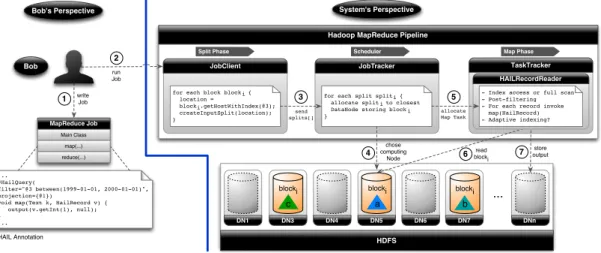
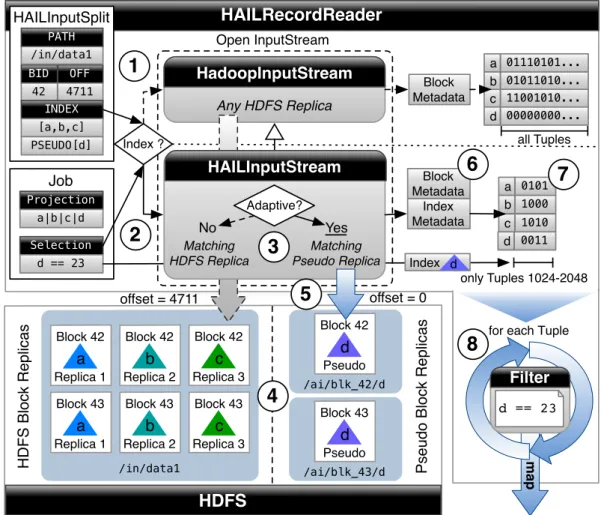
3. Job execution. We show how to effectively change the Hadoop MapReduce pipeline to exploit existing indexes (Section 3.4). Our goal is to do this with-out changing the code of the MapReduce framework. Therefore, we introduce optional annotations for MapReduce jobs that allow users to enrich their queries by explicitly specifying their selections and projections. HAIL takes care of per-forming MapReduce jobs using normal data block replicas or pseudo data block replicas (or even both).
3.2. Overview 23 4. HAIL scheduling. We propose a new task scheduling, calledHAIL Scheduling, to fully exploit statically and adaptively indexed data blocks (Section 3.7). The goal of HAIL Scheduling is twofold: (i) to reduce the scheduling overhead when exe-cuting a MapReduce job, and (ii) to balance the indexing effort across computing nodes to limit the impact of adaptive indexing.
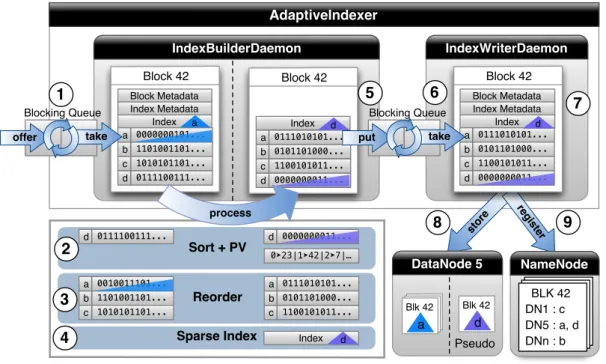
5. Zero-Overhead adaptive indexing. We show how to effectively piggyback adap-tive index creation on the existing MapReduce job execution pipeline (Sec-tion 3.5). The idea is to combine adaptive indexing and zero-overhead indexing to solve the problem of missing indexes for evolving or unpredictable workloads. In other words, when HAIL executes a map reduce job with a filter condition on an unindexed attribute, HAIL creates that missing index for a certain fraction of the HDFS blocks in parallel.
6. Adaptive indexing strategies. We propose a set of adaptive indexing strategies that makes HAIL aware of the performance and the selectivity of MapReduce jobs (Section 3.6). We present:
(a) lazyadaptive indexing, a technique that allows HAIL to adapt to changes in the users’ workloads at a constant indexing overhead.
(b) eager adaptive indexing, a technique that allows HAIL to quickly adapt to changes in the users’ workloads with a robust performance.
(c) We then show how HAIL can decide which data blocks to index based on the selectivities of MapReduce jobs.
7. Exhaustive validation. We present an extensive experimental comparison of HAIL with Hadoop and Hadoop++[35] (Section 3.9 and Section 3.10). We use seven different clusters including physical and virtual EC2 clusters of up to 100 nodes. A series of experiments shows the superiority of HAIL over both Hadoop and Hadoop++. Another series of scalability experiments with different datasets also demonstrates the superiority of using adaptive indexing in HAIL. In particu-lar, our experimental results demonstrate that HAIL: (i) creates clustered indexes at upload time almost for free; (ii) quickly adapts to query workloads with a neg-ligible indexing overhead; and (iii) only for the very first job does HAIL have a small overhead over Hadoop when creating indexes adaptively: all the following jobs are faster in HAIL.
3.2
Overview
In the following, we give an overview of HAIL by contrasting it with normal HDFS and Hadoop MapReduce. Thereby, we introduce the two indexing pipelines of HAIL.
First,static indexing allows us to create several clustered indexes at upload time. Sec-ond, HAIL adaptive indexing creates additional indexes as a byproduct of actual job execution, which enables HAIL to adapt to unexpected workloads. For a more detailed contrast to related work, see Section 3.8.
For now, let’s consider again our motivating example: How can Bob analyze his log file with Hadoop and HAIL?
3.2.1
HDFS and Hadoop MapReduce
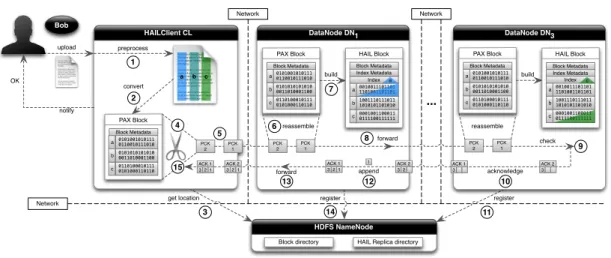
In HDFS and Hadoop MapReduce, Bob starts by uploading his log file to HDFS using theHDFS client. HDFS then partitions the file into logical HDFS blocksusing a con-stant block size (the HDFS default is 64MB). Each HDFS block is then physically stored three times (assuming the default replication factor). Each physical copy of a block is called a replica. Each replica will sit on a differentdatanode. Therefore, at least two datanode failures may be survived by HDFS. Note that HDFS keeps information on the different replicas for an HDFS block in a centralnamenodedirectory.
After uploading his log file to HDFS, Bob may run an actual MapReduce job. Bob invokes Hadoop MapReduce through a Hadoop MapReduceJobClient, which sends his MapReduce jobto a central node termedJobTracker. The MapReduce job consists of severaltasks. A task is executed on a subset of the input file, typically an HDFS block3. The JobTracker assigns each task to a different TaskTracker, which typically runs on the same machine as an HDFS datanode. Each datanode will then read its subset of the input file, i.e., a set of HDFS blocks, and feed that data into theMapReduce processing pipeline which usually consists of a Map, Shuffle, and a Reduce Phase (see [27, 35, 34] for a detailed description). As soon as all results have been written to HDFS, the JobClient informs Bob that the results are available. Notice that, the execution time of the MapReduce job is heavily influenced by the size of the input dataset, because Hadoop MapReduce reads the input dataset entirely in order to perform any incoming MapReduce job.
3.2.2
HAIL
In HAIL, Bob analyzes his log file as follows. He starts by uploading his log file to HAIL using theHAIL client. In contrast to the HDFS client, the HAIL client analyzes the input data for each HDFS block, converts each HDFS block directly to a binary columnar layout, which resembles PAX [4] and sends it to three datanodes. Then, all datanodes sort the data contained in that HDFS block in parallel using a different sort order. The required sort orders can be manually specified by Bob in a configuration file or computed by a physical design algorithm. For each HDFS block, all sorting
3.2. Overview 25 and index creation happens in main memory. This is feasible as the HDFS block size is typically between 64MB (default) and 1GB. This easily fits in the main memory of most machines. In addition, in HAIL, each datanode creates a different clustered index for each HDFS block replica and stores it with the sorted data. This process is called theHAIL static indexingpipeline.
After uploading his log file to HAIL, Bob runs his MapReduce jobs that can now immediately exploit the indexes that were created by HAIL statically (i.e., at upload time). As before, Bob invokes Hadoop MapReduce through a JobClient, which sends his MapReduce jobs to the JobTracker. However, his MapReduce jobs are slightly mod-ified so that the system can decide to eventually use available indexes on the data block replicas. For example, assume that a data block has three replicas with clustered indexes on visitDate, adRevenue, and sourceIP. In case that Bob has a MapReduce job filtering on visitDate, HAIL uses the replicas having the clustered index on visitDate. If Bob is filtering on sourceIP, HAIL uses the replicas having the clustered index on sourceIP and so on. To provide failover and load balancing, HAIL may fall back to standard Hadoop scanning for some of the blocks. However, even factoring this in, Bob’s queries run much faster on average, if indexes on the right attributes exist.
In case that Bob submits jobs that filter on unindexed attributes (e.g., on duration), HAIL again falls back to a standard full scan by choosing any arbitrary replica, just like Hadoop. However, in contrast to Hadoop, HAIL can index HDFS blocks in parallel to job execution. If another job filters again on the duration field, the new job can already benefit from the previously indexed blocks. So, HAIL takes incoming jobs, which have a selection predicate on currently unindexed attributes, as hints for valuable additional clustered indexes. Consequently, the set of available indexes in HAIL evolves with changing workloads. We call this process theHAIL adaptive indexingpipeline.
3.2.3
HAIL Benefits
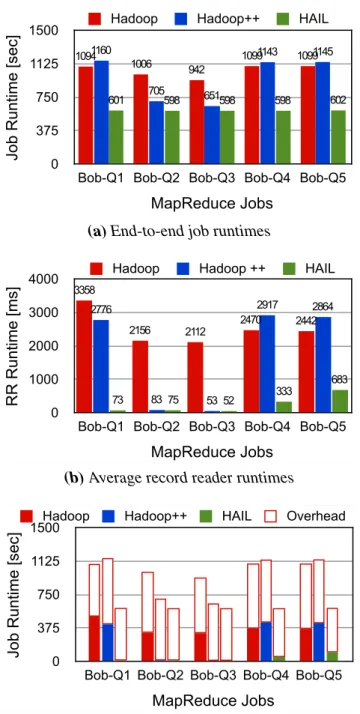
1. HAIL often improves both upload and query times. The upload is dramatically faster than Hadoop++and often faster (or only slightly slower) than with the stan-dard Hadoop even though we (i) convert the input file into binary PAX, (ii) create a series of different sort orders, and (iii) create multiple clustered indexes. From the user-side, this provides a win-win situation: there is no noticeable punishment for upload. For querying, users can only win: if our indexes cannot help, we will fall back to standard Hadoop scanning; if the indexes can help, query runtimes will improve.
Why do we not have high costs at upload time? We basically exploit the unused CPU ticks that are not used by standard HDFS. As the standard HDFS upload pipeline is I/O-bound, the effort for our sorting and index creation in the HAIL upload pipeline is hardly noticeable. In addition, since we parse data to binary